Brother’s Keeper or Only Child?
Black Middle Class Responses to Residential Mobility Initiatives in Prince George’s County, MD
Carley M. Shinault, Ph.D. Assistant Professor Department of Political Science Bloomsburg University of Pennsylvania
Abstract
The implications of urban revitalization, gentrification, and residential migration have
attracted widespread interest and ongoing debate among scholars across a range of disciplines.
While a significant body of literature explores race and class interactions within urban gentrifying
neighborhoods, few have examined the environments that await those displaced by this process.
This study explores the social and political impact of urban gentrification and class stratification
within the black community by examining responses of black middle class residents in Prince George’s County, MD to the growing in-migration of low-income and minority residents from
Washington, DC. Drawing on data from the U.S. Census Bureau, a multi-neighborhood sample
of ninety-five black middle class residents of Prince George’s County, and informal interviews
with subject-area experts, this study explores how race and class shape residential decisions and
their impact on residential mobility initiatives. Residents responded to a 26-item survey that covered
demographic information, political and community engagement, and their attitudes and beliefs about the
poor, changes in their community, and racial unity and responsibility. Findings from cross tabulations and
binary logistic regression indicate that lower middle class residents are the most likely to resist in-migration
by exiting their communities and/or voting against proposals to create affordable housing options. Core
and upper middle class residents were the most likely to stay in their neighborhoods despite increases in
low-income migration, to vote in support of policies to create affordable housing options and to believe
their responsibility to poor blacks could include sharing residential space.
Keywords: Gentrification; Residential Migration; Black Middle Class; Washington, DC;
PG County, MD
Introduction
Urban centers throughout the country are experiencing rapid transformation as affluent
residents migrate from other areas or return from the suburbs. In the District of Columbia, the
energy of urban renewal is palpable, with the sights and sounds of demolition and construction on almost every street. Former DC Mayor Vincent Gray noted, “On any given day, you will have
sixty or more cranes that are operating” (Merica 2013). Multi-phase revitalization and
construction projects will continue into the next decade to include new housing, retail and office
space, and new attractions throughout the District (Cooper 2014).
The landscape is not the only thing transforming in the capital once dubbed “Chocolate
City”, the racial and socioeconomic composition are rapidly shifting as well. Since 2000,
Washington’s white population jumped by 31 percent while the black population declined by 11
percent. The city simultaneously ranked third in median income growth among large cities
(Tavernise 2011). Further, “in the past decade, the district lost nearly 40,000 black residents, many
driven out by skyrocketing rents fueled by an influx of mostly white professionals flocking to increasingly gentrified neighborhoods” (Khalek 2014). In 2011, the first American city to have
an African American majority lost that status after more than half a century.
Given the almost certain prospects for a greater tax base to fill city coffers, local officials
often appear eager to meet the demands of developers and new residents — frequently at the
expense of long-time residents (Anderson 1990; Hwang and Sampson 2014; Milloy 2014; Smith
1996; Thomson 2014). With land among the most in-demand commodities, Washington’s housing
decade (Khalek 2014). Modeled after the federal Hope VI program, the city’s New Communities
Initiative targets public housing properties that are considered distressed and demolishes them with
the promise of quick renovation and redevelopment into mixed-income communities.1 Frequently,
however, public housing units are not replaced at an equal rate and often only one-third of residents are able to return (Cunningham 2001; Patillo 2007). Washington’s Temple Courts properties, for
example, were demolished in 2008 by then-mayor Adrian Fenty. Residents were promised a $700
million mixed-income community that would include at least 570 affordable units for displaced
families by 2009. Today, what used to be Temple Courts is a parking lot that charges $8 an hour,
and only 22 of the more than 200 families have moved back in (Khalek 2014).
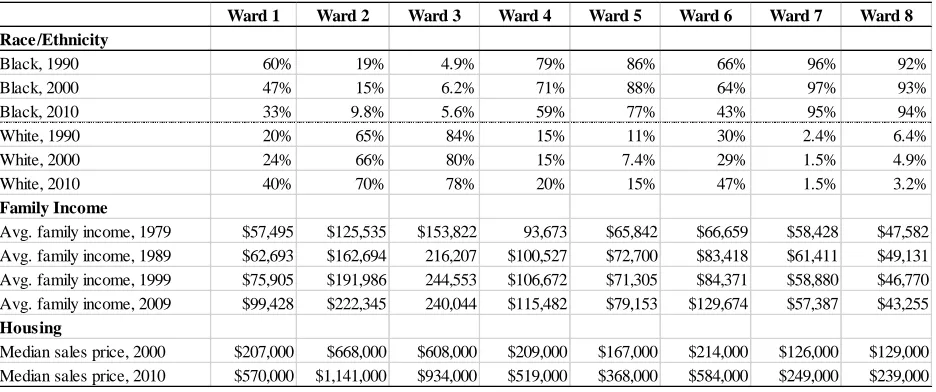
Table 1 illustrates changes in racial composition, growth in family income, and housing
costs for residents across the eight wards. White populations have consistently increased in wards
1, 2, 4, 5, and 6, where average family income has also increased significantly. In fact, average
family income has increased significantly in each of these wards and home sales have almost
doubled (ward 2) or more than doubled in value since 2000 (wards 1, 4, 5, 6). Black populations
have consistently increased in only ward 8, which currently has both the lowest average family
income and home values. In communities like wards 1 and 6, where black residents have gone from being the majority in 1990 to less 33% and 43% respectively, the city’s transformation takes
on new meaning. Fears of being pushed out are tangible, as 55% of black residents reported in
2014 that redevelopment is bad for people like them, up from 39 percent the previous year
(Schwartzman, Hauslohner and Clement 2014).
[Insert Table 1]
1 Established in 2005, the New Communities Initiative is a partnership between the DC Housing Authority and the
With land among the city’s most in-demand commodities, Washington’s housing authority
(DCHA), has demolished over one thousand housing units in the past decade (Khalek 2014). Modeled after the federal Hope VI program, the city’s New Communities Initiative targets public
housing properties that are considered distressed and demolishes them with the promise of quick
renovation and redevelopment into mixed-income communities.2 Initiatives for mixed-income
housing developments are supplemented with residential mobility programs. Bolstered by evidence from Chicago’s Gautreaux program and HUD’s Moving to Opportunity demonstration
(MTO)3, housing authorities suggest that blending different economic groups provides economic,
political, and social benefits for the poor (Clark 2005; Joseph 2010). Residents are offered housing
choice vouchers and encouraged to seek out homes in low-poverty communities. Among the target
destinations are neighborhoods largely comprised of black middle and working class residents. For Washington, DC residents, Prince George’s County, MD (PG County) has been an
early target for the displaced. “With its relatively affordable housing prices and middle-income
character, Prince George’s County seems to serve as a pathway to the middle class for large
numbers of lower-income, working minorities from Washington, DC” (DeRenzis and Rivlin 2007,
ii). The Washington Examiner reports that PG County averaged 13,775 migrants from DC
between 2006 and 2010, 81 percent of whom were black and predominantly lower-income
(Connolly 2013). Between 2000 and 2010, the black population in the county increased by 10
percent, while comparatively declining in the District (Urban Institute 2011). Research by Brooke
DeRenzis and Alice Rivlin (2007), of the Brookings Institute, indicates however, that as
low-income minority residents are moving into the county, the middle class is moving out. Of
2 Established in 2005, the New Communities Initiative is a partnership between the DC Housing Authority and the
Office of the Deputy Mayor for Planning and Economic Development.
3 “MTO is a 10-year research demonstration that combines tenant-based rental assistance with housing counseling to
particular interest to this research is whether awareness of incoming low-income residents is a
key-motivating factor in the relocations of middle-income residents.
Table 3 illustrates the migration patterns between Washington and PG County from 2006
to 2010 and 2008 to 2012. During the first four-year cycle, migration from Washington into PG
County comprised almost a third of all in-migration. Despite losing almost 6,000 residents to DC,
the county netted almost 8,000 new residents from Washington. The second four-year cycle also
indicates net gains in the county from Washington. Almost 12,000 DC residents moved to Prince George’s, comprising almost a quarter of all in-migrants. After accounting for residents who left
the county for Washington, PG County gained a little over 5,000 residents from Washington, DC.
Table 3
Migration Flows between Prince George’s County and District of Columbia
In-Migration Out-Migration Net Migration
Time Period From: Estimate Percent To: Estimate Percent Estimate
2006 - 2010 13,775 26.6% 5,951 11.2% 7,824
2008 - 2012 11,810 23.8% 6,529 13.6% 5,281
Source: U.S. Census Bureau, American Community Survey
Since 2000, the majority of migrants coming into the county came from Washington, DC and
Montgomery County and were predominantly lower-income and minority workers (DeRenzis and
Rivlin 2007). Those coming from the District represented a quarter to a third of all in-migration to Prince George’s each year and had the lowest median adjusted incomes. The Maryland
Department of Planning, Planning Data Services (2007), reported that between 1994-2004, the
average median adjusted gross incomes of in-migrants of PG County was $3,340 less than the
average median income of those moving out. Further, the adjusted gross incomes of in-migrants
population trends in the county, Prince George’s County Community Planning Division published
the following caution in its Consolidated Plan for FY 2016-2020:
“The numbers of households with incomes at or below the poverty level are growing by the thousands… The continued substantial growth in population and households living in poverty implies that, in the absence of strategies to bring about significant improvements in the educational attainment, job skills, potential for high-wage employment, and earning capacity, economic conditions of many residents will remain poor. The result will be large numbers of residents struggling to afford decent housing, many households living in substandard housing in overcrowded conditions, and many communities lacking quality amenities and services” (PG County 2015, 36).
With the active revitalization and gentrification occurring in Washington, DC, population trends indicate that social distress formerly tied to the District’s poorer neighborhoods is migrating
to Prince George’s County. Wayne K. Curry, the Prince George’s first black county executive
(1994 – 2002), attributed the county's slow economic progress to strained resources as a result of
low-income residents migrating to Prince George's after being pushed out of gentrifying D.C.
neighborhoods (Schwartzman 2010). Research indicates that as low-income minority residents are
moving into the county, the middle class is moving out (DeRenzis and Rivlin 2007). Of particular
interest to this research is to determine whether the incoming demographic is a key-motivating
factor in the relocations of middle-income residents.
A significant body of literature has explored the ramifications of race and class encounters
within gentrifying environments (Cunningham 2001; Hwang and Sampson 2014; Lee, Spain, and
Umberson 1985; Patillo 2001) and the impacts of residential mobility and mixed income
communities (Briggs and Turner 2006; Clark 2005; Turner and Popkin, 2010). The focus of most
of these studies, however, is overwhelmingly on urban centers, inter-racial interactions, or solely
the impact on the poor. What we know less about is the how the new destinations of the urban
suburban environments are impacted by gentrification and mixed-income initiatives have yet to be
adequately addressed; particularly in intra-racial residential contexts. The purpose of the current
study is to begin to fill this gap.
This study explores the social and political impact of urban gentrification and class tensions
within the black community by examining responses of black middle class residents to incoming
low-income and public housing tenants in Prince George’s County, MD. The racial character of
PG County may lead some to assume residents would welcome the opportunity to share resources
with poorer racial peers (Patillo 2007). However, the potential threat of low-income migrants to
their middle-class suburban lifestyle could incite the opposite response (Haynes 2001). The
success of residential mobility efforts is in large part dependent on the willingness of current
residents to stay in their communities.
Empirically, this study relies on data collected from a sample of 95 black middle class residents in Prince George’s County, MD through telephone interviews. In line with a growing body
of literature that identifies heterogeneity within the black middle class, residents were categorized into three
class positions – lower middle class, core middle class, and upper middle class – based on level of income,
education, and occupation. Residents responded to a 26-item survey that covered demographic information,
political and community engagement, and their attitudes and beliefs about the poor, changes in their
community, and racial unity and responsibility. Analysis of the results center on answering two (2) research
questions:
1. Are there differences among middle class blacks in how they respond to the changing demographics
of their communities – exit (out-migration), voice (voting/political mobilization/agitation), loyalty
(remaining in community)?
2. Are there differences among Lower, Core, and Upper middle class blacks’ sense of obligation and
responsibility to provide social and economic resources to low-income and public housing
Using cross tabulations and logistic regression, the predictive power of class position on residential behaviors to exit or stay in one’s community and to use voice in opposition or support
of low-income housing accommodations in one’s community. Results provide new insights into
the degree to which class impacts racial solidarity and residential outcomes, and how class
preferences among African Americans may impede the progress of social programs intended to
eradicate concentrations of poverty.
Theoretical Framework
This research draws on the concepts of linked fate, exclusionary boundaries, and exit,
voice, and loyalty to shape the direction and scope of inquiry. Each theory provides important
clues into the beliefs and behaviors of the black middle class across political and social contexts.
The blending of these concepts can explain the attitudes and beliefs, and likely responses of black middle class residents in Prince George’s County as a new demographic begins to infiltrate their
communities.
While literature indicates that the black middle class shares a sense of loyalty and
responsibility for their poorer racial peers (Dawson 1995; Patillo 2007), these sentiments are also
complicated by boundaries erected to protect social status and class identities (Lacy 2007; Weise
2006). A desire to maintain racial solidarity, both in sentiment and action, are complicated by the
need to maintain class boundaries to protect the material interests of residents and the community.
Lori Martin (2010) adds that blacks in the middle class may not perceive their destinies as tied to
other blacks with lower socioeconomic status; and in fact, may feel that they impede progress. The conflict between Dawson’s (1995) heuristic concept of linked fate and Fredrik Barth’s
(1969) theory of ethnic boundaries demonstrates the tensions “stemming from the black
class, on the other” (Haynes 2001, xix). To Mary Patillo (1999), such material interests include
better homes, safer neighborhoods, higher quality schools, and more amenities with their increased earnings. In an effort to protect these material benefits, black middle class residents “attempt to
fortify their neighborhoods against the encroachment” of the poor (Patillo 1999, 24). Steven
Gregory (1992) contends that, black middle class homeowners are more politically aligned with “middle class values” of neighboring white communities than with the “black community”. As
such, the black middle class is more inclined to organize around issues related to “their interests as homeowners than with interests that could be associated with race” (255).
Hirschman’s (1970) theory of exit, voice, and loyalty identifies likely behavioral responses
of current residents to the looming class changes and how those actions will affect neighborhood stability. Once the environment no longer embodies residents’ desired characteristics, residents
are prone to exit their community, use their voice (political action) to prevent the transformation,
and/or remain loyal to their community (Hirschman 1970). Black middle class residents will be
forced to consider the degree to which these changes necessitate the abandonment of their
communities, the use of collective action to resist the migration, and/or the decision to remain in
their communities. This study is particularly interested in investigating the extent to which
residents are willing to organize to maintain effective social control (i.e. curbing deviance in public
spaces and keeping out undesirable populations).
This study challenges the concept of linked fate by arguing that sentiments of racial unity
and obligation are expressed to different degrees based on position within class categories.
Contrary to scholarship that depicts the black middle class as one homogenous group, a growing
body of literature identifies three distinct categories: Lower, Core, and Upper middle class, based
(DeRenzis and Rivlin 2007; Lacy 2007; Rothman 1999). Sentiments of linked fate and
exclusionary boundaries are oppositional constructs that influence decision-making. The degree
to which they influence behavioral responses to the changing environment will depend heavily on
the security within class position and stability of middle class identity.
Methodology
This study utilizes descriptive statistics and logistic regression to evaluate PG County residents’ response to the changing demographics in their communities. Analysis relies on
quantitative analysis of telephone survey responses from a random sample of 95 black middle class residents of Prince George’s County. Residents responded to a 26-item partially structured
questionnaire. Responses closed-ended questions were evaluated to identify the potential predictive power of class position on residential choice to exit one’s community, use voice to
challenge local policies, and/or to be loyal to one’s community and stay. Informal telephone and
Skype interviews were secured with Alice Rivlin, Senior Fellow, Brookings Institution, Kreg
Steven Brown, Affiliated Scholar, The Urban Institute, and Bart Landry, Professor Emeritus,
University of Maryland. While the qualitative component is not empirically analyzed,
consideration of the vantage point of subject-area experts adds greater depth to the understanding
of the goals and challenges of residential mobility initiatives.
Using U.S. Census (2012) data on PG County median household income, level of
education, and Department of Labor occupational categories, participants were identified to
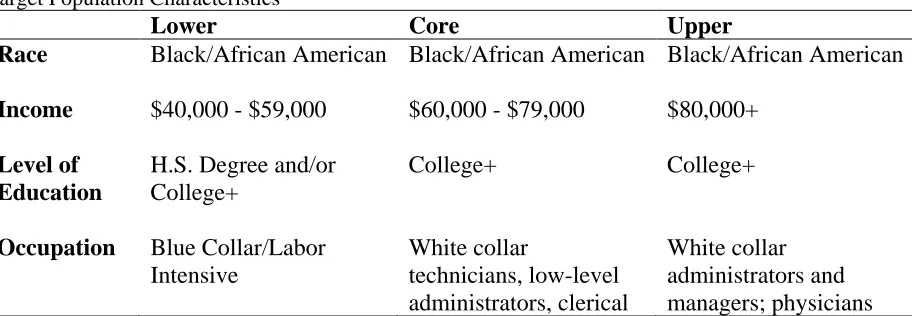
represent each category of black middle class: Lower, Core, and Upper. Table 4 provides the racial
Table 4
Target Population Characteristics
Lower Core Upper
Race Black/African American Black/African American Black/African American Income $40,000 - $59,000 $60,000 - $79,000 $80,000+
Level of Education
H.S. Degree and/or College+
College+ College+
Occupation Blue Collar/Labor Intensive
White collar
technicians, low-level administrators, clerical
White collar administrators and managers; physicians Evaluation of the quantitative data from the questionnaire will determine the predictive
power of class position on residential choice/behavior. Characteristics such as gender, family size,
and length of time in neighborhood will function as moderator variables. These variables may
affect the direction and/or strength of the relationship between the independent and dependent
variables. The independent variable is defined as Class Position (within the middle class), which
is divided into three categories of social class (Lower, Core, Upper)4. The dependent variable for
this study is: (1) Behavioral Response (Voice-Loyalty). In line with literature on the
Exit-Voice-Loyalty model: Exit is the expressed preference to leave one’s neighborhood, Voice is the
likelihood to vote in favor of mixed income neighborhoods, and Loyalty is a preference to remain in one’s community despite the changing demographics. The moderating variables in this analysis
are: Gender of Respondent, Family Size, and Length of Time in Community. Because sentiments
of linked fate may influence decisions of residential mobility, it will also be considered a
moderating variable.
Findings
This study explores two research questions to evaluate whether there are attitudinal
differences within the black middle class. Specifically, I explored whether class position indicates differences in attitudes toward the changing demographics in one’s community, and differences in
residents’ expressions of linked fate. Cross tabulations were used to examine responses to seven
survey questions regarding the aforementioned topics. Statistical significance was calculated
using chi-square (p <.05). Additional descriptive data on all additional survey questions are
provided in the Appendix.
R1: Are there differences among Lower, Core, and Upper middle class blacks in how they respond to the changing demographics of their communities?
The first research question explores heterogeneity within black middle class attitudes and
behaviors in response to unwanted change. Survey items #15, #21 and #23 were used to examine this question. Table 5 illustrates the findings to question #15: “As housing authorities relocate
some of the DC public housing residents, among their goals is to place them in mixed income
communities or low-poverty areas in nearby suburbs. Do you think this is a good idea or bad idea
for yourself and your community?” Survey question #21 asks: “If the influx of public housing hits
your community, do you anticipate moving out or staying in your neighborhood?” The findings
are statistically significant and reported in Table 6. Table 7 demonstrates findings to question #23 asks: “If your local government proposed a policy to provide more affordable housing options for
public housing and low- and moderate-income families, would you vote in favor of such a policy?”
Table 7 reports respondents who believed they would use voice to oppose the policy, support the
neighborhoods (NIMBY). The data reports the raw number and percentage of respondents who
felt good or bad about mixed income communities.
[Insert Table 5]
[Insert Table 6]
[Insert Table 7]
Across class positions, residents are generally not in favor of efforts to integrate suburban
low-poverty communities with public housing and low-income residents. Lower middle class
residents are the most likely to want to leave their community in response to the in-migration of
low-income and public housing residents into their communities (89.5%). The majority of core
and upper middle class residents would stay in their communities despite the change in
demographics (57.6% and 55.0% respectively). Though small percentages, core and upper middle
class blacks were the only group to indicate that they would definitely stay in their neighborhoods
(6.1% and 5.0% respectively). The p value for this analysis is .015, indicating that the differences
between each class category is not a matter of chance.
Lower middle class residents are also the most likely to resist policies that provide
affordable housing for public housing and low-income residents (52.6%). Further, among those
that would support such policies, lower middle class blacks are more likely to prefer that new
residents not be located in their neighborhoods (42.1%). The majority of core and upper middle
class would vote in favor of policies to provide affordable housing options in their communities
(69.7% and 85% respectively). Chi-Square = .005, indicating that the differences between class
positions is significant and not a matter of chance.
Core and upper middle class residents are more inclined to remain in their communities
provisions. The findings for both Exit-Loyalty and Voice were statistically significant, indicating
that class differences are not a matter of chance. One core middle class resident, a married father of two and retail manager, said “You know, everyone needs a place to stay. As long as they don’t
bring a lot of crime or drugs to the community, I don’t see a problem with it. PG was my step up
to better opportunities. I can’t see standing in the way of someone else”. A 39-year-old, married
upper middle class government analyst and mother of one was only mildly concerned about the
changes taking place. Although she lives in Greenbelt, MD, a city that experienced a population
increase of 12.4% since 2000, she did not anticipate low-income migration impacting her own
community. She stated, “I’ve seen some changes around other areas of the county, but I don’t think it will be as bad here” (Respondent 109, 2015).
When asked where they would go, should residents decide to leave the community, 61%
indicated they would remain in Prince George’s County, 23% preferred to relocate to Montgomery
County, MD, and just under 12% stated they would move elsewhere in the state of Maryland.
While much of the literature on gentrification asserts that suburban residents are moving to the
city, only 2.1% of respondents stated they would want to move to Washington, DC.
Steven Brown (2016), Urban Institute Affiliated Scholar, believes that the response of
black middle class residents to the potential influx of low-income residents typifies NIMBY-ism
(Not in My Backyard Syndrome). “They’re basically saying, ‘I want the best for them; I just don’t want them in my neighborhood’” (Brown 2016B). Further, he believes that the impact that
low-income migration has on a community is more a matter of perception than actual change. What
case to be made that having an influx of poor people will ruin a neighborhood. It’s the flight that hurts the neighborhood the most, not the influx” (Brown 2016B).
R2: Are there differences among Lower, Core, and Upper middle class blacks’ sense of obligation and responsibility to provide social and economic resources to low-income and public housing residents?
The second research question explores heterogeneity within black middle class beliefs in
and expressions of linked fate. Specifically, it addresses whether lower, core, and upper middle
class blacks have different beliefs about their connectedness to other black people in the country
and whether they feel a sense of obligation to help less fortunate racial peers. Survey items #9,
#10, #24, #25, and #26 were used to examine this question.
Tables 8 – 9 illustrate the findings to questions about sentiments of linked fate. The first
question examines whether black middle class residents feel connected to other blacks; it asks: “Do you think that what happens generally to black people in this country will have something to
do with what happens in your life?” The second explores the degree to which they believe they are
impacted: “Will it affect you a lot, some, or not very much?” The data reports the raw number and
percentage of responses.
[Insert Table 8]
[Insert Table 9]
Virtually all respondents believe that their fate is linked to that of other black people in the
United States. The largest proportion of respondents within each class category believes that their
lives are somewhat impacted by what happens to other blacks. Ninety percent of upper middle
affected some or a lot by what happens to other blacks. Differences between the groups, however,
are not statistically significant.
Table 10 illustrates findings to the question: “Would you say you strongly agree, agree,
disagree, or strongly disagree with the following statement: Black people who have made it are
doing a lot to improve the social and economic position of poor blacks”. The data reports the raw
number and percentage of responses within each class category. Findings indicate that class
position is a significant indicator of belief in the continued service to poor blacks by more
successful counterparts (p = .011). Most respondents also agree or strongly agree that blacks who
have attained success continue to help improve the life conditions of lower class counterparts.
Core and upper middle class blacks are more likely to strongly agree, while lower middle class
overwhelmingly agree with the statement. One respondent, 41-year-old lower middle class wife and mother of one, agreed that successful blacks have done a lot to help poor blacks, “but now it’s
time for [the poor] to step up on their own” (Respondent 3, 2014).
[Insert Table 10]
Table 11 illustrates findings to the question: “Do you think the black middle class has a
responsibility to remain in their communities in order to maintain social and economic stability
for low-income residents to benefit from?” The data reports the raw number and percentage of
respondents’ different degrees of racial responsibility in sharing residential space.
[Insert Table 11]
The opinions of residents toward a responsibility to stay in their community to benefit
lower class peers were somewhat mixed. Lower middle class residents are the least likely to
believe they have a responsibility to lower class counterparts to stay in their communities in order
believe they definitely or slightly do not have a responsibility to share residential space with
low-income residents (63.6% and 68.4% respectively). Equal proportions of core middle class
residents believe they are somewhat or definitely not responsible for assisting lower class
counterparts by remaining in their communities. One resident, a 31-year-old dental hygienist said
lower-income groups often bring crime and drugs to a community and there’s very little any of the
residents can do about it. For that reason, she was currently looking to move further into Prince George’s or Montgomery County (Respondent 33, 2015). Upper middle class residents are the
most likely to believe they have a responsibility to remain in their communities to assist lower
income residents. One resident, a 62-year-old retired wife and PG County resident of 13 years stated, “I believe I have to give back, but not put myself in danger to give back to the community.
When there’s crime I will leave. I want a safe community” (Respondent 5, 2014).
The above-analysis explored differences between lower, core, and upper middle class residents
of PG County in their expected behavioral responses to an influx in low-income residents, their
attitudes toward the poor, and degree of belief in linked fate and a responsibility to blacks as a
whole. While the analysis was challenged due to low sample size, it nonetheless yielded
interesting results.
Findings from the first research question revealed that there are real differences between lower,
core, and upper middle class residents in their response to the changing demographics in their
communities.5 Overall, black middle class residents are opposed to integrating low-income
households in their neighborhoods. Strongest disapproval for such efforts came from lower middle
class respondents. If faced with the influx, core and upper middle class residents opted most often
to stay in their communities while lower middle class preferred to leave. Similarly, core and upper
middle class would vote to support policies to provide low-income housing accommodations while
most lower middle class residents would vote against them.
Evaluation of the second research question indicates that that the black middle class
overwhelmingly believes their lives are connected to other blacks in America, although the
strength of that connection is moderate. In general, the black middle class believes that blacks
who have made it continue to work toward improving conditions for poor blacks. This is also
reflected in the community involvement of the respondents. Strong majorities of core and upper
middle class groups are actively committed to social improvement of blacks through civic and
church involvement. Interestingly, despite the acknowledged connection to blacks in general and
commitment to working toward racial uplift, few black middle class believe that this commitment
translates into sharing residential space. Majorities of lower middle class and core middle class
disagreed with having a responsibility, while the majority upper middle class blacks felt they “somewhat” had a responsibility to stay in their communities to provide social and economic
stability.
Conclusion/Discussion
For the subjects in this study, belief in linked fate was a widely shared sentiment across all class positions. In line with Dawson’s (1994) findings, core and upper middle class blacks were more
likely to believe their fates were linked than lower middle class residents. Pew’s (2007) study also
found that blacks with lower incomes and less education are more likely to see few shared values
between middle class and poor blacks. One core middle class administrative assistant and mother
said that the sense of connection to other blacks and the importance of working toward racial uplift
since I was a little girl. My parents made sure we knew the importance of serving the race”
(Respondent 30, 2015). Commitment to the black community through service organizations was
also a widely shared responsibility among core and middle class black residents.
The findings of this study indicate that there are limits to how linked fate is expressed. The
sense of shared experience and responsibility to serve less fortunate blacks does not seem to
translate into sharing residential space. Across class positions, residents are generally not in favor
of efforts to integrate low-poverty communities with public housing and low-income residents.
Lower middle class residents, especially, would want to exit their communities should the influx
of low-income residents reach their neighborhoods. The majority of core and lower middle class
respondents believe they definitely or slightly do not have a responsibility to share residential
space with low-income residents (63.6% and 68.4% respectively). Those in the highest class
bracket were the most likely to believe their responsibility to poor blacks could include sharing
residential space.
While the black middle class shares a sense of loyalty and responsibility for their poorer
racial peers (Dawson 1995; Patillo 2007), these sentiments seem to be complicated by boundaries
erected to protect social status and class identities (Lacy 2007; Weise 2006). If, as Wilson (1987) states, “it is difficult to speak of a uniform black experience when the black population can be
meaningfully stratified into groups whose members range from those who are affluent to those who are impoverished” (x), it is unlikely that their attitudes and beliefs about racial unity will be
uniform. As the findings indicate, black middle class residents hold different views based on their
differences and divisions translate into tangible disparities, the sense of community and communal
responsibility may be diminishing.
References
American Interest. 2013. Black middle class abandoning PG County public schools. The American Interest. 27 May 2013.
Anderson, E. 1990. Street wise: Race, class, and change in an urban community. Chicago: University of Chicago Press.
Barth, F. Introduction. 1969. In Barth, F. (Ed.) Ethnic Groups and Boundaries: The social organization of culture and difference. London: Allen & Unwin.
Bishaw, A. 2014. Changes in areas with concentrated poverty: 2000 to 2010. American Community Survey Reports: United States Census Bureau, ACS-27.
Brown, S. 2016. The stalled, struggling black middle class. Urban Wire: Race, Ethnicity, and Gender. Urban Institute (10 February 2016), web.
Brown, Steven. 2016B. Personal Interview – Telephone. July 19, 2016.
Cashin, S. 2007. Dilemma of place and suburbanization of the black middle class. In Bullard, Robert (Ed.). The black metropolis in the twenty-first century: Race, power, and politics of place. Lanham, MD: Rowman & Littlefield Publishers, Inc.
Clark, W. 2005. Intervening in the residential mobility process: Neighborhood outcomes for low-income populations. PNAS, 102(43): 15307-15312.
Connolly, M. 2013. Prince George’s County leads all jurisdictions in local migration.
Washington Examiner, March19, 2003. http://washingtonexaminer.com/article/2524859.
Dawson, M. 1994. Behind the mule: Race and class in African-American politics. New Jersey: Princeton University Press.
DeRenzis, B. and Rivlin, A. 2007. A pathway to the middle class: Migration and demographic change in Prince George’s County. The Brookings Institution.
Goetz, E. 2012. The transformation of public housing policy, 1985-2011. Journal of the American Planning Association, 78(4), 452-463.
Hirschmann, A.O. 1970. "Exit, voice and loyalty." Responses to Decline in Firms, Organizations, and States. Cambridge.
Hutto, J. and Green, R. 2016. Social movements against racist police brutality and Department of Justice Intervention in Prince George’s County, Maryland. Jounal of Urban Health: Bulletin of the New York Academy of Medicine, (Special Issue, Feb. 16, 2016).
Hwang, J. and Robert S. 2014. “Divergent Pathways of Gentrification: Racial Inequality and Social Order of Renewal in Chicago Neighborhoods,” American Sociological Review 79(4,) 726 – 751.
Joseph, M. 2010. Creating mixed-income developments in Chicago: Developer and service provider perspectives. Housing Policy Debate, 20(1), 91-118.
Khalek, R. 2014. “DC’s Poorest Residents Fight Displacement by Gentrification,” Truthout, January 31, 2014. http://www.truth-out.org/news/item/21563-poorest-residents-fight-displacement-by-gentrification.
Kneebone, E. 2014. The growth and spread of concentrated poverty, 2000 to 2008-2012. Washington, DC: Brookings Institute.
Lacy, K. 2007. Blue-chip Black: Race, class, and status in the new black middle class. Berkeley, CA: University of California Press.
Landry, B. 1987. The new black middle class. Berkley, CA: University of California Press. Merica, D. 2013. “A White Mayor for ‘the Chocolate City’?” CNN Politics, December 27, 2013.
http://www.cnn.com/2013/12/27/politics/washington-dc-white-mayor/.
Milloy, C. 2014. Initiative to revitalize Barry Farm is little more than an urban dispersal plan. Washington Post (October 28).
Patillo, M. 2007. Black on the block: The politics of race and class in the city. Chicago: University of Chicago Press.
Patillo, M. 2005. Black middle-class neighborhoods. Annual Review of Sociology, 31, pp. 305-329.
Prince George’s County. 2016. 2016 Maryland Report Card. reportcard.msde.maryland.gov.
Prince George’s County. 2015. Prince George’s County Consolidated Plan, FY 2016-2020. Department of Housing and Community Development, Community Planning Division. May 12, 2015.
Rothman, R. 1999. Inequality and stratification: Race, class, and gender (3rd ed.). Upper Saddle, NJ: Prentice Hall.
Schwartzman, P. 2014. Prince George’s County’s identity and aspirations shifting. Washington Post, Tuesday, June 22.
Smith, N. 1996. The New Urban Frontier: Gentrification and the Revanchist City. New York: Routledge.
Tavernise, S. (July 17, 2011). A population changes, uneasily. The New York Times. www.nytimes.com/2011/07/18/us/18dc.html?_r=0&pagewanted=print.
Thomson, S. 2014. Tracing the history of an idea as “Gentrification” turns 50. Curbed.
Urban Institute. 2014. Washington, DC: Our changing City. Chapter 1: Demographics. Datatools.urban.org.
Weise, A. 2006. “The house I live in”: Race, class, and African American suburban dreams in the postwar United States. In Kruse, K. and Sugrue, T. (Eds.) The new suburban history. Chicago, IL: University of Chicago Press.
White, E.F. 2001. Dark continent of our bodies: Black feminism and the politics of respectability. Philadelphia: Temple University Press.
Wilson, W.J. 1978. The declining significance of race. Chicago: University of Chicago Press.
Wilson, W. and Taub, R. 2006. There goes the neighborhood: Racial, ethnic, and class tensions in four Chicago neighborhoods and their meaning for America. New York: Vintage Books.
Wiggins, O. 2013. Middle-class parents closely watching changes in Prince George’s public schools. Washington Post (26 May 2013).
Figures and Tables
Table 1
Washington, DC Black/White, Income and Housing Profiles by Ward
Source: U.S. Census 2010
Table 56
“As housing authorities relocate some of the DC public housing residents, among their goals is to place them in mixed income communities or low-poverty areas in nearby suburbs. Do you think this is a good idea or bad idea for yourself and your community?”
Good Idea Neutral Bad Idea
Lower Middle Class 1 (5.3%) 0 (0.0%) 19 (94.7%)
Core Middle Class 1 (3.0%0 3 (9.1%) 29 (87.9%)
Upper Middle Class 1 (5.0%) 0 (0.0%) 19 (95.0%)
* p = .429
6 Original response categories include: Very Good Idea, Good Idea, Somewhat Good Idea, Neutral, Somewhat Bad
Idea, Bad Idea, and Very Bad Idea. Response categories were collapsed; Good idea includes those who also indicated very good and somewhat good and Bad Idea includes those who also indicated somewhat bad and very bad. It’s important to note that none of the respondents felt it was a very good idea.
Ward 1 Ward 2 Ward 3 Ward 4 Ward 5 Ward 6 Ward 7 Ward 8
Race/Ethnicity
Black, 1990 60% 19% 4.9% 79% 86% 66% 96% 92%
Black, 2000 47% 15% 6.2% 71% 88% 64% 97% 93%
Black, 2010 33% 9.8% 5.6% 59% 77% 43% 95% 94%
White, 1990 20% 65% 84% 15% 11% 30% 2.4% 6.4%
White, 2000 24% 66% 80% 15% 7.4% 29% 1.5% 4.9%
White, 2010 40% 70% 78% 20% 15% 47% 1.5% 3.2%
Family Income
Avg. family income, 1979 $57,495 $125,535 $153,822 93,673 $65,842 $66,659 $58,428 $47,582
Avg. family income, 1989 $62,693 $162,694 216,207 $100,527 $72,700 $83,418 $61,411 $49,131
Avg. family income, 1999 $75,905 $191,986 244,553 $106,672 $71,305 $84,371 $58,880 $46,770
Avg. family income, 2009 $99,428 $222,345 240,044 $115,482 $79,153 $129,674 $57,387 $43,255
Housing
Table 67
“If the influx of public housing hits your community, do you anticipate moving out or staying in your neighborhood?”
Stay Neutral Move
Lower Middle Class 1 (5.3%) 1 (5.3%) 17 (89.5%)
Core Middle Class 19 (57.6%) 0 (0.0%) 14 (42.4%)
Upper Middle Class 11 (55.0%) 3 (4.2%) 38 (52.8%)
* p = .015
Table 7
“If your local government proposed a policy to provide more affordable housing options for public housing and low- and moderate-income families, would you vote in favor of such a policy?”
No Yes Yes, NIMBY
Lower Middle Class 10 (52.6%) 1 (5.3%) 8 (42.1%)
Core Middle Class 7 (21.2%) 12 (36.4%) 11 (33.3%)
Upper Middle Class 3 (15%) 12 (60.0%) 5 (25.0%)
* p = .005
Table 8
“Do you think that what happens generally to black people in this country will have something to do with what happens in your life?”
Yes No Don't Know
Lower Middle Class 19 (100%) 0 (0.0%) 0 (0.0%)
Core Middle Class 33 (100%) 0 (0.0%) 0 (0.0%)
Upper Middle Class 19 (95%) 0 (0.0%) 1 (1.4%)
* p = .268
7 Original response categories include: Definitely Stay, Maybe Stay, Neutral, Maybe Move, and Definitely Move.
Table 9
“Will it affect you a lot, some, or not very much?”
A lot Some Not very much Don't Know
Lower Middle Class 5 (26.3%) 9 (47.4%) 1 (5.3%) 3 (15.8%)
Core Middle Class 8 (24.2%) 19 (57.6%) 4 (12.1%) 0 (0.0%)
Upper Middle Class 4 (20.0%) 14 (70.0%) 2 (10.0%) 0 (0.0%)
* p = .193
Table 10
“Would you say you strongly agree, agree, disagree, or strongly disagree with the following statement: Black people who have made it are doing a lot to improve the social and economic position of poor blacks?”
Strongly Agree Agree Disagree
Lower Middle Class 1 (5.3%) 15 (78.9%) 2 (10.5%)
Core Middle Class 15 (45.5%) 17 (51.5%) 0 (0.0%)
Upper Middle Class 12 (60.0%) 7 (35.0%) 1 (5.0%)
* p = .011
Table 11
“Do you think the black middle class has a responsibility to remain in their communities in order to maintain social and economic stability for low-income residents to benefit from?”
Somewhat Neutral Slightly Not Definitely Not
Lower Middle Class 4 (21.1%) 2 (10.5%) 5 (26.3%) 8 (42.1%)
Core Middle Class 10 (30.3%) 2 (6.1%) 11 (33.3%) 10 (30.3%)
Upper Middle Class 10 (50.0%) 3 (15.0%) 3 (15.0%) 4 (20.0%)