IJEDR1403076
International Journal of Engineering Development and Research (www.ijedr.org)3281
Hybrid Renewable Energy System by Optimized
Integration
(Creating Green and Sustainable Environment)
1
Upadhyayula Subramanya Aditya,
2Dondapati Ravi Kishore,
3Nakka Sai Teja
1Student, 2Associate Professor, 3Student 1Electrical and Electronics Engineering, 1K L University, Guntur, Andhra Pradesh, India
________________________________________________________________________________________________________
Abstract - Renewable energy and energy efficiency are sometimes said to be the “twin pillars” of sustainable energy policy. Both resources must be developed in order to stabilize and reduce carbon dioxide emissions. Efficiency slows down energy demand growth so that rising clean energy supplies can make deep cuts in fossil fuel use, using computer-based remote control and automation. They offer many benefits to utilities and consumer mostly seen in big improvements in energy efficiency on the electricity grid and in the energy users’ homes and offices. Although solar wind and Biomass energy are three of the most viable renewable energy sources, little research has been done on operating both energy sources alongside one another in order to take advantage of their complementary characters. It is fact that solar thermal power plant (STPP) and Wind Plant cannot operate stably and continuously due to variability of solar irradiation. We propose an optimal operating mode of hybrid STPP power plant with biomass for continuous electricity generation. In this we develop an optimal design for a hybrid solar wind- Biomass energy plant, where the variables that are optimized and the goal is to minimize costs. At first we make a stand alone system and then if production is more than consumption, it will fed back to the grid. Simulation studies and sensitivity analysis reveal that the hybrid plant is able to exploit the complementary nature of the three energy sources, and deliver energy reliably throughout the year along with a regular Power Supply Grid and synchronizing with it Provides an Excellent backup of Power and enhances sustainable energy production and reduces harmful effects like Global Warming etc.
Index Terms - Sustainable energy Policy, Hybrid Renewable Energy, Biomass Plant, Solar and Wind Power Plant
________________________________________________________________________________________________________
I. INTRODUCTION
Energy which is found naturally on Earth is termed as renewable Energy. Renewable energy is also produced from the processes which are natural and constantly replenished. There are different forms of renewable energy such as sunlight, wind, rain, Tides and geothermal heat. Renewable energy support in the consumption 16% globally. Out of 16%, biomass is used 10%, hydroelectricity is used 3.4% and another 3% from newer forms of renewable energy like modern biomass, solar, wind, bio fuels and geothermal . Now a day’s research is being done on renewable energy. Renewable sources used for electricity generation accounts for 19% globally. Out of this global electricity 19% is from hydroelectricity and 3% from new renewable energy sources. The share of wind power is increasing rapidly. We took village as model in which the resources are more available for the biomass. Because in villages we get more raw materials for biomass such as cow dung, husk, ark nut etc. Mostly rural areas take advantage of renewable energy. Energy is used for household lighting, entertainment, heating, cooking. It increases income as the electricity is in productive uses of electricity and also developments benefits. Renewable energy have been growing in productive uses in the areas of agriculture, small scale industries, services used for commercial and services like drinking water, education and health care. Nonrenewable energy produces air pollution which can aggravate asthma to patients. Burning coal produces sulphur oxides during burning for the production of the projects which are built to produce renewable energy are huge and costly. Mostly people in the rural and remote regions make use of the renewable energy on huge basis. Due to different climatic changes in various regions there are a huge concern for energy. Along with huge hike in oil prices, peak oil as well as government supporting the research in renewable energy, there is huge research and development going on. According to a 2011 projection by the International Energy Agency, solar power generators may produce most of the world’s electricity within 50 years. Main advantage of renewable energy is that as it is renewed means it is sustainable and so will never run out. Since there is less product from renewable energy, the cost of maintenance and overhead cost reduces. But the non-renewable means have bi-products as well as cost increases for the maintenance of the plants. Waste bi-products from renewable energy plants are carbon dioxide and chemical which have least harm hazard to the environment. Due to this economic benefits increases.
II. SOLAR THERMAL ENERGY
IJEDR1403076
International Journal of Engineering Development and Research (www.ijedr.org)3282
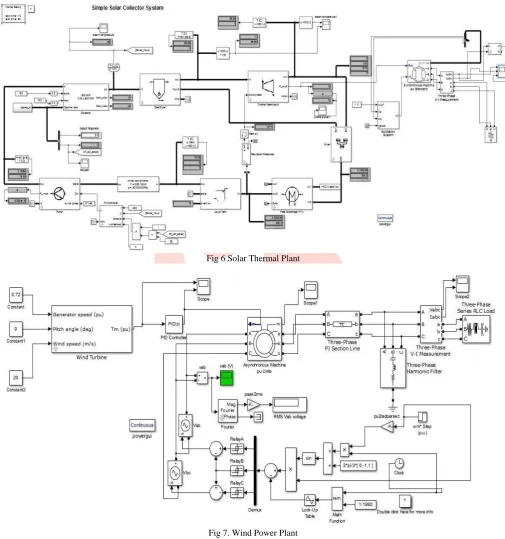
parabolic trough shaped mirrors to concentrate the incident Direct Normal Irradiation (DNI) onto a receiver tube which is placed at the focal line of the trough. This is the most commercial technology for CSPs because it is the most mature technology. As this\technology is considered in the paper, an in depth description is reported in the next section. In Solar Tower technology the solar collector field contains a radial arrangement of several sun tracking large mirrors that concentrate the solar energy onto the receiver placed on the top of a central tower. The third technology uses a parabolic dish-shaped solar concentrator that concentrates the sunlight onto a receiver placed at the focal point of the dish. This technology is considered in this paper remaining description discussed in later sections. In this paper for modeling solar thermal we use their model simulation in Simulink. Main components of solar thermal are solar collector, gas dryer, mixer, heat exchanger, liquid tank, and pump.III. WIND POWER GENERATION
The wind systems that exist over the earth’s surface are a result of variations in air pressure. These are in turn due to the variations in solar heating. Warm air rises and cooler air rushes in to takes its place. Wind is merely the movement of air from one place to other. There are global wind patterns related to large scale solar heating of different regions of the earth’s surface and seasonal variations in solar incidence. There are also localized wind patterns due to the effects of temperature differences between land and seas, or mountains and valleys. Wind speed generally increases with height above ground. This is because the roughness of ground features such as vegetation and houses cause the wind to be slowed.
3.1 Working and Block Diagram
Wind power is the conversion of Wind energy into a useful form of energy, such as using wind turbines to make electrical power, windmills for mechanical power, wind pumps for water pumping or drainage, or sails to propel ships. Wind energy is the kinetic energy of air in motion, also called wind. Total wind energy flowing through an imaginary area A during the time t is:
𝑬
=
𝟏𝟐𝒎𝒗
𝟐=
(A
v
t
𝝆
)
𝒗
𝟐=
𝟏𝟐𝑨𝒕𝝆𝒗
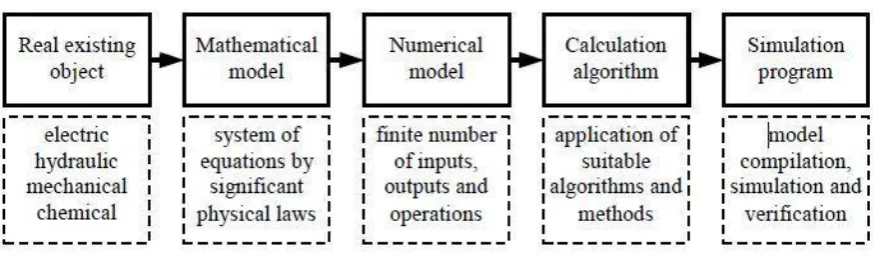
𝟑Where ρ is the density of air; v is the wind speed; Avt is the volume of air passing through A (which is considered perpendicular to the direction of the wind); Avtρ is therefore the mass m passing per unit time. Note that 12 ρv2 is the kinetic energy of the moving air per unit volume. The procedure during the mathematical modelling. The basis of any simulation is good knowledge of the system under consideration, because each model rises by the abstraction of real object. During this process the real object is necessarily simplified and some physical phenomena that practically haven’t any impact on its characteristics and behavior are neglected. The real system is replaced by the mathematical description of phenomena and their interactions on the basis of physical laws. This interpretation can be solved by two approaches, the analytical way of calculation and the way with the use of some numerical method.
Fig 1.Basic Block Diagram of Wind Model
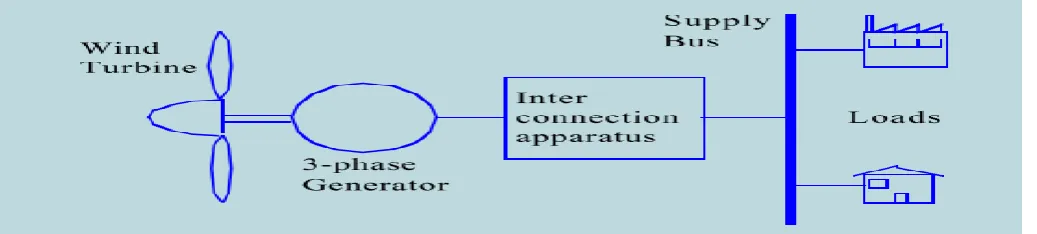
3.2 Structure of Wind Energy Conversion Systems
IJEDR1403076
International Journal of Engineering Development and Research (www.ijedr.org)3283
Fig 2. Structure of Typical Wind SystemMost modern turbine inverters are forced commutated PWM inverters to provide a fixed voltage and fixed frequency output with a high power quality. Both voltage source voltage controlled inverters and voltage source current controlled inverters have been applied in wind turbines. For certain high power wind turbines, effective power control can be achieved with double PWM (pulse width modulation) converters which provide a bi-directional power flow between the turbine generator and the utility grid.
IV. BIOMASS POWER PLANT
Garbage, landfill gases, wood, waste and alcohol fuels are the commonly found Biomass sources. Technically, Biomass is contains the commonly found elements. The three major elements are carbon, hydrogen and oxygen based. One of the main sources of Biomass is the energy from wood and this wood is obtained by pulping liquor or “black liquor,” a waste product from processes of the pulp, paper and paperboard industry. Second most commonly Biomass is from waste energy. Waster energy is found from different waste sites such as municipal solid waste, manufacturing waste and landfill gas. Bio fuels from sugar and oils are the first generation bio fuels obtained from sugarcane and corn, in turn produce bio ethanol. These fuels are used as gasoline. Garbage waste releases methane gas which is a type of biogas. Agricultural plants like corn and sugarcane are used to make engine fuel, ethanol using the process of fermentation. Such type of waste is mostly found in Mauritius and Southeast Asia (rice husks). United States have the highest amount of forest waste in the world. UK is one of the leading countries in poultry farms and these farms give out animal waste which is a good source of Biomass.
4.1 Generation of Electricity using Biomass
Energy may be in different forms like solid, liquid or gaseous. In fact energy from biomass also exists in the three forms. The fuel which exists in liquid form is used directly. Such fuel is used vehicles that travel on road, railroad and airway. They are used in engine and turbines which are used to run electric generator which are intern used to produce power. Solid and gases are in the same form or changed to a different form. They are too used for the production of electric power in turbine-equipped power plants. Also chemical products are also produced since the biomass is organic in nature. Biomass which are derived from industries, commercial or urban waste or agricultural or forestry residues given by products as power and sometimes chemicals
Biomass is also divided into primary, secondary and tertiary. The process of photosynthesis which occurs in plant produces the primary biomass. This biomass is mainly found on land. Perennial are short – rotation woody crops and herbaceous crops, the seeds of oil crops and residue which results from the agricultural products and trees from the forest. After the primary biomass is processed, the by product can be used as biomass and this is called the secondary biomass resource. The primary biomass undergoes either physically, chemically or biologically. The physical process can be sawdust in mills. Simple chemical process could be liquor from pulping processes. Manure produced by animals is considered as biological. Tertiary biomass includes animal fats and greases, even used vegetable oil, waste obtained from packaging. Construction sites and demolition debris is a heavy resource of biomass. So it is mainly the residue obtained from post-consumers.
4.2 Different Processes Used for Conversion
Bio power or biomass power is generation of electricity from biomass. There are different bio power technological pathways available. They are pyrolysis, combustion and gasification Pyrolysis – transformation of biomass feedstock materials into fuel (often liquid bio fuel) by applying heat in the presence of a catalyst. Combustion – transformation of biomass feedstock materials into energy through the direct burning of those feed stocks using a variety of burner/boiler technologies also used to burn materials such as coal, oil and natural gas Gasification – transformation of biomass feedstock materials into synthetic gas through the partial oxidation and decomposition of those feed stocks in a reactor vessel and oxidation process.
IJEDR1403076
International Journal of Engineering Development and Research (www.ijedr.org)3284
Fig.4 Block Diagram for Biomass PlantV. INTEGRATION
As we all know that now a day we all are facing a lot of problems with lack of power source because the demand of load is increased day by day and non-renewable resources are also decreasing day by day and so we have to concentrate on the renewable resources like solar, wind, biomass, bio fuel, hydro power, geothermal energy. As these resources are abundantly found in villages that too we all know that villages are the back bone of India. So we had designed an integration of solar wind and biomass power plant for a village of load 5mw individually.
5.1 Integration of solar, wind and biomass
The Solar Wind Biomass plant fulfils the scarcity of the power which we are facing now a day. Renewable energy sources are coming into action due to lack of coal etc. In that the main energy source we are utilizing is Solar Energy but it is not always present i.e. 24hours, so in addition to that wind came in action. Combining these two energy sources gave a partial answer to the above problem. Now we are introducing the new concept to this hybrid plant known as biomass because wind also may not be present all the time. In the absence any of these two resources biomass compensates it because the raw materials for biomass are cow dung, husk, wood etc. which is more in villages. When we combine these three plants we may get more production than consumption in that case we can fed back to the grid. But we will not get less than the required because we will design every plant on same rating, if the load is 5MW then each plant will be designed for 5MW only.
Operationally the conventional electrical grid starts at power generating systems such as power stations that generate 3 phase alternating current (AC) electricity. The 3 phase AC current is passed through a transmission substation that uses transformers to step up (increase) the voltage from thousands of volts to hundreds of thousands of volts. Increasing the voltage allows for efficient transmission of electricity over long distances. After being converted to high voltage, the 3 phase electricity is sent over long distance transmission lines through three lines, one for each phase. Before it can be distributed for having consistent peak power output is important mainly for industrial purposes, e.g., industrial 3 phase motors. Alternating current is used because it is easier to change voltages with it than with DC, and a very high voltage is fundamental to long distance electrical transmission because it reduces energy loss by lowering resistance in the wires.
IJEDR1403076
International Journal of Engineering Development and Research (www.ijedr.org)3285
End users, the electricity must pass through a power substation that steps down (decreases) the voltage with transformers so that it can be distributed to communities and used in homes and businesses at the correct voltage. A 3 phase current is used because electricity is generated in a sine wave that has peaks and troughs, meaning that power strength for a single phase fluctuate between weaker and stronger moments. By generating three phases and offsetting them by 120 degrees, the moment of peak power is evenly distributed between the three phases, allowing for more consistent peak power output.VI. SIMULATION CIRCUIT FOR SOLAR THERMAL,WIND AND BIOMASS
Fig 6 Solar Thermal Plant
IJEDR1403076
International Journal of Engineering Development and Research (www.ijedr.org)3286
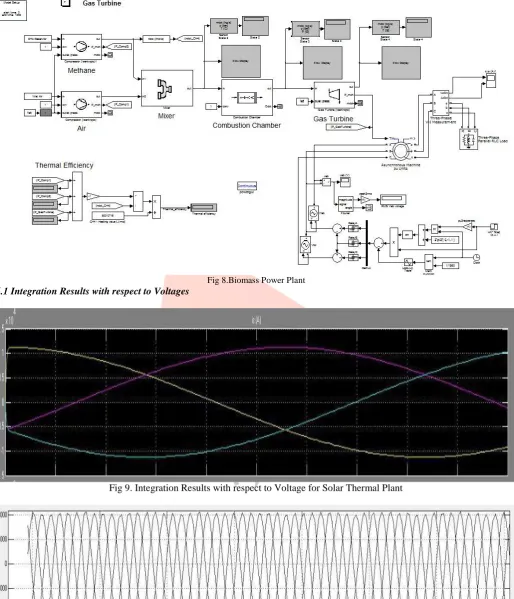
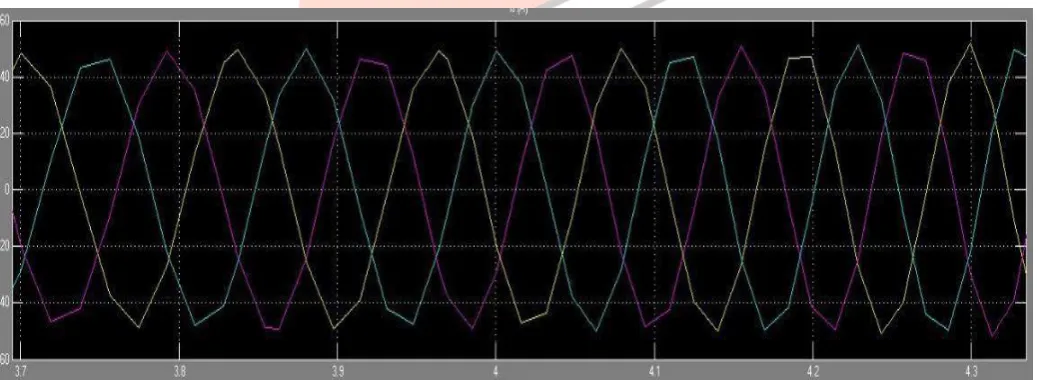
Fig 8.Biomass Power Plant6.1 Integration Results with respect to Voltages
Fig 9. Integration Results with respect to Voltage for Solar Thermal Plant
IJEDR1403076
International Journal of Engineering Development and Research (www.ijedr.org)3287
Fig 11. Integration Results with respect to Voltage for Biomass Plant6.2 Integration Results with respect to Currents
Fig 12. Integration Results with respect to Current for Solar Thermal Plant
IJEDR1403076
International Journal of Engineering Development and Research (www.ijedr.org)3288
Fig 14. Integration Results with respect to Power for Solar Thermal PlantFig 15.Integration Results with respect to Power for Wind Plant
Fig 16.Integration Results with respect to Power for Biomass Plant
VII. CONCLUSION
IJEDR1403076
International Journal of Engineering Development and Research (www.ijedr.org)3289
Off grid Renewable energy technologies satisfy energy demand directly and avoid the need for long distribution infrastructures. A combination of different but complementary energy generation systems based on renewable energies or mixed (RES) with a backup of Biomass which is available huge amount in Villages), is known as a hybrid power system (“hybrid system”). Gain an immediate access to reliable electricity at any time. Avoid long waits for grid extension and permit the connection if it comes. Reduce dependency from oil price fluctuations. Improve health care and education in rural areas. Increase economic productivity and create local employment opportunities.Strengthen social cohesion by providing access to electricity for ALL users. Fight climate change and poverty. Allow for a better Use of local natural sources. A combination of energy efficiency measures with the use of renewable energies will not only reduce electricity consumption and peak demand, thereby increasing the electricity service, but also reduce the production of conventional energy and greenhouse emissions from the combustion of fossil fuels we are generating each of 5MWof Power individually and total of 15MW.
We are giving power to a village continuously of 24/7 days of a year with an effective manner and with a low cost. We are taking the Village load as 5MWand we are generating a total of 15MWif all the resources (Solar, Wind and Biomass) are available we are storing some power and excess power feeding to the Grid Station. If Solar and Wind available continuously we are not operating Biomass. If any one of the two resources (Solar and Wind) are absent or both then we are operating Biomass power plant and we are giving continuous power to the Village.
REFERENCES
[1] Biofuels [Online], Date Accessed
06/04/2012http://topics.nytimes.com/top/news/business/energyenvironment/biofuels/index.html [2] Biodiesel Production and Distribution [Online], Date
Accessed06/03/2012http://www.afdc.energy.gov/fuels/biodiesel_production.html
[3] The Wikipedia link for Solar Power [Online], Date Accessed 06/08/2012http://en.wikipedia.org/wiki/Solar_power. [4] Solar Importance [Online], Date Accessed 06/11/2012
http://www.engineering.com/SustainableEngineering/RenewableEnergyEngineering/SolarEnergyEngineering/WhySolarEner gy/tabid/3893/Default.aspx
[5] Kanase-Patil, A.B., Saini, R.P., and Sharma, M.P. “Integrated Renewable Energy Systems For Off Grid Rural Electrification”, Renewable Energy, Vol. 35, pp. 1342- 1349, 2010.
[6] Co2now.org, “CO2 Now.”[Online]. Available: http://co2now.org/. [Accessed: 17-May-2013].
[7] “Solar Millennium AG - Home,” 2013. [Online]. Available: http://www.solarmillennium.de/index,lang2.html. [Accessed: 11-Jul- 2013].
[8] APP - Current Research > Solar thermal energy > CLFR
technology.”[Online].Available:http://www.physics.usyd.edu.au/app/research/solar/clfr.html. [Accessed: 10-Jul-2013]. [9] NREL, “NREL: Concentrating Solar Power Projects - Alba Nova 1.” [Online]. Available:
http://www.nrel.gov/csp/solarpaces/project_detail.cfm/projectID=221. [Accessed: 11-Jul- 2013]. [10]International Energy Agency, Wind Annual report 2000, May 2001.
[11]State of the World - 1991, World watch Institute. [12]www.micropower-connect.org