United Kingdom ISSN 2348 0386 Vol. VII, Issue 4, April 2019
Licensed under Creative Common Page 676
http://ijecm.co.uk/
THE IMPORTANCE OF FOREIGN EXPERIENCE IN THE
DEVELOPMENT OF EVALUATION ACTIVITY IN ORGANIZATIONS
Rikhsimboev Odiljon Kobiljon’s son
Associate Professor of Economics at Tashkent state university of economics, Uzbekistan
Abstract
This article is focused on the measures aimed at improving the development of information
technologies in the enterprises. Evaluation is closely related to performance management
(whether about organizations, groups, processes or individuals), which includes identifying
measures to assess progress toward achieving results. This article outlines the theoretical and
legal basis for organizing evaluation work, analyzed the views of scientists on the assessment,
analyzed foreign experience to create new evaluation methods and developed comprehensive
conclusions as well as recommendations.
Keywords: Mark, evaluation, assessment structures, principles of evaluation, international
standards, investment, property, financial reporting, management
INTRODUCTION
Evaluation is carefully collecting information about something in order to make necessary
decisions about it. There are a large number and wide variety of evaluations. Evaluation is closely
related to performance management (whether about organizations, groups, processes or
individuals), which includes identifying measures to assess progress toward achieving results.
A great deal of experience in organizing and managing valuation activity in foreign
countries has been accumulated and study examines the importance of this type of business in
the formation and development of the market economy, identifies as well as uses the basic
approaches, formulation, development and management of asset valuation in transition to a
Licensed under Creative Common Page 677 emphasizing the priorities of development and management of valuation activities. As well as I
can say that evaluation system in organizations is vital in the development of economy. We can
see some examples and ideas in the below.
LITERATURE REVIEW
The main theoretical and practical issues of valuing activity are developed and illustrated in the
works of many foreign economist scientists such as N. Ordey, F. Friedman and E. Klass.
Different aspects of valuation of the property (enterprises) are the economists and practitioners
of the countries of the Republic of Uzbekistan, including A.Gryaznova, V.V.Grigoryev, EE
Evstafeva, V.E.Esipov, S.P. Korostalev and HM Mamadjanov's case. At the same time, many
issues of improvement of methodological regulation and management of transitional activities in
the market economy have not been well elaborated on theoretical and methodological basis,
which is objective formulation of the assessment structure of the asset market infrastructure,
first of all, ways of assessing the value of new types of assets involved further scientific
research of the complex of problems connected with the improvement of technology,
normative-legal, informational, mathematical and the development of other types of supply, and the need
to develop sound guidelines for integrating assessment structures into international evaluators.
RESEARCH APPROACH
This research is focused on the measures aimed at improving the development of information
technologies in the enterprises. Such research methods as comparative analysis of the practical
data, statistic tables and other relevant data have been widely used in the research. Basing on
the research results appropriate proposals and recommendations have been developed.
ANALYSIS AND RESULTS
In most European and American countries, valuation activities are performed simultaneously by
consulting firms. This form of implementation of the set of works is attractive not only for the
valuation of the assets, but also for the clients who are interested in the achievement of the
goals that require this assessment.
The issue of state regulation in the field of organization and management of valuation
works in foreign countries is worthy of note. Three distinctive features of generalizing the
peculiarities of cooperation between the state and the evaluation structures:
- limited organization of state participation in the assessment work;
-organization and implementation of assessment work on the basis of cooperation with the state
Licensed under Creative Common Page 678 - Establishment and implementation of evaluation work with participation of only state
structures.
The first type of cooperation involves countries that use the American School of
Evaluation. Its essence is the highest degree of independence of the assessment structures,
which is characterized by the fact that the public management of evaluation works is of
particular importance.
The second type of cooperation is the countries that use the European rating school. Its
essence is that the assessment of the participation of the state and evaluation structures in the
evaluation process is balanced.
The third type of cooperation is the countries that use the School of the Assessment. Its
essence is the establishment and implementation of the assessment work only with the
participation of the state.
The first two types of cooperation are the countries with the most developed trade
unions.International Standards Committee (IVSC) is one of such prestigious organizations in
over 50 countries worldwide.
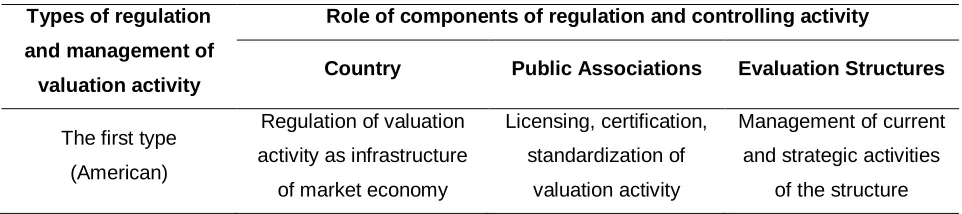
According to the first table, differing from the different types of governance valuation
activity, the involvement of state, public associations and separate assessment structures in this
process varies greatly.
According to the research, in the US or Europe, the "standards" are not considered an
unchanging package of laws. Therefore, one of the main objectives of the IVSC is to achieve a
harmonization between national standards of evaluation and standards that are most
appropriate for the needs of the international community. International Standards on Evaluation
(ISE) have a solid foundation that reflects the uniqueness of the economic principles that are not
bound by political boundaries. At the same time, regular work is underway to improve this
framework.
Table 1 Participation in various types of regulation and management of government, public
associations and separate assessment structures
Types of regulation
and management of
valuation activity
Role of components of regulation and controlling activity
Country Public Associations Evaluation Structures
The first type (American)
Regulation of valuation activity as infrastructure
of market economy
Licensing, certification, standardization of
valuation activity
Management of current and strategic activities
Licensed under Creative Common Page 679 The second type
(European)
Development, licensing, standardization of development as a type of
entrepreneurship
Assistance in certification, licensing
and standardization
Management of current and strategic activities
of the structure
The third type (Asian)
Regulation of the entire set of measurement
activities
-
Management of current and strategic activities
of the structure
In developing the European Standards for Evaluation, the European Fund of Asset
Management (TEGOVOFA) plays an important role, which was established in 1977 as a
Noncommerce Association of Western European Appraisers. After joining EUROVAL with such
a similar organization, this group is now called the "European Association of Valuers
Associations" (TEGoVA). One of the main goals of this organization was to create common
standards for evaluating the views of professional organizations in all countries of the European
Union. At present, the European Union's professional assessment bodies are members of the
TEGOAA, with the countries of Central and Eastern Europe, including the Czech Republic,
Hungary, Poland, Bulgaria, Romania and Albania. TEGoVA works closely with the International
Valuation Committee. One of the key features of the European standards for valuation is the
evaluation of the assessment carried out in order to comply with the adopted European
Accounting Standards.
President of the Republic of Uzbekistan Sh.Mirziyoev said in his report the following: "...
There was no concrete work and final result under the leadership of" Uzstandart "agency. Only
13% of the 21,000 standards of the International Organization for Standardization have been
introduced in our country. "This, in turn, requires special attention to the implementation of
international standards in our country.
The European evaluation standards are not mandatory for the members of the
organization, but are recommended to be considered as standards promoting the best practices
for incorporating the European Union's relevant regulatory documents and accepting the
relevant national standards of the European Union. The objectives of the European
benchmarking standard are to:
- assisting the appraiser in preparation of coordinated reports for their customers by providing
specific recommendations;
- Establishing agreed-upon assessments using standard approaches to market value
determination and evaluation;
- to have quality standards by confirming the general level of qualification;
Licensed under Creative Common Page 680 - clear basis for economic analysis of land and construction resources effectively;
- raising the awareness of the appraiser;
- Defining measures to ensure a clear definition of the value in accordance with national
legislation and standards and international accounting standards.
The last edition of the European Standards for Evaluation ("Green Book") was adopted
in 2000. This document includes 9 standard and 13 guidelines. At the same time, standards 1-3
deal with issues related to compliance with these standards with the International Valuation
Standards, as well as issues related to the Qualification of the Appraiser and his professional
ethics.
The basic principles for assessing and formulating the evaluation report are set out in
Principle 4. The objective of this Standard is to identify the main objectives and valuation
principles, as well as identify different values such as market value, lease rights value, valuation
of value under EU law, fair value, value in use, value in use, depreciation include.
The issues related to the evaluation of financial reporting purposes are governed by the
Standard 5. It contains a selection of the classification of assets and the basis for the
assessment. The standard contains another section. It defines the main definitions, issues of
evaluation methodology, features of evaluation of land, buildings and special objects.
As a pledge, the 6th standard is devoted to the problem of real estate, as well as other
objects of mortgage lending. This standard defines concepts such as collateral value, special
value of liabilities, and specific requirements for the appraiser, ie its independence, liability and
special knowledge.
The concepts such as investment grade, future or past date and future valuation of
future valuation issues in future periods are disclosed in Note 7.
Investments in insurance and insurance companies and pension funds are covered by
Standard 8. The standard deals with issues related to determining market value in accordance
with the EU guidelines and the evaluation methodology and the appraiser's qualification.
Issues related to the provision of evaluation results and forms of valuation clauses are
discussed in Chapter 9. This document includes the following 13 guidelines:
-Factors affecting value;
- evaluation of special facilities;
- Assessment of investment assets;
- assessment of agricultural facilities;
- Evaluation of real estate indices;
- international assessment;
Licensed under Creative Common Page 681 - distribution of values between land and buildings;
- Features of evaluation in different countries.
The European Standards Evaluation Criteria include appraisal of certification, evaluation
reports, and appraisal ethics. Property valuation for purposes of taxation and forced alienation is
not a subject of European evaluation standards. However, the general principles outlined there
can be used in the absence of any other specific guidance.
Leaving any appearance in the European benchmarking guidelines may result in
commercial or legal sanctions. Conversely, compliance with standards may be a part of
practical legal remedies where there is no evidence in favor of the counterpart when reviewing
the negligence claim.
The regulation and management of valuation activities in foreign countries are
paramount importance for the development as well as implementation of regulatory acts of
public organizations that define requirement of procedure for resolving a wide range of issues
arising in the course of valuation activity.
These documents include the law of Ethics for Evaluators, which include requirements
for appraisers and regulates their relationship with their buyers in the evaluation process.
Without prejudice to these documents, we would like to emphasize the high level of
requirements for the appraisers than usual, rather than the documents adopted by individual
states. It should be noted that non-observance of these requirements by members of public
associations creates serious penalties. At the same time they can be excluded from these
organizations and often deprived of their valuables for assistance.
In foreign countries, the most important prerequisite for the development of the market of
tangible and intangible assets is the preparation of qualified appraisers in the system of
development and management of valuation activities. For example, in Malaysia, the
International Program for Technical Cooperation in Developing Countries (IPTC) is being
implemented between developing countries, which are committed to satisfying the need for
asset valuation since 1980. This Program will also provide the exchange of experience, as well
as the preparation of experts who will evaluate:
- Fellowships for assessment work in various institutions in Malaysia;
- providing participants with decent conditions for reading at the expense of third countries and
charities;
- provision of expert services in different fields of knowledge in the field of valuation activity.
Another similar program was developed by the Evaluation Expert Training Program in
the Central Asian region. Generally speaking, developed and emerging economies in
Licensed under Creative Common Page 682 on the formation and development of civilized and intrinsic markets of material as well as
non-material assets.
CONCLUSION
Developing and regulating valuation activity in overseas countries In order to strengthen
macroeconomic stability to maintain high economic growth rates for the further development for
liberalization of the economy, increase the competitiveness of the national economy, the
following conclusions should be taken into account in the formulation, development and
management of this type of activity:
Firstly, value-added in developed countries is an important component of the
infrastructure of the market intangible and intangible assets. Valuation activity management has
a clear representation of state and public regulation as a type of entrepreneurial activity in most
countries;
Secondly, the development of the open economy, integration processes, capital
movements have identified the need for appraisers to adopt the unique concept and principles
of broader formulation assessment of international public relations of European assessment
standards. These principles serve as a basis for many countries to develop a national system of
standards taking into account their economic development;
Thirdly, leading foreign companies are constantly expanding the range of additional
services they provide, which increases the attractiveness of not only the asset but also the
stakeholders interested in achieving the goals;
Fourth, improvement of valuation activity, active participation of valuation agencies in
international trade organizations, certification of these organizations, compliance with
international standards on cost estimate increases the likelihood of foreign investors investing in
these activities;
Fifthly, regulation and management of the valuation activities in foreign countries are
aimed at:
- state regulation - development of activity as a type of business activity that allows to improve
the market economy;
- Public regulation - development of activity as a kind of production, taking into account specific
features of organization product and use of its results;
- managing these structures as one type of management that determines the implementation of
the strategy for the development and strengthening of evaluation structures;
Sixth, most foreign evaluators have a transnational nature, and they successfully
Licensed under Creative Common Page 683 economy. Based on the formation as well as development of national evaluation structures and
the creation of a competitive environment on the market of evaluation services, national
assessment structures should be gradually integrated into international labor market
consultants;
Seventhly, the assessment structure of the Republic of Uzbekistan should be directed to
the enhancement of the appraisers' awareness in international co-operatives, which will help to
increase the rating of these foreign investors.
REFERENCES
Bufetova L.P. History of Economics. Tutorial. Part I. Barnaul. Academy of Economics and Law. Altai Branch, 1996. Popov G.V. "Basics of asset valuation." Fifth edition, M., 1995.
Law of the Republic of Uzbekistan "On Valuation Activity", adopted on August 19, 1999 (amendments and additions). The constitution of the Republic of Uzbekistan. Tashkent, 2014.
The Decree of the President of the Republic of Uzbekistan "On the Strategy for Further Development of the Republic of Uzbekistan" dated February 7, 2017, PO-№ 4947.