A Monthly Double-Blind Peer Reviewed Refereed Open Access International e-Journal - Included in the International Serial Directories
International Journal in IT and Engineering
http://www.ijmr.net.in email id- [email protected] Page 175 Rajesh Saini1, Dr.VaibhavBansal2
Department of Computer Science and Engineering
1,2
OPJS University, Churu (Rajasthan)
ABSTRACT
Nowadays the cloud computing is considered a new technology that can improve the function of the
government. This paper surveys the G-Cloud i.e. the Cloud Government which is seen as one of the
e-government challenges and the upsides of cloud e-government, moreover the paper reviews the
change models of E-Government to travel it to the Cloud figuring notwithstanding checking on the
proposed models from e-government to the distributed computing.
Keywords: Cloud Computing, E-Government, Models, Maturity, Framework, Stages
1. INTRODUCTION
E-Administration (electronic organization) is using Data and Correspondence Innovations (ICTs) at various levels of the lawmaking body and the all-inclusive community part and past, with the ultimate objective of overhauling organization. E-organization is the usage of information and correspondence advances to change the profitability, sufficiency, easiness and obligation of enlightening and esteem based exchanges inside government, between govt. also, govt. associations of National, State, City and Neighborhood levels, subject and associations, and to empower occupants through get to and usage of information [1]. Information association is a rising to the e-association. E-Administration can smoothen the working technique for governmentcontraption by giving Straight imposition, convincing working,[2] minute
response and availability of information of government equipment to end customers, time to time. The present e-organization is especially serving driven, fiscally insightful in nature and gets itself not ready to address all classes of customers starting from commonplace urban to metropolitan locals [3].
2. SORTS OF E-GOVERNMENT
Sorts can be grouped into 4 classes:
Government to resident
Citizen to government
Government to government
Government to business
A Monthly Double-Blind Peer Reviewed Refereed Open Access International e-Journal - Included in the International Serial Directories
International Journal in IT and Engineering
http://www.ijmr.net.in email id- [email protected] Page 176 straightforwardness organization through
electronic documentation, online convenience, online organization transport, and soon. M-It conveys Ethical quality to administration as corruptions like paying off; red-tapes, and so on are disposed of. What's more, it makes the Organization dependable as each one of the data and information of Government is open online for thought about every subject, the NGOs and the media. R-Because of diminished printed material and expanded correspondence speeds and diminished correspondence time, the Administration offices get to be distinctly responsive. R-Innovation can change over an unreliable Government Capable. Expanded access to data makes more educated natives. T-With expanded profound quality, online accessibility of data and diminished red-tapism the procedure of administration gets to be distinctly straightforward ruling out the Legislature to disguise any data from the natives.
3. CHALLENGES
Adaptability: The present framework in
E-Government can't be expandable (versatile), adaptability Demand changes and overhauls of Equipment and programming over place and time, so it must be as often as possible moved up to meet these difficulties [6].
Modifiability: Since routine system is expandable, so to adjust the standard establishment it will cost an extraordinary arrangement, for example the saving time and
cost for moving from 100 customers to 10000 clients exhausting heaps of assets [7].
Physical security: giving an ensured area to
information planning and turning away unapproved physical access to registering apparatus is hard to keep up the traditional structure. Physical security incorporates: 1-microcomputer physical security, 2-individual physical get to control, and 3-dangers and office necessities [8].
Application Life Cycle organization: with
current system, the life cycle from examination, plot, change, testing to recording and retirement. For making it accessible we have some issue like security and cost when the replication cause duplication of assets of various government associations and offices, additionally the trouble and sophistications among the product life cycle assignment has changed and overhauled [9].
Programming allowing and reinforce: Each
application or programming requires an allow using, however only a solitary allow for the application is satisfactory for passed on server ranches.
Responsibility: Conventional frameworks have
applications that don't have focal power and responsibility.
4. CLOUD COMPUTING (CC):
A Monthly Double-Blind Peer Reviewed Refereed Open Access International e-Journal - Included in the International Serial Directories
International Journal in IT and Engineering
http://www.ijmr.net.in email id- [email protected] Page 177 farm from a capital-escalated set up to a
variable evaluated environment. Cloud computing depends on an extremely central main of reusability of IT abilities' [10]. The distinction that cloud computing conveys contrasted with customary ideas of "matrix computing", "cloud computing", "utility computing", or "autonomic computing" is to expand skylines crosswise over authoritative limits.
The three layer Cloud Computing
Cloud computing utilizes three layered conveyance models for the client which are based upon each other. The three compositional layers of Cloud Computing are:
Foundation as an Administration (IaaS): gives
a remote conveyance through the Web of a full PC framework.
Stage as an Administration (PaaS): has the
clients' applications or gives the required foundation to create and send their applications.
Programming as an Organization (SaaS):
enables the customers to access, to regulate and to administrate their own item or utilize available programming.
Focal points of Cloud computing
Information assurance: this component
depends on a participatory relationship between the customer and the specialist organization where each has a critical part
[11]. It is the customer side when you do any preparing and capacity of the information ought to make certain of the nature of its Web association and that he had really stores the document on the system and record data that nobody knows one else.
Guarantee that the administration forever
:The organization offered to cloud stockpiling
administration's dedication to guarantee that the administration is working all day and all night with the most ideal shape through furnished with the most recent gadgets that are over the ability to guarantee that no loss of your information [12].
Colossal foundation: gave by cloud administrations to do the tests and logical examinations, some perplexing estimations required years to lead consistent PCs.
Green ICT: cloud computing contribute
fundamentally in green ICT
substantial scale: Cloud Computing has an
extensive scale for instance Cloud computing focus of Google, IBM, Amazon and Microsoft have more than 200 million servers, so "Cloud" can give a bizarre computing power.
Virtualization: Cloud Computing help clients
A Monthly Double-Blind Peer Reviewed Refereed Open Access International e-Journal - Included in the International Serial Directories
International Journal in IT and Engineering
http://www.ijmr.net.in email id- [email protected] Page 178 On-request benefit: "Cloud Computing" is
blend of gigantic asset, the clients purchase these administration on-request. Cloud can run like power, gas, water and can charge agreeing devouring.
Low cost: and pay as you need
Get to anyplace: u can access from anyplace, in your office, home, even outside nation from keen gadgets Expanded adaptability: the immense framework and access with low value
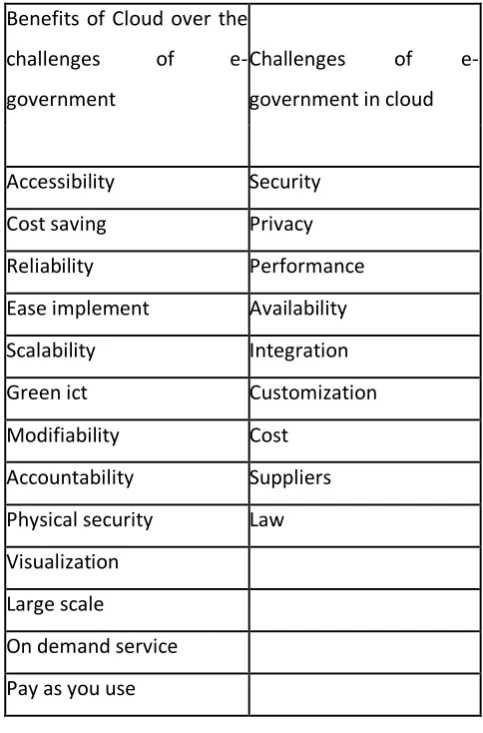
you can lessen execution times Simple to actualize: no compelling reason to buy new equipment or programming Most recent innovation: naturally redesigned Dependability: the administration quality more than every minute of every day administrations with all reinforcement arrange required The table condenses the advantages of cloud in government and difficulties of e-government in cloud as found in the accompanying table 1.
Table 1: Summary OF Benefits of cloud government and challenges
Benefits of Cloud over the challenges of e-government
Challenges of e-government in cloud
Accessibility Security
Cost saving Privacy Reliability Performance
Ease implement Availability
Scalability Integration
Green ict Customization
Modifiability Cost Accountability Suppliers
Physical security Law
Visualization Large scale
On demand service
A Monthly Double-Blind Peer Reviewed Refereed Open Access International e-Journal - Included in the International Serial Directories
International Journal in IT and Engineering
http://www.ijmr.net.in email id- [email protected] Page 179 5. CLOUD GOVERNMENT MODELS
In the writing, we found that, to part in two phases, first stage (first stage) get ready E-Government to be prepared to travel it to the Cloud Computing, the Second Stage (second stage) is the investigations of Cloud Government [14,15].
A First stage: First stage (first stage) is the
improvement models of E-Government (Development), contrasts between these models like nature in a scientific review and allude to the qualification amongst regions and nations until to be prepared to travel it to the cloud some rundown of the models will be appeared as took after:
A three phase demonstrate by World Bank:
World Bank Place for Popular government and Innovation proposed A model, That comprises of three phases: Execute arrange, Communicate stage, and Distribute organize A three phase display by Howard: Howard show comprise of three phases: the basic Stage is circulating stage, the moved stage is Partner organize, ultimately Executing stage these stages made by Howard in light of the model layout and the lion's share of that has the most noteworthy phase of e-government improvement.
A four phase demonstrate by Layne and Lee:
Layne and Lee proposed A model of: Even reconciliation arrange, Vertical combination organize Exchange stage, and List arrange.
A four Open Division Handle Reconstructing
(PSPR) display by Andersen and Hendrickson:
Andersen and Hendrickson proposed PSRR show that was an improvement of the Layne and Lee Model which contains of four phases: Exchange arrange, Flat incorporation organize, Vertical coordination stage, and List organize
A four-arrange demonstrate by Gartner: A
global Organization consultancy named Gartner’s proposed a four-organize display: Change customized organize Web nearness arrange, Exchange stage, and Communication arrange.
A four phase demonstrate by Siau and Long
Incorporate E-government arrange
display:Siau and Long another model from
blend diverse models utilizing the Meta-integrate strategy that is moderately new in IT field. By joining the similitudes and consolidating a few improvement models; the four phases: E-majority rule government organizes, Change arrange, Exchange stage, and Collaboration arrange.
A four phase show by Chandler and Emanuel:
Chandler and Emanuel a four phase display: first stage is Data arrange, propelled stage is Connection stage, and Exchange stage to empower exchanges of qualities amongst national and government, and the last stages is joining stage.
A Monthly Double-Blind Peer Reviewed Refereed Open Access International e-Journal - Included in the International Serial Directories
International Journal in IT and Engineering
http://www.ijmr.net.in email id- [email protected] Page 180 administration conveyance organize,
coordinated administration conveyance, the entryway organize with completely executable and Bulletin arrange.
A five-organize show by Hiller and Belanger:
Hiller and Belanger a five-arrange demonstrate: Investment arrange, Combination organize, Exchange arrange, Two-way correspondence stage, and Data organize.
A five - organize display by Joined Countries:
The Unified Countries and American Culture for Open Organization, the have a fundamental objective of the e-government is to offer proficient online open administrations. Likewise, they proposed a model that comprises of the five phases: Value-based nearness arranges, rising nearness organize, Intelligent nearness stage, Consistent or completely incorporated nearness stage and Improved nearness arrange.
A five-arrange demonstrate by Moon: Moon
has presented A Five-organize display:
Political cooperation stage, Demand and reaction for Two-way correspondence arrange, Administration, Vertical and even reconciliation organize, money related exchanges stage,, and Straightforward data scattering for one way correspondence arrange .
A five-organize demonstrate by Accenture:
Accenture of five-phase show for the improvement of e-government comprises of: Administration change arrange, Administration
accessibility arrange, Essential capacity organize, develop conveyance organize, and online nearness arrange
A six-arrange show by Asia Pacific: The Asia
Pacific nations displayed a mode that comprises of six phases: Setting up an email framework and inward system arrange, Computerized vote based system arrange, Empowering between hierarchical and free to data organize, Permitting trade of significant worth stage, Permitting two way interchanges stage, and Jointed up government arrange .
A six-arrange demonstrate by Deloitte: This model of a six-organize: Full incorporation and undertaking change organize, two-way exchanges arrange, Entryway personalization organize, Multi-reason entries organize, Grouping of basic administrations stage, and Data distributing stage .
A 6 phases show called 6I model to assess the
e-benefits in the legislature: A six phases
demonstrate called 6I display or new edge work comprise of Include stage , Interface arrange, Coordinate stage, Individualize organize, Intercommunicate stage, and Advise arrange that is utilizing meta-orchestrated approach on A ton of models .
A five phase show by Akram and Galal: A five
phase demonstrate : evaluation organize,
A Monthly Double-Blind Peer Reviewed Refereed Open Access International e-Journal - Included in the International Serial Directories
International Journal in IT and Engineering
http://www.ijmr.net.in email id- [email protected] Page 181 A model proposed in light of cloud
computing: To give effective conveyance of
workload and to get more easy to understand, They proposed a model in light of cloud computing with a sound induction specialist by considering the e-government arrangement of Saudi Arabia
A six layer proposed in cloud based
e-government Design: The layers proposed to cost sparing in ICT venture Six layer are: client layer, get to layer, benefit layer, administration layer, virtualization layer, and framework layer in Indonesian Government by 45.8% proficiency in the Cloud and more gainful by looked at NPV net present esteem between non-cloud and cloud
A Hadoop structure of Four Parts: Proposed a
system of e-government cloud based which is called hadoop is network of ware servers and a product layer, that contains of four segment proposed: (UI), Validation check (air conditioning), Computational Web benefit mapping (WSM) and Employment Scheduler (JS), they put these diverse Segment and indicate the Parts of Every one, these Segment which is called Hadoop is at the top which can got to by Item Equipment or Thin Customer
A proposed three layer system of
e-administration in view of cloud computing:
The three layer structure proposed of e-administration in light of cloud computing to be developed in versatility, security, accessibility and so forth., the main layer is
learning base layer, second is derivation motor layer, third is UI layer and the Hadamard network idea to upgrade the security for Cloud Government by improvement of unscrambling and encryption calculations.
6. ENHANCING EFFICIENCY OF CLOUD
GOVERNMENT
In setting of e-Government difficulties and advantages of Cloud they puts organization and engineering and choice of administration model, Arrangement models : private, open, cross breed and group display as far as Bound together standard, legitimate supports, Reliability, supportability, cost, protection and security, in expansion five layer of design :foundation, application layer . Application stage, customer layer and the administration layer, in identified with Choice of administration model (IaaS, PaaS, and SaaS) examination the attributes then fitting target were distinguished
Embrace Cloud computing in E-government: To Fast execution, To build adaptability, security notwithstanding lessen programming cost, stage cost and foundation cost they proposed a model to Receive Cloud computing in E-government which helps G2B, G2E, G2C and G2G applications to profits by the accessible administrations on the cloud.
A Monthly Double-Blind Peer Reviewed Refereed Open Access International e-Journal - Included in the International Serial Directories
International Journal in IT and Engineering
http://www.ijmr.net.in email id- [email protected] Page 182 situated (SOA and CMMS) and issues to
actualize it out in the open part.
Relocation from e-Administration to Cloud: Proposed model to move from e-administration to the cloud by utilizing innovation exchange demonstrate for 6 phases: learning, Prerequisite detail, Cloud model Improvement, Information and application relocation, cloud Rollout, Cloud headway.
A six stage for Cloud relocation technique: A six stage for cloud movement proposed initial step is learning , second step is Authoritative appraisal, third step is Cloud pilot, Fourths stage is Cloud preparation evaluation, fifth
step is cloud rollout system, and the six stage is proceeds with cloud change.
A model proposed show for Cloud Web based business: The proposed structure contains of 5 layers: first layer is business layer, the second layer is Server Layer, the Third layer is Asset administration layer, the Fourth layer is Programming asset layer and the last layer is Equipment Asset layer all layers together we can utilize the advantages of cloud computing all issues of big business web based business application will be explained.
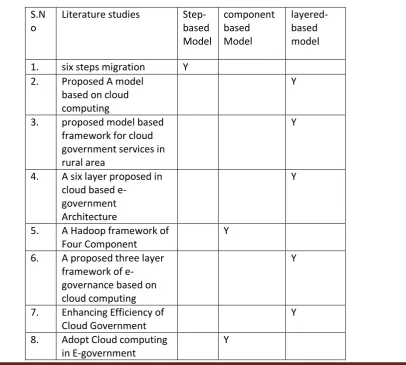
All Models Proposed in the Audited studies are step-based, part based or a layered-based model. As found in the accompanying table 2.
Table 2: Summary of studies Cloud computing in e-government
S.N o
Literature studies Step- based Model
component based Model
layered- based model
1. six steps migration Y 2. Proposed A model
based on cloud computing
Y
3. proposed model based framework for cloud government services in rural area
Y
4. A six layer proposed in cloud based
e-government Architecture
Y
5. A Hadoop framework of Four Component
Y
6. A proposed three layer framework of e-governance based on cloud computing
Y
7. Enhancing Efficiency of Cloud Government
Y
8. Adopt Cloud computing in E-government
A Monthly Double-Blind Peer Reviewed Refereed Open Access International e-Journal - Included in the International Serial Directories
International Journal in IT and Engineering
http://www.ijmr.net.in email id- [email protected] Page 183 9. Mapping Cloud
computing in e-governance
Y
10. Migration from e-Governance to Cloud
Y
11. A six step for Cloud migration strategy
Y
12. A model proposed model for Cloud E-Commerce
Y
7. CONCLUSION
all reviews are propelled about cloud government, it's the future in addition to it has many advantages some of them like adaptability, Modifiability, on request benefit, pay as you utilize and straightforwardness execution however a bunches of concerns must know in plan another stages, model or system some of them like protection, cost, security, customization and coordination, In the writing, we may check the accessibility of e-government to be prepared to travel it to the cloud, we discovered reviews proposed either a stage based model, a part based model or a layered-based model, all reviews are proposed structure to receive Cloud in e-taxpayer driven organizations, or puts advantages of cloud in e-government yet every one of the models are reasonable model and they didn't rehearse any review so we may do a test examine or proposed new hypothetical models.
REFERENCES
1. World Bank Website (2005) Definition
of E-Government,
http://www1.worldbank.org/publicsec tor/egov/definition. htm.
2. Kuldeep Vats , Shravan Sharma , AmitRathee "A REVIEW OF CLOUD COMPUTING AND E GOVERNANCE", International Journal of Advanced Research in Computer Science and Software Engineering , Volume 2, Issue 2, February 2012
3. Janine S. Hiller , France Bélanger , "e Government series 2001 privacy strategies for electronic government" , The PricewaterhouseCoopers Endowment for the business of government , January 2001
4. Zhiyuan Fang, Ph.D. –Thailand.”E-Government in Digital Era:Concept, Practice, and Development" , International Journal of The Computer, The Internet and Management, Vol. 10, No.2, 2002, p 1-22.
A Monthly Double-Blind Peer Reviewed Refereed Open Access International e-Journal - Included in the International Serial Directories
International Journal in IT and Engineering
http://www.ijmr.net.in email id- [email protected] Page 184 6. Whitepaper , " Cloud computing for
E-Governance" , IIIT Hyderabad , 2010 7. Panoslouuridas , " up in the air :
moving your application to the cloud ", IEEE Software Technology , 6-11, 2010 8. Chan, Tony (2009). Full interview:
AT&T’s Joe Weinman. Green Telecom Live, March 16, 2009.
9. Gartner (2008) Gartner Says Contrasting Views on Cloud Computing Are Creating Confusion. Gartner press release, 29 September 2008.
10. Gens F (2008) Defining “Cloud Services” and “Cloud Computing”. IDC eXchange, 23 September 2008.
11. Fellows W (2008) Partly Cloudy – Blue-Sky Thinking About Cloud Computing. 451 Position Paper, Executive Overview, The 451 Group.
12. Merrill Lynch (2008) The Cloud Wars: $100+ billion at stake. Merrill Lynch research note, May2008
13. Sultan N. (2010). Cloud computing for education: A new dawn? International Journal of Information Management, 30(2), 109–116.
14. Sharma P., Sood K. &Sumeet K. (2011). Security issues in cloud computing. In Mantri A., Nandi S., Kumar G. &Kamur S. (Eds.).Communication in Computer and Information Science: Vol. 169. HighPerformance Architecture and Grid Computing (pp. 36– 45).Heidelberg: Springer-Verlag Berlin. 15. Mell P. &Grance T. (2011). The NIST