International Journal in Commerce, IT & Social Sciences (Impact Factor: 4.218) Impact of Purchase Intention based on User Generated Content
Dr.A.S.Saranya, Associate Professor, Department of Commerce Ethiraj College for Women,
Chennai- 8.
S.Gayathri, Associate Professor, Department of Commerce Ethiraj College for Women,
Chennai- 8. Introduction:
Social media has managed to revolutionize the ways Internet users communicate and interact with each other within a very short period. It has made it possible for consumers to share reviews, opinions and thoughts. In addition to the increasing time spent on social media, user adoption has multiplied with some prominent examples being Face book (900 million users), Twitter (500 million users) and Qzone (480 million users). The spectrum of social media however does not consist solely of networking sites but also encompasses a wide range of applications, such as media sharing (You Tube, Flickr) business and academia networking virtual worlds, blogs and many other platforms. Over the past years business executives and marketers have realized the business potential that these platforms may have for gaining a competitive edge for attracting new customers and gaining direct customer feedback. This User Generated Content (UGC) which can be considered to be part of social commerce, is likely to influence other consumers’ attitudes toward a product and subsequent purchase intentions. This user generated content is communication created by consumers who may have tried the product and are willing to share their experiences with other consumers and users inside or outside their social circle The shopping process is conceptualized as a sequential series of behaviours, along with the underlying motivations which lead to the purchase of the item. Utilitarian and hedonic motivations differ fundamentally. Utilitarian motivation is defined as goal and also as rational oriented. Hedonic motivation contrarily refers to the search of emotions such as happiness, enjoyment and fantasy experienced during the shopping procedure. Therefore, consumers with a strong hedonic motivation seek the enjoyment of the process rather than the utility of the purchased
International Journal in Commerce, IT & Social Sciences (Impact Factor: 4.218) Objectives:
i) To examine Hedonic use as a determinant of intention to purchase based on UGC. ii) To examine Utilitarian use as a determinant of intention to purchase based on UGC iii) To examine trust as a determinant of intention to purchase based on UGC
iv) To examine relationship of intention to purchase based on UGC with hedonic use, utilitarian use, and trust
Methodology:
Primary data has been collected from 50 UG and 50 PG female students in the age group of 18-23 years, using stratified random sampling technique through a structured questionnaire having statements on Utilitarian Use, Hedonic Use and Trust on a five point Likert scale. t- Test, Factor Analysis, Inter Correlation and Regression are the tools employed for data analysis.
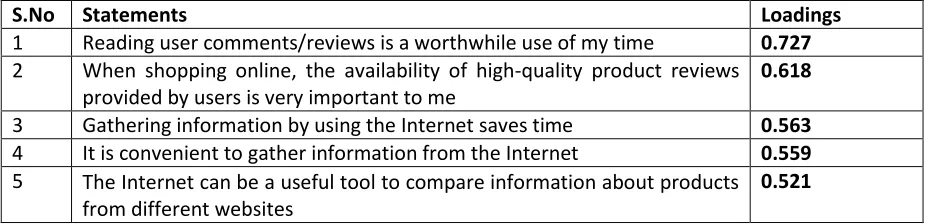
Analysis and Interpretation: Table No.1 Factor I - Utilitarian Use
S.No Statements Loadings
1 Reading user comments/reviews is a worthwhile use of my time 0.727 2 When shopping online, the availability of high-quality product reviews
provided by users is very important to me
0.618 3 Gathering information by using the Internet saves time 0.563 4 It is convenient to gather information from the Internet 0.559 5 The Internet can be a useful tool to compare information about products
from different websites
0.521
The consumers feel that reading user reviews is a worthwhile use of their time since this has secured the highest factor loading of 0.727. They opine that UGC is very important to them. (0.618), saves times (0.563), is convenient (0.559) and helps is comparison of information about products from different websites (0.521). Since all the above statements measure the Utilitarian use of UGC with respect to product reviews the factor has been named as “Utilitarian Use”
Table No.2 Factor II - Hedonic Use
S.No Statements Loadings
1 Searching for information on the internet is a good way to spend time 0.654 2 I find searching for information on the Internet to be enjoyable 0.561 3 Information searching on the Internet is fun rather than tedious 0.471
International Journal in Commerce, IT & Social Sciences (Impact Factor: 4.218) Table No.3 Factor III – Trust
S.No Statements Loadings
1 I trust user comments/reviews from people who have purchased the pdt 0.780 2 I believe user reviews of a product are more beneficial than manufacturer
provided information
0.668 3 I trust user comments/reviews of a product to be reasonably accurate
representations of a product
0.550
4 I would trust a product review posted by an average user more than a product review posted by an expert
0.537 5 I trust reviews from friends or people I follow on social networking
websites
0.464
All the above five statements measure the extent of trust consumers have on UGC with factor loading ranging from 0.464 to 0.780. Consumers trust reviews from people who have purchased the product (0.780) more than manufacturer provided information (0.668). They feel that UGC is reasonably accurate (0.550) and they trust product reviews posted by an average user (0.537) and friends (0.464) than by an expert. Therefore the factor has been named as “Trust”
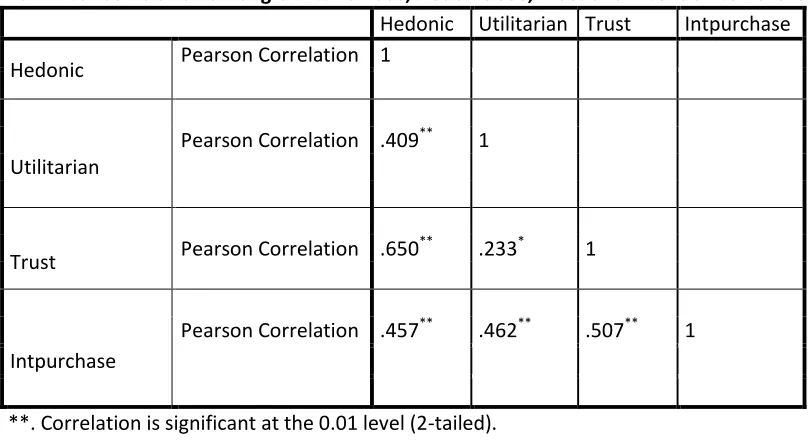
Thus the results of factor anlaysis reveal the emergence of three factors in the order of importance as Utilitarian Use, Hedonic Use and Trust. The results of inter correlation among the four factors are depicted in the Table below:
Table No.4 Inter Correlation among Utilitarian use, Hedonic use, Trust and Intention to Purchase Hedonic Utilitarian Trust Intpurchase
Hedonic Pearson Correlation 1
Utilitarian
Pearson Correlation .409** 1
Trust Pearson Correlation .650
**
.233* 1
Intpurchase
Pearson Correlation .457** .462** .507** 1
**. Correlation is significant at the 0.01 level (2-tailed). *. Correlation is significant at the 0.05 level (2-tailed).
From the above table it is clear that there exists a positive relationship among Hedonic use, Utilitarian use, Trust and Intention to Purchase and it is significant at 1% level and 5% level. The relationship between hedonic and trust is the strongest (0.650) followed by Intention to purchase (0.457) and finally by utilitarian use (0.409) at 1% level of significance.
International Journal in Commerce, IT & Social Sciences (Impact Factor: 4.218)
Regression analysis was done with intention to purchase based on UGC as the dependent variable and composite measures of hedonic use of UGC, utilitarian use of UGC and consumers’ trust in UGC as independent variables.
Table No: 6 Regression Analysis: Model Summaryb
Model R R Square Adjusted R
Square
Std. Error of the Estimate
Durbin-Watson
1 .620a .385 .365 .40356 2.488
ANOVAa
Model Sum of
Squares
Df Mean Square F Sig.
1
Regression 9.772 3 3.257 20.002 .000b
Residual 15.634 96 .163
Total 25.407 99
Coefficientsa
Model Unstandardized
Coefficients
Standardized Coefficients
t Sig.
B Std. Error Beta
1
(Constant) 1.457 .393 3.705 .000
Utilitarian .076 .128 .067 .596 .553
Hedonic .234 .059 .345 3.932 .000
Trust .331 .091 .383 3.636 .000
a. Dependent Variable: Intention to purchase b. Predictors: (Constant), Trust, Utilitarian, Hedonic
Intention to Purchase = 1.457 + 0.076 Utilitarian +0.234 Hedonic +0.331 Trust
The most important independent variables which have an impact on intention to purchase of the consumers based on user generated content is Trust (.331) followed by Hedonic Use (0.234) and Utilitarian Use (0.076). R square is .385, which indicates the amount of variance explained in the dependant variable (Intention to purchase), by the 3 predictors of intention to purchase of the consumers who purchase products based on user generated content.
Conclusion:
A significant finding of this research was the identification of hedonic and utilitarian uses of websites. The factor analysis showed that consumers use UGC because it is enjoyable to read these reviews and because there is a real practical benefit to do so. It is also found that utilitarian use of UGC is more important than hedonic use. A paired samples t-test revealed that utilitarian use was significantly greater than hedonic use at the 0.001 level. The mean difference between the two was found to be 0.62 on a 5-point scale. So, we conclude that consumers clearly regard utilitarian use to be the most predominant.
International Journal in Commerce, IT & Social Sciences (Impact Factor: 4.218)
In addition, although we expected to find that utilitarian use would have more influence on intention to purchase based on UGC, we find that both hedonic and utilitarian use of websites had a significant effect on it. The consumers trust reviews from friends and people they follow on social networking sites, and they trust reviews posted by an average user more than that posted by an expert. They do not trust reviews from celebrities they follow on social networking sites. As a result of this finding, for a product which is considered by management to be a good, strong product, purchasers should be strongly encouraged to write detailed quality reviews.
This finding concludes that UGC is regarded as a very trustworthy source of information.
Bibliography:
1. Babin, Barry J., William R. Darden, and Mitch Griffin. 1994. “Work and/or Fun: Measuring Hedonic and Utilitarian Shopping Value.” Journal of Consumer Research 20: 644–656.
2. Babin, Barry J., and Eric G. Harris. 2014. Consumer Behavior. Boston, OH: Cengage
3. Bloch, Peter H., and Marsha L. Richins. 1983. “A Theoretical Model for the Study of Product Importance Perceptions.” Journal of Marketing 47: 69–81.
4. Lee, Jumin, Do-Hyung Park, and Ingloo Han. 2008. “The Effect of Negative Online Consumer Review son Product Attitude: An Information Processing View.” Electronic Commerce Research and Applications 7: 341–352