The Full Abstraction of the UC Framework
Jes´us F. Almansa [email protected]
BRICS∗, Department of Computer Science University of Aarhus
IT-parken, Aabogade 34 DK-8200 Aarhus N, Denmark
Abstract
We prove that security in the Universal Composability framework (UC) is equivalent to security in the probabilistic polynomial time calcu-lus ppc. Security is defined under active and adaptive adversaries with synchronous and authenticated communication. In detail, we define an encoding from machines in UC to processes in ppc and show it is fully abstract with respect to UC-security and ppc-security, i.e., we show a protocol is UC-secure iff its encoding is ppc-secure. However, we restrict security in ppc to be quantified not over all possible contexts, but over those induced by UC-environments under encoding. This result is not overly-simplifying security in ppc, since the threat and communication models we assume are meaningful in both practice and theory.
Contents
1 Introduction 1
2 UC framework 3
2.1 Interactive Setting . . . 3
2.2 Security Definition . . . 4
2.2.1 The Hybrid Model . . . 4
2.2.2 The Ideal Process . . . 5
3 Probabilistic calculus ppc 6 4 Encoding and Main Result 10 4.1 Encoding Environments . . . 13
4.2 Main Result . . . 15
5 Appendix: 19 5.1 ∅-hybrid Model and Ideal Process . . . . 19
5.2 Encoding of Interactive Rules . . . 19
5.3 Proof Proposition1 . . . 19
5.4 Proof Lemma 1 . . . 20
5.5 Proof Lemma 2 . . . 20
1
Introduction
For as long as at least two decades there has been a gap in the analysis of security protocols as approached by different research communities with distinct methods: notably process calculi and (probabilistic) machine-based.
Calculi appeal especially because they are susceptible to automated proof-construction or at least automated proof-validation. However, they have tradi-tionally fallen short of modeling realistic adversarial behaviours, thus disabling them as frameworks for reasoning about general security.
In contrast, probabilistic machine-based methods have traditionally better captured realistic adversarial threats. However, proofs are by nature hand-made, thus error-prone when applied to challenging scenarios like large dis-tributed systems.
Because security-reasoning is subject to specifying an (realistic as it can be) adversarial model, given the above said, it seems natural to look for bridging the gap in the direction from calculi to the machine-based field, aiming at soundness and completeness results. Nonetheless, several attempts in this line have focused on specific security concerns, mainly secure message transmission, and/or on restricted adversarial models, mainly passive adversaries.
In this document we take the other direction for bridging the gap and show the existence of a fully-abstract encoding of a machine-based framework into a process-calculus framework, under active and adaptive adversaries, with authenticated and synchronous communication.
We emphasize these are frameworks for reasoning about any protocol-security concerns. The term fully-abstract refers to the soundness and com-pleteness of the notion of security in the calculus with respect to that in the machine-based framework. The adversarial model is active and adaptive, meaning respectively that a corrupt party can arbitrarily deviate from the protocol and corruptions can occur at any point of the computation.
The machine-based framework is that introduced by Canetti in [Can01], where secure protocols enjoy general concurrent composition or, as it is called there, Universal Composability (UC). All computing entities are modeled as probabilistic polynomial time (PPT) Interactive Turing Machines (ITM’s), which are basically PPT multi-tape Turing machines, that can exchange data by sharing some of their tapes. It adopts the simulatability paradigm to define security, where a protocol-run is compared to a simulated-run that has access to an ideal functionality (another ITM) defining the input/output behaviour of the protocol. The security definition states a protocol realizes the ideal functionality if no adversarial environment can tell apart interactions with the protocol and those with the simulation that uses the ideal functionality.
[LMMS98], where a compositional property is derived. It adopts the simu-latability paradigm to define security, where a real-process is compared to an ideal-process that simulates its data-exchange behaviour. The security defi-nition states that real and ideal process are equivalent if no context can tell apart data-exchange with the real process and that with the ideal process.
In [Can01] it had already been stated how that framework could serve as a computationally-sound basis for automated analysis with formal methods. With the advent of [MMS03] it was left open the question whether there was a correspondence between their PPT process calculus and the UC framework. We therefore answer this question in affirmative and moreover prove that a protocol is UC secure if and only if its encoding is ppc secure, subject to the adversarial model mentioned above.
We observe that to that end we restrict security in ppc to contexts in-duced by UC environments under encoding, instead of quantifying over any context. But we argue that this is a natural restriction to make due to our basic assumptions on the adversarial and computation models.
An Intuition The interactive setting of the UC framework can be thought of as a laboratory we use to carry out our experiments under controlled and unbiased conditions. In particular, it relies on an interleaving mode of concur-rency. Similarly, linking tapes do not model communication channels of real protocols.
This is an importan clarificatory observation since it is this interactive setting what we encode in the ppc calculus. As an effect, we separate from the traditional notion of attacks over channels on process calculi, in order to introduce that of corruption of parties.
We believe this is a major step towards automation of security proofs in the UC framework. Having translated the framework once and for all, protocol design reduces to providing the code of parties, and security analysis reduces to study patterns of observable traces with the existent tools for process calculi.
Related Work Many research efforts stemmed from the process calculus approach. Among the most relevant is the project in [MMS98, LMMS98, LMMS99, MMS03], where PPT processes are considered. This is the source of the calculus we base our result on.
separation between adversaries and distinguishers). Although they relate their results to machine-based models in terms of expressivity they do not formally provide an evidence1.
Their work and ours are thus complementary in that we treat explicitely the three above mentioned aspects, while crossing from a PPT machine-based model to a process-calculus approach, thus closing a gap up to now existing in literature.
Finally, the work by Backes, Pfitzmann and Waidner [PW00, BPW04], stands out as an alternative model for simulatability-based security analysis. By formalizing the notion of a reactive system using input/output automata, they have also achieved general concurrent composition properties while at the same time already provided tools for automated reasoning.
Organization The rest of this document is organized as follows. Section 2 begins with a general discussion about ITM’s and proceeds by describing the UC framework and its security definition. Section 3 describes the process calculus ppc and its security definition. Section 4 introduces an encoding from UC machines into ppc processes and ends by stating our main result and providing its proof.
Acknowledgments The author would like to thank Marco Carbone, Ivan
Damg˚ard, Karl Krukow, Peter D. Mosses, and Mogens Nielsen for numerous discussions and invaluable suggestions and insights. Likewise, I express my gratitude to Frank Valencia and Daniele Varacca for their comments on early versions or this document.
2
UC framework
2.1 Interactive Setting
Following [Can01], we adapt the notion of ITM from [GMR89, Gol01] to the multiparty case. An ITMEis a PPT multi-tape Turing Machine that interacts by sharing some of its tapes. We use !tapeE,E0 vto indicate the action of writing
v on the (write-only) tape named tapeE,E0. Similarly, we use ?tapeE00,E v to
indicate the action of readingv from the (read-only) tape named tapeE00,E.
We sayE1,E2arelinked by (linking) tapestapeE1,E2 andtapeE2,E1, if
when-ever E1 executes !tapeE
1,E2 v then E2 will execute ?tapeE1,E2 v, and vice-versa
with the other tape. A machine’s signature is the set of its linking tapes. The execution-mode is interleaving, i.e., only one machine isactivated at a time. This is modeled by a tapeactivateshared by all machines and containing
1To the best of the author’s knowledge, this is still the case when [DKMR04] made transit
the identity of the currently running machine. A machine that is not activated is said to bewaiting.
The behaviour of an ITMEis defined by its associatedinteractive function (~v0, ς0)← E(~v, ς). It takes (~v, ς) as argument, formed by the vector of received values found at the moment of its activation, and its current state. It computes (~v0, ς0), consisting of the values to be sent at the end of its activation, and its next state. The initial state contains only the system’s security parameter, the machine’s random tape and possibly some auxiliary input.
We defineE(~v, ς) as a (finite) set of interactive rules of form
?rtape1,...,rtapeR v1, . . . , vR
(~v0,ς0)←E(~v,ς)
!wtape1,...,wtapeW v10,...,vW0 ,
according to the values ~v can take. Such a rule is read: Upon activation, if E has received values ~v = v1, . . . , vR, with vi on rtapei, i = 1, . . . , R, and has current stateς, then compute E(~v, ς), to result in values~v0 =v10, . . . , v0W and new state ς0, write vj0 on wtapej sequentially, and pick machine Ej, j = 1, . . . , W, to be activated next.
Thus, to describe an ITMEis sufficient to provide its signature and its set of interactive rules.
We define ann-party interactive protocol as consisting ofnITM’sP1, . . . , Pn having distinctid’s, that arenot linked among them. Such protocol is geared towards holding an ongoing interaction with an environment, which is ex-plicitely modeled by an ITMZthat is linked to each party. With this definition we are to embed communication between each two parties through interactions with the environment. This setting shows particularly useful when providing adversarial attributes to the environment.
2.2 Security Definition
Security is defined by comparing a protocol execution with an ideal process that specifies its input/output (I/O) interaction with the environment. We declare security if no environment can distinguish interactions with the real protocol from those with the ideal process.
2.2.1 The Hybrid Model
We adopt the activation model of [DN03, Nie04], which is a specialization of the UC framework to synchronous networks. For space reasons we consider only the ∅-hybrid model or real-life model, but we observe that our result holds straightforwardly in the more general case.
to and receives outputs from the parties. Furthermore, it models point-to-point open but authenticated channels between each pair of parties and is assumed to provide (partially) synchronous communication.
This entity also models the adversary and so it schedules the order of activation of parties, and breaks into parties actively and adaptively. We emphasize that although Z reads the messages exchanged between parties, it is not allowed to inject, delete or modify any message.
Definition 1 The signatureΣ(E)ofE ∈ {Z, Pi},i= 1, . . . , n, in the∅-hybrid
model is defined as follows, where -r-,-w- stand for read-onlyand write-only: Σ(Z)def={ -r-outByPi, -w-inToPi,
-r-msgByPi, -w-msgToPi,
-r-corrByPi, -w-corrToPi } Σ(Pi)
def
={ -r-inToPi, -w-outByPi, -r-msgToPi, -w-msgByPi, -r-corrToPi, -w-corrByPi }
The environment is activated first and the execution proceeds by rounds, where
Zruns commands (beg rnd) and (end rnd), to begin and end a round, respec-tively. It can also run commands (corrupt) and (guess), to corrupt some party and to decide its observation of the execution and halt, respectively. The out-put of the ∅-hybrid execution is a bit b output by Z. The interactive rules appear in Fig 2 in Appendix, where it is formally defined how Z runs com-mands, how parties respond to them, and what linking tapes are used.
Notation 2 We denote HYB∅π,Z(k, z,~r), the bit output by Z on security
pa-rameter k, auxiliary input z to Z and random input~r = rZ,r1, . . . ,rn. This
gives rise to a random variable HYB∅π,Z(k, z), when~r is uniformly chosen. We
denote HYB∅π,Z the ensemble{HYB∅π,Z(k, z)}k∈N,z∈{0,1}∗.
2.2.2 The Ideal Process
As mentioned in the begining of this section, security is defined with respect to an ideal functionality, ITMF, that specifies the I/O behaviour of the protocol. It also specifies information allowed to beleaked from the protocol.
We can think of F as all Pi’s comprised in one single machine. In fact, there are no parties in the ideal process. A special ITMT called interface is introduced to respond on behalf of parties to commands byZ.
The signature of Z is the same as in the ∅-hybrid model, but we include it in the next definition for the sake of completeness.
Definition 3 The signature Σ(E) of E ∈ {Z,F,T } in the ideal process is defined as follows, where -r-,-w- stand for read-only and write-only, and i= 1, . . . , n:
Σ(Z)def={ -r-outByPi, -w-inToPi, -r-msgByPi, -w-msgToPi, -r-corrByPi, -w-corrToPi }
Σ(T)def={ -r-msgToPi, -w-msgByPi, -r-corrToPi, -w-corrByPi,
-r-leaked, -w-probe }
Σ(F)def={ -r-inToPi, -w-outByPi,
-r-probe, -w-leaked }
The output of the ideal process is a bitb output by Z. Fig. 3 in Appendix formally describes the simulation.
Notation 4 We denote IDEALF,T,Z(k, z,~r), the bit output by Z on security
parameter k, auxiliary input z to Z and random input ~r = rZ,rT,rF. This
gives rise to a random variable IDEALF,T,Z(k, z) when~r is uniformly chosen.
We denoteIDEALF,T,Z the ensemble{IDEALF,T,Z(k, z)}k∈N,z∈{0,1}∗.
In our next definition,≈c stands for computational indistinguishability.
Definition 5 (UC Security) A protocolπ t-securely realizes a functionality
F (in the ∅-hybrid model) if there exists an interface T such that for all
en-vironments Z corrupting at mostt parties it holds that IDEALF,T,Z c
≈HYB∅π,Z.
We finish this section by stating two properties about the interactive pattern of machines in the UC framework.
Proposition 1 In both the∅-hybrid model and the ideal process it holds that:
i) No execution leads to a deadlock.
ii) For each machine other than Z, there is one and only one interactive rule to be applied upon activation. For Z this is also the case except for the corruption rule and the guessing rule which can always be applied.
3
Probabilistic calculus ppc
The calculus is given a security parameter k and sets Var, Chan of vari-ables and channels. Its setTerm of terms represents all PPT functions on k, PPT(k), and only these. Moreover, iftf ∈Term corresponds tof ∈PPT(k), then the probability thattf(x) evaluates to someais defined as the probabil-ity that the associated machine Mf computing f converges to a on inputx, i.e.,P(tf(x)→a)
def
= P(a←Mf(x, k)).
In addition, there is a bandwidth map w : Chan → q, where q is the set of all N-valued polynomials in one variable. This map bounds the length of data sent through channels and guarantees that computations are polynomial time.
We use the synchronous version of ppc with input choice. Its expressions are of the following kind: Inaction0,private channelνc.Q,outputhtic.Q,input (x)c.Q,matching[t1=t2].Q,parallel Q1|Q2,input-choice ht1ic1.Q1+ht2ic2.Q2,
and replication !qQ, where q is a polynomial in |k|, and the expression is expanded to polynomially in |k| many copies of Q. An expression Q where the security parameter takes a fix natural numberm is called a process and denotedQm.
A free variable is one not in the scope of any (·)c. A process is closed if it has no free variables.
It is customary to assume that private channels are named apart from other calledpublic. Typically, private channels are used for modeling internal data exchange in a single machine, hence it is considered an unobservable behaviour. In contrast, data exchange through public channels models the observable behaviour. We will come back to this later.
The meaning of a process Q is a Markov chain over multisets of subpro-cesses ofQwithout parallel operator. Recall a Markov chain can be modelled as a state machine, where transiting from one state to another is assigned a probability and where the fan-out probabilities for each state sum up to one. Thus, the intuition for the Markov chain of a process is that states are stages of reduction and transitions are probabilistic choices between reductions.
The only two sources of probabilities in ppc are evaluation of terms and selection among simultaneous process reductions. The first case was already mentioned above. For the second case, a policy of reduction has to be fixed, so that the next process to be reduced can be selected probabilistically.
Given a process Q, a Markov chainS(Q) where a policy of reduction has been fixed is called ascheduler. The initial multiset (state) is obtained fromQ by expanding all replications and next removing all parallel operators. Private channel operators are also removed by renaming private channels with fresh channels, from a set distinct to Chan, that conserve the bandwidth. In the sequel, unless the contrary is indicated, we will assume all replication and private operators have been removed.
and communications, in this order. It is defined that only communications over public channels are observable. They are pairs hc, vi of public channels and values. Any other reductions are silent actions and are modeled by τ. Private communications thus are silent. The set Ob includes both τ and all observable communications.
By establishing that τ actions have higher priority of reduction than pub-lic communication, it is ensured that an adversary will not distinguish two processes by sampling their internal (unobservable) behaviour.
Finally, in order to determine which observations take place in a process (out of the set Ob of all possible observations), a modulated Markov process K(Q) = (S(Q), O(Q)) is given, where S(Q) is a fix scheduler andO(Q) is the stochastic process of observations of Qover Ob. Roughly, K(Q) is like S(Q), but assigns probability zero to any other observation in Ob not ocurring in S(Q). Details on this are out of the scope of this document and can be found in [MMS03].
Given K(Q), the probability of observing some o ∈ Ob at any point of the reduction trace is written P(Tr(Q)S
k =o). It is an infinite series indexed i= 1,2, . . ., where series-termiis the probability thatois output for the first time at the i-th reduction step. Notice random variable Tr is parameterized with the security parameter k and scheduler S. We abbreviate Tr(Q) the random ensemble{Tr(Q)S
k}k∈N,S.
For the next definition recall contexts are processes with holes.
Definition 6 A closed processQ1is observationally equivalent to anotherQ2, written Q1 ' Q2, iff for all schedulers and for all contexts C[ ] it holds that Tr(C[Q1])
c
≈Tr(C[Q2]).
The definition of protocol security follows by relating a protocol with an ideal specification and showing they are observationally equivalent, with respect to classes A,B of contexts modeling real-process and ideal-process adversaries, respectively.
Definition 7 ([MMS03]) A closed process Q emulatesan ideal specification closed process I with respect to sets of contexts A and B, written Q ≡A,B I,
iff for allA[ ]∈ A there exists B[ ]∈ B such that A[Q]'B[I].
For instance, an adaptive adversary is one that can make a corruption at any point of the reduction (execution). The term “at any moment” is what defines adaptiveness and should be expressed by the calculus, but it does not depend on whether the reduction is in an ideal or a real process. Clearly, “to make a corruption” is something to be defined too.
Only once the threat model is set, the notion of security is captured by taking any real-process adversarial strategy (constrained to the threat model) and proving there is some ideal-process adversarial strategy (constrained to the same threat model) but deemed unsuccessful in the ideal-process reduction, hence showing that a real-process is as secure as the ideal-process specification it emulates. As we will see later, a technical contribution of our work shows that different threat models can be expressed in the calculus, since they can al-ready be expressed as (adversarial) machine behaviours that can be translated via encoding.
Under the above considerations, it would just suffice to dropA,B in defi-nition 7:
Definition 7’ (Revised) Fix a threat model. A closed process Q emulates an ideal specification closed process I, written Q ≡ I, iff for all A[ ] bound to the threat model there exists B[ ] bound to the same threat model such that A[Q]'B[I].
One has to be careful with the meaning of quantifying overallcontextsC[ ] in definition 7’. There, adversaries are separate entities from distinguishers, and so the process-interaction a contextC[ ] sustains is limited to (public data-exchange) providing inputs and receiving outputs but without the capability of corrupting.
We are precisely now in a position similar to that in [Can01]2 where it could be argued there is not loss of generality in allowing distinguishers model adversaries too, since they both are contexts. Let us present the alternative security definition before resuming our discussion.
Definition 8 Fix a threat model. A closed process Qemulates an ideal speci-fication closed processI iff there exists a contextD[ ]bound to the threat model such that Q'D[I], where observational equivalence is defined with respect to all contexts whose corrupting capabilities are bound to the threat model.
ContextsC[ ] in the definition above could be thought of as having the form C0[A0[ ]] whereA0[ ] models its corrupting capabilities (bound to the underlying threat model) and C0[ ] models its reactive feature (of providing inputs and receiving outputs).
Notice well here that definitions 7’ and 8 are essentially swapping the order
of quantifiers, from ∀A[ ] ∃B[ ] to ∃D[ ] ∀A0[ ], respectively3. It follows the natural question of under which conditions the two definitions are the same.
One direction is obvious4. The implication from definition 7’ to definition
8 is not immediate. At its core lies what black-box simulatability is, which is the most-known form of simulatability so far in the literature.
For concreteness, we mention two ways to get around this implication: We could in the first place prove our result of full abstraction of UC in ppc, with respect to both definition 7’ and 8 separately, and then use the fact that in the UC framework the corresponding two definitions are equivalent. But deriving the equivalence of the two definitions of security in ppc is not our goal. We aim at showing there is a correspondence between security in the UC framework and security in a non-machine-based framework as ppc.
An alternative is to directly use the result in [DKM+04, DKMR04], where
it is proved definitions 7’ and 8 are equivalent for any process calculus whose notion of process-equivalence satisfies certain axioms, and apply it in particular to ppc.
In the remaining of this document we will make use of definition 8. Our choice is motivated by the belief this definition is technically simpler and intuitively well justified, although arguably less pedagogical.
Finally, it is worth noticing the compositional-security guarantee of ppc in terms of definition 8 also holds (See section 5.6 in Appendix).
4
Encoding and Main Result
We define an encoding that translates the ITM’s of UC into processes in ppc. Since we are interested in transporting the interactive setting of UC, for an encoding to be “reasonable” we require it to preserve: machine signatures, interleaving mode, activation orders, and probability distributions over linking tapes.
Intuitively, a machine’s encoding consists of a choice of (the encoding of) its interactive rules wrapped up by a bigger process reminiscent of the machine’s shell.
A salient disctinction, however, is that while the premise of a rule is a predicate for a machine, the same premise is actually a prefix of inputs on channels for the machine’s encoding. This poses a challenge when encoding, in the case there are twointersecting rules, i.e., there is a tape in the premises of two rules from where they expect different values.
One solution is to group intersecting rules into a single one by prefixing with the common input channel (tape) and then branching according to the
3To see why, develop in both definitions the meaning of observational equivalence and
use the fact thatC[ ] =C0[A0[ ]] in definition 8.
values they expect.
We observe the only difference between encodings of intersecting and non-intersecting rules is their input prefixes. But this does not affect the interactive pattern of the machine under encoding.
For simplicity, our definition of encoding does not consider intersecting rules, and we postpone encoding non-intersecting rules to section 5.2 in Ap-pendix.
Definition 9 Let n∈Nand k∈Nbe a security parameter. Let E ∈ {Pi,F}, i= 1, . . . , n, having l pairs of linking tapes5, and m non-intersecting interac-tive rules of form
?rtapes1,...,sR i
vs1, . . . , vsRi
(~vt0, ς0)← E(~vs, ς)
∀t1,...,tWi!wtapet. v 0 t. !activate Ea
waiting
,
wheres1, . . . , sRi, t1, . . . , tWi ∈ {1, . . . , l}, and a∈ {t1, . . . , tWi}. The encoding
JEK is defined as:
JE(k)K = !q(k)( )unblockE.( )activate.( h iisToDeliver |(b)deliverySet.(
[b=empty].(h igetStateE|Rules) |[b=notempty].h ideliver))
!q(k)StoreE
with Rules = (ς)currentStateE.(Rule1+· · ·+Rulem), and
Rulei = (vs1)rtapes1.· · · .(vsRi)rtapesRi .
hproj1(E)(~vs, ς)iwtapet1| · · · |hprojWi(E)(~vs, ς)iwtapetW i
| hprojWi+1(E)(~vs., ς)iupdateStoreE.h iunblockE.hEaiactivate
where projj(E) is the j-th projection ofE, j= 1,2, . . . , Wi.
Subprocess StoreE encodes E’s state. Channels ( )rtapes., h iwtapet. are public
and encode E’s linking tapes; channel ( )activate is private to the system and
encodes its activation tape. All other channels are private to E but accessible to subprocess StoreE.
We define the encoding ofnITM’sE1, . . . ,En, asJE1, . . . ,EnK def
= JE1K|. . .|JEnK.
Since PPT(k) and Term are in one-to-one correspondence, we use the same expression for denoting functionsprojj(E) and its terms.
Even though a key element of our encoding is a heavy use of updatable storage cells in order to model machines’ states, the definition of StoreE is left out from this document. Encoding states does not require more than
5For ann-party protocol,l
what is known in the literature for encoding data structures. On the other hand, this is a laborious effort that does not add clarity to our discourse. Nevertheless, we can informally specify whatStoreE does and we observe its tasks are exclusively performed through private channels.
Several remarks justifyingE’s encoding are in place: First, the replication operator ensures the encoding is polynomial-time in the same security param-eter k. Also, the reduction of terms projj(E) on arguments (vs1, . . . , vsWi, ς)
has the same distribution as E’s computation on those arguments6. Finally,
E’s linking tapes with the environment are the only public channels, on which data-exchange is to be observed.
We recall a feature of ppc is that private data-exchange has higher prior-ity than the public one. This is exploited to enforce some computations in sequence without altering the probability distributions of public events.
Process E =JEK computes by activations turns, where there is one copy of its replicator per activation. Observe all copies of E are blocked. Each activation turn finishes with two actions: First, it releases a new copy of itself through private channelh iunblockE and second, it activates another processEa
through public activation channelhEaiactivate. This guarantees that only one
copy of a process is available per activation.
WhenEis activated, it first asks throughh iisToDeliver whether there is any
data to deliver. SubprocessStoreEanswers through ( )deliverySet, based on a set
containing the identities of processes for which there is data to deliver. If this set is not empty, then StoreE chooses a new process and activates it through its activation channel, and also releases a new copy of E. If the delivery-set is empty, StoreE is then asked to send E’s current state and next one of the encoded interactive rules will be used.
ProcessRules receives firstE’s state and then, in virtue of Proposition 1, reduces through the only rule whose input prefix is valid. Let Rulei be this rule. It then computes the functionE(vs1, . . . , vsRi, ς), by using the projection functions projj, j = 1, . . . , Wi, in order to write each of the resulting values (v0t1, . . . , v
0
tWi) in the corresponding public channels for processes Et., as well as writing its next stateς0 to StoreE.
Notice that writinghvt.iwtapet.does not activate processesEt.. First,StoreE constructs the delivery set with the identities of processesEj to be activated in sequence, one at a time. Only then a new copy ofE is released, exhausting the current one, and the activation is handed over toEa.
Furthermore, at the end of an activation there are not dangling subpro-cesses of the current activated copy, since all possible simultaneous alternatives are exhausted either by matchings or input choices.
JZ(k, z)K = !q(k)( )unblockZ.( )activate.(
h icorrupt|( )corruptdone.(
h iguess|( )noguess.(
h iisToDeliver|(b)deliverySet.(
[b=empty].(h igetStateZ|Rules)
|[b=notempty].h ideliver))))
|!q(k)StoreZ |!q(k)Corrupt
|!q(k)Guess
withRules= (ς)currentStateZ.(( )beg rnd.Rule BgnRnd+ ( )end rnd.Rule EndRnd)
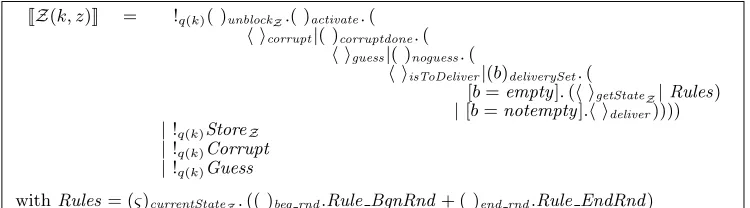
Figure 1: Definition of Process Environment
4.1 Encoding Environments
Crucially, we can also encode both interfaces and environments, hence adver-sarial behaviours. Here we examine only the case of environments, but observe that the other case uses similar ideas.
The translation is somewhat different to that in definition 9, since an environment can corrupt a party at any moment or decide its guess on the execution and halt. Concretely, by the definition of an environment ITM in Fig. 2, its encoding has rules Rule BegRnd, Rule EndRnd, modeling Z’s behaviour when receiving messages or outputs from parties, respectively. In contrast, both the corruption case and the guessing case are not just rules, but replicated subprocessesCorrupt and Guess, which are at the same level ofZ’s state. Figure 1 formally defines an environment.
We describe onlyRule BegRnd, but observe that Rule EndRnd is similar. This rule is valid when a new round of computation is to begin and this happens when all honest parties have sent their previous-round outputs: Rule BegRnd =hP1iinHonest|(a)isHonest([a=no].0 |
[a=yes].(v1)msbByP1.hv1ifwdmsgByP1.
(hP2iinHonest. . .(J(·)← ZK). . .))
We have written J(·)← ZKto abbreviate Z’s actions in that point of the rule. It consists in sending in parallel the new-round messages and inputs for each honest party through corresponding channelsh imsgToPi andh iinToPi, by using the projections functions ofZ.
This rule simply reads partyPi’s channel as long as this party is honest, and if so, forwards the value through a private channel to its inner-most process
J(·)← ZK.
respectively. From this moment on, party Pj will not be activated any more, since in J(·) ← ZKabove, new-round messages and inputs are computed and sent only to honest parties.
Encoding environments gives rise to a prominent set of processes in ppc:
Definition 10 Let n ∈ N. We let ZUC(n, k, z) be the image under encoding
of the set of all UC environments modeling threshold, active and adaptive ad-versaries with synchronous and authenticated communication, that interact in n-party protocols with variable security parameterk∈Nand variable auxiliary
inputz∈ {0,1}∗. i.e., Z
UC(n, k, z)
def
={JZ(k, z)K:Z ∈UC}.
We intend to use these processes as distinguishers in ppc. In order to do so, we restrict observational equivalence to the class of contexts of formZ|[ ], where Z∈ZUC(n, k, z). More precisely,
Definition 11 A closed process Q1 is UC-observationally equivalent to an-other Q2, writtenQ1 'UCQ2, iff for all schedulers and for all Z∈ZUC(n, k, z)
it holds thatT r(Z|[Q1])
c
≈T r(Z|[Q2]).
Consequently, we redefine the notion of secure processes:
Definition 12 A processQUC-emulatesan ideal specification processI, writ-tenQ≡UCI, if there exists a context D[ ] such thatQ'UCD[I].
An important observation is that if Q1, Q2 are processes whose public
data-exchange is exclusively with UC contexts7, then the quantification over
sched-ulers is virtually useless for the overall distribution, or in other words, distin-guishing two processes is independent on any external scheduler. This is so because UC contexts (probabilistically) decide which process to send data to (activate) next, and choose one at a time. Hence, the only kind of simulta-neous data-exchange are private, but these are silent actions, and therefore should not affect indistinguishability of processes. This reasoning is a direct consequence of the following:
Lemma 1 Let n ∈ N. Let Q be a closed process whose public channels are contained among the public channels of ZUC(n,·,·). Then, for any scheduler
the transition probability on any public data-exchange is equal to one.
A second implication of interacting with UC contexts is that the probability distribution of values transmitted through public channels is preserved up to a factor dependable exclusively on the probability distribution for private data-exchange.
7This is precisely the case of the encodings of machinesP
Lemma 2 Let n ∈ N. Let Z,E be linked, and let E compute v0 ← E(v, ς), on value v and current state ς, and send v0 to Z through tapeE,Z. Then, pv0 =P(v0 ← E(v, ς)) iff P(htapeE,Z, v0i ∈T r(Z|Q)Sk) =pv0 ·uS, where Q has
E=JEKas a subprocess.
When private data-exchange is sequentialized, then uS is always one.
Our last observation is that UC-equivalence is weaker than that in defi-nition 6, i.e., Q1 'UC Q2 does not necessarily imply Q1 ' Q2, or
colloqui-ally, quantification over the class of UC-adversaries doesnot necessarily imply quantification over all contexts.
This is an expected effect, since the environments we are considering are constrained to the assumptions of the adversarial and communication mod-els, e.g., activation of all parties once per round, message-delivery guaranteed, authenticated channels, threshold corruptions, etc. Nonetheless, this defini-tion of security is not trivial at all, since useful realizadefini-tions can be proved secure under such assumptions. Hence, by defining equivalence of processes in ppc restricted to the contexts induced by UC environments, we are not over-simplifying the notion of security in ppc.
4.2 Main Result
We can now prove a correspondence between the UC framework and the pro-cess calculus ppc under UC-observational equivalence:
Theorem 1 (Full Abstraction) Let n ∈ N and t < n. Let π be a n-party
reactive protocol, F be an ideal functionality, and T be an interface.
1. (Soundness) If JπK ≡UC JTK | JFK then T proves π t-realizes F; and
reciprocally,
2. (Completeness) IfT proves π t-realizesF, then JπK≡UCJTK |JFK.
Proof:
1. If it was not the case, there would exist an environment Z negating indistinguishability in UC. But this would refute the validity of JTK|[ ] in the hypothesis, since the context JZK|[ ] induced by Z would also negate indistinguishability in ppc. Indeed, by lemma 2, both Z and Z
would observe hguess, bi with comparable probabilities, and this would be sufficient, according to lemma 1 to call for distinguishability in ppc.
2. If T is an interface proving π t-realizes F, then it should hold that
JπK'UCJTK|[JFK], since otherwise, there would exist according to lemma
1 JZK|[ ] ∈ ZUC negating indistinguishability in ppc, and consequently
observes hpublic tape, vi with overwhelming distinct probabilities, then by lemma 2 Z does so too and at that point can halt and output the
References
[BPW04] M. Backes, B. Pfitzmann, and M. Waidner. A general composition theorem for secure reactive systems. InLNCS, volume 2951, pages 336–354, 2004. TCC’04.
[Can01] R. Canetti. Universally composable security: A new paradigm for cryptographic protocols. InProceedings of the 42nd IEEE Sympo-sium on Foundations of Computer Science, page 136, 2001.
[DKM+04] A. Datta, R. K usters, J. Mitchell, A. Ramanathan, and V. Shmatikov. Unifying equivalence-based definitions of proto-col security. In Workshop on Issues in the Theory of Security, 2004. WITS’04 Satellite Workshop at ETAPS’04.
[DKMR04] A. Datta, R. K usters, J. Mitchell, and A. Ramanathan. Sequen-tial probabilistic process calculus and simulation-based security. Technical report, Stanford University and Christian-Albrechts-Universit¨at zu Kiel, 2004. TR-SPPC-2004.
[DKMR05] A. Datta, R. K usters, J. Mitchell, and A. Ramanathan. On the relationships between notions of simulation-based security. In Pro-ceedings of Theory of Cryptography Conference (to appear), 2005.
[DN03] Ivan Damg˚ard and Jesper Buus Nielsen. Universally compos-able efficient multiparty computation from threshold homomor-phic encryption. In LNCS, volume 2729, pages 247–264, 2003. CRYPTO’03.
[GMR89] S. Goldwasser, S. Micali, and C. Rackoff. The knowledge complex-ity of interactive proof systems.SIAM J. Comput., 18(1):186–208, 1989.
[Gol01] O. Goldreich. Foundations of Cryptography: Basic Tools, vol-ume 1. Cambridge University Press, 2001.
[LMMS98] P. Lincoln, J. Mitchell, M. Mitchell, and A. Scedrov. A probabilis-tic poly-time framework for protocol analysis. InACM Conference on Computer and Communications Security, pages 112–121, 1998.
[LMMS99] P. Lincoln, J. Mitchell, M. Mitchell, and A. Scedrov. Probabilis-tic polynomial-time equivalence and security analysis. In World Congress on Formal Methods, pages 776–793, 1999.
time. InProceedings of the 39th IEEE Symposium on Foundations of Computer Science, pages 725–733, 1998. FOCS’98.
[MMS03] P. Mateus, J. Mitchell, and A. Scedrov. Composition of crypto-graphic protocols in a probabilistic polynomial-time process cal-culus. In LNCS, volume 2761, pages 327–349, 2003. CONCUR 2003.
[Nie04] Jesper Buus Nielsen. On Protocol Security in the Cryptographic Model. PhD thesis, BRICS, University of Aarhus, Department of Computer Science, IT-parken, Aabogade 34, DK-8200 ˚Arhus N, Denmark, 2004.
5
Appendix:
5.1 ∅-hybrid Model and Ideal Process
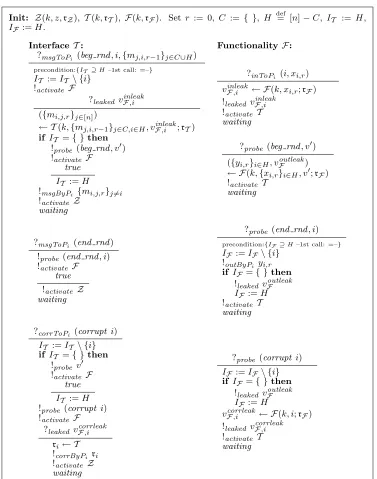
Figures 2 and 3 define the∅-hybrid model and the ideal process, respectively. The code of each rule should be self-explanatory. The piece of code under the horizontal line is to be executed indivisibly, as a single transition.
However, we allow nested rules, hence, we assume resumption: If there is a point where the activation is handed over to another machine, then once recovered the execution resumes at the point it was left before.
We could be more succinct to the expense of rigorousity in regard to ma-chines’ states. Our main purpose is to illustrate the interactive pattern of the UC model by means of our notation. In constrast, we have to prevent our-selves of this relaxation in a full translation from machines into processes. As an example, the first rule for Z reads: Upon activation in roundr, check the condition whether all honest parties i∈H have sent their roundr−1’s out-putsyi,r. If it holds, then pick an honest partyi, compute his roundr’s input xi,r and round r−1’s messages from corrupt parties {mj,i,r−1}j∈C. Observe messages {mj,i,r−1}j∈H where sent by honest parties in the previous round. Writexi,ron tapeinToPi, and (bgn rnd, i,{mj,i,r−1}j∈C∪H) on tapemsgToPi. Activate this party by writingPi on tapeactivate, and switch to control state waiting.
This rule is to be executed as long as there are honest parties to be activated with command beg rnd. To do so, we use a variable com(r) ∈ {beg rnd,end rnd} that indicates which command is to be executed next. In addition, a set I contains the indices of remaining honest parties to be acti-vated.
Note well that on every new activation of Z, the set I, from where an honest party is picked, may have changed, sinceZ may decide first to corrupt a party before executing this rule.
5.2 Encoding of Interactive Rules
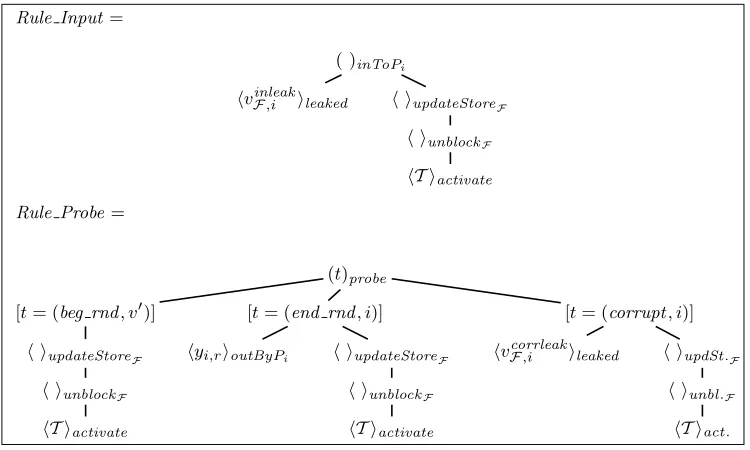
Figures 4 and 5 define the encodings of the interactive rules for a partyPi and a functionalityF, respectively.
5.3 Proof Proposition1
Proof: In UC framework deadlock is prevented because parties are linked
only to the environment, and the environment is assumed not to activate two machines at a time. The remaining properties follow by checking the
5.4 Proof Lemma 1
Proof: Let S be any scheduler over multisets M of subprocesses of Z|Q. Then, given that S is a Markov chain and since data-exchange over public channels occur one at a time, it holds thatS(M1,M2) = 1, where
i. {hvic,(x)c.X} ⊂ M1 and there are no other probable transitions inM1;
ii. M2 = (M1\ {hvic,(x)c.X})∪ MXx
v and X x
v is the process obtained by substituting all free occurrences of x by v inX; and
iii. c∈ {inToPi,outByPi,msgToPi,msgByPi,corrToPi,corrByPi}. ♦
5.5 Proof Lemma 2
Proof:(Sketch) The proof proceeds by induction on the number of activations
in the execution. The key fact is that machines and processes are scheduled in the same order by Z and its encoding Z. Thus, when machine E is acti-vated with input value v, its corresponding process E is activated with the same input value and having, by induction hypothesis, the same stateς asE. Then, in virtue of our encoding, process E would initiate a tree of reduction involving solely private data-exchange in order to update its state. Assume the chosen branch in this tree has probability uS. The branch ends at the point valuev0 is computed by sendinghE(v, ς)itapeE,Z, with probabilitypv0. Finally,
the sent value is actually observed with probability one, as it is the unique public data-exchange at this point of the computation (reduction). Therefore, P(htapeE,Z, v0i ∈T r(Z|Q)Sk) =pv0·uS·1. ♦
5.6 ppc-Composition Theorem
We provide a prove of the compositional theorem inppcwith respect to defi-nition 8. In what follows we use≡to stand for protocol emulation.
Proposition 2 (Composition) Let Q≡I and R[I]≡J. Then R[Q]≡J.
Proof: The hypotheses can be rephrased as:
∃ D[ ] Q'D[I] (1)
∃E[ ] R[I]'E[J] , (2)
where ' means observational equivalence (cf. Definition 6). We will prove thatD[E[ ]] is a context such that R[Q]'D[E[J]], i.e., for all schedulers and for all contextsC[ ] it holds that
Tr(C[R[Q]])≈c Tr(C[D[E[J]]]).
Tr(C[R[Q]]) c
≈ ( (1) with C[R[ ]] )
Tr(C[R[D[I]]]) =
Tr(C[D[R[I]]]) c
≈ ( (2) with C[D[ ]] )
Tr(C[D[E[J]]])
The second step above holds as long as contextsR[ ] andD[ ] are of formX|[ ] or ( )c.[ ] and there is no clash of free-names. We claim, albeit without further evidence here, this kind of composition is sufficient for modelling the inter-action of ITM’s where linking tapes do not stand for actual communication
Init: Z(k, z,rZ),Pi(k,ri). Setr:= 0,C:={ },H def= [n]−C,I:=H.
Environment Z: PartyPi:
∀i∈H ?outByPi yi,r−1
precondition:comand(r)=beg rnd
precondition:{I⊇H–1st call: =–}
I:=I\C i∈I ← Z
I:=I\ {i} if I={ }then
com(r) :=end rnd I:=H
({mj,i,r−1}j∈C, xi,r)← Z !inToPi (i, xi,r)
!msgToPi (beg rnd, i,{mj,i,r−1}j∈C∪H)
!activate Pi
waiting
?inToPi (i, xi,r)
?msgToPi (beg rnd, i,{mj,i,r−1}j∈C∪H)
({mi,j,r}, yi,r) =Pi({mj,i,r−1}, xi,r) !msgByPi {mi,j,r}j6=i
waiting
∀i∈H ?msgByPi {mi,j,r}j6=i
precondition:comand(r) =end rnd precondition:{I⊇H–1st call: =–}
I:=I\C i∈I ← Z
I:=I\ {i} if I={ }then
r:=r+ 1
com(r) :=beg rnd I:=H
!msgToPi (end rnd)
!activate Pi
waiting
?msgToPi (end rnd)
!outByPi yi,r
!activate Z
waiting
if |C|< tthen
i∈H← Z
C:=C∪ {i}
I:=I\C
if I={ }then
com(r) := 1−com(r)
I:=H
!corrToPi (corrupt i)
!activate Pi
waiting
?corrToPi (corrupt i)
!corrByPi ri
!activate Z
waiting
b← Z
!guessb halt
Init: Z(k, z,rZ), T(k,rT), F(k,rF). Set r := 0, C :={ }, H def= [n]−C, IT := H,
IF:=H.
Interface T: FunctionalityF:
?msgToPi (beg rnd, i,{mj,i,r−1}j∈C∪H)
precondition:{IT ⊇H–1st call: =–} IT :=IT \ {i}
!activate F
?leaked vFinleak,i ({mi,j,r}j∈[n])
← T(k,{mj,i,r−1}j∈C,i∈H, vFinleak,i ;rT)
if IT ={ }then !probe (beg rnd, v0)
!activate F
true IT :=H
!msgByPi {mi,j,r}j6=i
!activate Z
waiting
?inToPi (i, xi,r)
vinleakF,i ← F(k, xi,r;rF)
!leaked vinleakF,i !activate T
waiting
?probe (beg rnd, v0)
({yi,r}i∈H, vFoutleak)
← F(k,{xi,r}i∈H, v0;rF)
!activate T
waiting
?msgToPi (end rnd)
!probe (end rnd, i)
!activate F
true
!activate Z
waiting
?probe (end rnd, i) precondition:{IF⊇H–1st call: =–} IF:=IF\ {i}
!outByPi yi,r
if IF={ }then
!leaked vFoutleak
IF:=H
!activate T
waiting
?corrToPi (corrupt i)
IT :=IT \ {i} if IT ={ }then
!probe v0
!activate F
true
IT :=H
!probe (corrupt i)
!activate F
?leaked vcorrleakF,i ri← T
!corrByPi ri
!activate Z
waiting
?probe (corrupt i)
IF:=IF\ {i} if IF={ }then
!leaked vFoutleak
IF:=H
vcorrleakF,i ← F(k, i;rF)
!leaked vcorrleakF,i !activate T
waiting
Rule Rnd=
(t)msgToPi
[t= (beg rnd, v0)]
( )msgToPi
h{mi,j,r}j6=iimsgByPi h iupdateStorePi
h iunblockPi
hZiactivate
[t= (end rnd)]
hyi,rioutByPi h iupdateStorePi
h iunblockPi
hZiactivate
Rule Corrupt=
(t)corrToPi
hriicorrByPi h iupdateStore Pi
h iunblockPi
hZiactivate
Figure 4: Enconding ofPi’s Interactive Rules
Rule Input=
( )inToPi
hvFinleak,i ileaked h iupdateStoreF
h iunblockF
hT iactivate
Rule Probe=
(t)probe
[t= (beg rnd, v0)]
h iupdateStoreF
h iunblockF
hT iactivate
[t= (end rnd, i)]
hyi,rioutByPi h iupdateStoreF
h iunblockF
hT iactivate
[t= (corrupt, i)]
hvFcorrleak,i ileaked h iupdSt.F
h iunbl.F
hT iact.