Indifferentiability of Single-Block-Length and Rate-1 Compression
Functions
Hidenori Kuwakado Masakatu Morii
Faculty of Engineering Kobe University
1-1 Rokkodai-cho Nada-ku Kobe 657-8501, Japan
December 26, 2006 January 8, 2007 (revised)
Abstract
The security notion of indifferentiability was proposed by Maurer, Renner, and Holenstein in 2004. In 2005, Coron, Dodis, Malinaud, and Puniya discussed the indifferentiability of hash functions. They showed that the Merkle-Damg˚ard construction is not secure in the sense of indif-ferentiability. In this paper, we analyze the security of single-block-length and rate-1 compression functions in the sense of indifferentiability. We formally show that all single-block-length and rate-1 compression functions, which include the Davies-Meyer compression function, are insecure. Fur-thermore, we show how to construct a secure single-block-length and rate-1 compression function in the sense of indifferentiability. This does not contradict our result above.
1
Introduction
Most of the hash functions are designed as iterative processes which hash an arbitrary-length message by processing successive fixed-size blocks of the message. A function for processing the fixed-size blocks is called a compression function. The Merkle-Damg˚ard construction is widely used to construct a hash function by the iteration of the compression function [4][10]. To improve the security, other constructions have been proposed recently (e.g., [3][7][14]).
In all constructions, the security of the underlying compression function is closely related with that of the constructed hash function. Compression functions are usually designed using secure block ciphers. For example, the Davies-Meyer compression function, the Matyas-Meyer-Oseas compression function, and the Miyaguchi-Preneel compression function, which are the most popular compression functions, are based on block ciphers [9]. Compression functions can be classified as the hash length and the number of calls. Let nbe the ciphertext length of the underlying block cipher, and let `and
m be the output length and the message length of the compression function, respectively.
Hash length: If `/n = 1, then the compression function is called a single-block-length compression function. If `/n= 2, then it is called a double-block-length compression function.
Number of calls: Let σ be the number of calling the underlying block cipher to produce one output of the compression function. A rate r of the compression function is defined asr=m/(nσ), which represents the efficiency of the compression function. A compression function with a rate ofr is called a rate-r compression function.
resistance is not larger thanO(2`/2) where`is the output length. This fact is often called the birthday bound. From the practical viewpoint, drawbacks of actual hash functions have been firstly found in terms of collision resistance [5][15][16]. In addition to the three security notions above, the notion of indifferentiability has been introduced to the security of hash functions and compression functions recently [3][6]. The notion of indifferentiability is stronger than that of collision resistance. To design more secure hash functions or more secure compression functions, it is necessary to discuss the security in the sense of indifferentiability.
In this paper, we restrict our attention to single-block-length and rate-1 compression functions (SBL-1 compression functions). The class of SBL-1 compression functions is practically important. For example, the popular compression functions above are included in this class. When the ciphertext length of the underlying block cipher is equal to its key length, the efficiency of SBL-1 compression functions is optimal because, by definitions, the rate of any single-block-length compression function is not larger than 1.
The security of SBL-1 compression functions has been studied in detail. Preneel, Govaerts, and Vandewalle [13] have discussed the security against several attacks, and concluded that 12 compression functions are secure against the attacks. We note that 64 possible SBL-1 compression functions exist. Black, Rogaway, and Shrimpton [2] have investigated the provable security of the 64 possible SBL-1 compression functions. They concluded that the 12 compression functions of Preneel et al. is optimally collision resistant.1 Black, Cochran, and Shrimpton [1] have shown that no rate-1 compression function can produce a provable collision-resistant hash function if the key space is a small fixed set. Their result is practically significant because the practical hash speed would be improved by the precomputation of the key schedule algorithm of the block cipher if the key space were small. Accordingly, SBL-1 compression functions must be designed in such a way that the key space is fully used.
The notion of indifferentiability has been introduced by Maurer, Renner, and Holenstein [8] to discuss the extended indistinguishability of systems. Coron, Dodis, Malinaud, and Puniya [3] have applied the notion of indifferentiability to the construction of hash functions from underlying com-pression functions. They showed that the Merkle-Damg˚ard construction is insecure in the sense of indifferentiability, and they also proposed some methods for enhancing the security of the Merkle-Damg˚ard construction. In this paper, we discuss the security of SBL-1 compression functions in terms of indifferentiability, not hash functions. Indeed, Coron et al. [3] briefly discussed the indifferentia-bility only of the Davies-Meyer compression function. Hirose [6] discussed the indifferentiaindifferentia-bility of double-block-length compression functions with the special-form input. This paper formally discusses the indifferentiability of the 12 SBL-1 compression functions, which are secure in the sense of collision resistance [2][13]. Furthermore, this paper proposes a new SBL-1 compression function that is secure in the sense of indifferentiability.
The organization and the contribution of this paper are as follows. In Sect. 2, we describe notations and definitions about indifferentiability. The definition of indifferentiability is the same as that of previous papers [3][8], but we introduce an experiment to evaluate the advantage of a distinguisher.
In Sect. 3, we discuss the indifferentiability of the Davies-Meyer compression function. When the distinguisher can have access only to the encryption oracle, the Davies-Meyer compression function is not so insecure. However, when the distinguisher can have access to the encryption oracle and the decryption oracle, the Davies-Meyer compression function is insecure. This drawback was briefly pointed out by Coron et al. [3], but they did not analyze the security formally. We give the formal analysis of the Davies-Meyer compression function in terms of indifferentiability.
In Sect. 4, we show that the negative result of the Davies-Meyer compression function is applicable to other SBL-1 compression functions. As a result, all the 64 SBL-1 compression functions have the security drawback in terms of preimage resistance, second-preimage resistance, collision resistance, or indifferentiability.
In Sect. 5, we propose a new SBL-1 compression function, which is called a block-cipher-selection
1They also showed that 8 compression functions are not collision resistant, but hash functions based on the 8
Hfˆ
x y
ˆ
f
u z
ˆ
H
x y
u z
D ˆ
f
fHˆ
Figure 1: The indifferentiability betweenHfˆand ˆH.
compression function (a BCS compression function). The feature of the BCS compression function is that one block cipher is selectively used among many block ciphers to produce an output for a given input. We prove that the BCS compression function is secure in the sense of indifferentiability. We explain why this result does not contradict the result of Sect. 4. In Sect. 6, we summarize results of this paper and problems in the future.
2
Notations and Definitions
We will write a ← b to mean that a is to be set to the result of evaluating expression b, and write
a← A$ to mean thatais uniformly chosen at random from a finite setA. Letκ, nbe positive integers. A block cipher is a function e: {0,1}κ × {0,1}n → {0,1}n where, for each w ∈ {0,1}κ, e(w,·) is
a permutation on {0,1}n. For the block cipher e, the inverse (the decryption function) is denoted by d, i.e., d(w, z) is the string x such that z = e(w, x). Let Eκ,n be the set of all block ciphers e:
{0,1}κ × {0,1}n → {0,1}n. A block cipher ˆe is said to be an ideal block cipher if ˆe is uniformly
selected at random from Eκ,n, i.e., if ˆe← E$ κ,n. Let Hm,n be the set of all functions from {0,1}m to
{0,1}n. A function ˆH is said to be a random function if ˆH is randomly selected from Hm,n, i.e., if
ˆ
H ← H$ m,n. By definitions, it holds that Eκ,n⊂ Hκ+n,n.
In this paper, we discuss the construction of a single-block-length and rate-1 compression function
H based on the block cipher e∈ En,n. That is,H is a function in H2n,n and requires one invocation
of e to produce an output for a given input. Our goal is to construct the compression function H
that is indistinguishable from the random function ˆH ∈ H2n,n. In previous works, the security of
the compression function based on the block cipher has been studied in terms of preimage resistance, second-preimage resistance, and collision resistance. Since the random function ˆH naturally satisfies these security requirements with desirable level, our goal is reasonable. Our idea is similar to that of Coron et al. [3] They considered that the random function was ideal of the hash function. Accordingly, they studied how to construct a hash function{0,1}∗→ {0,1}nthat is indistinguishable from a random
function {0,1}∗→ {0,1}n.
To measure the indifferentiability between two functions, the following definition has been intro-duced in [3][8] (Fig. 1).
Definition 1 A function Hfˆ with oracle access to an ideal primitive fˆ is said to be (tD, tf, q, ²)
indifferentiable from an ideal primitiveHˆ if there exists a simulatorfHˆ such that the following equation holds for any distinguisher D.
¯ ¯ ¯ ¯Pr
·
DHfˆ,fˆ= 1
¸ −Pr
·
ˆ e Heˆ
x y
w
ˆ e x
w
z
ˆ H x
w
y e x
w
z
D
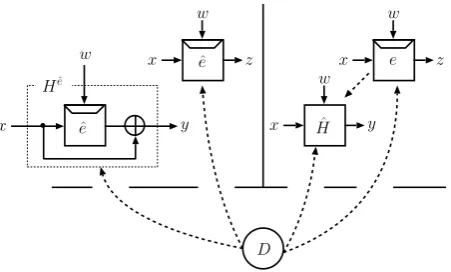
Figure 2: The indifferentiability of the Davies-Meyer compression function.
The distinguisher has access to not only Hfˆ but also fˆ (similarly, not only Hˆ but also fHˆ
). The simulator fHˆ has oracle access to Hˆ and runs in time at most tf. The distinguisher runs in time at
most tD and makes at most q queries. If ² is a negligible function of the security parameter k, then
Hfˆis said to be indifferentiable from Hˆ.
When we focus on the probability ², we consider the following experiment to evaluate it.
step 1: Choose a bit ξ∈ {0,1} at random, then determine (H, f) as follows:
(H, f) =
(Hfˆ,fˆ) ifξ = 0,
( ˆH, f) otherwise.
The distinguisher does not know the value ofξ.
step 2: After the distinguisher had access to (H, f), the distinguisher guesses the value ofξ, denoted by ξD.
Using the above experiment, we define the advantage of the distinguisherDwith at mostq queries as follows:
AdvH(D, q) = Pr [ξ=ξD]−
1 2,
where Pr [ξ=ξD] is the probability thatDcan correctly guess the value ofξwith at mostqqueries. We
note that ifDdeterminesξDat random, then Pr [ξ=ξD] is equal to 1/2. Thus, it can be assumed that
Pr [ξ =ξD] is not smaller than 1/2. We use the value ofAdvH(D, q) as the value of ²of Definition 1.
We define the achievable advantage with q queries as
AdvH(q) = max
D {AdvH(D, q)}.
In this paper, we denote by a symbol without ‘ˆ’ an actual algorithm, and denote by a symbol with ‘ˆ’ an ideal function. In addition, we denote by a symbol with ‘ ’ either the actual algorithm or the ideal function. For example, when we argue a block cipher,g is an actual block cipher, ˆg is an ideal block cipher, and g is either the actual block cipher gor the ideal block cipher ˆg.
3
Davies-Meyer Compression Function
There are 12 compression functions that are secure in the sense of collision resistance [2]. The Davies-Meyer compression function, which is widely used in actual hash algorithms such as SHA-2 [12], is one of the 12 compression functions. In this section we discuss the indifferentiability of the Davies-Meyer compression function (Fig. 2). The Davies-Meyer compression function H is defined as
H(w, x) = ˆe(w, x)⊕x, (1)
3.1 Only Encryption Oracle
We discuss the indifferentiability between the Davies-Meyer compression function and the random function when the distinguisher is allowed to have access to only e. One must construct a simulator
eHˆ such that interacting (Hˆe,ˆe) is indistinguishable from interacting ( ˆH, eHˆ). We assume that the distinguisher does not make the same query. Our simulator eHˆ is defined as follows:
step 1: Initially, i←0 andeHˆ(w, x) is undefined for any (w, x)∈ {0,1}n× {0,1}n.
step 2: eHˆ receives a query (w, x) from the distinguisher. i←i+ 1,wi←w,xi ←x,yi ←Hˆ(wi, xi),
zi ←yi⊕xi.
step 3: eHˆ(wi, xi)←zi and eHˆ returns eHˆ(wi, xi).
The above simulator eHˆ may fail to emulate the ideal block cipher ˆe. Specifically, if eHˆ(w i, xi) =
eHˆ(wι, xι)∧wi = wι for ∃ι∈ {1,2, . . . , i−1}, then e
ˆ
H fails to emulate ˆe because eHˆ
wi is no longer a
permutation on {0,1}n. LetC
i be the event that there exists such anι∈ {1,2, . . . , i−1} at thei-the
query and there does not exist such an ι at previous queries. As long as Ci does not occur, eHˆ can
perfectly emulate ˆe. Since the probability Pr [Ci] is not larger than (i−1)/2n, the probability Pr [fail]
that eHˆ fails to emulate ˆeis given as follows:
Pr [fail] = Pr [C1∨C2∨. . .∨Cq]
≤
q
X
i=1 Pr [Ci]
≤
q
X
i=1
i−1 2n =
q(q−1) 2n+1
Since the following equation holds for any distinguisher D,
Pr [ξ =ξD] = Pr [ξ=ξD|¬fail] Pr [¬fail] + Pr [ξ =ξD|fail] Pr [fail]
≤ 12+ 1
2Pr [fail] we have
AdvH(q) ≤
1
2Pr [fail]
≤ q(2qn−+21). (2)
By demonstrating a distinguisher that achieves advantage close to the above upper bound, we show that the bound is tight. Our distinguisher Dis defined as follows:
step 1: Drandomly chooses w0 from {0,1}n.
step 2: Fori= 1,2, . . . , q,Dperforms the following. Dsends (w0, i) toH, and receivesyi=H(w0, i).
D computes zi =yi⊕i
step 3: If there exists a pair of (ι, λ) such that zι = zλ in {z1, z2, . . . , zq}, then D outputs ξD = 1,
otherwise D outputsξD = 0.
We note that if H =Hˆe, i.e.,ξ = 0, then there is no such a pair. We evaluate the probability Pr [col] that there is such a pair as follows:
Pr [col] = 1−
qY−1
i=1
µ
1− i 2n

≥ 1−
q−1
Y
i=1 exp
µ − i
2n

≥ 1−exp
µ
−q(q−1)
2n+1
where we used the fact that 1−x≤exp(−x) for 0≤x≤1. Since the following equation holds,
Pr [ξ =ξD] = Pr [ξ=ξD|¬col] Pr [¬col] + Pr [ξ =ξD|col] Pr [col]
= 1 2 +
1
2Pr [col], we have
AdvH(D, q) = Pr [ξ =ξD]−
1 2
= 1
2Pr [col]
≥ 1
2 − 1 2exp
µ
−q(q−1)
2n+1

. (3)
Using the fact that exp(−x) gives a close approximation to 1−xwhenxis close to 0, we observe that the lower bound of Eq. (3) is approximately equal to the upper bound of Eq. (2) if q is sufficiently smaller than 2n. We notice that the above distinguisher does not have access toe. The availability of
e is not effective for this distinguisher.
3.2 Encryption and Decryption Oracles
We discuss the indifferentiability between the Davies-Meyer compression function and the random function when the distinguisher is allowed to have access to both of the encryption oracle e and the decryption oracle d. Although one should construct a simulator (eHˆ, dHˆ) such that interacting (Hˆe,(ˆe,dˆ)) is indistinguishable from interacting ( ˆH,(eHˆ, dHˆ)), it is impossible to construct such a simulator. This drawback was briefly pointed out by Coron at el. [3], but they did not discuss the differentiability quantitatively. In this section, we analyze the differentiability by demonstrating a distinguisher.
Let us consider the distinguisher Ddefined below.
step 1: For i = 1,2, . . . , q, D performs the following. D sends a query (i,0) to d, and receives
xi=d(i,0). Dsends a query (i, xi) to H, and receives yi=H(i, xi).
step 2: If xj =yj for∀j∈ {1,2, . . . , q}, thenD outputsξD = 0, otherwise DoutputsξD = 1.
If H =Heˆ, i.e., ξ = 0, then it holds that xj =yj for ∀j∈ {1,2, . . . , q} from Eq. (1). IfH = ˆH, i.e.,
ξ = 1, then there may exist ι such that xι 6=yι for ∃ι∈ {1,2, . . . , q}. When H = ˆH, the probability
Pr [neq] that there exists such an ιis given by
Pr [neq] = 1−
Ã
1−
µ
1− 1 2n
¶2n!q
≥ 1−(1−exp(−1))q
≥ 1−
µ 64
100
¶q
.
Hence, if H= ˆH, then the probability of ξD = 1 exponentially tends to 1 asq increases. For example,
when q = 10, we have Pr [neq]≥0.98. Using the following equation,
Pr [ξ =ξD] = Pr [ξ=ξD|¬neq] Pr [¬neq] + Pr [ξ =ξD|neq] Pr [neq]
= 1 2+
1
2Pr [neq]
we obtain the advantage of the distinguisher D as follows:
AdvH(D, q) =
1
2Pr [neq]
≥ 1
2
µ
1− µ 64
100
¶q
In the above discussion, we did not say anything about the algorithm of the simulatordHˆ. Because,
even ifdHˆ is intelligently constructed, the advantage cannot be decreased. To decrease the advantage,
dHˆ must findxsuch thatx= ˆH(w, x) for a givenw. Since ˆH is the random function, the probability that there exists such an xis given by
Prhx s.t. x= ˆH(w, x)i = 1−
µ
1− 1 2n
¶2n
= 1− 1
exp(1) (as 2
n→ ∞)
≈ 64
100.
Conversely, there does not exist such an x with a probability of approximately 36/100. Since this probability is based only on the randomness of ˆH, dHˆ cannot change it even ifdHˆ has the unlimited computational resources. In the case that there is no such an x, whatever dHˆ may return as xj, the
distinguisher can obtain (xj, yj) such thatxj 6=yj.
4
Other Collision-Resistant Compression Functions
In Sect. 3, we discussed the (in)differentiability of the Davies-Meyer compression function. In this section, we discuss the indifferentiability of other 11 SBL-1 compression functions that are secure in the sense of collision resistance [2]. As described below, we will find that the 11 compression functions are not better than the Davies-Meyer compression function in terms of the indifferentiability.
We classify the 12 SBL-1 compression functions including the Davies-Meyer compression function as the feedforward. Denoting by ˆethe ideal block cipher in En,n, we have the following six sets.
Type-1: H1eˆ(w, x) = ˆe(w, x)⊕x
Type-2: H2eˆ(w, x) = ˆe(w, x)⊕x⊕w
Type-3: H3eˆ(w, x) = ˆe(w, w⊕x)⊕x
Type-4: H4eˆ(w, x) = ˆe(w, w⊕x)⊕x⊕w
Type-5: H5eˆ(w, x) = ˆe(w⊕x, x)⊕x
Type-6: H6eˆ(w, x) = ˆe(w⊕x, x)⊕w
For example, the type-1 set includes the Davies-Meyer compression function and the Matyas-Meyer-Oseas compression function. In the case of the Davies-Meyer compression function, w is a message block andxis an output of the previous compression function. In the case of the Matyas-Meyer-Oseas compression function, w is an output of the previous compression function and x is a message block. The type-2 set includes the Miyaguchi-Preneel compression function, which takes w as an output of the previous compression function and x as a message block.
The discussion in Sect. 3 does not depend on the use of parameters, i.e., which a parameter is a message block. Hence, all type-1 functions have the same security as the Davies-Meyer compression function in the sense of indifferentiability.
4.1 Only Encryption Oracle
Suppose that the distinguisher is allowed to have access to only e. We consider the construction of a simulator eHˆi where i ∈ {2,3, . . . ,6} that is similar to the simulator of Sect. 3.1. For a given query
(ω, χ) toeHˆi, the query (w, x) to ˆH
i is uniquely determined. Like the simulator of Sect. 3.1, the output
zi is computed from ˆHi(w, x) and (ω, χ). Although the computation of zi depends on ˆHi, it can be
done by the bitwise exclusive OR. When eHˆi(ω,·) is no longer the permutation for ∃ω,eHˆi(ω,·) fails
4.2 Encryption and Decryption Oracles
Suppose that the distinguisher is allowed to have access to eand d. We consider a distinguisher that is a similar to that of Sect. 3.2. Namely, the distinguisher first asks (ω,0) to d, and then asks the query (w, x), which is based on the response of d, to Hi. When the output of ˆe is 0, the output of
Heˆ
i is computed by a bitwise function of (w, x). On the other hand, the output of ˆH is not probably
given by the bitwise function of (w, x). Therefore, there exists the distinguisher that can achieve the advantage of Eq. (4).
5
Block-Cipher-Selection Compression Function
From results of [2][13] and results of previous sections, we conclude that all the 64 SBL-1 compression functions have the security drawback in terms of preimage resistance, second-preimage resistance, collision resistance, or indifferentiability. However, we propose a new SBL-1 compression function that is secure in the sense of indifferentiability.
5.1 Construction
Let u = 2n−1. Let ˆei (i = 0,1, . . . , u) be ideal block ciphers in En,n where each ˆei is selected
independently of each other, i.e., ˆei ← E$ n,n for∀i ∈ {0,1, . . . , u}. We define a compression function
Heˆ0,eˆ1,...,eu as follows:
Hˆe0,ˆe1,...,eu(w, x) =
ˆ
e0(w, x) ifx= 0,
ˆ
e1(w, x) ifx= 1, . . .
ˆ
eu(w, x) ifx=u,
(5)
where x ∈ {0,1}n is considered as the binary representation of an integer in {0,1, . . . , u}. For sim-plification, we denote by {eˆ}u the set of ˆe0,eˆ1, . . . ,and ˆeu. Using this notation, we rewrite Eq. (5)
as
H{ˆe}u(w, x) = ˆex(w, x).
Since H{ˆe}u is a function in H2n,n and requires one invocation of ˆei to produce an output for a given
input, H{ˆe}u is an SBL-1 compression function. We call this compression function a
block-cipher-selection compression function (a BCS compression function).
5.2 Security Analysis
We now discuss the indifferentiability between the BCS compression function H{eˆ}u and the random
function ˆH. As described below, unlike the 64 SBL-1 compression functions, the BCS compression function is completely indifferentiable from the random function. That is, even if the distinguisher has infinitely computational resources, the probability that the distinguisher can distinguish the BCS compression function from the random function is equal to 0. Hence, the BCS compression is optimal in the sense of indifferentiability. This fact is due to two properties of the BCS compression function.
• For a fixed i, ˆei(·, i) is the random function in Hn,n, not a permutation on{0,1}n.
• For a fixed i, almost all mappings ˆei(w, x) are not used for the computation of Heˆi, i.e., only
mappings ˆei(w, i) are used.
We assume that the distinguisher does not make the same query. Let (e, i, w, x) be a query toei for
requiring the computation of ei(w, x) where e is a special symbol to denote a used oracle. Similarly,
x
y
001 ... 1010 111 ... 0111 101 ... 0000
110 ... 0001 101 ... 0000 000 ... 1111
blank
blank
blank
blank
Xi,w
Y
i,wj
i,wPlaintext Ciphertext
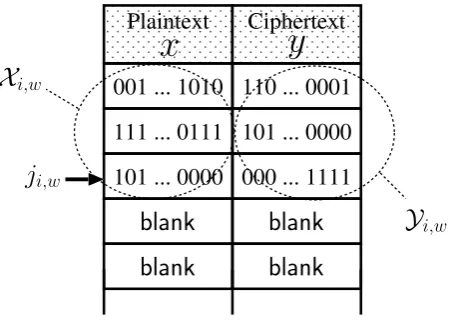
Figure 3: The plaintext-ciphertext tableei(w).
5.2.1 Only Encryption Oracle
Suppose that only {e}u is available to the distinguisher. We discuss the indifferentiability between
H{ˆe}u and ˆH.
Theorem 1 Suppose that only {e}u is available to the distinguisher. The BCS compression function
of Eq. (5) is (∞, t, q,0) indifferentiable from the random function, where t ≤ min(22n, q) and q ≤
22n(2n+ 1). The space complexity of the simulator is O(q).
One must construct a simulator {eHˆ}u such that interacting (H{eˆ}u,{eˆ}u) is indifferentiable from
interacting ( ˆH,{eHˆ}
u). Our simulator {eHˆ}u is defined as follows. Our simulator has
plaintext-ciphertext tables of eHiˆ(w,·) for∀i∈ {0,1, . . . , u} and ∀w∈ {0,1}n as shown in Fig. 3. Each table is denoted by ei(w). LetXi,w be the set of plaintextsx inei(w), and letYi,w be the set of ciphertexts y
in ei(w).
step 1: Initially, ji,w ← 0 for ∀i ∈ {0,1, . . . , u} and ∀w ∈ {0,1}n. All tables are initialized with a
special symbol blank, which means that the entry is not yet used.
step 2: The simulator receives a query (e, i, w, x) from the distinguisher. ji,w ←ji,w+1 andxji,w ←x.
After v←Hˆ(w, i), the simulator determinesyji,w as follows: (
yji,w ←v ifi=x,
yji,w
$
← {0,1}n− Yi,w− {v} otherwise.
The simulator replaces (blank,blank) in the tableei(w) with (xji,w, yji,w), and returns yji,w.
Unlike the simulator of Sect. 3.1, {eHˆ}
u can perfectly emulate{eˆ}u. In step 2, the simulator updates
the table ei(w), keeping a one-to-one and random mapping. When x takes a string in {0,1}n for a
fixed i and a fixed w, the distribution of eiHˆ(w, x) is identical to that of ˆei(w, x). Hence, we have
AdvH(q) = 0, which is better than that of the Davies-Meyer compression function.
The time complexity of the simulator depends on the number of queries to ˆH. Keeping ˆH(w, i), the simulator makes at most min(q,22n) queries to ˆH. The size of tables is O(q). The distinguisher can make at most 23n queries to{e}u and at most 22n queries toH. Hence, the number q of queries
is not larger than 22n(2n+ 1).
5.2.2 Encryption and Decryption Oracles
Suppose that both of {e}u and {d}u are available to the distinguisher. We now discuss the
Theorem 2 Suppose that both of {e}u and {d}u are available to the distinguisher. The BCS
com-pression function of Eq. (5) is (∞, t, q,0) indifferentiable from Hˆ where t ≤ min(22n, q) and q ≤
22n(2n+1+ 1). The space complexity of the simulator is O(q).
One must construct a simulator ({eHˆ}u,{dHˆ}u) such that interacting (H{ˆe}u,({eˆ}u,{dˆ}u)) is
indif-ferentiable from interacting ( ˆH,({eHˆ}
u,{dHˆ}u)). Our simulator ({eHˆ}u,{dHˆ}u) is defined as follows.
Our simulator has plaintext-ciphertext tables of eHiˆ(w,·) for ∀i∈ {0,1, . . . , u} and ∀w ∈ {0,1}n, as well as the simulator of Sect. 5.2.1 (Fig. 3). Suppose that the table ei(w) is shared bye
ˆ
H i and d
ˆ
H i .
step 1: Initially, ji,w ← 0 for ∀i ∈ {0,1, . . . , u} and ∀w ∈ {0,1}n. All tables are initialized with
blank.
step 2: When the simulator received a query (e, i, w, x), the simulator checks whether x ∈ Xi,w or
not.
step 2.1: If x is equal toxι ∈ Xi,w, then the simulator returnsyι.
step 2.2: If x does not exist in Xi,w, thenji,w ← ji,w+ 1 and xji,w ← x. After v ← Hˆ(w, i),
the simulator determines yji as follows: (
yji,w ←v ifi=x,
yji,w
$
← {0,1}n− Y
i,w− {v} otherwise.
The simulator replaces (blank,blank) in the table ei(w) with (xji,w, yji,w), and returnsyji,w.
step 3: When the simulator received a query (d, i, w, y), the simulator checks whether y ∈ Yi,w or
not.
step 3.1: If y is equal to yι∈ Yi,w, then the simulator returnsxι.
step 3.2: If ydoes not exist inYi,w, then ji,w←ji,w+ 1 andyji,w ←y. Afterv←Hˆ(w, i), the
simulator determines xji as follows: (
xji,w ←i ify=v,
xji,w
$
← {0,1}n− X
i,w− {i} otherwise.
The simulator replaces (blank,blank) in the tableei(w) with (xji,w, yji,w), and returnsxji,w.
This simulator can perfectly emulate ({ˆe}u,{dˆ}u). For∀ei(w),x∈ Xi,wcorresponds to uniquey∈ Yi,w,
i.e., there is no xι, xλ ∈ Xi,w such that eHiˆ(w, xι) =eHiˆ(w, xλ) and there is no yι, yλ ∈ Yi,w such that
dHiˆ(w, yι) = d
ˆ
H
i (w, yλ). Furthermore, yji,w in step 2.2 (or xji,w in step 3.2) is randomly selected
from {0,1}navoiding the collision. This behavior is identical to that of the ideal block cipher ˆe i(w,·).
Hence, we haveAdvH(q) = 0, which is substantially better than that of the Davies-Meyer compression
function.
The time complexity of the simulator depends on the number of queries to ˆH. Keeping ˆH(w, i), the simulator makes at most min(q,22n) queries to ˆH. The size of tables is O(q). The distinguisher can make at most 23n+1 queries to ({e}u,{d}u) and at most 22n queries to H. Hence, the numberq
of queries is not larger than 22n(2n+1+ 1).
5.3 Implementation
However, we have a possible way to implement the BCS compression. For example, the 256-bit key is available to AES, i.e., AES256 :{0,1}256× {0,1}128→ {0,1}128. Forw, x∈ {0,1}128,ei(w, x) is
implemented as AES256(ik w, x) where k denotes the concatenation operator on strings. Using this way, we can obtain 2128 block ciphers inE128,128. Since a long-length key is usually available to actual
block ciphers, this way is applicable to many actual block ciphers. We notice that the discussion is separately needed to make a formal determination whether the set of block ciphers obtained by this way can be considered as the set of ideal block ciphers.
6
Concluding Remarks
In this paper, we have shown that the 12 single-block-length and rate-1 (SBL-1) compression functions, which are secure in the sense of collision resistance, are not secure in the sense of indifferentiability. Notice that the Davies-Meyer compression function is one of the 12 SBL-1 compression functions. From results of [2][13] and those of this paper, we concluded that all the 64 SBL-1 compression functions have the security drawback in terms of preimage resistance, second-preimage resistance, collision resistance, or indifferentiability.
We have proposed the block-cipher-selection (BCS) compression function, which is secure in terms of indifferentiability. Although the BCS compression function is formally the SBL-1 compression function, the negative result above is inapplicable to the BCS compression function. Unlike the 64 SBL-1 compression functions, the BCS compression function selectively uses one block cipher among many block ciphers. We have proved that if the simulator has reasonable computational resources, then the BCS compression function can perfectly emulate the random function, that is, the BCS compression function is optimal in the sense of indifferentiability. We have also proposed the implementation of the BCS compression function using actual block ciphers. However, the security of the implementation must be analyzed in future.
References
[1] J. Black, M. Cochran, and T. Shrimpton, “On the impossibility of highly-efficient blockcipher-based hash functions,” Advances in Cryptology - EUROCRYPT 2005, Lecture Notes in Computer Science, vol. 3494, pp. 526–541, 2005.
[2] J. Black, P. Rogaway, and T. Shrimpton, “Black-box analysis of the block-cipher-based hash-function constructions from PGV,” Advances in Cryptology - CRYPTO 2002, Lecture Notes in Computer Science, vol. 2442, pp. 320–335, 2002.
[3] J. S. Coron, Y. Dodis, C. Malinaud, and P. Puniya, “Merkle-Damg˚ard revisited: How to construct a hash function,” Advances in Cryptology - CRYPTO 2005, Lecture Notes in Computer Science, vol. 3621, pp. 430–448, 2005.
[4] I. B. Damg˚ard, “Collision free hash functions and public key signature schemas,” Advances in Cryptology - EUROCRYPT ’87, Lecture Notes in Computer Science, vol. 304, pp. 203–216, 1988.
[5] H. Dobbertin, “Cryptanalysis of MD4,” Fast Software Encryption, Lecture Notes in Computer Science, vol. 1039, pp. 53–69, 1996.
[6] S. Hirose, “How to construct double-block-length hash functions,” The Second Cryptographic Hash Workshop, August 2006. http://www.csrc.nist.gov/pki/HashWorkshop/2006/Papers/ HIROSE_article.pdf.
[8] U. Maurer, R. Renner, and C. Holenstein, “Indifferentiability, impossibility results on reductions, and applications to the random oracle methodology,” First Theory of Cryptography Conference, TCC 2004, Lecture Notes in Computer Science, vol. 2951, pp. 21–39, 2004.
[9] A. J. Menezes, P. C. van Oorschot, and S. A. Vanstone, HANDBOOK of APPLIED CRYPTOG-RAPHY, CRC Press, 1996.
[10] R. C. Merkle, “One way hash functions and DES,” Advances in Cryptology - CRYPTO ’89, Lecture Notes in Computer Science, vol. 435, pp. 428–446, 1990.
[11] National Institute of Standards and Technology, “Advanced encryption standard (AES),” Federal Information Processing Standards Publication 197, 2001. http://csrc.nist.gov/ publications/fips/fips197/fips-197.pdf.
[12] National Institute of Standards and Technology, “Secure hash standard,” Federal Information Processing Standards Publication 180-2, August 2002. http://csrc.nist.gov/publications/ fips/fips180-2/fips180-2.pdf.
[13] B. Preneel, R. Govaerts, and J. Vandewalle, “Hash functions based on block ciphers: a synthetic approach,” Advances in Cryptology - CRYPTO ’93, Lecture Notes in Computer Science, vol. 773, pp. 368–378, 1993.
[14] P. Sarkar and P. J. Schellenberg, “A parallel algorithm for extending cryptographic hash func-tions,” Progress in Cryptology – INDOCRYPT 2001, Lecture Notes in Computer Science, vol. 2247, pp. 40–49, 2001.
[15] X. Wang, X. Lai, D. Feng, H. Chen, and X. Yu, “Cryptanalysis of the hash functions MD4 and RIPEMD,” Advances in Cryptology - EUROCRYPT 2005, Lecture Notes in Computer Science, vol. 3494, pp. 1–18, 2005.