LETHAL SECTORING
AND
THE
DELAYEDINDUCTION
OF ANEUPLOIDYIN
YEAST1A. P. JAMES, ELIZABETH R. INHABER AND GABRIELLE J. PRPFONTAINE
Division of Biological Sciences, National Research Council of Canada, Ottawa, Ontario, Canada KIA OR6
Manuscript received October 29, 1973
ABSTRACT
Persistent lethal sectoring in a homothallic strain of yeast has been ascribed to tetrasomy for chromosome I. Such aneuploids can appear many genera- tions after irradiation. The data thus indicate that a n induced predisposition towards aneuploidy can be prolonged through successive post-irradiation cell divisions. Sporadic cell death in tetrasomics for chromosome I was found to result from a metabolic imbalance and not from a genetic instability con- seqent to aneuploidy. This imbalance may be due to a dosage effect involving cistrons for ribosomal RNA since many of these are known to be located on chromosome I. Tetrasomy is not the only cause of persistent lethal sectoring; the phenomenon has been initiated through genetic recombination involving normal diploids. It has also been concluded that, i n trisomics, equational divi- sion af the supernumerary chromosome sometimes occurs a t the f i t meiotic division.
N yeast lethal sectoring, the sporadic production of dead cells, is of two types-
'
transient and persistent. Transient lethal sectoring is one of the immediate and frequent consequences of irradiation (JAMES and WERNER 1966). Persistent lethal sectoring, on the other hand, is usually found in clones derived from cellsin which transient sectoring has been detected (JAMES et al. 1968; JAMES and
SAUNDERS 1968). Persistent lethal sectoring is more amenable to investigation by
classical genetic techniques and the studies described here were undertaken with the expectation that conclusions about this kind of instability would lead to a bctter understanding of transient lethal sectoring.
Attention was concentrated on one mutant, the colonies of which are morpho- logically distinctive. Previous studies had shown that the genetic lesion responsi- ble for lethal sectoring ir this mutant is recessive or nearly so (JAMES 1972).
A study of meiotic reversion had shown that reversion occurs during the first meiotic division, suggesting that aneuploidy is involved (JAMES 1973). On the other hand, many meiotic revertants are only partial, a fact which is seemingly
in
conflict with this interpretation. The present investigation has shown that aneuploidy is indeed a cause of persistent lethal sectoring. It is concluded that radiation-induced transient lethal sectoring results from a prolonged disturbance of normal centromere behavior o r spindle formation which can, in turn, lead to the production of aneuploids in post-irradiation mitotic generations.2
A. P . JAMES et al.MATERIALS A N D M E T H O D S
The unstable strain was isolated as a segregant from the UV-induced unstable line of the homothallic yeast Saccharomyces cerevisiae (var. ellipsoidem) termed B67 in this laboratory. The mutant was termed unsl in a previous publication (JAMES 1972). The phenotype, referred to as SI in this report, is distinctive; colonies are ragged in appearance when viewed micro- scopically at 24 hours. This morphology is due to a high frequency of large, abnormally shaped cells many of which are dead.
B67 contains few genetic markers. Consequently, for linkage studies it was necessary to cross the mutant to well-marked heterothallic strains. These strains, X1012-1D, X1687-16C, X2928-7D,
X2944-14A, X2950-5C, and X4002-2B, were obtained from R. K. MORTIMER, University of Cali-
fornia, Berkeley. Unfortunately, the spores produced by such hybrids germinated very poorly and the growth of spore colonies was so inadequate that frequently the unstable phenotype could not be identified with any degree of certainty. This problem was solved by inserting genetic markers individually into B67 in a series of backcrosses. Backcrossing was continued until the growth of segregants was normal o r near-normal. At this point these genetically marked homothallic strains were crossed to the unstable strain.
Media and methods were routine and have been described previously (JAMES and WERNER
1966). Matings were either spore to spore, cell to spore, or were carried out by a mass mating technique involving genetically marked strains. Phloxine B, to a concentration of .025 mg/ml, was added to the solid medium to enhance the distinguishing characteristics of the unstable phenotype. The dead cells i n the mutant colonies are stained brightly with this dye. Medium containing phloxine B becomes toxic on exposure to visible light. For this reason a red filter was attached to the microscope.
The pattern of lethal sectoring was determined by pedigree analysis. This involved the isola- tion 3f an individual vegetative cell in logarithmic growth phase to a slab of agar medium. Sub- sequently, bud separations were carried out through four generations to produce a total of six- teen cells. These were incubated and inspected microscopically a t 24 hours. A lethal sector was considered t3 have been initiated in any one of these cells when all its vegetative progeny pro- duced abortive clones.
RESULTS
Tetrad analyses:
TABLE I Tetrad ratios for crosses involving SI and markers on ten di#erent chromosomes Tetrads 2nd div. seg. Back- No: No. Test Lhromosonie. Cross cross asci discarded' PD NPD T Locus No. XV ade2 IV trpi sl ade2
+
5 134 6 sl - ade2 10 20 98f
+
frpl sl - trpl 58 69 1 nde2- trpl 12 18 98+
leu2+
si - trpi 25 31 0 leu2 - trpl 23 24 9 I11 leu2 IV trpl si+
trpl 5 72 16 si - leu2 23 24 9 leu2 9 V ura3 IV frpl sl -/- trpi 4 76 21 si - ura3 29 22 4 ura3 4 _______+
leu2 f sl - frpl 28 25 2 trpl 2U
5:
3
VI his2 IV trpl sl
+
trpl 4%
VI1 leui IV trpl si+
frpz 3 15 0 SI - leu1 780s
+
leu1+
sl - trpl 870 VI1 leul, trp5 XV ade2 SI+
f ade2 1 88 27 sl - leul 28 25 182
f leu1 trp5+
leu1 - irp5 43 0 18z
2
3
4 A. P . J A M E S et al.
evident that a second division segregation for s l would be incorrectly scored as a crossover in those instances in which a crossover for each of the other two markers occurred in the same cell. However, it seemed unlikely that all instances of second division segregation for s l had such an origin: the frequency of these was even higher than those for trpl alone within the same set of data (7/444). The mutation was found to involve chromosome I, the chromosome on which
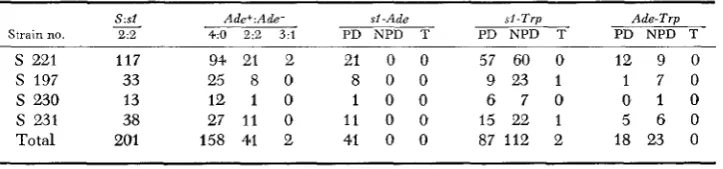
adel is located. Summarized data are presented i n Table 2. Two aspects of these data are of particular interest. Firstly, although the mutant segregated normally (2:2) in each of 201 instances, the segregations for adel were anomalous: the great majority (158/201) were 4:O (+:-) while a very few (2/201) were 3:l. Secondly, sl and adel showed close linkage; only parental ditypes appeared among 41 segregations.
Two explanations of tlie anomalous segregations for adenine requirement were considered. (1) The 4:O segregations f o r adenine were attributable to the presence of revertants (ADEI ADEl) among the presporulation cells, and the rare 3:l segregations were attributable to gene conversion. (2) The hybrids were trisomic for chromosome I, being of the genetic constitution ADEl A D E l / a d e l . If so, it would iollow that the lethal sectoring displayed by the mutant homozygote was a consequnnce of tetrasomy for that chromosome.
Positive support for th? first explanation was provided by the evidence, con- sidered above, of recombination between
SI
and its centromere. Further support was provided by the fact that the frequencies (158, 41, 2) of 4:0, 2:2 and 3:l segregations differed very significantly (P<
.Ol) from the frequencies 127, 60,and 14, expected of a trisomic as calculated from the formulae 1/3 (2-z), 1/3
(1-x)
,
and 2/3 x, wherex
is the frequency of second-division segregation (.lo) expected of adel. The frequency of 3:l segregations was fewer than expectedby
a factor of seven. Furthermore. the frequency of 4:O segregations was greater
tharr the frequency of 2:2 segregations by a factor of nearly four rather than by
a factor of about two, as would be expected if the low frequency of crossovers involving adel was a result of an overestimate of the distance between that locus and its Centromere.
A test for the second explanation, trisomy of the hybrids and tetrasomy as a cause of lethal sectoring, was available using the segregations which provided the data of Table 2. If those spores that germinated to produce lethal sectoring
TABLE 2
T h phenotypes of segregants of crosses SI ADEl trpl x S adel TFU'l (complete tetrads o n l y )
Strain no.
S : s l
2.9
-
A d d : Ade-4:O 2:2 3:l
SI -Ade PD NPD T
s l - T r p
PD NPD T
Ads-Trp PD NPD T ~~
s
221 117 9+ 21 2 21 0 0 57 60 0 12 9 08 0 0 9 23 1 1 7 0
S 197 33 25 8 0
S 230 13 12 1 0 1 0 0 6 7 0 0 1 0
s
231 38 27 11 0 11 0 0 15 22 1 5 6 0DELAYED A N E U P L O I D Y I N YEAST
TABLE 3
Tetrad analysis of spore colonies produced b y three asci derived from
the cross SI ADEl trpl
x
S adel TRPl5
Spore Col. A B C D
Phenotype SI A&+ sl Ade+ S Ade+ S A d d
Ade+:Ade- Ade+:Ade- A&+:Ade- Ade+:Ade-
4:O 2:2 3:l 0:4 4:0 2 2 3 : l 4:O 2:2 3:l 4:O 2 : 2 3:l
Ascus
1 5 2 0 0 4 0 2 7 0 0 8 0 0
2 1 2 0 1 0 6 1 2 7 0 0 6 0 0
3 50 15 14 2 3 4 0 14* 0 0 6 0 0
Total 67 17 15 2 13 5 4 28 0 0 20 0 0
~ ~~ ~~~ ~
* Colony morphology was aberrant in a majority of the 56 spore colonies.
colonies ( s l ) were indeed disomic, then among those segregations that were
4:O
for adenine, all sl segregants should be heterozygous for adenine. Since the strain was homothallic, this could be tested directly by sporulating these segregants. Positive evidence of aneuploidy was obtained from the segregations of the 12 spore colonies from three asci (Table 3). Each of the six unstable spore colonies, when resporulated, produced one or more adenine-requiring segregants. I n con- trast, the six stable spore colonies produced none. The accumulated frequencies of 4:0, 2:2, and 3:l segregations from the six unstable spore colonies were 80:22:19. This ratio was in general accord with that expected of a tetrasomic of genotype ADEl ADEl adel adel, 73:33:15, as calculated from the formulae provided by
ROMAN,
PHILLIPS and SANDS (1955) for bivalent pairing.Confirmation of tctrasomy as a cause of lethal sectoring was provided by the segregations from three exceptional zygotic cultures ( s l A&+ Trp-
x
S Ade- T r p + ).
These cultures segregated 4S:Osl, Zn indication that reversion to stability had occurred before mating, In each instance (Table4)
adenine, as well as tryptophan, segregated normally. It is clear that reversion of sl to wild type was accompanied by a resumption of normal 2:2 segregations for adenine and that, despite other evidence to the contrary, persistent lethal sectoring in SI was caused by aneuploidy. The existence (Table 1 ) of second-division segregation of s l must be interpreted not as a consequence of recombination between sl and a centro- mere, but as a consequence of equational division of the supernumerary chromo-TABLE 4
The normal segregation of the adenine locus (adel) in crosses sl A d d Trp-
x
S Ade- Trp+in which SI reuerted to wild type at or prior to mating
S : d Ade*:Ade- Ade-Trp
4:0 3:l 2:2 4:O 3:l 2:2 1:3 PD NPD T
S 294 7 0 0 0 1 6 0 4 2 0
S 295 7 0 0 0 0 6 1 1 3 2
S 296 8 0 0 0 0 8 0 1 6 1
6 A . P . J A M E S et al.
some in the trisomic at the first meiotic division rather than at the second. Such behavior has been noted in plants
(BURNHAM
1962).Two asci in the data of Table 3 were exceptional in producing only adenine- requiring spore colonies despite the fact that the premeiotic cells were tetrasomic for chromosome
I
and presumably of the genotype ADEl adel/ADEl adel.Sporulation of these eight segregants produced only adenine-requiring spore colonies, and crosses to wild type (S A D E l ) produced strains ( a d d a d e l / A D E l )
which segregated 2:2 for sl and for adenine. These segregants, when of sl pheno- type, in turn segregated as expected of tetrasomics ADEl adel/ADEl adel.
It
was thus demonstrated that the original exceptional segregants had indeed been of the genotype adel adel/adel adel. In the absence of a better explanation, the
complete “loss” of two ADEl loci was attributed to mitotic crossing over in both pairs of chromosomes prior to the meioses in which the exceptional segregants appeared.
Metabolic imbalance and lethal sectoring:
The effect of culture conditions on lethal sectoring in the tetrasomic strain was studied by transferring individual cells in logarithmic phase from
YEPD
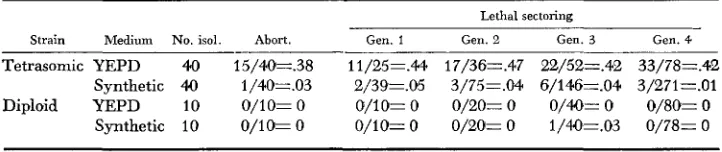
medium to minimal medium. The cells were then subjected to pedigree analysis through four subsequent mitotic generations.The results (Table 5 ) showed that the stability of sl is probably a conse- quence of metabolic imbalance rather than of genetic instability. The frequency with which lethal sectors were produced was reduced by a factor of about 14
during €our mitotic generations on a synthetic medium. Furthermore, it was apparent that cells which were moribund on YEPD were reactivated in the presence of unfortified medium. Thus, 15 of 40 cells were abortive when trans- ferred to YEPD, whereas only one of 40 was abortive when cells from the same culture were transferred to synthetic medium.
Lethal sectoring as an indicator of aneuploidy:
Five unstable lines of independent origin have now been isolated from the progeny of irradiated cells of B67. All five have demonstrated the “centromere linkage” expected of tetrssomics, and preliminary tests have indicated that at least two different chromosomes are involved. However, the correspondence
TABLE 5
The influence of growth medium on lethal sectoring in a sfrain of yeast
tetrasomic for chromosome I
Lethal sectoring
Strain Medium No. isol. Abort. Gen. 1 Gen. 2 Gen. 3 Gen. 4
Tetrasomic YEPD 4.0 15/40=.38 i1/25=.44 17/36=.47 22/52=.42 33/78=.42 Synthetic 4Q 1/40=.03 2/39=.05 3/75=.Ct4 6/146=.04 3/271=.01 Diploid YEPD 10 0/10= 0 O/lO= 0 0/20= 0 0/4Q= 0 0/80= 0
DELAYED ANEUPLOIDY I N YEAST 7
TABLE 6
The appearance of a locus for lethal sectoring through genetic recombination involving a homothallic (B67) and a heterothallic (1687-16C) strain
Segregants
Tetrads (stablemnstable)
0:4 1:3 2:2
Diploid Phenotype Germ. Unstable
SI (1687-16C x B67) stable 51/64 = .80 28/51 = .55 0 3 5
S2 (Sl-15B x B67) stable 56/68 = .82 40/56 = .71 2 4 4
S68 (SZ-9C x B67) stable 158/172=.92 88/158=.56 0 2 34
0 1 4 ‘ 4
S72 (S68-17B X B67) stable 189/192 = .98 95/189 = .50
between lethal sectoring and aneuploidy is far from complete: lethal sectoring can exist in the absence of aneuploidy and aneuploidy can exist in the absence of lethal sectoring.
The existence of lethal sectoring in the absence of aneuploidy was demon- strated in the “synthesis” of a mutant locus through recombination between.the homothallic and a heterothallic strain, both of which were free of lethal sectoring. The initial hybrid (Table 6) was stable. Many of its segregants displayed poor colony forming ability but some produced typical unstable colonies. A series of backcrosses of unstable segregants to B67 resulted in a strain, S72, which pro- duced a clear 2:2 segregation for stability. An unstable “mutant” from this strain produced a stable diploid when crossed to si. This diploid when sporulated pro- duced a segregation pattern in which the double mutant was identified through its production of abortive colonies. The frequencies of tetrad types, PD:NPD:T,
was 2:2:10, an indication that the mutant locus under test was not centromere- linked.
Tetrasomy in the absence of lethal sectoring was demonstrated in an isolate of B67 which had been exposed to ultraviolet irradiation. This line was evidently tetrasomic for chromosome IX: in crosses involving his5 and
Zysl
the frequencies of 4:0, 2:2 and 3:l segregations were 12, 1, 11 for his5, and 15, 3,5
for Zysl.Markers on four other chromosomes segregated normally.
DISCUSSION
These studies have shown that the persistent lethal sectoring that appears in the progeny of irradiated yeast is frequently a result of aneuploidy. Earlier studies have indicated that this persistent lethal sectoring can be initiated many vegetative cell generations after irradiation (JAMES and SAUNDERS 1968). The data imply, then, that the induction of aneuploidy need not be confined to the immediate post-irradiation generation. It seems that irradiation can induce a heritable predisposition towards aneuploidy. Comparable phenomena have been reported for plants and for animals. VAN DER MEY (1973) has noted the delayed induction of chromosome aberrations after irradiation of tomato plants, and
ZARTMAN, FECHHEIMER and BAKER (1969) have made similar observations
8 A. P. JAMES et al.
Since it is among yeast cells engaged in so-called transient lethal sectoring that aneuploids have been detected, the data further imply that it is in these par- ticular cells that the predisposition exists. It is thus of some interest to review what is now known about this initial damage: (1) The damage is dominant, since it is expressed with high frequency in the immediate vegetative progeny of irradiated diploids. (2) The most prominent expression is the sporadic occur- rence of lethal sectors among the vegetative progeny of a n irradiated cell. These tend to originate in daughter cells (JAMES and WERNER 1966). (3) The pro- pensity €or lethal sectoring is accompanied by a reduced rate of cell division and a tendency towards cell enlargement (JAMES et al. 1968). (4) Repair of the damage occurs spontaneously and with such high frequency that affected cells tend to be rare among older clones. Nevertheless, the damage is transient only a t the population level; affected cells can persist through many generations, as demonstrated by a procedure involving serial transfer of selected clones (JAMES and SAUNDERS 1968).
( 5 )
Spontaneous recovery is a multistep process. Thus, the progeny of a single irradiated cell are heterogeneous in regard to propensity for producing lethal sectors, some demonstrating complete recovery, others only a partial recovery (JAMES and WERNER 1969a). (6) There is some reason to believe that the damage responsible for lethal sectoring is qualitatively similar to a fraction of that which produces outright death, but differs from it in the number o€ “sites” which have been affected within an irradiated cell (JAMES and WERNER 1967). (7) Recovery of affected cells is promoted by post-irradiation treatment with P-mercaptoethanol, evidently through the action of this substance as a mitotic inhibitor. Recovery is promoted by treatment in the interval between the first and second post-irradiation division as well as in the interval prior to the first post-irradiation division (JAMES and WERNER 1969b).To these characteristics may now be added a predisposition toward aneuploidy, a state which suggests that the initial damage, characterized as transient lethal sectoring, involves a tendency toward abnormal centromere behavior which, though subject to attenuation, can persist through repeated mitotic generations. The fact that tetrasomy for chromosome I induces lethal sectoring is of par- ticular interest since recent data have indicated that cistrons for ribosomal RNA are located on this chromosome (FINKELSTEIN,
BLAMIRE
and MARMUR 1972; OYEN 1973). Few other genes have as yet been located on this chromosome, a fact which invites the speculation that lethal sectoring is attributable to a n excess of ribosomal RNA. This possibility is in accord with the evidence that the lethal sectoring in the tetrasonnic is a consequence of metabolic imbalance rather than of genetic instability. I t should be noted that the trisomic is phenotypically normal except for a slight reduction in rate of cell division; the data thus indicate a threshold for this dosage effect.Aneuploidy involving chromosome I has been reported by HAWTHORNE and MORTIMER (1960), who detected the state through irregular segregation of a
DELAYED A N E U P L O I D Y I N YEAST 9
anied by a distinct colonial morphology which involves lethal sectoring. Thus, in yeast as in Aspergillus ( K A F E R 1961), aneuploids may display distinctive phenotypes. The fact that the authors referred to above did not note the presence of lethal sectoring is not srqrising since, as the present investigation has shown, the abnormal phenotype is largely absent under some conditions of culture. The phenotype is also influenced by genetic background: although the phenotype of the trisomic is near-normal within the homothallic strain, it is similar to that of the tetrasomic in the hybrid resulting from a cross of the homothallic to a hetero- thallic strain.
L I T E R A T U R E C I T E D
BURNHAM, C. R., 1962
Cox, B. S. and E. A. BEVAN, 1962 Aneuploidy in yeast. New Phytol. 61: 342-355. FINKELSTEIN, D. B., J. BLAMIRE and J. MARMUR, 1972
HAWTHORNE, D. C. and R. K. MORTIMER, 1960
JAMES, A. P., 1972
Discussions in Cytogenetics. Burgess Publishing Co., Minneapolis, Minn.
Location of ribosomal RNA cistrons in yeast. Nature New Biol. 240: 279-281.
Chromosome mapping in Saccharomyces: Centromere-linked genes. Genetics 45: 1085-1 110.
The chromosomal nature of lesions responsible for lethal sectoring in yeast. Can. J. Genet. Cytol. 14: 959-969. -
,
1973 Meiotic reversion in an unstable strain of yeast. Genet. Res. 21: 17-27.JAMES, A. P. and M. M. WERNER, 1966 Radiation-induced lethal sectoring in yeast. Radiation
Res. 29: 523-536. -, 1967 Multi-site damage and x-ray-induced lethality in yeast.
Can. J. Genet. Cytol. 9: 129-135.
-
, 1969a Multiple-step recovery from heritablelethal sectoring in yeast. Genetics 62 : 533-541. --, 1969b p-Mercaptoethanol-induced
recovery of X-irradiated yeast cells. Can. J. Genet. Cytol. 11: 848-856.
JAMES, A. P., M. M. WERNER, A. S . SAUNDERS and M. A. HARRIS, 1968 Persistence of x-ray- induced lethal sectoring in yeast. Radiation Res. 34: 475-487.
JAMES, A. P. and A. S. SAUNDERS, 1968 Recovery from radiation-induced lethal sectoring in
yeast. Can. J. Genet. Cytol. 10: 283-293.
KAFER, E., 1961 The process of spontaneous recombination in vegetative nuclei of Aspergillus niduluns. Genetics 4 6 : 1581-1609.
MORTIMER, R. K. and D. C. HAWTHORNE, 1966 Genetic mapping in Saccharomyces. Genetics
53: 165-173.
@YEN, T. B., 1973 Chromosome I as a possible site for some rRNA cistrons in Succhromyces
cereuisiue. FEBS Letters 30: 53-56.
ROMAN, H., M. M. PHILLIPS and S. M. SANDS, 1955 Studies of polyploid Saccharomyces. I. Tetraploid segregation. Genetics 40 : 546561.
VAN DER MEY, J. A. M., 1973 Persistence of anaphase abnormalities in fast neutron irradiated
tomato. Genetica 44: 8@92.
ZARTMAN, D. L., N. S . FECHHEIMER and L. N. BAKER, 1969 Chromosome aberrations in cul-