ENZYMATIC STUDIES OF
THE
HEMOPOIETIC DEFECT IN FLEXED MICE1D. L. COLEMAN, ELIZABETH S . RUSSELL AND E. Y. LEVIN
The Jackson Laboratory, Bar Harbor, Maine 04609 and
T h e Department of Pediatrics, T h e Johns Hopkins University School of Medicine, Baltimore, Maryland 21205
Received August 6, 1968
HE
flexed mutation in the mouse causes a flexed tail, belly spotting, and a transitory siderocytic anemia which is most severe from the 13th to the 16th day of gestation and which persists into the first week of neonatal life ( GRUNEBERG 1944a,b; RUSSELL,THOMPSON
and MCFARLAND 1968). Thereafter, flexed mice are hematologically normal, but when adults are made anemic, abnormalities of hemopoiesis occur, which may reflect the primary defect usually manifested only in fetal life. Recent studies using the spleen colony technique have shown that hemopoietic cells derived from either fetal liver or adult marrow of flexed mice, when injected into irradiated normal hosts, produce the same number of coloniesin the host spleen as do hemopoietic cells derived from these tissues of normal mice (THOMPSON et al. 1966). However, colonies from flexed donors are smaller and contain fewer erythroid precursors than are found in normal colonies. In separate experiments, in which larger numbers of hemopoietic cells were trans- planted, the period of high iron uptake was delayed in recipients of flexed erythroid cells, as compared with normal (FOWLER et al. 1967). Later when erythroid repopulation had been completed, the amount of iron incorporated returned to the same normal levels in mice which had received either flexed o r normal implants. This suggests that hemopoietic cells from flexed adults still retain the metabolic defect, although it is manifested only during periods of rapid differentiation and proliferation.
Further evidence for the persistence of a hemopoietic defect into adult life comes from the studies of MARGOLIS and RUSSELL (1965), who observed that adult flexed mice were deficient in 8-aminolevulinate dehydratase (ALD)
,
compared with normal mice from a highly congenic line of the same strain. Also, flexed mice made anemic by phenylhydrazine treatment did not exhibit the normal com- pensatory splenic increase in enzyme activity 24 hours after the treatment. Since ALD catalyzes the conversion of 8-aminolevulinic acid to porphobilinogen (PBG),
a heme precursor, it seemed reasonable to assume that this relative enzyme defi- ciency, coupled with an inability of ALD to respond adequately in periods of
1 This investigation was supported in part by Public Health Service Research Grants CA-05873 and CA-01074 from the National Cancer Institute, NB-05367 from the National Institute of Neurological Diseases and Blindness, i n part by Grant E-435 a n Edith C. Gooding Memorial Grant for Cancer Research from the American Cancer Society, in part by Contract AT(30-1)-1800 with the U.S. Atomic Energy Commission, and in part by The Aaron E. Norman Fund.
632 D. L. COLEMAN et al.
hemopoietic crisis, might be the cause of the anemia which occurs in the fetal period when blood volume is increasing at an extremely rapid rate.
Tissue ALD is under the control of a single gene at the levulinate locus in mice
(RUSSELL and COLEMAN 1963; COLEMAN 1966). Most strains can be classified as being either Lv"/Lv" with high tissue levels, or Lua/Lub with low tissue levels of enzyme. In 1965, F'L/Re-f/f mice showed tissue levels of ALD identical to those seen in normal Lub/Lub strains such as C57BL/6J, while mice of the presumably congenic FL/Re-+/+ line showed tissue levels identical to those seen in Lv"/Lv"
strains of mice (MARGOLIS and RUSSELL 1965). These observations suggested that the flexed locus also controls tissue levels of ALD.
The results described in this report show that the flexed locus controls ALD
only indirectly, and that the FL/Re-f/f line is homozygous for Lub while the FL/Re-
+/+
line is homozygous for LVa. Further, the levulinate and flexed loci are not linked and the Lu" allele must have been retained in the congenic normal control line by chance alone. The flexed locus does control the rate of compensa- tory increases in ALD and uroporphyrinogen synthetase when mice are made anemic by phenylhydrazine treatment, and may act by controlling the rate of proliferation of hemopoietic cells.MATERIALS A N D METHODS
Animnls. The principles of laboratory animal care as promulgated by the National Society for Medical Research are observed in this laboratory. All mice used in these studies were obtained from the research stocks maintained at The Jackson Laboratory. Male and female mice of five strains were used: the four highly congenic FL/Re strains which differ both at the flexed and
levulinate loci (for actual genotypes and origin see "genetic studies" section in the RESULTS) and the unrelated C57BL/6J strain of mice, homozygous for Luh/Lub, and
+/+
at the flexed locus. This latter strain was used as a normal and nonflexed control strain for the FL/1 Re-f/f mice before the appropriate+/+
congenic line was developed. When this became available, the results obtained with the C57BL/6J strain were confirmed using the+/+
congenic line and no differences were found.Embryonic age of mice used in studies involving fetal liver was determined by detection of vaginal plugs from timed matings.
Phenylhydrazine treatment. Mice were made anemic by three intraperitoneal injections of neutralized phenylhydrazine hydrochloride (COLEIMAN 1966; LEVIN and COLEMAN 1967). Hema- tocrit, red cell, and reticulocyte determinations were made on each animal before the mice were killed to provide tissue f o r the enzyme studies.
Assays. The erythropoietic activity in the spleens and bone marrows of four mice of each genotype was measured by counting the percentage of nucleated cells which stained for hemo- globin with Lepehne's solution (FOWLER and NASH 1968). ALD and uroporphyrinogen synthetase activities were assayed by previously published methods (COLEMAN 1966; LEVIN and COLEMAN 1967). Incubations were carried out a t 37°C for 3/2 hr and the enzyme activities are expressed as
pmoles PBG produced per hr per g wet weight of tissue for ALD, and as w m o l e s PBG con- sumed per hr per g wet weight of tissue for uroporphyrinogen synthetase. In the assay for ALD activity in hemopoietic tissue, some of the product PBG was converted to porphyrins because the homogenates contained other enzymes in the heme biosynthetic pathway. Corrections for this loss were made using the method described by SHEMIN (1962).
RESULTS
HEMOPOIESIS I N F L E X E D MICE 633
RUSSELL
1965) showed low levels of S-aminolevulinic dehydratase in tissues ofFL/Re-f/f and littermate FL/Re-f/+ mice, but high activity (approximately 3 times that in flexed) in highly congenic FL/Re-+/+ mice. These findings were difficult to understand because differences in activity of this enzyme, among hema- tologically normal mice of several different inbred strains, are k n o w n to be con- trolled by alleles at the levulinate locus. Three alternative hypotheses could be advanced to account for this phenomenon.
1. The flexed mutant might be a dominant allele ( L v f ) at the Lu locus, exert- ing its full repressive effect in a single dose (implied by MARGOLIS and RUSSELL 1965).
2. The flexed (f) locus and the Lv locus might lie close together in genetic link- age group
XIV,
so that in spite of the establishment of highly congenic stocks, Lvb remained coupled with the f allele and Lu" with the+
allele of flexed (RUSSELLand MCFARLAND 1966). This explanation does not account for the observed low, rather than intermediate, level of ALD in FL/Re-f/+ heterozygotes.
3. The f and Lv loci might not be closely linked. The di€fering Lv alleles may have become fixed in the two FL/Re lines by chance, rather than through linkage with f; they may have been still segregating in the common ancestors of the FL/lRe-f/f and FL/2Re-+/+ lines at the time of their separation (see Figure 1,
RUSSELL and MCFARLAND 1966). T o start the FL/2Re strain, two pairs of FL/Re- f/+ mice derived from the 11th and 13th generations of backcrosses of f/+ indi- viduals to mice of the latest brother-sister generation
(F12
of the incipient FL/ lRe-f/f strain),
were mated to produce FL/Re-+/+ offspring (genotype estab- lished by progeny test). Two proven FL/Re-+/+ offspring of these matings formed the P, of the FL/2Re-+/+ inbred line, which has been maintained by full-sib matings for 26 generations (JUNE 1968) completely independent of the FL/lRe-f/f inbred line (FZ9, JUNE 1968). Chance presence of the Lv" allele in ancestors of the new line (FL/lRe-f/+ at b.c. 11, b.c. 13, or FL/IRe-f/f at F12)and transmission of this allele to the P, of FL/2Re-+/+, could account for the observed strain difference.
634 D. L. COLEMAN et al.
TABLE 1
Liver 8-aminoleuulinate dehydratase activity in flexed strains of mice
Strain
Genotype 8 - h i n o l e v d i n a t e dehydratase activity' at
flexed locus High (Lu"/Lu*) Intermediate (Lua/Lub) Low ( L u b / L u b )
1. FL/2Re
+/+
5.46 f 0.12 (11) . . .2. FL/lRet f/+
4. FL/lRe f/f
5. (Class 2 x class 4) f/+
5a. " f/f
6a. " f/f . . . 3.70 f 0.10 (IO)
. . . . . .
3. FL/Re$ f/+ . . . 3.45 t 0.05 (26)
. . . . . . . . . . . . . . . . . .
6. (Class3 x class4) f/+ . . . 3.18 f 0.07 (9)
. . .
1.84 t 0.04 (31)
1.79 i 0.03 (29) 1.88 f 0.06 (19) 1.90 f 0.04 (18)
2.09 f 0.16 (9)
. . .
1.99 2 0.10 (11)
* Figures represent pmoles of porphobilinogen produced per hr per g wet weight of liver +-
j- Offspring of FL/lRe-f/+ x FL/lRe-f/f matings, from backcrosses within FL/lRe. $ Offspring of FL/Re-+/+
x
FL/Re-f/f matings between FL/1 Re-f/f and FL/2 Re-+/+.dent assortment of alleles at the f and Lu loci. Conclusive evidence of independent assortment of
Lv
and f comes from their established linkage relationships. The f locus is known to be in linkage group XIV. Recent tests show close linkage between the Lv and b loci in linkage group VI11 (HUTTON and COLEMAN, m- published).Having established that
J
and Lv segregate independently, we set out to estab- lish two new FL/Re lines. FL/3Re-f/f L@/Lv' (now at F7 in JUNE 1968) was started by selecting f/f Lfl/Lva individuals €rom the F, of a cross between FL/lRe-f/f Lvb/Lub and FL/2Re-+/+ Lu/Lv". FL/4Re-+/+ Lvb/LuS (at F, in JUNE 1968) was started by selecting
+/+
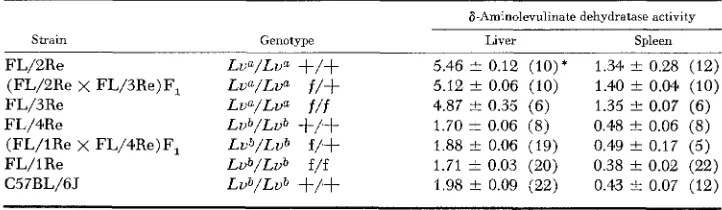
Lvb/Lub individuals from offspring of a cross between two FL/lRe-f/+ Lub/Lub mice from b.c. 30 within FL/lRe.The typical enzyme activity values from liver and spleen of mice both homo- zygous and heterozygous for the flexed locus are seen in Table 2. Those strains S.E.M. Number of mice in parenthesis.
TABLE 2
Liver and spleen ALD activity of the highly congenic FL/Re strains which differ at the leuulinate and flexed loci
Strain Genotype
FL/2Re Lva/Lua
+/+
FL/3Re Lua/Lua f/f
FL/4Re Lub/Lub
+/+
FL/1 Re L u b / L u b f/f C57BL/6J Lub/Lub
+/+
(FL/2Re x FL/3Re)F, Lua/Lfl f/+(FL/lRe x FL/4Re)F, Lvb/Lub f/+
8-Aminolevulinate dehydratase activity
Liver Spleen _____
5.46 f 0.12 (IO)* 1.34 f 0.28 (12) 5.12 f 0.06 (10) 1.40 f 0.04 (IO) 4.87 -i- 0.35 (6) 1.35 +- 0.07 (6) 1.70 f 0.06 (8) 0.48 f 0.06 (8) 1.88 i 0.06 (19) 0.49 f 0.17 (5) 1.71 f 0.03 (20) 0.38 f 0.02 (22) 1.98 2 0.09 (22) 0.43 I 0.07 (12)
* Figures represent pmoles of porphobilinogen formed per hr per g wet weight of tissue f
HEMOPOIESIS I N FLEXED MICE 635
homozygous for the L f l allele (l?L/2Re-+/+, FL/3Re-f/f and crosses between them) had ALD activities in the order of 5.5 units/g in liver and 1.3 units/g in spleen while those strains homozygous for the Lvb allele (FL/4Re-+/+, FL/lRe-
f/f and crosses between them) had enzyme activities of 1.8 units/g in liver and
0.4 units/g in spleen. No effect of the flexed locus on ALD activity is apparent and the values obtained correspond to that predicted by the alleles at the Lu locus
[RUSSELL
and COLEMAN 1963).Phenylhydrazine studies. Previous observations
(MARGOLIS
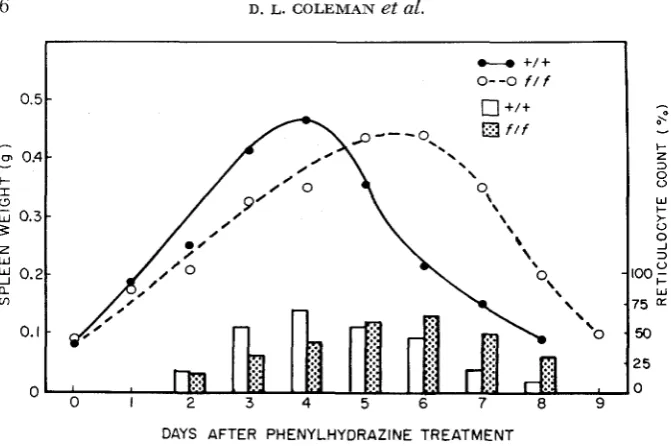
and RUSSELL 1965) suggested that flexed mice were unable to increase the level of splenic ALD in order to compensate for the severe anemic state induced by phenylhydrazine injection. The following studies were undertaken in order to fully evaluate the entire recovery period with respect to the nature and extent of the differences between flexed and normal mice. We first studied the change in peripheral blood and the rate of red blood cell formation in both genotypes after phenylhydrazine treatment. A marked anemia was seen on the first day following cessation of the treatment. Qualitatively the degree of anemia was the same in all genotypes studied (hematocrit 17 to 23% with total red blood cell count of 2.5 to 3.5 mil- lion). In all normal strains of mice, including those heterozygous for the flexed gene, the percentage of reticulocytes increased rapidly, reaching a maximum (61 to 83%) on the fourth day after phenylhydrazine treatment (Figure 1). Thiswas followed by a drop in the reticulocyte count until a normal blood picture was seen by the 9th day post-phenylhydrazine. In contrast, flexed mice exhibited a delay in the production of reticulocytes, reaching a maximum on day 6 or later. A completely normal blood profile was not observed until day 10 or 11 after phenylhydrazine treatment. Hypertrophy of the spleen closely paralleled the rise in the reticulocyte count in mice of both flexed and normal genotypes: maxi- mum spleen weight was observed on day
4
in normal mice and on day 6 in mice of flexed genotypes (Figure 1 ).
636 D. L. COLEMAN et al.
I 1
I
w +/+
0 - 4 f / f
DAYS AFTER PHENYLHYDRAZINE TREATMENT
FIGURE 1.-Changes i n spleen weights and reticulocyte counts i n flexed and normal mice recovering from phenylhydrazine-induced anemia. Each point represents the average value ob- tained from at least 10 mice. No effect of the alleles a t the L u locus was observed and the data from the
+/+
mice homozygous for either Lva or Lub were pooled as were the data from flexed mice of either genotype.Enzyme studies. Having established both the importance of the spleen in the compensatory hemopoiesis which follows phenylhydrazine treatment and the involvement of the flexed locus in delaying the rate at which the spleen can participate, it was of interest to examine the enzymatic changes in spleen which occurred during the recovery period. The endogenous activity of 6-aminolevuli- nate dehydratase is controlled in liver, spleen, and kidney by the levulinate locus
(COLEMAN 1966). The normal level observed for mice homozygous for Lub is 0.39 units per g wet weight of spleen, while that for mice homozygous for Lu" is 1.35 units per g wet weight of spleen (Table 2 and Figure 2). In normal mice this activity is doubled by the first day after phenylhydrazine treatment, while in flexed mice no change is observed until day 2 or 3 after the induction of the anemia (Figure 2a and 2b). These results are in agreement with earlier studies, which were terminated after day 1 (MARGOLIS and RUSSELL 1965). If studies are extended throughout the entire anemic period, it is seen that peak levels of splenic
ALD are achieved in the
f/f
spleens about 3 days after the peak occurs in the+/+
spleens; and further, this delay is cormnon to Lua/Lua f/f (Figure 2a) and Lub/ Lub f/f (Figure 2b) mice. Thus the slower appearance of maximum ALD activity is directly dependent upon the presence of the flexed mutation, and independent of the action of the Lu alleles.H E M O P O I E S I S I N F L E X E D M I C E 63 7
6.01
- 0 c
-1 I I I I I I 1 I
0 I 2 3 4 5 6 7 8 9
DAYS AFTER PHENYLHYDRAZINE TREATMENT 01
FIGURE 2.-Effect of phenylhydrazine treatment on 8-aminolevulinate dehydratase activity in spleen from flexed and normal mice homozygous for t h e Lfl-gene (2A) and homozygous for the Lvb-gene (2B). Units of activity are pmoles of porphobilinogen produced per hour per g of spleen. Each point represents the average value obtained from 4 to 8 separate assays performed on individual spleens.
Lvb/Lvb
f/f
(1.8 units/g) and Lub/Lub+/+
(1.9 units/g).
However, the peaks in mice of both LV"/Lv" genotypes are 3 to 4 times greater than tliose in mice of the corresponding Lvb/Lvb genotypes. This indicates that although the flexed gene controls the delay in reaching peak enzyme activity, it is theLv
allele which con- trols the magnitude of this response.I n both genotypes, the pattern of increase in ALD activity closely parallels the increase in spleen weight, percentages of erythropoietic cells in spleen, and reticu- locyte count. This increase in enzyme activity is not due to increase in the size
638 D. L. COLEMAN et al.
0 - - 0 +/+
-
f / f\
5
5.0-
a
p 4.0-
N
5
3.0-W J
ul
0
W
z
!3 2.0:
/ /
I
2 3
I
4
I 5
I
6
-
7 8 I 9DAYS AFTER PHENYLHYDRAZINE TREATMENT
FIGURE 3.-Effect of phenylhydrazine treatment on uroporphyrinogen synthetase activity in spleens from flexed and normal mice homozygous for the Lvb-allele. Each point represents the average value obtained from 4 to 6 separate assays. Each assay was run on the combined homoge- nates of spleen from 2 or 3 treated mice.
activity of the ALD per gram of spleen, coupled with a 6-fold increase in spleen size represents a 24-fold increase in enzyme activity per spleen. This is consistent with the observation that the spleen cells actively producing hemoglobin multiply 30 times as rapidly as do other cell types, increasing from 2% to 60% of the total after phenylhydrazine treatment.
These data further suggest that the flexed locus does not have a role in con- trolling ALD activity directly, but instead may control the differentiation or pro- liferation of the hemopoietic cells which contain this enzyme. On the basis of this hypothesis, other enzymes in the heme-biosynthetic pathway should be altered in spleens of stressed flexed mice. Therefore, studies were initiated on the next enzyme in the pathway, uroporphyrinogen synthetase. Spleens from normal non- anemic mice do not have detectable amounts of this enzyme under the assay con- ditions, but by day 3 or 4 after phenylhydrazine treatment some synthetase is present. The changes in synthetase in flexed and normal mice homozygous for Lvb are summarized in Figure 3. Again a 2- to 3-day delay in response is observed in flexed mice, with maximal activity on day 4 in normal mice but not until day 7 in flexed mice.
HEMOPOIESIS I N F L E X E D MICE 639 TABLE 3
Activity of S-aminolevulinute dehydratase and uroporphyrinogen synthetase i n normal and fiexed fetal liver
6-Aminolevnlinate dehydratase activity Uroporphyrinagen synthetase activity
Fetal
age Lua/Lua +/f Luh/Lub
+/+
LUb/LVb f/f Lub/Lvb f/f Lu”Lub f/f’Days pmoles PBG produced/hr/g of liver mpnoles PBG utilized/hr/g of liver 13 4.80+ (1) 1.67 f 0.03 (3) 1.76 t 0.19 (3) 145 f 2.9 (4) 95 f 16.9+(4) 14 6.43 t 0.15 (4) 2.05 f 0.07 ( 5 ) 1.93 t 0.13 (4) 157 k 4.2 (8) 140 2 6.3 (6) 15 6.15 2 0.17 (4) 1.99 2 0.07 (6) 1.90 t 0.07 (5) 180 f 9.2 (5) 161 f 4.3 (3) 16 5.60 f 0.17 (5) 2.16 f 0.09 (5) 1.90 t 0.09 (4) . . . 17 5.40 i: 0.18 (8) 1.77 f 0.07 (6) 1.85 i: 0.08 ( 5 ) . . .
+ Figures represent units of enzyme activity f standard error of the mean. The numbers in
+This value for synthetase activity in flexed fetuses is significantly lower than the normal parenthesis refer to the number of determinations made on each genotype.
value ( P
<
0.05).locus, in agreement with previous observations (RUSSELL and COLEMAN 1963). Fetal liver from normal mice homozygous for the
Lv”
allele had ALD activities about 3 times those seen for normal mice homozygous for L d at each age studied. Peak enzyme activity occurred on days 14 and 15 and coincided with the prob- able period of maximum heme biosynthesis. Superimposition of the flexed gene on mice homozygous for Lvb had no effect on the developmental profile.Since ALD is a normal constituent of adult liver, which does not participate in hemopoiesis, it was felt that the endogenous non-hemopoietic level of this en- zyme in fetal liver might be sufficient to obscure possible changes in ALD ac- tivity. Therefore, studies were extended to uroporphyrinogen synthetase, an en- zyme which is not found in significant quantities in adult liver, and is more spe- cific to hemopoietic tissue. The developmental pattern of this enzyme from 13 to 15 days is also shown in Table 3 . No deficiency of enzyme was seen in days 14 and 15 in flexed mice but a moderate deficiency was found on day 13. This sug- gests that the developmental pattern of hemopoietic cells in livers from flexed fetuses may be delayed. Confirmatory studies were not feasible at 12 days be- cause of the unavailability of sufficient amounts of fetal liver from flexed em- bryos.
DISCUSSION
Enzyme studies in spleens made hemopoietic by phenylhydrazine treatment confirmed the persistence of a hemopoietic defect in adult flexed mice. This defect only becomes apparent under conditions demanding rapid differentiation and proliferation of erythropoietic tissue, a conclusion in agreement with that of
640 D. L. COLEMAN et al.
they observed may safely be attributed to flexed gene action. Although the same number of colonies developed from flexed as from normal implanted cells, those from f/f cells LLwere found to be small in size and to possess a decreased ability to incorporate radio-iron into haem” (THOMPSON et al. 1966). Peak Fe59 incorpora- tion into heme was delayed following implant of f / f as compared with
+/+
cells.FOWLER et al. (1967) demonstrated by radioautography that these defects in f/f
iron incorporation were caused by delay in proliferation of erythroid cells. They also showed the flexed hemopoietic defect was specific for erythropoiesis, since proliferation of myeloid cells was normal.
I n contrast to the results obtained by MARGOLIS and RUSSELL (1965), in our study no direct effect of the flexed gene was observed on the resting level of ALD in liver, kidney, or spleen. Their results can be explained by genetic studies which established that the highly congenic FL/2Re-+/+ strain used as a normal control in their studies was homozygous for the
Lv‘
allele while the flexed strain was homozygous for the Lub allele at the levulinate locus. Their failure to observe a compensatory increase in ALD activity 24 hr after phenylhydrazine treatment was caused by the delay in response of this enzyme in spleens from flexed mice.A similar delay occurs in the rise of splenic uroporphyrinogen synthetase. These parallel changes in two enzymes involved in heme biosynthesis confirm the lag in proliferation of heme-synthesizing cells which was suggested by the actual cell counts in LEPEHNE’S stained preparations.
It was hoped that by studying the developmental profile of hemopoietic en- zymes in fetal liver a similar delay in the development of maximal specific ac- tivity would be observed. This was not the case with ALD activity, and with uroporphyrinogen synthetase, only a marginal deficiency in 13-day old fetal liver was observed, However, the observed normal enzyme complement of fetal liver from flexed mice was based an a gram wet weight of tissue. RUSSELL et al. (1968) have shown that flexed mice at all ages are smaller than normal and our experi- ence indicates that the liver-weight of flexed fetuses is only 50 to 60% that of normal fetuses. Thus, the actual enzyme activity per liver is decreased in flexed mice even though the amount per gram is normal. This decrease in the relative size of the fetal liver, which is composed mainly of hemopoietic cells, is in keep- ing with the hypothesis that the flexed locus in some fashion regulates the rate of proliferation of erythropoietic cells.
RUSSELL et al. (1968) also demonstrated anemia and decreased weight of flexed fetuses when compared with normals on the 12th day of gestation, indi- cating that alleles at the flexed locus affect hemopoiesis and growth rate prior to the development of the liver as the major hemopoietic site. This suggests that the flexed locus may influence differentiation or proliferation of tissues other than hemopoietic tissue. The reduced body weight observed in flexed mice during post- natal growth is compatible with this hypothesis (RUSSELL and MCFARLAND
HEMOPOIESIS I N F L E X E D MICE 64 1
though both of these pleiotropic effects may be secondary to flexed fetal anemia, they may equally well represent independent action o€ the flexed genes in other tissues
(RUSSELL
and MCFARLAND 1966).The authors express their appreciation to Mrs. ELEANOR C. MCFARLAND and Mr. R. H. COPP for excellent technical assistance, to Miss EDITH KENT, Miss JANICE SOUTH- and Mrs. MARY
NORWOOD for invaluable assistance in developing and maintaining the inbred strains used in these studies, and to Mr. L. C. LIBMAN who initiated studies on the effects of phenylhydrazine on 8-aminolevulinate dehydratase activity in several inbred strains of mice during his tenure as a summer student. Dr. JOHN FOWLER generously provided facilities and direction for the measure- ment of numbers of erythropoietic cells.
SUMMARY
The activity of 6-aminolevulinate dehydratase (ALD) has been investigated in liver and spleens from flexed ( f / f ) and normal strains of mice known to be homo- zygous for either the
Lv"
or Lvb allele at the levulinate locus. The level of this enzyme was controlled solely by the levulinate locus, and no effect of the flexed locus was observed. Similarly, in tissues actively undergoing hemopoiesis, such as fetal liver or spleens of mice made anemic by phenylhydrazine, both the basal level and the maximal rise of enzyme activity was dictated by the levulinate locus. However, a delay in the normal compensatory increase in ALD activity was observed i n spleens from homozygous flexed mice after phenylhydrazine treatment when compared with normal mice. The parallel delays in the rate ofspleen hypertrophy in the increase of nucleated cells staining for hemoglobin, and in the development of a second enzyme in the heme biosynthetic pathway, uro- porphyrinogen synthetase, suggest that the flexed locus affects hemopoiesis by controlling the rate of proliferation of hemopoietic cells. This delay was not ob-
served in the development of the hemopoietic capacity of fetal liver when based on a gram wet weight of tissue, but the smaller size of the livers from flexed fetuses when compared with normal fetuses indicates that a deficiency in blood- forming capacity exists throughout the period when liver is the major hemopoietic site.
LITERATURE CITED
COLEMAN, D. L., 1966
FOWLER, J. H., and D. NASH, 1968
FOWLER, J. H., J. E. TILL, E. A. MCCULLOCH, and L. SIMINOVITCH, 1967
Purification and properties of 8-aminolevulinate dehydratase from tissues
Erythropoiesis in the spleen and bone marrow of the pregnant mouse. Develop. Biol. 18: 331-353.
The cellular basis for the defect in haemopoiesis in flexed-tailed mice. 11. The specificity of the defect for ery- thropoiesis. Brit. J. Haematol. 13: 250-264.
of two strains of mice. J. Biol. Chem. 241: 5511-5517.
FRUHMAN, G. J., 1968 GRUNEBERG, H., 1942a
Blood formation in the pregnant mouse. Blood 31: 232-248.
The anaemia of flexed tailed mice ( M u s musculus L.). I. Static and 1942b The anaemia of flexed-tailed mice dynamic hematology. J. Genet. 43: 45-46.
( M u s musculus L.) 11. Siderocytes. J. Genet. 44: 246-271. -
64.2 D. L. COLEMAN et al.
uroporphyrinogen catalyzed by extracts of hematopoietic mouse spleen. J. Biol. Chem. 242:
424&-1253.
MARGOLIS, F. L., and E. S. RUSSELL, 1965 Delta aminolevulinate dehydratase activity in mice with hereditary anemia. Science 150: 496.497.
RUSSELL, R. L., and D. L. COLEMAN, 1963 Genetic control of hepatic 8-aminolevulinate dehy- dratase in mice. Genetics 48: 1033-1039.
RUSSELL, E. S., and E. C. MCFARLAND, 1966 Analysis of pleiotropic effects of W and f genic
RUSSELL, E. S., M. W. THOMPSON, and E. C. MCFARLAND, 1968 Analysis of effects of W and f
SHEMIN, D., 1962 8-aminolevulinic acid dehydrase from Rhodopseudomonas spheroides. pp. 883-884. In: Methoak of Enzymology, Volume V. Edited by S. P. COLOWICK and N. 0.
KAPLAN Academic Press, New York.
The cellular basis for the defect in haemopoiesis in flexed-tailed mice. 1. The nature and persistence of the defect. Brit. J. Haematol. 12: 152-160.
substitution in the mouse. Genetics 53: 949-959.
genic substitutions on fetal mouse hematology. Genetics 58: 259-270.