Tactical Enabling Operations
Chapter 12
Security
Operations
The officers and men who permit themselves to be surprised deserve to die, and the commanding general will spare no efforts to secure them their desserts.
D. H. Hill, 1863
Security
operations
are those
operations
undertaken
by a
com-mander
to provide
early
and accurate
warning
of enemy
opera-tions, to provide
the force being protected
with time and
maneu-ver space within
which to react
to the enemy,
and to develop
the
situation
to allow the commander
to effectively
use the protected
force. The ultimate goal of security operations is to protect the force from
CONTENTS
Fundamentals of Security Operations 12-2 Provide Early and Accurate Warning 12-2 Provide Reaction Time and Maneuver
Space 12-2
Orient on the Force or Facility to be
Secu red 12-2
Perform Continuous Reconnaissance .12-3
Maintain Enemy Contact 12-3
Historical Example 12-3
General Considerations for Security
Operations 12-4
Common Security Control Measures ...12-4 Planning Considerations for Security
Missions 12-5
Movement into Security Areas for
Stationary Security Missions 12-10
Movement During Moving Flank
Security Missions 12-11
Screen 12-13
Critical Tasks for a Screen 12-14
Organization of Forces 12-15
Screen Control Measures 12-15
Executing a Stationary Screen 12-15
Executing a Moving Screen 12-17
Screening Operations During Limited
Visibility 12-19
Guard 12-19
Organization of a Guard Force 12-20
Control Measures 12-20
Advance Guard 12-21
Flank Guard 12-22
Rear Guard 12-25
Cover 12-25
Organization of a Covering Force 12-26
Offensive Cover 12-27
Flank Cover 12-29
Defensive Cover 12-29
Area Security 12-31
Local Security 12-32
surprise and reduce the unknowns in any situation. A commander may conduct security operations to the front, flanks, or rear of his force. The main difference between security operations and reconnaissance opera-tions is that security operations orient on the force or facility being pro-tected, while reconnaissance is enemy and terrain oriented. Security op-erations are shaping operations.
12-1. There are five forms of security operations-screen, guard, cover, area security, and local security.
.
Screen is a form of security operations that primarily provides early warning to the protected force..
Guard is a form of security operations whose primary task is to protect the main body by fighting to gain time while also ob-serving and reporting information and preventing enemy ground observation of and direct fire against the main body. Units conducting a guard mission cannot operate indepen-dently because they rely upon fires and combat support assets ofthe main body..
Cover is a form of security operations whose primary task is toprotect the main body by fighting to gain time while also ob-serving and reporting information and preventing enemy ground observation of and direct fire against the main body.
.
Area security is a form of security operations conducted topro-tect friendly forces, installations, routes, and actions within a specific area.
.
Local security consists of low-level security operations conduct-ed near a unit to prevent surprise by the enemy.The screen, guard, and cover, respectively, contain increasing levels of com-bat power and provide increasing levels of security for the main body. How-ever, more combat power in the security force means less for the main body. Area security preserves the commander's freedom to move his reserves, posi-tion fire support means, provide for command and control, and conduct sus-taining operations. Local security provides immediate protection to his force.
12-2. All maneuver forces are capable of conducting security operations. Ground and air cavalry units and scout platoons are specially trained, equip-ped, and organized to conduct security missions; however, there are rarely enough of them to meet all the security needs of a force. A commander should ensure that subordinate maneuver units train to perform specific security missions. This allows subordinate units to add these missions to their mission-essential task list (METL) and train for them. Habitual relationships with attachments are required to obtain proficiency in these missions.
12-4. All forces, regardless of whether they are combat, combat support (CS), or combat service support (CSS), have an inherent responsibility to provide for their own local security. Local security consists of observation posts (OPs), local security patrols, perimeter security, and other measures to provide close-in security of a force. This chapter focuses on security operations con-ducted by one force or a subordinate element of a force that provides security for the larger force. Echelon-specific manuals discuss local security.
FUNDAMENTALS
OF SECURITY OPERATIONS
12-5. Successful security operations depend on properly applying five funda-mentals:
.
Provide early and accurate warning..
Provide reaction time and maneuver space..
Orient on the force or facility to be secured..
Perform continuous reconnaissance..
Maintain enemy contact.PROVIDE EARLY AND ACCURATE WARNING
12-6. The security force provides early warning by detecting the enemy force quickly and reporting information accurately to the main body commander. The security force operates at varying distances from the main body based on the factors of METT-TC. As a minimum, it should operate far enough from the main body to prevent enemy ground forces from observing or engaging the main body with direct fires. The earlier the security force detects the ene-my, the more time the main body has to assess the changing situation and react. The commander positions ground security and aeroscouts to provide long-range observation of expected enemy avenues of approach, and he rein-forces and integrates them with available intelligence collection systems to maximize warning time.
PROVIDE REACTION TIME AND MANEUVER SPACE
12-7. The security force provides the main body with enough reaction time and maneuver space to effectively respond to likely enemy actions by operat-ing at a distance from the main body and by offering resistance to enemy forces. The commander determines the amount of time and space required to effectively respond from information provided by the intelligence preparation of the battlefield (IPB) process and the main body commander's guidance re-garding time to react to enemy courses of action (COA) based on the factors of METT-TC. The security force that operates farthest from the main body and offers more resistance provides more time and space to the main body. It at-tempts to hinder the enemy's advance by acting within its capabilities and mission constraints.
ORIENT ON THE FORCE OR FACILITY TO BE SECURED
commander must know the main body's scheme of maneuver to maneuver his force to remain between the main body and the enemy. The value of terrain occupied by the security force hinges on the protection it provides to the main body commander.
PERFORM CONTINUOUS RECONNAISSANCE
12-9. The security force aggressively and continuously seeks the enemy and reconnoiters key terrain. It conducts active area or zone reconnaissance to de-tect enemy movement or enemy preparations for action and to learn as much as possible about the terrain. The ultimate goal is to determine the enemy's COA and assist the main body in countering it. Terrain information focuses on its possible use by the enemy or the friendly force, either for offensive or defensive operations. Stationary security forces use combinations of OPs, avi-ation, patrols, intelligence collection assets, and battle positions (BPs) to per-form reconnaissance. Moving security forces perform zone, area, or route re-connaissance along with using OPs and BPs, to accomplish this fundamental.
MAINTAIN ENEMY CONTACT
12-10. Once the security force makes enemy contact, it does not break contact unless specifically directed by the main force commander. The security asset that first makes contact does not have to maintain that contact if the entire security force maintains contact with the enemy. The security force com-mander ensures that his subordinate security assets hand off contact with the enemy from one security asset to another in this case. The security force must continuously collect information on the enemy's activities to assist the main body in determining potential and actual enemy COAs and to prevent the enemy from surprising the main body. This requires continuous visual con-tact, the ability to use direct and indirect fires, freedom to maneuver, and depth in space and time.
HISTORICAL
EXAMPLE
12-11. Military history contains numerous examples of the importance of se-curity operations. The following historical example illustrates the major role of security operations in ensuring the success of an operation. This non-US example illustrates that the study of other armies and other times can con-tribute toward helping to understand the art and science of tactics.
Operation Bagration, 1944
During Operation Bagration, 22 June to 29 August 1944, the Red Army destroyed the German Army Group Center and recaptured the last significant part of the Soviet Union remaining under German control. Soviet security operations played a major role in this operation's success. Soviet field regulations of 1944 specified the purposes of security operations: prevent surprise attack of the main body by enemy ground or air forces, prevent enemy reconnaissance, and give friendly forces time and conditions for deployment against the enemy.
by partisans, kept the Germans so busy conducting area security operations that they had few resources to devote to ground reconnaissance. The Red Army Air Force kept German aerial reconnaissance from looking deep into the Red Army's rear to operational depths. All the Soviet fronts (army groups) preparing for the summer offensive established a 25-kilometer-deep security area against German ground reconnaissance. Frontline divisions conducted numerous and frequent patrols to counter German reconnaissance efforts and maintain regular physical contact with adjoining divisions.
The Soviets used all available assets to maintain the security of forces involved in the operation. Throughout the operation, the Red Army Air Force provided aerial
cover, especially for mobile groups and forward detachments. Because the
marshy nature of much of the terrain prevented using large mechanized forma-tions, the Soviets used horse cavalry corps, augmented with tanks, to cover ground unsuitable for heavier forces and maintain contact between separated elements of their forward mobile forces.
On the flanks of Operation Bagration, the Soviet 1st Guards Tank Corps served as a covering force against reinforcements or relief efforts from the German
Army Group North. A combined horse-cavalry mechanized group served the
same role in the south for the 1st Byelorussian Front against the German Army
Group North Ukraine.
GENERAL
CONSIDERATIONS
FOR SECURITY
OPERATIONS
12-12. There are a number of general considerations when conducting secur-ity operations. These apply to all forms of security operations but are most applicable to screen, guard, and cover missions.
COMMON SECURITY CONTROL MEASURES
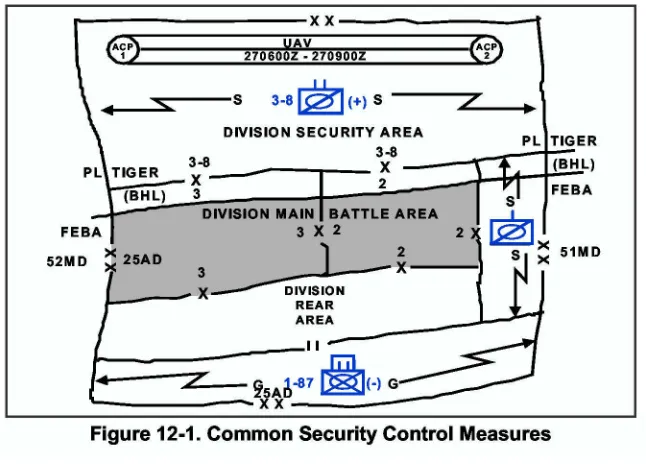
12-13. Security operations are depicted on overlays using a lightning bolt on either side of the symbol representing the unit conducting the security opera-tion and are labeled with the letter S, G, or C to denote screen, guard, or cover. The end of the lightning bolt has arrowheads that touch the designated operational graphics, which define the left and right limits of the security op-eration. (See Figure 12-1.)
12-14. The screen, guard, and cover have many common control measures, starting with boundaries defining the security area. The main body com-mander establishes the security area. For a security force operating to the front of the main body, the lateral boundaries of the security area are nor-mally an extension of the lateral boundaries of the main body. The security force's rear boundary is normally the battle handover line (BHL).
S 3.8~(+) S ./
. DIVISION SECURITY AREA
PL TIGER
3.8 3.8X (BHL)
X 2
FEBA
3 S
DIVISION MAIN BATTLE AREA
~3X 2 2
~2
S ~51MD.X
.~ DIVISION
REAR AREA
control the passing of responsibility for the enemy to the main body. Nor-mally, the responsibility of the flank security force begins at the trail element of the advance security force or the lead combat element in the main body. It ends at the rear of the main body or the lead element of the rear security force. The main body commander clarifies responsibilities as necessary.
12-16. Either the main body or the security force commander designates ad-ditional PLs to control the operation. These PLs may serve as subsequent screen or delay lines. Each element of the security force must report when crossing or occupying them. Displacement to these subsequent PLs is event-driven. The approach of an enemy force, relief of a friendly unit, or movement of the protected force dictates the movement of the security force. The secur-ity force commander normally assigns additional lateral boundaries within the security area to delineate the areas of operations (AOs) for subordinate units.
12-17. The commander uses checkpoints and named areas of interest (NAIs) to indicate specific areas of interest and to coordinate movement and surveil-lance. He uses contact points to facilitate coordination with flank units during front and rear security missions or between elements of a security force with-in the security area. Units conducting flank security for a moving force physi-cally contact the main body at contact points. If the security force commander wants to ensure coverage of a specific NAI or avenue of approach, he estab-lishes OPs.
~~~
XX
~AV
270600Z .270900Z ~~~
...
.7'
II
~5A~.87rIIH G xx
Figure 12-1. Common Security Control Measures
PLANNING CONSIDERATIONS FOR SECURITY MISSIONS
12-18. In addition to the planning considerations applicable to other types of operations discussed in this manual, such as control of key terrain and ave-nues of approach, the commander assigning a security mission and the secur-ity force commander must address special considerations:
.
Force to be secured.SECURITY MISSION
ECHELON Screen Advance Guard Flank/Rear Guard Cover Battalion/Task Force PLATOON CO/TM
Brigade
CO/TM BNTF CO/TM BN TF(+)Division DIVCAVBNTF DIV CAY (+)BDE DIV CAYBNTF DIV CAY (+)BDE
AR CAY SOD AR CAY SOD(+) ACR (+)
Corps BNTF ACR or or
BDE BNTF Division
Echelons Above Corps DIV (+) ACR DIV (+)
ACR (+) or or or
(JTF/Numbered Army) Corps BDE Corps
.
Initial observation post locations..
Types of OPs..
Time to establish the security force..
Criteria for ending the security mission..
Augmentation of security forces..
Intelligence support to security operations..
Special requirements or constraints..
Fire planning..
Integration of ground and air operations..
Planning the engineer effort..
Reporting..
Positioning of command and control (C2) and CSS assets..
Combat service support.Force to Be Secured
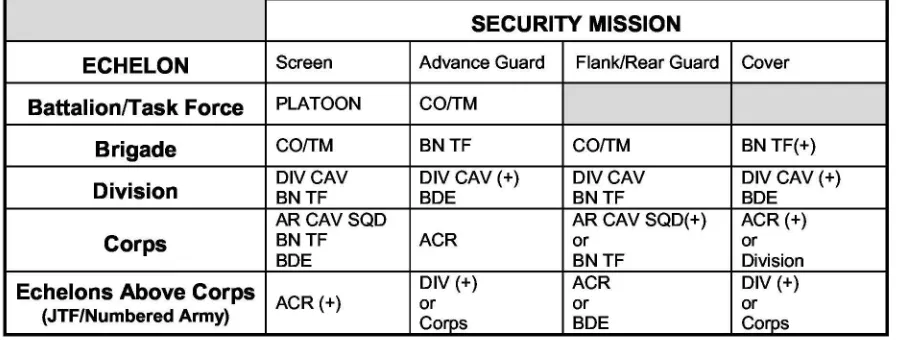
12-19. The main body commander must designate the exact force to secure. This designation determines the limits of the security force's responsibilities. The security force must orient on the force it is securing. If the main body moves, the security force also moves to maintain its position in relation to the main body. Table 12-1, page 12-8, shows the typical size of security forces for a given echelon. The limited capabilities of most maneuver platoons prohibit them from having a mission separate from their parent company. Scout platoons are the exception to this rule.
Table 12-1. Typical Size of Security Forces for a Given Mission and Echelon
Location and Orientation of the Security Area
critical OPs or positions. It also prevents the enemy from penetrating the se-curity area too easily and prevents gaps from occurring when OPs or units displace or are lost. The wider the area to secure, the less the security force can take advantage of the increased depth because it will have fewer forces to position in depth. A very shallow security area may require a guard to pro-vide needed reaction time.
12-21. The security force commander conducts a detailed analysis of the ter-rain in the security area. He establishes his initial dispositions (usually a screen line) as far forward as possible on terrain to allow good observation of avenues of approach. Next, he assigns clear responsibility for identified ave-nues of approach and designated NAIs. For a screen or guard, the initial screen line must be within supporting range of the main body, yet provide the desired amount of early warning.
Initial Observation Post Locations
12-22. The security force commander determines tentative initial OP loca-tions along or behind the screen line to ensure effective surveillance of the sector and designated NAIs. The unit or asset that occupies each OP may shift its exact location to achieve the commander's intent. A commander may place more than one OP along a high-speed avenue of approach to allow an enemy contact to be tracked from one OP to another, thus maintaining enemy contact without requiring security forces to displace. The security force com-mander tasks subordinate units to perform reconnaissance and combat pa-trols to cover gaps between OPs. To prevent fratricide, the commander places a restrictive fire support coordinating measure around OP locations.
Types of Observation Posts
12-23. Observation posts may be either mounted or dismounted. Mounted OPs can use their vehicular optics, weapon systems, and speed of displace-ment. However, an enemy can detect them more readily than dismounted OPs. Dismounted OPs provide maximum stealth but lack the speed of dis-placement, optics, and weapons of mounted OPs. It takes a minimum of two soldiers to man an OP, and then for no more than 12 hours. Observation posts manned for more than 12 hours require, as a minimum, an infantry squad or scout section to ensure continuous operation. The screening force pa-trols dead space and the area between OPs, conducts resupply operations, and rests or sustains its personnel.
Time the Security Force Must Be Established
Criteria for Ending the Security Mission
12-25. Security missions are usually time- or event-driven. The criteria for ending a security mission can be an action by the main body (such as com-pleting a specific mission), a fIxed-time period (for example, not allowing ene-my penetration of a PL for two hours), or criteria based on the enemy force (such as its size). To terminate its security mission, the security force com-mander normally requires the permission of the main body commander to withdraw behind the rear boundary.
Augmentation of Security Forces
12-26. The main body commander is responsible for reinforcing the security force. When the security area is large, additional combat and CS assets may reinforce the security force's organic combat power. Any unique requirement posed by the mission may require assets not organic to the security force. Ground surveillance radars, engineers, and chemical reconnaissance ele-ments are common attachele-ments at the company or troop level.
Intelligence Support to Security Operations
12-27. Intelligence assets can greatly enhance security operations. These as-sets can conduct rapid surveillance of large areas to detect enemy presence. Remote sensors, unmanned aerial vehicles, battlefIeld surveillance radars, signal intelligence systems, and downlinks from theater and national assets can expand the area under surveillance and cue the security force. Advanced aircraft, such as the OH-58D Kiowa Warrior and the AH-64D Longbow, can detect and report enemy forces at extended ranges with thermal imaging and other advanced detection equipment. This permits a commander to concen-trate his security force on likely enemy avenues of approach, NAIs, targeted areas of interest (TAIs), and restrictive terrain that degrades sensor perform-ance. The commander can use his intelligence assets to detect enemy move-ments. This gains time to reposition his security force and mass other assets to counter enemy actions. The commander increases the size of his security force to reduce his risk if he cannot anticipate suffIcient advance warning from his intelligence assets.
Special Requirements or Constraints
12-28. The main body commander may impose special requirements or con-straints, including engagement, disengagement, and bypass criteria. He may order the security force not to become decisively engaged or fall below a cer-tain combat strength. He may be willing to accept a lesser degree of security, which results from either the loss of more terrain or reduced preparation time by the main body, to preserve his security force for later use.
Fire Planning
to delay or disrupt the enemy. Providing adequate indirect fire support to the security force may require the main body to position its artillery well forward in the formation of the main body.
Integration of Ground and Air Operations
12-30. Integrating ground and air operations is critical to the success of many security missions. Aviation units, especially air cavalry, assist in reconnais-sance of the security area as the ground element of the security force moves forward. They can perform the following tasks:
.
Extend the screen in front of the flank security element's screen line..
Screen forward of the ground security force..
Conduct reconnaissance of areas between ground maneuver units..
Assist in maintaining contact between the security force and the main body..
Assist in clearing the area between the flank security element and the main body during moving flank security missions..
Assist in disengaging ground units, which is especially valuable when conducting battle handover and passage of lines with the main body..
Monitor terrain that is hard to reach or would require too much time to cover with ground reconnaissance assets.Planning the Engineer Effort
12-31. Countermobility plays a critical role in the security area. With proper-ly integrated obstacles, the security force can maintain a mobility advantage over the enemy. The commander may mass engineer support in the security area initially and then shift support to the main battle area (MBA) once those units are prepared to begin developing engagement areas. They also enhance the mobility of the security force by identifying repositioning routes and task organizing engineers to provide breaching capability. However, the senior commander must consider the impact of prioritizing the countermobility ef-fort in the security area rather than in the MBA or at the decisive point. In the offense, a commander can employ situational obstacles, covered by fire, on the flanks of an advancing force to provide additional security.
Reporting
12-32. The security force reports enemy activities to the main body. The main body headquarters is responsible for disseminating that information to other affected friendly forces. The main body commander ensures that the security force has access to all pertinent intelligence and combat information obtained by the main body. This supplements the security force's capabilities. By con-tinuously exchanging information, both the security force commander and the main body commander have time to choose a suitable COA. Force digitization greatly assists commanders in maintaining a common operational picture.
Combat Service Support
maintaining, and using standing operating procedures (SOP). Logisticians and operators must use the SOP and should be involved in their develop-ment. The SOP should be exercised and tested during training and changes made as needed. The commander ensures that his staff includes the sustain-ment of these security elements in logistics rehearsal.
12-34. The security element commander designates the individual within the security element who is responsible for sustaining the element. This is nor-mally the senior noncommissioned officer within platoons and companies as-signed security tasks. For example the platoon sergeant of a scout platoon as-signed the mission of establishing a flank screen for a battalion task force would coordinate with the first sergeant of the adjacent company team to in-clude the scout platoons sustainment requirements in the company team's lo-gistics package. Likewise the first sergeant of a brigade reconnaissance troop assigned a screening mission coordinates directly with the brigade logistics and forward support battalion staffs for resupply and medical treatment. This individual must have access to the appropriate nets to coordinate logistic sup-port and casualty evacuation.
12-35. That individual coordinates with the appropriate supporting logistics point of contact as soon as possible after receiving the security mission warn-ing order. Coordination includes such items as the mission of the security ele-ment, the AO assigned to the security element, the routes it will take to that area from its current location, and movement times. He gives the exact sus-tainment requirements for the security element-including any specialized items of supply required by the mission, such as cratering charges-to the supporting logistics element. He ensures the support element establishes communication links with the security element and receives a copy of the support element's CSS overlay.
12-36. The commander must place special attention on treating and evacuat-ing casualties for security elements operating removed from normal medical support because of time, terrain, or distance factors, or a need for the security element to remain undetected by the enemy. For this reason, the security ele-ment should include as many soldiers trained as combat lifesavers as is pos-sible. The more combat lifesavers within the security element, the more pre-pared it is for casualties.
Positioning of C2 and CSS Assets
12-37. The security force commander positions himself where he can best control the operation. This is often where he can observe the most dangerous enemy avenue of approach. He positions his command post to provide contin-uous control and reporting during initial movements. His combat trains posi-tion behind masking terrain but remain close enough to the combat elements of the security force to provide rapid response. They are best sited along routes that provide good mobility laterally and in-depth.
MOVEMENT INTO SECURITY AREAS FOR STATIONARY SECURITY MISSIONS
requirements, and to provide the necessary level of security for itself. The se-curity force moves into the security area using one of three basic methods: tactical road march, movement to contact, or zone reconnaissance.
12-39. The fastest but least secure method of deploying is a tactical road march from the rear boundary of the security area to the initial positions. The security force moves to a release point on the rear boundary. From the re-lease point, subordinate elements deploy to occupy initial positions, moving by the quickest means possible. This method is appropriate when enemy con-tact is not expected, time is critical, or an aviation unit is conducting a zone reconnaissance forward of the ground element and has found no enemy in the security area.
12-40. In the second method, the security force conducts a movement to con-tact from a line of departure (usually the rear boundary of the security area) to the initial positions. This method is slower than a tactical road march but more secure. It is appropriate when enemy contact is likely, time is limited, terrain reconnaissance is not needed, or an aviation unit is conducting zone reconnaissance forward of the ground element and enemy forces have been detected in the security area.
12-41. The most secure method for moving to the initial positions is for the security force to conduct a zone reconnaissance from the security area rear boundary to its initial security line positions or the forward limit of the secur-ity area. Given adequate time, this method is preferred because it allows the security force to clear the security area and become familiar with the terrain that it may have to defend. The security force can reconnoiter potential sub-sequent positions and fire support system firing positions as it moves to its initial positions. A zone reconnaissance is appropriate when time is available and information about the enemy or terrain is unknown. While this technique provides information of tactical value on the enemy and terrain in the area, it may also be time consuming. Using air reconnaissance forward of the ground units increases the speed and security of the movement.
MOVEMENT DURING MOVING FLANK SECURITY MISSIONS
12-42. There are three techniques of occupying and moving in a flank secur-ity area for moving secursecur-ity missions based on how the security force crosses the line of departure:
.
Security force crosses the line of departure (LD) separately from the main body and deploys to perform the mission..
Security force crosses the LD separately from main body; lead elements conduct a movement to contact..
Security force crosses the LD with the main body and conducts a zone reconnaissance out to the limit of the security area.12-43. The security force should not be required to make its own penetration when it faces prepared enemy defenses. This may prevent or significantly delay the security force from assuming its duties. These three techniques are often combined.
to perform the mission. The security force then conducts a tactical road march, an approach march, or tactical movements parallel to the main body and drops off OPs or occupies BPs along the flank of the main body. This technique keeps the two forces from interfering with each other during de-ployment. It is appropriate when another force penetrates the line of contact, the main body is not in contact with the enemy and is moving quickly, the LD is uncontested, and the IPB process indicates that enemy contact is not likely in the area through which the security force is moving. It is the fastest but least secure technique.
e~~~~'V9
PL
:"'.~:": TIN
:':"£;~f
. t . :=''''Ullf ~..~::.:.:
PL STEEL
-I
L:::...
I
PL COPPER
I~I
~
Figure 12-2. Security Force Crossing the LD Separately from the Main Body to Establish a Flank Screen
~B~~~~'V9
II
101
PL
PL STEEL PL STEEL
~
...
~I~I
I~I
-PL COPPER
SCREEN
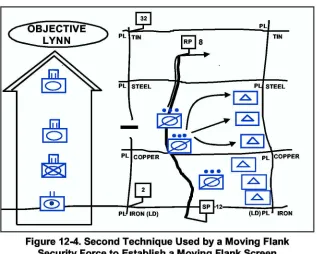
12-45. In the second technique, the security force crosses the LD separately from the main body, and its lead elements conduct a movement to contact. Follow-on elements occupy positions as they are reached. (See Figure 12-4.) This technique is appropriate to use when the main body is moving slower than in the first method, the LD is uncontested, and the IPB process indicates possible enemy contact. It is slower than the previous technique but provides better security.
CB~~~~IV~
TINPL
PL STEEL
~
~
-I.L:::..I
PLCOPPER
I~I
~
(!)
Figure 12-4. Second Technique Used by a Moving Flank Security Force to Establish a Moving Flank Screen
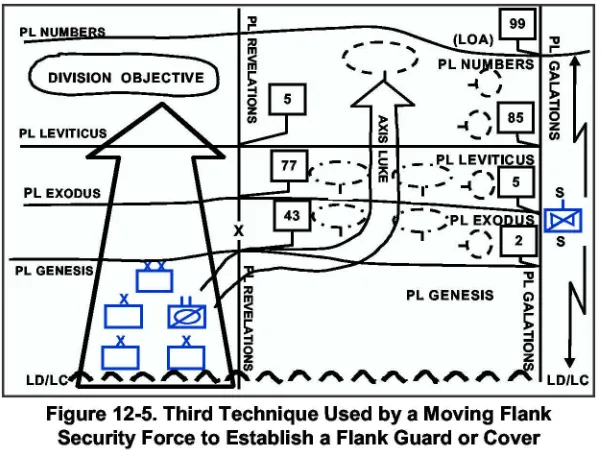
12-46. Finally, in the third technique, the security force crosses the LD with the main body and conducts a zone reconnaissance out to the far limit of the security area. (See Figure 12-5, page 12-14.) This technique is appropriate when the LD is also the line of contact, the main body makes its own penetra-tion of the enemy defenses along the line of contact, the main body is moving slowly, and the enemy situation is not clearly understood. The security force may follow the lead element of the main body through the gap and deploy when the situation permits. This technique provides increased security for both the security force and the main body; it is also the most time-consuming.
PL NUMB
"'II
r-PL GENESIS
D~
kJ,,~
"'II
fI! PL GENESIS :;
iii :J>
S ~
i
~
UI
"''' " '" '" "''' ",(
LD/LC LD/LCFigure 12-5. Third Technique Used by a Moving Flank Security Force to Establish a Flank Guard or Cover
12-48. A screen is appropriate to cover gaps between forces, exposed flanks, or the rear of stationary and moving forces. The commander can place a screen in front of a stationary formation when the likelihood of enemy action is small, the expected enemy force is small, or the main body needs only limited time, once it is warned, to react effectively. Designed to provide mini-mum security with minimum forces, a screen is usually an economy-of-force operation based on calculated risk. If a significant enemy force is expected or a significant amount of time and space is needed to provide the required de-gree of protection, the commander should assign and resource a guard or cover mission instead of a screen. The security element forward of a moving force must conduct a guard or cover because a screen lacks the combat power to defeat or contain the lead elements of an enemy force.
12-49. A security force normally conducts a screen by establishing a series of OPs and patrols to ensure adequate surveillance of the assigned area. The commander uses reconnaissance patrols (mounted, dismounted, and aerial), relocates OPs, and employs technical assets to ensure continuous and over-lapping surveillance. The commander also employs terrain data base analy-tical support systems to ensure the integration of his reconnaissance and sur-veillance assets to provide that necessary coverage.
CRITICAL TASKS FOR A SCREEN
12-50. Unless the commander orders otherwise, a security force conducting a screen performs certain tasks within the limits of its capabilities. A unit can normally screen an avenue of approach two echelons larger than itself, such
commander determines that he cannot complete an assigned task, such as maintain continuous surveillance on all avenues of approach into an AO, he reports and awaits further instructions. Normally, the main force commander does not place a time limit on the duration of the screen, as doing so may force the screening force to accept decisive engagement. Screen tasks are
to-.
Allow no enemy ground element to pass through the screen undetected and unreported..
Maintain continuous surveillance of all avenues of approach larger than a designated size into the area under all visibility conditions..
Destroy or repel all enemy reconnaissance patrols within its capabili-ties..
Locate the lead elements of each enemy advance guard and determine its direction of movement in a defensive screen..
Maintain contact with enemy forces and report any activity in the AO..
Maintain contact with the main body and any security forces operating on its flanks..
Impede and harass the enemy within its capabilities while displacing.ORGANIZATION OF FORCES
12-51. A screen normally requires the subordinate elements of the security force to deploy abreast. A screen force normally organizes itself into a number of OPs determined by the number of avenues of approach into the main force and any additional NAIs it must cover, as specified by the main force com-mander. The screening force may retain a small reaction force or reserve to extract endangered OPs.
12-52. The size of the avenue of approach kept under surveillance varies by echelon. Normally, a unit maintains observation over avenues of approach used by operationally significant enemy forces. These are normally avenues of approach used by enemy forces one echelon smaller than the friendly unit. For example, a battalion maintains surveillance over enemy company-size avenues of approach, while the corps maintains surveillance over division-size avenues of approach. The situation may require the unit to maintain sur-veillance over mobility corridors that can be used by enemy units two eche-lons smaller than the friendly force.
SCREEN CONTROL MEASURES
12-53. The control measures necessary to conduct a screen were previously discussed in this chapter under common security control measures in para-graphs 12-13 to 12-17. (Figure 12-6, page 12-16 displays examples of control measures associated with a screen.)
EXECUTING A STATIONARY SCREEN
establishes OPs in-depth on high-speed avenues of approach. The commander plans routes between the initial and subsequent screen lines to facilitate rap-id occupation of subsequent screen lines. The screening force reserve deploys in-depth and positions itself to react to contingencies that develop during the screen. The screening force takes advantage of its surveillance, target acquisi-tion, and night-observation equipment and information provided by higher-level systems to expand the area and quality of security provided.
, NAl25
/
PL
[ZSJ [ZSJ [ZSJ
..
REDA- C
PL
WHITE WHITEPL
~
PL BLUE
PL BLUE
Figure 12-6. Control Measures Used in a Screen Mission
12-55. Observation posts should remain undetected while those manning them report the presence of enemy elements. Prompt, accurate reporting is essential to keep the assets constituting the screen from being overrun or un-knowingly bypassed. Once the enemy is detected, the OP uses fire support channels to direct engagement of the enemy at maximum range. This helps the OP avoid detection by the enemy and prevents the enemy from penetra-ting the screen line. The screening force may destroy enemy reconnaissance assets with direct fire if indirect fire cannot accomplish this task. It also attempts to slow the movement of other enemy elements, primarily using in-direct fires and close air support.
12-56. As enemy pressure threatens the security of the OP, the unit reports and requests to move to the next screen line. The commander may have pre-viously established criteria that allow the screening force to displace to subse-quent screen lines, based on certain enemy or friendly actions. These criteria should allow subordinates to use their initiative when conducting operations. When displacing from one screen line to another, the screening force empha-sizes rapid movement while maintaining contact with the enemy. This en-sures that any gaps that occur during movement are quickly closed. The screen's C2 elements displace as required to maintain control and keep from being overrun. The force repeats this procedure as often as necessary.
D
M A
I 5
N
B
D
0 5
D
r
y
METHOD CHARACTERISTICS ADVANTAGES DISADVANTAGES
.
Main body moves faster.
Very secure method.
Execution takes timeAlternate
.
Conducted by platoon or.
Maintains maximum.
Disrupts unit integrityBounds . company/Contact is possibletroop surveillancesecurity areaover the
by OPs
.
Conducted from rear tofront
.
Main body moves faster.
Execution does not take.
May leave temporaryAlternate
.
Conducted by platoon or a great deal of time gaps in coverage Boundscompany/ troop
.
Maintains gOOd.
Contact is possible surveillance over theby Units
.
Conducted from rear to security areafront
.
Maintains unit integrity.
Main body is moving slowly.
Most secure method.
Execution takes the.
Conducted by platoon or.
Maintains maximum most timecompany/troop surveillance
.
Unit is less secureSuccessive
.
.
Contact is possible.
Maintains unit integrity when all elements areConducted simultaneously moving simultaneously
Bounds or in succession
.
Simultaneous.
Unit should maintain an air movement may leavescreen during ground temporary gaps
movement
.
Main body is moving.
OPs displace quickly.
Least secure method relatively quickly.
Maintains unit integrityContinuous
.
Performed as a routereconnaissance
Marching
.
Enemy contact is not likely.
Unit should maintain an air screen on the flankscreening force can move behind the PL that designates the rear boundary of the security area and hand off the battle to the main body.
EXECUTING A MOVING SCREEN
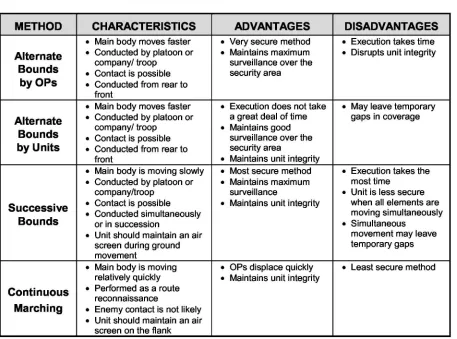
12-58. The screening force may use several methods to move the screen as the protected force moves. Table 12-2 summarizes each method's advantages and disadvantages.
12-59. A force maintains a moving screen along the flanks and rear of the protected force. The screen move-ment is keyed to time and distance factors associated with the main body's movement. (See Figure 12-7.) Responsibilities for a moving flank screen begin at the front of the main body's lead combat element and end at the rear of the protected force. They do not include front and rear security forces. A force executes a moving screen in the same way it conducts a stationary screen, except for the movement techniques.
Table 12-2. Screen Movement Methods
Figure 12-7. Moving
PL ...
,. -.: .:\ :
. . . .
I \.:::::..: M I M A I I[/\:~
A N I N B PL B 0D \ 0
Y
"
-[bJ
YD[bJ
LD PL M A I N PL B 0 D S Y PL12-60. The commander considers the factors of METT-TC in his decision re-garding the movement method employed. Figures 12-8 and 12-9, page 12-18, illustrate four methods of controlling movement along a screen line:
.
Alternate bounds by individual OPs from the rear to the front. (This method is usually employed at the companyltroop level and below.).
Alternate bounds by subordinate units from the rear to the front..
Successive bounds by units along the screen line..
Continuous marching along the route of advance.PL PL
...
.,..- .J' , r::.:::~:'1
I
,
-,
': :...::..."
~
I
'
.~ ,I I ..!.~.~.. : ..,.:=..:~
: :...::...": PL
.~ , II I
,
,
\
\
'...~
...
,
--""'--
...
~LD
Method 1
-
Alternate bound by OP Method 2-
Alternate bound by unit Figure 12-8. Displacement Methods for a Flank Screen.
r
,,- -- ,,:...:
/ '-1/:: / -.... I. \
\
"
,.
,_-
'--M A I N PL LD PL B 0 D Y PL LD~G
DG --z....
~GDG~~~~~G
MAIN GD
D
G GG BODY G
D
BD
1
r
G 0 G
4
D
r
Y
~GDG~
<llEz..GDG...:r
Figure 12-10. Guard Locations
SCREENING OPERATIONS DURING LIMITED VISIBILITY
12-61. Limited visibility often affects the screening force's ground and air ob-servation capabilities. During limited visibility, the screening force uses all available night and thermal observation devices and depends more on elec-tronic surveillance devices. Although the screening force can use technical re-connaissance and surveillance assets to offset limited visibility, it should also adjust its techniques and procedures to the conditions. For example, the commander of a screening force may need to adjust the number and location of his OPs in limited-visibility conditions. He can establish more OPs to cover avenues of approach that become masked in these conditions. He plans for indirect illumination and uses it when necessary. He closely coordinates his patrols to prevent misidentification and engagement by friendly elements. Rigorous sound and light discipline prevents compromise and potential bypass of OPs by enemy reconnaissance forces. Near OPs and along dismounted avenues of approach, the screening force can use trip flares, protective minefields, and mechanical devices, such as noisemakers integrated into tanglefoot obstacles, to detect the enemy and warn of his approach. Additional OPs along enemy avenues of approach can provide depth to facilitate detecting enemy forces that may have eluded forward security elements.
GUARD
12-62. A guard differs from a screen in that a guard force contains sufficient combat power to defeat, cause the withdrawal of, or fix the lead elements of an enemy ground force before it can engage the main body with direct fire. A guard force routinely engages enemy forces with direct and indirect fires. A screening force, however, primarily uses indirect fires or close air support to destroy enemy reconnaissance elements and slow the movement of other ene-my forces. A guard force uses all means at its disposal, including decisive en-gagement, to prevent the enemy from penetrating to a position were it could observe and engage the main body. It operates within the range of the main body's fire support weapons, deploying over a narrower front than a comparable-size screening force to permit concentrating combat power.
12-63. The three types of guard operations are advance, flank, and rear guard. A commander can assign a guard mission to protect either a stationary or a mov-ing force. (See Figure 12-10.)
request guidance on which tasks to complete or the priority of tasks. Mter starting the guard, if the unit determines that it cannot complete an assigned task, such as cause deployment of the enemy advance guard, it must report this to the commander and await further instructions. Guard
tasks-.
Destroy the enemy advance guard..
Maintain contact with enemy forces and report activity in the AO..
Maintain continuous surveillance of avenues of approach into the AO under all visibility conditions..
Impede and harass the enemy within its capabilities while displacing..
Cause the enemy main body to deploy, and then report its direction of travel..
Allow no enemy ground element to pass through the security area un-detected and unreported..
Destroy or cause the withdrawal of all enemy reconnaissance patrols..
Maintain contact with its main body and any other security forces operating on its flanks.12-65. A commander employs a guard when he expects enemy contact and re-quires additional security beyond that provided by a screen. The multiple re-quirements of the guard mission are often performed simultaneously over relatively large areas. While the guard force's exact size is determined by pre-vailing METT -TC conditions, Table 12-1 provides general guidance on the size of an echelon's guard force.
ORGANIZATION OF A GUARD FORCE
12-66. Whether the guard is for a stationary (defending) or moving (attack-ing) force, the various types of guard missions and knowledge of the terrain and enemy dictate the specific task organization of the guard force. The guard force commander normally plans to conduct the guard mission as an area de-fense (Chapter 9), a delay (Chapter 11), a zone reconnaissance (see FM 3-55), or a movement to contact (Chapter 4) mission within the security area.
CONTROL MEASURES
12-67. The commander uses graphic control measures to control the opera-tions of his guard force within the security area. The assigned mission also in-fluences the size of the AO given to subordinate elements. For example, a movement to contact normally takes place across a narrower frontage than if the same unit makes a zone reconnaissance to allow adequate concentration of combat power.
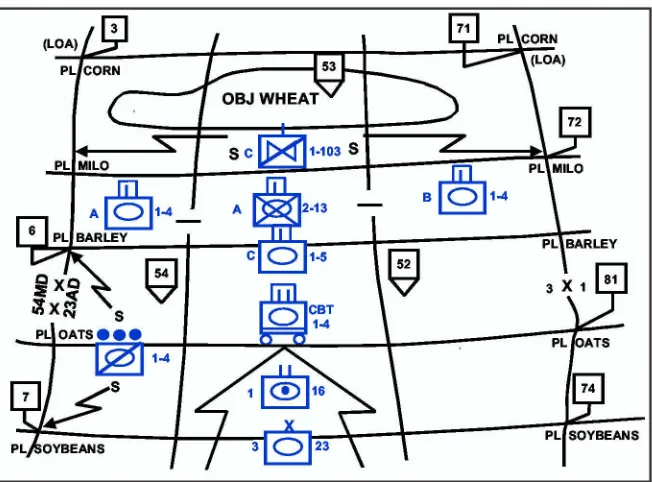
ADVANCE GUARD
12-69. An advance guard for a stationary force is defensive in nature. It de-fends or delays in accordance with the main body commander's intent. An ad-vance guard for a moving force is offensive in nature. (See Figure 12-11.) The advance guard develops the situation so the main body can use its combat power to the greatest effect. The main body's combat power must not be dissi-pated through piecemeal commitment. The full combat power of the main body must be available immediately to defeat the main enemy force.
A~1-4-6 PL BARLEY
r&l
PL MILO
B ~1-4
~
1-4
7~S
PL SOYBEANS
Figure 12-11. Advance Guard for a Division Shaping Attack
12-70. An advance guard for a moving force normally conducts a movement to contact. It organizes and uses the graphics of a movement to contact. (See Chapter 4.) Ground subordinate elements of a guard are normally deployed abreast to cover the axis of advance or the main body's AO.
12-71. The advance guard is responsible for clearing the axis of advance or designated portions of the AO of enemy elements. This allows the main body to move unimpeded, prevents the unnecessary delay of the main body, and defers the deployment of the main body for as long as possible.
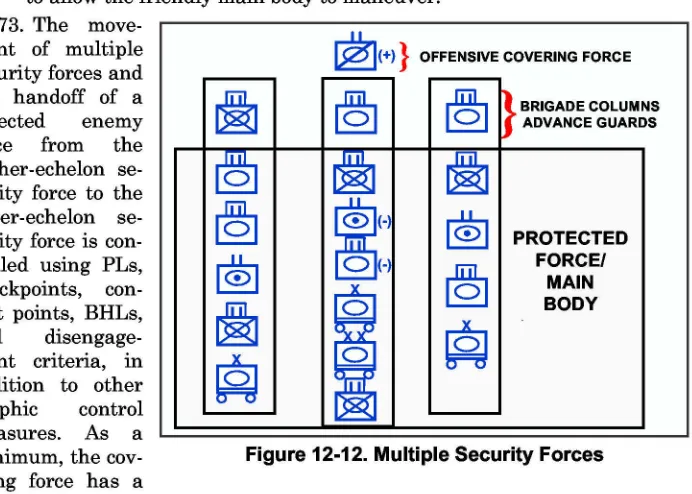
12-72. The advance guard may operate behind the security force of a higher echelon. For example, a division may use its cavalry squadron (reinforced) as an offensive covering force, while each subordinate brigade column organizes one of its battalion task forces into an advance guard. (See Figure 12-12, page 12-22.) In these situations, the higher-echelon security force will ini-tially develop the situation. A commander may task the advance guard
to-.
Coordinate and conduct the rearward passage of lines of the covering force.FLANK GUARD
.
Eliminate enemy forces bypassed by the covering force..
Coordinate and conduct a forward passage of lines through the cover-ing force and fIx enemy forces in the enemy's main defensive positions to allow the friendly main body to maneuver.12-73. The move-ment of multiple security forces and the handoff of a detected enemy force from the higher-echelon se-curity force to the lower-echelon se-curity force is con-trolled using PLs, checkpoints, con-tact points, BHLs, and disengage-ment criteria, in addition to other graphic control measures. As a minimum, the cov-ering force has a
rear boundary that is also the forward boundary of the advance guard.
12-74. The advance guard engages in offensive operations when necessary to accomplish the mission. Mter the guard makes enemy contact, the command-er detcommand-ermines whether the guard mission requires an attack, a defense, or a delay based on the factors of METT-TC. For example, if the guard force has sufficient combat power to defeat an enemy, it may conduct a hasty attack or defend from its current location. The guard force will not assault strong ene-my positions from the front if this can be avoided. The advance guard then destroys the withdrawing enemy force as it exposes itself by moving to other positions. If the advance guard encounters an enemy force that it cannot stop from interfering with the movement of the main body, the security force re-ports its presence to the main body. It then establishes a defense, continues reconnaissance operations, and prepares to pass elements of the main body forward while facilitating the deployment of the main body.
12-75. If the guard force does not have enough combat power to defeat an ap-proaching enemy, and the depth of the security area permits, the commander can delay back one or more positions before becoming decisively engaged. This reduces the enemy's combat power. Unless the security force is relieved of the guard mission, it must accept decisive engagement to prevent enemy ground forces from using direct fires to engage the main body.
~
~(+)}
~
BRIGADE COLUMNSADVANCE GUARDS
OFFENSIVE COVERING FORCE
~
~
~
~
~
~
~
~
~
PROTECTED FORCEI
MAIN BODY
Figure 12-12. Multiple Security Forces
12-76. A flank guard protects an exposed flank of the main body. A flank
12-77. The commander of the main body designates the general location of the flank guard's positions. Areas of operation assigned to the flank guard should be sufficiently deep to provide early warning and reaction time. How-ever, flank guards must remain within supporting range of the main body. To determine the guard force's exact initial positions, the flank guard com-mander considers the front and rear of1:he flank of the main body, the axis taken by the main body, the enemy's capabilities, and the available avenues of approach.
12-78. The flank guard moves to its initial positions using one of the move-ment techniques discussed on pages 12-11 to 12-13. On reaching the initial positions, the flank guard establishes defensive positions in assigned BPs or within its assigned AO and establishes a screening element forward of these positions. (See Figure 12-13.) In situations where knowledge about the enemy is vague, the flank guard maintains a larger reserve than in situations where the enemy's actions are more predictable.
x
,~
,
I I...~
ENY
ENY ENY
FEBA "'II
r-III r-c: m ,.,
I
,
I
\ ,
-xx
",
, ,
I
,
,
\"
-tD
1IIr-:I:c: 'cm
"'II III ;ij C
Figure 12-13. Stationary Flank Guard
12-79. Once the flank guard makes contact with the enemy, it can attack; de-fend to defeat or fix enemy ground forces in their current positions before they can engage the main body; or conduct a delay as required by the situa-tion.
12-81. The lead element of a moving flank guard must accomplish three tasks. It must maintain contact with the protected force's main body, recon-noiter the area between that main body and the flank guard's routes of ad-vance, and reconnoiter tb.e flank guard's route. It accomplishes these tasks by conducting a zone reconnaissance. The speed of the main body determines how thoroughly it can carry out the reconnaissance. The exact size of the AO for any given unit conducting a guard is METT-TC dependent. For example, on typical central European terrain, an AO wider than 10 kilometers from the guard line to the boundary of the main body should not be assigned to a com-pany or troop. An organization of this size quickly finds itself unable to match the movement of the main body. When the distance from the guard line to the main body boundary exceeds 10 kilometers, the commander of the flank se-curity element should use two or more company-size elements abreast. This ensures that the element making contact with the main body is not over-tasked and can match the tempo of the main body. An air cavalry troop may maintain contact with the main body, or a following ground element may per-form route reconnaissance along the flank guard's route of advance. Under these conditions, the lead security element does not reconnoiter BPs or oc-cupy them unless required when making contact.
12-82. The rest of the flank guard marches along the route of advance and oc-cupies BPs as necessary. Criteria for the route are the same as in a moving flank screen. The commander designates company-size BPs parallel to the axis of the main body. He places these BPs outside the flank guard's route of advance and along avenues of approach into the flank guard. The flank guard occupies OPs along a screen line forward of these BPs.
12-83. Since the flank guard is moving in one direction and orienting on pro-viding protection to the secured force in another direction, the flank guard commander plans control measures to facilitate this dual orientation. These control measures are normally associated with the moving screen, as well as PLs that run parallel to the direction of movement of the main body. The commander uses these PLs to control the delay or defense if the enemy at-tacks from the flank being protected. (See Figure 12-14.) He may also assign the flank guard an objective that secures the flank for the main body's objec-tive or otherwise serves to orient its security efforts.
12-84. The flank guard regulates its movement along the route of advance by the pace of the main body, the distance to the objective, and the enemy situa-tion. The three methods of movement are successive bounds, alternate bounds, or continuous marching. (See Chapter 14.) If the main body stops, the flank guard occupies blocking positions. As the speed of the main body changes, the flank guard changes its movement methods. The guard com-mander must not allow the force to fall behind the main body or present a lu-crative target by remaining stationary along the route.
12-85. If the flank guard becomes overextended, the guard commander in-forms the main body commander and recommends one of the following COAs:
.
Reinforce the flank guard..
Reduce the size of the flank guard's AO.xx
D
"'IIr-::eJ: :::j m
"'II
r-"'II Z
'" IiiJ: !:
"'II
r-::e J: :::j m
PL BORRIS
PLYURI
PL MACHIAULD
Figure 12-14. Moving Flank Guard Control Measures
REAR GUARD
12-86. The rear guard protects the exposed rear of the main body. This occurs during offensive operations when the main body breaks contact with flanking forces or during a retrograde. The commander may deploy a rear guard be-hind both moving and stationary main bodies. The rear guard for a moving force displaces to successive BPs along PLs or delay lines in depth as the main body moves. The nature of enemy contact determines the exact move-ment method or combination of methods used in the displacement (successive bounds, alternate bounds, and continuous marching).
12-87. During a retrograde, the rear guard normally deploys its ground ma-neuver elements abreast, behind the main body's forward maneuver units, generally across the entire AO. Mter the main body conducts a rearward pas-sage of lines, the rear guard accepts battle handover and then defends or de-lays. Alternatively, the rear guard may conduct a relief in place as part of a deception plan or to take advantage of the best defensive terrain. In both cases, the rear guard establishes passage points and assists the rearward passage of the main body, if necessary. The rear guard accomplishes its de-fensive mission in the same way as any other guard operation after the main body clears the security area. As the main body moves, the rear guard moves to subsequent PLs in depth. Contact with the enemy force may eventually be lost if it does not follow the retrograding friendly force. Fighting a defense or a delay is necessary if the enemy detects the movement and attacks. (Chap-ter 11 discusses retrograde operations.)
COVER
body and the covering force. The width of the covering force area is the same as the AO of the main body.
12-89. A covering force is a self-contained force capable of operating independently of the main body, unlike a screening or guard force. A covering force, or portions of it, often becomes decisively engaged with enemy forces. Therefore, the covering force must have substantial combat power to engage the enemy and accomplish its mission. A covering force develops the situation earlier than a screen or a guard force. It fights longer and more often and defeats larger enemy forces.
12-90. While a covering force provides more security than a screen or guard force, it also requires more resources. Before assigning a cover mission, the main body commander must ensure that he has sufficient combat power to resource a covering force and the decisive operation. When the commander lacks the resources to support both, he must assign his security force a less resource-intensive security mission, either a screen or a guard.
12-91. A covering force accomplishes all the tasks of screening and guard forces. A covering force for a stationary force performs a defensive mission, while a covering force for a moving force generally conducts offensive actions. A covering force normally operates forward of the main body in the offense or defense, or to the rear for a retrograde operation. Unusual circumstances could dictate a flank covering force, but this is normally a screen or guard mISSIon.
ORGANIZATION OF A COVERING FORCE
12-92. Whether the cover is for a stationary (defending) or moving (attacking) force, the various types of cover missions, as well as knowledge of the terrain and enemy, dictate the specific task organization of the covering force. The covering force commander normally plans to conduct the cover mission as an area defense (Chapter 9), a delay (Chapter 11), a zone reconnaissance (see FM 3-55), or a movement to contact (Chapter 4) mission within the security area.
12-93. The commander normally assigns subordinate units one of these mis-sions or the mission of screen or guard. The covering force uses those organi-zations and control measures associated with these missions. In addition, the commander establishes those control measures necessary for conducting the covering force's passage of lines (forward and rearward). (See Chapter 15.)
12-95. A division covering force is normally a reinforced brigade, often with the divisional cavalry squadron as part of the covering force, to perform re-connaissance or other security missions. If the division AO is narrow enough, an adequately reinforced cavalry squadron may perform a cover mission. At both corps and division echelons, the amount of reinforcement provided to the covering force determines the distance and time it can operate away from the main body. These reinforcements typically revert to their parent organiza-tions on passage of the covering force. Brigades and battalions typically or-ganize a guard force instead of a covering force because their resources are limited.
12-96. Since one task of the covering force is to deceive the enemy into think-ing he has found the main body, the commander should supply the covering force with combat systems that are representative of the main body. For example, if the main body has organic or reinforcing systems, such as MLRS, available to it, the commander should organize the covering force with the same systems.
OFFENSIVE COVER
12-97. An offensive covering force seizes the initiative early for the main body commander, allowing him to att-ack decisively. Figure 12-15 shows an attacking main body with an advance covering force and a flank guard.
12-98. Unless the commander orders otherwise, an offensive covering force performs specific tasks within its cap-abilities. If a unit does not have the time or other resources to complete all of these tasks, it must inform the commander assigning the mission of the shortfall and request guidance on which tasks to complete or the prior-ity of tasks. Mter starting the mis-sion, if the unit determines that it cannot complete an assigned task,
such as destroying or repelling enemy reconnaissance and security forces in the enemy security area, it must report this to the commander and await fur-ther instructions. Offensive covering force tasks
include-.
Performing zone reconnaissance along the main body's axis of advance or within the AO..
Clearing or bypassing enemy forces within the AO in accordance with bypass criteria..
Denying the enemy information about the strength, composition, and objective of the main body.s--
s0
s z...0 0 0
}
COVERING[!]
FORCE~
~G N
OK
G G
U A R D
MAIN BODY
~
Figure 12-15. Attack Using a Covering Force
12-99. Covering tasks against a defending enemy
.
Determining enemy strengths and dispositions..
Locating gaps or weaknesses in the enemy's defensive scheme..
Defeating or repelling enemy forces as directed by the higher commander..
Deceiving the enemy into thinking the main body has been committed and causing him to launch counterattacks prematurely..
Fixing enemy forces to allow the main body to maneuver around enemy strengths or through weaknesses.12-100. In a meeting engagement, covering tasks
include-.
Destroying enemy reconnaissance, the advance guard, and the lead ele-ments of the main body..
Determining the location of enemy assailable flanks..
Fixing enemy forces to allow the main body to maneuver around enemy strengths or through weaknesses.12-101. Planning for offensive covering force operations is similar to planning for zone reconnaissance or movement to contact. Mission analysis using the products of the IPB process helps determine the width of the area to cover and areas (NAIs and TAIs) or routes of special importance. The commander determines specific missions for subordinate elements and assigns bounda-ries. The covering force commander retains a reserve, which is ready to de-ploy anywhere in the covering force area. This reserve may be centrally located; it typically locates itself on the most dangerous or critical avenue of approach in the security area.
12-102. The covering force advances on a broad front, normally with its sub-ordinate ground maneuver elements abreast (except for the reserve). This force should clear the enemy's security area of small combat elements while penetrating into the enemy's main defenses. Air cavalry normally reconnoi-ters forward of advancing ground covering force elements. On enemy contact, the air cavalry reports the enemy's location to the appropriate ground unit and maintains contact. Once the air cavalry makes contact, the covering force rapidly develops the situation. It reports enemy dispositions immediately to the main body commander so he can exploit enemy weaknesses. The covering force fIxes encountered enemy forces and destroys them using fIre and move-ment. The covering force does not bypass enemy forces without the permis-sion of the main body commander.
12-103. If the covering force discovers a gap in the enemy's defenses, it pre-pares to exploit the weakness and disrupt the integrity of that defense. The covering force commander immediately reports this to the main body com-mander so he can divert main body follow-on forces to support the penetra-tion. The main body commander synchronizes the penetration by the covering force with the arrival of other maneuver units, es, and ess to prevent coun-terattacking enemy forces from isolating and destroying the penetrating ele-ments of the covering force.
s~s
PL BRIAN
II
LJ
D
X
Pi
c!J
XII
X
[!]
XII
II PL TOM
~X
(BHL) X
~PL
DANIEL
PL DANIEL (BHL)
X
,
X EBAFEBA X
I
around the covering force. If the covering force has accomplished its mission, the main body commander will attack the enemy's weak point with pre-viously uncommitted main body forces at the appropriate time.
FLANK COVER
12-105. When the main body commander perceives a significant threat to one of his flanks, he normally establishes a flank covering force. That force con-ducts its mission in much the same way as a flank guard performs its mis-sion. The main differences between the two missions are the scope of opera-tions and the distance the covering force operates away from the main body.
12-106. Just as in a flank guard, the flank covering force must clear the area between its route of advance and the main body. It must also maintain con-tact with an element of the main body specified by the main body commander. This element is normally part of the advance guard for the flank unit of the main body.
DEFENSIVE COVER
12-107. A defensive covering force prevents the enemy from attacking at the time, place, and combat strength of his choosing. (See Figure 12-16.) Defen-sive cover gains time for the main body, enabling it to deploy, move, or pre-pare defenses in the MBA. It accomplishes this by disrupting the enemy's at-tack, destroying his initiative, and establishing the conditions for decisive op-erations. The covering force makes the enemy deploy repeatedly to fight through the covering force and commit his reserve or follow-on forces to sus-tain momentum.
Figure 12-16. Generic Depiction of a Defensive Cover
commander assigning the mission of the shortfall and request guidance on which tasks to complete or the priority of tasks. Mter starting the mission, if the unit determines that it cannot complete an assigned task, such as defeat enemy advance guard formations, it must report this to the commander and await further instructions. A defensive covering force emphasizes the follow-ing
tasks-.
Prevent the main body from being surprised and becoming engaged by direct-fire weapons..
Defeat enemy advance guard formations..
Maintain continuous surveillance of high-speed avenues of approach into the security area..
Defeat all enemy reconnaissance formations before they can observe the main body..
Cause the deployment of the enemy main body..
Determine the size, strength, composition, and direction of the enemy's main effort..
Destroy, defeat, or attrit enemy forces within its capacity..
Deprive the enemy of his fire support and air defense umbrellas, or re-quire him to displace them before he attacks the MBA..
Deceive the enemy regarding the location of main body and main de-fensive positions..
Avoid being bypassed.12-109. The defensive covering force may be required to defend, delay, or counterattack. If the covering force area is not occupied, the force may have to reconnoiter and clear the area before establishing the cover. As in offensive operations, aerial reconnaissance is necessary to extend the area covered. Aviation units can screen less threatened areas and rapidly reinforce with their fires when other elements of the covering force are heavily engaged.
12-110. Whatever the command relationships may be at the outset, as the de-fensive covering force battle progresses, the covering force will be forced back toward the MBA. At this time, some or all of the covering force units fall under the control of the brigades charged with defending the MBA. Once the defensive covering force completes its mission, ground maneuver task forces reinforcing the covering force can do one of three things, separately or in com-bination. They can take up positions in the MBA, undergo reconstitution, or become part of the echelon reserve. The commander may use cavalry and other reconnaissance elements from the covering force as flank or rear secur-ity forces. Alternatively, he may use them to locate and follow the movement of the enemy's follow-on forces. They only establish BPs in the MBA as a last resort.