New Impossible Differential Attacks on AES
Jiqiang Lu1,⋆, Orr Dunkelman2,⋆⋆, Nathan Keller3,⋆ ⋆ ⋆, and Jongsung Kim4,†
1
Department of Mathematics and Computer Science, Eindhoven University of Technology,
5600 MB Eindhoven, The Netherlands [email protected] 2 Ecole Normale Sup´erieure´
D´epartement d’Informatique, 45 rue d’Ulm, 75230 Paris, France.
Einstein Institute of Mathematics, Hebrew University. Jerusalem 91904, Israel
4 Center for Information Security Technologies(CIST), Korea University
Anam Dong, Sungbuk Gu, Seoul, Korea [email protected]
Abstract. In this paper we apply impossible differential attacks to reduced round AES. Using various techniques, including the early abort approach and key schedule considerations, we significantly improve previously known attacks due to Bahrak-Aref and Phan. The improvement of these attacks leads to the best known impossible differential attacks on 7-round AES-128 and AES-192, as well as to the best known impossible differential attacks on 8-round AES-256.
Keywords:AES, Impossible differential cryptanalysis
1
Introduction
TheAdvanced Encryption Standard (AES)[13] is a 128-bit block cipher with a vari-able key length (128, 192, and 256-bit keys are supported). Since its selection, AES gradually became one of the most widely used block ciphers. AES has received a great deal of cryptanalytic attention, both during the AES process, and even more after its selection.
In the single-key model, previous results can attack up to 7 rounds of AES-128 (i.e., AES with 128-bit key). The first attack is a SQUARE attack suggested in [15]
⋆
The work was done when this author wasa Ph.D. student at Royal Holloway, University of London.
⋆⋆
The first author was supported by the France Telecome Chaire. Some of the work presented in this paper was done while the first author was staying at K.U. Leuven.
⋆ ⋆ ⋆
This author is supported by the Adams Fellowship Program of the Israel Academy of Sciences and Humanities.
which uses 2128−2119 chosen plaintexts and 2120 encryptions. The second attack
is a meet-in-the-middle attack proposed in [16] that requires 232 chosen plaintexts
and has a time complexity equivalent to almost 2128 encryptions. Recently, another
attack on 7-round AES-128 was presented in [1]. The new attack is an impossible differential attack that requires 2117.5 chosen plaintexts and has a running time of
2121 encryptions.
Similar results, but with better attack algorithms and lower complexities were reported in [20]. The resulting impossible differential attack on 7-round AES-192 has a data complexity of 292chosen plaintexts and time complexity of 2162 encryptions,
while the attack on AES-256 uses 2116.5chosen plaintexts and running time of 2247.5
encryptions.
There are several attacks on AES-192 [1, 14, 15, 18–20]. The two most notable ones are the SQUARE attack on 8-round AES-192 presented in [15] that requires almost the entire code book and has a running time of 2188encryptions and the meet in the
middle attack on 7-round AES-192 in [14] that requires 234+n chosen plaintexts and has a running time of 2208−n+ 282+nencryptions. Legitimate values fornin the meet in the middle attack on AES-192 are 94≥n≥17, thus, the minimal data complexity is 251 chosen plaintexts (with time complexity equivalent to exhaustive search), and
the minimal time complexity is 2146(with data complexity of 297chosen plaintexts).
AES-256 is analyzed in [1, 14, 15, 18, 20]. The best attack is the meet in the middle attack in [14] which uses 232 chosen plaintexts and has a total running time of 2209
encryptions.
Finally, we would like to note the existence of many related-key attacks on AES-192 and AES-256. As the main issue of this paper is not related-key attacks, and as we deal with the single key model, we do not elaborate on the matter here, but the reader is referred to [21] for the latest results on related-key impossible differential attacks on AES and to [17] for the latest results on related-key rectangle attacks on AES.
The strength of AES with respect to impossible differentials was challenged several times. The first attack of this kind is a 5-round attack presented in [5]. This attack is improved in [11] to a 6-round attack. In [19], an impossible differential attack on 7-round AES-192 and AES-256 is presented. The latter attack uses 292 chosen
plaintexts (or 292.5 chosen plaintexts for AES-256) and has a running time of 2186
encryptions (or 2250.5 encryptions for AES-256). The time complexity of the latter
attack was improved in [20] to 2162encryptions for AES-192.
In [1] a new 7-round impossible differential attack was presented. The new attack uses a different impossible differential, which is of the same general type as the one used in previous attacks (but has a slightly different structure). Using the new im-possible differential leads to an attack that requires 2117.5 chosen plaintexts and has
a running time of 2121 encryptions. This attack was later improved in [2, 20] to use
2115.5chosen plaintexts with time complexity of 2119encryptions.
The last application of impossible differential cryptanalysis to AES was the ex-tension of the 7-round attack from [1] to 8-round AES-256 in [20]. The extended attack has a data complexity of 2116.5chosen plaintexts and time complexity of 2247.5
We note that there were three more claimed impossible differential attacks on AES in [8–10]. However, as all these attacks are flawed [7].
In this paper we present a new attack on round AES-128, a new attack on 7-round AES-192, and two attacks on 8-7-round AES-256. The attacks are based on the attacks proposed in [1, 19] but use additional techniques, including the early abort
technique and key schedule considerations.
Our improvement to the attacks on 7-round AES-128 from [1, 20] requires 2112.2
chosen plaintexts, and has a running time of 2117.2memory accesses. Our improvement
to the attack on 7-round AES-192 from [19] has a data complexity of 291.2 chosen
plaintexts and a time complexity of 2139.2 encryptions. Since the first attack is also
applicable to AES-192, the two attacks provide a data-time tradeoff for attacks on 7-round AES-192.
The best attack we present on 8-round AES-256 requires 289.1 chosen plaintexts
and has a time complexity of 2229.7 memory accesses. These results are significantly
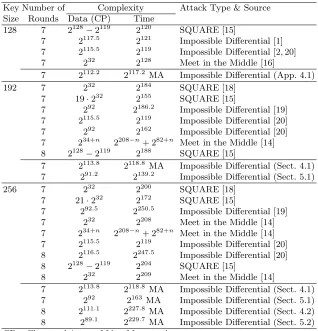
better than any previously published impossible differential attack on AES. We sum-marize our results along with previously known results in Table 1.
Although the attacks presented in the paper are not the best known attacks on AES, the results are important, both due to the significance of the AES, and since the techniques used in the paper can be useful in other works as well.
This paper is organized as follows: In Section 2 we briefly describe the structure of AES. In Section 3 we discuss the previous impossible differential attacks. In Section 4 we describe the possible improvements and extensions (to 8-round AES-256) of the Bahrak and Aref attack. The improvement of Phan’s attack on 7-round AES-192 along with its extension to 8-round AES-256 is presented in Section 5. In Appendix A we describe a technique which is repeatedly used in impossible differential attacks on AES. Appendix B outlines the impossible differentials used in this paper for the sake of completeness. We conclude the paper in Section 6.
2
Description of AES
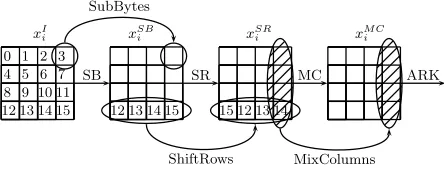
The advanced encryption standard [13] is an SP-network that supports key sizes of 128, 192, and 256 bits. A 128-bit plaintext is treated as a byte matrix of size 4x4, where each byte represents a value inGF(28). An AES round applies four operations
to the state matrix:
– SubBytes (SB) — applying the same 8-bit to 8-bit invertible S-box 16 times in parallel on each byte of the state,
– ShiftRows (SR) — cyclic shift of each row (thei’th row is shifted byibytes to the left),
– MixColumns (MC) — multiplication of each column by a constant 4x4 matrix over the fieldGF(28), and
– AddRoundKey (ARK) — XORing the state with a 128-bit subkey.
Key Number of Complexity Attack Type & Source Size Rounds Data (CP) Time
128 7 2128
−2119 2120 SQUARE [15]
7 2117.5
2121
Impossible Differential [1] 7 2115.5
2119 Impossible Differential [2, 20] 7 232
2128
Meet in the Middle [16] 7 2112.2
2117.2
MA Impossible Differential (App. 4.1) 192 7 232 2184 SQUARE [18]
7 19·232 2155 SQUARE [15]
7 292
2186.2
Impossible Differential [19] 7 2115.5
2119
Impossible Differential [20] 7 292
2162
Impossible Differential [20] 7 234+n
2208−n
+ 282+n
Meet in the Middle [14] 8 2128
−2119 2188 SQUARE [15]
7 2113.8
2118.8
MA Impossible Differential (Sect. 4.1) 7 291.2
2139.2
Impossible Differential (Sect. 5.1)
256 7 232
2200
SQUARE [18] 7 21·232 2172 SQUARE [15]
7 292.5
2250.5
Impossible Differential [19] 7 232
2208
Meet in the Middle [14] 7 234+n
2208−n
+ 282+n
Meet in the Middle [14] 7 2115.5
2119
Impossible Differential [20] 8 2116.5
2247.5
Impossible Differential [20] 8 2128
−2119 2204 SQUARE [15]
8 232 2209 Meet in the Middle [14] 7 2113.8
2118.8
MA Impossible Differential (Sect. 4.1) 7 292
2163
MA Impossible Differential (Sect. 5.1) 8 2111.1
2227.8
MA Impossible Differential (Sect. 4.2) 8 289.1
2229.7
MA Impossible Differential (Sect. 5.2) CP – Chosen plaintext, MA – Memory Accesses
Time complexity is measured in encryption units unless mentioned otherwise
Table 1.A Summary of the Previous Attacks and Our New Attacks
operation is omitted. As all other works on AES, we shall assume that reduced-round variants also have the MixColumns operation omitted from the last round.
The number of rounds depends on the key length: 10 rounds for 128-bit keys, 12 rounds for 192-bit keys, and 14 rounds for 256-bit keys. The rounds are numbered 0, . . . , N r−1, where N r is the number of rounds (N r ∈ {10,12,14}). For the sake of simplicity we shall denote AES withn-bit keys by AES-n, i.e., AES with 192-bit keys (and thus with 12 rounds) is denoted by AES-192.
xI
i x
SB
i x
SR
i x
M C i
0 1 2 3 4 5 6 7 8 9 10 11
12 13 14 15 12 13 14 15 15 12 13 14
ShiftRows MixColumns
SB SR MC ARK
SubBytes
Fig. 1.An AES round
N k= 8 for 256-bit keys. The remaining words ofW[·] are updated according to the following rule:
– Fori=N k, . . . ,43/51/59, do
• Ifi≡0 modN kthenW[i] =W[i−N k]⊕SB(W[i−1]≪8)⊕RCON[i/N k],
• OtherwiseW[i] =W[i−1]⊕W[i−N k],
whereRCON[·] is an array of predetermined constants, and≪ denotes rotation of
the word by 8 bits to the left. We also note that for 256-bit keys, wheni≡4 mod 8 the update rule isW[i] =W[i−8]⊕SB(W[i−1]≪8).
2.1 The Notations Used in the Paper
In our attacks we use the following notations:xI
i denotes the input of roundi, while
xSB
i ,xSRi ,xM Ci , andxOi denote the intermediate values after the application of Sub-Bytes, ShiftRows, MixColumns, and AddRoundKey operations of round i, respec-tively. Of course, the relationxO
i−1=xIi holds.
We denote the subkey of roundibyki, and the first (whitening) key isk−1, i.e., the subkey of the first round isk0. In some cases, we are interested in interchanging the order of the MixColumns operation and the subkey addition. As these operations are linear they can be interchanged, by first XORing the data with an equivalent key and only then applying the MixColumns operation. We denote the equivalent subkey for the altered version bywi, i.e., wi=M C−1(ki).
We denote bytes of some intermediate statexi or a keyki(orwi) by an enumera-tion{0,1,2, . . . ,15}where the byte 4m+ncorresponds to then’th byte in them’th row ofxi, and is denoted byxi,4·m+n. We denote thez’th column ofxi byxi,Col(z),
i.e.,w0,Col(0)=M C−1(k0,Col(0)). Similarly, byxi,Col(y,z)we denote columnsy andz
ofxi. We define two more column related sets. The first isxi,SR(Col(z)) which is the
bytes inxi corresponding to the places after the ShiftRows operation on column z, e.g.,xi,SR(Col(0)) is composed of bytes 0,7,10,13. The second is xi,SR−1(Col(z)) which
is the bytes in the positions of columnz after having applied the inverse ShiftRows operation.
3
Previous Impossible Differential Attacks on AES
use very similar impossible differentials as well as similar algorithms. In this section we present the previously known results:
All known impossible differential attacks on the AES, are based on the following 4-round impossible differential of AES, first observed in [5]:
Proposition 1. Let ∆(xI
i) denote the input difference to round i, and let ∆(xSRi+3) denote the difference after the ShiftRows operation of roundi+ 3. If the following two conditions hold:
1. ∆(xI
i)has only one non-zero byte,
2. In∆(xSR
i+3), at least one of the four sets of bytesSR(Col(i)), for the four different possible columns, is equal to zero,
then∆(xI
i)−→∆(x SR
i+3)is an impossible differential for any four consecutive rounds of AES. We outline one of these impossible differentials in Figure 4 (in Appendix B). We also note that if in roundi+ 3 the order of MixColumns and AddRoundKey is swapped, then, one can consider the impossible differential∆(xI
i)−→∆(x O i+3).
Proof. On the one hand, if∆(xI
i) has only one non-zero byte then∆(xIi+1) has
non-zero values in a single column, and therefore,∆(xI
i+2) has non-zero values in all the
16 bytes of the table (following the basic diffusion properties of AES, a fact used in many attacks on AES). On the other hand, if Condition (2) holds then∆(xI
i+3) has at
least one zero column, and hence at least one of the four sets of bytesSR−1(Col(i))
in∆(xI
i+2) is equal to zero, a contradiction.
3.1 The Original Bahrak-Aref Attack on 7-round AES-128
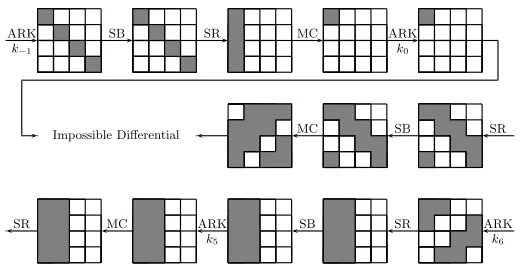
The algorithm of the BA attack, as described in [1], is the following (depicted in Figure 2):1
1. Encrypt 285.5structures of 232plaintexts each, such that in every structure, bytes SR−1(Col(0)) assume all the 232possible values and the rest of the bytes are fixed.
2. In each structure, look for ciphertext pairs with zero difference in bytesSR(Col(1,2)) and discard the other pairs.
3. Guess the values ofk6,SR(Col(3))and partially decrypt all the remaining ciphertext
pairs through round 6 to obtain the difference∆(xSR
5,Col(3)). Select only the pairs
for which∆(xSR
5,Col(3)) has a non-zero value only in byte 7.
4. Guess the values of bytes k6,SR(Col(0)) and partially decrypt all the remaining
ciphertext pairs through round 6 to get the difference ∆(xSR
5,Col(0)). Select only
the pairs for which∆(xSR
5,Col(0)) has a non-zero value only in byte 0.
5. Guess the values of bytes (0,7) of the equivalent keyw5and partially decrypt all the remaining ciphertext pairs through round 5 to get the difference∆(xSR
4,Col(0)).
Select only the pairs for which∆(xSR
4,Col(0)) has one zero byte value.
1
Impossible Differential ARK
k−1
SB SR MC ARK
k0
ARK
k6
SR SB
MC ARK
w5
SR
SR SB
MC
A gray box stands for a non-zero difference in the byte, while a white box stands for a zero difference.
Fig. 2.The 7-Round Impossible Differential Attack on AES by Bahrak and Aref
6. For each of the remaining pairs, consider the corresponding plaintext pair and discard all the values ofk−1,SR−1(Col(0)) that lead to the input difference of the
impossible differential in the input of round 1. If a guess for these bytes remains, guess all the remaining key bytes and check the guess using trial encryption. Otherwise, repeat Steps 4–6 for a different guess ofk6.
Step 1 of the attack consists of encryption of 2117.5 chosen plaintexts. Step 2
requires 2117.5 memory accesses, and suggests 284.5 pairs to Step 3. Step 3 takes
2117.5partial decryptions and passes 260.5 pairs, for a given subkey guess, to Step 4,
which in turn takes 2125.5partial decryptions and outputs 236.5pairs to Step 5. Step 5
requires 2117.5partial decryptions, and leaves 230.5pairs to Step 6, which uses 2118.5
memory accesses.
Hence, the total time complexity of the attack is 21217-round AES encryptions.2
The data complexity of the attack is 2117.5 chosen plaintexts, and the memory
com-plexity is 2109bytes of memory required for storing the list of discarded key values.
3.2 The Phan Attack Algorithm on 7-Round AES-192
The algorithm of the Phan attack, as described in [19], is the following (depicted in Figure 3):
1. Encrypt 260 structures of 232 plaintexts each such that in every structure, the
bytes of SR−1(Col(0)) assume all the 232 possible values and the rest of the
bytes are fixed.
2. Select only the ciphertext pairs, corresponding to plaintexts in the same structure, for which the difference in bytesSR(Col(2,3)) is zero.
2
Impossible Differential ARK
k−1
SB SR MC ARK
k0
ARK
k6
SR SB
ARK
k5
MC SR
SR SB
MC
Fig. 3.The 7-Round Impossible Differential Attack on AES-192 by Phan
3. Guessk6 and partially decrypt the remaining ciphertext pairs through round 6 to getxI
6.
4. Using the guessed value ofk6, retrievek5,Col(0,1)by the key schedule algorithm.
For each remaining pair, decryptxI
6 throughARK−1◦M C−1◦SR−1◦SB−1◦ M C−1 to get the difference∆(xSR
4 ).3 If the difference does not satisfy Condition
(2) of Proposition 1, discard the pair.
5. Consider the plaintext pairs corresponding to the remaining ciphertext pairs. Guess the value of k−1,SR−1(Col(0)) and partially encrypt each plaintext pair
through ARK ◦SB ◦SR◦M C to get the difference ∆(xI
1). If the difference
satisfies Condition (1) of Proposition 1, discard the guess ofk−1,SR−1(Col(0)).
6. If all the guesses ofk−1,SR−1(Col(0))are discarded for a guess ofk6, repeat Steps 3–
5 with another guess ofk6. If a candidate ofk−1,SR−1(Col(0)) remains, the rest of
the key bits (or their equivalent) are exhaustively searched.
Step 1 of the attack consists of the encryption of 292 chosen plaintexts. Step 2
of the attack takes 292 memory accesses and proposes 259 pairs for further analysis.
Steps 3 and 4 take together 2188 two-round decryptions, and suggest 229 pairs for
Step 5 (for a given key guess). Step 5 takes 21851-round encryptions.
Therefore, the data complexity of the attack is 292chosen plaintexts, and the time
complexity is 2186.2 7-round AES-192 encryptions. The attack requires 2157 bytes of
memory, used for storing the discarded guesses ofk6 andk−1,SR−1(Col(0)).
4
Improvement of the Bahrak-Aref Attack
4.1 Improvement of the Bahrak-Aref Attack on 7-Round AES-128
Our improvements to the 7-round attack are based on several techniques and observa-tions. First, instead of partially decrypting each candidate pair under many possible
3
Note that theARK−1
key guesses, we use table look ups to deduce which key it suggests. The second im-provement is based on re-using the data, i.e., repeating the attack several times by using a slightly different impossible differential. Using these two ideas along with sev-eral additional techniques, we succeed in reducing the data and time complexities of the BA attack.
We first discuss the improvement of the time complexity of the attack. However, as we demonstrate later, the data complexity of the attack can be reduced to 2112.2
chosen plaintexts. Hence, we use this figure in the computation of the time complexity as well.
Improving the Time Complexity of the BA Attack Steps 1 and 2 of the attack remain unchanged, except for the reduction in the number of plaintexts. As a result, the time complexity of Step 2 is 2112.2 memory accesses, and the number of pairs
remaining after Step 2 is 279.2.
In Step 3 of the BA attack the attacker decrypts a full column through round 6 by guessing 32 subkey bits. This step is significantly improved by using a well-known observation related to differential cryptanalysis: Given an input and an output differences of the SubBytes operation, there is on average one pair of actual values that satisfies these differences.4 Since for any ciphertext pair, the difference∆(xSB
6,Col(3))
is known, the knowledge of the difference∆(xI
6,Col(3)) can be used to find the actual
values ofxSB
6,Col(3), and hence the value of k6,SR(Col(3)) as well. ere are only 28−1
possible values of ∆(xSR
5,Col(3)) in which only byte 7 is non-zero. Thus, there are
only 255 possible differences∆(xI
6,Col(3)) that may be considered for further analysis.
Hence, the attacker can perform Step 3 of the attack in the following way:
– Initialize 232 empty lists, each corresponds to a different guess ofk6
,SR(Col(3)).
– For each remaining ciphertext pair, and for each of the 255 possible differences in ∆(xI
6,Col(3)), compute the key which leads this specific pair to this specific
difference. Add this pair to the list corresponding to that specific key guess.
For each pair of ciphertexts and a guess of the difference in∆(xI
6,Col(3)) we expect
one key suggested on average. These 279.2·255 = 287.2 suggestions are distributed
over 232 possible subkeys, and thus, for a given subkey guess, we expect 255.2 pairs
to remain.
As finding the key suggestion can be done by a simple look-up table, the time complexity of the modified Step 3 is 255·279.2 = 287.2 memory accesses. We note
that by storing the results in the table in an efficient way, we can obtain the result in one memory access even if more than one key is suggested. Actually, most of the queries are expected to fail, while about 1/16 of the queries are expected to return 16 options (which can be efficiently stored in one 32-bit memory block), and even smaller fraction are expected to return more options. Hence, in total we expect 287.2
memory accesses to perform this step.
4 More accurately, for randomly chosen input and output differences we expect that about
Step 4 of the attack can be modified similarly to Step 3. As a result, the time complexity of the modified Step 4 is 295.2 memory accesses, and the number of
re-maining pairs (for a given subkey guess of the 64 bits ofk6,SR(Col(0,3))) after Step 4
is 231.2.
Step 5 of the attack can be also improved using the observation presented above. Recall that the goal of the attacker in Step 5 is to check whether∆(xSR
4,Col(0)) has one
zero byte value. There are 4·2553valuesu=∆(xSR
4,Col(0)) satisfying this requirement,
and for each such valueu, there is a unique v=∆(xI
5,Col(0)) such that v=M C(u).
Of the 4·2553possiblev’s there are 4·255≈210with zero difference in bytes (8,12).
Hence, the goal of the attacker is to check, for every guess of bytes (0,7) of w5, whether the value in bytes (0,4) of∆(xI
5,Col(0)) falls into these 210values.
As explained before, given the input/output differences of the SubBytes operation, the actual inputs and outputs can be determined. In turn, these values can be used to determinew5 in a similar way to that described in Step 3.
Thus, at the end of this process, the 231.2 pairs and the 210 possible differences
propose 241.2candidate keys which are scattered among 216candidate values. Hence,
for a given guess for bytes (0,7) ofw5 we expect 241.2/216 = 225.2 pairs which lead
to the output difference of the impossible differential. As finding the key suggestion can be done by a simple look-up table, this step takes 231.2·210 memory accesses for
a given subkey guess ofk6, or a total of 264·231.2·210= 2105.2 memory accesses.
We note that the overall complexity of these steps can be reduced to about 290
memory accesses. This is done by observing that in the first step of the filtering, i.e., Step 2, we obtain 279.2pairs with 264 possible differences. Our analysis can be easily
augmented to take this into consideration and analyze only one pair with a given difference. However, we note that this is not the bottleneck in our algorithm (and thus, this step is not as optimized as possible).
Improving Step 6 of the BA Attack and Reducing the Data Complexity Since our improved attack uses less data than the original attack, it is expected that for every guess of the 80 bits ofk6 andw5, only 225.2 pairs are analyzed in Step 6 of
the attack. This number of pairs is far from being sufficient to discard all the possible values ofk−1,SR−1(Col(0)). Hence, Step 6 of the original attack has to be modified.
We start with a simple observation: In step 6 of the BA attack, the attacker uses only pairs that have a non-zero difference only in byte 0 (while the remaining bytes have a zero difference). As there are actually 4 impossible differentials which originate from this column (one for each possible non-zero byte ofx1,Col(0)), we can use other
pairs as well. This observation increases the number of keys each pair discards from 28 to 210.5
Furthermore, we observe that four variants of the original attack can be applied using the same data set. For each guess ofk6,SR(Col(0,3))we apply four similar attacks:
The first is the BA attack, and in the other three variants, bytes (0,7) of w5 are replaced by the pairs of bytes (4,11),(8,15), and (12,3), respectively. Each attack discards possible values of 112 subkey bits, including 96 common bits (the bits of
k6,SR(Col(0,3))andk−1,SR−1(Col(0))) and 16 bits that differ between the attacks. After
applying the four attacks separately, we aggregate the remaining subkey values to get a small number of suggestions for part of the key, and check the suggestions by exhaustive search over the remaining key bits.
This is done efficiently by running the modified steps 3–5 each time for each guess of k6,SR(Col(0,3)) with different two active bytes in xM C4 . For each guess of k6,SR(Col(0,3)) we obtain the remaining candidates for k−1,SR−1(Col(0)) and the two
respective bytes ofw5. We store these in a table indexed by thek−1,SR−1(Col(0))
val-ues. The 225.2analyzed pairs (for a guess ofk6
,SR(Col(0,3)and two bytes ofw5) suggest
(1−2−32)235
.2
= 2−13.25remaining candidates fork−1
,SR−1(Col(0))on average.
Equiv-alently, for each value ofk−1,SR−1(Col(0)), there are 2
2.75 remaining values of the two w5 bytes for each of the four pairs of two bytes fromw5 (for a givenk6,SR(Col(0,3))
guess). After applying the four attacks separately, we go over the k−1,SR−1(Col(0))
values, and for each value we compute all the possible combinations of w5,Col(0,3)
that correspond to the value ofk−1,SR−1(Col(0)) in the respective attack. As a result,
for each value ofk−1,SR−1(Col(0)) we expect (22.75)4= 211 values ofw5,Col(0,3).
Com-bining all thek−1,SR−1(Col(0)) values, we get 243 possible values for w5,Col(0,3), and
consequently, a list of 243 values fork5
,Col(0,3).
Hence, for each guess of k6,SR(Col(0,3)) we are left with 243 possible values of k5,Col(0,3). Now we observe that by the key schedule of AES-128, there is a relation
between k6,SR(Col(0,3)) and k5,Col(0,3). The following relations hold due to the key
schedule:
1. k6,0=k5,0⊕SubBytes(k5,7)⊕RCON[7],
2. k6,12=k5,12⊕SubBytes(k5,3)⊕RCON[7],
3. k6,7=k5,7⊕k6,6.
Since all the key bytes in the above three equations are included ink6,SR(Col(0,3))and k5,Col(0,3), the equations yield a 24-bit filtering on the remaining key possibilities.
Therefore, for each guess ofk6,SR(Col(0,3)), we are left with 243·2−24= 219 possible
values ofk5,Col(0,3).
Finally, we observe that due to the key schedule, the values ofk6,SR(Col(0,3)) and k5,Col(0,3), along with three additional key bytes, are sufficient to recover the secret
key. Hence, the remaining possible key values can be checked by exhaustive key search with a time complexity of 264·219·224= 2107encryptions.
The total time complexity of the modified attack is dominated by the four appli-cations of the basic attack, which are in turn dominated by discarding the possible key values in Step 6 of the attack. Hence, the total time complexity of the improved attack is 280·225.2·210·4 = 2117.2 memory accesses.
For AES-192 and AES-256 the attacker has to use a stronger filtering (as the last part of exhaustive key search is dominating). For AES-192, by using 2113.8 chosen
plaintexts, the attacker can find the key using 2118.8 memory accesses (the increase
expected to be much faster than the first one due to the already known key material. The resulting data complexity is 2113.8 chosen plaintexts and the time complexity is
2118.8memory accesses.
Improving the Memory Complexity We conclude this section by improving the memory complexity of the attack. We observe that there is no need to store the discarded values of the 112 guessed subkey bits. Instead, for each guess of the 64 key bits ofk6 the attack is performed separately, and if the guess is not discarded it is checked immediately by exhaustive search. Thus, most of the memory is used to store the 287.2 remaining pairs, i.e., a total of 293.2 bytes of memory.
Summarizing the improved attack, the data complexity of the improved attack is 2112.2 chosen plaintexts, the time complexity is 2117.2 memory accesses, and the
memory complexity is 293.2 memory bytes.
4.2 Extension of the Bahrak-Aref Attack to 8-Round AES-256
The obvious extension which is based on guessing the 8th round subkey and applying the 7-round attack, has a time complexity of 2237.2 encryptions and 2245.7 memory
accesses.
We improve this basic attack by exploiting the key schedule and by modifying the way the partial decryption of round 7 is handled. We first note that the knowledge ofk7leads to the knowledge ofk5,Col(1,2,3). By slightly changing the attack to use an
impossible differential which depends on bytes ofw5,Col(1,2,3), we eliminate the need
to “guess” bytes ofw5.
Furthermore, we observe that the partial decryption can be handled in a more efficient manner. Rather than guessing the entire subkey of the last round, we guess only 96 bits of the key, and then try all the possible 216 differences in the remaining column to find the key guesses that fit the analyzed pair in a more efficient way.
The resulting attack algorithm is as follows:
1. Guess bytes k7,SR(Col(0,1,2)) and decrypt all the ciphertexts through ARK−1◦ SR−1◦SB−1◦M C−1in three columns to get∆(xSR
6,Col(0,1,2)). Discard all pairs in
which∆(xSR
6,Col(0,1,2)) is not equal to zero in at least one of the bytes (0,1,4,10,12,13).
2. Initialize for each guess ofk7,Col(3) an empty list.
3. For each of the remaining pairs, and each of the possible differences in∆(xSR
6,Col(3))
in which bytes (7,11) are zero, find the key that this pair suggests (using the knowledge of the input/output differences to the SubBytes operation in Round 7), and add the pair to the list corresponding to this key.
4. Repeat the 7-round attack with the following changes:
(a) In Step 3 of the 7-round attack the attacker guessesw6,SR(Col(3)) and selects
only pairs in which∆(xSR
5,Col(3)) has non-zero value only in byte 3.
(b) In Step 4 of the 7-round attack the attacker guessesw6,SR(Col(2)) and selects
only pairs in which∆(xSR
5,Col(2)) has non-zero value only in byte 6.
(c) The attacker then partially decrypts the pair (using the knowledge of the relevant bytes of w5), and checks whether the obtained difference is active only in three bytes ofxM C
Analysis of the Improved Partial Decryption The result of the improved partial decryption is the same as the result obtained by a naive approach: There are 279.2
remaining pairs for each 128-bit guess ofk7, and Steps 3–6 of the 7-round attack can be applied. The time complexity of the Steps 1–3 of the 8-round attack is 3·2112.2·296=
2209.8one column decryptions for Step 1 and 296·295.2·216= 2207.2 memory accesses
(there are about 295.2pairs remaining after Step 1 for each subkey guess). These steps
can be further optimized, but due to the complexity of other steps in the 8-round attack, we refrain from doing so.
Analysis of Steps 3–4 of the 7-Round Attack in the 8-Round Attack Steps 3 and 4 of the 7-round attack are repeated for each guess of the 128-bit keyw7. The time complexity of Step 3 is therefore 279.2·28·2128= 2215.2 memory accesses. The
time complexity of Step 4 is 2223.2 memory accesses. As before, the number of pairs
remaining after Step 4 is 225.2 for a given guess ofk7 andw6
,SR(Col(2,3)).
Analysis of Steps 5–6 of the 7-Round Attack in the 8-Round Attack While the time complexity for Steps 3–4 of the 7-round attack is the same as in the 7-round attack, the time complexity of Step 5 of the 7-round attack is reduced considerably, since bytes (3,6) ofw5are known to the attacker and there is no need to guess them. The time complexity of Step 5 is 2·225.2·2192= 2217.2 partial decryptions that are
equivalent to 2215.2 encryptions. We note that there is no change in the number of
pairs which are passed for analysis in Step 6.
The time complexity of Step 6 is also reduced due to the smaller amount of guessed subkey bits (i.e., Step 6 is repeated less times). Its time complexity is 225.2·210·2192+
231.8·2189= 2227.8 memory accesses.6
Another Improvement to the 8-Round Attack We observe that the 7-round attack can be repeated for three different sets of columns, i.e., for w6,SR(Col(1,2)), w6,SR(Col(1,3)), andw6,SR(Col(2,3))(with the appropriate changes to the pairs of active
bytes in round 5). We note that as each 7-round attack is in itself a repetition of 4 times the BA attack, we obtain 12 parallel applications of the improved BA attack (for each guess ofk7). The results of these attacks are combined into suggestions for
w6,SR(Col(1,2,3)).
Let 2−x be the probability that in a given run of the 7-round attack (for any of the 12 runs), a given guess ofk−1,SR−1(Col(0)) remains. The probability that for
a given guess of w6,SR(Col(i,j)), this guess of k−1,SR(Col(0)) remains after the four
corresponding runs of the 7-round attack is 2−4x. This statement can be read as “the expected number of remainingw6,SR(Col(i,j)) guesses is 264−4x for each of the three
pairs of values for (i, j)”. After finishing the attacks, the attacker goes over all possible values ofk−1,SR−1(Col(0))and combines the lists to generate a list of candidate 96-bit
6 This time complexity is the outcome of first using only 2110.2 chosen plaintexts. This
guesses (for w6,SR(Col(1,2,3))). The total number of expected values is 296−4x for a
given guess ofk7andw1,SR(Col(3)), or a total of 2128−4x for a given guess ofk7.
As in the 7-round attack, we set the probability that a wrong subkey guess ofk7
andw6 passes Step 6 (i.e., there is at least one candidate value for k−1,SR−1(Col(0))
left) to 2−43. Thus, out of the 2224guesses of bytes ink7 andw6, about 2181 guesses
remain. For each such guess, the attacker guesses the remaining 32 bits ofw6, uses the full value ofw6to computek6, and then retrieves the secret key from the values ofk6 andk7. Then, the suggested key can be checked by exhaustive key search. The time complexity of this step is 2181·232= 2213encryptions.
The above computation requires that x = −6.25, i.e., that for each of the 12 iterations of the attack, the number of pairs analyzed in Step 6 of the 7-round attack is 224.1. This reduces the data complexity by a factor of 21.1, in exchange of repeating
each attack several times (but now each attack takes less time).
Summarizing the attack, the data complexity of the attack is 2111.1chosen
plain-texts, and the time complexity is 2227.8memory accesses. The memory complexity is
less than 2116.1 bytes of memory.
5
Improving and Extending the Phan Attack
In this section we improve the Phan attack on 7-round AES-192 and extend it to an attack on 8-round AES-256.
5.1 Improvement of the Phan Attack on 7-Round AES-192
The improvement of the Phan attack is based on the early abort technique and key schedule considerations, as well as on a reuse of the data. Our approach reduces the data and time complexities of the attack significantly.
Reducing the number of guessed key material We observe that the amount of guessed key bytes can be reduced for AES-192. This observation was made indepen-dently in [20] and was used there only to gain an immediate reduction in the time complexity of the Phan attack by factor 224. This follows the fact that the 16 subkeys
bytes are needed by the attack:k6,SR(Col(0,1)) andk5,Col(0,1)(rather than the entire k6 and k5,Col(0,1) as done in the original version of the Phan attack). In the Phan
attack, the attacker needs to guess these 16 subkey bytes. However, using the key schedule of AES-192, the amount of guessed bytes can be reduced:
1. The knowledge ofk6,(10,11) yields the knowledge ofk5,9.
2. The knowledge ofk6,(10,13) yields the knowledge ofk5,8.
3. The knowledge ofk6,(1,14)yields the knowledge ofk5,12.
Reducing the Time Complexity of Steps 3–4 of Phan’s Attack The time complexity of Steps 3 and 4 of the attack can be further reduced. We first note that in the Phan attack the attacker can use four “output” differences for the impossible differential, i.e., requiring one of the four setsSR(Col(0)), SR(Col(1)), SR(Col(2)) orSR(Col(3)) of bytes to have a zero difference. Thus, the attacker repeats Steps 3– 4 four times, each time under the assumption that the (shifted) column with zero difference is different. We shall describe the steps the attacker performs under the assumption thatxSR
4,SR(Col(0))is zero.
In the improved attack, the attacker guesses the 80 bits of the key which compose
k6,SR(Col(0,1))andk5,Col(0) (there are 2 bytes ofk5,Col(0)which are known due to the
key schedule). Then, all the remaining pairs are decrypted to find the differences in
∆xM C
4,SR−1(Col(0))(we note that the actual values of x
M C
4,SR−1(Col(0,2,3)) are also known
to the attacker). Under the assumption that the pair has a difference which satisfies Condition (2) of Proposition 1 forxSR
4,SR(Col(0)), the attacker can immediately deduce
the actual difference in each column of xM C
4 . This follows the fact that the M C
operation is linear, and as the attacker knows for each column the byte with zero difference before theM C operation, and the difference in three bytes after theM C
operation, she can determine the difference in the fourth byte of each column. Once∆xM C
4 is computed, the attacker knows the input differences to SubBytes of
round 5 as well as the output differences (in all bytes), and thus, she can compute the exact inputs and outputs. Given an input and an output difference of the SubBytes operation, there is on average one pair of actual values that satisfies these differences.7
Once the outputs are known, the attacker encrypts the values through Round 5 and retrieves the key bytes ink5,Col(1) suggested by this pair. Of course, if the suggested
key disagrees with the known byte (recall thatk5,9is known due to the key schedule)
then the pair is discarded (for the specific 80-bit subkey guess). Otherwise, the pair is passed for further analysis in Steps 5–6 of the attack (for a specific guess of 104 bits of the key, 80 that were guessed and 24 that were computed).
The attacker starts with 259 pairs, and for each 80-bit key value and shifted
column, partially decrypts these pairs through three columns (two in one round, and then another one in the second round), and analyzes the fourth column. Hence, the time complexity of this step is roughly 2·259·280·4 = 2142 1-round encryptions,
which are equivalent to 2139.27-round encryptions.
Each of the 259·280·4 = 2141 partially decrypted pairs is expected to suggest
one value fork5,Col(1). With probability 1−2−8this value is discarded, and thus, for
a given 104-bit guess, we expect 2141·2−8/2104 = 229 pairs which are analyzed in
Steps 5–6.
Optimizing Steps 5–6 of the Phan 7-Round Attack Step 5 of the Phan attack can be performed efficiently using the hash table method described in [5]. A short description of this technique can be found in Appendix A. For each guess of the
7 More accurately, for randomly chosen input and output differences we expect that about
104 key bits ink5 andk6 there are 229 pairs, each suggesting 210 values of the key
to be removed. The time complexity of this step is 2104·229·210 = 2143 memory
accesses. Therefore, it is expected that all the wrong guesses of the 104 guessed bits are discarded, and the attacker is left with the right value of 104 subkey bits. The rest of the key can be easily found using an exhaustive key search.
The memory complexity of the attack also can be significantly improved. We observe that there is no need to store the discarded values of the 136 guessed subkey bits. Instead, for each 80-bit guess ofk6,SR(Col(0,1)) andk5,Col(0), the attacker repeats
Steps 3–4 and stores for each value ofk5,Col(1)the pairs which can be used for analysis.
Therefore, the amount of memory required for the attack is smaller, as we mainly need to store the data. The memory complexity of the attack is therefore roughly 265 bytes of memory.
Finally, we slightly reduce the data complexity (and thus the time complexity) of the attack. We observe that in the Phan attack, a wrong subkey fork6has probability 2−152.7 to remain after Step 5.8 As the time complexity of the attack is already
above 2130encryptions, even if more subkeys remain, the attack can be completed by exhaustive key search without affecting the overall time complexity.
We first note that out ofW[24–29] (whose knowledge is equivalent to the knowl-edge of the key) the attacker already knows 96 bits (for a given 104-bit guess). Thus, as long as Step 5 does not suggest more than 234values for the 104-bit key, the
exhaus-tive key search phase of the attack would be faster than 2130. Hence, we can reduce
the data complexity by a factor of 20.8, which in turn reduces the time complexity of
the attack by a similar factor.
Summarizing the improved attack, the data complexity of the attack is 291.2chosen
plaintexts, the time complexity is 2139.2encryptions. The memory complexity is 265
bytes of memory. For AES-256, as the attacker cannot exploit the key schedule, the data complexity is 292 chosen plaintexts and the time complexity is 2163 memory
accesses.
5.2 Extension of the Phan Attack to 8-Round AES-256
The trivial extension of the Phan attack to 8-round AES-256 (by guessing the last round subkey, partial decryption, and application of the 7-round attack) leads to an attack whose time complexity is significantly higher than 2256. By using key schedule arguments, changing the used impossible differentials, using a more advanced attack algorithm, and reusing the data, we can present an attack on 8-round AES-256.
Our attack still maintains the above general approach, i.e., the attack is of the form:
– Encrypt 260 structures of 232 plaintexts each such that in every structure, the
bytes of SR−1(Col(0)) assume all the 232 possible values and the rest of the
bytes are fixed.
8
In this step of the attack in [19] there are 229
remaining pairs after the analysis, each discarding 210
subkeys out of 232
possible ones. Hence, about 232
·(1−2−22)2
29
= 232e−27
≈
2−152.7
– For each value ofk7determine the pairs that are to be analyzed with this subkey guess.
– Apply the 7-round attack with the selected pairs.
To perform the actual attacks, we need to make several modifications in the in-ternal 7-round attack. The first change is to use an impossible differential in which the two active columns inxO
5 are (2,3) (rather than (0,1)). As a result, in the 7-round
attack there is no need to guess bytes fromk5 since these key bytes are known due to the key schedule, given the knowledge ofk7. Thus, in each iteration of the 7-round attack only 8 bytes fromk6are guessed.
As we show later, 290.7 chosen plaintexts are sufficient for the attack. Hence, we
describe the results while taking this figure into account. As the partial decryption takes only 290.7·2128= 2218.71-round decryptions, which is less than the time
com-plexity of the remainder of the attack, we do not optimize this step (though a method similar to the one we suggest in Section 4.2 can be used).
Analysis of Steps 3–4 of the 7-Round Attack in the 8-Round Attack The most time consuming steps of the new 8-round attack are Steps 3–4 of the 7-round attack. This step is repeated 2128 times, where each time the attacker has to analyze
257.7pairs under 264possible subkey guesses. However, the time complexity of these
steps can be further reduced. We observe that if ∆xSR
4,SR(Col(0)) has a zero difference (recall that the attack is
repeated four times, once for each possible shifted column), and ifxM C
4 has eight bytes
with a zero difference, there are 28−1 possible differences in each of the columns
of xM C
4 . As there is a difference only in two bytes of each column, we deduce that
there are only 216·(28−1) ≈224 different pairs of actual values in the two active
bytes in the pair (rather than 232). Thus, forxM C
4,SR−1(Col(2,3)) there are 2
96 possible
pairs of intermediate encryption values which satisfy the required differences. As we are dealing with the actual values, we can partially encrypt these values through the SubBytes operation, and the following ShiftRows operation andM C (applied to Columns (2,3) ofxSR
5 ). Given the value ofk5,Col(2,3), the attacker is able to further
compute the actual values which enter the SubBytes of round 6, and its outputs. Hence, Steps 3–4 can be performed in a slightly different manner: For each guess of
k7, the attacker computesk5,Col(1,2,3). Then, for each of the 296possible actual values
of xSB
5,SR−1(Col(2,3)), the attacker computes the respective values of x
SR
6,SR(Col(2,3)).
Then, the attacker partially decrypts all the ciphertexts through round 7, and obtains
xO
6. For each of the 257.7expected pairs with zero difference in∆(xO6,SR(Col(0,1))), the
attacker then computes the equivalent keyw6,SR(Col(2,3)) suggested by the pair for
each of the 296 possible pairs of values ofxSR
6,SR(Col(2,3)). For each of the 2
57.7 pairs,
about 296/264= 232values ofw6
,SR(Col(2,3)) are suggested.
An efficient implementation would therefore require only 232memory accesses for
any remaining pair to retrieve this list of suggestedw6,SR(Col(2,3)) values. Then, each
pair is added to the lists corresponding to the suggested values of w6,SR(Col(2,3)).
Steps 5 and 6 of the 7-round attack are repeated with these pairs (for a guess ofk7
andw6,SR(Col(2,3))). We note that as there are 257.7 pairs, each suggesting 232out of
To further optimize the above attack, we note that the 296 pairs of values of xSR
6,SR(Col(2,3)) (computed from the 296possible pairs of values ofxM C4,SR−1(Col(2,3))) are
not changed as long as the value ofk5,Col(2,3)is not changed. Thus, an optimized
im-plementation would try all possible values ofk7in the order of the values ofk5,Col(2,3).
This reduces the total computational time of generating these 296 pairs of values to
about 264·296 encryptions of two columns for two rounds, which is negligible with
respect to the time complexity of the attack.
To conclude, this approach reduces the time complexity of this step to only 2128· 257.7·232·2 = 2218.7memory accesses for a given shifted column with zero difference
after round 4, or a total of 2220.7 memory accesses.
Reducing the Time Complexity of Step 5 of the 7-Round Attack As in the 7-round attack, Step 5 (of the 7-round attack) can be performed efficiently using the hash table method described in [5]. The time complexity of this step is 2192·237.7=
2229.7memory accesses.
The data complexity of the attack can be reduced as the attack can tolerate wrong keys which remain with probability higher than 2−152. Given the time complexity of
the rest of the attack, it is sufficient to set the probability at 2−43, i.e., we expect
that out of the 2192guesses of bytes ink7andw6, only 2149guesses remain. For each
such guess, the attacker guesses the remaining 64 bits ofw6, computes k6 from w6, recovers the secret key, and tests it using trial encryptions. The time complexity of this step is close to 2149·264= 2213 encryptions, which is negligible with respect to
the other steps of the attack.
Another observation is that it is possible to reuse the data and repeat the 7-round attack using different pairs of columns. The attack can be repeated with Col(1,3) or Col(1,2) in round 5 instead of Col(2,3). Thus, the attacker repeats the above analysis, assuming that there is no difference in columns 1 and 2 (or 1 and 3) of
xO
5. The attack algorithm is similar (with slight modifications of the columns and the
bytes involved). Each of these attacks retrieves a candidate value fork6,SR(Col(1,2))(or k6,SR(Col(1,3)) in the inner 7-round attack. As these subkeys share bits, if a candidate
value is discarded in one of the attacks, it is sufficient to deduce that this value cannot be true. Hence, it is sufficient to use 289.1chosen plaintexts. The time complexity does
not increase despite the 3 repetitions of the attack, as the data analyzed each time is reduced by a similar factor.
Summarizing the 8-round attack, the data complexity of the attack is 289.1chosen
plaintexts, the time complexity is 2229.7memory accesses, and the memory complexity
is about 2101 bytes of memory (used mostly to store the table of 296pairs).
6
Summary and Conclusions
We presented two attacks on 7-round AES. The first attack (applicable to AES-192 and AES-256) has a data complexity of about 291.2chosen plaintexts and a time
complexity of 2139.2encryptions for AES-192 (or 2163memory accesses for AES-256).
The second attack requires 2112.2chosen plaintexts, and has a running time of 2117.2
memory accesses (when attacking AES-128, a slightly higher complexities are needed for AES-192 and AES-256).
We also presented two attacks on 8-round AES-256. The first and better one requires 289.1chosen plaintexts and has a time complexity of 2229.7memory accesses.
The second one has a slightly smaller running time, in exchange for much more data (2111.1 chosen plaintexts and 2224.3 memory accesses).
References
1. Behnam Bahrak, Mohammad Reza Aref,A Novel Impossible Differential Cryptanalysis of AES, proceedings of the Western European Workshop on Research in Cryptology 2007, Bochum, Germany, 2007.
2. Behnam Bahrak, Mohammad Reza Aref,Impossible Differential Attack on Seven-Round AES-128, IET Information Security journal, Vol. 2, Number 2, pp. 28–32, IET, 2008. 3. Eli Biham, Alex Biryukov, Adi Shamir,Miss in the Middle Attacks on IDEA and Khufu,
proceedings of Fast Software Encryption 6, Lecture Notes in Computer Science 1636, pp. 124–138, Springer-Verlag, 1999.
4. Eli Biham, Alex Biryukov, Adi Shamir,Cryptanalysis of Skipjack Reduced to 31 Rounds, Advances in Cryptology, proceedings of EUROCRYPT ’99, Lecture Notes in Computer Science 1592, pp. 12–23, Springer-Verlag, 1999.
5. Eli Biham, Nathan Keller, Cryptanalysis of Reduced Variants of Rijndael, unpublished manuscript, 1999.
6. Eli Biham, Adi Shamir, Differential Cryptanalysis of the Data Encryption Standard, Springer-Verlag, 1993.
7. Jie Chen,personal communications, August 2008.
8. Jie Chen, Yongzhuang Wei, Yupu Hu,A New Method for Impossible Differential Crypt-analysis of 7-round Advanced Encryption Standard, Proceedings of International Confer-ence on Communications, Circuits and Systems Proceedings 2006, Vol. 3, pp. 1577-1579, IEEE, 2006.
9. Jie Chen, YuPu Hu, Yongzhuang Wei,A New Method for Impossib le Differential crypt-analysis of 8-Round Adanced Encryption Standard, Wuhan Univeristy Jouranl of Na-tional Sciences, vol. 11, number 6, pp. 1559-1562, 2006.
10. Jie Chen, YuPu Hu, YueYu Zhang, Impossible differential cry ptanalysis of Advanced Encryption Standard, Science in China Series F: Information Sciences, vol. 50, number 3, pp. 342–350, Springer-Verlag, 2007.
11. Jung Hee Cheon, MunJu Kim, Kwangjo Kim, Jung-Yeun Lee, SungWoo Kang,Improved Impossible Differential Cryptanalysis of Rijndael and Crypton, proceedings of Informa-tion Security and Cryptology — ICISC 2001, Lecture Notes in Computer Science 2288, pp. 39–49, Springer, 2002.
12. Joan Daemen, Vincent Rijmen,AES Proposal: Rijndael, NIST AES proposal, 1998. 13. Joan Daemen, Vincent RijmenThe design of Rijndael: AES — the Advanced Encryption
Standard, Springer-Verlag, 2002.
15. Niels Ferguson, John Kelsey, Stefan Lucks, Bruce Schneier, Mike Stay, David Wag-ner, Doug Whiting,Improved Cryptanalysis of Rijndael, proceedings of Fast Software Encryption 7, Lecture Notes in Computer Science 1978, pp. 213–230, Springer-Verlag, 2001.
16. Henri Gilbert, Marine Minier,A collision attack on 7 rounds of Rijndael, proceedings of the Third AES Candidate Conference (AES3), pp. 230–241, New York, USA, 2000. 17. Jongsung Kim, Seokhie Hong, Bart Preneel,Related-Key Rectangle Attacks on Reduced
AES-192 and AES-256, Proceedings of Fast Software Encryption 14, Lecture Notes in Computer Science 4593, pp. 225–241, Springer-Verlag, 2007.
18. Stefan Lucks,Attacking Seven Rounds of Rijndael under 192-bit and 256-bit Keys, pro-ceedings of the Third AES Candidate Conference (AES3), pp. 215–229, New York, USA, 2000.
19. Raphael Chung-Wei Phan,Impossible Differential Cryptanalysis of 7-round Advanced Encryption Standard (AES), Information Processing Letters, Vol. 91, Number 1, pp. 33-38, Elsevier, 2004.
20. Wentao Zhang, Wenling Wu, Dengguo Feng, New Results on Impossible Differential Cryptanalysis of Reduced AES, proceedings of ICISC 2007, Lecture Notes in Computer Science 4817, pp. 239–250, Springer-Verlag, 2007.
21. Wentao Zhang, Wenling Wu, Lei Zhang, Dengguo Feng,Improved Related-Key Impos-sible Differential Attacks on Reduced-Round AES-192, Proceedings of Selected Areas in Cryptography 2006, Lecture Notes in Computer Science 4356, pp. 15–27, Springer-Verlag, 2007.
A
The Biham-Keller Technique for Efficiently Eliminating
Wrong Subkeys
In [5] a technique for eliminating wrong subkey candidates in the round before the impossible differential is presented. The attack has two stages: In the precomputation stage, the attacker considers all possible pairs (z1, z2) of values ofxM C
0,Col(0) that have
difference in a single byte. For all these 210·232= 242 pairs, the attacker computes
the correspondingxI
0,SR−1(Col(0)) values (denoted by (w1, w2)), and stores in a table
the values (w1⊕w2, w1). The table is sorted according to thew1⊕w2 values. In the online stage, for each input pair, the attacker computes the XOR differ-ence between the two plaintexts in the bytes SR−1(Col(0)), and uses the table to
detect the 210 pairs of xI
0,SR−1(Col(0)) values corresponding to this difference. Since
the AddRoundKey operation does not change the XOR difference between the two plaintexts, by XORing the 210 corresponding w1 values with one of the plaintexts,
the attacker gets a list of 210 values ofk
−1,SR−1(Col(0)) that lead the plaintext pair
to the input difference of the impossible differential at the beginning of Round 1. These values are then marked in a list of all the possible k−1,SR−1(Col(0)) values.
SB SR MC ARK
ki
SB
SB
ARK
ki+2
MC SR
SB
A Contradiction ARK
ki+1
MC SR
ARK
wi+3
SR
A gray box stands for a non-zero difference in the byte, while a white box stands for a zero difference.
Fig. 4.An Example for a 4-Round Impossible Differential of AES