MAHMOOD, TARIQ. The Reproduction of Pakistan through Globalization, Mediatization, and Social Networks. (Under the direction of Dr. Stephen B. Crofts Wiley).
This study examines Pakistan in the context of contemporary social forces of
globalization, mediatization, and social networks. The study construes Pakistan as a logic that has appropriated social territories of media, politics, culture, and security. It is a departure from conventional studies of Pakistan from a nationalist perspective either in the critical tradition or the structural-functional paradigm. T
he theoretical frame and methodology of the study facilitate tracing trends and patterns of change that are usually ignored, such as the global reproduction of Pakistan in media and social
by Tariq Mahmood
A dissertation submitted to the Graduate Faculty of North Carolina State University
in partial fulfillment of the requirements for the degree of
Doctor of Philosophy
Communication, Rhetoric and Digital Media
Raleigh, North Carolina 2018
APPROVED BY:
_______________________________ _______________________________ Dr. Stephen B. Croft Wiley Dr. Jason Swarts
Committee Chair
DEDICATION
BIOGRAPHY
Tariq Mahmood is working as a civil servant in Pakistan. He did his Bachelor's (Honors) in 1989, passed Civil Superior Services (CSS) exam and joined Information Group in 1991. He is currently working as Director General, Cyber Wing, Ministry of Information and Broadcasting and Managing Director, Associated Press of Pakistan
ACKNOWLEDGMENTS
After successfully defending my dissertation and a sigh of relief, I realized that this work would not have been possible if a number of people had not helped and supported me in my endures. In the words of Paulo Coelho, all the universe conspires to achieve what we want. First of all, I owe this achievement to my dissertation committee members. The first person I met in NC State was Dr. Stephen Wiley, he came to receive me at the airport in the capacity of head of the department, and I was obliged. But more than that we instantly accepted each other.
Academia and scholars are often defined as people who complexify simple matters. Dr. Wiley far excels in this art and that was the bond that tied us. I often used to think about humans and social life in a global context. Dr. Wiley provided me a legitimate thought apparatus of
Globalization and Communications to continue with my thinking. Being my chair, he literally led me through all intellectual complexities.
I am indebted to Dr. Jason Swarts for introducing me to the concept of networks. This intellectual tool liberated my thought, helping me imagining the social reality that otherwise would have been clumsy and wooly. Dr. David Rieder brought me out of my comfort zone, the usual ways of thinking about media and communication, he encouraged me of imagining media in unusual ways. Dr. Robert Moog provided an anchor to my thought that is the compulsion of sound scholarship. Whenever I carried away by unbridled imagination about Pakistan, both in a positive and negative manner, he brought me back to reality.
Michael Gillespie, and Associate Professor Paolo Cargpignano, from New School University New York.
I am equally indebted to friends and family members. Long discussions regarding
Pakistani issues with my friends Nofil, Shahid, Raza, Mohsin, Qaisar,and late Iftikhar and Ikram and family members, parents, and siblings and philosophical issues with Dwight Stephen (NC State) and Chris Mann (New School) contributed to this work in a direct way. Completing this work would have been nearly impossible without the emotional support and company of my wife, Phool Nargis, and lovely kids Laila Tariq and Ahmed Tariq while living in the USA and in the succeeding years in Pakistan.
TABLE OF CONTENTS
LIST OF TABLES... ix
LIST OF FIGURES... x
CHAPTER 1: THE REPRODUCTION OF PAKISTAN...1
Introduction... 1
Theoretical Framework... 5
Research on Pakistan... 5
Research on Pakistani Media... 7
Research on Globalization... 9
Research on Global Communication... 11
The Contribution of this Study... 13
Methodology... 17
Outline of Chapters... 24
CHAPTER 2: MEDIA NETWORKS: SPACES OF REIMAGINING PAKISTAN... 28
Introduction... 28
Media Networks Concerning Pakistan...31
Print Publications... 32
Transnational Newspapers... 34
The Reproduction of Pakistan in Print... 35
The Axact Scam Event...35
The Prime Minister's Interview...36
Electronic Broadcasting... 38
The Early Public Electronic Media... 38
The Beginning of Private Electronic Media... 39
The Regulatory Networks... 40
Current Media Networks...41
National Media Networks... 42
Local/Ethnic Media Networks... 45
Finances of Media Networks... 48
Content Supply Networks... 50
Distribution Networks...51
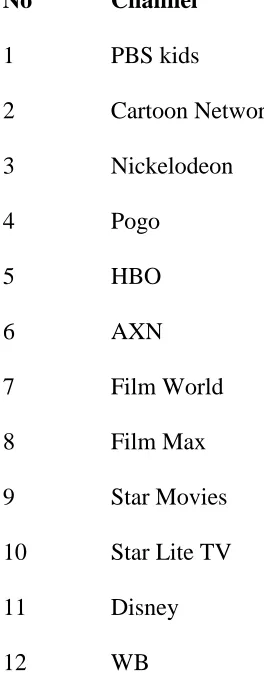
Multinational TV Channels...52
Collaborative Media Networks (local, national, multinational)... 53
The Reproduction of Pakistan in Electronic Media... 59
The Malala Yousafzai Event...59
The Asia Bibi Event... 60
Reproduction of Pakistan in Sports...60
The Telecom Companies... 62
History of the Internet in Pakistan... 68
The Cyberspace Concerning Pakistan... 69
The Reproduction of Pakistan in Cyber Space... 71
The Trump-Imran Event... 71
The Bianka Zubeck Event...75
Conclusion... 77
CHAPTER 3: THE POLITICAL MEDIA NETWORKS AND PAKISTAN... 80
Introduction... 80
The Rise of Political Media Networks... 84
The Political Media Networks in Action... 93
Campaign Against Musharraf... 93
Global Discourses... 94
TV Channels... 100
Changing Demographics...102
Social Media... 105
Global Media and Organizations... 108
Conclusion... 110
CHAPTER 4: MEDIA NETWORKS AND PRODUCTION OF PAKISTANI CULTURES... 115
Introduction... 115
Modern Media and Culture Production... 120
Culture Production in Early Print Media... 121
Post-Independence Islamic Trends... 123
Post-Independence Multicultural Trends... 124
Current Cultural Media Networks... 127
Transformation of Pakistani culture...129
Transforming Roles of Women... 129
Transforming Life Styles... 131
Transnational Flows... 131
Indian Flows...132
Western Flows... 133
Pakistani Flows... 134
Transformation of Language...135
Transforming Values... 136
Monetization, Commodification, and Commercialization...136
Increasing Role of Social Media... 138
Conclusion... 139
Introduction... 142
The Rise of Threat- Security Networks... 146
Current Threat and Security Networks... 150
The Dominant Threat Networks... 150
The Demography of Networks...151
Facilitating Factors...152
Financing Networks... 153
The Struggling Security Networks...155
Media and Threat-Security Networks... 157
The Supportive Political Networks... 159
The Unending Cycle of Threat and Security... 160
Toward a New Security Model... 161
Conclusion... 165
CHAPTER 6: GLOBALIZED, MEDIATIZED, AND NETWORKED PAKISTAN... 168
Chapter Summary... 169
Theoretical and Policy Implications... 172
Future Research... 176
LIST OF TABLES
Table 2.1: The cross-media ownership of Pakistan media networks...43
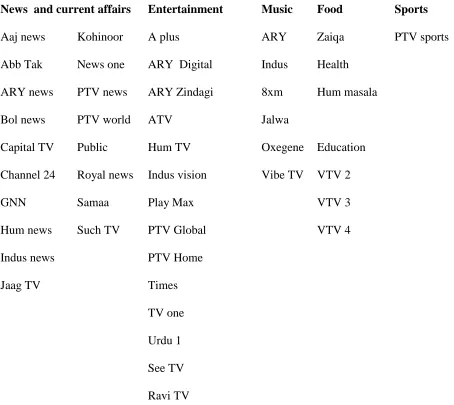
Table 2.2: National TV channels without print publications...45
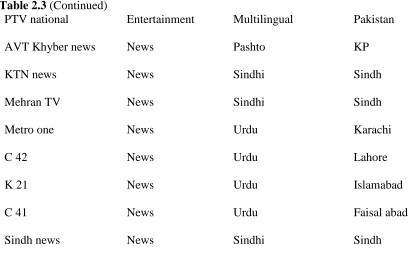
Table 2.3: Local and ethnic channels...46
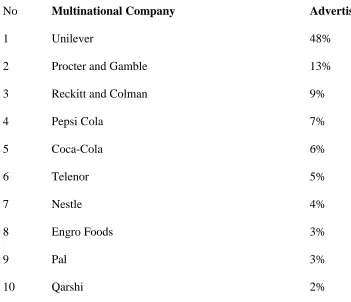
Table 2.4: Top ten multinational advertisers in Pakistan based media network...48
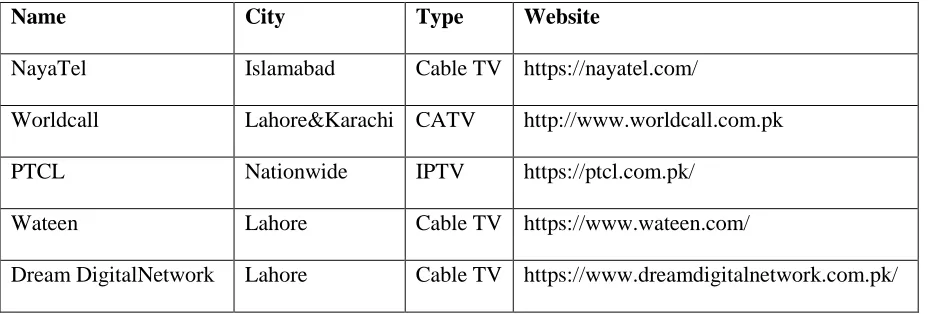
Table 2.5: Cable companies for TV channels distribution...51
Table 2.6: Multinational media networks beaming in Pakistani territory...52
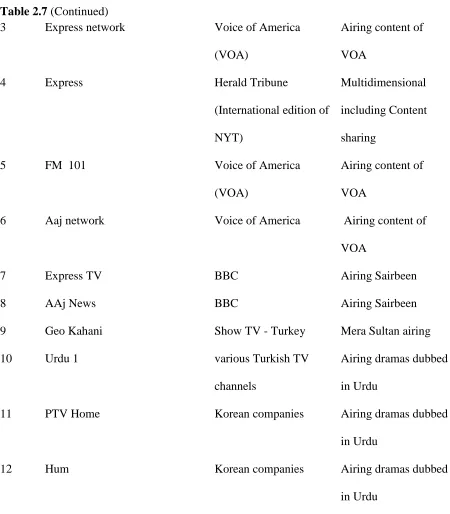
Table. 2.7: Content sharing and working arrangements in national and international media...53
Table 2.8: Air time share of channels by Genre...56
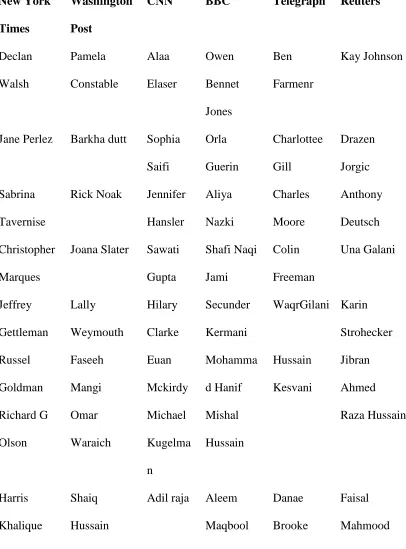
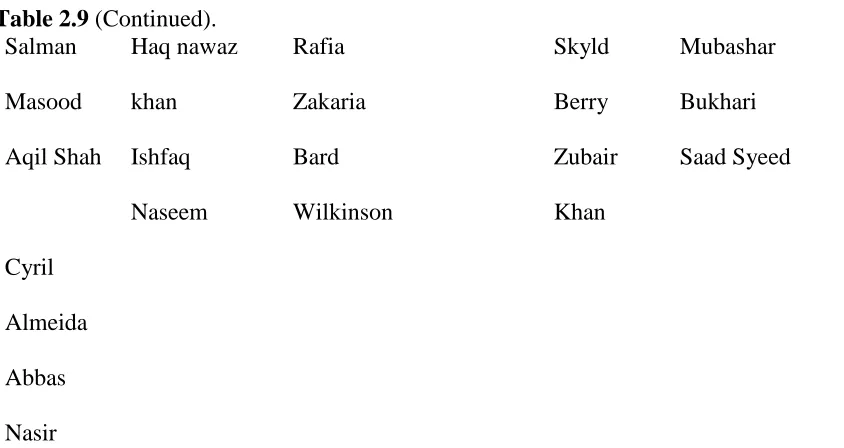
Table 2.9: List of Journalists working on stories about Pakistan across the globe...57
Table 2.10: Relationship between Pakistani Telecom and Multinational Companies...63
LIST OF FIGURES
Figure2.1: Numbers of cell phone telephony and broadband subscribers in Pakistan...64
Figure2.2: Cellular Market Share...64
Figure 2.3: The subscriber base of internet service provider companies...66
Figure 2.4: Annual wireless loop subscribers...67
Figure 2.5:NGMS subscribers...67
Figure 2.6: Digital statistics...69
Figure 2.7: Social media statistics...70
Figure 2.8: Tweet from Donal Trump...71
Figure 2.9: Tweet from Donal Trump...72
Figure 2.10: Tweet from Imran Khan ...72
Figure 2.11: Tweet from Imran Khan ...73
Figure 2.12: Tweet from Imran Khan ...73
Figure 2.13: Tweet from Imran Khan ...74
CHAPTER 1: THE REPRODUCTION OF PAKISTAN
Introduction
The genesis of Pakistan can be traced back to the mid-nineteenth century when
colonization was a global phenomenon and was transforming societies through communication, transportation, and industrial technologies. Modernization brought a new education system, administrative setup, political thought, and democratic institutions, providing a conducive environment for the formation of an “imagined community” (Anderson, 2006) of Muslim India. Pakistan was a nation-building project based on the aspirations of the Muslim community of India; it evolved through modern communication processes—specifically newspapers and books, which were significant products and tools of globalized modernity. The evolution of a modern Muslim community aspiring to make Pakistan was a result of the process of colonization, which had created a sense of deprivation in the community after the fall of the Mughal empire. The Indian Muslims were contesting for power and identity. During the movement to establish Pakistan and after its inception as an independent nation, two clear contradictory national
identity images evolved; these images are played out, historically, in various political movements and media presentations. The conventional media, comprised of the printing press and
socialist. Struggles over the genesis of Pakistan and the future course of the nation is a dominant feature of politics, academic debates, and media presentations about Pakistan. These images are partially the product of overbearing ideological and modernist methodological perspectives that lead to diverse images of Pakistan. The conventional approaches to Pakistan, though diverse, are not able to capture some aspects of Pakistan. These approaches also do not visualize Pakistan fully in the context of contemporary global communication revolution and its impact of transforming societies.
This study explores Pakistan as a social formation without the presupposition of nationality, religion, and the centrality of a few institutions and classes. After sitting aside traditional conceptual barriers, the study will probe Pakistan as an open social object, tracing the entities and linkages that constitute and define it. This study aims to bring out an original image of Pakistan in the context of globalization, the transformations wrought by communication technologies, and evolving social network forms.
The analysis begins with media networks because of their primacy as central social spaces where Pakistan is produced. In conventional, nation-based approaches, these networks are called "the media of Pakistan," which is a limiting concept. The media concerning Pakistan can be transnational. The conventional concept of media also theorizes media as an instrument of institutions or classes. Media networks in this study constitute spaces where Pakistan is
construction of Pakistan that the conventional approach to media will find hard to reach, such as non-national and non-institutional spaces. The main questions in this area concern the media spaces where Pakistan is reproduced and how it is reproduced. The exploration will bring out the diversity and extent of those media spaces that are associated with Pakistan and will help us understand aspects of Pakistan that are usually ignored. It will bring a comprehensive and holistic image of Pakistan regarding media, local and global, where Pakistan is reproduced.
The second prominent social space examined in this dissertation is Pakistani politics. Pakistani politics have been theorized mostly as interactions between state institutions and political parties. The dominant political themes are nationalism and democracy. Some critical processes are conventionally ignored in contemporary Pakistan studies such as the mediatization of politics and, because of mediatization, the transforming trends of nationalism and democracy. The present study will explore the linkages of media to politics that are traditionally ignored or given a secondary role while studying politics. The study will try to assess the role of media in politics and their mutual impact on each other, in the context of extensive transnational media flows regarding political events concerning Pakistan. The study will further explore the impact of a globalized political sphere regarding Pakistan. The main questions raised in this chapter are about the impact of mediated, globalized and networked forms of politics, transforming conventional politics and conceptualization of nationalism and democracy.
about forms of the Pakistani culture and how these forms are transformed into a globally integrated world.
The fourth area is threat and security regarding Pakistan. Security is the primary concern of Pakistanis and non-Pakistani people associated with Pakistan. It is essential to identify
different forms of threats and the appropriate security responses to different threats. It is important to know how the Pakistani security paradigm is being transformed by the global war on terrorism as well as regional conflicts and what is the way forward.
This study examines processes such as globalization, mediatization, and emerging network forms of societies—processes that are generally ignored in conventional studies of Pakistan. A comprehensive study of Pakistan will also add to the literature on globalization, which lacks a case study about Pakistan. There is no proper documentation of the globally extended, Pakistan-related media landscape. This study intends to document and map media about Pakistan for the first time. Similarly, media studies of Pakistan are restricted to specific areas such as culture or politics. The media research examined in this dissertation spans vast areas of media networks, politics, culture and security. It will be a valuable addition for the students who want to understand the role of media concerning Pakistan. However, the
fundamental contribution of the study is to Pakistan studies. Pakistan is imagined in this study in innovative ways.
various perspectives and social territories. Pakistan is understood as a logic that appropriates social networks and discourses. Drawing on this approach, I employ a strategy proposed by Christine Hine (2011) as “Internet Research and Unobtrusive methods” and provide a review of the sources used for the study. Last, I will give a summary of the main conclusions for each perspective and social territory of transformation.
Theoretical Framework
Research on Pakistan
Modernist political histories of Pakistan are written mostly from cultural and economic perspectives, focusing on communal or class issues. Scholarship on Pakistan employs conceptual and theoretical models either from the Marxist critical tradition or from a structural-functionalist, sociological approach. Some quality literature about Pakistan comes from the critical tradition (Abbas, 2005; Alavi 1989; Sayeed, 1980 ). Critical theory has ontological presumptions regarding power relations. Critical approaches in the context of Pakistan start with colonial models of imperialism, visualizing Pakistani State an extension of the British Empire. Such constructs envision the Pakistani State as a tool and as an arena for the struggle between various classes (Alavi 1989; Sayeed, 1980). The theorists presume intrinsic power relations between supposed classes and try to predict future possibilities in that imagined context.
Some salaried and professional classes (groups) such as bureaucrats, generals, TV anchors, and judges are more involved in critical decision making than conventional landlords or the
bourgeoisie in the Marxist sense. The critical approach needs to be rethought to accommodate these social transformations.
Sociological theories about Pakistan, primarily based on a structuralist- functionalist framework, make presuppositions about institutional demarcations and their functions. These approaches look at Pakistani history and contemporary Pakistan as a space of constant war and reconciliation among institutions. They focus on the role of prominent institutions such as the military, the courts, executives, legislatures, political parties, and foreign nations(Ahmed,1998; Akhtar,2000; Cohen, 2004; Haqqani, 2005). The approach emphasizes the role of leadership and ideology. The method needs to take into account, in a more detailed way, the complex but significant connections among individuals and groups that are working beyond or parallel to institutional interactions. Focusing on leadership and institutional structures diverts attention from multiple cross-links and logics that organize humans and materiality side by side with public institutions. The structuralist-functionalist approach cannot fully explain changes in the system, as it ignores processes that are beyond institutional images and functions. Because of the digital media and internet revolution during the last few decades, processes of globalization and the formation of social networks through digitization and mediatization have transformed societies significantly.
the media are influencing the judiciary and the judiciary is doing politics. Given the limitations of conventional approaches, a new strategy is required to understand the globalized, mediatized, and networked social processes that are transforming Pakistan.
The conventional nation-based critical and institutional approaches cannot adequately represent the current power formations that undergird contemporary experiences. For example, the question raised about the loyalty of Pakistani diasporas and not allowing them power positions in Pakistan is a dichotomy, as foreign currency sent by "foreign" Pakistanis primarily fulfills foreign currency exchange requirements of the Pakistani economy. A conventional nation-based view has no solution to this dilemma. Conventional nationalism cannot trust the Pakistani diasporas because of their foreign loyalties, but their dollars are desperately needed in a globally integrated economy. The conventional nation-based perspectives in such a scenario are under stress and require revision.
Research on Pakistani Media
through a theoretical framework that can visualize the media as a whole, both “foreign” and “national.”
The second shortcoming of media research is its reliance on conventional critical theory or structural-functionalist sociology, considering the media an institution with a predetermined role, such as the assigned role of watchman for the public interest. Critical and institutional approaches often focus on the role of media in a cause-effect, institutional paradigm, but today most media have acquired nonlinear, networked forms of interaction. Various components are working independently but at the same time working as part of a larger network (Castells, 2010).
A third shortcoming is a limited "instrumental approach" toward media. The conventional approaches are less inclined to integrate media into the power structures; instead, they
conceptualize these two as different spheres of social activity. The literature about the media of Pakistan tends to portray media as playing an instrumental role in relation to politics. There are two contradictory views about the role of media in politics of Pakistan. Akhtar (2000) depicts media as a tool in the hands of dominant feudal class and military dictators, while Niazi (1994) focuses on the progressive role of media in resistance against dictatorships and authoritative regimes. Nawaz (1983) has studied the role of media as a significant tool in the field of economic development and education. He proposes the use of media for development. The instrumentalist approach to media either for positive or negative contributions towards society visualizes media as partial and marginal, an additional factor to some other, more fundamental social process. The debates about the instrumental role of media are reflected, for example, in debates over talk shows on satellite TV channels. The debates revolve around the idea that media can serve public interests (a theoretical abstraction) against special political and money interests. This
Research on Globalization
Globalization is as old as human history. The interaction among human beings across the globe has been a feature of human experience through the journey of human civilizations
(Stearns, 2010). However, globalization emerged as an academic discipline in the 1970s with the pioneering work of World Systems Theory by Immanuel Wallerstein (Wallerstein, 2007).
Globalization is a multifaceted phenomenon and scholars have diversely theorized it. Robertson and White (2007) have traced the origin of the concept of globalization, finding its source in anti-globalization movement that later developed into the non-ideological and multi-dimensional concept of globalization (p.56). According to Robertson and White, globalization means
increasing consciousness of the globe (p.63) and increasing global interconnectivity (p. 56). Appadurai (1990) considers the tension between homogenization and heterogenization as the defining aspect of current globalization (p. 295). According to Appadurai, the disjuncture between economy, culture, and politics and five dominant dimensions of global cultural flows such as ethnoscapes, mediascapes, technoscapes, finanscape, and ideoscapes define
contemporary globalization (p.296). He criticized models that have conceptualized “center and periphery” as the main feature (p 296). He is more inclined to the concept of imagined worlds instead of imagined communities that characterized in a sense the dominance of the globe over the nation. Central to his theory are the deterritorialization of people, money, images, ideas, and technology (p.202, 203).
conceptualizing Pakistan as a place and as a container. The world beyond that place or container is defined as "foreign." According to Wiley (2004), nation-based theory has dominated the social sciences since they began. The nation-state, capitalism, and the social sciences evolved together, each enriching and strengthening the other in a symbiotic relation while excluding and
marginalizing thinking patterns that did not fit in the conglomeration. Social theory in general and communication theory, in particular, have been shaped by the confines of the nation-state (Wiley, 2004). Wiley considers globalization a considerable challenge to nation-based social theory (p. 78). He proposes a theoretical model to bypass the confines of the nation-state,
opening up space for globalization in theories of the nation. He suggests starting with a nation as a logic that, along with other logics, organize and appropriate different social territories.
One other dominant feature of contemporary societies is the network forms of social entities. According to Castells, societies are drifting from hierarchical structures towards network forms (Castells, 2010). A modernist global society of hierarchical structures is
transforming into a complex web of global networks (Galloway and Thacker, 2007) comprised of humans and materials that are interlinked in local, national, and regional networks directly or indirectly. These networks cover all dimensions of human life, from very personal to the macro-social; including political, economic, religious, cultural, and educational realms, as well as entertainment, sports, and others. Castells (2010) proposes the formation of a global network society that is fundamentally transforming the contemporary world. The structural-functional formulations of society most explicitly constructed by Weber and Durkheim, culminating in Levi-Straus and Parsons, are giving way to horizontal, network formulations in every sphere of society at a global scale. The networks of finance, politics, communication, commerce,
are interconnected, and the functioning and power relations of society reside in these network constellations. According to Castells (2010), networks are constructing global, regional, national, or local spaces. In reality, the formation of these networks is not symmetrical; instead, the space that they generate is usually asymmetrical (Sassen, 2008). The asymmetrical networks do not fit in the conventional scalar categories of local, regional, national and global. Sassen gave an example of lex constructionis, a private "law" developed by the major engineering companies in the world to establish a standard mode of dealing with the strengthening of environmental standards in a growing number of countries, where these firms are building (p. 62). The global network social forms, symmetrical and asymmetrical, are occupying all types of social spaces.
Research on Global Communication
Since the invention of electrical communication technologies, the rise of networks is visible in all spheres of social activities including politics, economy, security, and culture. Castells notes, "A network society is a society whose social structure is made around networks activated by microelectronics-based, digitally processed information and communication technologies" (2009, p.24). According to Castells, the networks are structured around
to connect and disconnect networks and nodes. Castells (2009) considers the commercialization and corporate control of media as the main characteristics of the dominant global communication network (p. 42, 43). Media businesses are increasingly concentrated in conglomerations and networks. There is growing segmentation, customization, and diversification of media markets, with emphasis on the cultural identification of the audience along with the formation of
multimedia business groups that reach out to all forms of communication, including the Internet (Castells, 2009, p 71). The growing convergence in media companies, internet companies, computer companies, and telecommunication companies is another trend. These trends have been made possible by policies of liberalization and deregulation at the national and global level (p 116). Castells (2009) has explored the connections of the media networks at all levels to other business networks through ownership of parent corporations and common boards of directors (p. 93). Connections with global financial networks through the stock exchange and allied supply media networks such as advertising and PR, production houses, news agencies, talent agencies, and HR networks are prominent features of these media networks. On a larger scale, the media networks are connected to other networks of politics, businesses, and culture. The connections of national and local level media networks with other national, regional, and global media networks are extensive and frequent (p 58, 71).
The place of media can be better understood through the process of mediatization in a society. The current media environment has expedited the process of the mediatization of
societies (Stromback 2008; Hjarvard, 2008). Stromback proposes various stages of mediatization in the context of politics. The first phase is mediation, when dominant institutions start
media logic, and in the fourth stage the media logic is internalized and there is no distinction between media logic and other logics (Stromback 2008; Hjarvard, 2008). These stages are not exclusive, however; various social institutions are at different stages of mediatization. The four phases of mediatization are four perspectives on media through which social institutions work. Social institutions experience every stage and institutions are using each mediatization
stage/process as per their developed capacity for media interaction. The degree of the
mediatization of a society alludes to the level of primacy and dominance of media logic as other logics operate increasingly through media.
The Contribution of this Study
Before elaborating on contributions of this study to various types of literature, I would like to explain what conversations led me to this study. Pakistan is an important nation-state in South Asia, a nuclear-armed country with 200 million people. Recently, it has acquired global importance due to the "global war" on terrorism. It is important to see how Pakistan is
conventionally imagined and reproduced and what are the consequences of such imagining. However, it is more important to see how Pakistan is currently reproduced and imagined and the consequences of new imagining.
One of the most common debates in Pakistani media is about national interests. The political debates are prolific over media: who is working for and who is working against national interests; who is a patriot and who is a traitor; who is a "foreign" agent and who is not (Nation, 2017). Political groups and segments of the establishment welcome or oppose "foreign"
interests (Hyder, 2016). At times these debates advocate isolationist tendencies and propose it as a solution. This study aspires to explore how much we are globally connected and who is
connected to whom in the areas of politics, culture, and security. Are only the accused connected to foreign groups and governments, or are the accusers also connected? The study is expected to influence widespread conversations and policy options about national sovereignty and national interests in political literature and national media.
Similarly, conventional approaches that see media as an instrument encourage various parts of the establishment to control the media and utilize them for nationalistic political and cultural agendas. They either support or oppose free media or certain flows in media, depending on which side of the political conflict they are on and how the media are supporting or criticizing them. There are widespread complaints that militant groups, political parties, and the military establishment are coercing the media into falling in line (CPJ, 2018). This practically means curbs on certain journalists, media outlets, and media flows. The study will explore the reach and extent of media associated with Pakistan and its role in politics and culture. This is expected to influence the policy options and debate whether media can be censored and controlled or not.
This study contributes to the literature on globalization and to Pakistan studies. It will add to the literature on globalization by applying Wiley's (2004) research model, examining the logic of Pakistan in global flows and in conventional national spaces simultaneously. This case study of Pakistan in the literature on globalization will be an addition as it is not grounded in the cause-and-effect paradigm (the effect of global on local); instead, social spaces are imagined as
container. It will study logic Pakistan as a living and changing entity appropriating and incorporating new spaces and at the same time excluding and eliminating social spaces
previously defined as Pakistan. For example, Pakistan is as much reproduced in The New York Times (New York) as in the daily Dawn (Karachi). Indian movies reproduce a specific Pakistan as much as its opposite is reproduced by Pakistani TV channels. Pakistan is more forcefully imagined and produced in the IMF than in the State Bank of Pakistan. In the same way, the conventional approach to Pakistan, a rigid entity, defined once for all, is unrealistic. Pakistan is reproduced continuously and regularly, globally and locally, and this reproduction affects its future course and role in the global scenario. The idea of a geographically limited Pakistan with a single dimension of security or politics is just a tiny part of the expansive and larger global Pakistan with multiple dimensions and perspectives.
This study applies Castells’ concept of the global network society to Pakistan, bringing network social forms to light in Pakistani society, in contrast to conventional literature that focuses solely on institutional forms, neglecting the new social reality of networks. Visualizing Pakistan as part of global network society and imagining Pakistani society as a network of networks will bypass the limits imposed by the study of Pakistan as few dominant institutions within a container nation state. The approach opens up access to many social spaces such as small institutions, groups, and publics, at local, national, regional and global levels, which appear nowhere in the conventional approaches. This strategy also facilitates noticing social patterns and trends that are not possible to see in a strict structural-functional approach.
institutional assumptions is a positive contribution to media studies in Pakistan. The study revolves around the mediatization of social territories appropriated by a logic Pakistan. The inclusion of mediatization in studying areas of politics, culture, and security will enrich Pakistan studies, bringing a new perspective that is rarely taken into account in contemporary Pakistan studies. This study covers the mediatization of politics, culture, and security in Pakistan and will be a valuable addition to media studies concerning Pakistan.
The strength of the present study lies in bringing diverse perspectives to the study of Pakistan. However, the most productive contribution is addressing some fundamental
dichotomies that have generally plagued social sciences. The important dichotomies, questioned by this study are media versus other institutions, national media versus foreign media, print versus electronic media, and old media versus new interactive media. These dichotomies may be useful in other contexts but are insufficient to capture contemporary social processes that are shaping Pakistan at the moment. New conceptual categories from research on globalization, networks, and mediatization are required to understand contemporary communication processes in the context of Pakistan. In a broader context, the conventional conceptual dichotomies of societies such as national versus foreign, our political institutions versus foreign political groups, our culture versus alien culture, and our security institutions versus others, also need to be
rethought in the context of the globalization, networking, and mediatization of societies because these are insufficient to represent and explain globalized, networked and mediatized societies.
theories of media versus integration of media into social life. The proposed theoretical
formulation will be a fresh view on Pakistan beyond nationalistic and institutional approaches. Additionally, the work will enhance studies of globalization, social networks, mediatization, and Pakistan studies by applying concepts and perspectives to the transformation of an important national society (Pakistan) that is generally neglected in mainstream studies of globalization, networks, and mediatization.
Methodology
Two dimensions constitute the methodology in this study: first, the conceptual frames and second, the methods. Understanding Pakistan as a globalized, networked, and mediatized research object necessitates adopting a conceptual frame that takes into account processes of globalization, mediatization, and networking. Wiley (2004) has suggested a methodological model for research in response to the complexity of issues in communication studies:"This conceptual move allows us to separate the question of nationality from the modernist geography of nation-states that has so thoroughly shaped our thinking and opens up a range of new
theoretical possibilities and research questions" (p. 79). Surveying a range of theoretical
perspectives, he concludes that social theory is stuck in the mould of the nation-state and needs rescue. Wiley (2004) states that
logics of the public, ethnic and racial logics, state logics, etc.), we can delink theories about the nation from the modernist ontological and epistemological assumptions of the nation (p. 90-91).
His approach is innovative and consequential, alluding to the changing world where confines of “nation” at the conceptual level will not be restricting mental horizon and imagination.
He further states:
I want to propose an approach in which nationality is understood as a particular kind of logic—one logic among others—according to which social spaces can be organized. Then, instead of beginning with the nation as place and arguing about what kind of place it is, about the proper way to conceptualize it and engage with it, one could begin with a social space and ask how, or if, or to what extent, it is organized as national (pp. 90-91). …The second approach focuses on national logics rather than on a predefined social context. It asks where nationality—or one particular logic of nationality—plays a role in organizing social space (p. 92). Building on Wiley's concept, I propose that two components of a logic are more pronounced: first, the organizing principles and second, the discourses. A logic has core
2004, p. 91). I propose that these logics exist in a power configuration, interacting with each other. Foucault (1980, 1995) has visualized the process of power formations at both at the macro and micro level. At the micro level, an interesting study of Wikipedia by Swarts (2009)
enumerates multiple interactive processes through which "facts"—which I see as stable and condensed power configuration of logics, a perceived social reality—come into being and are dissolved. According to Swarts (2009),"facts build up through accretion, but just as often through negotiation and transformation"(p. 282); this is also the case of power configurations of interacting logics. The power configurations of logics such as Islamic logic, secular logic,
democratic logic, security logic, socialist logic, and capitalist logic, concerning the logic Pakistan kept changing. These evolving logics continually amend the logic Pakistan and its organizing principles and discourses, such as the prevalence of dictatorial or democratic and Islamic or multicultural principles and discourse in different eras. Besides a permanent aspect, the logic Pakistan constitutes transforming organizing principles and discourses. A logic is essentially an agency that performs tasks of creating, eliminating, appropriating, disappropriating, and
assigning proximity and values to social territories. It performs these tasks more frequently when it comes into contact with a multitude of flows from other logics. Inside a power configuration, a logic can be in a conflictual, supportive, conciliatory, subservient, and dominant relationship with another logic.
The method part of the methodology is based on data and literature collection and
adopted previous technologies but mocked the use of emerging technologies. He concludes that "the very definition of ethnography has been called into question due to increased social
mobility, globalization, and hyper-connectivity, as well as constant changes in Internet
applications and services, and the availability of digital data" (p 665). Christine Hine (2011) has explored the method of online study sites in "Internet Research and Unobtrusive methods."These unobtrusive measures/methods have been a part of ethnography since 1966 (Webb et al., 1981). Webb, et al., have advocated multiple nonreactive and unobtrusive methods in comparison to reactive methods of interviews and surveys, in which respondents may respond in socially desirable ways or adapt their responses due to the consciousness of being under scrutiny (Hine, 2011).Hine (2011) and Lee (2000) have advocated the use of the methods on the internet,
however, with cautionary notes of limitations due to the digital divide, the bias of search engines, and the lack of information about the motivations of content providers on the internet. I took a number of measures to overcome these limitations. Besides requiring some basic planning, the research was mostly a free-ranging exploration. The method, in place of "designing appropriate ethnographies in advance," "instead increases focus on adaptive ethnography which explores connections and boundaries experientially … This form of ethnography is simultaneously old and new, being grounded in a tradition of emergence and adaptation" (Hine, 2007, p 632).
In this study, two factors played an essential role in the selection of the areas of focus. One was the relevance of the area to the study’s objective, the construction of a new
these two tests, but it was partially integrated into the chapter on culture because of similarity in content.
After getting a sense of the broad areas for the study, the question remained how to select sites for the study. The primary determinant came from following the logic of Pakistan. Wiley (2004) suggested that nationality should be considered a national logic, organizing social space (p.92). I followed this logic on the internet, through searches regarding Pakistan, which led me to websites of TV channels, newspapers, news agencies, think tanks, political parties, government agencies, and other specialized organizations that are operating at local, national, regional, and global levels. Google was the primary search engine. however, I also used Bing, Yahoo, and Ask. I moved from website to website and selected websites where I saw the logic of Pakistan playing a role in organizing some social territory. I also used the site-specific search tools of the websites I visited to find information and stories regarding Pakistan. My expectations about where to find relevant websites and information within websites and where and how a story happened were influenced by the concepts of globalization (Castells, 2009), mediatization (Stromback, 2008), and networks (Castells, 2010). After finding some information or story, I determined the general area (media, politics, culture, security) and the social territory of the information. I also analyzed the role of globalization, mediatization, and networking in shaping the social territory under analysis and infer its relationship to the logic Pakistan.
These methodological limitations were balanced through two techniques: first, performing extensive searches; and second, using multiple sources for information. To overcome the possibility of less presence of the logic Pakistan in media and to neutralize search-engine bias, I explored many result pages extensively, not limiting myself to the top results on a page given by an internet or website search engine. Second, to minimize narrators' bias, I did not rely on a single source for a story or information. I looked for a story and information on multiple
websites. The words and phrases used in the internet and database searches varied from chapter to chapter as each chapter is mainly about different social space and territory.
The internet searches in the chapter on media were about media organizations and the content they produce about Pakistan. The internet searches were extended to information about various media platforms such as the print, radio, television and internet, allied businesses such as content supply and advertising, and regulatory regimes and organizations. The global,
the licenses issued, and from there reaching the licensees' media outlets through an internet search. Most of the information, though not all, obtained from websites was cross-checked through other online sources.
The chapter on politics is about tracing Pakistan in political territories that are appropriated and organized by the logic of Pakistan. The main phrases used to determine political entities of Pakistan were, "Musharaff regime", "agitation against Musharraf", " Musharraf and global media" “Political parties in Pakistan," “Trade bodies in Pakistan," “Associations in Pakistan," and “Election Commission of Pakistan." The websites of political parties, associations, and interest groups were studied carefully for their narratives. The political TV talk shows are a valid form of political mediatization in Pakistan and records are available on the websites of channels and are archived by other political websites. I watched and took notes of hundreds of talk shows in full or in part about the political debate regarding Pakistan. Scholarly literature about politics in Pakistan was searched in databases. Reports about Pakistan were also traced in international media. The most relevant material is referred to at the end.
The security area is highly documented because of the interest of the Western World. Terrorism is a global issue, and Afghanistan and Pakistan's Tribal Areas are the centers of global attention. The security apparatus of Pakistan inevitably comes into the debate. I have gone through database searches, internet searches and listened to security experts to map out the security paradigm of Pakistan. The main phrases used were related to terrorism and security such as "terror networks of Pakistan," "security of Pakistan," “terrorism in Afghanistan," "role of Pakistan army." I have reviewed the work of security think tanks, research organizations working on security issues, country reports of the US government, and articles in security journals. After carefully looking for essential trends and dominant patterns of social change appearing in the material, I scrutinized the trends and patterns and reached conclusions.
Outline of Chapters
The analysis of the accumulated data showed dominant trends in the respective area and the extent to which these trends are influenced and shaped by forces of globalization,
mediatization, and social networks. In the dissertation, I argue that the dominant social spaces and territories appropriated by the logic of Pakistan are significantly transformed by processes of globalization, mediatization, and the formation of social networks. The transformation can be seen in the areas of media, politics, culture, and security. The globalized and mediatized social networks and processes that constitute Pakistan are not uniform and non-contradictory social patterns. Instead, constituent parts of the media trends, political forms, cultural patterns, and security processes are sharply contradictory. However, all opposite parts have their roots in globalization, mediatization and social networks.
platforms of newspapers, television, and the Internet. The rise of media networks concerning Pakistan are mapped in historical perspective from print to electronic and then digital media. The genesis and growth of current media networks are traced showing how Pakistan was produced. The global networks of media content production, distribution, regulations, media workers, finances, and audiences are explored that make part of Pakistani media networks. Pakistan was imagined initially in print media, and still, Pakistani newspapers play an important role in reproducing Pakistan. The global Print media, such as the New York Times and the Guardian play an important role in shaping events and images related to Pakistan. Pakistan television and radio were public entities and played a significant role in reproducing diverse images of
Pakistan. With the liberalization of electronic media, private TV channels, cable distribution networks, and transnational television, Pakistan is reproduced across the globe in a diverse manner. The digitalization of media and growth of the Internet have transformed the
conventional media and social processes. Social media plays a significant role in reproducing Pakistan.
Chapter three is about the political dimension of the logic Pakistan. The chapter explores the rise and working of political media networks, in addition to conventional
approaches of studying media and politics as separate spheres. James Hicky's Bengal Gazette 1780, was a precursor in India of political media networks. The rise of a Muslim press in India provided the basis for the movement for Pakistan. Pakistan movement was run and executed through early forms of political media networks. In subsequent history, Pakistani politics was primarily done through newspapers as electronic media was nationalized and played a one-sided role. The study analyzes the working of political media networks through the Judiciary
channels played a crucial role in igniting and sustaining movement against Pervez Musharraf. The digital media such as Facebook and interactive websites became a partner in organizing events and connecting people against Pervez Musharraf. The global media, Pakistani diasporas, and transnational groups and organizations came together through social media and participated in the movement.
Chapter four focuses on the cultural dimension of the logic Pakistan and explores cultural transformations in the light of mediatization and globalization through cultural media networks. The chapter traces the early forms of cultural media networks with the rise of print media in the subcontinent. The contestation over cultural values, one side promoting
conservative values and other side promoting British ways of life are quite visible. These contestations continued over the years in media, getting complex with increased cultural flows from the capitalist West and the socialist Soviet Union. Capitalism is affecting and transforming local cultures, and local cultures are consuming and transforming global trends through
mediatization. The chapter explores the changing cultural territories of Pakistani society from the very concrete such as food, cloth, and relation patterns, to the abstract components of culture such as values of consumerism, commodification, and monetization. The discussion is focused on the broader contexts of capitalism, the dominant process of our era that is transforming the ways and meaning of life in Pakistani society.
Chapter five focuses on networks of threat and security, a theme that has continuously occupied the discourses, narratives, and history of Pakistan. Threat and security are a
casts the networks of both terror and security of Pakistan in global and mediatized forms. It is concluded that the forms of threat and counter security arrangements and responses are becoming globalized, mediatized and acquiring network forms. The study makes a distinction between threats that can be countered by effective national security networks and those that need cosmopolitan and regional collaborative security arrangements. There is also an emerging trend of change in the process of securitization, transforming the forms of threats and patterns of measured responses.
CHAPTER 2: MEDIA NETWORKS: SPACES OF REIMAGINING
PAKISTAN
Introduction
Media are not the only spaces where collective matters are discussed. A significant portion of communication in Pakistani society, including conversations about collective matters, is face-to-face, not mediated by technical networks. However, these conversations soon end up in media. It is hard to imagine crucial communication about collective matters remaining
unmediated. The development of media has transformed the form of collective human experiences and movements, including the formation of imagined communities (Anderson, 2006). The origin of the idea of Pakistan and its diverse interpretations first took place in print media such as pamphlets, books, and regular publications. The process of reproduction and transformation of Pakistan continued into electronic broadcast media with the addition of audio-visual elements. Currently, Pakistan is reproduced through diverse forms of media in the new digital-media era, through local, national and global collaborating networks.
I have covered the general conceptual and theoretical framework in the first chapter. I will only briefly touch on the concepts and theories that relate to this chapter. The processes of globalization, networking, and mediatization are at the heart of transformations in contemporary societies. Castells' notions of " Communication power" (2009) and "Network Society" (2010) depict the rise of a global society that is organized and driven by the new digital media
that new and old media are invoking the twin logics of immediacy and hypermediacy in their effort to remake themselves and each other (p. 17). This process is closely associated with remediation, which involves a double logic of multiplying media and erasing mediation at the same time, and this is possible because at one level all media involve a play of signs (p.5). Social and cultural processes are mediatized, and the mediatized content provides a basis for further social and media processes that are again mediatized, and the loop goes on. The impact of Castells and Stromback is visible on this study. Castells helped me to imagine media and social sites concerning Pakistan in a globally networked society. Castells and Stromback both made me realized how media are prime sites for the reproduction of social reality. I applied these theories to trace the logic (Wiley, 2004) of Pakistan through online connective ethnography (Hine, 2007) in the area of media. This chapter shows how Pakistan as a logic came into being through
modern media: how the logic Pakistan was articulated in early modern media before existence of the state Pakistan and then gradually appropriated by modern media technologies and global communication processes through regulation, financing, mediatization, and technical and human networks. I visualize the whole process as an interaction between a global logic of nation state (Pakistan) and the global logics of communication and capitalism.
Contemporary media can be conceptualized as the rise of communication power, an extension of capitalism (Castells 2009). However, communication power works both as a tool of suppression and control, and subversion and revolt. Capitalism may be the foundation of
networks in their own right, interacting with other networks, including mega-constructs and logics such as capitalism and state. Media can be visualized as part of a larger mega construct, but it will be more appropriate to imagine media as a mega construct itself and a focus of study. The instrumentalist approach to media, whether working in favor of hegemony or resistance, can be complemented with an understanding of media as an integrated form and an arena for various struggles. While examining the media networks through which Pakistan is constructed,
reproduced, and transformed, this study assigns primacy neither to mega-constructs such as capital, state, or politics, nor to ontological and cognitive categories such as technology, humans, or symbols (Latour, 1996). Network theory as expounded by Castells and Latour influenced the research in this chapter tremendously. The logic Pakistan as it is shaped by spatially and
temporally scattered media and social nodes and which in turn appropriates and shapes diverse media and social territories would have been difficult to imagine without foundations of network theory. This chapter proceeds in from the print publications to electronic broadcast media, to new digital media, showing the emergence of media networks that provide the infrastructure for constructing “Pakistan.” Majority of print publications have their internet version and sister electronic media companies as detailed in the chapter below. A story hardly remains restricted to a specific medium. I select stories that are generated in a specific medium such as print,
electronic, or the Internet, to highlight the role of the medium. I trace the genesis of various media such as print, electronic, and the Internet, concerning Pakistan, focusing on the facilitative and restrictive political and administrative factors and networks of regulation, finance, media persons, content supply, and content distribution. To avoid repetition, I restrict myself to
This chapter explores the role of print, electronic, and internet media for reproducing Pakistan in general. It is explored how media networks provide a basis for shaping various aspects of
Pakistan. I analyze specific events that are especially relevant for the reproduction of Pakistan to see what are the dominant logics and broader connections of active nodes of media networks concerning Pakistan. Three tiers of objects and processes are analyzed simultaneously while tracing the reproduction of Pakistan in these events: first, the mega processes of globalization, mediatization, and networking; second, actor or agency networks of technology, regulators, financiers, advertisers, media workers, content suppliers, audiences, political organizations, business companies, government organizations, and institutions; and third, logics of nationalism, religion, conservatism, liberalism, power, and capitalism, in their multiple shades and forms, working through these events. The media networks concerning Pakistan are at the heart of this dissertation. The various chapters of the dissertation focus on media networks in areas of politics, culture, and security. This chapter focuses on media alone and provides a basis for exploration of the areas in other chapters.
Media Networks Concerning Pakistan
and groups worldwide. Media networks concerning Pakistan are not a fixed object with clear spatial or temporal boundaries. The Media networks concerning Pakistan are expanding, contracting, assimilating, and getting penetrated regularly, both spatially (geographically and socially) and temporally (absolutely and relatively). I describe the emergence of Media networks concerning Pakistan in historical context, leading up to their existing forms and processes, and I explore their connections with other social networks.
Print Publications
Printing press provided basis for the evolution of the Muslim nationalism in the 19th century British India. Historically, newspapers generated the oldest spaces where preliminary ideas of Muslim nationalism led to the idea of Pakistan. The press had a long tradition of private ownership and independence since the British era and had played an active role in the movement for Pakistan, seeking independence from British and separation from India.
The rise of the printing press is one of the significant processes in human history. Historians and sociologists have generally underestimated the importance of this process. Elizabeth Eisenstein (1983) has analyzed the role of the printing press. Her book The Printing Revolution of Early Modern Europe has taken account of the impact of the printing press on the
Renaissance, Protestantism, and the rise of modern science.
Habermas (1989) highlighted the role of the printing press in the rise of the public sphere. According to Habermas, the printing press played a pivotal role in the rise of democratic
Anderson explored the role of the printing press in the formation of "imagined communities" (Anderson, 2006)
Maulana Abdul Haleem Sharar presented the idea of division of India into two states as early as 1890 in his newspaper Mohazzab (Khan, 2016). Allama Mohammad Iqbal (1967-1938), the national poet of Pakistan, proposed the prototype of the idea of Pakistan (Hussain, 1965). The name Pakistan was coined by Chaudhry Rehmat Ali, a student of the University of Cambridge, in 1933. He wrote and circulated a pamphlet, "Now or never," outlining the sketch of a proposed homeland for Muslims. The name "Pakistan" was not included in the Lahore resolution 1940, which provided the basis for Pakistan, but the name was popularized by the Hindu press (Dawn, 2013). British and Congress newspapers played a part though adversarial in shaping the idea of Pakistan (Khan, 2016).
I cover in the next chapters the historical developments that led to the rise of media networks concerning Pakistan in political, cultural, and security perspectives. Here, I will elaborate only contemporary print publications and their reproducing Pakistan.
Presently, hundreds of newspapers are part of media networks concerning Pakistan. The website of All Pakistan Newspaper Society (www.apns.com.pk) lists 434 publications papers as members. The Audit Bureau of Circulation (ABC), a government body responsible for
circulation audit, has audited around 1600 publications. The number keeps fluctuating as some papers stop publishing and new publications start appearing. The exact circulations of these papers could not be ascertained officially. However, according to the Audit Bureau of
newspapers are important spaces for the reproduction of Pakistan in areas of politics, economy, culture, and sports.
Pakistani magazines usually produce content related to economy and culture. According to the Audit Bureau of Circulation, most circulated magazines are the Weekly Akhbar e- Jahan (akhbar-e-jehan.com), and the Weekly Herald (herald.dawn.com). According to owners of newspapers and hawkers, after the Internet edition, the circulation of printed newspapers has declined. These newspapers are based in Pakistan and are owned by Pakistanis. The Press, Newspaper, News Agencies and Books Registration Ordinance 2002, the law governing press
matters, restricts the maximum shares of non-Pakistanis individuals and companies to 25 percent in a publication.
The newspapers have transformed through the process of remediation (Bolter and Grusin 2000); have created their websites and sister companies in electronic media but their authenticity and aura that come through their print past are distinct from recently evolved electronic and digital media. It is not possible to separate print media from electronic and digital media anymore. The chronological order of print, electronic, and digital becomes insignificant in the contemporary media environment. I analyze the social processes and activities concerning Pakistan in print media in this mixed media environment. I focus first on events that are primarily initiated in the printing press and were later picked up by other media.
Transnational Newspapers
Some newspapers across the globe are commenting on issues related to Pakistan and are at times more influential than national papers in affecting events on the ground regarding Pakistan. The most influential is the US-based publications, the Daily New York Times
(wsj.com), the Weekly Newsweek (newsweek.com);the UK base papers, the Daily Guardian (theguardian.com) and the Daily Telegraph (telegraph.co.uk); and the Indian based papers, the Daily Times of India (timesofindia.indiatimes.com), the Daily Hindu (www.thehindu.com), and the Daily Hindustan Times ( hindustantimes.com). These newspapers carry news and analysis about Pakistan and are closely read by audiences that are interested in Pakistan.
Despite the low literacy rate in Pakistan (58% according to Economic Survey of Pakistan), newspapers are significant spaces. Even today, influential discourses and conversations, generated and popularized in the publications, are carried forward by the television and the Internet. The role of newspapers, situated in various global centers, is more than just a space for discussions. The papers influence actual administrative and policy matters and political processes. I will be analyzing two different stories, each one generating a range of images of Pakistan. The Internet and television covered the events later after the international newspapers initially published them. The publication of events in old prestigious newspapers was one of the reasons for attracting public and media attention.
The Reproduction of Pakistan in Print
The Axact Scam Event
and anchors. The story was covered in news channels in the US, the UK, the Middle East, and Pakistan. The Pakistani authorities soon took action and arrested the company owner, Shoaib Sheikh, who took a plea that he had cheated nobody and had violated no laws. The majority of famous journalists and anchors canceled their contracts with the newly launched TV channel of the company. The activists on media and from civil society and political parties pressed for action against the owner and advocated for strengthening cyber laws to check such crimes in the future. The case was tried in a US court, and a company executive was jailed (Mian, 2017). The Shoaib Sheikh was sentenced by a Pakistani district court but has submitted an appeal in the High Court. The event involved the media networks based in Pakistan, multiple transnational media networks, governments, especially where degrees were sold such as the US and the Middle East. The investigation agencies and court networks of the US and Pakistan, and a vast number of people from the US, Pakistan, and the Middle East got involved in administrative and legal processes. The politics of education, fraudulent practices, and fake degrees, networked through national and global media, reproduced Pakistan negatively at the world stage. The positive image was stopping the business of the fake degree and prosecuting the criminals. The reproduction of Pakistan in such diverse and unusual patterns is primarily because of a global networked society with media at center stage. The crime itself became possible because of the global proliferation of online classes and educational institutions.
The Prime Minister's Interview
The second story is an interview of the Prime Minister, Imran Khan, by Lally Weymouth, published in the Washington Post on 6 December 2018. The interview covered wide-ranging issues. The interview was noticed because of global digital media networks; however, its
relationship with Pakistan and the US. Some readers criticized Pakistan, such as Indians and others from the Middle East, criticized the US, finding an opportunity to vent their feelings in the context of US-Pakistan relations. The readers also criticized the prime minister's policy
statements, highlighting present-day contradictions of Pakistan. One reader commented, " Honestly, he is right in some of his US criticisms, though his failure to criticize China's anti-Muslim policies is questionable." One other reader said, " He (is) like Bernie style---That when I stop reading---Good luck." One reader from the US empathies with Imran Khan but at the same time distanced from his views in this way.
I understand Mr. Khan's anger at and frustration with U.S. policies - past and present - in Pakistan and Afghanistan. However, I believe that he is
disingenuous at best when he asserts that the Pakistani gov't did not know of Osama bin Laden's presence in the country. I am not gonna buy that bridge, thank you very much. And I am truly glad that our troops killed the man. After all, it was our country that suffered bin Laden's 9/11 attack - not Pakistan.
Pakistan was initially imagined in the spaces of print publications. The historical
these newspapers shows that audiences worldwide, and not necessarily just Pakistanis, are involved in discussions about Pakistan, formulating diverse images. The print newspapers and their remediation on the Internet are significant to reproduce Pakistan, but electronic broadcast media have raised reproduction to another level.
Electronic Broadcasting
The Early Public Electronic Media
Media transformations in Pakistan have generally followed global trends, albeit with some time lags comparing to developed countries. The history of electronic broadcasting started with the radio under colonial rule. According to Radio Pakistan website (www.radio.gov.pk), in March 1926, a private Indian Broadcasting Company (IBC)‚ was formed, which started
broadcasting from Bombay in 1927 and later Lahore in 1928. In April 1930, broadcasting was placed under the direct control of the government under the title 'Indian State Broadcasting Service' (ISBS). The service was slowly extended to other cities. Quaid-e-Azam Muhammad Ali Jinnah made a historic address on air and announced the creation of the newly independent state of Pakistan on 3 June 1947 (Radio Pakistan, 2016) when all parties agreed on the partition of India. The radio, named later Pakistan Broadcasting Corporation, known as Radio Pakistan, announced the creation of the newly independent state on 14 August 1947 when powers were handed over to the newly created state. The introduction of television in the mid-1960s transformed the mediatization of Pakistani society significantly. Legally, public radio and television are autonomous public sector organizations; the government of Pakistan appoints the boards of directors and chief executives. Pakistan Television Corporation (PTV)
in 1974. Since then, the PTV has diversified its channels (18) and content (current affairs, sports, entertainment), and is broadcasting in multiple prominent Pakistani languages.
Radio Pakistan and Pakistan Television are the largest broadcasters of Pakistan in terms of terrestrial transmission, number of stations, transmitters, technological and immovable assets, and human resource (Radio Pakistan, 2016). Historically, both played an important role in reproducing Pakistan with cultural and linguistic diversity. Politically, both institutions have worked as a mouthpiece of incumbent governments. Because of an inherited monopoly over rights for terrestrial broadcasting over the whole of Pakistan and all types of content production, both broadcasters have the edge over private radio and television broadcasters who have limited broadcast rights and specified category of content production. Radio Pakistan and Pakistan Television trained the human resource such as technicians, producers, performers, writers that later played a significant role in running private sector broadcasting. These two institutions dominated broadcasting in Pakistan until the 90s (Khan, 2011).
The Beginning of Private Electronic Media
The media landscape drastically transformed after the Musharaf government (1999-2008) allowed private electronic media to operate in 2002 (Khan, 2011). The democratic tendencies of the military regime are generally credited for introducing a liberal regime regarding electronic media; however, many insiders believe that the liberal policy was a result of negative coverage of the Kargil war by the Indian private electronic media in 1999 (Khan, 2011). The Kargil war broke out when Pakistan sent forces to cut off the Indian supply line to Kargil in Kashmir. The military government felt helpless before a vast propaganda machine from India that had