www.euacademic.org DRJI Value: 5.9 (B+)
The importance of managers in terms of
perceptions of operational problems and motivation
at work
Prof. Ass. Dr. AZIZ REXHEPI M.Sc. BESARTA REXHEPI-SAHATQIJA
M.Sc. ADELINA REXHEPI-BRAHA
Abstract
We always try to be happy, never cease but not always try to limit it as it is very difficult to achieve with all the techniques which come and become more specialized. The belief that satisfied employees are more productive than unsatisfied ones ruled in the minds of managers for a long time and has been the focus of many studies. The give of premiums and different bonuses in relation to the given performance or promotions motivate employees more. Other strategies include increasing self-esteem of employee for himself and for the organization where he works and give permission to create social connections within the organization. There is a very strong work satisfaction with the effectiveness of the employees, so the more satisfaction people gain from their work the more effective they will be.
Key words: motivation, decision-making styles, job satisfaction, organizational performance, organizational culture.
1. INTRODUCTION
Today everything has changed. Globalization has changed the way of doing business. According to Thomas Friedman, knowledge and capital move through borders with a much faster speed than it was possible a few years ago (Wheelen&Hunger, 2012). Almost every ménage aspect includes decision taking. Studies show that the differeneces into perception, worth and trust can lead to a different understanding of decision taking. Nature and complexity change due to the level of menagment. Menagers have important differences in the aspect of perception of operational problems. This survey’s goal is to identify a number of characteristics that have an important impact in the way of how we work or how we take the decisions.
One of the main factors, that impact in business organizations decisions, is the personal and the artificial intelegence. Research of decision taking processes in organizations, through organization behavior, motivation and personal intelegence impact is a theme that has not been studieda lot in Kosovo.
Motivation can impact certain behaviours. In psychological aspect, they are shown in a form of emotions, instincts, reactions or decision taking in a sponatous way. Motivation is an impuls, which leads human behaviours. Motivation helps on finishing a started activity, as well as helps on fulfilling the human needs.
Many of us consider the work as stress, tiredness, perhaps even torture. It is interesting that according to Hale Dwoskin, CEO and director of Sedona Training Associates, work is always something more than the work that contributes to our unhappiness.
If you do a work which does not satisfy you, it is never just working. We also contribute to or create our dissatisfaction" he says. Perhaps this is partly because going to a work you do not like, can create feelings of fear. Or maybe you shuffle off your work responsibilities because you do not like it, creating an unnecessary stress. Also, it can be difficult to see the positive aspects of your work, because you are focused on the negative ones.
"First and foremost, decide if you like the work you have, or want to change," Dwoskin says.If you are working in a very hostile environment, you would better go elsewhere. Just remember to let negative feelings wipe out which associate you with the old work before requesting a new one. "If you decide to leave," Dwoskin continues, "it is important to leave the desire you have to change what you do not like about your current job. If you do not do this, you will create the same problems at your new job.One important factor that can help increase work satisfaction is to improve the conditions of employees and being adequate with the technology changes. Also, financial sustainability providing is a major impetus for increasing employee work satisfaction.
1.2 Problem Solving
achieving as work creates opportunities for individuals to achieve their goals in life, ego, gratitude, the work itself, responsibility and moving forward.Other factors associated with satisfaction and others with work dissatisfaction. Internal factors as: the achievement of the objectives, gratitude we are shown from others, the work itself, responsibility and advancement seem to be related to work satisfaction. Whereas external factors such as the company's policy, administration, supervision, relationships with collaborators, working conditions etc. Seem to be related to work dissatisfaction.So Herzberg explains that satisfaction and dissatisfaction do not stay in one segment in one dimension. Consequently, an individual can be happy and unhappy at the same time, where Herzberg represents zero point
1.3 Purpose of the study
The main purpose of this study is to contribute on improving of decision making processes in business organization, through the study of organization behavior impact as well as human resources motivation in SMEs , public sector in Kosovo. For this reason, a temporary literature, empirical studies and experiences of places in transition and the developed places will be used. One of the most popular scholars of human behavior at work Federik Herzberg studied and analyzed the problem of "what do people want from work? “ His theory is based on the belief that man's relationship with his work and attitude towards work can determine success or failure. From his study he noticed that situations when people felt good at work were completely different from those when they felt bad at workA lot of businesses face different development challenges with a competition inside and outside the country, with a lack of financial capacity and human resources trained about new challenges. In this aspect, the main objective of this study is to analyse and produce a document with practical and theoretical values about economical subjects in Kosovo.The main objectives are:
1. Revision of the literature on decision making and motivation factors which impact in an effective decision making.
3. Analysis of motivation factors, organizative behavior and personal intelegence in SMEs personal section in Kosovo, and their impact in decision making.
Other purposes of this study are:
1. SMEs helping on orientiation of creating and showing an ambitious mentality regarding to the importance of menagment of human resources and increasing the value of their businesses. 2. To show the reason why motivation is important in SMEs.
3. To analyse and to make a full evaluation of the process of decision making and the motivation of Kosovo.
4. Type of the research method consists of qualitative and quantitative methods. The usage of these methods on data processing, gives us a chance not only on testing the hypothesis but also getting into the issues through the research questions n SMEs in Kosovo in general, and especially in Kosovo.
2. METHODOLOGY
averaged response gives no information about where and what should be changed and improved.
3. STUDY SAMPLE
Study sample from 175 businesses was relatively acceptable and has been done in the ground. Moreover, the sample creation was done within the contacts with other researchers of the same field. Michailova and Liuhto (1999) argument that when planned transition economies research in Northen Europe are done, the researchers should use their informal contacts, including friends and family, to have an access in this field.
According to the section where they operate and based of the 175 respondents of SMEsprivat sector in Kosovo, the structure table of SMEs according to sections in Ferizaj municipality has been done.
Table 1: Structure of responding enterprises Sektori në të cilin operon kompania juaj
Frequency Percent Valid Percent
Cumulative Percent
Manufacture 17 9.0 9.7 9.7
Service 42 22.2 24.0 33.7
Construction 20 10.6 11.4 45.1
Trade 68 36.0 38.9 84.0
Transport 7 3.7 4.0 88.0
Catering, restaurant and
tourism 15 7.9 8.6 96.6
Public Sector 6 3.2 3.4 100.0
Total 175 92.6 100.0
Source: Questionnaire in SMEs, publik sektor 2019 done by the author
Relying to the questionnaire result in SMEs. publik sectorin Kosovo, we can see the trade section is represented by 36%, and then the service section is represented by 22.2% and the construction section by 10.6%. Other sections are represented by a lower percentage. However representation is related to the percentage of these businesses’ activities in the total businesses’ activities in Kosovo.
4. RESULT ANALYSIS RELATED TO MOTIVATION AND DECISION MAKING
productivity and the job satisfaction of their employees. A satisfied employee will also be a satisfied client. One of the main elements which impacts in decision making of businesses is undoubtedly motivation.
4.1 Employee’s Motivation
H1 – Leadership impacts in motivation and the behaviours of employees in SMEs in Ferizaj.
Table 2. Do you think that the employee’s motivation is necessary?
Frequency Percent Valid Percent
Cumulative Percent
Valid jes 140 86.8 93.7 93.7
no 10 5.8 6.3 100.0
Total 150 92.6 100.0
Missing System 14 7.4
Total 164 100.0
ANOVA (F-statistics) 9.231***
Source: Questionnaire in SMEs, privat sector Kosovo 2019, done by the author
According to the questionnaire in SMEs in Kosovo, we can conclude that about 87% of the respondent menagers declare that motivation is very important, considering it as one of the main elements in job productivity increasing. Therefore if the employees are motivated, it would be easier to make decisions. Meanwhile, all who were pro motivation, at the same time they were pretending that they motivatre their employees. Only 52% applied this process constantly. About 32% used the process of motivation occasionally.
According to the questionnaire conducted with these entrepreneurs, we can conclude that in Ferizaj region, the employees’ motivation is in a high level, since as soon as the employees feel motivated enterpices will be more rentable.
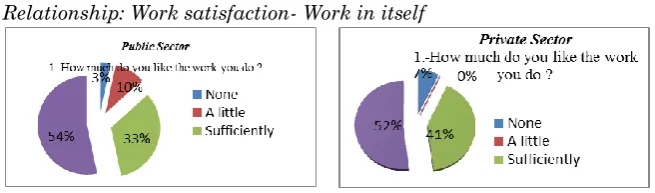
The survey performed in relation to the work itself was observed that: 54% of participants surveyed in the public sector like the work they do and the rest answered "Sufficiently" 33%, "A little" 10% and only 3% of them did not like at all the work they did. "
Considering the private sector noticed that 52% of workers like "A lot" the work they do, 41% said "Sufficiently" and only 7% of them like it "A little" and none of them replied "None”
This shows that in these two institutions public and private one there are no significant differences regarding how much or little the employees like the work they do or the profession.
On the question "How does the work you do seem to be" 50% of employees who were surveyed in public sector deem their work "with responsibility" versus 57% of respondents in the private sector. In both institutions in the public and private one, the number of employees who see their work as "Motivating" and "Safe" is almost with the same percentage as shown in the chart above. We cannot say the same for those who consider their work as "challenging". The survey shows that 15% of public sector employees see their work as challenging whereas 3% of employees in the private sector.
5. RECOMMENDATIONS
different sexes, ages, civil statuses and different seniority are expressed differently in these two sectors.
During the analysis, considering statistical methods, we came up with a result that there is a powerful positive correlation between decision making and the business performance.
1. To make good decisions we should know how to predict the quality of a decision. We would not like to analyse a decision afer we implement it, and then to discuss it as a success or as a failure. 2. In this way we have found the main factor in the menaging or
leadership process. So, if you want to menage in a good way, you should also menage people not only the problems.
3. A decision is as good as the weakest point should be analysed.
There are a lot of ways of analyzing a decision. Below we will use a framework with two groups, each one with three points of decision. Three first points of decision are definition, people and the process – including the declaration of your decision.
4. A weak decision can lead to good results. This can be considered as lucky thing, But we should be careful because luck cannot always be in our side. Good decisions should not be left in luck’s hand.
5. Decisions are related. Decisions can not be concepted as unconnected. They are related with decisions made earlier and those which will be made in the future.
REFERENCES
1. Kume, Vasilika, “Marrja e Vendimeve Manaxheriale”, Shtepia Botuese Pegi, 2010
2. Dorjana Feimi & Vasilika Kume, (2014), “Importance of innovation for SME growth: evidence from Albania” International Journal of Research in Commerce, Economics and Management, Volume No. 4 ISSUE No. 03 (March), ISSN 2231-4245.
3. Kasimati, M., Sjellje Organizative, 2010 4. Work-Satisfaction, www.scribd.com
6. Stephen P.Robbins David DeCenzo – Bazat e menaxhimit 2012 Tiranë
7. Stermasi, E., www.psikologji.net
8. Aaker, D. A(1989). "Managing Assets and Skills: The key to a sustainable Competitive Advantage," California Management Review , fq91-106
9. Drucker, Peter F., Management: Tasks, Responsibilities, Practices. New York: Harper & Row, 1973. ISBN 0-06-0110992-9.