Available online:
https://edupediapublications.org/journals/index.php/IJR/
P a g e | 1310Palatal Rugae Pattern Based on Lineage
(Pilot study for ethnic bugise – South of Sulawesi Indonesia)
Burhanuddin Daeng Pasiga & Lestari Hardianti S
1Department Public Dental Health. Faculty of Dentistry, Hasanuddin University Makassar Indonesia ;2Colleger Profession Stage, Faculty
of Dentistry, Hasanuddin University.Makassar, Indonesia
Correspondence address : Burhanuddin Daeng Pasiga, Dental Public Health. Faculty of Dentistry Hasanuddin University. Email : [email protected] / [email protected]
ABSTRACT
Background: Palatal rugae pattern are stable, and unique oral topographical structures to an individual, like his or her finger prints. Palatoscopy are comparable to dental, fingerprint and DNA identification techniques. Aim: to knowledge the palatal rugae pattern based on lineage. Methods: This study is a cross sectional study that carried out on 20 families. Each families consists of father, mother and their child (boy or girl). Palatal rugae pattern was recorded using an alginate impression material and appropriate metal tray for all sample. Result: The percentage distribution of the pattern of palatal rugae of a child that resembles one of its parents is most often found in the wavy type that is in the father-child relationship (50%). The association of palatal rugae pattern with based on shape, in the father-child relationship (the coefficient coefficient value = 0.731; p = 0,000). and based on the unification (coefficient contingency value = 0.522; p = 0,006). For the mother-child relationship, the contingency coefficient value of the mother-child relationship, based on the shape (contingency coefficient =, 0.478; p = 0,639), this indicates that the weak relationship occurs between mother and child and is not statistically significant Conclusion: This result finds a derivative pattern that occurs in the pattern of rugae palatina between of fathers with children or between mothers and children, this can be an important tool in personal identification and determine the relationship of family lineage of a person.
Keyword: Palatal rugae, lineage
Mailing address : Burhanuddin D.Pasiga. Faculty of Dentistry, Hasanuddin University; email :
[email protected] / [email protected]
INTRODUCTION
Identification of an individual is a prerequisite for certification of death and for personal, social and legal reasons. DNA, fingerprint and dental record comparisons are the most commonly used scientific methods of forensic identification. Limitations to the use of fingerprints occur in situations where the hands are charred or mutilated and while teeth are more durable, identification using dental records may also prove to be inconclusive, since many ante mortem dental records may be inaccurate or incomplete. Although DNA profiling is accurate, it is expensive and time consuming for use in large populations.1,2
Since dental, fingerprint and DNA identification cannot always be used; sometimes it is necessary to apply different and less known techniques. Palatoscopy are comparable to dental, fingerprint and DNA identification techniques. Palatoscopy or palatal rugoscopy is the name given to the study of palatal rugae in order to establish a person’s identity. Palatal rugae are irregular, asymmetric ridges of mucous membrane extending lateral from the incisive papilla and the anterior part of the median palatal raphe, which is just behind the maxillary central incisor teeth.1,3
There is a fact that the palatal rugae patterns are stable, and unique oral topographical structures to an individual, like his or her finger prints. The rugae are located at a more secured position in the oral cavity, well bounded by cheek, lip, tongue, teeth, and alveolar process. Hence, they are well protected from trauma, extreme finger sucking in infancy, and persistent pressure with orthodontic treatment and dentures. The uniqueness, stability and the resistance to damage, facilitate palatal rugae as one of the important anatomical landmarks in forensic investigation.4 Some
researchers have found a derivative pattern that occurs in the palatal rugae pattern, this can be an important tool in personal identification and determine the relationship of an individual’s family lineage.2,5 According to Mendel's
genetic theory, a child will have the same character as his parents because the child gets the same gene derivatives from his parents and the result is influenced by the dominant and recessive factor of the gene that the parent possesses.6
Available online:
https://edupediapublications.org/journals/index.php/IJR/
P a g e | 1311MATERIALS AND METHODS
This study is an observational study with design study is cross sectional study. Sample collection was conducted at RSGM Universitas Hasanuddin. The sample of this study was selected from the colleger of dental profession of Hasanuddin University that registered at RSGM Universitas Hasanuddin using convenience sampling method. The sample of this research is the colleger of dentistry profession of Hasanuddin University and the parents of dental profession colleger of Hasanuddin University who are willing to be used as research sample, amounting to 20 family pairs, each pair of family consisting of 1 father, 1 mother and 1 child. The sample of the study was chosen according to the study criteria, i.e.:
a. Inclusion criteria :
1. Sample with healthy palatal rugae
2. Sample who are willing to be used as research sample b. Exclusion criteria :
1. Sample with palate and lip defect
2. Sample who had previous orthodontic treatment or on going treatment
3. Sample with torus palatine
4. Loss of one tooth or all teeth, between the central incisors, the lateral incisors, the canines, the first premolars, the second premolar and the maxillary first molars
Palatal rugae pattern of the parents and colleger of each family was obtained by using alginate impression
material according to manufacturer’s instruction and appropriate perforated metal tray for all subjects. Negative impression that was obtain using alginate were then casted using dental stone type III.
Assessment criteria were performed by observing the dominant palatal rugae pattern found on both sides of the palatal positive model of the sample jaw. The pattern of rugae palatina is assessed by the classification of Thomas and Kotze.
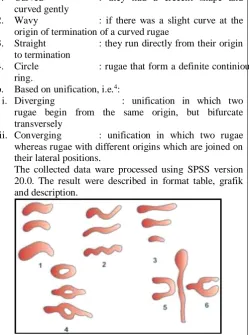
Classification of Thomas and Kotze that citation by Rajan VP et al7, divided into several types as follows.7
a. Based on their shape, i.e.7:
1. Curved : they had a crecent shape and curved gently
2. Wavy : if there was a slight curve at the origin of termination of a curved rugae
3. Straight : they run directly from their origin to termination
4. Circle : rugae that form a definite continious ring.
b. Based on unification, i.e.4:
i. Diverging : unification in which two rugae begin from the same origin, but bifurcate transversely
ii. Converging : unification in which two rugae whereas rugae with different origins which are joined on their lateral positions.
The collected data ware processed using SPSS version 20.0. The result were described in format table, grafik and description.
Sumber : Journal od Indian Academy of Oral Medicine and Radiology. 2015.
Figure 1. Classification of Thomas and Kotze
RESULT
Table 1 shows the distribution of palatal rugae patterns by sex. Based on shape, men have the most wavy type (53.9%) and in women have the most curved type (50.0%). Based on the unification, men and women have the most diverging type than converging type, which is 16 person (61.5%) in males and 25 person (73.5%) in females.
Table 1. Percentage of palatal rugae patterns (Type Shape and Unification) by sex (n=60)
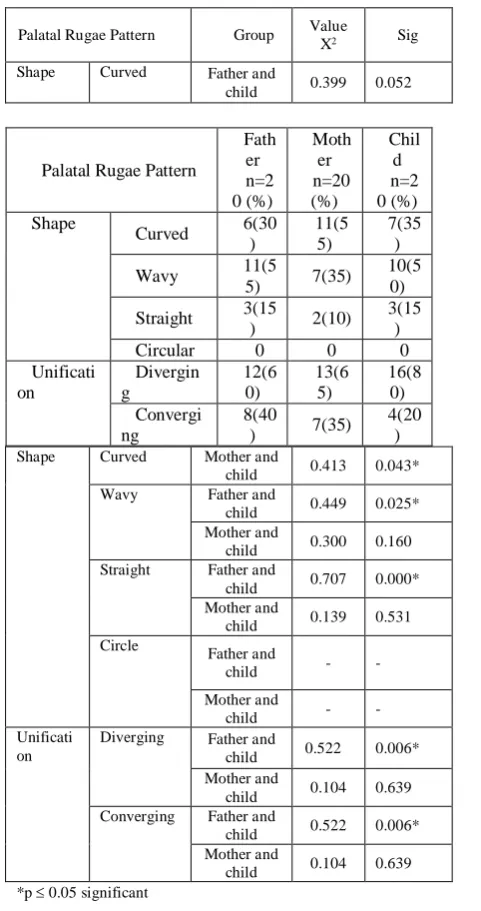
Table 2 shows the percentage distribution of palatal rugae pattern, based on shape, fathers having the most wavy type (55%), mother having the most curved type (55%) while in children having more wavy type (50%). Palatal rugae pattern based on the unification, diverging Palatal Rugae Pattern
Female
n (%) n(%)
Shape Curved 7(26,9) 17(50)
Wavy 14(53,9) 14(41,2)
Straight 5(19,2) 3(8,8)
Circular 0 0
Unification Diverging 16(61,5) 25(73,5)
Available online:
https://edupediapublications.org/journals/index.php/IJR/
P a g e | 1312type is the most type that happened in father (60%) and mother (65%) and children (80%).
Table 3 shows the percentage distribution of palatal rugae pattern that resembles its parent. It can be seen that the pattern of palatal rugae of a child that resembles one of its parents is most often found in the wavy type that is in the father-child relationship (25%), while in the mother-child relationship found most curved type (15%)).
Then when looking at the relationship pattern of child palatal rugae that resembles both parent, on pattern of wavy type and curved type there are equal amount of that is as much as 3 pairs (15%).
Table 2. Percentage distribution of palatal rugae pattern based on group of father, mother and child
Table 3. Percentage Palatal rugae patern based on Family relationship
Palatal Rugae Pattern
Family member relationship n=20 (%)
Father-Child
Mother-Child
Father- Child-Mother
Shape
Curved 1(5) 3(15) 3(15)
Wavy 5(25) 2(10) 3(15)
Straight 3(15) 0 0
Circular 0 0 0
Unification
Diverging 6(30) 4(20) 6(30)
Converging 3(15) 0 1(5)
Table 4 shows the association of palatal rugae pattern with based on shape, in the father-child relationship (the coefficient coefficient value = 0.731; p = 0,000). and based on the unification (coefficient contingency value = 0.522; p = 0,006). For the mother-child relationship, the
contingency coefficient value of the mother-child relationship, based on the shape (contingency coefficient =, 0.478; p = 0,639), this indicates that the weak relationship occurs between mother and child and is not statistically significant .
Table 4. Contingency coefficient shows association of palatal rugae pattern among the samples
*p 0.05 significant
Table 5. Contingency coefficient based on shape type details and unification type detail among Family member relationship
Palatal Rugae Pattern Group Value
X2 Sig
Shape Curved Father and
child 0.399 0.052
Shape Curved Mother and
child 0.413 0.043* Wavy Father and
child 0.449 0.025* Mother and
child 0.300 0.160 Straight Father and
child 0.707 0.000* Mother and
child 0.139 0.531 Circle Father and
child - -
Mother and
child - -
Unificati on
Diverging Father and
child 0.522 0.006* Mother and
child 0.104 0.639 Converging Father and
child 0.522 0.006* Mother and
child 0.104 0.639 *p 0.05 significant
relationships in both diverging and converging patterns. Palatal Rugae Pattern
Fath er n=2 0 (%)
Moth er n=20 (%)
Chil d n=2 0 (%) Shape
Curved 6(30 )
11(5 5)
7(35 )
Wavy 11(5
5) 7(35) 10(5
0)
Straight 3(15
) 2(10) 3(15
)
Circular 0 0 0
Unificati on
Divergin g
12(6 0)
13(6 5)
16(8 0) Convergi
ng
8(40
) 7(35) 4(20
) Palatal
Rugae Pattern
Family member relationship
Contingency
Coeffisient Siq
Shape Father and
child 0.731 0.000*
Mother and
child 0.478 0.206
Unification Father and
child 0.522 0.006*
Mother and
Available online:
https://edupediapublications.org/journals/index.php/IJR/
P a g e | 1313Based on the origin of the sample tribe (Figure 1 - Figure 5), it can be seen that there is a prominent relationship shown between father-mother-child in each pattern. In the Buginese curved pattern (Figure 3), the number of child who have this pattern is almost equal to the number of mothers, therefore it can be said that in this pattern more the pattern of child who resemble the mother. In contrast to the Buginese wavy pattern (Figure 4), the number of child is more of the resemble fathers than mothers. In the pattern of straight on Buginese (Figure 5) also so, the number of children who have this pattern equal to the number of fathers. Then,
Table 5 shows the details of the contingency coefficient and the relationship of each shape and unification. It was found that on the pattern of palatal rugae based on shape, the wavy type on the father-daughter has a positive contingency coefficient value and this relationship was statistically significant (p value = 0.025). While in mother-child positive contingency coefficient value was strongly found in curved type and this relationship was statistically significant (p value = 0.043). In the palatal rugae pattern based on its unification, a strong positive contingency coefficient value (0.522; 0.5222) and
significant (p value = 0.006; 0.006) were found in father-son
when observed based on the division of the pattern according to their unification, in diverging and converging patterns (Figure 6 and Figure 7), it appears that most children follow the pattern of their father rather than their mother.
When viewed based on the similarity of palatal patterns shared between father-son and mother-child according to the tribe (Figure 2 - Figure 6), a significant relationship exists only in the father-children relationship in the Buginese wavy pattern (p = 0.024), on diverging pattern of Buginese (p = 0.026). Whereas in other patterns there is no significant relationship, either in Buginese family or non-Buginese.
In Figures 2, the percentage of curved rugae palatal pattern between father, mother and child based on Pedigree for Bugise ethnic, for mother equal to 72,7% compared to father 33,3%. Ethnic non-bugise for Father 66,7% and mother 27,3%. For Figures 3, where the most percentage of palatal rugae pattern wavy type based on lineage (Ethnic Buginese) is the father of 72,7%, for ethnic non-bugise is mother 57,1%.
DISCUSSION
The uniqueness and stability of palatal rugae in addition to human identification has been known and implemented in forensic and orthodontic fields. Regardless of the controversy about the stability of the qualitative and quantitative characteristics of rugae and the degree of difference between ethnic groups and sexes, the uniqueness of individuals has been recognized in forensic science as a source of potential identification and determining the relationship of one's family lineage.5,8
Fig 2. Percentage of palatal rugae pattern curved type between father, mother and child based on Lineage (Ethnic Buginese and Non-Buginese).
Buginese Non-Buginese
33.30%
66.70% 72.70%
27.30% 71.40%
28.60%
Available online:
https://edupediapublications.org/journals/index.php/IJR/
P a g e | 1314Fig 3. Percentage of palatal rugae pattern wavy type based on Lineage (Ethnic Buginese and Non-Buginese (Family n=20).
This research was conducted with the aim is to know palatal rugae pattern based on lineage from colleger of dental profession of Hasanuddin University. The observed patterns are classified according to the classification of Thomas and Kotze according to their shape (shape) and unification (unification).4,9
This study shows a significant association between palatal rugae pattern between child and parent (Table 4). Based on the shape, the wavy pattern of the father-daughter and the mother-father-daughter curved pattern is seen as most dominant between the child and parent relationship, and in each pattern has a significant value. Based on its unification, in both diverging and converging patterns, a significant relationship is seen only in the father-son relationship (Table 4). However, the dominant relationship in the diverging pattern is more common than the converging pattern (Table 2). The large number of rugae palatina patterns for the wavy patterns occurring between the child and his parents has also been reported by Patel et al5 in his research, and a
strong and significant relationship is also shown in the relationship between father and his/her child/offspring.5
Fig 4. Chart of palatal rugae pattern curved type that resemble between father-son and mother-daughter based on Buginese and Non-Buginese (n=20).
The various forms of rugae are duly indicated by various dominant levels. The most dominant palatal rugae pattern in this study, regardless of family relationship status, but only in terms of sex, based on shape, the dominant pattern is the wavy type found followed by the curved type, whereas based on its unification, the dominant is the diverging type compared to the converging type. The high incidence of wavy and curved patterns has been reported also by Ibeachu et al8,
Thabitha et al7, Saxena et al10, Bajracharya et al11, and
Kumar et al12, and the effect of this pattern can be
regarded as the dominant pattern in most populations. The results of this research that conducted by researchers there are differences with research conducted by Dwivedi N and Nagarajappa AK13 and by Pillai J et
al4 which shows the straight pattern as the most
dominant occur among the population studied. This difference is expected to occur due to differences in ethnicity, race, gender and habitual patterns in the environment. In forensic anthropology, there are only three main groups of a group of races found (at least outside the continent of Australia and the Pacific region) ie Caucasian (composed of Europeans, Asians of Indian subcontinent, Mediterranean people and Americans of similar breeds) Mongoloid (Asian and Native American), and Negroid (African and African-American mix).14
According to two layer theory, there are two racial migrations to Indonesia through the Asian continent, the Austromelanesoid race and the Mongoloid race. The first mixing between the Austromelanesoid race and the Mongoloid race is called the Proto Melayu (Old-Malay) group. The descendants of this group are Toraja (South Sulawesi), Sasak (West Nusa Tenggara), Dayak (Central Kalimantan), Nias (North Sumatera), Mentawai, Baduy, Batak (North Sumatra) and Kubu (South Sumatra). The second mixing between Proto Malays and the Mongoloid race is called the Deutro Melayu group (Malay Youth). The descendants of this group are the tribe of Aceh, the Minangkabau (West Sumatera), the Sundanese, the Javanese, the Balinese, and the Buginese and Makasar.15
These differences in races are determined by the characteristics of an individual's face. Researchers assume that differences in the pattern of facial shape owned by someone based on his race will affect the pattern of rugae palatina form owned by an individual. In this study, when observed based on the origin of the tribe (Figure 2 - Figure 4), the dominant pattern that occurs in the Buginese father is the wavy pattern, whereas in the Buginese mother is the curved pattern. In the straight pattern, the dominant pattern has occurred with the Buginese father, but the sample comparison is too small to be categorized. The dominant pattern derived from the Buginese parents to their son is the
Buginese Non-Buginese
72.70%
27.30% 42.90%
57.10% 50.00%
50.00%
Father Mother Child
Buginese Non-Buginese
50.00% 50.00%
69.20%
30.80% 56.20%
43.80%
Available online:
https://edupediapublications.org/journals/index.php/IJR/
P a g e | 1315wavy pattern followed by the curved pattern. The existence of the same pattern that is passed on by the parents to the child is thought to be influenced by genetic factors. According to Mendel's theory, each of the genes of the parents will be passed on to the child. The child will exhibit one of the dominant parental traits because it may be due to one of the genes of the predominant parent compared to the other who has been derived.6 In
addition, the Bugis tribe is known as a kasiratangan marriage term. According to some who still adhere to the Buginese tradition, this marriage is an ideal marriage that considers the search for a mate in a relative's environment, particularly in a relative's environment that is in a horizontal line, eg a marriage between a cousin.16
The existence of such a tradition, researchers assume that similarity the pattern of rugae palatina among most Buginese acquired is due to the existence of such marriage tradition.
CONCLUSION
It concludes that there was statistically significant resemblence of child’s palatal rugae pattern with their parent’s palatal rugae patterns. This patterns seemingly influenced by their tribe origin and their races origin. In this study, Buginese is the most tribe that was observed and the most pattern type that was found in this tribe is wavy type.
REFERENCE
1. Singh B, Batth N, Singh K, Kaur H. Rugae palatina – a finger print of oral cavity. Research & Review: Journal of Dental Sciences 2015; 3(2): 1
2. Madhusuand K, Patel RN, Umesh K, Sangeeta, Patel R, Patel H. Rugae palatina patterns and its association with lineage. International Journal of Analytical, Pharmaceutical and Biomedical Sciences 2014; 3(5): 15
3. Sabarigirinathan C, Vinayagavel K, Meenakshi A, Selvamani C, Sriramaprabu G, Sivasakthikumar S, et al. Rugae palatina in forensic odontology – a review. IOSR Journal of Dental and Medical Sciences 2015; 14(10): 83
4. Pillai J, Banker A, Bhattacharya A, Gandhi R, Patel N, Parikh S. Quantitative and qualitative analysis of rugae palatina patterns in gujarati population: a retrospective, cross-sectional study. Journal of Forensic Dental Sciences 2016; 8(3): 127
5. Patel RN, Umesh, Sangeeta, Patel R, Patel H, Patel N, et al. Assessing the inheritance of rugae palatina pattern. International Journal of Advanced Research 2015; 3(6):298,300
6. Laird NM, Lange C. The fundamentals of modern statistical genetics. USA: Springer; 2011. P.15-28
7. Thabitha RS, Reddy RE, Manjula M, Sreelakshmi N, Rajesh A, Kumar VL. Evaluation of rugae palatina pattern in establishing identification and sex determination in nalgonda children. Journal of Forensic Dental Sciences 2015; 7(3): 232-6
8. Ibeachu PC, Didia BC, Arigbede AO. A comparative study of rugae palatina patterns among igbo and ikwerre ethnic groups of nigeria: a university of port harcourt study. Anatomy Research International 2014: 1-7
9. Rajan VP, John JB, Stalin A, Priya G, Abuthagir AKS. Morphology of rugae palatina patterns among 5-15 years old children. Journal of Pharmacy and Bioallied Sciences 2013; 5(1): 44
10. Saxena E, Chandrashekhar BR, Hongal S, Torwane N, Goel P, Mishra P. A study of the rugae palatina pattern among male female and transgender population of bhopal city. Journal of Forensic Dental Sciences 2015; 7(2): 142-7
11. Bajracharya D, Vaidya A, Thapa S, Shrestha S. Rugae palatina pattern in nepalese subjects. Orthodontic Journal of Nepal 2013; 3(2): 36-9
12. Kumar S, Vezhavendhan N, Shanthi V, Balaji N, Sumathi MK, Vendhan P. Palatal rugoscopy among puducherry population. The Journal of Contemporary Dental Practice 2012; 13(3): 401-3
13. Dwivedi N, Nagarajappa AK. Morphological analysis of rugae palatina pattern in central indian population. Journal of International Society of Preventive and Community Dentistry 2016; 6(5): 417-21
14. Novita M. Facial, upper facial, and orbital index in batal, klaten, and flores student of jember university. Dental Journal 2006; 39(3): 116-9
15. Rieuwpassa IE, Hamrun N, Riksavianti F. Ukuran mesiodistal and servikoinsisal gigi insisivus sentralis suku Bugis, Makassar and Toraja tidak menunjukkan perbedaan yang bermakna. Dentofasial 2013; 12(1): 1-4