Redefining Wireless Technology with Spectral Efficiency
Monika Tuteja#1, Shally Gujral#2, Baljit Kaur#3#
Electronics & Communication Department, PTU, Jalandhar# Anand College of Engineering & Management, Kapurthala
1
[email protected], [email protected], [email protected]
ABSTRACT
The field of wireless and mobile communication has a remarkable history that spans over a century of technology innovations from Marconi’s first transatlantic transmission in 1899 to the worldwide adoption of cellular mobile services by over four billion people today. Wireless has become one of the most pervasive core technology enablers for a diverse variety of computing and communications applications ranging from third-generation/fourth-generation (3G/4G) cellular devices, broadband access, indoor Wi-Fi networks, vehicle-to-vehicle (V2V) systems to embedded sensor and radio-frequency identification (RFID) applications. This has led to an accelerating pace of research and development in the wireless area with the promise of significant new breakthroughs over the next decade and beyond. This paper provides a perspective of some of the research frontiers of wireless and mobile communications, identifying early stage key technologies of strategic importance and the new applications that they will enable. Specific new radio technologies discussed include dynamic spectrum access (DSA), white space, cognitive software-defined radio (SDR), antenna beam steering and multiple-input–multiple-output (MIMO), 60-GHz transmission, and cooperative communications [1]. Taken together, these approaches have the potential for dramatically increasing radio link speeds from current megabit per second rates to gigabit per second, while also improving radio system capacity and spectrum efficiency significantly. The paper also introduces a number of emerging wireless/mobile networking concepts including multihoping, ad hoc and multihop mesh, delay-tolerant routing, and mobile content caching, providing a discussion of the protocol capabilities needed to support each of these usage scenarios. In conclusion, the paper briefly discusses the impact of these wireless technologies and net-working techniques on the design of emerging
audiovisual and multimedia applications as they migrate to mobile Internet platforms.
KEYWORDS: Ad hoc and mesh networks; audiovisual
communication; broadband services; cognitive radio; delay-tolerant routing; future Internet; MIMO; mobile multimedia; radio access networks; software-defined radio; wireless communication; 3G and 4G mobile communication.
1. INTRODUCTION:
Mobile wireless industry has started its technology creation, revolution and evolution since early
1970s. In the past few decades, mobile wireless technologies have experience 4 or 5 generations of technology revolution and evolution, namely from 0G to 4G. The cellular concept was introduced in 5G Technology stands for 5th Generation Mobile technology. 5G technology has changed the means to use cell phones within very high bandwidth. User never experienced ever before such a high value technology. Nowadays mobile users have much awareness of the cell phone (mobile) technology. The 5G technologies include all type of advanced features which makes 5G technology most powerful and in huge demand in near future.
Were a 5G family of standards to be implemented,
it would likely be around the year 2020, according to
some sources. A new mobile generation has appeared
spectral bandwidth per frequency channel (1G up to 30 kHz, 2G up to 200 kHz, 3G up to 5 MHz, and 4G up to 40 MHz), but the main issue that there is little room for new frequency bands or larger channel bandwidths. From end users point of view, previous mobile generations have implied substantial increase in peak bit rate (i.e. physical layer net bitrates for short-distance communication). However the major difference from a user point of view between 4G and 5G techniques must be something else than increased maximum throughput; for example lower battery consumption, lower outage probability (better coverage), high bit rates in larger portions of the coverage area, cheaper or no traffic fees due to low infrastructure deployment costs, or higher aggregate capacity for many simultaneous users.
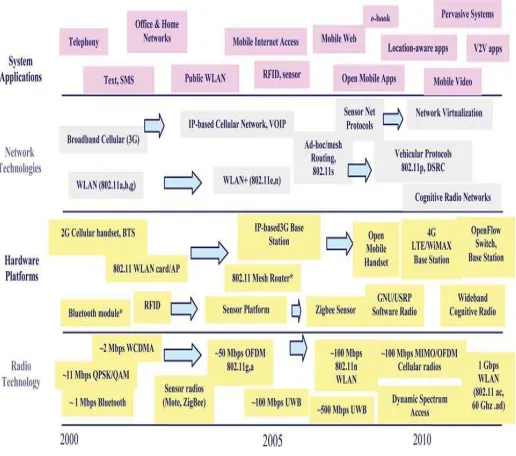
Fig. 1. Wireless technology roadmap
2. WIRELESS TECHNOLOGY ROADMAP
Wireless technology has progressed significantly during the past decade, with many new research ideas and pro-duct innovations currently in the pipeline. Fig. 1 shows a summary roadmap for wireless technology, identifying some of the important innovations during the period 2000–2010. The diagram is organized into four layers: radio hardware platforms, wireless
physical layer technologies, network protocols and software, and mobile systems/applications. At the hardware platform level, it is observed that there has been a proliferation of new radio equipment during this period including 3G, 4G, Wi-Fi, Bluetooth, open mobile handsets, software-defined radio, and most recently, open virtualized access points and base stations. In terms of the radio physical layer, it can be seen that cellular radio link speed has increased from about 2 Mb/s with early 3G systems in the year 2000 to 100 Mb/s with 4G (LTE and WiMax) systems using
multiple-input– multiple-output (MIMO) radio
technology. Similarly, short-range Wi-Fi radio speeds have increased from 11 Mb/s 802.11b in the year 2000 to 300 Mb/s with 802.11n.[2] Thus, wide-area cellular and short-range radio have become 30–50 times faster over this period, roughly matching Moore’s law advances in computing speed; see Fig. 2, which shows approximately exponential increases over the past 20 years. The bit-rate trajectories in Fig. 2 also show future increases in 4G and Wi-Fi speeds to 200 Mb/s and 1 Gb/s by taking advantage of wideband dynamic spectrum allocation or new higher frequency bands such as 60 GHz being considered for the gigabit per second 802.11ad standard. Clearly, we are currently in the midst of historic increases in wireless bit rate and system capacity to levels needed to support large-scale delivery of audiovisual and rich media applications.
Fig. 2. Exponential increases in WLAN and cellular access speeds over past 20 years
3. ADVANCES IN WIRELESS AND MOBILE TECHNOLOGY
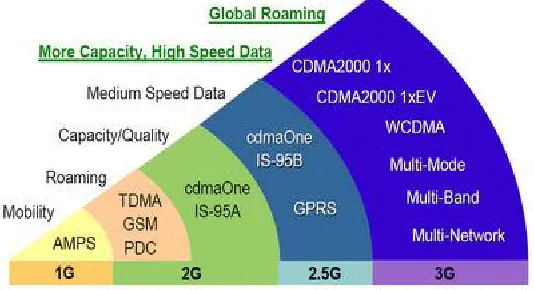
mobile phones so we are going to analyze the various generations of cellular systems as studied in the evolution of mobile communications from 1st generation to 5th generation. We can analyze that this could be due to increase in the telecoms customers day by day. In the present time, there are four generations in the mobile industry [3]. These are respectively 1G- the first generation, 2G- the second generation, 3G- the
Fig. 3. Different wireless technologies
third generation, and then the 4G- the forth generation,5G-the fifth second generation.
3.1. 1G Generation: The first generation of mobile phones was analog systems that emerged in the early
1980s.1G- technology replaced 0G technology, which
featured mobile radio telephones and such technologies as Mobile Telephone System (MTS), Advanced Mobile Telephone System (AMTS), Improved Mobile Telephone Service (IMTS), and Push to Talk (PTT). Its successor, 2G, which made use of digital signals, 1G wireless networks used analog radio signals. Through 1G, a voice call gets modulated to a higher frequency of about 150MHz and up as it is transmitted between radio towers. This is done using a technique called Frequency-Division Multiple Access (FDMA). But its fail in some field such as in terms of overall connection quality, 1G compares unfavorably to its successors. It has low capacity, unreliable handoff, poor voice links, and no security at all since voice calls were played back in radio towers, making
these calls susceptible to unwanted eavesdropping by third parties.
3.2. 2G Generation: The second generation, 2G system, fielded in the late 1980s and finished in the
late 1990s, was planned mainly for voice transmission
with digital signal and the speeds up to 64kbps.
Second Generation (2G) wireless cellular mobile services was a step ahead of First Generation( 1G) services by providing the facility of short message service(SMS) unlike 1G that had its prime focus on verbal communication. The bandwidth of 2G is 30-200 KHz. During the second generation, the mobile telecommunications industry experienced exponential growth in terms of both subscribers and value-added services [4].
3.3. 2.5G Generation: It is used to describe 2G-systems that have implemented a packet switched
domain inaddition to the circuit switched domain. 2.5
G can provide data rate, up to 144 kbps. GPRS, EDGE
and CDMA 2000 were 2.5 technologies.
integration of services at the upper layer is expected.
3.5. 4G Generation: When It is still to estimate as to how many number of people have moved on from 2G
to 3G , technology has come up with the latest of its
type namely 4G.A successor of 2G and 3G, 4G promises a downloading speed of 100Mbps. Then with the case of Fourth Generation that is 4G in addition to that of the services of 3G some additional features such as Multi-Media Newspapers, also to watch T.V programs with the clarity as to that of an ordinary T.V. In addition, we can send Data much faster than that of the previous generations.
3.6. 4.5G Generation:
A user can also hook their 5G technology cell phone with their Laptop to get broadband internet access. 5G technology including camera, MP3 recording, video player, large phone memory, dialing speed, audio player and much more you never imagine. For children rocking fun Bluetooth technology and Piconets has become in market.
3.7. 5G Generation:
5G Technology stands for 5th Generation Mobile technology. 5G mobile technology has changed the means to use cell phones within very high bandwidth. User never experienced ever before such a high value technology. Nowadays mobile users have much awareness of the cell phone (mobile) technology. The 5G technologies include all type of advanced features which makes 5G mobile technology most powerful and in huge demand in near future [2].
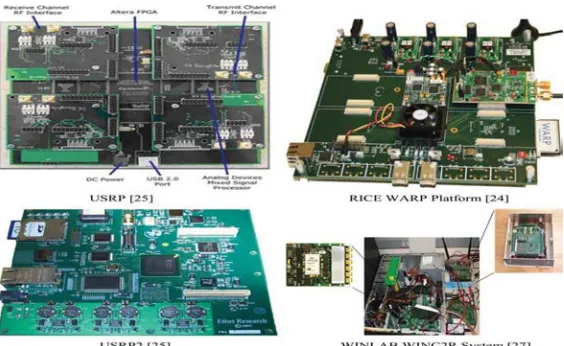
Fig. 4. Photos of experimental cognitive radio platforms
4.Wireless Communication Algorithms
1) MIMO: For several emerging wireless data services and requirements, the application of multiple-antenna systems appears to be one of the most promising solutions leading to even higher data rates and/or the ability to support greater number of users. Multiple transmit and multiple receive antenna systems that embody an implementation of the MIMO concept in wireless systems [6]. The potential and promise of multiple-antenna techniques has now resulted in widespread proposals for the use of these in a variety of contexts: for wide area wideband wireless transmission in next-generation cellular systems; for local area hot-spot data service overlays in cellular systems; for emerging short-range WLAN networks; for promoting efficient spectrum sharing in the unlicensed bands; and a variety of collaborative techniques in wireless ad hoc networks. A key attribute required of any multiple-antenna technique to be successful in any of the above contexts is the need for reliable and efficient channel state information (CSI) [4]. Such CSI is absolutely necessary at the receiver to realize the potential capacity gains that are promised in such systems. Further, the CSI is also necessary at the transmitter in the case of transmitter optimization techniques used in conjunction with multiple antennas.
cooperative coding, relaying, and forwarding. It is perhaps not surprising that cooperative techniques can often lead to a better overall result than independent or competitive techniques, and a good deal of important research in this area has occurred. A related aspect that has also been considered extensively in research studies is that cooperation may involve significant costs, and that the greatest immediate benefits will not necessarily go to the users that bear the greatest immediate cost. For example, cooperation may require that a terminal delay its own transmissions and use its limited energy budget to relay messages for other terminals [14]. Over time, such costs and benefits may equalize, but there is no reason to assume that users will willingly bear an immediate cost for a speculative future benefit. In the case of spectrum shared by autonomous terminals, how-ever, as is typical in the ISM and U-NII bands, protocols are relatively unconstrained and the assumption of a selfless, cooperative sharing of the spectrum resource may not be realistic. Several mechanisms have been proposed to facilitate cooperation among autonomous nodes. These mechanisms can be roughly classified as reputation-based, credit-based incentive, network-assisted pricing mechan-isms, and mechanisms based on forwarding (or ad hoc) games [5]. These prior efforts often mimic the operation of a complex economy and in doing so they illustrate the inherent difficulty of such an approach. Such approaches may be sometimes more complex than is war-ranted for this problem and simpler approaches based on the mechanisms of barter and exchange have also been considered. Bandwidth, stored battery energy, and data are the tangible assets of a radio resource manager, and will be the basis for our barter-exchange economy. Bandwidth and data can be traded directly between nodes, and energy can be saved by one or both on the basis of their cooperation [7].
We note that such cooperative techniques can also help to improve power efficiency and hence are applicable to emerging B green[ information technology initiatives. While current projections for
carbon emissions due to information and communication technologies are about 2%–4% of the total [8], rapidly increasing demand for wireless data services has motivated efforts toward improving energy efficiency in wireless networks. In modern cellular systems, approximately 80% of the energy costs are incurred at the base station, and a further 80% of this cost is incurred in the operation and support of the power amplifiers used in the transmitter [9]. Cooperative forwarding by relays has been proposed for reducing cellular base station transmit power while also improving coverage and capacity. Preliminary results [10] demonstrate gains of about 2.5-dB savings in peak transmit power and 3-dB savings in average transmit power.
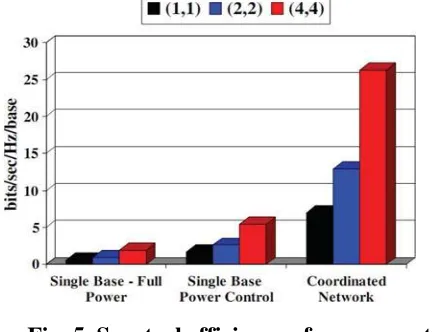
Fig. 5. Spectral efficiency of power control scheme with different number of antennas systems. ðNt ; Nr Þ denotes antennas at the
transmitter and the receiver, respectively
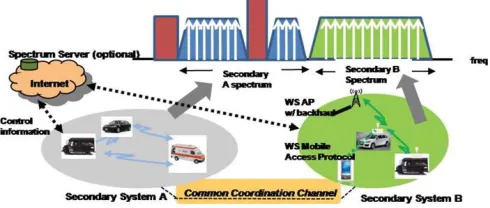
availability and do not allow dynamic spectrum adaptation or modulation that will be required for open access under varying spectrum availability. The emerging cognitive radio technologies on the other hand enable DSA. In their simplest embodiments (which are by no means simple to implement) cognitive radios can recognize the available systems and adjust their frequencies, waveforms, and protocols to access those systems efficiently. Such dynamic access hinges on the development of cognitive protocols and algorithms that exploit temporal and spatial variability in the spectrum via: 1) initial cooperative neighbor discovery and association; 2) spectrum quality estimation and opportunity identification; and 3) radio bearer management. These, in turn, imply a framework that senses neighborhood [conditions to identify spectrum opportunities for communication by building an awareness of spectrum policy, local network policy, and the capability of local nodes (including non-cooperative Blegacy nodes [11].
In concept, cognitive radios [12] extend the SDR framework to include multiple domains of knowledge, model-based reasoning, and negotiation. The knowledge and reasoning can include all aspects of any radio etiquette such as radio-frequency (RF) bands, air interfaces, proto-cols, and spatial as well as temporal patterns that moderate the use of the radio spectrum. Negotiation implies strategy-directed communication with peers about the use of radio spectrum over the dimensions of space, time, and frequency. The key to such an enablement of DSA lies in the ability to program such radios to become radio-domain aware and intelligent agents, and to provide the supporting structures which allow awareness and negotiation to take place. The PHY and MAC layer innovation that allows such seamless spectrum access is based on OFDM and access based on OFDMA [13]. The use of multiple carriers such as in OFDM techniques allows support of high date rate applications such as video without necessarily encountering frequency selective radio channels at the receiver, since the multiple carriers effectively
present to the receiver a set of parallel flat fading channels. Further, the advent of noncontiguous OFDM techniques [9] also presents opportunities for flexible and versatile DSA where a transmitter can simultaneously and opportunistically transmit data over multiple frequency channels that are not adjacent [16].
4) Network Coding: In the last few years, the area of network coding has seen an explosive growth in research activity while being touted as the foundation on which several applications related to the robust operation of both wired and wireless networks can be built [17]. The breadth of areas that have been touched by network coding is vast and includes not only the traditional disciplines of information theory, coding theory, and networking, but also topics such as algorithms, combinatory, distributed storage, network monitoring, content delivery, and security. Since the pioneering work by Ahlswede et al. [6] that established the benefits of coding in routers and provided theoretical bounds on the capacity of such networks, there have been many fine results for network coding strategies for multi-cast traffic, as well as their design and implementation in polynomial time. In fact, it can be said that for multicast traffic, linear codes achieve the maximum capacity bounds and can be done in polynomial time. Further, the above is true even when routers perform random linear operations. The above results have been extended to various situations in wireless networks and also in the context of content distribution, distributed storage, and secrecy [4].
V. CONCLUSION
Wireless has become one of the most pervasive core technology enablers for a diverse variety of computing and communications applications ranging from 3G/4G cellular devices, broadband access, indoor Wi-Fi networks, vehicle-to-vehicle (V2V) systems to embedded sensor and RFID applications. It is also of central importance to the future of mobile pervasive audiovisual and multimedia applications. This has led to an accelerating pace of research and development in the wireless area with the promise of significant new breakthroughs over the next decade and be-yond.We have provided a perspective of some of the research frontiers of wireless and mobile communications and identified early stage key technologies of strategic importance and the new applications that they will enable. Specific new radio technologies discussed include DSA, white space, cognitive software-defined radio (SDR), antenna beam steering and MIMO, 60-GHz transmission, and cooperative communications. Taken together, these approaches have the potential for dramatically increasing radio link speeds from current megabit per second rates to gigabit per second, while also improving radio system capacity and spectrum efficiency significantly.
References:
[1] Amos Edward Joel (Bell Labs), “Cellular Mobile Communication System.”
[2] Andrew McGirr, Barry Cassidy (Novatel), 1992, “Radio telephone using received signal strength in controlling transmission power”.
[3] Douglas Fougnies et al. (Freedom Wireless) 1998, “Security cellular Telecommunications system”.
[4] Siegmund M. Redl, Matthias K. Weber, Malcolm W. Oliphant (March 1995): "An Introduction to GSM.”
[5] Gregory P.Pollini, David J.Goodman,”Signalling
system performance evaluation for personal communication”,”IEEE Transactions on vehicular Technology”,Vol.45, no.1, pp.131-138 Feb 1996. [6] http://freewimaxinfo.com/5g-technology.h
[7]http://www.scribd.com/doc/22050811/5g-Wireless-Architecture-v-1. [8] en.wikipedia.org/wiki/5G.
[9] http://kevin-peter.hubpages.com/hub/3G-and-4G-Mobile-Services.
[10] http://www.teknocrat.com/1g-vs-2g-vs-3g-vs-4g-vs-5g-comparison-differences-and-
analysis.html.
[11]http://www.ijcaonline.org/volume5/number4/px c3871282.pdf.
[12]
http://www.globalreviewchannel.com/forum/3290-G-way.aspx.
[13] Kavitha Ammayappan, Ashutosh Saxena and
Atul Negi,”Mutual Authentication and Key
Agreement based on Elliptic Curve Cryptography
for GSM“. In International conference on
advanced computing and communications, 2006 (pp.183-186).
[14] Chin-Chen Chang*, Jung-San Lee, Ya-Fen Chang(2005).”Efficient authentication protocols for GSM”.Computer Communications, 28, 921-928. [15] Khalid Al-Tawil, Ali Akrami, Habib Youssef.” A New Authentication Protocol for GSM Networks”.In IEEE 23rd Annual Conference on Local Computer Networks (LCN’98) (pp.21-30). [16] Toorani, M.; Beheshti Shirazi, A.A.(2008) “Solutions to the GSM Security Weaknesses ”, Next Generation Mobile Applications, Services and Technologies, 2008. Page(s): 576 – 581.
[17] Kumar,K.P., Shailaja, G.,Kavitha, A.,and
Saxena, A.(2006).”Mutual Authentication and
key agreement for GSM”.In International