Optimal Coordination of Directional
overcurrent Relay Using Hybrid BFO-DE
Algorithm
Reshma Chingakham1, Shuma Adhikari2
PG Student [Power and Control], Dept. of EE, NIT Manipur, Imphal, Manipur, India1 Assistant Professor, Dept. of EE, NIT Manipur, Imphal, Manipur, India2
ABSTRACT:This paper aims to solve the coordination problem encounter by IDMT directional overcurrent relays in meshed power systems, using a hybrid optimization algorithm called hybrid BFO-DE (Hybrid Bacterial Foraging Optimization and Differential Evolution). The operating time of the overcurrent relays influence a non-linear relationship with TDS and PS. The objective of hybrid optimization algorithm is to reduce total operation time for each protective relay. The competence of the proposed hybrid algorithm is shown in the paper. In this study two models are considered namely IEEE 3-bus model and IEEE 4-bus model. The result has shown that the BFO-DE approach provides good convergence speed and solution quantity.
KEYWORDS: IDMT Directional Overcurrent Relay, Protection Coordination Problem, Bacterial Foraging
Optimization (BFO), Differential Evolution Algorithms.
I.INTRODUCTION
As the demand for power increases, the industrial power system are developing which causes the stability and security issues highly considerable for power system researchers. The protection of power system (protective system) involves two major tasks:(i) detection (ii) clear fault area as fast and selective as possible. The faulty part has to be isolated quickly from healthy system by using protective relays. Protective relays can detect the system abnormalities and execute appropriate command and hence protect the system from damaging caused by fault. Coordination between the protection relays in proper and appropriate manner is necessary to maintain the suitable operation of overall protection system of power system.
Based on the requirements of sensitivity, reliability, selectivity and speed, relay parameter are set or selected for protective relays coordination. For the protection of transmission and distribution system the directional overcurrent relay are popularly considered as good technical and economic choice [1]. The overcurrent unit consists of two parameters: (i) Plug Setting (PS) and (ii) Time Dial Setting (TDS). The application of computer in power system relay coordination helps to remove the load of huge mathematical calculation for protection engineers [2]. Conventional classical protection philosophy and several parameter optimization techniques have been proposed for coordinating directional overcurrent relay. For coordination of overcurrent relay, proper setting of relay is important. At first the remote end relays are set, and then corresponding backup relays are set from coordination protection point view. In this way all possible paths are taken into account for optimal setting of relay parameters [3]. The optimization algorithm helps to solve the coordination problem by minimizing the operating time of all main relays. The subjected constraint of the problem are as follows-(i)backup relay(operates only when the primary relays fails to respond the fault near to it),(ii)Time Dial Setting(TDS),(iii)Plug Setting(PS) and (iv)minimum operating time of relay. The operating time of the overcurrent relays holds a non-linear relationship with TDS and PS.
Colony algorithm (ABC) [18], Firefly Optimization Algorithm (FOA) [19, 20], Modified Swarm Firefly Algorithm (MSFA) [21], and Biogeography Based Optimization (BBO) [22].
In this paper, hybrid optimization technique called Hybrid BFO-DE is used for optimal relay settings. This algorithm helps in minimizing the operation time for each protection relay for IEEE-3 bus and IEEE-4 bus system. The result shows that algorithm is competent enough to solve such non linear problem.
II. OPTIMAL RELAY COORDINATION OF OVERCURRENT RELAY
Inverse Definite Minimum Time (IDMT) relays play an important role in power system. The IDMT overcurrent relay enables quick isolation of faulty part from healthy system. The operating time of overcurrent relays is inversely proportional to fault current. Hence when high fault current is sense, the overcurrent relays start to execute or operate fast. The characteristics of relay depend on the type of standard selected for the relay operation; which can be ANSI, IEEE, IEC or user defined. The tripping time of overcurrent relays is decided according to time overcurrent delay curve in which the time delay depends on current. The operating time of relay is control by three main factors: TDS, PS and the fault current ( ) and it is defined by a non-linear mathematic equation [5], [13]-[28] with respect to the coordination time constraint between the backup and primary relays:
(1)
Where is the fault current at CT (Current Transformer) primary terminal where fault occurs. is the primary rating of CT. In equation (1) are constant which is equal to 0.14, 0.02 and 1.0 respectively as per IEEE standard [29].The current seen by the relays denoted as is given by the ratio of to , which is a non-linear equation:
(2)
The level of non-linearity in the equation is defined by the ratio of and PS.
II (A) OBJECTIVE FUNCTION
The given Fig 1 demonstrate the close-in fault (near end fault),a fault that occurs near or close to the relay and far-bus fault (far end fault),a fault that occurs at the other end of line.
Fig.1: Close-in fault and far-bus faults for a relay
In coordination studies an objective function is defined as the summation of operating time of all the primary relays to clear faults such as close in fault or far-bus fault and it has to be minimized. This objective function are given in following form [6],[16],[17]:
(3)
Where
(5)
Where is the relay operation time to remove near end fault and is its operation time to remove
far end fault. and denotes the number of relays installed at ends of primary line.
II(B) CONSTRAINT
For coordination problem (OF to be minimized),the three contraints need to be considered are TDS,PS and .
(1 )TDS of relay denotes the time delay before the relay operates whenever the fault current becomes greater than or equal to PS (plug setting).
Where and are the minimum and maximum values for TDS which values are given as 0.05 and 1.10
respectively where i varies from 1 to . (2) PS of relay are represented as follows:
Where and are the minimum and maximum values for PS which values are given as 1.25 and 1.50 respectively, where i varies from 1 to .
(3) Operating time of relay depends on the fault current which can be seen by the relay and the pickup current setting. Operating time of relay depends on the type of the relay and it can be determined by either standard characteristic curves of the relay or analytic formula. Operating time is represented by:
Where and are the minimum and maximum values for operating time which values are equal to 0.05 and
1.00 respectively. The coordination time interval between the primary and the backup relays must be confirmed during optimization procedure. In this paper, the chronometric coordination between the primary and the backup relays is given as in equation:
CTI is the minimum coordination time interval which is varied between 0.30 and 0.40 sec for electromechanical relay and between 0.10 and 0.20 sec for numerical relays.
and are the operating time of the backup and primary relays respectively which can be obtained using
the equations: and
III.HYBRID ALGORITHM BFOA-DE
The hybrid algorithm BFOA-DE combines and incorporates the advantages of both BFOA and DE algorithm. BFOA helps in finding new solution by elimination and dispersal while DE algorithm promotes social information exchange.The algorithm is briefly described below:
Initialize parameters S, NC,, NS,, C(i)(i=1,2…N), F, CR. where,
S: The number of bacteria in the population, D:Dimension,
NC : No. of chemotactic steps,
C (i): the size of the step taken in the random direction specified by the tumble. F: Scale factor for DE type mutation
CR: Crossover Rate. Set j = 0, t = 0;
Differential evolution mutation loop: t = t +1;
θ(i, j, t) denotes the position of the ith bacterium in the jth chemotactic and tth differential evolution loop. for i = 1,2,...,S, a chemotactic step is taken for ith bacterium.
(a)Chemotaxis loop:
(i) Value of the objective function J (i, j, t ) is computed, where J (i, j, t) symbolizes value of objective function at j th chemotaxis cycle for i- th bacterium at t-th DE mutation step;
(ii) J J (i, j, t) last = we store this value of objective function for comparison with values of objective function yet to be obtained in future.
(iii) Tumble: generate a random vector D D(i)ÎÂ with each element i m D m D ( ), = 1,2,..., is a random number on [-1, 1].
(iv) Move: θ(i, j+ 1, t)=ω.θ (i, j, t) +C(i).(Δ (i) / ) (i) );
Where, ω = inertia factor which is generally equals to 1 but becomes 0.8 if the function has an optimal value
close to 0.
C(i) = step size for k th bacterium = 0.1 .{J(i.j.t)}/{J(i,j,t)+1000}
Step size is made an increasing function of objective function value to have a feedback arrangement. (v) J (i, j, t) is computed.
(vi) Swim: We consider here only i-th bacterium is moving and others are not moving. Now Let m = 0; while m < Ns (no of steps less than max limit).
Let m = m +1;
If last J (i, j, t) < J (if going better) Jlast =J (i, j, t) ;
And letθ(i, j+ 1, t)=ω.θ (i, j, t) +C(i).(Δ (i) / ) (i) ); Else, m = N (end of while loop);
for i = 1,2,...,S, a differential evolution mutation step is taken for i-th bacterium.
(b) Differential Evolution Mutation Loop:
(i) For each θ (i, j +1, t) trial solution vector we choose randomly three other distinct vectors from the current
population namely θ (l), θ (m), θ (n) such that
i ≠ l ≠ m ≠ n
(ii) V (i, j +1, t) =θ(l) + F.(θ (m) −θ (n));
Where, V (i, j +1, t) is the donor vector corresponding to θ (i, j +1, t) .
(iii) Then the donor and the target vector interchange components probabilistically to yield a trial vector U(i, j +1, t) following:
Up (i, j +1, t) = V p (i, j 1,t) + If ( rand p (0,1) ≤CR ) or (p = rn(i))
θp(i, j 1, t) + If (rand p (0,1) > CR ) or (p≠rn(i)) for p-th dimension.
where rand p (0, 1) € [0,1] is the p-th evaluation of a uniform random number generator.
rn(i) € {1,2,....,D}is a randomly chosen index which ensures that U(i, j +1, t) gets at least one component from V(i, j +1, t) .
(iv) J (i, j +1, t) is computed for trial vector;
(v) If J (U(i, j +1, t)) < J (q (i, j +1, t)) , q (i, j +1, t +1) =U(i, j +1, t);
If j < Nc ,start another chemotaxis loop.
Fig 2. One line diagram of IEEE 3 bus system
IV. RESULTS AND DISCUSSION
The performance of the proposed algorithms is experimented on IEEE-3 bus and IEEE-4 bus system shown in Fig 2 and Fig 3. IEEE-3 bus system consists of 3 buses, 3 lines, 1 generators and 6 DOCRs accordingly the number of decision variables is 12 (two for each relay) i.e. TDS1-TDS6 and - . IEEE-4 bus system consists of 4 generators, 4
lines and 8 directional overcurrent relays. Therefore number of decision variables is 16 (two for each relay) i.e. TDS1-TDS8 and - .
Parameters for BF-DE Algorithm:
p=12; S=20;
Nc=20; Ns=5;
Nre=10; Ned=1; Ped=0.09
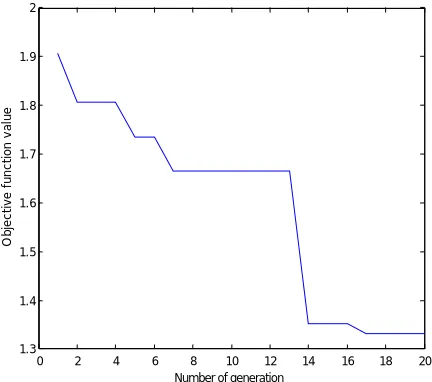
To obtain the optimal values of the problem the program is developed in MTALAB 7. Each model is executed 30 trial runs and the best result is reported in the paper. Figure 4 and Figure 5 shows convergence characteristics of the proposed hybrid BFO-DE.
0 2 4 6 8 10 12 14 16 18 20
1.3 1.4 1.5 1.6 1.7 1.8 1.9 2
Number of generation
O
b
je
c
ti
v
e
f
u
n
c
ti
o
n
v
a
lu
e
Fig 4. Convergence characteristics of proposed BFO-DE for IEEE 3 bus system
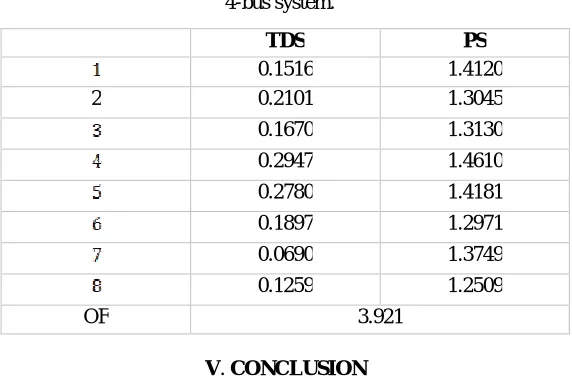
The optimal solution of TDS and PS are tabulated in Table 1 and Table2.
.
V. CONCLUSION
In this study the coordination problem of directional overcurrent relays is solved by experimenting a proposed hybrid BFO-DE algorithm on IEEE-3 bus and IEEE-4 bus system. The co-ordination of the directional overcurrent relay is highly non linear and complex problem subject to various constraints. The results obtained from experiments gives most optimal values of TDS, PS and minimum operating time of relays. Hybrid BFO-DE exhibits good quality solutions with higher convergence rate.
REFERENCES
[1] .D. Birla, R.P. Maheshwari, and H.O. Gupta, “An Approach to Tackle the Threat of Sympathy Trips in Directional Overcurrent Relay Coordination”, IEEE Transactions on Power Delivery, Vol. 22, No. 2, pp. 851-858, 2007.
[2]. SLEVA A.F., Protective Relay Principles, Published by CRC Press, UK, 2009.
[3]. Mohamed Zellagui and Almoataz Youssef Abdelaziz , “Optimal Coordination of Directional Overcurrent Relays using Hybrid PSO-DE Algorithm”.International Electrical Engineering Journal (IEEJ) Vol. 6 , No. 4, pp. 1841-1849 ISSN 2078-2365, 2015
[4] J.A. Sueiro, E. Diaz-Dorado, E. Míguez, and J. Cidrás, “Coordination of Directional Overcurrent Relay using Evolutionary Algorithm and Linear Programming”, International Journal of Electrical Power and Energy Systems, Vol. 42, pp. 299-305, 2012.
[5] R. Thangaraj, T.R. Chelliah, and M. Pant, “Overcurrent Relay Coordination by Differential Evolution Algorithm”, IEEE International Conference
TDS PS
0.1830 1.4290
2 0.3620 1.2598
0.1378 1.3331
0.0922 1.3740
0.1223 1.3979
0.1031 1.3601
OF 4.3401
TDS PS
0.1516 1.4120
2 0.2101 1.3045
0.1670 1.3130
0.2947 1.4610
0.2780 1.4181
0.1897 1.2971
0.0690 1.3749
0.1259 1.2509
OF 3.921
Table 2. Optimal setting of relays for IEEE 4-bus system.
on Power Electronics, Drives and Energy Systems (PEDES), Bengaluru, India, December 16-19, 2012.
[6] R. Thangaraj, M. Pant, and K. Deep, “Optimal Coordination of Overcurrent Relays using Modified Differential Evolution Algorithms”,
Engineering Applications of Artificial Intelligence, Vol. 23, No. 5, pp. 820-829, 2010.
[7] M. Mohseni, A. Afroomand, and F. Mohsenipour, “Optimum Coordination of Overcurrent Relays Using SADE Algorithm”, 16th IEEE Conference on Electrical Power Distribution Networks (EPDC), Bandar Abbas, Iran, 19-20 April, 2011.
[8] M. Zellagui, R. Benabid, M. Boudour, and A. Chaghi, “Mixed Integer Optimization of IDMT Overcurrent Relays in the Presence of Wind Energy Farms using PSO Algorithm”, Periodica Polytechnica - Electrical Engineering and Computer Science, Vol. 59, No. 1, pp. 7-19, March 2015. [9] H. Zeineldin, E. El-Saadany, and M. Salama, “Optimal Coordination of Overcurrent Relays using a Modified Particle Swarm Optimization”,
Electrical Power Systems Research, Vol. 76, No. 11, pp. 988-995, 2006.
[10] M.M. Mansour, S.F. Mekhamer, and N.E.S. El-Kharbawe, “A Modified Particle Swarm Optimizer for the Coordination of Directional Overcurrent Relays”, IEEE Transactions on Power Delivery, Vol. 22, No. 3, pp. 1400-1410, 2007.
[11] H. Leite, J. Barros, and V. Miranda, “The Evolutionary Algorithm EPSO to Coordinate Directional Overcurrent Relays”, 10th IET International Conference on Developments in Power System Protection (DPSP), Manchester, UK, March 29 - April 1, 2010.
[12] A. Fetanat, G. Shafipour, and F. Ghanatir, “Box-Muller Harmony Search Algorithm for Optimal Coordination of Directional Overcurrent Relays in Power System”, Scientific Research and Essays, Vol. 6, No.19, pp. 4079-4090, 2011.
[13] J. Moirangthem, S.S. Dash, and R. Ramaswami, “Zero-one Integer Programming Approach to Determine the Minimum Break Point Set in Multi-loop and Parallel Networks”, Journal of Electrical Engineering & Technology (IJET), Vol. 7, No. 2, pp. 151-156, 2012.
[14] M. Singh, B.K. Panigrahi, and R. Mukherjee, “Optimum Coordination of Overcurrent Relays using CMA-ES Algorithm”, IEEE International Conference on Power Electronics, Drives and Energy Systems, Bengaluru, India, 16-19 December, 2012.
[15] T. Amraee, “Coordination of Directional Overcurrent Relays Using Seeker Algorithm”, IEEE Transactions on Power Delivery, Vol. 27, No. 3, pp. 1415-1422, 2012.
[16] M. Singh, B.K. Panigrahi, and A.R. Abhyankar, “Optimal Coordination of Directional Overcurrent Relays using Teaching Learning-Based Optimization (TLBO) Algorithm”, International Journal of Electrical Power and Energy Systems, Vol. 50, pp. 33-41, 2013.
[17] T.R. Chelliah, R. Thangaraj, S. Allamsetty, and M. Pant, “Coordination of Directional Overcurrent Relays using Opposition based Chaotic Differential Evolution Algorithm”, International Journal of Electrical Power and Energy Systems, Vol. 55, pp.341-350, 2014.
[18] M. Singh, B.K. Panigrahi, and A.R Abhyankar, “Optimal Coordination of Electro-Mechanical based Overcurrent Relays using Artificial Bee Colony Algorithm”, International Journal of Bio-Inspired Computation, Vol. 5, No. 5, pp. 267-280, 2013.
[19] R. Benabid, M. Zellagui, A. Chaghi, and M. Boudour, “Application of Firefly Algorithm for Optimal Directional Overcurrent Relays Coordination in the Presence of IFCL”, International Journal of Intelligent Systems and Applications (IJISA), Vol. 6, No. 2, pp. 44-53, 2014. [20] S.S. Gokhale, and V.S. Kale, “Application of the Firefly Algorithm to Optimal Over-Current Relay Coordination”, International Conference on Optimization of Electrical and Electronic Equipment (OPTIM), Bran - Romania, 22-24 May 2014.
[21] M.H. Hussain, I. Musirin, A.F. Abidin, and S.R.A. Rahim, “Modified Swarm Firefly Algorithm Method for Directional Overcurrent Relay Coordination Problem”, Journal of Theoretical and Applied Information Technology, Vol. 66, No. 3, pp.741-755, 2014.
[22] M. Zellagui, R. Benabid, M. Boudour, and A. Chaghi, “Optimal Overcurrent Relays Coordination in the Presence Multi TCSC on Power Systems Using BBO Algorithm”, International Journal Intelligent Systems and Applications (IJISA), Vol. 7, No. 2, pp. 13-20, 2015.
[23] C. Xu, X.Zou, R. Yuan, and C. Wu, “Optimal Coordination of Protection Relays using New Hybrid Evolutionary Algorithm”, IEEE Congress on Evolutionary Computation (CEC), Hong Kong, 1-6 June 2008.
[24] J.A. Sueiro, E. Diaz-Dorado, E. Míguez, and J. Cidrás, “Coordination of Directional Overcurrent Relay using Evolutionary Algorithm and Linear Programming”, International Journal of Electrical Power and Energy Systems, Vol. 42, pp. 299-305, 2012.
[25] M.T. Yang, and A. Liu, “Applying Hybrid PSO to Optimize Directional Overcurrent Relay Coordination in Variable Network Topologies”,
Journal of Applied Mathematics, Vol. 2013, 2013.
[26] F.B. Bottura, M. Oleskovicz, D.V. Coury, and S.A. De Souza, “Hybrid Optimization Algorithm for Directional Overcurrent Relay Coordination”, IEEE PES General Meeting - Conference & Exposition, National Harbor, USA, 27-31 July 2014.
[27] A.V.A. Papaspiliotopoulos, T.S. Kurashvili, and G.N. Korres, “Optimal Coordination of Directional Overcurrent Relays for Distribution Systems with Distributed Generation based on a Hybrid PSO-LP Algorithm”, 9th Mediterranean Conference on Power Generation, Transmission Distribution and Energy Conversion (MedPower), Athens - Greece, 3-7 November, 2014.
[28] S.H. Mousavi Motlagh, and K. Mazlumi, “Optimal Overcurrent Relay Coordination using Optimized Objective Function”, SRN Power Engineering, Volume 2014, Article ID 869617, 2014.