Effective Boiler Automation System
S. S. Dhavale
1,
T. H. Salunke
2, S. R. Ranaware
3, H. M. Sakhare
4, A. S. Bodhe
5UG Students Dept. of EE, S. B. Patil College of Engineering, Indapur, Maharashtra, India1-4
Assistant Professor, Dept. of EE, S. B. Patil College of Engineering, Indapur, Maharashtra, India5
ABSTRACT: As we know the boiler is very important part in industry and it require continuous inspection with
specific time interval. Earlier days this inspection and monitoring is done with human workers. There are number of possibilities of errors with human workers while measuring particular values in boiler operation process. So a reliable monitoring system is required to avoid these errors and maximize profit. This paper gives design and development of some techniques used for boiler automation. Boiler automation includes the monitoring of temperature, pressure and water level using different sensors. In case of emergency different automated check valves are used to release pressure, steam and inform the concerned authority through alarm.
KEYWORDS: Boiler, Embedded System, Fuzzy Logic, PID Controller, Programmable Logic Controller (PLC),
Supervisory Control and Data Acquisition system (SCADA).
I. INTRODUCTION
Over the years the demand for high quality, greater efficiency and automated machines has increased in the industrial
sector of power plants. Basically boilers are used to produce steam which will then used for different operations like to run the turbine which in turn produces the electricity. After that steam water used for different sectors for reuse. During this process it is essential to monitor the temperature, steam pressure, water level, etc for reliable operation and to avoid errors and damages. But with the human workers there are number of possibilities of errors while measuring at different stages. The boiler automation techniques are very much important to avoid the errors due to human workers. Various controlling mechanism are used to control the boiler system so that it works properly. The section II describes the concept of boiler automation. The section III summarizes the PID controller method with its benefits and drawbacks. The section IV deals with Fuzzy logic control method with its advantages and drawbacks. The section V deals with Embedded system based control with its advantages and disadvantages. Section VI deals with boiler automation using PLC and SCADA and finally the section VII includes conclusion.The main objective of this paper is discussing the available methods used in Automation. In this paper we discuss some of this methods in detail. Then we compare those methods including their benefits and drawbacks.
II. CONCEPT OF BOILER AUTOMATION
The target for the boiler automation is to take care of the boiler safety to prevent dangerous conditions occurrence. Thus the boiler automation must be at the same time fast and informative and it has to be able to offer the operator a tool for his use so that he is able to control the boiler. The automation software programs and hardware are built so that the modularity is taken in account. Thus the whole automation solution is easy to handle and expand if needed.
III. PID CONTROLLER METHOD
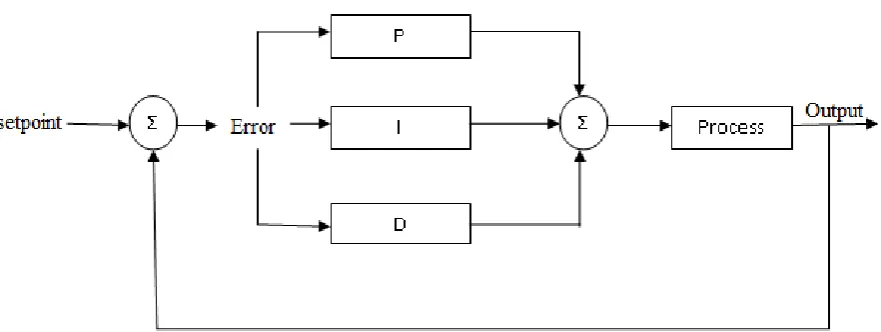
In present situation conventional Proportional-Integral-Derivative (PID) controller is being used for boiler control. This controller corrects the error between measured value and desired set point value by calculating the error value. The PID controller separately calculates the three parameters i.e. the proportional, the integral, and the derivative values. In short in this method some set points are fixed for different controls like temperature control, pressure control, level control, etc. With the use of temperature sensor, pressure sensor, etc. The controlling parameters are measured and this measured value sent to the controller in the form of signal. After that the controller checks out that value and takes the proper action with respect to set point. These conventional PID controllers in power plants are become unstable when there are fluctuations and, in particular, there is an emergency occurring. Continuous processes in power plant and power station are complex systems characterized by nonlinearity, uncertainty and load disturbances.
In this method calculation of errors is very fast also it is feasible and easy to implementation. Some of limitations with this method are as the controllers do not work accurately in a system having nonlinearity in it. Also these controllers in power plants are not very stable when there are fluctuations and, in particular, there is an emergency occurring.
Fig. 1. PID control block diagram
IV. FUZZY LOGIC CONTROL METHOD
Fig. 2. Block Diagram for FLC Based Boiler Control
The FLC based boiler control consists of three sections, temperature control, pressure control and level control. A microcontroller will be programmed with the fuzzy knowledge base rule. A level indicator circuit will be interfaced with the microcontroller which will indicate the water level inside the boiler chamber and the temperature sensor will be inter-faced with the microcontroller to monitor the steam temperature. The microcontroller will take the temperature sensor output, pressure sensor output and level indicator output as the three inputs for the Fuzzy Inference System. After fuzzification of the inputs and applying suitable rules and defuzzifying the output the microcontroller generates appropriate control signals.
As the PID controller is not stable to perform accurately if there are uncertainty and nonlinearity, this drawback is overcome by Fuzzy Logic Control Method. This method has drawbacks like it is time consuming retuning even if applied to a similar system in other location. Alsoit has huge software for simple application.
V. EMBEDDED SYSTEM BASED METHOD
water level and flame sensing using GSM module. The obtained temperature, level and flame measuring data are transferred through the PIC microcontroller. The microcontroller read the available data and processed.
VI. PLC AND SCADA BASED CONTROL METHOD
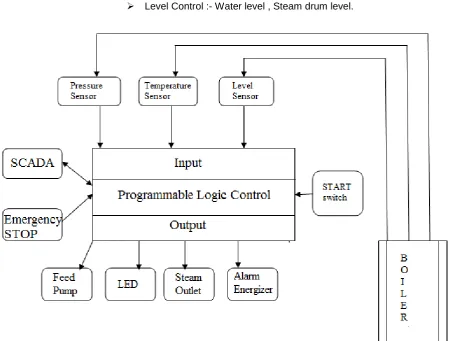
In order to automate a power plant and minimize human intervention, there is a need to develop a PLC &SCADA system that helps to reduce the errors caused by humans. PLC and SCADA interfaced through communication cables. SCADA is used to monitor the boiler temperature, pressure and water level using different sensors and the corresponding output is given to the PLC which controls the boiler temperature, pressure and water level.
Temperature Control :- Feed water temperature , Flue gas temperature .
Pressure Control :- Steam drum pressure , Turbine inlet steam pressure , Flue gas pressure.
Level Control :- Water level , Steam drum level.
Fig. 3. Block Diagram of Boiler Automation
emergency like temperature or steam pressure increases very high than predefined limit the Alarm goes ON and at the same time Emergency STOP button automatically get actuated.
Though it is costly method it has the benefits like higher productivity, superior quality, efficient usage of raw material, improved safety,mminimize human error, less maintenance and reduce space require
VII. COCLUSION
In this paper various Boiler control and Automation techniques has been discussed from which we can conclude that newer technique of PLC and SCADA based boiler automation is an effective system which overcome the drawbacks of other control methods.
REFERENCES
[1] Chuntanman, Jia Li,Lanying Wang,Yantao Chi, “The fuzzy PID control system for superheated steam temperature of boiler‖,” Strategic Technology (IFOST) , IEEE International Conference ,Vol. 2, pp. 967-970, 2011.
[2] S.Kalaivani, M.Jagadeeswari, “PLC & SCADA Based Effective Boiler Automation System for Thermal Power Plant,” (IJARCET), Vol. 4, Issue 4, 2015
[3] Shital S. Chopade, Pradhuman Verma, Prashant Verma, “Simulation of Boiler Control using PLC & SCADA,” (IJEAT) ISSN: 2249 – 8958, Vol. 3, Issue-3, December 2013
[4] T.Karuppiah, Sivasankaran V, Azha , Periasamy, Muruganand S, “Embedded System Based Industrial Power Plant Boiler Automation Using GSM Technology,” IJARCCE , Vol. 2, Issue 8, 2013.
[5] Anabik Shome, Dr. S.Denis Ashok , “Fuzzy Logic Approach for Boiler Temperature & Water Level Control,” International Journal of Scientific & Engineering Research, Volume 3, Issue 6, 2012.
[6] K. Ghousiya Begum Mercy D, Kiren Vedi H, Ramathilagam V, “An Intelligent Model Based Level Control of Boiler Drum,” IJETAE , Volume 3, Issue 1, 2013