Smart Mobility System for Physically
Handicap Using Labview
Arun M. Dongardive
Assistant professor, Dept. of Instrumentation, Government College of Engineering Jalgaon, India
ABSTRACT:In India around 41.32% peoples are physically disabled. The disease named Muscular Dystrophy makes the person disabled below their neck and the person cannot even move a single part of his body below the neck. They become totally dependent on others and they just start feeling guilty of being dependent. In this paper smart wheel chair is described which will help these disabled persons to become self dependent. The wheel chair described can be controlled using the facial movements of a disabled person. The system developed makes use of image processing in LabVIEW to control the chair. The paper includes the basics of interfacing of hardware with LabVIEW using Arduino to acquire the image information and development of the LabVIEW code to control the chair.
KEYWORDS:LabView; Face Controlled Wheelchair; LabView Interface for Arduino.
I.INTRODUCTION
Automation is playing a vital role in making the life of physically challenged people comfortable. In India around 41.32% people are having some or other kind of disability. The main motive behind this work is to make the life of physically challenged people better and make them able to move on their own without a support of any other person or caretaker. It can play vital role for the patients who are suffering from muscular dystrophy in which they cannot move a single part of their body below the neck. Because of mascular dystrophy they become dependent on others and they start feeling guilty and get demoralized. In order to keep the self-esteem of such patients, they need the system which will be self sufficient. Systems that exist currently for helping the disabled are costly and beyond the reach of the common man. The system developed is very cost effective and a middle class family can also afford the system.
As per the objectives of the development of this mobility system the physically handicapped people will be able to move according to their need without being dependent on the others. Patients suffering from muscular dystrophy can be able move at their own using only face movements. It can help in improving the lives of fully paralyzed patients.
The system designed uses different digital image processing algorithms using LabVIEW and IMAQ vision toolbox. This toolbox presents a complete set of digital image processing and acquisition functions that improve the efficiency of the system and reduce the programming efforts of the users obtaining better results in less time.
II.HARDWAREANDSOFTWAREDEVELOPMENT
The prototype developed consists of many hardware components needed for the automation and smooth motion. The hardware modules used in this design are.
i. Wheelchair (Prototype) ii. Battery
iii. Arduino Uno R3 iv. Camera
v. Ultrasonic Sensor
i. NI Lab VIEW 2013. ii. NI Vision Assistant 2013 iii. NI Vision Aquisation 2013 iv. Vision Development Module 2013
v. Arduino LDE
III.LITERATURESURVEY
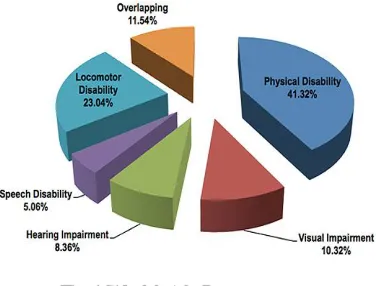
According to the senses 2001, it has been revealed that over 21 million people in India are suffering from one or the other kind of disability . It is equivalent to 2.1% of the total population. 12.6 million males and 9.3 million females are among the total disabled in the country. The number of disabled is more in villages and urban areasThe disability rate for the country works out to 2130 in which 2369 cases are male and 1874 are female[9]. World wide disability dta is shown in fig 1
Fig 1 Worldwide Data
Presently number of systems available for the patients suffering from Muscular Dystrophy. In one kind of wheelchair thoughts or neural impulse is used to command motorized wheelchair. But the cost is not affordable to the normal person. Another devise ic controlled by placing array of electrodes on the face. Cost of these sensors is too high and not easily available.
IV.WORKINGPRINCIPLE
.
Fig 2 Work Flow Diagram
The system consist of many hardware modules like arduino which here working as the microcontroller which is connected with the LabView and through labview it is getting the signal to run the motors at the output. The arduino output pins are connected with the motor driver ic i.e. L293D which is used to run the motor in both forward and reverse direction
V.DEVELOPMENTANDTESTINGINLABVIEW
The topic includes the development of the program done in the LabView 2013 for the image processing using different tools present in the pallete of the LabView. There are numerous blocks are used and each block have its own distinguish properties and working.
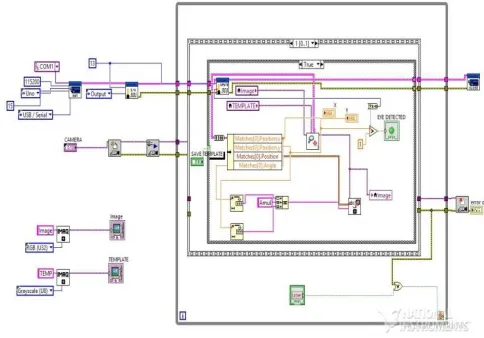
Block Diagram View
With reference to fig 3, the image taken of the Block Diagram panel of the LabView in which the graphical coding is done. Programmer have to write the code in this panel. Below is the programming done for the image processing in LabView. The above blocks are used to code the program for image recognition. The IMAQ section is used to capture and compare the image with the template and give the proper output to the controller. For communication of Labview with Arduino the arduino blocks are used they initialise and use the digital pins of the arduino for controlling the motors. The structures are used for loop and conditions .
Front Panel View
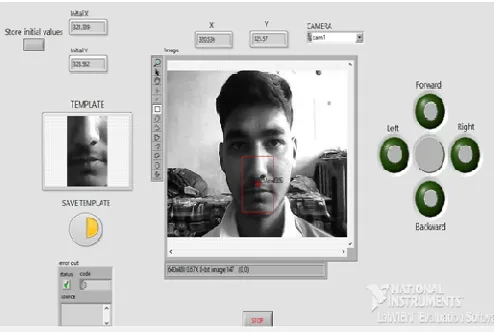
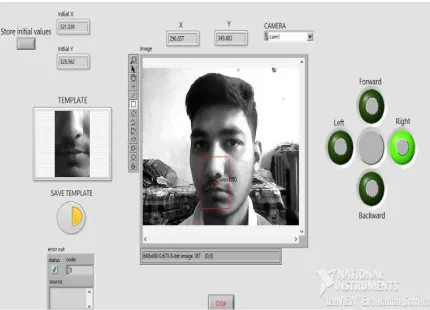
This is the panel which is infront of the patient. Patient is continuously watching this panel and using the panel leads patient come to know the direction of wheelchair. As shown in below fig 3.
Fig 3 Front Panel View
a. Initial Position of Face
b. Up Movement of Face
Fig 5 Face Recognition for the Forward Motion of Wheelchair
In the above image it is shown that when the patient will move his face in upward direction the wheelchair will move in forward direction. The motion of wheelchair can be seen on the LEDs mounted on screen on right hand side.
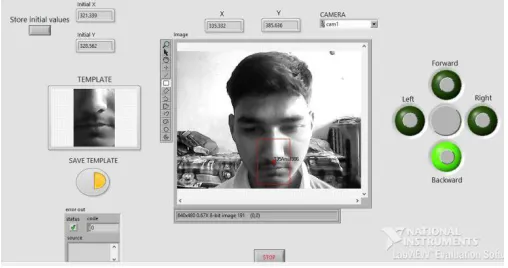
c. Down Movement of Face
d. When the patient will move his face in downward direction the wheelchair will move in Backward direction untill the patient will come to initial position or any other position.
e. Left Movement of Face
Fig 7 Face Recognition for the Left Motion of Wheelchair
When the patient will move his face in right direction the wheelchair will move in left direction untill the
patient will come to initial position or any other position.
f. Right Movement of Face
When the patient will move his face in left direction the wheelchair will move in right direction untill the patient will
come to initial position or any other position.
Fig 8 Face Recognition for the Right Motion of Wheelchair
VI.PROTOTYPEOFTHESYSTEM
VII.CONCLUSION
Different basis techniques of digital image processing using LabVIEW have been boarded in this report. At the beginning some theoretical concepts about the image generation were discussed for standing out the effects of illumination, scene and acquisition system in the results of image processing.
Then the stages of a classic system of image processing were described as well as the necessary tools of the LabVIEW platform to achieve each stage, from the acquisition of the image to a control of a mobile using the image matching template. The image transformation leave to know how the output image is generated from an input image with the use of punctual and grouped operations, some examples were presented of most comment image transformations.
Finally the output of the system is shown which highlights the successful working of the model and its effectiveness. The prototype is made which is considered as the wheelchair with two wheels and for the backward motion the L293D IC is used. Using these systems the working model is come into existence.
REFERENCES
[1] Rubén Posada-Gómez, Oscar Osvaldo Sandoval-González, Albino Martínez Sibaja, Otniel Portillo-Rodríguez and Giner Alor-Hernández,“Digital Image Processing Using LabView“,Instituto Tecnológico de Orizaba, Departamento de Postgrado e Investigación, México. [2] George C Panayi, Alan C Bovik and Umesh Rajashekar Laboratory for Vision Systems, “IMAGE PROCESSING FOR
EVERYONE”,Department of Electrical and Computer Engineering The University of Texas at Austin, Austin, TX 78712-1084 USA
[3] Amul Shravankumar Jalan , International Journal of Innovative Research in Science, Engineering and Technology, “Automatic Street Lightning System on Indian Streets”,March 17..
[4] Amul Shravankumar Jalan , International Research Journal of Engineering and Technology(IJRJET), “LabVIEW Interface For Arduino : A Real Time Monitoring System”, Vol:04Issue :03March 2017
[5] Amul Shravankumar Jalan, Gajanan Hoge, Swapnil Banaitkar and Prof. Shirish Adam, Department of Instrumentation Engineering, Government college of Engineering, Jalgaon; International Journal of Advanced Research in Electrical ,Electronics and Instrumentation Engineering,“Campus Automation using Arduino”,Vol 6 Issue 6, June 17..
[6] Denning ,D.(2006). Software Engineering.IEEE transaction on,SE-13,222-232..
[7] Lisa K. Wells and Jeffrey Travis, "LabVIEW for Everyone, Graphical Programming made even easier," Prentice Hall, 1997 [8] "Labview User Manual," National Instruments, 1996..