Available online: https://edupediapublications.org/journals/index.php/IJR/ P a g e | 1388
Discrete Mathematical Structures
Gaurav Verma1, Harmandeep Singh21Department of Mathematics, Gobindgarh Public College, Alour, Punjab, India.
2Department of Math, Stat & Physics, Punjab Agricultural University, Ludhiana, Punjab, India.
Email id: [email protected], [email protected]
Abstract
The present paper discusses the concept of mathematical discrete structures. The paper describes various types of discrete
mathematical structures briefly. Research in discrete mathematics increased in the latter half of the twentieth century partly due to the development of digital computers which operate
in discrete steps and store data in discrete bits. Concepts and notations from discrete mathematics are useful in studying and describing objects and problems in branches of computer science,
such as computer algorithms, programming languages, cryptography, automated theorem proving, and software development. Although the main objects of study in discrete
mathematics are discrete objects, analytic methods from continuous mathematics are often employed as well.
Keywords
: discrete, mathematics, structures.
1. INTRODUCTION
Available online: https://edupediapublications.org/journals/index.php/IJR/ P a g e | 1389
work on Computable Numbers. In the meantime, military necessities roused propels in operations inquire about. The Cold War implied that cryptography stayed essential, with basic advances, for example, open key cryptography being created in the next decades. Operations research remained important as a tool in business and project management, with the critical path method being developed in the 1950s. The telecommunication industry has also motivated advances in discrete mathematics, particularly in graph theory and information theory. Formal verification of statements in logic has been necessary for software development of safety-critical systems, and advances in automated theorem proving have been driven by this need. Computational geometry has been an important part of the computer graphics incorporated into modern video games and computer-aided design tools. Several fields of discrete mathematics, particularly theoretical computer science, graph theory, and combinatorics, are important in addressing the challenging bioinformatics problems associated with understanding the tree of life.
Available online: https://edupediapublications.org/journals/index.php/IJR/ P a g e | 1390
this level, discrete mathematics is sometimes seen as a preparatory course, not unlike precalculus in this respect.
2. TYPE OF VARIOUS MATHEMATICAL DISCRETE STRUCTURES
(A)Theoretical Computer Science: Hypothetical computer engineering incorporates regions of discrete arithmetic applicable to computing. It draws intensely on graph theory and mathematical logic. Included inside theoretical computer engineering is the investigation of calculations for scientific mathematical outcomes. Computability thinks about what can be processed on a basic level, and has close binds to logic, while complexity concentrates the time taken by calculations. Automata theory and formal theory are firmly identified with computability. Petri nets and process algebras are utilized to model computer frameworks, and strategies from discrete arithmetic are utilized as a part of examining VLSI electronic circuits. Computational geometry applies calculations to geometrical issues, while computer image investigation applies them to portrayals of pictures. Theoretical computer science also includes the study of various continuous computational topics.
(B)Information theory: Information theory involves the quantification of information. Closely related is coding theory which is used to design efficient and reliable data transmission and storage methods. Information theory also includes continuous topics such as: analog signals, analog coding, analog encryption. A key measure in information theory is "entropy". Entropy quantifies the amount of uncertainty involved in the value of a random variable or the outcome of a random process. For example, identifying the outcome of a fair coin flip (with two equally likely outcomes) provides less information (lower entropy) than specifying the outcome from a roll of a die (with six equally likely outcomes). Some other important measures in information theory are mutual information, channel capacity, error exponents, and relative entropy.
Available online: https://edupediapublications.org/journals/index.php/IJR/ P a g e | 1391
(D)Set theory: Set theory is the branch of mathematics that studies sets, which are collections of objects, such as {blue, white, red} or the (infinite) set of all prime numbers. Partially ordered sets and sets with other relations have applications in several areas. In discrete mathematics, countable sets (including finite sets) are the main focus. The beginning of set theory as a branch of mathematics is usually marked by Georg Cantor's work distinguishing between different kinds of infinite set, motivated by the study of trigonometric series, and further development of the theory of infinite sets is outside the scope of discrete mathematics. Indeed, contemporary work in descriptive set theory makes extensive use of traditional continuous mathematics.
(E)Combinatorics: Combinatorics studies the way in which discrete structures can be combined or arranged. Enumerative combinatorics concentrates on counting the number of certain combinatorial objects - e.g. the twelvefold way provides a unified framework for counting permutations, combinations and partitions. Analytic combinatorics concerns the enumeration (i.e., determining the number) of combinatorial structures using tools from complex analysis and probability theory. In contrast with enumerative combinatorics which uses explicit combinatorial formulae and generating functions to describe the results, analytic combinatorics aims at obtaining asymptotic formulae. Design theory is a study of combinatorial designs, which are collections of subsets with certain intersection properties. Partition theory studies various enumeration and asymptotic problems related to integer partitions, and is closely related to q-series, special functions and orthogonal polynomials. Originally a part of number theory and analysis, partition theory is now considered a part of combinatorics or an independent field. Order theory is the study of partially ordered sets, both finite and infinite[6].
Available online: https://edupediapublications.org/journals/index.php/IJR/ P a g e | 1392
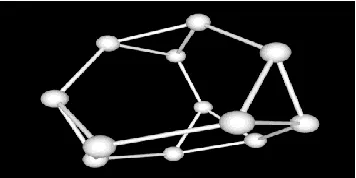
of discrete mathematics[7-9]. Graph theory has close links to group theory. This truncated tetrahedron graph is related to the alternating group A4.
Fig 1: Graph of alternating group A4
(G)Number theory: Number theory is a branch of pure mathematics devoted primarily to the study of the integers. It is sometimes called "The Queen of Mathematics" because of its foundational place in the discipline.[1] Number theorists study prime
numbers as well as the properties of objects made out of integers (e.g., rational numbers) or defined as generalizations of the integers (e.g., algebraic integers).Number theory is concerned with the properties of numbers in general, particularly integers. It has applications to cryptography, cryptanalysis, and cryptology, particularly with regard to modular arithmetic, diophantine equations, linear and quadratic congruences, prime numbers and primality testing. Other discrete aspects of number theory include geometry of numbers. In analytic number theory, techniques from continuous mathematics are also used.
Available online: https://edupediapublications.org/journals/index.php/IJR/ P a g e | 1393
well as the discrete metric there are more general discrete or finite metric spaces and finite topological spaces.
(I) Discrete probability theory: Discrete probability theory deals with events that occur in countable sample spaces. For example, count observations such as the numbers of birds in flocks comprise only natural number values {0, 1, 2, ...}. On the other hand, continuous observations such as the weights of birds comprise real number values and would typically be modeled by a continuous probability distribution such as the normal. Discrete probability distributions can be used to approximate continuous ones and vice versa. For highly constrained situations such as throwing dice or experiments with decks of cards, calculating the probability of events is basically enumerative combinatorics. A discrete probability distribution is a probability distribution characterized by a probability mass function. Thus, the distribution of a random variable X is discrete, and X is called a discrete random variable.
(J) Algebra: Algebraic structures occur as both discrete examples and continuous examples. Discrete algebras include: boolean algebra used in logic gates and programming; relational algebra used in databases; discrete and finite versions of groups, rings and fields are important in algebraic coding theory; discrete semigroups and monoids appear in the theory of formal languages.
(K)Discrete geometry and Computational geometry: Discrete geometry and combinatorial geometry are about combinatorial properties of discrete collections of geometrical objects. A long-standing topic in discrete geometry is tiling of the plane. Computational geometry applies algorithms to geometrical problems. Discrete geometry has a large overlap with convex geometry and computational geometry, and is closely related to subjects such as finite geometry, combinatorial optimization, digital geometry, discrete differential geometry, geometric graph theory, toric geometry, and combinatorial topology[10].
3. APPLICATIONS OF DISCRETE STRUCTURES
Available online: https://edupediapublications.org/journals/index.php/IJR/ P a g e | 1394
with discrete mathematics is an extremely important problem-solving skill, which students have the opportunity to develop by constructing their own models in some of the exercises.
REFERENCES
[1] Johnsonbaugh, R., Discrete Mathematics, Prentice Hall, 2008.
[2] Biggs, N. L., Discrete mathematics, Oxford Science Publications (2nd ed.), New York, 2002.
[3] Hopkins, B., Resources for Teaching Discrete Mathematics, Mathematical Association of America, 2008.
[4] Howson, A.G., Mathematics as a Service Subject, Cambridge University Press, pp. 77–78, ISBN 978-0-521-35395-3, 1988.
[5] Wilson, R., Four Colors Suffice, London: Penguin Books, ISBN 978-0-691-11533-7, 2002.
[6] Hodges, A., Alan Turing: the enigma, Random House, 1992.
[7] Hodkinson, T.R., and John A. N., Reconstruction the Tree of Life: Taxonomy and Systematics of Large and Species Rich Taxa, CRC Press INC. p. 97, 2007.
[8] Buss, S.R., Handbook of Proof Theory, Elsevier. p. 13, ISBN 978-0-444-89840-1, 1998.
[9] Brotherston, J., Bornat, R. and Calcagno, C., "Cyclic proofs of program termination in separation logic", ACM SIGPLAN Notices, 43 (1), doi:10.1145/1328897.1328453, 2008.