Spectroscopy
Adrian Wirth
Spectroscopy
Adrian Wirth
Dissertation
an der Fakult¨at f¨
ur Physik
der Ludwig–Maximilians–Universit¨at
M¨
unchen
vorgelegt von
Adrian Wirth
aus W¨
urzburg, Deutschland
Motion in the microcosm unfolds via the formation of wavepackets, resulting from a co-herent superposition of quantum states. Pioneered by A. H. Zewail, nuclear motion in (bio-)molecules as well as the formation and rupture of chemical bonds have been accessed extensively by femtosecond (1 fs = 10−15 seconds) pump-probe spectroscopy. For these
outstanding experiments, A. H. Zewail was awarded the Nobel prize in 1999, establishing the research area of femtochemistry. However, the resolution offered by femtosecond spec-troscopy is insufficient to track the dynamics of electronic motion in atoms or molecules since they evolve on an attosecond (1 as = 10−18 s) to few-fs time scale and thus remain
elusive so far.
This thesis establishes attosecond transient absorption spectroscopy as a new approach for the exploration of electronic motion. By combining quasimonocycle (1.5 optical cycles) near infrared (NIR) laser pulses as an initiation event and non-invasive isolated extreme ultraviolet attosecond pulses in a unique exertion as probe pulses, several proof-of-concept experiments are presented. Strong-field ionization of noble gas atoms via the ultrashort NIR laser pulse produces several charged states whose formation during the ionization process has been tracked by the attosecond probe pulse and yielded the first real-time, state-resolved observation of atomic ionization, indicating a delayed formation of higher charged states with respect to lower ones.
Strong-field ionization of krypton atoms—performed with quasimonocycle laser pulses, lim-iting the ionization window to less than 3.2 fs—creates singly charged ions in a coherent superposition of quantum states. The subsequent evolution of the valence electron motion has been traced for the first time. Attosecond transient absorption spectroscopy, in com-bination with appropriate modeling, has enabled the complete reconstruction of valence electron motion, including its degree of coherence, which is not accessible by conventional time-integrated spectroscopy.
Besides the investigation of prototypical open systems, this new tool has also been suc-cessfully applied to study more complex systems. For instance various quantum beats in xenon ions have been measured in different charge states, indicating complex multi-electron dynamics.
Bewegungen im Mikrokosmos entstehen anhand der Formierung von Wellenpaketen als Resultat einer koh¨arenten Superposition von Quantenzust¨anden. Auf der Grundlage der Pionierarbeit von A. H. Zewail, konnte die Kernbewegung in (Bio-)Molek¨ulen, sowie auch die Entstehung und Aufhebung von chemischen Bindungen durch die Anwendung von Femtosekunden (1 fs = 10−15 Sekunden) Anrege-Abfrage-Spektroskopie weitreichend
un-tersucht werden. Diese hervorragenden Experimente wurden im Jahre 1999 mit dem Nobel-preis f¨ur Chemie ausgezeichnet und begr¨undeten den Forschungsbereich der Femtochemie. Jedoch ist die Aufl¨osung, welche Femtosekundenspektroskopie bietet, nicht ausreichend um Dynamiken der Elektronenbewegung in Atomen oder Molek¨ulen aufzuzeichnen, da diese im Bereich von Attosekunden (1 as = 10−18 s) oder wenigen Femtosekunden ablaufen und
somit bis zuletzt schwer zug¨anglich waren.
Diese Dissertation erschließt transiente Attosekundenabsorptionsspektroskopie als einen neuen Ansatz f¨ur die Erforschung der Elektronenbewegung. Erm¨oglicht durch die Kombi-nation von nahinfraroten (NIR) gewissermaßen Einzykluslaserpulsen (1,5 optische Schwing-ungen) als Ausl¨oseereignis und nicht invasiven isolierten extrem ultravioletten Attosekun-denpulsen, welche erstmals als Auslesepulse eingesetzt wurden, werden einige grundlegende Experimente dargelegt. Die Starkfeldionisation von Edelgasatomen, erzeugt mit ultra-kurzen NIR Laserpulsen, ergibt mehrere Ladungsstufen, deren Formierung w¨ahrend des Ionisationsprozesses durch die Attosekundenpulse ausgelesen wird und somit die erstma-lige echtzeit- und ladungsstufenaufgel¨oste Beobachtung der atomaren Ionisation begr¨undet, welche eine verz¨ogerte Entstehung der h¨oheren Ladungsstufen im Vergleich zu den niedri-geren aufweist.
Starkfeldionisation von Krypton Atomen – durchgef¨uhrt anhand von ann¨ahernd Einzyklus-laserpulsen, welche das Ionisationsintervall auf weniger als 3.2 fs beschr¨anken – hinterl¨asst einfach geladene Ionen in einer koh¨arenten ¨Uberlagerung von Quantenzust¨anden. Die da-rauffolgende Bewegung der Valenzelektronen wurde erstmals ausgelesen. Transiente Atto-sekundenabsorptionsspektroskopie in Kombination mit geeigneter theoretischer Beschrei-bung, erm¨oglichte die vollst¨andige Rekonstruktion der Valenzelektronenbewegung inklusive des Grades der Koh¨arenz, welcher nicht anhand von konventioneller, zeitintegrierter Spek-troskopie ermittelt werden kann.
Neben der Betrachtung von prototypischen offenen Systemen, wurde die neue Methode auch erfolgreich zur Messung an komplexeren Systemen herangezogen. Zum Beispiel wurden zahlreiche Quantenschwebungen in Xenon Ionen unterschiedlicher Ladungsstufe gemessen, die komplexe Multielektronendynamiken indizieren.
Abstract vii
Zusammenfassung ix
Introduction 1
1 Ionization of atoms in intense laser fields: Fundamentals 9
1.1 The Keldysh parameter: Classification of different ionization regimes . . . 10
1.2 Multi-photon and above threshold ionization . . . 10
1.3 Adiabatic tunnel and barrier suppression ionization . . . 12
1.4 Nonadiabatic tunneling . . . 13
1.5 High-harmonic generation: bursts of coherent XUV light pulses . . . 14
1.6 Double ionization . . . 16
1.6.1 Sequential ionization . . . 18
1.6.2 Non-sequential ionization . . . 18
2 Generation and metrology of isolated attosecond XUV pulses 21 2.1 Introduction and requirements . . . 21
2.2 Phase stabilized, few-cycle laser pulse system . . . 22
2.2.1 Laser pulse amplification, spectral broadening and compression . . . 22
2.2.2 Carrier-envelope phase stabilization of laser pulses . . . 23
2.3 Generation of isolated attosecond XUV pulses . . . 27
2.4 Attosecond metrology: Characterizing ultrashort laser & XUV pulses . . . 31
2.4.1 Concept of the attosecond streak camera . . . 32
2.4.2 Mathematical description of attosecond streaking . . . 32
2.4.3 FROG retrieval of an attosecond XUV pulse . . . 36
3 Apparatus for attosecond pump-probe experiments and metrology 39 3.1 High-order harmonic generation section . . . 40
3.2 Attosecond end station . . . 42
3.3 Beam characterization and determination of pump intensity . . . 45
4 Attosecond transient absorption spectroscopy (ATAS) 51
4.1 Methods . . . 51
4.2 Experimental details . . . 52
4.3 Overview of performed experiments . . . 54
5 ATAS studies I: Real-time observation of valence electron motion 55 5.1 Theory of transient absorption spectroscopy . . . 55
5.1.1 Atomic response . . . 55
5.1.2 Propagation of probe pulse through the absorbing medium . . . 58
5.1.3 Absorption by laser generated ions - the density matrix description 61 5.2 Real-time observation of valence electron motion in Kr+ . . . . 63
5.2.1 Theoretical modeling of XUV absorption by Kr+ ions . . . . 63
5.2.2 Attosecond transient absorption spectrograms addressing Kr+ . . . 70
5.3 Complete reconstruction of quantum mechanical motion in Kr+ . . . . 72
5.3.1 Determination of density matrix elements . . . 72
5.3.2 Snapshots of the hole density motion . . . 75
5.3.3 Comparison to theoretical predictions and conclusion . . . 78
5.4 Apparent paradoxical characteristics of ATAS . . . 81
5.4.1 The uncertainty principle in pump-probe absorption spectroscopy . 81 5.4.2 Spectral resolution versus quantum coherence . . . 81
5.5 Attosecond absorption spectroscopy in more complex systems: Kr2+ . . . . 84
5.6 Attosecond absorption spectroscopy in more complex systems: Xe ions . . 88
5.6.1 Identifying absorption lines . . . 91
5.6.2 Explanation for spectrally broadband negative absorbance . . . 94
5.6.3 Preliminary interpretation of multiple beats and their probing . . . 96
5.6.4 Conclusions and most recent experimental indications . . . 99
6 ATAS studies II: Real-time observation of atomic ionization 101 6.1 Motivation . . . 101
6.2 Towards a theoretical description of ATAS under strong field influence . . . 104
6.2.1 Inapplicability of the reduced density matrix description . . . 104
6.2.2 Atomic excitation cross-section in the presence of a strong laser field 105 6.3 Ionization build-up dynamics in krypton . . . 111
6.3.1 Identifying absorption lines obtained in krypton . . . 111
6.3.2 Observed absorption build-up dynamics in krypton . . . 112
6.3.3 Absence of ionization half-cycle step-like structures . . . 119
6.4 Conclusion and steps towards tracing ion populations in real-time . . . 121
7 Conclusions and Outlook: ATAS & sub-cycle waveform synthesis 125 7.1 Conclusions . . . 125
7.2 Development of ultrawide-band light wave synthesis . . . 126
A Additional data sets and details 131
B Storage of raw data and analysis programs 137
Bibliography 145
Acknowledgment 157
Dynamic processes in the microcosm, although generally imperceptible to our senses, affect our every day life. It is, for instance, protein folding, light absorption processes, energy transfer from light-harvesting complexes into the photosynthetic reaction center and a vast variety of chemical reactions involving electronic as well as nuclear correlated dynamics that determine the macroscopic behavior of matter.
Dynamics in the microcosm occur via the formation and subsequent evolution of wavepack-ets resulting from the coherent superposition of non-degenerate quantum states [1]. The speed of the motion, namely the oscillation period, is defined byh/∆E where ∆Eis the en-ergy separation between the superimposed quantum states andhthe Planck’s constant. In atoms and molecules, this separation amounts to tens, hundreds or even thousands of mil-lielectronvolts and hence leads to ultrafast motion from the picosecond (1 ps = 10−12
sec-onds) (molecular rotation), the femtosecond (1 fs = 10−15 s) (atomic motion in a molecule) or even electronic motion unfolding on an attosecond (as) (1 as = 10−18 s) to few-fs time
scales. Determining the composition of the microcosm, rigorously understanding and pre-cisely controlling the essential dynamics which determine the basic processes observed in every day life, will remain as some of mankind’s greatest ambitions.
Absorption/emission spectroscopy
Among other scientific approaches, spectroscopy has played probably the most influential role in the exploration of the microcosm. One of the breakthroughs for determining certain elements was inspired by experiments dating back to 1802 when W. H. Wollaston and independently in 1814 J. v. Fraunhofer discovered the appearance of a number of dark features in the spectrum of the sun. The first spectrochemical analysis ever made was performed by Kirchhoff in 1859 where he proved that the Fraunhofer lines in the sun’s spectrum are atomic absorption lines created by certain elements in the atmosphere of the sun [2, 3]. In these classic experiments, Kirchhoff and Bunsen showed that the elements in flames give characteristic emission and absorption spectra.
realized that the types of flames which were used for emission flame photometry would be very well-suited for atomic absorption spectroscopy, especially for elements which are inappropriate photon emitters [2]. The standard atomic absorption method, or generally speaking atomic absorption spectroscopy, is still being used very extensively for instance in modern atomic absorption spectrometers for the qualitative and quantitative determination of chemical elements.
Time-resolving molecular dynamics
By the middle of the 19th century, the ability to record dynamic processes was not anymore limited to time scales of ∼ 1 s, which corresponds to the blink of an eye or the responses of the ear (∼ 0.1 ms), i.e. the natural observation techniques that dominated scientific inquiry until the 18th century. Some of the most famous demonstrations of these advances were for instance the time-resolving of animal and human locomotion in the years 1887 and 1901 [6] and later the well-known pictures of bullets passing through objects by Harold Edgerton in the mid 1950s. Utilizing snapshot photography, chronophotography and stro-boscopy temporal resolutions down to microseconds became available.
For tracing dynamic processes in chemistry, transient absorption spectroscopy was used to track the absorbance of light at a certain photon energy or in a spectral range as a function of time. If the dynamics are slow compared to conventional shutter speeds of spectropho-tometers, the temporal resolution can be obtained with a continuous probe beam. Six years after the discovery of stimulated optical radiation in ruby at ∼ 694 nm [7], pulsed lasers with durations in the picosecond regime [8] became available. Based on these devel-opments, pump-probe experiments with picosecond temporal resolution became possible, which for instance allowed the investigation of dynamics in complex molecules like the kinetics of rhodopsin in 1978. In these experiments, laser pulses centered at 1060 nm are amplified and frequency doubled to 530 nm before being spatiotemporally divided, result-ing in two pulses with an adjustable delay. One acts as the excitation pulse, while the second pulse, upon its spectral broadening in a benzene cell, is employed as the probe pulse. The experiment was designed to observe transient absorption effects in rhodopsin [9]. In the following, many research groups in physics, chemistry, biology, medicine and material science have been using sub-picosecond laser pulse systems. The exploration of ever shorter dynamics in (bio-)molecular reactions had been strongly coupled to the fur-ther reduction of laser pulse durations, finally approaching sub-100 fs pulses. Experiments which measured the delay-resolved dynamic absorbance of a probe pulse, led by A. H. Zewail and G. R. Fleming [10, 11, 12], have permitted the real time observation of atomic motion inside molecules as well as the formation and rupture of the chemical bond [13]. As a result of these pioneering efforts, A. H. Zewail was awarded the 1999 Nobel prize for chemistry.
spec-trum which allowed for a simultaneous probing of dynamics encoded on several absorption resonances. Sub-50-fs frequency tunable pulses, generated by excimer amplifiers or via optical parametric amplification [17, 18, 19, 20, 21], allowed the specific tailoring of pump-probe pulses for the study of ultrafast molecular dynamics from the ultraviolet (UV) to near infrared (NIR) wavelengths.
In order to facilitate inner-shell excitations in atoms, the photon energy of the light pulses has to be extended towards extreme ultraviolet (XUV) or x-ray photon energies. Pulsed synchrotron x-ray pulses enabled the measurement of hole-orbital alignment of
Kr+ photoions [22]. Femtosecond XUV light pulses, generated via high-order harmonic
generation have been used to interrogate the complete quantum state distribution of Xe+
produced by optical strong-field ionization [23] and to investigate the dissoziative ionization of CH2Br2 induced by NIR strong-field irradiation [24].
The millielectronvolt-scale spacing of vibrational energy levels implies that changes in molecular structure occur on a multifemtosecond timescale and can thus be accessed by femtosecond pump-probe spectroscopy. However, electronic phenomena in the valence band are one hundred to one thousand times faster and so have remained elusive thus far. Femtosecond laser systems, in combination with pump-probe transient absorption experiments, have shed light onto an incredible range of dynamics in several areas of science over the last three decades, but still can not access these fundamental but very fast electron dynamics. Yet, this limitation is only due to the femtosecond temporal resolution afforded by the probe pulse.
Motivation for time-resolving electronic motion and first experiments
The ability to access electronic coherence is a key to determine the time-resolved electronic dynamics of quantum systems, such as the electronic motion in the valence shell. So far, only a few experiments have been performed recently which study the electronic motion in kinematically complete experiments. For instance, the core hole localization in nitrogen molecules (N2) following the absorption of a x-ray photon was studied by utilizing Auger
electron angular emission patterns as an ultrafast probe [25]. From these experiments the electron motion can be inferred but it is not directly observed. Except for the simplest systems, experimental techniques are unable to probe all degrees of freedom. Therefore one generally has to consider an open system, which can then only be characterized in terms of ensemble-averaged quantities (observables) predicted by the system’s density matrix. Under these circumstances, the synchrony of wavepacket dynamics in the specimens of the ensemble (that is the wavepacket’s coherence) is indispensable and only time-resolved measurements can provide direct access to the observables of the motion.
struc-ture of the molecule is imprinted on the diffracted electron distribution or on recollision-induced fragments of the molecule. For the observation of dynamics, it is essential that both wavepackets (the probed vibrational and the continuum electron wavepacket) are cor-related and one of them can be controlled by the strong laser pulse. The excursion time, namely the time it takes the electronic wavepacket to recollide after ionization, defines the pump-probe equivalent delay. Scanning the wavelength of the driving pulse thus changes the pump-probe delay which is only possible in rather strict and narrow limits. Recently, it was reported that a recolliding electron which originates from one ore more electronic states that form the bound state wavepacket, imprints—upon its recombination—specific characteristics about the relative motion of the continuum and bound wavepackets onto the spectrum of the emerging attosecond pulse/high-harmonic spectrum [28]. Finally, the combination of the powerful concepts of correlated measurement and high-harmonic inter-ferometry have recently uncovered signatures of electronic coherence, the relative phase between different channels in strong field ionization, and the resulting dynamics in an en-semble of ionizingCO2 molecules within a temporal window of ≈ 1 fs following ionization
[29]. However, the degree and the persistence of coherence have not been measured and the method is limited to the scrutiny of systems with large (>10 eV) ionization potentials and to processes occuring under strong-field influence.
Even though direct real-time observation of electric motion in the valence shell of atoms or molecules has not been possible before the work presented in this thesis, experiments that demonstrate first steps in electron control have been taken. For example ultrashort light-waveform-controlled laser pulses, comprising only a few optical cycles, as well as po-larization and amplitude-shaped light sources, have been proven ideal for accessing and steering the ionization dynamics of atoms [30] and the electronic motion in molecules [31, 32]. Driving electronic motion—which unfolds on an attosecond time scale—with light is a fundamental first step towards the ultimate and systematic coherent electronic control of quantum systems. However, before such control is realized, detailed knowledge of the dynamics that follow excitation, which remain poorly understood due to limited techno-logical capabilities, need to be explored.
Tools capable of granting access to the real-time observation of electronic motion within a control pulse, to study the interaction of the control mechanism, and finally the detection of the unfolding motion after the ultrashort controlled initiation pulse, are needed in order to study and systematically control the fundamental electron dynamics in atomic, molecular and solid state systems.
Development of isolated attosecond light pulses
ini-tial implementations, attosecond streaking spectroscopy has permitted direct access to the vector potential of light fields [34, 35] and the characterization of attosecond XUV pulses [36, 37]. This approach is now known as attosecond streaking spectroscopy and has been implemented for the study of atomic ionization [38] and attosecond spectroscopy in con-densed matter [39] which has been investigated and explored theoretically [40, 41], just to name a few of them. Other implementations of attosecond spectroscopy include attosec-ond pump-probe strategies which have for instance enabled the observation of electron localization following attosecond molecular photoionization [42] and attosecond tunneling spectroscopy, which permitted the real-time observation of electron tunneling [43].
Furthermore, it shall be mentioned that less technologically challenging attosecond experi-ments can be carried out which utilize trains of attosecond pulses [44, 45, 46]. Those trains of pulses are less flexible for the implementation of two-color pump-probe experiments as it is difficult to disentangle the interaction of individual pulses of the train with the studied system.
Attosecond transient absorption spectroscopy
Over the last few years, an important step in transient absorption spectroscopy has been taken by S. Leone and colleagues. High harmonic pulses generated by multi-cycle laser pulses have been combined with their femtosecond driver pulse to implement femtosecond XUV absorption spectroscopy. Due to the promotion of a core electron to the valence shell by the XUV pulse, XUV absorption spectroscopy offers an impressive sensitivity to processes occurring in the valence shell. However, the temporal resolution offered by femtosecond high-order harmonic transient absorption spectroscopy [23, 24] is insufficient for tracking the attosecond motion of electrons and to resolve sub-cycle dynamics of matter exposed to intense fields in the visible and infrared. Therefore a dramatic extension of this approach is necessary to access these fundamental dynamics.
In this thesis, the potential of combining attosecond resolution with core hole transient absorption spectroscopy is explored experimentally for the first time. We conduct proof-of-concept experiments in which we trace electron and ionization dynamics on a sub-optical cycle time-scale during and after the quasimonocycle initiation pulse.
In this work, I present the first experiments in which—in contrast to any demon-stration so far—an isolated attosecond extreme ultraviolet pulse is employed as a probe. With such a well confined probe I have been able to acquire snapshots of unfolding ionization dynamics by tracing the ionization of an atom, being triggered by a quasimonocylce pulse, in real time. The non-invasive XUV attosecond probe pulse is transmitted through a medium and records electron dynamics which mani-fest themselves as modulations on the XUV spectrum as a function of its delay with respect to the laser field.
can be time resolved. In our experiments, the formation of singly, doubly and triply charged krypton ions within the laser pulse as a function of time has been recorded. This comprises the first time resolved observation of the non-simultaneous formation of different charge states, a fact which was up to now only phenomenologically inferred from time integrated observations. In addition, attosecond transient absorption spec-troscopy enabled the temporally resolved detection of saturation in ionization for the singly charged krypton ions at higher intensities. This will allow for the identifica-tion of contributing and dominant ionizaidentifica-tion mechanisms of strong-field ionizaidentifica-tion of matter, since ionization can now be traced with sub-cycle precision inside the laser pulse. An attempt is made to establish a link between the strength of absorption lines with underlying populations, which is a non-trivial relation in the presence of a strong laser field, intense enough to ionize noble gas atoms.
Due to their ultrashort nature, the few-cycle laser pulses confine ionization of matter to less than∼3.4 fs which, by itself, exclusively enables the efficient superposition of electronic states and the onset of ultrafast wavepacket motion—for example, in ions which evolve for tens of femtosecond after the laser pulse. Furthermore, attosecond transient absorption spectroscopy allowed me to directly trace for the first time va-lence electron motion (spin-orbit wavepacket dynamics) in real-time, for instance in strong-field singly ionized krypton ions. Careful modeling has enabled the complete reconstruction of the quantum mechanical valence electron motion in Kr+ ions and
to determine its degree of coherence (pureness of the quantum wavepacket super-position) in the specimen of the ensemble, which is by itself not accessible by time integrated spectroscopy. Finally, the periodically-varying hole density distribution of the valence shell, with a period of 6.2 fs, can be visualized as a function of time.
Apart from this simplest prototypical opened system, attosecond transient absorp-tion spectroscopy was furthermore applied to study atomic electron dynamics at the valence shell of more complex systems. In the doubly charged krypton ion, even faster quantum beats were triggered and traced. Due to the confinement of double ioniza-tion to a time window shorter than the pulse length (∼3.4 fs), these quantum beats could be triggered coherently despite the fact that their period is short compared to the pulse duration of the pulses used. Enabled by the state resolved character of transient absorption spectroscopy, their analysis indicates that the strong-field generated population ofKr2+ states deviates from those expected by adiabatic
tun-neling. Multiple quantum beats in different charge states of xenon up to Xe3+ and
concomitant excited states were configuration-resolved observed which manifest com-plex multi-electron dynamics. Both experiments promise to shed light on hole-hole and multi-hole correlations in atoms whose theoretical ab-initio modeling is not yet within reach.
metrology of isolated attosecond pulses is described in chapter 2. It includes the basic concepts of the few-cycle phase-stabilized laser frontend. Chapter 3 is devoted to the de-scription of the ultra high vacuum attosecond pump-probe experimental end station. The combination of attosecond technology and XUV transient absorption spectroscopy is then applied in several aspects to atomic systems. The experiments performed in the frame of this work can be separated into two main categories. The first set of experiments focuses on the pump-probe delay regime, where there is no temporal overlap between pump and probe pulse, saying that XUV absorption happens in the absence of strong field influence (chapter 5). In the introduction of this chapter, I also give a general overview of the cur-rent theoretical understanding of attosecond transient absorption, which, though it can be found in the literature, facilitates a comprehensive description of the experiments. The second category of experiments is reported in chapter 6, where the pump and probe pulses overlap in time. The ongoing next developments and potential prospects of attosecond transient absorption spectroscopy will be laid out in chapter 7.
List of publications in the context of the work presented in this thesis
[P1] A. Wirth, M. Hassan, I. Grguras, J. Gagnon, A. Moulet, T.T. Luu, S. Pabst, R. Santra, Z. Alahmed, A.M. Azzeer, V.S. Yakovlev, V. Pervak, F. Krausz and E. Goulielmakis,Synthesis of light field transients,in preparation for submission to SCI-ENCE (2011).
[P2] E. Goulielmakis, Z.H. Loh, A. Wirth, R. Santra, N. Rohringer, V.S. Yakovlev, S. Zherebtsov, T. Pfeifer, A.M. Azzeer, M.F. Kling, S.R. Leone and F. Krausz, Real-time observation of valence electron motion, NATURE, 466, 739 (2010).
[P3] M. Schultze, A. Wirth, I. Grguras, M. Uiberacker, T. Uphues, A.J. Verhoef, J. Gagnon, M. Hofstetter, U. Kleineberg, E. Goulielmakis and F. Krausz, State-of-the-art attosecond metrology, JOURNAL OF ELECTRON SPECTROSCOPY AND RELATED PHENOMENA, 184, 66 (2011).
Further publications in the framework of the author’s dissertation
[P4] S. Zherebtsov, A. Wirth, T. Uphues, I. Znakovskaya, O. Herrwerth, J. Gagnon, M. Korbman, V.S. Yakovlev, M.J.J. Vrakking, M. Drescher and M.F. Kling,Attosecond imaging of XUV-induced atomic photoemission and Auger decay in strong laser fields, J. PHYS. B: AT. MOL. OPT. PHYS., 44 (2011).
M.J.J. Vrakking B. Langer, C. Graf, M.I. Stockman F. Krausz, E. Ruhl and M.F. Kling,Controlled near-field enhanced electron acceleration from dielectric nanospheres with intense few-cycle laser fields, NATURE PHYSICS, DOI: 10.1038/nphys1983 (2011).
[P6] B. Bergues, M. Schultze, O. Herrwerth, A. Wirth, W. Helml et al., Ion microscopy with XUV-Radiation at FLASH,In preparation (2011).
[P7] N.G. Johnson, O. Herrwerth, A. Wirth, S. De, I. Ben-Itzhak, M. Lezius, B. Bergues, M.F. Kling, A. Senftleben, C.D. Schr¨oter, R. Moshammer, J. Ullrich, K.J. Betsch, R.R. Jones, A.M. Sayler, T. Rathje, K. R¨uhle, W. M¨uller and G.G. Paulus, Single-shot carrier-envelope-phase-tagged ion-momentum imaging of nonsequential double ionization of argon in intense 4-fs laser fields, PHYSICAL REVIEW A,83, 013412 (2011).
[P8] J. Lin, N. Weber, A. Wirth, S.H. Chew, M. Escher, M. Merkel, M.F. Kling, M.I. Stockman, F. Krausz and U. Kleineberg,Time of flight-photoemission electron micros-cope for ultrahigh spatiotemporal probing of nanoplasmonic optical fields, JOURNAL OF PHYSICS: CONDENSED MATTER, 21, 314005 (2009).
[P9] I. Znakovskaya, P. von den Hoff, S. Zherebtsov, A. Wirth, O. Herrwerth, M.J.J. Vrakking, R. de Vivie-Riedle and M.F. Kling, Attosecond Control of Electron Dy-namics in Carbon Monoxide, PHYSICAL REVIEW LETTERS,103, 103002 (2009).
Oral conference contributions of the author
[C1] A. Wirth et al., ’Sub-optical-cycle waveform light synthesis: Steering and tracing ion-ization and electron dynamics in real-time’, LPHYS’11, July 2011, Sarajevo, Bosnia and Herzegovina(Invited)
[C2] A. Wirth et al., ’Attosecond transient absorption spectroscopy for real-time obser-vation of valence electron motion’, ULTRAFAST PHENOMENA XVII, July 2010, Snowmass Village, CA, USA(Highest-ranked contribution)
[C3] A. Wirth et al., ’Attosecond transient absorption spectroscopy’, ATTOFEL Network Meeting, May 2010, Lund, Sweden
Ionization of atoms in intense laser
fields: Fundamentals
Enabled by the development of ultra short pulse lasers which permitted for the first time the creation of electric field strengths comparable to the fields which bind electrons inside atoms, many new phenomena have been observed and explored. Modern ultra short pulse laser systems deliver routinely pulses as short as a few femtoseconds (fs) (10−15 s) and peak
powers in the terrawatt (1012 Watt) regime. Advancement of these laser systems has led
to the generation of laser pulses in the (near) infrared range which only last a few cycles of the optical field oscillations, yielding pulse durations as short as ∼ 4 fs (section 2.2). For controlling further atomic processes, the sweep of the carrier frequency (chirp) and the timing between the maximum of the envelope of the pulse with the electric field oscilla-tion, expressed as a phase related to the central laser period and named carrier envelope phase (CEP) are of enormous importance and can be well characterized and controlled as described in section 2.4.
Based on the interaction of ultrashort pulses with matter, even shorter laser pulses, only lasting several tenth of attoseconds (as) (10−18 s) centered in the extreme ultraviolet (XUV)
1.1
The Keldysh parameter: Classification of
differ-ent ionization regimes
Depending on the atom or molecule, laser pulses in the near infrared or in the visible spectral range start ionizing at around 1012 W/cm2. The mechanism of ionization depends
on the intensity of the laser pulse and the ionization potentialIp of the atomic system. The
different regimes with their diverse mechanisms of ionization were first characterized by Keldysh in 1964 [47] by defining an adiabaticity parameter which is also known as Keldysh parameter γ:
γ = ωL
p
2meIp
eE0
=
s
Ip
2Up
. (1.1)
Here the laser electric field is described as E(t) = E0cos(ωLt), e denotes the electron’s
charge and me the mass of the electron. The adiabaticity parameter is the ratio between
the estimated tunneling time of an electron through a potential well, referenced to the laser period. The deeper meaning of the Keldysh parameter will become apparent in paragraph 1.3 where the concept of electronic tunneling is introduced. Alternatively the Keldysh parameter can also be expressed by introducing the ponderomotive energyUp which is the
cycle-averaged kinetic energy of an electron in a laser field, being put in relation to the ionization potential of the ionization medium. The ponderomotive energy of a free electron in a laser pulse at an intensity 4·1014 W/cm2 centered at a wavelength of 750 nm yields
according to the equation Up[eV] = 9.3·I[1014W/cm2]λ2[µm] [48] around 21 eV.
For γ ≫ 1 or E0 ≪ Eatom where Eatom is the electric field inside the atom which is for
hydrogen of the order of 109 V/cm, the tunneling time is substantially longer than the
laser period which shows that ionization is a multi-photon process [47]. The multi-photon ionization (MPI) as being the limit for large γ values, can be accurately described by n-th order perturbation theory as needed to describe an n-photon process [47]. For γ ≪1, that is when E0 ≤ Eatom, tunnel ionization of atomic states dominates the ionization process.
Both processes are outlined in the next paragraphs.
1.2
Multi-photon and above threshold ionization
Multi-photon ionization occurs in a strong laser field when the energy of a photon hν is not sufficient to overcome the binding energy of the valence electron and γ is substantially larger than 1. The valence electron is excited from the bound state into the continuum by absorbing many photons as schematically depicted by black arrows in Fig. 1.1. This nonlinear response can be described with a n-photon ionization rate Γnand can be written
as:
Γn =σn·In
where σn is the n-photon ionization cross-section andI the laser intensity [48].
0
Ener
gy (eV
)
V(x)
x
0
-Ip
n h⋅ ν
s h⋅ ν
Figure 1.1: Multi-photon ionization by absorption of n photons of energy hν and above threshold ionization by absorbing s excess photons. V(x) shows the atomic potential without external field (blue line) and including the laser field (dashed red curve).
field strength, MPI cannot be treated anymore by perturbation theory. The non-perturba-tive signatures of MPI particularly manifest itself in non-perturbanon-perturba-tive effects of the above threshold ionization (ATI) [48, 49]. Here, the bound electron absorbs more photons than the minimum required number. The electron which is still influenced by the Coulomb potential can absorb additional excess photons (depicted as red arrows). It is shown in [48] that the ATI-rate originating from the absorption of n+s photons can be expressed as:
Γn+s ∝In+s.
The kinetic energy spectrum of ATI photoelectrons exhibits a strong structure consisting mainly of a series of peaks spaced by the photon energy hν [49, 50]. ATI effects can be found at intensities where ionization is still well described by perturbation theory and at higher intensities where perturbative descriptions fail. The non-perturbative characteris-tic of above threshold ionization manifests itself as the disappearance of many expected photoelectron peaks at low kinetic energies in the photoelectron spectrum at high laser intensities. Higher-order processes responsible for the ATI spectrum have gained in weight with respect to lower order ATI peaks [48].
the modulation depth of the ATI peaks is reduced for decreasing laser pulse durations. For laser pulses only consisting of one single-ionization event, the ATI modulation vanishes completely.
1.3
Adiabatic tunnel and barrier suppression
ioniza-tion
0
Ener
gy (eV
)
x 0
-Ip 0
Ener
gy (eV
)
V(x) x 0
-Ip
VL(x)
V(x)+VL(x)
V(x)+VL(x)
VL(x)
a) b)
Figure 1.2: Schematic diagram of strong-field photoionization forγ ≪1 illustrating tunnel ionization a)and Barrier suppression ionization b).
Keldysh realized that strong enough fields E0 .Eatom distort the atomic Coulomb
po-tential V(x) such that it forms a popo-tential barrier which alternating with the laser frequency is formed on opposite sides of the atom as indicated in Fig. 1.2 a). Now, the electron can tunnel with a non-negligible probability through the potential barrier. This picture applies only if the oscillation period of the external laser field is substantially longer than it takes the wavepacket to tunnel through the barrier (quasi stationary approximation) which is in agreement with γ ≪1 (Eq. 1.1).
The cycle averaged ionization rate for tunnel ionization was worked out first by Keldysh [52, 47] and further developed for instance by Perelomov, Popov and Terent’ev [53] (PPT-Model) and Ammosov, Delone and Krainov (’ADK-Theory’)[54, 47]. For short and very intense laser pulses fulfilling γ ≪1 the ionization rate Γ can be expressed as:
Γ =N ·exp −4
√
2meIp3/2
3~eE0 !
, (1.2)
ionization is taking place [47, 55]. This analytical expression describes the tunneling rate in a DC electric field with amplitudeE0 in good approximation. In the quasistatic
approx-imation these rates can be applied to oscillating electric fields if the tunneling time is less than the oscillation period (γ 61/2). It became common to describe the tunnel ionization by using the ’ADK-Theory’ and involving the cycle-averaged field intensity instead of the DC field amplitude or even the instantaneous field intensity E0 → |E(t)| [56] where the
latter accounts for phase effects of the ionization rate. As expected, the ionization rate strongly peaks at intensity crests confining ionization to a temporally very narrow window around the intensity peaks of the field oscillations.
As the most extreme case of ionization, the regime of barrier suppression ionization (BSI) (or ’over-the-barrier ionization’) shall be mentioned for completeness, too. Here the laser electric field exceeds the one of the atomic system and hence the tunnel barrier is reduced down to the point where the ground state is no longer bound and the initial wavepacket is free to escape from the Coulomb atomic potential as sketched in Fig. 1.2 b) [48]. The field which is necessary to trigger the barrier suppression ionization can be expressed as the critical intensity:
IBSI[W/cm2] = 4·109(Ip[eV])4Z2.
Here Z denotes the charge state of the atom or ion (for ionization of neutral atoms Z
equals one). As an example, an onset of BSI is expected according to the approximative equation for neutral krypton atoms to happen at intensities exceeding 1.3·1014 W/cm2.
1.4
Nonadiabatic tunneling
To describe the formation of ion population as a function of time during a few-cycle NIR laser pulse, the ADK description of the ionization rate is strictly speaking not applicable, since the envelope changes substantially on a sub-cycle timescale and the adiabaticity parameter changes within the pulse. For few-cycle laser pulses of a duration of 4 fs which were utilized for the measurements reported in this dissertation, the Keldysh parameter amounts to≈0.6 for the ionization of krypton at an intensity of 4·1014 W
cm2. The intermediate
range, where γ is on the order of unity, the assumptions made for deriving the Keldysh-like ionization rate (Eq. 1.2) is not anymore adequate but still being used extensively in nowadays publications, mainly out of computational convenience since simple closed-form analytical expressions for the instantaneous ionization rates of γ ∼1 are absent [55]. Yudin and Ivanov have derived a simple expression for the sub-cycle ionization rate in the intermediate γ range for an electric field E(t) = Ef(t)cos(ωLt+ϕ0) where E denotes the
amplitude,f(t) the envelope function peaked att= 0,f(0) = 1 andϕ0the carrier envelope
phase. The time-dependent ionization rate in atomic units can be expressed as:
Γ(t) = Ne(t)·exp
−E
2f(t)2
ω 3
L
Φ (γ(t), θ(t))
. (1.3)
The adiabaticity parameterγ(t) is a function of the envelope f(t) and the functionθ(t) =
of the scope of this work it is refrained from showing the complete analytical expressions forNe(t) and Φ(t) since it is reported in detail in [55], but it should be mentioned that the complete phase dependence θ(t) is contained in the function Φ(t).
The obtained analytical expression infers - as expected - that forγ ≫1 the ionization rate does not depend onθ(t) whereas a clear phase dependence is reproduced with the analytical expression for γ ≪ 1. In the intermediate regime, tunneling still dominates but multi-photon effects are not negligible and lead to a softening of the temporal ionization window at intensity crests. The Yudin and Ivanov approximation agrees well with a Schr¨odinger-equation analysis of ionization [56]. To our knowledge, the Yudin Ivanov expression can be seen as being currently the most appropriate analytical expression describing the ionization rate inside a cycle laser pulse in the most common intensity regime of nowadays few-cycle laser pulses where γ varies between unity and substantially smaller values. The difference between the Yudin Ivanov approach and instantaneous ADK equation forγ ∼0.5 is small as it is compared in [56], however for larger Keldysh parameters the difference significantly increases.
1.5
High-harmonic generation: bursts of coherent XUV
light pulses
High-harmonic generation (HHG) is a process where optical light of a certain frequency is frequency converted by a highly nonlinear process which involves in the first place the tunnel ionization of gas atoms. Low-order nonlinear frequency conversion processes (for instance wave-mixing) already take place at sufficiently low laser intensities and do not require ionization of the medium. The interaction in this perturbative regime can be described by a nonlinear optical susceptibility χ(q) of the order q. The efficiency of
per-turbative processes is expected to drop rapidly for higher orders [58]. By focusing laser pulses of central frequency ωL to reach intensities of 1014−1016 Wcm2 in gases, the relative
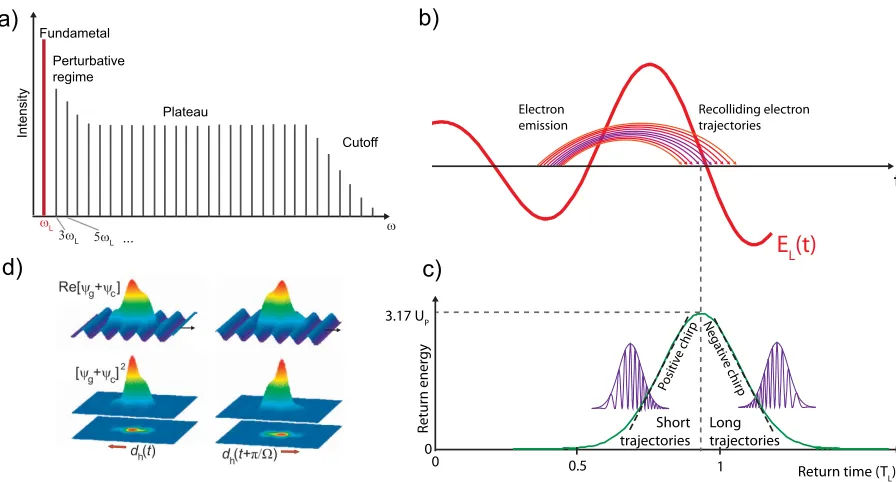
intensity of individual harmonics of the high-harmonic generation can be described by the simplified schematic spectrum shown in Fig. 1.3a). It is composed of three main parts: low-order harmonics in the perturbative regime can be described by the nonlinear dipole response of the gas medium. The so called plateau-harmonics have all similar efficiency and the cutoff range contains the highest harmonics which are generated.
hap-EL(t) t Recolliding electron trajectories R etur n ener gy
Return time (TL) 1
3.17 UP
0 0.5 0 Short trajectories Long trajectories Electron emission Posit ive ch
irp Nega tiv e ch irp ω L 3ω L 5ωL ...
ω Cutoff Plateau Fundametal Perturbative regime In te n si ty a) b) c) d)
Figure 1.3: a) Schematic high-harmonic spectrum with sub-division into perturbative regime, plateau region and the cut-off range which contains the highest photon energy. For an isolated recombination cycle of ionized, accelerated and recombining electrons, tra-jectories for different times of birth are visualized. The vertical coordinate displays the distance from the parent ion versus the return time in laser cyclesTL. Energy of the
return-ing electrons for different trajectories and their individual return times c). d) Quantum mechanical origin of high-order harmonic generation. A spatially and temporally rapidly varying electron density is created by the interference of the returning continuum part of the electron wave function ψc with its bound part ψg shown for the two reversal points
(illustration taken from [57]).
pens once each optical period. But since the emission of photons takes place near every zero-crossing of the electric field, the HHG spectrum of gas harmonics consists of odd har-monics of the fundamental frequency. An isolated recombination event would result in a broad, structureless spectral continuum with no harmonic modulation.
The recombination of the electron with its parent ion can lead to the generation of extreme ultraviolet (XUV) photons. Since the recombination event has a low cross-section, efficien-cies of the order of 10−6 keep the production yield of XUV photons low. The maximum
emitted photon energy Ecut-off would be on first sight the sum consisting of the kinetic
re-turn energy of the electron which is intuitively related to the ponderomotive potential UP
and the ionization potential IP of the gas atom when the electron returns to the ground
state of the atom. However, detailed analysis of the electron trajectories for linear po-larized laser fields yields a maximum return energy of 3.17·UP [59]. Figs. 1.3b) and c)
the moment of ionization, the electrons encounter the core at different times with different energies. Panel c) shows the corresponding return energy as a function of return time. A detailed analysis gives that electrons have the highest return energy when they are ionized not at the field crest, but rather at a phase ωL ·t =17° after the tunnel maximum [59].
Finally, the trajectory with the highest return energy defines the cut-off energy which can be expressed as
Ecut-off= 3.17 UP +IP. (1.4)
Driven by few-cycle laser fields, valence electrons in neon or helium will stay in the ground state up to several times 1015 W/cm2. Here the emitted photons can reach energies of
thousands of electron volts (eV) [57].
Fig. 1.3c) furthermore indicates that recolliding electron trajectories with return times smaller than the excursion time of the trajectory which provides the highest return energy, are called short and the others long trajectories. There is one trajectory in every set along which the electron has acquired the same energy at the time of recombination. XUV bursts being dominated by short (long) trajectories carry positive (negative) chirp1 [60].
As a consequence, by filtering out the most energetic recombination event, the XUV burst would inherit the least amount of chirp.
The quantum mechanical description of high-order harmonic generation treats the wave function of the photoelectron as being composed of a contributionψg which remains bound
and a continuum part ψc. When the recolliding photoelectron arrives at its parent ion,
the unbound part of its wave function with its fast oscillating phase can interfere with its bound part. This interference leads to a fast oscillation of the electron density and hence results in the harmonic emission. Fig. 1.3d) (taken from [57]) visualizes theoretically the real part of the electron wave function and its concomitant electron density for two adjacent moments in time.
1.6
Double ionization
The formation of doubly charged ions with laser ionization ranges back to the end of the 1970s. Laser pulses with picosecond durations were used to create doubly charged ions via multi-photon ionization [63, 64, 61]. The intensity which is necessary to trigger multiple ionization by absorbing several photons amounts to > 1013 W
cm2. One of the pioneering
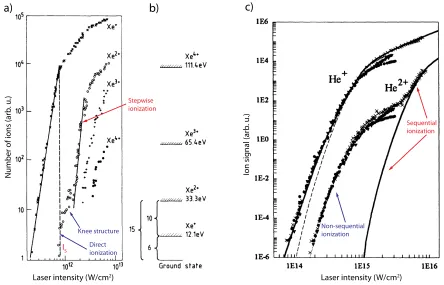
experimental results are shown in Fig. 1.4a) (taken from [61]). These findings still inspire experimental and theoretical physicists up to now. The number of detected ions in Xe, created with 50 ps laser pulses at 532.2 nm are shown in a double-logarithmic plot as a function of the intensity. For Xe+, the indicated slope of 6±0.5 for the variation of Xe+
ions as a function of the intensity corresponds to a 6 photon absorption leading from the ground state of xenon to Xe+ as indicated in Fig. 1.4b). The saturation intensity I
S,
a) b) c)
Knee structure
IS
Laser intensity (W/cm2)
Number of ions (ar
b
. u
.)
Laser intensity (W/cm2)
Ion sig
nal (ar
b
. u
.)
Stepwise ionization
Direct ionization
Non-sequential ionization
Sequential ionization
Figure 1.4: a)Number of xenon ions formed as a function of laser intensity with pulses of 50 ps and 532.2 nm central wavelength reported in [61]. Already at saturation intensity
IS of the Xe+ yield, a substantial amount of doubly charged ions is detected. The process
of double-ionization has apparently two contributions which result in the so called ’knee-structure’ at their crossover from direct 15 photon absorption to a stepwise (sequential) process involving 6+10 photons b) [61]. Even though the processes leading to double-ionization are different for ultrashort laser pulses with durations in the femtosecond regime, contributions from non-sequential process dominate the double ionization in the range of the saturation intensity of the single ionization. Ion yield for ionization of helium with 100 fs pulses at 780 nm from [62] precisely indicate the pronounced appearance of the knee-like structure in double ionization even for shorter laser pulses (see text for details and possible non-sequential ionization processes).
marked as a vertical dashed line, is a typical effect in multiphoton ionization experiments when the ionization probability approaches unity indicating that almost all atoms in the ionization volume are ionized. With increasing intensity the law of variation changes to something less steep since with increasing intensity the ionization volume expands. Look-ing at the ion yield of Xe2+ shows that a so called ’knee-structure’ is obtained. Below
the saturation intensity of Xe2+, two different processes were suggested and theoretically
are formed from neutral atoms by absorption of 15 photons and a stepwise process where first six photons are absorbed for the generation of Xe+ and afterwards another 10 to
createXe2+ (see Fig. 1.4b). The sudden increase of the yield of doubly charged ions right
after the knee structure is explained by the stepwise process whereas the direct double ionization process dominates at intensities below IS [61].
Similar ’knee-structures’ for doubly charged ions and higher charged states were also ob-served with ultrashort laser pulses with durations in the femtosecond regime. Fig. 1.4c) ([62]) shows a high resolution measurement on the single and double ionization of helium with NIR laser pulses and pulse durations of 100 fs. The solid curves show the modeling based on the single active electron approach (SAE) (see next paragraph for details) and for the generation ofHe2+ the extended stepwise yield. Also in these experiments the yield of
doubly charged ions below 1·1015 W
cm2 are several orders of magnitude higher than expected
from stepwise calculations [65].
1.6.1
Sequential ionization
The number of singly charged ions versus laser intensity and the double ionization yields for laser intensities larger than the appearance of the knee structure are well described by assuming ionization processes which are based on the so called single active electron (SAE) approximation [62, 66, 67]. Within this approximation, the ionization dynamics are dominated by single-electron excitations which lead to sequential (stepwise) production of ionic charge states. Any correlations between electrons in a many-electron atom are only included by the field-free initial state wave function. All other electrons besides the outermost electron, which describes the ionization dynamics, remain in the same state. In general, any sequential process which leads to double ionization can be written for an atom A in the following stepwise way
A+n·hν → A+ A++m·hν → A2+
wheren, m are the numbers of absorbed photons. Both emitted electrons tunnel indepen-dently from each other at different instances of the laser field. In the simplest approach the double ionization can be calculated as two independent events of single ionization [68]. For example, the ’ADK-formula’ (Eq. 1.2) or the nonadiabatic tunneling expression (Eq. 1.3) by Yudin & Ivanov provide estimates for the stepwise ionization rates ΓA→A+ and
ΓA+→A2+. Since the ’knee-structure’ cannot be explained by any kind of sequential
pro-cess, it was established in the community to call the ionization process which produces the ’knee-structure’ as non-sequential ionization.
1.6.2
Non-sequential ionization
as non-sequential ionization mechanisms [62]. In the literature several processes which explain the non-sequential double ionization (NSDI) were proposed. All non-sequential processes involve electron correlations. The dynamic of the second electron is influenced by the first electron. Potential processes of non-sequential ionization are:
Shake-off mechanism
The first electron is removed by ionization very quickly (’sudden approximation’). The wave function of the remaining bound electrons relaxes to the new eigenstates of the modified potential. Some of these new states are located in the continuum (’shake-off’) or are still bound but excited (’shake-up’), which means that a second electron can be ’shaken off’ in the course of the relaxation process [68]. A ’shake-up’ electron can be tunnel ionized within the next half-cycle [69, 62]. It becomes the dominant mechanism of double ionization at very high incident photon energies in the keV range [68]. Its importance to non-sequential double ionization by strong-field ionization in the tunneling regime is negligible since the underlying ’sudden approximation’ is strictly speaking not fulfilled.
Collective two-electron tunneling
Another possible mechanism for NSDI is the quantum mechanical process in which two electrons tunnel through the potential barrier created by the Coulomb potential and the strong external electric field. This scenario is only possible if the two electrons have the same distance from the nucleus. If not, the delayed electron is recaptured with a high probability [70]. However it was found that this ionization rate on its own cannot explain the high experimentally observed ionization rate. Possibly it is a contributing channel to NSDI but might become dominant for very high field strengths or sub-cycle pulses.
Rescattering mechanism
In experiments where NSDI is observed with ultashort laser pulses, the importance of tun-neling in the non-sequential mechanism is been proven [65]. In the rescattering model, on which also the high-order harmonic generation is based [59], the first electron is tunnel or over the barrier ionized close to an electric field maximum and afterwards accelerated and finally driven back to its parent ion. If the recollision energy is larger than the ionization potential of the singly charged ion, the recolliding electron can directly knock off the second electron (for HHG the recolliding electron recombines). This is known as the recollision-induced direct ionization (RIDI) process. If the return energy of the driven first electron is not sufficient to lead to double ionization, it can collisionally excite a still bound electron to an excited state which then can rapidly field ionize in a so called recollision-induced excitation plus tunneling process (RIET) [62, 71].
se-quential contribution for intensities of 1014 to 1016 W
cm2. Recent experiments indicate that
the role of the rescattering mechanism for ionization, and any non-sequential ionization is strongly suppressed for intensities between 1016 to 1018 W
cm2 [72].
The applicability of the proposed ionization mechanisms and their relative contribution to the final ion yield cannot only be charged upon the integrated measurement of the ion counts after the strong field laser pulse. A technique which measures the momentum of every electron or ion in coincidence, namely measurements addressing electron-electron and electron-ion coincidences which are based on the COLTRIMS (cold target recoil ion momentum spectroscopy) technique have shown to deliver additional insight into the dom-inant processes responsible for NSDI [65, 73].
Generation and metrology of isolated
attosecond XUV pulses
2.1
Introduction and requirements
Time-resolved studies of tracking and controlling electron dynamics in the interior of atoms as well as in molecules and solids, require attosecond temporal resolution. Experiments, mainly those which are based on the generation of high-order harmonic radiation are very sensitive to the field waveform rather than the envelope of the driving laser field and there-fore have very high demands on the precision, stability and reproducible control of the carrier envelope phase or more generally speaking of the waveform of the laser pulses. With driving pulse durations as short as 1.5 cycles of the carrier field, experiments become even more sensitive to variations of the carrier envelope phase as the interaction is con-fined to a small fraction of a cycle. Since several highly nonlinear processes are employed to generate isolated attosecond XUV light bursts, the overall generation of those pulses is also very sensitive to intensity fluctuations of the driving laser pulses. Thus, a high degree of shot-to-shot and long term laser pulse stability is essential for the performance of attosecond pump-probe experiments.
Actuated mirror 2
Actuated mirror 1
Neon filled hollow core fiber f = 1.8 m
f = - 0.5 m re-collimation Prism compressor Pulse duration CEP Positive dispersive mirrors Negative chirped mirror compressor IR photodiode Ti:Sapphire
oscillator Stretcher SF57
+ dispersion correction PP-MgO:LN dichroic
mirror
400 µJ / <4 fs 750 nm Auto-correlator 2% Dispersion control f-to-2f interferometer PSD PSD BBO Short-pass filter Half-wave plate Glan-Thompson polarizer Spectrometer Feedback QS Nd:YLF pump laser
3kHz 9-pass Ti:Sa CPA amplifier
CW LBO pump laser Acousto-optic
modulator
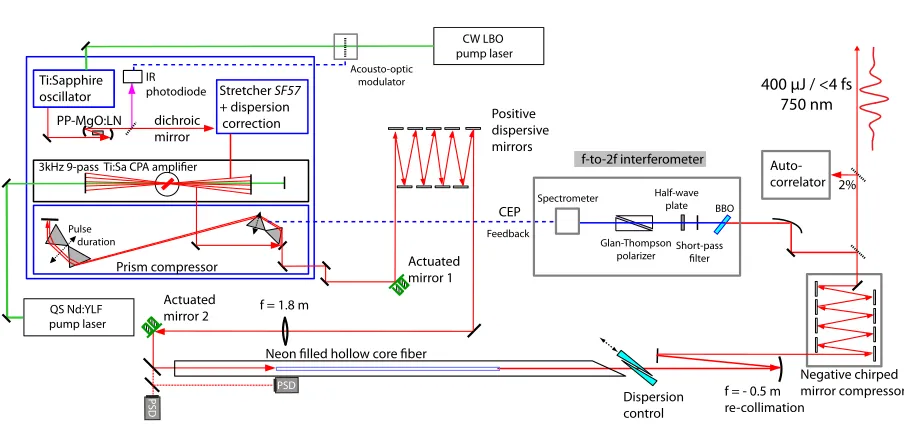
Figure 2.1: Overview of the 3 kHz sub-1.5-cycle laser pulse system for attosecond ex-periments. It shows the commercially available front end consisting of a Ti:Sa oscillator seeding a 9-pass Ti:Sa amplifier system which was tailored for the special needs of at-tosecond experiments. Subsequent spectral broadening of the pulses is taking place in a neon filled hollow-core fiber. Pulses are dispersion controlled and compressed by a chirped mirror compressor yielding a pulse duration of sub-4fs laser pulses centered at 750 nm with 330 µJ pulse energy.
2.2
Phase stabilized, few-cycle laser pulse system
2.2.1
Laser pulse amplification, spectral broadening and
com-pression
Front-end of laser system
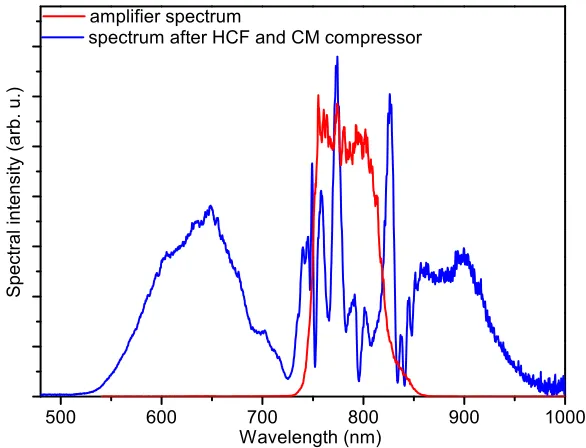
complete train of oscillator pulses is amplified by four passes in the Ti:Sa CPA multi-pass amplifier, pumped by a Q-switched neodymium-doped yttrium lithium fluoride (Nd:YLF) pump laser at 527 nm (∼20 W), before a Pockels cell reduces the repetition rate to 3 kHz. Another 5 amplification passes through the amplifier crystal raise the pulse energy to 1.3 mJ. Two dielectric filters, installed in the seed beam, modulate the spectrum of the oscillator such that gain narrowing during the amplification process is reduced such that a spectral bandwidth of 64 nm (Fig. 2.2) is maintained after the amplification which is very essential for the next steps where short pulse durations of the amplified pulses is a prerequisite for spectral broadening. The spectral bandwidth supports pulses down to 18 fs pulse duration. Typically pulses with 25 fs have been used here. Subsequent re-compression takes place in a hybrid prism/positive dispersive mirror-compressor. The prism compressor is modified to overcompensate the positive chirp of the amplified pulses to avoid self-phase modulation (SPM) which would narrow and modulate the spectrum and thus hinder the final temporal compression of the pulses. The pulses are compressed by positive-dispersion chirped mirrors yielding sub-25-fs pulses at 850 µJ [76].
Hollow fiber-chirped mirror pulse compressor
The amplified pulses are focused by a thin bi-convex lens (f= 1.8 m) into a 1 m long hollow-core fiber (HCF) with an inner diameter of 250 µm which is mounted on a straight rail in a pressure chamber filled with neon at ∼2.5 bar. The FWHM diameter of the focus is around 230 µm. A 4D beam stabilization system, consisting of two piezo actuated mirrors (actuated mirror 1 and 2 in Fig. 2.1) and two position sensitive detectors (PSD), stabilizes the pointing and steering of the laser beam and therefore ensures a proper coupling into the HCF over several hours. Both entrance and exit windows of the pressure chamber are placed substantially far away from the entrance and end of the HCF to avoid SPM. Non-linear propagation of these pulses in the HCF waveguide results in substantial broadening of their spectrum, primarily due to controlled SPM, self steepening and ionization-induced blue shift [77, 78]. The transmission through the fiber is around 55% yielding a throughput of 450 µJ pulse energy. Dispersion controlled by two fused silica glass wedges, the pulses are compressed by a low-loss chirped mirror compressor optimized for the wavelength range of 500 to 1000 nm to a pulse duration of less than 4 fs [79] what equals less than 1.6 optical cycles in the FWHM pulse width. Their spectral content is displayed in Fig. 2.2. Besides a characterization of the pulses with an autocorrelator or transient grating FROG [80], the pulses were accurately characterized by the attosecond streak camera as exemplarily described in section 2.4. The final pulse energy available for driving high-order harmonic generation amounts to 330 µJ.
2.2.2
Carrier-envelope phase stabilization of laser pulses
500 600 700 800 900 1000
S
p
e
c
t
r
a
l
i
n
t
e
n
s
i
t
y
(
a
r
b
.
u
.
)
W av elength (nm ) spectrum after HCF and CM com pressor am plifier spectrum
Figure 2.2: Typical laser spectrum after the amplification process and final spectral content of the sub-4fs laser pules measured after the hollow-core fiber (HCF) and the chirped mirror (CM) compressor.
atoms [30], controlling the electron localization in molecular dissociation [31] and electron dynamics in carbon monoxide [32] as well as steering the near-field enhanced electron acceleration from dielectric nanospheres [81]. Especially for the reliable generation of single isolated attosecond XUV pulses the precise control of the carrier envelope phase is very critical [34, 82, 83, 33]. Thus, the described sub-1.5-optical-cycle pulses delivering laser system has to be carrier phase stabilized such that the electric field of consecutive pulses has the same temporal structure. This requires the carrier envelope phase (CEP) stabilization of the oscillator and of the amplification and pulse broadening process.
Stabilization of laser oscillator: The f-to-zero technique The electric field of a pulse train can be described as
E(t) =
∞
X
n=−∞
A(t−n νR−1) exp(iφn) +c.c.,
where νR is the repetition rate of the pulse train and φn is the CEP of the nth pulse.
The function A(t) is the complex electric field amplitude of a single pulse that vanishes for |t| > 2 ν1−1
S
tr
ength
12 ν 11 ν
13 ν
R ν CEO ν
ν
CEO n R
ν + ν
0
DFG ν
CEO ν
Figure 2.3: F-to-zero measurement scheme used for tracking the offset frequency of the frequency comb. Difference frequency generation between modes from opposite ends of the comb and the subsequent mixing with frequencies from the low-frequency wing of the spectrum result in an interferometric beating at νCEO.
φn+1 −φn = 2πνCEOνR , where νCEO is the offset frequency of the phase locked comb of
laser modes as indicated in Fig. 2.3. For vanishing νCEO subsequent pulses of the pulse
train have an identical carrier-envelope phase. LockingνCEO for instance to arth fraction
of the repetition rate principally ensures that every rth pulse of the pulse train has the same carrier envelope phase. Picking only those pulses which have the same phase for seeding the amplifier, results in an amplified pulse train whose pulses have the same CEP. In the case of the ultra broadband output of the femtosecond oscillator which ranges from 630 nm to 1015 nm, the so called f-to-zero technique allows access to νCEO and therefore
enables locking the offset frequency of the frequency comb [85]. The output of the laser oscillator is tightly focused into a highly nonlinear periodically poled magnesium-oxide-doped lithium niobate (PP-MgO:LN) crystal which is optimized for type 0 second-harmonic generation (SHG) at 1500 nm. The pulses undergo spectral broadening in form of SPM and difference-frequency generation (DFG). This leads to spectral components of the laser pulses up to 1600 nm. DFG between modes from the high (νCEO+nhigh·νR) and low (νCEO+
nlow·νR) side of the frequency comb result in DFG frequencies at the long wavelength side
of the spectrum according to
νDF G = (νCEO+nhigh·νR)−(νCEO +nlow·νR) = (nhigh −nlow)νR.
Mixing those DFG frequencies spaced by multiple integers ofνR(schematically shown with
blue, violet and red arrows in Fig. 2.2.2), with modes ν2k = νCEO+k ·νR from the
low-frequency wing as indicated in Fig. 2.3 for whichnhigh−nlow =kresults in a beat frequency
of νCEO. This beat frequency is imprinted on the pulse train in the spectral range above
spectral range of interest and directs the beating signal onto a fast photodiode (Fig. 2.1). Locking electronics in combination with the fast photodiode are used to detect the beat frequency and to generate an error signal proportional to the deviation of νCEO from the
desired value which is set in our case to one fourth of the repetition rate. The derived error signal is used in a closed loop as feedback signal to drive an acousto-optic modulator that is installed in the beam path of the oscillator pump laser and modulates the transmitted pump power (Fig. 2.1). A Pockels cell picks only integer multiples of every fourth pulse of the oscillator output pulse train to ensure amplification of only isolated pulses which should have by definition and in the absence of any thermal/optical fluctuations the same carrier-envelope phase and thus inherit identical waveforms. The stabilization is used to compensate for phase drifts that occur due to instabilities introduced by thermal changes or drifts in the pump laser parameter. Reference [85] provides information about the stability performance of such systems.
Phase stabilization of amplified pulses: The f-to-2f approach
2νCEO+2nνR
S
tr
ength
R ν CEO ν
( )
HCF
I ν ISHG( )ν
ν
CEO n R
ν + ν
CEO ν
0
Figure 2.4: F-to-2f measurement scheme used for tracking changes in the carrier envelope phase of amplified pulses. Frequency doubling of the octave-spanning output of the fiber in a BBO crystal and spectral mixing of modes in common area of both pulses leads to the creation of a beat frequency at νCEO. Analysis of the spectral interferometry between
both pulses carries signatures which depend on νCEO (see Eq. 2.1).
into a BBO crystal for second harmonic generation. Since the amplified and broadened pulses cover a spectrum which exceeds one octave, the spectrum of the fundamental pulse
IHCF(ν) overlaps on its high frequency tail with frequencies from the high wavelength side
of the frequency doubled spectrum ISHG(ν) as indicated in Fig. 2.4. A short-pass filter
blocks low frequency components and a half-wave plate turns the polarization to be parallel to the blue part of the fundamental spectrum. Beating of the modes 2νCEO + 2nlow ·νR
with modes νCEO+nhigh·νR gives rise to a beat note at
2(νCEO +nlowνR)−νCEO +nhighνR=νCEO.
Additional beat notes arise at n ·νR ±νCEO for n = 1,2.... [86]. Experimentally, the
signature of the beat frequency is observed in form of an interference pattern in the spectral region where the fundamental and the frequency doubled light overlap. A Glan-Thompson polarizer is used to balance the relative intensity and the interference pattern which carries the information about changes in the carrier envelope phase. The spectral interference is recorded with a fiber spectrometer. Mathematically treated, the spectral interference result
S(ν) between the output of the fiber IHCF and its frequency doubled counterpart ISHG,
separated by a time delay τ upon walk-off effects in the BBO and related optics, can be expressed as
S(ν) = (1−ǫ)IHCF(ν) +ǫISHG(ν) + 2 p
ǫ(1−ǫ)IHCF(ν)ISHG(ν)·
cos(φSHG(ν)−φHCF(ν) + 2πν τ+φ0) (2.1)
where ǫ is the polarizer transmission for the polarization of the SHG light, φ0 the carrier
envelope phase and φHCF (φSHG) denotes the spectral phase of the fiber broadened
(fre-quency doubled) pulse [87]. A continuous Fourier analysis of the part of the spectrum containing the interference pattern tracks changes ofφ0. Changes of the spectral phases of
the two interfering spectra and especially of the delay between the two interfering pulses can be neglected for an intensity-stable laser system. A standard proportional controller algorithm adjusts the insertion of the prisms in the prism compressor based on the devi-ation of the fringe phase of the interference pattern from the user defined reference phase (Fig. 2.1). The achieved CEP stability is typically better than 100mrad RMS fluctuations [88].
2.3
Generation of isolated attosecond XUV pulses
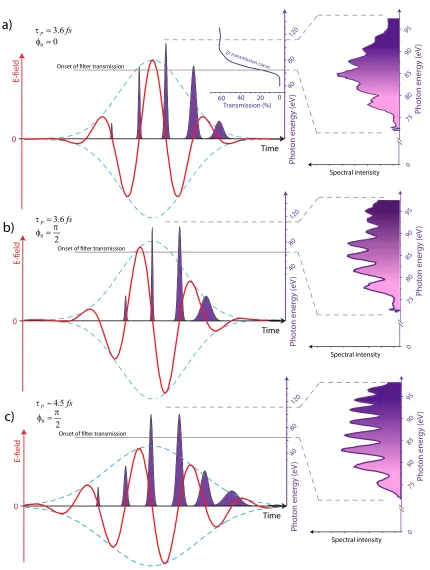
As discussed in chapter 1.3 the generation of attosecond light bursts happens every half-cycle of the laser field and leads to the appearance of discrete harmonic spikes in the spectrum of the attosecond pulse train spaced by twice the driving laser frequency corre-sponding to around 3.1 eV for an 800 nm NIR driving pulse.
![Figure 2.7: Phase reconstruction based on the measured streaking spectrogram given ina) and the FROG-like algorithm described in [96]](https://thumb-us.123doks.com/thumbv2/123dok_us/8124930.1353828/50.595.112.525.206.544/figure-phase-reconstruction-measured-streaking-spectrogram-algorithm-described.webp)