SAAS (Software As A Service) INTEGRATION ISSUES
IN CLOUD COMPUTING
Prof. Rajan Datt
1, Prof. Dhaval Jha
2,
1,2
Department of Computer Science & Engineering
Nirma University, Ahmadabad, Gujarat, (India)
ABSTRACT
Cloud Computing emerged as buzz word in the IT Industry. In this paper we have mentioned the list of the issues
that are faced when the user is trying to integrate the systems. Cloud computing providing the three various
cloud service such as Software as a Serivce (SaaS), Platform as a Service (PaaS) and Infrastructure as a
Service (IaaS). Integration is the association between the systems that can be applied by any one service of the
cloud computing but here we have talked about integration from the SaaS service point of view.
We have discussed the some list of the issues that are occurred when the SaaS integration is implementing.
Key words: Cloud Computing, Integration, Software as a Service.
I. INTRODUCTION
Cloud Computing is a model which providing universal, convenient, on-demand computing resources from the network (e.g., servers, storage, applications, and services). This cloud model is consisting of various features, three service models, and four types of cloud. Cloud Computing is defined as a type of computing which share resources on server or personal devices as well as handle all the resources from the network resources. Cloud computing work as service delivery platform for the service computing. Cloud computing provide the user network resources for the specified time period according to their requirement. Cloud provide the resources over the network and homogeneous platform that are available on the network (internet). Cloud is used for the multi tenancy and the virtualization.
Cloud computing refers to both the applications delivered as services over the Internet and the hardware and systems software in the data centers that provide those services. The cloud services are referred to as Software as a Service (SaaS),IaaS (Infrastructure as a Service) and PaaS (Platform as a Service) [2].
II. CLOUD ARCHITECTURE AND SERVICE
Fig 1. Cloud Architecture
Software as a Service (SaaS). TheSaaS means the ability to allow the user to run on the cloud infrastructure.
Here the software or the applications are available from the client devices through the standard interface. User not manages all the cloud resources.
Platform as a Service (PaaS). ThePaaS means Platform as a Service capability provided user to deploy onto the cloud infrastructure or acquired applications created using programming languages, libraries, services, and tools supported by vendors.
Infrastructure as a Service (IaaS).TheIaaS means Infrastructure as a Service provided to the user to access the storage, networks, and other computing resources where the user is able to deploy and run arbitrary software, which can include operating systems and applications.
III. SAAS SERVICE IN CLOUD
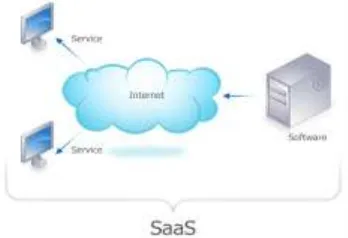
SaaS or Software as Service is a way of delivering applications over the Internet—as a service.SaaS applications are sometimes called Web-based software, on-demand software, or hosted software.
Software as a Service (SaaS) is software that is provided over network or internet as service. These SaaSsoftwares can be accessed using web browsers or thin client. The actual software isn’t installed on client machine but on SaaS provider’s machine. Client or user can access this service based software by subscribing. There are some vendors who provide software using other SaaS provider services [2][3].
internet.SaaS providers also provide sharing of the data or document created such as document or reports can be shared with other users also.
Updates and upgrades are directly provided on SaaS platforms, users can access any new features without delay or needing to pay full price which they have to pay for new versions.Software vendors can charge users periodically or usage basis which is more profitable then selling software in full single time.As they are hosted on internet software vendors can get more customers and also global basis.
IV. INTEGRATION IN CLOUD SAASSERVICE
User is going to use the service which is provided by the vendor from the vendor server or machine, but in order to use that services user has to make connection or link with that server. So here the role of the integration is occurred where the linkage is required. Integration is having many characteristics like:
Connectivityis the ability of integration between the both source and target systems. Connectivity can be provided by the web service.
Semantic Meditationrefers to the ability to which demonstrate the differences between application semantics between two or more systems.Semantics means how the information gets understood, interpreted and represented within the information systems.
Data Meditationconverts the data from source data format to destination data format. In short it is data transformation process which convert the data from the one format to another format according to the source and the target systems
Data Migrationis the process of transferring the data between different systems, formats and storage types.Data migration means that the data in the old system is mapped to the new systems according to their require format. Data Securitymeans the ability to insure that information extracted from the source systems has to securely place into target systems. It shows the when the data are transformed from the source to destination there is no tempering with data.
Data Integritymeans data is complete and consistent and it match with guaranteed, when data is getting mapped and maintained during integration operations.
Governancerefers to the processes and technologies which are howcontrol and accessed.
4.1 Lifecycle steps for Data Integration
Data Integration Lifecycle includes some steps like understanding, definition, design, implementation and testing.
Understandingin order to make integration it is required to understand the existing problem means defining the metadata that is native within the source system and the target system.
Definitionis the process which is identify the input from the previous step and defining it at high level. It is suggest that whatever the integration process is performed it is performed in the in the right direction.
Implementationrefers as actually implementing the data integration solution within the selected technology. This means connecting the source and the target systems, implementing the integration flows as designed in the previous step.
Testingisassuring that the integration is properly designed and implemented and that the data synchronizes properly between the involved systems means source and target system. It also check whether the system and data are working according to the input or not.
V. ISSUES IN SAAS SERVICE INTEGRATION
Convenient It is difficult to stop the user who using the current application and make him convince to use cloud based applications.
Time When user is using SaaS as application from the internet then it is difficult to maintain the number of user if number of user are increased in big numbers.
Integration When user use the SaaS as software it is also need to maintain the association between the softwares. So integration is also the one of the issue.
Hardware SaaS vendor also required to keep high configuration machine in order to maintain the millions of users.
Cost SaaS provider also have to provide the service at low cost in order to get the more user and best services.
Security When user is using SaaS as application you are going to use the network and when the data transfer are happening on network, it is the responsibility of the provider to provide the security to the data.
Scalable To develop highly scalable application
VI. CONCLUSION
This paper has not provide the above issues but also given the area where the research can be possible from the researcher. Researcher can improved the cloud systems by solving the above issues.
REFERENCES
[1] Tharam Dillon, Chen Wu and Elizabeth Chang, Cloud Computing: Issues and Challenges, 2010 24th IEEE International Conference on Advanced Information Networking and Applications.
[2] RajkumarBuyya, James Broberg, Andrzej M Goscinski, Cloud Computing: Principles and Paradigms, Wiley Publication.
[3] RajkumarBuyya, Christian Vecchiola, S. ThamaraiSelvi, Mastering Cloud Computing: Foundations and applications programming, Elsevier Morgan Kaufmann.
[4] Jiyi WU, Lingdi PING, Xiaoping GE,Ya Wang and Jianqing FU, Cloud Storage as the Infrastructure of Cloud Computing, 2010 International Conference on Intelligent Computing and Cognitive Informatics. [5] ShyamPatidar, DheerajRane and Pritesh Jain, A Survey Paper on Cloud Computing, 2012 Second
International Conference on Advanced Computing & Communication Technologies.
[6] William J. Yeager and Jean-Henry Morin, Introduction to Secure Cloud Computing mini-track, 2013 46th Hawaii International Conference on System Sciences.
[7] C.Saravanakumar and C.Arun, Survey on Interoperability, Security, Trust, PrivacyStandardization of Cloud Computing, 978-1-4799-6629-5/14/$31.00_c 2014 IEEE.
[8] TahiraMahboob, Sidra Ghaffar, ZaharaBatool Akhtar, A Survey – Cloud Computing a Global Perspective, 2015 IEEE Conference on e-Learning, e-Management and e-Services.
[9] Bhaskar Prasad and Ian Lump, A Taxonomy and Survey of Cloud Computing Systems, 2009 Fifth International Joint Conference on INC, IMS and IDC.