Simulation and Performance of Hybrid QOS
Aware Multipath Routing Protocol
L.Jagadeesh Naik1, Dr.K.V.Ramanaiah2, Dr.K.Soundara Rajan3
Associate Professor, Dept of ECE, BIT IT-Hindupur, Anantapur dt. India. 1
Professor, Dept of ECE, Y.S.R.Engg. College, Yogivemana University, Proddutur, India 2
Professor, Dept of ECE, J.N.T.U. Anantapur, India
.
3ABSTRACT: This is Researcher paper, we are Developing Protocol and Proposed method is the Hybrid QoS Aware Multipath Routing (HQAMR) protocol. Recent years, wireless network is a very hot topic. Using multiple paths is one way to improve the performance of routing protocols by addressing the problems of scalability, security, lifetime of network and instability of wireless transmission. MP-OLSR is one of the multipath routing protocols. The proposed HQAMR protocol simulation results are compared with MPOLSR protocol based on performance metrics such like packet delivery ratio, energy consumption, end-to-end delay, throughput and overhead ratio.
KEYWORDS: Manet, HQAMR, MP-OLSR, Multipath Routing, In NS-2
I. INTRODUCTION
A Mobile Ad hoc Network (MANET) is a group of self-organized wireless mobile nodes (MNs) able to communicate with each other without the need of any neither fixed network infrastructure nor centralized administrative support. MANETs suffer from link breakages due to nodes that move and have limited battery life, which produce frequent changes in the network topology. In addition, the transmission range in such mobile devices is limited, so multi-hop paths as well as efficient routing protocols will be needed. Each MANET node will operate both as a terminal host and as a forwarding node. MANETs should adapt dynamically to be able to maintain communications despite of all these issues [1] [2] [9].
MANETs have attracted much attention from the research community over the last years and important technical advances have risen. These multi-hop networks are foreseen as an important kind of next generation access networks, where multimedia services will be demanded by end users from their wireless devices everywhere. In many situations and areas, users may spontaneously form an infrastructure less ad hoc network to share their resources and contents. Besides, MANETs can be used together with existing cellular networks forming a hybrid cellular-ad hoc network as MANETs can extend the coverage, capacity and interconnectivity of current cellular networks [2]. Multimedia services require Quality of Service (QoS) provision. The special characteristics of MANETs, such as mobility, dynamic network topology, energy constraints, infrastructure less and variable link capacity, make the QoS provision over these networks an important challenge. In particular, instead of using fixed network configuration parameters, a better solution would be to adjust the framework parameters according to the current environmental conditions.
II. PROPOSED HYBRID QOS AWARE MULTIPATH ROUTING (HQAMR) PROTOCOL
Multipath Routing (HQAMR) protocol is introduced which considers the link quality as a QoS metric. This protocol while minimising the overhead and the energy consumption of nodes, increases the throughput and there by extends the lifetime of nodes.
In MANETs, the Quality of Service (QoS) depends on the available resources in the network and node mobility as mobility may result in frequent route failures. Some existing hybrid approach of multi-path routing technique rarely considers QoS metrics for path selection. In this technique, topology discovery is performed proactively and route discovery is performed in the reactive manner. In proactive topology discovery phase, each node collects the battery power, queue length and residual bandwidth of every other nodes and stores in the Topology Information Table (TIT). By exchanging the TIT among the nodes, the topology is discovered. When the source node wants to forward the data packet to the destination, it verifies TIT and computes the Link Metric (LM) using the data in its TIT. The source chooses the nodes with minimum LM and initiates the packet transfer through the chosen node within 2-hop. The Multi-path Dijkstra algorithm is employed to transmit the data through multiple paths with the nodes holding minimum link metric. When any intermediate node does not recognize the next 2-hop information from TIT towards destination, then it propagates route request (RREQ) message to all the nodes as per any reactive multi-path routing protocol like AOMDV [10]. Then route reply (RREP) messages are sent along the reverse routes to the source, using which it can setup the best path to the destination. Whenever the new path is discovered reactively, the source then updates its TIT.
III. MULTI-PATH ROUTING
This multipath algorithm is to construct a group of N routes devoid of loops, connecting source (S) and destination (D). In the source node, the MP-OLSR protocol sets a flag Zi for each feasible node in the network for recognizing the path credibility connecting to node. Primarily, Zi is assigned to be false which reveals that either there is no route related to the destination or renewal process is required. The condition to acquire the multiple paths for any node ni is as follows.
If Zi = false, Then
The node executes multipath Dijkstra algorithm to obtain the multiple paths to ni, store it in the multipath routing table, and performs the renewal of corresponding Zi to be true.
Else
The node identifies a suitable route to ni in the multipath routing table. End if
IV HQAMR Protocol:
The proposed HQAMR protocol is a hybrid protocol that combines the features of both proactive and reactive protocol. It involves two phases.
Phase 1: Proactive Topology Discovery Phase 2: Reactive Route Discovery 4.1 Phase 1: Proactive topology discovery: Step 1
Each node deployed in the network periodically exchanges a topology message with its neighbour nodes. Step 2
By exchanging the topology messages, every node measures QoS metrics such as the residual battery power (PR), Queue Length (QL) and residual Bandwidth (BR) of its neighbour nodes. (Explained in section 3.2.1-3.1.3)
Step 3
After the measurement of QoS metrics, each node gathers information about other nodes and stores in a TIT. Thus TIT holds the source node ID, 1-hop and 2-hop neighbour node ID, residual battery power (PR), Queue Length (QL) and residual Bandwidth (BR) of each node along with the 2-hop neighbourhood information.
4.2 Reactive Multi-Path Routing:
Step 1
The intermediate node (ni) broadcasts route request (RREQ) message to all neighbouring nodes through the eligible links towards the destination (D) and waits for the route reply (RREP) message.
n i
RREQ
n neigh
Step 2
When any nneigh possessing an eligible route receives the RREQ, it replies requested ni with the RREP message.
ni
RREP
nneigh Step 3
On receiving the RREP, ni computes its link metrics and compares the link metrics with the value already stored in its TIT, and if satisfies the requirement, it start sending data following that route and discard duplicate RREP packets received in other feasible paths.
From the intermediate node 5, 1, 8 starts broadcasting RREQ packets. Upon receiving the RREQ packet, the neighbour nodes reply with the RREP packet to the requested node. The node 5, 1 and 8 verifies the RREP and computes its link metrics and if the link metrics matches with the value already stored in its TIT, it starts sending data following that route and discard other duplicate RREP packets.
V MP-OLSR Routing:
Recovery mechanisms may also us e both proactive and reactive schemes. That is the case of MP – OLSR [ 2 ] , [ 3], which inherently uses the same proactive mechanisms as the OLSR protocols it extends, with some added on - demand mechanisms. MP-OLSR, which is a hybrid multipath protocol, has link state properties, because it reuses OLSR to disseminate and build the topology information. However, routing is performed differently: routes are computed when there are data packets to emit and are built at the source node, with the available link state information. The computation of multiple routes uses the Multipath Dijkstra (MP - Dijkstra) a lgorithm . MP – Dijkstra , which extends the Dijkstra shortest - path algorithm , selects multiple paths according to the information gathered by the topology sensing mechanisms and can be configured to obtain either node - or link - disjoint paths . LSR packets are extended with a MP - OLSR header containing the list of intermediate nodes to the destination. Those intermediate nodes will forward packets accordingly, after verifying in their link state information that the next hop is reachable. If not, a route recovery phase is initiated. It relies on the multipath nature of MP - OLSR but, if no alternate route is available, packets are eventually dropped.MP - OLSR (and OLSR) recovery performance can be significantly increased by the optional support of OLSR Link Layer Notification (LLN) [1]. In this case, the routing protocol is able to receive notifications from the link layer when a link between a node and one of its neighbors is broken. Such notifications, which are used concurrently to HELLO messages information, significantly decrease the average delay of link loss detection
5.1 Route Recovery:
The mobility, congestion, packet collisions, node failures etc can result in link failures in ad hoc networks. When any node detects a link failure, it broadcasts the route error (RERR) packets to its neighbour nodes. In case of link failure
ni
RERR
nneigh
The neighbour nodes re-broadcast the packets till the source nodes receive the RERR packets. When a source node receives the RERR, it erases entries in its TIT that uses the broken link and considers the shortest backup paths as primary paths. The RERR packets should contain the information about the primary path and the backup path failures. In case all the backup paths are broken, the source node will initiate a route discovery process.
VI SIMULATION OF HQAMR PROTOCOL
Hybrid QoS Aware Multipath Routing (HQAMR) protocol. In this simulation, the channel capacity of mobile hosts is set to the value of 11 Mbps. The distributed coordination function (DCF) of IEEE 802.11 for wireless LANs is used as the MAC layer protocol. It has the functionality to notify the network layer about link breakage. In the simulation, the number of nodes is varied as 30, 50, 70, 90 and 110. The mobile nodes move in a region of 1250 x 1250 square meters for 50 seconds simulation time assuming each node moves independently with the same average speed. All nodes have the same transmission range of 250 meters. In the simulation, the speed is varied from 10 m/s to 40m/s. Random Way Point mobility model is used. The simulated traffic is Constant Bit Rate (CBR).
The parameters and their ranges are noted in table
VII. SIMULATION RESULTS
The performance is evaluated by HQAMR and MP-OLSR protocols for CBR traffic source for varying number of nodes and speed in terms of application oriented metrics such as end – end delay, throughput, energy consumption and packet delivery ratio is presented below.
The number of nodes is varied as 30, 50, 70, 90 and 110.
Figure 7.1 Nodes Vs Packet Delivery Ratio
Figure 7.1 show the results of average packet delivery ratio and throughput, respectively for the increased nodes scenario. Clearly the proposed HQAMR protocol achieves better packet delivery ratio and throughput than the MPOLSR since the proactive routing is done based on the QoS parameters bandwidth and queue length.
Nodes Vs Delay
0 200 400 600 800 1000
30 50 70 90 110
Nodes
D
e
la
y
(m
s
)
HQAMR
MPOLSR
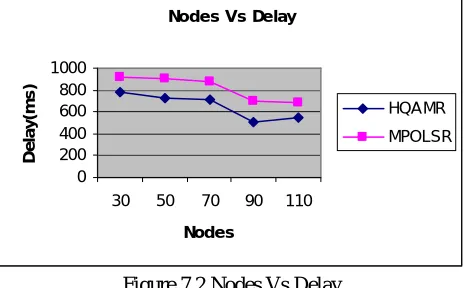
Figure 7.2 Nodes Vs Delay
Fig7.2 shows the results of average end – end delay for the increasing number of nodes. The figure depicts that delay increases when the nodes are increased from 30 to 70, and then it reduces beyond 70 nodes. This is due to fact
Nodes Vs Packet Delivery Ratio
0 0.2 0.4 0.6 0.8
30 50 70 90 110 Nodes
Pa
c
k
e
t
D
e
li
v
e
ry
R
a
ti
o
that the proactive routing could not discover shortest paths, since the nodes are sparse. From the results, it is seen that HQAMR protocol has lower delay than the MPOLSR protocol.
Figure 7.3 Nodes Vs Overhead Ratio
Figure 7.3 shows the results of routing overhead Vs number of nodes. The routing overhead decreases up to 70 nodes and increases beyond that. After 70 nodes, reactive routing is applied, rather than proactive. HQAMR protocol has of lower overhead than the MP-OLSR protocol.
Figure 7.4 Nodes Vs Throughput
Figure 7.4 shows the results of throughput obtained in both the protocols for various numbers of nodes. From the results it is seen that HQAMR protocol has 17% high throughput when compared with the MP-OLSR protocol.
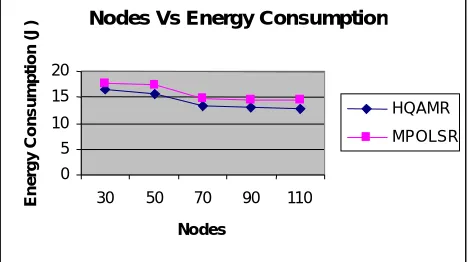
Figure 7.5 Nodes Vs Energy Consumption
Nodes Vs Energy Consumption
0 5 10 15 20
30 50 70 90 110 Nodes En e rg y C o n s u m p ti o n ( J ) HQAMR MPOLSR Nodes Vs Throughput
0 2 4 6 8 10
30 50 70 90 110 Nodes T h ro u g h p u t M b /s e c HQAMR MPOLSR Nodes Vs Overhead ratio
0 0.05 0.1 0.15 0.2
Figure 7.5 shows that the results of energy consumption for the varying nodes scenario. Since battery power in considered as one of the QoS parameters while constructing the topology information table, the energy consumption for HQAMR protocol is less than MP-OLSR.
VIII. SUMMARY
Hybrid QoS Aware Multi-path Routing protocol for MANETs is proposed. In this protocol, topology discovery is performed proactively and route discovery is performed in the reactive manner. In topology discovery phase, the QoS metrics such as battery power, queue length and residual bandwidth is learnt from each node and is stored in TIT. The Multipath Dijkstra algorithm is employed to transmit the data through multiple paths with the nodes holding minimum link metric. When any intermediate node does not recognize the next 2-hop information from TIT towards destination, the reactive multi-path routing protocol is performed for route discovery. The mathematical analysis of the proposed HQAMR protocol is also discussed. From simulation results it is shown that the proposed HQAMR protocol achieves improved throughput and packet delivery ratio. The HQAMR approach reduces the overhead, energy consumption and end -to -end delay.
REFERENCES
[1] Premalatha.J and Bala Subramanie.P, “Enhancing the quality of service in MANETs by effective routing”, ICWCSC, 2010.
[2]Moon Jeong Kim, Dong Hoon Lee, and Young Ik Eom, “Enhanced Non-disjoint Multi-path Source Routing Protocol for Wireless Ad-Hoc Networks”, Proceedings: International conference on Computational science and its applications - Volume 3,2007.
[3] Melike Oz Pasaogullari, Catherine M. Harmonosky and Sanjay Joshi, “Node Independent Multipath Routing Algorithm for MANET”.
[4] Chengyong Liu, Kezhong Liu and Layuan Li, “Research of QoS –aware Routing Protocol with Load Balancing for Mobile ad hoc Networks”, WiCom’ 08, 4th International Conference on Wireless communication, 2008.
[5]. Boukerche, A. Algorithms and Protocols for Wireless, Mobile Ad Hoc Networks; Wiley-IEEE Press: Hoboken, NJ, USA, 2008.
[6]. Lao, L.; Cui, J.H. Reducing multicast traffic load for cellular networks using ad hoc networks. Proceedings of the 2nd Int'1 Conference on Quality of Service in Heterogeneous WiredAVireless Networks (QShine′05), Orlando, FL, USA, 22–24 August 2005.
[7]. Al-Tarazi, M. Load Balancing Using Multiple Paths in Mobile Ad Hoc networks. Ph.D. Thesis, Jordan University of Science and Technology, Irbid, Jordan, 2009.
[8] Vinay Rishiwal, S. Verma and S. K. Bajpai, “ QoS Based Power Aware Routing in MANETs”, International Journal of Computer Theory and Engineering, Vol. 1, No. 1, April 2009.
[9] Shruti Sangwan, Nitin Goel, and Ajay Jangra, “ AELB: Adaptive and Efficient Load Balancing Schemes to Achieve Fair Routing in Mobile Ad hoc Networks (MANETs)”, International Journal of Computer science and technology, Vol- 2 Issue– 3, 2011.