ISSN (Print) : 2320 – 3765 ISSN (Online): 2278 – 8875
I
nternational
J
ournal of
A
dvanced
R
esearch in
E
lectrical,
E
lectronics and
I
nstrumentation
E
ngineering
(An ISO 3297: 2007 Certified Organization)
Website: www.ijareeie.com
Vol. 6, Issue 6, June 2017
A New Approach of Tracking Human
Movements in Large View Cases
Vaishnavi D. Sontakke , Prof. Shridevi S. Vasekar
Department of Electronics & Telecommunication Engineering, Smt. KashibaiNavale College of Engineering, Vadgaon Bk. Pune, India
ABSTRACT: Object tracking is an important task in the field of computer vision. In which the camera tracking have become a common requirement in today’s society. The inexpensive video camera and the high quality lens generate a great interest in the object tracking field. Generally, it is not easy to track human behavior in an environment with a large view. So the project aims to solve the big problems which are associated with the large view camera system to track the people in the large area which is single targets in nonlinear motion, handle occlusion & to reduce the processing time. In this paper a new algorithm is used to solve the problems which are by using a GbLN-BCO & model based particle filter. The proposed algorithm is tested on the several set of video data. The accuracy of the tracking perform is greater than the previous techniques i.e. unscented Kalman filter &Parzen Particle Filter.
KEYWORDS: GbLN-BCO, Model Based, Particle Filter, Multiple Targets, Occlusion. I. INTRODUCTIONS
Image processing and analyzing is vast area of application, one of which is in the field of computer vision. Human motion analysis is receiving increasing attention from researchers of different fields of study. The interest is motivated by a wide spectrum of applications, such as athletic performance analysis, surveillance, man-machine interface, video-conferencing, and human-computer interaction, motion capture (games and animation). A complete model of human consists of both the movements and the shape of the body. Many of the available systems consider the two modeling processes as separate even if they are very close. Depending on the applications (animation, visualization, medical imaging) different methods can be used for the measurement of the body shape: laser scanner, infra-red light scanner, photo grammetry, structured light. The modeling of the movement is often obtained capturing the motion with tracking processes: this can be achieved with photogrammetric methods, electromagnetic or mechanical sensors systems and image-based methods [2][3].
In general the tracking process can be described as the establishment of correspondences of the image structure between consecutive frames, based on features related to position, velocity, shape, color and texture [3]. The main problem is to establish automatically the corresponding features in different images. The tracking is required for 2D and 3D object localization and it is also used for object detection, classification and identification.
A multi-camera tracking system has to record a large volume of video data using a number of cameras, in which the cameras are located at different points of view in space. Hence, real-time processing is a critical issue in a multi-camera tracking system. This makes tracking an object’s movement over multiple video streams a very challenging task [2]. Also, to enable the system track an object’s movement using simultaneous video data in real time, it is essential to minimize the processing time of the data. To solve the target tracking problem, this paper proposes an alternative method, in combination of bacteria colony optimization with a particle filter, to predict the trajectory of a moving human being.
ISSN (Print) : 2320 – 3765 ISSN (Online): 2278 – 8875
I
nternational
J
ournal of
A
dvanced
R
esearch in
E
lectrical,
E
lectronics and
I
nstrumentation
E
ngineering
(An ISO 3297: 2007 Certified Organization)
Website: www.ijareeie.com
Vol. 6, Issue 6, June 2017
In the rest, our research makes the following contributions:
1. The proposal and generalization of a new variant of BCO algorithm, called Global-best Local Neighborhood oriented Bacteria Colony Optimization (GbLN-BCO) algorithm to speed up the template matching process, and consequently reduces the processing time in order to search the object location.
2. The combination of GbLN-BCO and model-based particle filter is able to handle the problems in nonlinear motion. II. OBJECTIVES
The objectives of the project are listed below:
To study the Bacteria colony Optimization & particle filter.
To implement GbLN BCO Model for object Detection.
To track target in nonlinear motion.
Differentiate occlusion of images in large view.
To reduce processing time.
III. LITERATURE SURVEY
Various authors have researched on the object detection and the tracking some of the literature are listed below.
Nicolas Papadakis et.al,[4] introduced a silhouette method for object tracking and used the Max flow Min Cut algorithm for each object under analysis either visible or occluded. The main merits of the graph cuts based approach was the focus on varying image intensities, multiple colored objects and energy minimization. The method also suffered from a few issues namely resource wastage due to bad predictions and errors. Also complete occlusions went undetectable while tracking. In the proposed MLP based system, bus topology implementation handles occlusion effectively.
YunjiZHAO et.al [5] The CHOG based particle filter algorithm improves the accuracy of the object tracking. in this paper the weight is applied to a particle and the object is tracked the main disadvantage of the proposed algorithm is if the foreground and backgrounds contains the same colur the system get fails.
Koichi Ichige et.al [6] In this paper the author proposes the novel method of object tracking in which they used the pixels TDOA i.e. time difference between arrival. The accuracy of the system get increased as compared to the previous method the application of such tracking is in sports environment.
Suraj K Mankani et.al [7] This paper proposes the hybrid technique of detection and tracking of a system. They used the modified background subtraction algorithm for the tracking. They use the on DSP board EmbestDev kit 8500D using C++ language integrated with OpenCV library. The accuracy of the system is moderate but the processing time is very high.
Swati NareshSharma et.al [8] In this paper the basic TLD method is used for tracking purpose. The process of the template matching on the frames is very quick than the component extraction. The statedmethod computes the tracking result for each frame and estimates the best in it. At the same time framework provides functionality of learning objects model at runtime.
ISSN (Print) : 2320 – 3765 ISSN (Online): 2278 – 8875
I
nternational
J
ournal of
A
dvanced
R
esearch in
E
lectrical,
E
lectronics and
I
nstrumentation
E
ngineering
(An ISO 3297: 2007 Certified Organization)
Website: www.ijareeie.com
Vol. 6, Issue 6, June 2017
IV. SYSTEM ARCHITECTURE A. BLOCK DIAGRAM
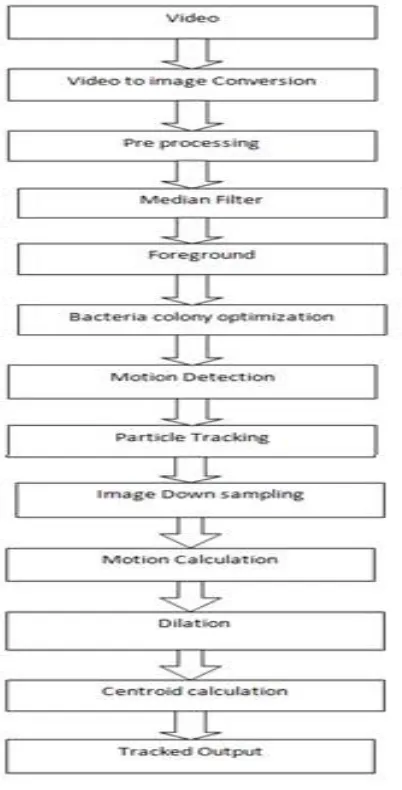
The below figure is the block diagram of the proposed system which is further divided into two parts i.e. GbLN-BCO algorithm and particle filter for motion model. In which the human tracking is done. The briefdescription of the both parts is given below.
Fig 1: Block Diagram of system
Here we have used Caltech data set. The avifile is the input to the system. The video contains the no of frames so; the video is converted into no. of frames having the size of frames 250*250.
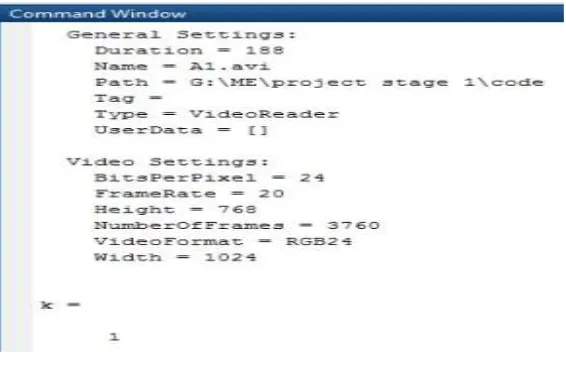
Frame conversion: -The input to the proposed system is the audio video interface file. For the detection of the object video is converted into frames having the frame rate of 20\s and Bitper Pixel of 24. The height & width of the file format is 768*1024.
Preprocessing: - Imagepre-processing typically denotes a processing step transforming a source image into a new image which is fundamentally similar to the source image, but differs in certain aspects, e.g. improved contrast. According to the above definition, pre-processing results in changing the brightness of individual image pixels. This step includes the physical transformation of the RGB and the grayscale image.
Median Filter:-It is a nonlinear type of digital filter which is used to remove the noise from the signal and image. It is used to enhance the quality of the signal. The advantage of the median filter it gives the precise output and it preserves edges while removing noise.
ForegroundDetection:-The purpose of the foreground detection is to detect the changes in the image sequences. For the tracking purpose we do not need the entire background image so the foreground detection is used for the detection of the moving part.
Bacteria Colony Optimization:-In this optimization the artificial bacteria is used of detection. For the detection of the target the bacteria goes from the 5 stages i.e. Chemotaxis, Elimination, Reproduction and Migration, Communication. The Chemotaxis& Communication is used to update the positions of the bacteria. Bacteria swim by rotating whip-like flagella.The bacteria is used to track the object.
Particle Filter:-In a particle filtering a set of particles are used to track the object. The particle filter methodology is used to solve Hidden Markov Chain (HMM) and nonlinear filtering problems arising in signal processing and Bayesian statistical inference.
ISSN (Print) : 2320 – 3765 ISSN (Online): 2278 – 8875
I
nternational
J
ournal of
A
dvanced
R
esearch in
E
lectrical,
E
lectronics and
I
nstrumentation
E
ngineering
(An ISO 3297: 2007 Certified Organization)
Website: www.ijareeie.com
Vol. 6, Issue 6, June 2017
B. FLOWCHART
The whole design & development carried out in three stages: 1) Video to image conversion and pre processing of image. 2) Detection of target using BCO
3) Tracking of the detected part.
Stage 1:- Video to image conversion and pre-processing of image.
The input to the proposed system is in AVI file so, for the detection and the tracking of the nonlinear target the video is converted into no of frames having the frame rate of 20\s. then the raw image is pre-processed and the image is converted into new size. The output of the system is shown in figure After resizing the image contains noise using the median filter the noise in the image is get removed. This is the first stage of the proposed system in which the enhanced image is the output of the first stage which further used for the detection and tracking purpose.
ISSN (Print) : 2320 – 3765 ISSN (Online): 2278 – 8875
I
nternational
J
ournal of
A
dvanced
R
esearch in
E
lectrical,
E
lectronics and
I
nstrumentation
E
ngineering
(An ISO 3297: 2007 Certified Organization)
Website: www.ijareeie.com
Vol. 6, Issue 6, June 2017
Stage 2:- Detection of target using BCO
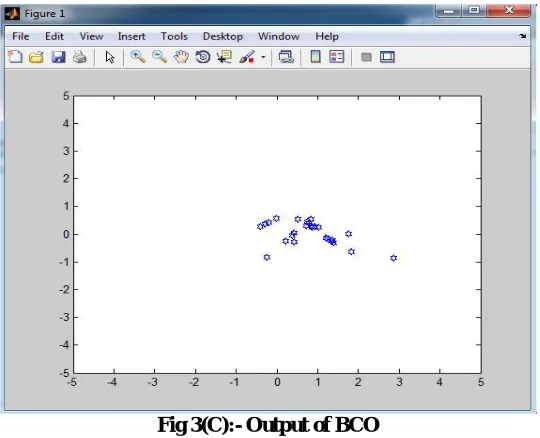
The input given to the 2ndstage is the filtered image from stage 1.For the detection of the nonlinear motion the foreground detection is used. For the detection and tracking purpose we do not need all background images so the foreground detection is used for the detection of the moving part. The purpose of the foreground detection is to detect the changes in the image sequences. The out of the fore grounded image is given in figure 3(B). Now, the bacteria are spread on the image. Here we are spreading 1000 bacteria on an image when the motion is happens the bacteria generated its own off springs and communicated with each other and calculate the local best and the global best when the value of local best is equal to global best the bacteria is updated and the target is detected. The output of the bacteria is shown in figure3 (C).
Stage 3:- Tracking of the detected part
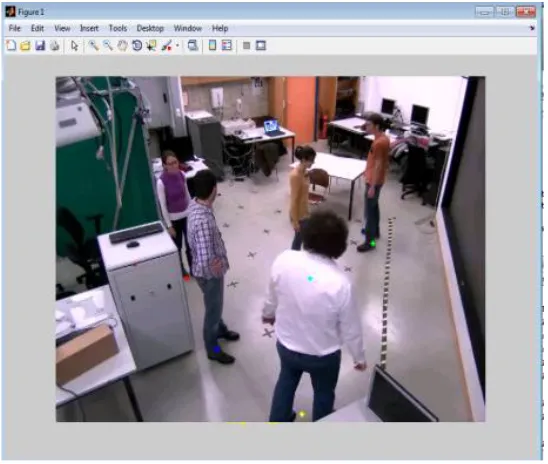
The input given to the 3ndstage is the detected part of the stage 2. Then on the detected part the particle filter is used for the tracking purpose. It is a digital type of filter which is used for the nonlinear tracking. In the tracking the morphological operation i.e. dilation is applied on the image for increasing the accuracy of the tracking .after the dilation the Centroid of the image is calculated and we get the tracked output. The output of the tracking is shown in figure 3(D).
V. IMPLEMENTATION RESULTS
The developed application software efficiently performed on the input video. The system not only accurately detects the target but also tracked it very efficiently. The system first converts video into no of frames. The whole operations i.e. bacteria spreading and particle spreading are performed on the images i.e. frames. The output of the various stages are given below
Stage 1:- Results of Video to image conversion
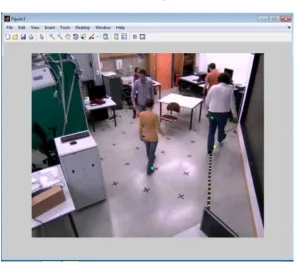
The video is converted into no of frames using a MATLAB 2013.
Fig 3(A):- Output of video to Frame conversion
ISSN (Print) : 2320 – 3765 ISSN (Online): 2278 – 8875
I
nternational
J
ournal of
A
dvanced
R
esearch in
E
lectrical,
E
lectronics and
I
nstrumentation
E
ngineering
(An ISO 3297: 2007 Certified Organization)
Website: www.ijareeie.com
Vol. 6, Issue 6, June 2017
Stage 2:- Results of Detection of target using BCO
The converted frames are given to the stage 2 for the processing i.e. the median filter is applied on the system for removing the noise from the image. For the detection and tracking purpose we do not need all background images so the foreground detection is used for the detection of the moving part. The output of the foreground detection is given in fig3 (B).
Fig 3(B):- Output of Foreground Detection
Now, the bacteria are spread on the image. Here we are spreading 1000 bacteria on an image when the motion is happens the bacteria generated its own off springs and communicated with each other.
Fig 3(C):- Output of BCO
ISSN (Print) : 2320 – 3765 ISSN (Online): 2278 – 8875
I
nternational
J
ournal of
A
dvanced
R
esearch in
E
lectrical,
E
lectronics and
I
nstrumentation
E
ngineering
(An ISO 3297: 2007 Certified Organization)
Website: www.ijareeie.com
Vol. 6, Issue 6, June 2017
Fig 3(D):- Output of BCO
Stage 3:- Tracking of the detected part
Now, at the detection part the particles filter is applied. The accuracy of the particle filter at the nonlinear tracking is always greater than other method. Output of the tracking of system is given in the figure 3 (D).
Fig 3(E):- Output of Particle filter
ISSN (Print) : 2320 – 3765 ISSN (Online): 2278 – 8875
I
nternational
J
ournal of
A
dvanced
R
esearch in
E
lectrical,
E
lectronics and
I
nstrumentation
E
ngineering
(An ISO 3297: 2007 Certified Organization)
Website: www.ijareeie.com
Vol. 6, Issue 6, June 2017
Fig 3(F):- Tracking Output
Stage 3:- confusion matrix
Now, we computed the final result in the form of confusion matrix. The confusion matrix gives the output accuracy of the proposed system. The below figure shows the confusion matrix.
Below Figure Visualize the final result with confusion matrix. The numbers in the bottom side of the matrix give the overall accuracy. We achieved the final accuracy of 95.3% as shown in fig. 3(C)
No of Data set Frames: - 1000 Positive (P):-750
Negative (N):- 250
Detected Non Detected
Detected 730 [TP] 20[TN]
Non Detected 17[FP] 223[FN]
The manual calculations are given below:-
Accuracy= = = 95.3%
ISSN (Print) : 2320 – 3765 ISSN (Online): 2278 – 8875
I
nternational
J
ournal of
A
dvanced
R
esearch in
E
lectrical,
E
lectronics and
I
nstrumentation
E
ngineering
(An ISO 3297: 2007 Certified Organization)
Website: www.ijareeie.com
Vol. 6, Issue 6, June 2017
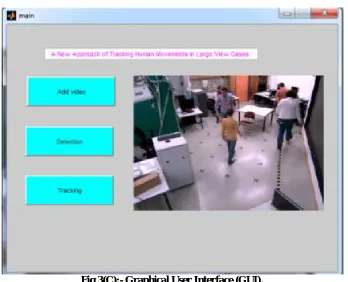
Stage 4:-Graphical User Interface (GUI).
The last stage of the proposed system is the formation of the GUI. The above results describes the system works very efficiently and it detects and track the object very accurately the processing time is very small than the other methods.
Fig 3(C):- Graphical User Interface (GUI).
VI. CONCLUSION
The proposed method is used to track the human and objects in a large view. The GbLN algorithm is used to track the object efficiently and it reduces the processing time. GbLN-BCO algorithm is used to speed up the template matching process, and consequently reduces the processing time in order to search the object location the proposed method with particle filter has the ability to steadily track the locations of multiple human movements that move in different directions. In addition, this method can accurately recognize the object region and is able to distinguish the different object movements, during the process of occlusion or after the objects have occluded. The results from the study also show that the Parzen particle filter is able to accurately recognize objects that are overlapped, but is unable to accurately recognize the object region. Consequently, it is unable to accurately distinguish the overlapped objects. The accuracy of the tracking perform is 95% i.e. greater than the previous techniques i.e. unscented Kalman filter &Parzen Particle Filter.
REFERENCES
[1] Muhammad Imran Shehzad, Yasir A. Shah , Zahid Mehmood , Abdul Waheed Malik , Shoaib Azmat” K-means based multiple objects tracking
with long-term occlusion handling ” ISSN 1751-9632 Received on 17th May 2016Revised 17th August 2016 IET Comput. Vis., © The Institution of Engineering and Technology 2016, Vol. 11 Iss. 1, pp. 68-77
[2] Huiling Wu, Weihai Li “ROBUST ONLINE MULTI-OBJECT TRACKING BASED ON KCF TRACKERS AND REASSIGNMENT “
978-1-5090-4545-7\16\2016 IEEE PP 124-128
[3] Koichi Ichige, Osamu Shibata “Accurate Radio-Based Moving Object Tracking And Its Application to Sports Analysis” 2016 International
ISSN (Print) : 2320 – 3765 ISSN (Online): 2278 – 8875
I
nternational
J
ournal of
A
dvanced
R
esearch in
E
lectrical,
E
lectronics and
I
nstrumentation
E
ngineering
(An ISO 3297: 2007 Certified Organization)
Website: www.ijareeie.com
Vol. 6, Issue 6, June 2017
[4] Nicolas Papadakis Aurélie Bugeau “Tracking with Occlusions via Graph Cuts” IEEE Transaction on Pattern Analysis and Machine Intelligence
( Volume: 33,Issue :1 , Jan. 2011 ) 144 - 157. Jan 2011
[5] Yunji ZHAO, Hailong PEI “Object tracking based on particle filter with discriminative features ” J Control Theory Application 2013 11 (1) 42–
53 DOI 10.1007/s11768-013-1088-0 PP 42-53
[6] Koichi Ichige, Nobuya Arakawa, Yokohama “Accurate Radio-Based Moving Object Tracking An Its Application to Sports Analysis”
978-1-5090-2889-4/16/$31.00 ©2016 IEEE 328 2016 International Conference on Advances in Electrical, Electronic and System Engineering, PP 328-332 14-16 Nov 2016..
[7] Suraj K Mankani, Naman S Kumar, Prasad R Dongrekar, Shreekant Sajjanar, Mohana, H V Ravish Aradhya “Real-Time Implementation of
Object Detection and Tracking on DSP for Video Surveillance Applications ” IEEE International Conference On Recent Trends In Electronics Information Communication Technology, May 20-21, 2016, India
[8] Swati Naresh Sharma, Ajitkumar Khachane, Dilip Motwani “Multi-Object Tracking Using TLD Framework ” 978-1-5090-0774-5/16/ 2016
IEEE International Conference On Recent Trends In Electronics Information Communication Technology, May 2021, 2016, India PP 1766 -1769[
[9] Kai Xiang Yang, Ming Hwa Sheu “Edge-basedMoving Object Tracking Algorithm for an Embedded System ”978-1-5090-1570-2/16/$31.00