Ionization and heating by X-rays and cosmic rays
Manuel Güdel
1Department of Astrophysics, University of Vienna, Türkenschanzstrasse 17, 1180, Vienna, Austria
Abstract.High-energy radiation from the central T Tauri and protostars plays an impor-tant role in shaping protoplanetary disks and influences their evolution. Such radiation, in particular X-rays and extreme-ultraviolet (EUV) radiation, is predominantly generated in unstable stellar magnetic fields (e.g., the stellar corona), but also in accretion hot spots. Even jets may produce X-ray emission. Cosmic rays, i.e., high-energy particles either from the interstellar space or from the star itself, are of crucial importance. Both high-energy photons and particles ionize disk gas and lead to heating. Ionization and heating subsequently drive chemical networks, and the products of these processes are accessi-ble through observations of molecular line emission. Furthermore, ionization supports the magnetorotational instability and therefore drives disk accretion, while heating of the disk surface layers induces photoevaporative flows. Both processes are crucial for the dispersal of protoplanetary disks and therefore critical for the time scales of planet for-mation. This chapter introduces the basic physics of ionization and heating starting from a quantum mechanical viewpoint, then discusses relevant processes in astrophysical gases and their applications to protoplanetary disks, and finally summarizes some properties of the most important high-energy sources for protoplanetary disks.
1 Introduction
Protostellar and protoplanetary disks are immersed in various types of high-energy radiation and par-ticle fluxes. Among them figure most prominently extreme-ultraviolet and X-ray radiation from the magnetized stellar corona of the central star and in some cases from collimated jets; hard X-rays and gamma-rays from stellar flares; interstellar X-rays from neighboring stars in stellar clusters or from distributed hot plasma in star-forming regions; and galactic cosmic rays and energetic particles ejected during stellar flares (“stellar cosmic rays”). High-energy radiation and cosmic rays modify cold pro-tostellar disk gas primarily due to their ionization power. In the process of ionizing disk gas, the upper layers of the disk are also heated to temperatures of up to several thousand K. Both temperature gradients and ionized species drive a plethora of chemical reactions that would be impossible in the absence of high-energy sources. Ionization and heating are also prime agents of disk destruction: the former by possibly inducing the magnetorotational instability (MRI) through coupling of ionized disk gas to magnetic fields, and the latter by photoevaporating gas from the uppermost layers of the disk. The disk lifetime may thus well be controlled by high-energy processes taking place on or near the central star.
14thLecture from Summer School “Protoplanetary Disks: Theory and Modelling Meet Observations”
DOI: 10.1051/ C
Owned by the authors, published by EDP Sciences, 2015 /201
epjconf 51020 0 10
7KLVLVDQ2SHQ$FFHVVDUWLFOHGLVWULEXWHGXQGHUWKHWHUPVRIWKH&UHDWLYH&RPPRQV$WWULEXWLRQ/LFHQVHZKLFKSHUPLWV XQUHVWULFWHGXVHGLVWULEXWLRQDQGUHSURGXFWLRQLQDQ\PHGLXPSURYLGHGWKHRULJLQDOZRUNLVSURSHUO\FLWHG
treatment of radiation processes. I summarize here the principal steps leading to the photoionization cross section. Extensive treatments can be found, e.g., in Rybicki & Lightman (1979), Shu (1991), or Kahn (2005).
The wave functionψ(x,t) of an electron is the probability amplitude for the electron (e.g., bound in an atom) to be located atxat timet. It obeys theSchrödinger equation,
i∂ψ∂
t =Hψ, (1)
whereHis the Hamiltonian associated with the energy of the system. For a time-independent Hamil-tonian, thetime-independent Schrödinger equation
Hψj=Ejψj (2)
is used to find the stationary states (“eigenstates”)ψjwith energyEj(the eigenvalues of the equation).
Quantum mechanics describes interactions of radiation (“photons”) with particles in terms of a change of quantum state, described by matrix elementsf|H|i involving an initial state|i, a final state|f, and a “perturbing Hamiltonian” associated with the external radiation field.
To findHfor the system, we start with the classical Euler-Lagrange equation
d dt
∂
L
∂x˙
= ∂∂L
x. (3)
TheLagrangian Lof a particle in an electromagnetic field reads
L=1
2m|x˙|
2−qϕ(x,t)+qx˙
cA(x,t). (4)
The first two terms express the kinetic and the potential energy;ϕandAare, respectively, the scalar and vector potentials (The aboveLleads to the correct equation of motion of the particle in a field). In what follows, we are using theCoulomb gauge, i.e.,∇ ·A=0. The Hamiltonian follows fromL
and thecanonical momentum p=∂L/∂x˙as
H=xp˙ −L = 1
2me
p−q
cA(x,t)
2+qϕ(x,t)
= 1
2me|
p|2− q
2mc(p·A+A·p)+ q2
2mc2A·A+qϕ(x,t). (5)
For the electron, we now setq=−eandm=me. We separateHinto three terms,
H0= 1 2me
|p|2−eϕ(x), H1=
e
2mec
(p·A+A·p), H2=
e2 2mec2
These Hamiltonians describe the electronic equilibrium state of the atom (staticH0), perturbations due to one-photon interactions (H1) and two-photon interactions (H2). It is easy to show that the relative importance of the three terms is, e.g. for a hydrogen atom,H2/H1 ∼a20E/eandH1/H0 ∼a20E/e, the ratio of the electric field (E) of the radiation field to the Coulomb field at one Bohr radiusa0. This ratio is usually1 (e.g., Shu 1991). We therefore neglectH2for two-photon processes in the following.
We introduce quantum-mechanical treatment by identifyingpwith the quantum mechanical oper-ator−i∇, thus writing the Hamiltonian termsH0andH1as
H0=− 2
2me∇
2−eϕ(x), H 1=−
ie mec
A· ∇ (7)
where we have usedA·p=p·AforH1because∇A=0. We assume a monochromatic plane wave and therefore write the vector potential as
A(x,t)=ReA0ei(kx−ωt)
= 1 2|A0|
ˆ
ei(kx−ωt)+ˆ∗e−i(kx−ωt) (8)
where ˆis the polarization vector of the wave. The time-averaged Poynting vector of the radiation field is
<S >= c
4π|E(t)| 2kˆ= ω2
8πc|A0|
2kˆ (9)
whereEis the wave electric field and ˆkis the unit vector in the propagation direction of the wave. The Poynting energy flux|<S >|can also be expressed in terms of discrete-photon flux through areaF,
dN/dFdt:
dN
dFdt =
|<S >|
ω = ω 8πc|A0|
2. (10)
Returning to the Hamiltonian, the static part H0 describes the structure of the stationary states of the atom. From the Schrödinger equation, we see that the energy eigenstates follow the time dependence
ψj(x,t)=ϕj(x)e−iEjt/. (11)
Any wave functionψ(x,t) for the atomic system (bound or free) can be expanded by the complete basis defined by all eigenfunctionsϕj(x). BecauseH1 can be considered a small perturbation ofH, we therefore write,
ψ(x,t)=
j
cjϕj(x)e−iEjt/ (12)
with the normalization condition ψ(x,t)ψ∗(x,t)d3x≡ ψ|ψ=1. We now substitute this expansion into the time-dependent Schrödinger equation to find
j
cjH1ϕje−iEjt/=i
j
˙
cjϕje−iEjt/ (13)
where we have subtracted the zero-order terms involvingH0 j...= jEj.... Eq. 13 is a differential
equation system for the time-dependent coefficientscj. The initial condition is that for t = 0, the
system is in an eigenstateϕi(x):
ψ(x,0)=ϕi(x). (14)
We multiply the above equations withϕ∗feiEft/defining a possible final state, and integrate over allx.
For simplicity, we now change to the Dirac notation:
j
cjei(Ef−Ej)t/ϕf|H1|ϕj ≡
j
cf(t)=
iϕf|H1|ϕi 0
e dt=−
ϕf|H1|ϕi ω
f −ωi±ω
(17)
Recall that in quantum mechanics,|cf(t)|2(equal to the absolute square of the wave function) gives
the probability that the system is now, at timet, in its final state f. The transitionrateis therefore
R=lim
t→∞ |cf(t)|2
t =
2π
2|f|H¯1|i| 2δ(ω
f−ωi±ω)=
2π
|f|H¯1|i|2δ(Ef −Ei±ω). (18)
(Kahn 2005) whereδstands for the “delta” distribution. We immediately see that a transition requires emission or absorption of an energy quantumωthat is (fort → ∞) equal to the energy difference Ef−Ei. IfEf >Ei, thenω <0, which represents an absorption of a photon from the electromagnetic
field. Using ourH1in Eq. 7 andAfrom Eq. 8, we find
R= πe
2
2m2 ec2
|A0|2|f|e±ikxˆ(∗)· ∇|i|2δ(Ef −Ei∓ω) (19)
(the upper sign and ˆfor absorption, the lower sign and ˆ∗for emission).
Assume now that|ϕi is a bound state and|ϕf is a free state. For the total transition rate, we
integrate over all f states (i.e., all possible p). By the uncertainty principle, a particle cannot be localized in a phase space volume less than d3xd3p=(2π)3. The density of free states is therefore (E=mv2/2→ p= √2mE)
n(E)dE= Vd
3p
(2π)3 =
Vm(2mE)1/2dEdΩ
(2π)3 . (20)
We write for the final, free state of the electron
ϕf(x)=
1
V1/2e
−ipfx/ (21)
(so thatψf|ψf=1 if integrated over the allowable volume). Integrating the transition rateRover all
energies of the final states, using the density of statesn(E), yields
dR=1
4
e2
(2πc)2vf|A0|
2|e−ipfx/|e±ikxˆ· ∇|i|2dΩ (22)
(wheremvf =(2mEf)1/2) and therefore the differential cross section
dσ dΩ =
dR/dΩ
dN/dtdF =
dR/dΩ
ω|A0|2/(8πc)
= e2vf
2πcωe
Let us now apply this theory to the concrete situation in which a K shell electron of a hydrogen-like atom is liberated to a free state via photoionization. We write for the initial state, including normalization,
ϕi=
1 (πa3
Z)1/2
e−|x|/aZ (24)
whereaZ = 2/(Zmee2) corresponds to the “Bohr radius” for a nucleus of charge Z. A lengthy calculation for the integration in Eq. 22 yields a transition rate (Shu 1991)
R= 8πe
2a3
Z
3Vm2 ec3
ω−3N(ω)(k e)2
⎛
⎜⎜⎜⎜⎝
mea2Z
⎞ ⎟⎟⎟⎟⎠4
(25)
whereN(ω) is the photon occupation number for frequencyω. For the photoionization cross section out of thenth shell in a hydrogen-like ion is
σn(ω)=
64α
3√3
Z4
n5
1Ry
ω
3
πa2
0g≈const
Z4
n5ω3 [cm
2] (26)
where the fine structure constantα = e2/(c) ≈ 1/137, the Bohr radiusa
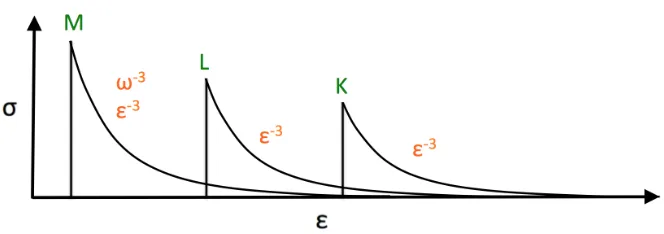
0 = 2/(mee2) ≈ 5.3× 10⁻⁹ cm, and 1Ry = mee4/(22) = 13.6 eV, andgis a Gaunt factor of order unity. This important result shows that the cross section is largest forn=1 (inner shell), and also strongly depends on the atomic number,Z. Furthermore, the cross section is largest at the ionization edge and drops likeω3.
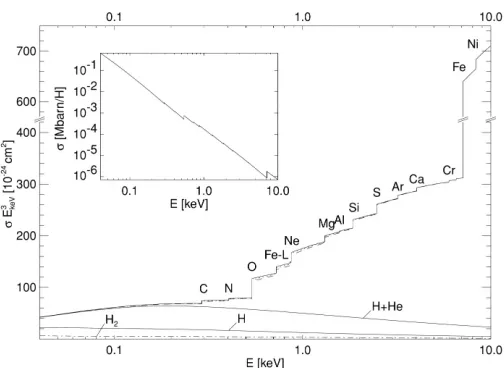
Many-electron atoms show a series of ionization edges as they lose electrons from successive shells - see Fig. 1. For the most important cosmic elements, these edges are located between 13.6 eV for hydrogen (the H Lyman edge) and 7.1 keV for Fe. X-rays below≈7 keV and extreme-ultraviolet radiation therefore suffer from absorption as they propagate through interstellar space, with relevant equivalent hydrogen column densities ofNH≈7.5×1023cm−2forτ=1 at 7 keV,NH≈4×1021cm−2 for 1 keV, orNH ≈2×1019 cm−2for 0.1 keV. This interstellar or circumstellar matter absorbs EUV and soft E-rays first, while the photoionization cross section rapidly decreases for increasing photon energy due to theν−3dependence of the cross section. Beyond the Fe K edge, photons encounter only the rapidly decaying tail of the K-edge cross section. Measuring EUV/X-ray absorption therefore provides an important method to estimate (near-neutral) gas column densities along the line of sight to the source.
By implication, softer X-rays are more efficient agents of ionization than hard photons although due to the larger optical depth, ionization occurs closer to the “surface” of an obstacle such as a pro-toplanetary disk for softer photons. Harder X-ray photons penetrate into deeper, cooler layers of the disk, while the hardest photons eventually cross the entire disk without absorption. It follows that pho-toionization is locally dominated by the lowest-energy photons that have not been attenuated, i.e. by photons close to the energy at which the photoelectric absorption optical depth is unity. Significantly higher-energy photons are then less important for this layer.
3 Thomson and Compton scattering
Photoelectric absorption is the dominant interaction of photons with matter for photon energies ∼
<10 keV. For higher energies, Thomson/Compton scattering begins to dominate.
Figure 1. Schematic illustrating the absorption cross sections as a function of photon energyε(or associated radiation frequencyω) for ionization at the M-, L-, and K shell. Above the ionization threshold, the cross section decreases likeε−3orω−3(after Shu 1991).
(perpendicular toz) with accelerations of
¨
x=−eE
i x
me
, y¨=−eE
i
y
me
(27)
whereEixandEiyare the oscillating electric field components of the unpolarized infalling wave with <E2
x>=<E2y>. The indicesiandf stand forinitial(infalling) and f inal(scattered wave). The oscillating electron emits radiation according to the Larmor formula,
dQ(ϕ)=e
2|r¨|2sin2ϕ
4πc3 dΩ [erg s
−1]. (28)
whereϕis the angle between the oscillation direction in thexzplane and the outgoing wave vector
kf. Letθbe the scattering angle of a wave in thexzplane (betweenkf and the ˆzdirection). For the
electron oscillations alongxandy, we find
dQx∝ |x¨|2sin2ϕ, dQy∝ |y¨|2. (29)
The Poynting vector (energy flux density of the electromagnetic wave) is
S= c
4πE ×B=
c
4π|E| 2kˆ
i [erg cm−2s−1]. (30)
The time average of this is
S ≡ |S|= 2c 4πE
2
x (31)
and therefore
dQ(ϕ)= e 4S
i(sin2ϕ+1)
2me2c4
dΩ [erg s−1]. (32)
The differential cross sectiondσis the ratio between the energy flux scattered intodΩand the infalling energy flux,Si,
dσ(ϕ)= dQ
S = e4S
i(sin2ϕ+1)
2me2c4Si
dΩ =(sin
2ϕ+1)
2 a
2 0dΩ≡
a2 0 2(cos
Figure 2.Polar diagram showing the Klein-Nishina scattering cross section for Thomson/Compton scattering for different incoming electron energies (colors). The limiting case for low photon energies (Thomson scattering) is represented by the blue graph. The photon is injected from the left, the electron is initially at rest in the center (fromhttp://commons.wikimedia.org/wiki/File:Klein-Nishina_distribution.png).
wherea0 =e2/mec2 =2.8·10−13 cm is the classical electron radius. Integration overθ= π/2−ϕ gives the total (“Thomson”) scattering cross section,
σT =a20
π
0
(sin2ϕ+1)πsinθdθ= 8π 3 a
2
0 (34)
and therefore
Q=SσT≡curadσT. (35)
Compton scattering is essentially the same process for high photon energies, i.e., ω ∼> mec2 where we need to consider energy and momentum transfer from the wave to the electron, i.e., we need to consider photons. The electron itself will therefore not stay at rest and also propagates at an angle ηto thezdirection. This case is, however, less relevant for protoplanetary disks irradiated by stellar X-rays. We only provide the relevant Klein-Nishina cross section (εi=incoming photon energy,εf
outgoing photon energy),
dσ=a 2 0 2
ε
i εf +
εf εi −
sin2θ εf εi
2
dΩ, εi
εf =
1+ εi
mec2
(1−cosθ). (36)
Fig. 2 displays a polar diagram showing scattering efficiency as a function of angle, including the low-energy limit for Thomson scattering.
4 Simplified Treatment of Collisional Ionization
Figure 3. Absorption cross section for a gas with the composition of the interstellar medium, including dust admixture (solid and dotted lines). For the main plot,σhas been multiplied byE3for illustration purposes, while
the inset showsσwithout this multiplier. The contributions of atomic hydrogen, helium, hydrogen plus helium, and molecular hydrogen (H2) are shown at the bottom of the plot (from Wilms et al. 2000; cAAS. Reproduced
with permission).
If two electrons, one being at rest initially (the valence electron in an atom) and the other having kinetic energyE, collide with an impact parameterb, the energy transfer is
ΔE= E
1+E 2b2
e4
(37)
For an ionization to happen,ΔEmust exceed the ionization potentialχ, which implies that the impact parameter must be less thanbc,
bc=
e2
E
E
χ −1
1/2
(38)
so that the geometric cross section becomes
σ=b2cπ=πe4 1 E2
E
χ −1
(39)
wherea2is the Bohr radius. This expression needs to be summed over all electrons in the atom and their associatedχas long asE≥χ. The approximation is good as long asEχ.
5 Ionization and Heating by X-Ray Irradiation in Astrophysical Gases
5.1 Energy Partitions and Heating
Figure 4. Sketch illustrating primary ionization due to an incoming X-ray (left) and secondary ionization due to photoelectron and Auger electrons (right). Secondary electrons will continue to ionize and excite and also dissociate molecules. Fluorescence as an energy loss path is also shown.
≈600 eV predominantly ionize H, H2, and He. For a pure H2gas, the most important reaction is
γ+H2→H+2+e. (40)
followed by
H+2+H2 → H+3 +H (41)
H+3 +e → H2+H or 3H (42)
H+H → H2 (on grains) (43)
the first two being exothermic reactions liberating 10.96 eV of which a fraction goes into heat, and the third one liberating 4.5 eV for internal excitation.
Thephotoelectron(Fig. 4) ejected as a consequence of the ionization process carries away the inci-dent photon energy minus the ionization energy, minus≈1.1 eV for vibrational excitation (Glassgold & Langer 1973). It is typically an energetic electron (several 100 eV). Furthermore, the inner-shell vacancy in the photoionized atom is filled by an electron from a higher shell. The energy difference may either be radiated away (“fluorescence” emission) or transmitted to another bound, outer electron, thus ejecting it as anAugerelectron.
Fluorescenceis typically important for heavy atoms such a Fe (fluorescent yield=fraction of inner-shell holes filled by emission of a fluorescent photon exceeds 10% for atomic numbers ∼>20 after removal of an 1selectron, see Osterbrock & Ferland 2006). In contrast, lighter elements pre-dominantly eject Auger electrons (that are also produced by heavy atoms). The fluorescent photons themselves are X-ray photons and therefore further continue inducing reactions as listed above.
AnAuger electroncarries away the energy difference between the inner-shell hole and the outer,
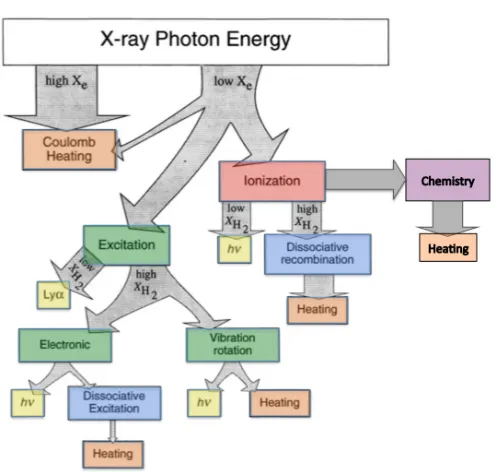
Figure 5. Sketch illustrating the loss channels for an energetic electron injected into a dense gas. The widths of the arrows indicate the approximate fractions of the initial energy channeled into the respective processes (the branching depends on the electron and the H2fractions; after Maloney et al. 1996, complemented with the
chemical reaction path to the right; cAAS. Reproduced with permission).
Effectively, therefore, almost all of the incident X-ray energy is transferred to energetic electrons (photoelectrons and Auger electrons) that subsequently interact collisionally with other atoms, pre-dominantly H, H2, and He, thus inducing excitation, dissociation, and secondary ionization at the valence shell (Krolik & Kallman 1983; Lepp & McCray 1983; Weisheit 1974):
e+H2 → e+H2 (elastic scattering) (44) e+H2 → e+H∗2 (electronic[E(e)>11.2 eV]/vibrational/rotational excitation) (45) e+H2 → e1+e2+H+2 (ionization forE(e)>15.4 eV) (46) e+H2 → e+2H (dissociation forE(e)>8.8 eV) (47)
The ionization channel then leads to further reactions involving H+2 as described above, involving heating. Heating is also involved in the dissociation reaction, and in collisional de-excitation of ro-tational transitions, while de-excitation of electronic and vibrational transitions will lead to photons leaving typical astrophysical systems. For electrons above 10 eV, further ionization, dissociation and electronic excitation are important, while for lower-energy electrons, these channels are essentially irrelevant and the energy mostly ends up in rotational and vibrational excitation and heating through collisions (Shull 1979). Collisional de-excitation of rotational excitations in a sufficiently high-density gas will lead to further heating. This is obviously a basic difference to atomic gas.
(ground-state binding energy=13.6 eV) per 1 keV photoelectron is thus 1 keV×0.4/13.6 eV≈30 for atomic hydrogen gas (and≈ 26 for molecular hydrogen gas, i.e., ≈37 eV are expended for the production of one ion pair). For strongly ionized gases (ne/ntot >0.01) Coulomb heating dominates (Lepp & McCray 1983; Shull 1979).
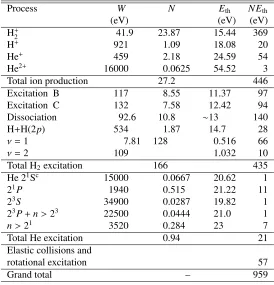
The entire chain of ionization, excitation, dissociation and heating reactions (see Fig. 5) has been analyzed in detail for molecular gas by Glassgold & Langer (1973), Dalgarno et al. (1999) and Glass-gold et al. (2012). Their results may be summarized as follows, as detailed in Tables 1 and 2 for a H2 +He neutral gas. Table 1 (after Dalgarno et al. 1999) shows the energy partition for 1 keV of initial electron energy. The columns provide the energyW expended for a given process (W is in-dependent ofEas long asE ∼>200 eV) although not all energy is required for the primary product of this process; then the number of such processes forE, i.e., N = E/W, for E =1 keV; then the threshold energyEth for the process; and finally the energy from this process, i.e.,NEth. From the ionization reactions in Table 1, one finds that the average energy used to produce one ion pair (H+2, H+, He+, and He2+) is 37 eV per keV. 47% of the energy is in ionization, 47% in H2 and He exci-tation, and 6% (60 eV per keV) in direct heating and collisional de-excitation of H2rotational levels (also heating the gas). Subsequent transformation into heat through chemical reactions, dissociation and collisional de-excitation of these initial products was calculated by Glassgold et al. (2012) and is summarized in Table 2 for an initial 1 keV electron. We note that dissociation of collisionally excited states contributes 57 eV per keV, elastic collisions and collisional de-excitation of rotational states also 57 eV, collisional de-excitation of vibrational levels 141 eV per keV, and chemical heating by reactions between the generated ions and neutrals 252 eV per keV. The total heating thus amounts to 507 eV per keV, or 18.7 eV per produced ion pair, or 51% of the energy expended for the production of an ion pair.
The heating rate can therefore be expressed as
ΓX=4.×10−11ζX
Δh 30 eV
nH [erg cm−3s−1] (48)
(Qi et al. 2006 based on Glassgold et al. 2004),Δh≈30 eV=heating per ionization for H2gas.
5.2 Simple Photoionization Estimates in Astrophysical Gases
We provide some rough estimates for ionization in an astrophysical gas irradiated by an point-like X-ray source, following the presentation of Krolik & Kallman (1983). Although a realistic X-ray spectrum can be dominated by lines, especially for soft (∼>1 keV) sources, the details of the spec-tral energy distribution are less important (see Sect. 5). We approximate the intrinsic source X-ray spectrum by an exponential (appropriate for the bremsstrahlung continuum),
Fε=F0e−ε/kT, (49)
εbeing the photon energy andTthe source temperature. The radiation suffers photoelectric absorption while entering cold (near-neutral) gas, following the cross section (see Eq. 26)
σ(ε)=σ0
ε
kT
−3
(50)
Dissociation 92.6 10.8 ∼13 140
H+H(2p) 534 1.87 14.7 28
ν=1 7.81 128 0.516 66
ν=2 109 1.032 10
Total H2excitation 166 435 He 21Sc 15000 0.0667 20.62 1
21P 1940 0.515 21.22 11
23S 34900 0.0287 19.82 1
23P+n>23 22500 0.0444 21.0 1
n>21 3520 0.284 23 7
Total He excitation 0.94 21
Elastic collisions and
rotational excitation 57
Grand total – 959
Table 2.Heating per ion pair and per keV
Process Qper ion Qper keV
(eV) (eV) Elastic coll., coll. de-excitation of rotational levels 2.1 57 Dissociation after collisional excitation 2.1 57 Collisional de-excitation of collisionally excited vibrational levels 2.8 76 Collisional de-excitation of vibrational levels excited after fluorescence 2.4 65
Chemical reactions of H+2 7.7 209
Chemical reactions of H+ 0.3 8
Chemical/CX reactions of He+ 1.3 35
Total heating 18.7 507
Energy for an ion pair 36.8 —
in particular O and, above 7.1 eV, Fe (Wilms et al. 2000, Fig. 3). The primary ionization rate per hydrogen atom is consequently,
ζx=
∞
ε0
e−τ(ε)Fε
ε σ(ε)dε=F0σ0
∞
ε0
1
x4e −x−τ/x3
whereτ =σ0NHis the optical depth at the ionization location for photons of energykT,NHbeing the equivalent hydrogen column density measured from the source. We have substitutedx ≡ε/kT. Similarly, we obtain for the heating rate per hydrogen atom:
G=
∞
ε0
e−τ(ε)Fε
ε σ(ε)εdε=F0σ0kT
∞
ε0
1
x3e−
x−τ/x3
dx (52)
Generally,ε0the ionization threshold for H, 13.6 eV.
The structure of an X-ray irradiated gas volume shows a series of nested, distinct regions, starting with a highly ionized “coronal” region close to the source, with temperatures similar to the source temperature (106 −108 K). It is followed by a H
ii region at∼ 104 K determined by the balance between ionization and hydrogen recombination. Next follows, subject to a thermal instability, an atomic Hiregion at∼8000 K, and then, after a rapid decline in temperature, the molecular H2region below 5000 K (Lepp & McCray 1983). WhereT >700 K in the H2 region, vibrational H2infrared emission is efficiently produced. Near the dissociation front, H2 emission is induced by excitation due to thermal collisions, while in cooler regions it follows from a cascade through vibration-rotation states following electronic excitation of H2molecules by non-thermal electrons or ultraviolet radiation (Black & Dalgarno 1976; Lepp & McCray 1983).
Krolik & Kallman (1983) perform detailed ionization calculations for molecular gas (in a star-forming region) with a density ofnH(atoms) = 4×105 cm−3 andT = 50 K. A total of 53 atomic, ionic, and molecular species were linked by 585 chemical reactions. It was assumed that≈ 45% of the photoelectron and Auger electron energy is effectively used for ionization, the rest going into heating and excitation. The main results of this study demonstrated that the typical ionization rate in a molecular cloud such as the Orion Nebula with embedded T Tauri and hot stars is of the same order of magnitude as the cosmic-ray ionization rate, i.e.ζ≈10−17s−1. Furthermore, given that most of the ionization is due to secondary electrons, the chemistry in the irradiated cloud is similar to the case of cosmic-ray irradiation for similar total ionization rates.
6 Cosmic Rays
6.1 Collisional Ionization by Cosmic Rays
Effects of collisional ionization and heating by cosmic rays (CR) was discussed foratomicgas by Spitzer & Tomasko (1968). The CR first ionizes H by ejecting an additional “first-generation sec-ondary electron” with a typical energy of 35-50 eV (Bethe 1933) depending on the CR energy, the more energetic of which produce further ionizations (further “secondaries”). Eventually, the total number of secondaries is 5/3 times the number of first-generation secondaries, and therefore the ion-ization rate is
ζCR= 5 3
4πj(E)σCRdE (53)
wherej(E) is the CR spectrum in particles per cm2per unit energy per unit solid angle. The observed CR spectrum suggestsζCR≈10−17s−1in the interstellar medium.
Figure 6.Schematic showing a cut through an X-ray photodissociation region. Approximate temperature, chem-ical composition, and ionization fractions are given. HXis the energy deposition rate per particle andnis the
gas density. The X-rays are injected from the left and are continuously attenuated as they proceed through the medium, the softer photons being absorbed more rapidly (from Maloney et al. 1996; cAAS. Reproduced with permission).
if thevelocitiesof the two particle species are the same, i.e., a fast electron behaves similarly as a proton if the electron kinetic energy isE=(me/mp)Ep(Glassgold et al. 2012).
Each secondary electron contributes an average energy Eh to the gas heating. Therefore, the
heating rate by cosmic rays can be approximated as (Jonkheid et al. 2004)
ΓCR=ζCR(5.5×10⁻¹²nH+2.5×10⁻¹¹nH2) (54)
7 Applications to Protoplanetary Disks
7.1 X-Ray and CR Ionization and the Magnetorotational Instability
We follow the same approach as in Eq. 51 approximating the X-ray spectrum by an exponential; however, the stellar X-ray spectrum is continuously being absorbed along the pathway from the star to the disk surface by a disk wind (which is perhaps driven by the X-ray irradiation itself - see below). We follow Glassgold et al. (1997) and separate the dependence of the photon flux spectrum on energy and position (r=radius of the disk segment) for a geometrically thin, flat disk,
F0(ε,r)=
R r
1 2
1 4πr2
LX
kT
1
εe−ε/kT, ε > ε0 (55)
{
{
f(r) g(ε)
where we have assumed that the X-ray source is located at the center of the disk but vertically dis-placed byR r;R/rthus is the glancing angle at which the X-rays strike the disk; the 1/εfactor transforms energy flux to photon flux; the 1/(kT) factor normalizes the total luminosity toLX, andε0 is introduced to simulate the low-energy cutoffdue to absorption along the way from the star to the disk.
On encountering the disk gas, the X-rays are continuously being attenuated by photoelectric ab-sorption, i.e. the total ionization rate is calculated from (see Eq. 51)
σ(ε) =
k
xkσk(ε) = total photoionization cross section per H nucleus (56)
τ(r, ε) = r
RN⊥(r)σ(ε) = optical depth for X−rays with energyε (57)
ζX = f(r)
k
∞
εk
g(ε)e−τ(ε)σk(ε)
ε−ε
k+k
Δε
dε (58)
where here we have summed over all elementskwith abundancexk, photoionization cross sectionσk
(rather than assumingσ(ε)∝ ε−3 as adopted in Eq. 51), ionization potentialε
k, and average Auger
energyk(assumed to be=εkin Eq. 51). Δε≈37 eV is the average energy needed for a collisional
ionization of H or H2, andN⊥ is the vertical hydrogen column density into the disk. Eq. 58 shows that, if Augerk ≈ εk(ionization energy), essentially all of the initial X-ray energyεis used up to
produce ionization, expendingΔε ≈ 37 eV per ionization pair. For photon energyε, integration is over the cross sectionσkstarting at the ionization edgeεkfor the considered speciesk. The sum is
over all possible species.
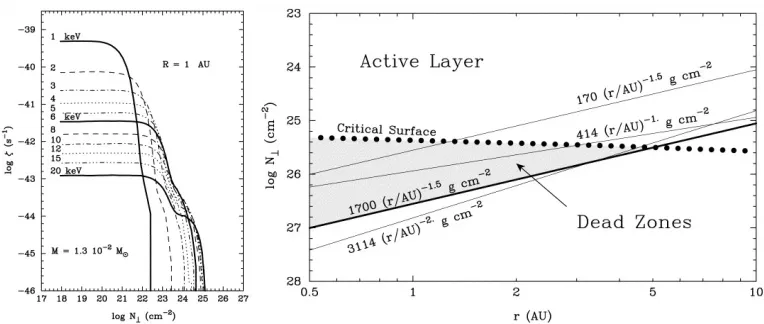
Numerical evaluation of these expressions for a realistic disk profile were performed by Glassgold et al. (1997); Igea & Glassgold (1999) improved these calculations for more realistic disk shapes and consideration of Compton scattering of energetic X-rays. The results can be summarized as follows (see Fig. 7):
• the ionization rate by the softest X-rays at the disk surface at optical depth1 is approximately constant, owing to the spectral cutoffε0;
• the ionization rate rapidly decreases toward larger column depths where harder photons of the spec-trum ionize predominantly heavier elements;
• harder spectra penetrate deeper into the disk and therefore ionize deeper layers;
• for a typical stellar coronal temperature ofkT =1 keV, the ionization degree corresponding to the adopted cosmic-ray ionization degree of 2×10⁻¹⁷ s−1 is found at depths ofN
Figure 7. Left: Ionization rates for monochromatic X-rays as a function of column density vertically into a disk for a gas with standard interstellar composition, at a radius of 1 AU. The source X-ray luminosity has been normalized to 1 erg s−1. The shoulder at deep levels are due to Compton scattering (from Igea & Glassgold
1999). –Right:Electron fraction in a disk due to X-ray ionization, shown in the radius -N⊥(vertical column density) plane. “Critical surface” marks the height below which the ionization fraction is too low to induce the magnetorotational instability. The solid lines give disk mid-planes from different models (from Igea & Glassgold 1999; cAAS. Reproduced with permission).
• At column densities greater thanNH≈1.5×1024cm−2, the ionizing X-rays have energies>10 keV where the Compton cross section becomes larger than the absorption cross section, andζX begins
to be altered by Compton scattering.
The ionization fraction follows from the balance betweenζX and the dissociative recombination rate
with molecular ions. Consider a simple model (Oppenheimer & Dalgarno 1974) involving molecules mjand a heavy atoms Mi, their ions m+j and M+i, and free electrons e. Densities of these species are
denoted byn(...), andnis the total particle density,n(m)= jn(mj),n(M)= in(Mi) and analogous
for the ions m+and M+. The adopted “chemical reactions” are
Ionization of all mj mj →m+j +e total rateζX
Dissociative recombination of molecule mj m+j +e →mj rate coeff.αj
Radiative recombination of atom Mi M+i +e →Mi+hν rate coeff.γi
Charge exchange between mjand Mi Mi+m+j →M+i +mj rate coeff.βji
The following relations apply to this simple system:
Electron density n(e)=
i
n(M+i)+
j
n(m+j) (59)
Variation ofn(e) dn(e)
dt =ζXn−
j
αjn(m+j)n(e)−
i
γin(M+i)n(e) (60)
Variation ofn(m+j) dn(m +
j)
dt = fjζXn−αjn(m
+
wherefjis the fraction of ionizations creating the molecular ion m+j. Using the equilibrium condition
d/dt=0 and adopting, for a simplifying approximation,αj=α,βji=β,γi =γindependent ofiand
j, one finds (Oppenheimer & Dalgarno 1974)
n(e)3+βn(M)α n(e)2−ζαXnn(e)−ζXnβαγn(M) =0 (62)
Typically,α γ. Various assumptions can be made to solve this equation forn(e). For a purely molecular gas, we may neglect terms with M and keep only the first and the third term, from which we find for the electron fractionxe=ne/n
xe=
ζ
X
nα
1/2
(63)
where, in a realistic situation for protoplanetary disks,α ≈ 2×10⁻⁶T−1/2 cm3 s−1 andn is the hy-drogen number density (Glassgold et al. 1997; Igea & Glassgold 1999). Calculations by Glassgold et al. (1997) and Igea & Glassgold (1999) show (accounting for sedimentation of condensible heavy elements) thatn(e) decreases rapidly toward the disk midplane; for a given vertical column density
N⊥,n(e) decreases with distancer; together, the disk ionization structure is stratified in such a way that a given ionization fraction defines a wedge-shaped region around the inner disk mid-plane with its apex at the mid-plane at some outer radius (Fig. 7b).
The magnetorotational instability (Balbus & Hawley 1991) requires a minimum ionization degree for magnetic fields to couple to the disk gas and maintain magnetic turbulence; this process is held responsible for disk accretion. Disk regions that fulfill the ionization criterion for the instability are “active”, other regions are referred to as “dead zones” (Gammie 1996). The criterion is actually given by the magnetic Reynolds number,ReM. From Ampère’s, Faraday’s and Ohm’s equations, one finds theinduction equation
∂B
∂t =∇ ×(v×B)+η∇
2B (64)
whereη ≡ c2/(4πσ) is the magnetic diffusivity, withσbeing the electric conductivity, and vis the plasma flow velocity. The magnetic Reynolds number expresses the relative importance between advection (the first term on the RHS) and magnetic diffusion (the second term),
ReM =
Lv
η ≈7.4×10¹³xeα1/2
R
1 AU
3/2 T
500 K
M M
−1/2
(65)
whereLis the characteristic length of variations in B, and the last numerical expression is due to Gammie (1996), withαbeing the Shakura-Sunyaev viscosity parameter (α1/2is of order unity). For MRI to be efficient, the criticalReM is about 100, and this corresponds to an ionization fraction of ≈10−12(see discussion in Fromang et al. 2002).
Computing the loci of the critical ionization fraction for the operation of the magnetorotational instability (Balbus & Hawley 1991), Glassgold et al. (1997) and Igea & Glassgold (1999) find that a significant part of the disk surface will couple sufficiently to magnetic fields to drive the instability, while the central layer around the midplane of the inner (few AU) disk is insufficiently ionized and is therefore not subject to the instability (“dead zone” not participating in MRI-driven accretion; Fig. 7b; see Turner et al. 2014 for a discussion of non-ideal MHD effects working against MRI).
total. Ionization and photodissociation lead to local heating of the gas and drive the chemistry. X-rays dominate in heating of themid-planein the innermost disk, but also the disk surface layers at AU distances. Most of the heat energy is carried away by dust emission and the [Oi] 63μm line which is in fact predicted tostrongly correlate with the X-ray irradiation level.The entire chemistry in the inner disk and on the disk surface layer of this model is found to bedominated by photoionization and photodissociation caused by UV and X-rays.
Cosmic rays are efficient in ionizing disk material. Their importance for driving MRI was recog-nized in particular by Gammie (1996) who developed a model of layered accretion in T Tauri disks. The crucial question is that of the ionization rate. In the interstellar space,ζCR≈10−17s−1(Spitzer & Tomasko 1968). Gammie (1996) used a limit for the magnetic Reynolds number ofReM ∼>1 for the operation of MRI, and adopted the interstellar ionization rate. Using the equilibrium condition Eq. 63 between ionization and (gas-phase) dissociative recombination, he showed that, for typical disk pa-rameters (e.g.,nH≈1013cm−3) the criterion for instability is marginally fulfilled in the top layers of the disk. However, largerReM≈100 may be required (see Fromang et al. 2002).
Another significant problem is the propagation of cosmic rays onto the disk surface. In the present solar system, low-energy cosmic rays are suppressed because of diffusion, convection and adiabatic cooling in the solar wind. The low-energy cosmic-ray spectrum is therefore highly uncertain for energies ∼<109eV due to modulation of the interstellar CR spectrum by the magnetized solar wind (filling the “heliosphere”). Various extrapolations down to lower energies provide largely diverging spectra (see summary by Cleeves et al. 2013). The interstellar ionization rate is therefore unlikely to be appropriate for a protoplanetary disk environment, especially because T Tauri stars are, like the Sun, producing magnetic fields and are very likely to produce ionized winds. Cleeves et al. (2013) estimate the ionization rate expected for a protoplanetary disk from estimates of the much enhanced magnetic activity of a T Tauri star compared to the present-day Sun, using knowledge of the CR modulation during the solar activity cycle. They conclude that an enhanced T Tauri heliosphere attenuates the cosmic ray flux at, say, 1 AU from the star by≈3 orders of magnitude compared to the Sun and at least 6 orders of magnitude compared to interstellar conditions. The total CR ionization rate is therefore estimated to be at levels ofζCR≈10−22−10−20s−1. In the disk midplane, radioactive decay will provide a floor to the ionization rate, and higher layers of the disk will be ionized predominantly by stellar X-rays. The CR exclusion by T Tauri winds therefore results in much larger “dead zones” in protoplanetary disks, possibly reaching out to distances of 25 AU.
7.2 X-Ray Heating and Photoevaporation
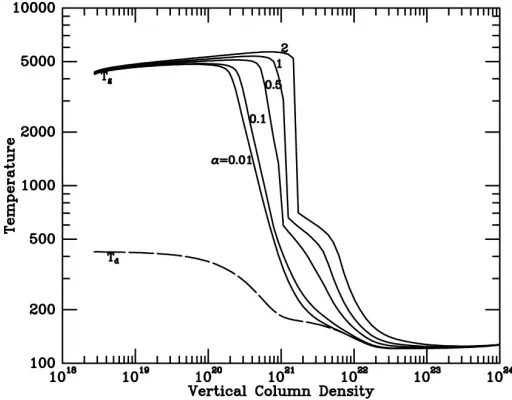
Figure 8.Gas and dust temperature profiles as a function of vertical column density into a disk, at 1 AU from a central T Tauri star; apart from X-ray heating, viscous heating is present, characterized by the variousαvalues (α=0 for no viscous heating; from Glassgold et al. 2004; cAAS. Reproduced with permission).
model. The heating rate due to X-rays can be expressed in terms of the ionization rate (see Eq. 48)
ΓX =ζXΔhnH (66)
whereΔhsimply defines the heating rate per ionization. There are two components to consider, direct
X-ray heatingΔh1≈10 eV per ionization and indirect heatingΔh2 ≈20 eV per ionization owing to the increase in X-ray produced electronically excited states that heat gas by collisional de-excitation. Therefore,Δh≈30 eV.
These calculations show that the upper,atomiclayers of the disk are heated by X-rays (and/or viscous dissipation) to several thousand K at 1 AU (for typical stellar X-ray luminosities; Fig. 8). A strong temperature inversion is thus seen along the vertical direction through the disk. At
N⊥≈1021cm−2, the temperature steeply drops and eventually approaches the dust temperature which remains much lower even in the upper layers of the disk. X-ray heating is most efficient in the range ofN⊥ =1019 −1022 cm−2. The heating rate increases from the top down because of the increasing hydrogen density, but then declines again because of progressive X-ray attenuation. Monte-Carlo simulations by Ercolano et al. (2008) support this picture, but also show much hotter “disk coronae” closer to the star, which eventually become fully ionized at temperatures up to≈106K at a fraction of an AU. X-rays are very important heating agents (for standard stellar and disk parameters) out to ∼35−40 AU but disk ionization by stellar X-rays can be seen out to 190 AU in these models.
In the transition region whereT drops rapidly, atN⊥ ≈ (1−2)×1021 cm−2, CO cooling is im-portant. In fact, CO is formed there where H still abounds in its atomic form, and accelerates cooling through CO ro-vibrational and CO rotational emission, generating a strong temperature gradient; cor-responding emission lines provide important observational diagnostics of disk heating.
of km s−1) are seen in many T Tauri spectra, indicating mass loss rates of order 10−10−10−8 Myr−1 (Hartigan et al. 1995). The other two boundary conditions relate to time scales. Statistically, proto-planetary dust disks as seen in the infrared disperse with a time scale of≈3 Myr (Mamajek 2009). However, the actual removal of an optically thick disk occurs rapidly at the end of this process, on a time scale of perhaps 0.5 Myr. This “two-time scale problem” has initially been addressed for EUV irradiation of protoplanetary disks. The “UV switch” model by Clarke et al. (2001) assumes that the mass accretion rate initially largely exceeds the wind evaporation rate, so that the disk evolves on an accretion time scale. However, at some point the accretion rate falls below the wind mass loss rate at a certain radius of the disk, at which point the resupply of the inner disk is suppressed and a gap is forming at this distance. The inner disk now disperses on its own, short time scale.
The EUV photoevaporation model of disks was first and extensively developed by Hollenbach et al. (1994). Because a typical disk is optically thick to Ly continuum radiation, it is rather the diffuse recombination radiation field that ionizes the disk gas at large radii. From such models, Hollenbach et al. (1994) derived an expression for the mass-loss rate that depends on the flux of EUV photons,Φ, and the mass of the central star,M∗,
˙
Mw≈4.4×10⁻¹⁰
Φ 1041s−1
1/2
M∗
1M
1/2
Myr−1. (68)
These models assume that the disk mass above a height where the escape criterion is fulfilled flows away at sound speed of the ionized gas,cs≈10 km s−1, so that the mass loss rate per unit disk surface
area isρcsand the total mass loss rate at radiusRis
˙
Σw(R)=2μmHn0(R)cs(R) (69)
whereμis the mean molecular weight of the gas (≈ 2.3 for a molecular gas),mHis the mass of a hydrogen atom, the factor of 2 accounts for the two sides of the disk, andn0is the number density of the disk gas.
However, once the inner disk has drained, there is a significant contribution ofdirectradiation supporting the evaporation process in particular at the inner edge of the disk so that the outer disk also rapidly disperses. Such models have been studied in detail and extended by Alexander et al. (2006a). They find that the escape speed is typically 0.4csand derive a mass-loss formula,
˙
Mw(<Rout)≈2.2×10⁻⁹
Φ 1041s−1
1/2
Rin 3 AU
1/2H/R
0.05
−1/2⎡
⎢⎢⎢⎢⎢
⎣1−
Rin
Rout
0.42⎤
⎥⎥⎥⎥⎥
⎦ Myr−1 (70)
mass loss rate by an order of magnitude above the estimate in Eq. 68. Numerical simulations confirm this behavior and suggest that at the end of the disk lifetime (several Myr), the disk rapidly disperses within ∼>105yr (Alexander et al. 2006b).
EUV (Ly continuum) radiation is problematic because it may not reach the disk at all if disk winds absorb them early on. EUV may therefore be more important at late disk evolution stages (Gorti & Hollenbach 2009) although Pascucci et al. (2014) claim that the EUV contribution is, based on observational evidence, too small to be effective for photoevaporation. An extension to X-rays seems in order. There are significant changes to the picture, however. Apart from the complex ionization and heating theory described further above that is now required, the indirect, diffuse field is unimportant for X-rays. X-rays mostly propagate along the radial direction and deposit heat at the place of their photoabsorption. Initial estimates of mass loss driven by X-ray heating indicated mass loss rates at best comparable to EUV-driven mass loss rates, and probably much lower (Alexander et al. 2004). More recent models based on Monte-Carlo methods for radiation exhibit, however, mass loss rates about one order of magnitude higher, thus perhaps dominating mass-loss by high-energy (ionizing) photons, with wind mass-loss rates of order 10−8 M yr−1 (Ercolano et al. 2008). The important advantage of X-rays here is their much larger penetration depths than for EUV, resulting in a much larger disk area subject to photoevaporation (out to∼40 AU) compared to the EUV case (for which the inner cutoffatRg≈5 AU for 104K gas limits the evaporation efficiency additionally).
The latter studies find that the soft X-ray regime is the most efficient for photoevaporation. While EUV is subject to too much absorption along the paths between star and disk, harder X-rays penetrate too deeply into the disk where they deposit their energy into a larger volume, thus not contributing much to the disk surface heating (Ercolano et al. 2009). These studies were qualitatively and quanti-tatively supported by full hydrodynamic simulations by Owen et al. (2010) and Owen et al. (2011), emphasizing that the soft X-ray part of a stellar spectrum is the dominant driving mechanism for photoevaporation (rather than EUV alone). Their initial model, using a standard disk and a star with
LX =2×1030 erg s−1, produces photoevaporation in a large range of radii, from 1–70 AU, with a mass-loss rate of about 1.4×10⁻⁸Myr−1. A hole develops first around 1 AU. Furthermore, they find the mass-loss rate to scale linearly withLX.
Observationally, photoevaporative flows have been reported recently in particular from observa-tions of slightly blueshifted mid infrared lines of Neii, but may equally be related to observations of “slow winds” seen in Oi6300 Å lines (Hartigan et al. 1995). Analysis of Neii lines is particu-larly important since it relates directly to the uppermost material in a disk that has been ionized by the same X-ray radiation. Blueshifts of order a few km s−1are seen in some T Tauri stars (Herczeg et al. 2007; Najita et al. 2009; Pascucci et al. 2007; Pascucci & Sterzik 2009) but caution is in order because a mixture of photoevaporative winds, contributions from fast jets, and emission from steady disk surfaces may be present (Baldovin-Saavedra et al. 2011).
7.3 X-Ray Driven Disk Chemistry
Ultraviolet and X-ray irradiation of astrophysical gases drives chemical reactions in, respectively, photon dominated regions (PDRs) at the surfaces of clouds and in X-ray dominated regions in deeper volumes in the clouds, given their deep penetration depths. Detailed models and comparisons be-tween PDRs and XDRs including ionization, excitation, heating, cooling, and results from advanced chemical networks were computed by Meijerink & Spaans (2005).
Complex thermo-chemical models of irradiated disks show that the abundances of neutral molecules such as CO, OH, and H2O are not overly sensitive to X-ray irradiation (a change by less than an order of magnitude over the range of many orders of magnitude inLX). In contrast, the X-ray sensitive ionization fraction in the upper layers of the disk strongly influences ion chemistry. The following reactions are important (Aresu et al. 2011):
H2+e→H+2 H+2+H2→H+3
H+3+O→OH+ OH+grows approximately linearly withLX. H+3+OH→H2O+ H2O+grows somewhat less than OH+.
H+3+H2O→H3O+ H2O+grows by factor of 10-100 over a factor of 1000 inLX. N+reacts very sensitively to the presence of X-rays and grows about linearly withLX.
These reactions also spread in disk area, being pushed to larger distances asLX grows. A special case of interest is the fine-structure emission of [Oi]. The models clearly predict a linear growth of its line flux with the sum ofLX+LUV. Whichever of the two luminosities dominates determines the correlation. Because of the usually appreciable UV field around T Tauri stars, an X-ray dependence comes into play only aboveLX ≈ 1030 erg s−1 (Aresu et al. 2014). Observations support the flux levels approximately although the correlation is not evident, possibly due to some influence by other parameters such as grain size distribution, surface density distribution, etc. in real objects.
The complexity of chemical networks and the correspondingly expensive computing time of ad-vanced models motivated researchers to study reduced networks that represent the dominant chemical networks, but then allow to study disk structure and evolution more comprehensively. Semenov et al. (2004) utilized a detailed disk model irradiated by a stellar X-ray and UV source and cosmic rays, and furthermore subject to radioactive decay; three distinct layers of the disk were analyzed: the mid-plane ionized by cosmic rays and radionuclids requiring a reduced network of only 10 species and a similar number of reactions; the intermediate layer ionized by stellar X-rays requiring more complex chemistry between more than 100 species with hundreds of reactions; and the surface layer subject to a set of photoionization-recombination processes, using 21 species and 27 reactions.
8 Irradiating EUV/X-Ray Sources
This section provides a short summary of X-ray sources relevant for irradiation, ionization, and heat-ing of protoplanetary disks.
8.1 Stellar X-Rays
active main-sequence stars. X-rays from CTTS saturate at a level of log(LX/Lbol)≈ −3.5 (Telleschi et al. 2007). Note that for the Sun,LX≈2×1027erg s−1andLbol ≈3.85×1033erg s−1. Flaring is common in TTS (Stelzer et al. 2007), the most energetic examples reaching temperatures of≈108K (Imanishi et al. 2001).
Class I protostars have amply been detected in X-rays by XMM-Newtonand Chandraalthough sample statistics are biased by the X-ray attenuation, favoring detection of the most luminous and the hardest sources. Overall, X-ray characteristics are very similar to T Tauri stars, confirming that magnetic coronae are present at these earlier stages. In the Orion region, the X-ray luminosities increase from protostars to TTS by about an order of magnitude, although the situation is unknown below 1–2 keV (Prisinzano et al. 2008). No significant trend is found for the electron temperatures, which are similarly high (≈1–3 keV) for all detected classes.
8.2 Stellar X-Ray Flares
A flare is a manifestation of a sudden release of magnetic energy in the solar or in a stellar corona. Observationally, flares reveal themselves across the electromagnetic spectrum, usually showing a rela-tively rapid (minutes to hours) increase of radiation up to the “flare peak” that may occur at somewhat different times in different wavelength bands, followed by a more gradual decay (lasting up to several hours).
Increased temperatures during flares are a consequence of efficient heating mechanisms. Spectral observations of large stellar flares have consistently shown electron temperatures up to 100 MK, in some cases even more (e.g., Tsuboi et al. 1998). Somewhat unexpectedly, the flare peak temperature,
Tp, correlates with the peak emission measure, EMp(or, by implication, the peak X-ray luminosity), roughly as
EMp∝Tp4.30±0.35 (71)
(Güdel 2004) although observational bias may influence the precise power-law index.
8.3 X-Ray Fluorescence
Photoionization of cool material by X-ray photons above the Fe K edge at 7.11 keV produces a prominent line feature at 6.4 keV (Fe Kαfeature). This feature is usually too faint to be detected in any stellar X-ray spectrum; but exceptions include a few T Tauri stars for which fluorescence on the circumstellar disk due to irradiation by stellar X-rays has been proposed.
A meaningful sample of CTTS fluorescent signatures is available (Tsujimoto et al. 2005), with several unexpected features deserving further study. Specifically, strong fluorescence in the Class I protostar Elias 29 (in theρOph region) appears to be quasi-steady rather than related to strong X-ray flares (Favata et al. 2005); even more perplexing, the 6.4 keV line is modulated on time scales of days regardless of the nearly constant stellar X-ray emission; it also does not react to the occurrence of appreciable X-ray flares in the light curve (Giardino et al. 2007). The latter authors suggested that here we see 6.4 keV emission due to non-thermal electron impact in relatively dense, accreting magnetic loops.
8.4 Accretion-Induced X-Rays
Accretion streams falling from circumstellar disks toward the central stars reach a maximum velocity corresponding to the free-fall velocity,
vff =
2GM∗ R
1/2
≈620
M M
1/2
R R
−1/2
ray radiation. The bulk of the ensuing X-rays are probably absorbed in the shock, contributing to its heating, although part of the X-rays may escape and heat the pre-shock gas (Calvet & Gullbring 1998); suggestive evidence for accretion-related X-ray production is available in the very soft X-ray range (e.g., based on flux excess in the Oviiand Neixline triplets or indications of very high densities; Güdel & Telleschi 2007; Kastner et al. 2002).
8.5 Jets and Herbig-Haro Objects
Shocks in outflows and jets may produce X-ray emission. Terminal shocks between jets and the in-terstellar medium, known as “Herbig-Haro (HH) objects”, are obvious candidates. Sensitive imaging observations have indeed detected faint X-ray sources at the shock fronts of HH objects (e.g., Pravdo et al. 2001). Shocks may also form inside the jet, close to the driving star. Such X-ray sources have been found close to the class I protostar L1551 IRS5 (Bally et al. 2003; Favata et al. 2002) and the classical T Tauri star DG Tau (Güdel et al. 2008). The faint low-resolution spectra are soft and indicate temperatures of a few million K, compatible with shock velocities of a few 100 km s−1.
8.6 Stellar High-Energy Particles
The elevated activity of the central star may produce high proton fluxes (“stellar cosmic rays”) at planetary distances. Feigelson et al. (2002) estimated the proton flux at 1 AU of a solar analog in its T Tauri phase, from a statistical X-ray study of T Tauri stars in the Orion Nebula Cluster. They found that frequent flares on T Tauri stars are 101.5 times more luminous than the largest solar flares (or 104times more than solar flares that occur with a daily frequency). These same flares occur at a rate about 102.5 higher than the rate of the largest solar flares. As solar proton fluxes scale non-linearly with the solar X-ray luminosity, Feigelson et al. (2002) estimated a proton flux for “T Tauri Sun” about 105times higher than at present (i.e., 107protons cm−2s−1at 1 AU). Given the high flare rate, this flux was probably present almost continuously.
9 Summary
Ionization and heating of gas in protoplanetary disks are primary consequences of high-energy photon and cosmic-ray irradiation. Further processes are involved, such as excitation and molecular dissoci-ation. Chemical networks are driven in particular involving molecular ions, given the high reaction rates of many of them. At the end of the cascade, about 50% of the incoming energy will be trans-formed into heat.
their enhanced magnetic activity levels and strong accretion processes, perhaps even the presence of shocks in winds and outflows. In contrast, cosmic rays may be largely suppressed in the “interesting” regions of a protoplanetary disk, owing to the presence of a strong, magnetized wind akin to the solar wind. For proper disk modeling, it is therefore pivotal to characterize the magnetic activity characteristics of the central star although ionized winds are so far elusive, owing to the lack of measurable diagnostics.
The consequences of disk ionization and heating are far-reaching. While heating leads to photo-evaporation processes in disks at intermediate radii and therefore to the formation of gaps and even-tually accelerated dispersion of the entire disk, ionization amplifies the magnetorotational instability leading to enhanced accretion, and therefore also to the disappearance of the disk. Ionization and heating processes are therefore prime actors in the removal of protoplanetary disks, setting critical time limits to the formation of gas giant planets.
AcknowledgmentsI thank the organizers of our fantastic summer school for providing a relaxing setting and a unique environment for discussing a plethora of disk physical and chemical processes. Christian Rab provided important corrections and comments on the manuscript. This work has been supported by the European Union Seventh Framework Programme FP7-2011 under grant agreement no 284405.
References
Alexander, R. D., Clarke, C. J., & Pringle, J. E. 2004, MNRAS, 354, 71
Alexander, R. D., Clarke, C. J., & Pringle, J. E. 2006a, MNRAS, 369, 216
Alexander, R. D., Clarke, C. J., & Pringle, J. E. 2006b, MNRAS, 369, 229
Aresu, G., Kamp, I., Meijerink, R., et al. 2014, A&A, 566, A14
Aresu, G., Kamp, I., Meijerink, R., et al. 2011, A&A, 526, A163
Balbus, S. A. & Hawley, J. F. 1991, ApJ, 376, 214
Baldovin-Saavedra, C., Audard, M., Güdel, M., et al. 2011, A&A, 528, A22
Bally, J., Feigelson, E., & Reipurth, B. 2003, ApJ, 584, 843
Bethe, H. 1933, in Handbuch der Physik, Vol. 24, 491
Black, J. H. & Dalgarno, A. 1976, ApJ, 203, 132
Calvet, N. & Gullbring, E. 1998, ApJ, 509, 802
Casanova, S., Montmerle, T., Feigelson, E. D., & Andre, P. 1995, ApJ, 439, 752
Clarke, C. J., Gendrin, A., & Sotomayor, M. 2001, MNRAS, 328, 485
Cleeves, L. I., Adams, F. C., & Bergin, E. A. 2013, ApJ, 772, 5
Dalgarno, A., Yan, M., & Liu, W. 1999, ApJ Suppl., 125, 237
Giardino, G., Favata, F., Pillitteri, I., et al. 2007, A&A, 475, 891
Glassgold, A. E., Galli, D., & Padovani, M. 2012, ApJ, 756, 157
Glassgold, A. E. & Langer, W. D. 1973, ApJ, 186, 859
Glassgold, A. E., Najita, J., & Igea, J. 1997, ApJ, 480, 344
Glassgold, A. E., Najita, J., & Igea, J. 2004, ApJ, 615, 972
Gorti, U. & Hollenbach, D. 2004, ApJ, 613, 424
Gorti, U. & Hollenbach, D. 2009, ApJ, 690, 1539
Güdel, M. 2004, A&A Rev., 12, 71
Güdel, M., Skinner, S. L., Audard, M., Briggs, K. R., & Cabrit, S. 2008, A&A, 478, 797
Güdel, M. & Telleschi, A. 2007, A&A, 474, L25
Hartigan, P., Edwards, S., & Ghandour, L. 1995, ApJ, 452, 736
Herczeg, G. J., Najita, J. R., Hillenbrand, L. A., & Pascucci, I. 2007, ApJ, 670, 509
Hollenbach, D., Johnstone, D., Lizano, S., & Shu, F. 1994, ApJ, 428, 654
Igea, J. & Glassgold, A. E. 1999, ApJ, 518, 848
Imanishi, K., Koyama, K., & Tsuboi, Y. 2001, ApJ, 557, 747
Jonkheid, B., Faas, F. G. A., van Zadelhoff, G.-J., & van Dishoeck, E. F. 2004, A&A, 428, 511
Kahn, S. M. 2005, in Saas-Fee Advanced Course 30: High-energy spectroscopic astrophysics, ed. M. Güdel & R. Walter, 3–81
Kastner, J. H., Huenemoerder, D. P., Schulz, N. S., Canizares, C. R., & Weintraub, D. A. 2002, ApJ, 567, 434
Krolik, J. H. & Kallman, T. R. 1983, ApJ, 267, 610
Lepp, S. & McCray, R. 1983, ApJ, 269, 560
Mamajek, E. E. 2009, in American Institute of Physics Conference Series, Vol. 1158, American Insti-tute of Physics Conference Series, ed. T. Usuda, M. Tamura, & M. Ishii, 3–10
Meijerink, R. & Spaans, M. 2005, A&A, 436, 397
Najita, J. R., Doppmann, G. W., Bitner, M. A., et al. 2009, ApJ, 697, 957
Oppenheimer, M. & Dalgarno, A. 1974, ApJ, 192, 29
Osterbrock, D. E. & Ferland, G. J. 2006, Astrophysics of gaseous nebulae and active galactic nuclei
Owen, J. E., Ercolano, B., & Clarke, C. J. 2011, MNRAS, 412, 13
Owen, J. E., Ercolano, B., Clarke, C. J., & Alexander, R. D. 2010, MNRAS, 401, 1415
Pascucci, I., Hollenbach, D., Najita, J., et al. 2007, ApJ, 663, 383
Pascucci, I., Ricci, L., Gorti, U., et al. 2014, ApJ, 795, 1
Pascucci, I. & Sterzik, M. 2009, ApJ, 702, 724
Pravdo, S. H., Feigelson, E. D., Garmire, G., et al. 2001, Nature, 413, 708
Prisinzano, L., Micela, G., Flaccomio, E., et al. 2008, ApJ, 677, 401
Qi, C., Wilner, D. J., Calvet, N., et al. 2006, ApJL, 636, L157
Rybicki, G. B. & Lightman, A. P. 1979, Radiative processes in astrophysics
Semenov, D., Wiebe, D., & Henning, T. 2004, A&A, 417, 93
Shu, F. H. 1991, The physics of astrophysics. Volume 1: Radiation.
Shull, J. M. 1979, ApJ, 234, 761
Shull, J. M. & van Steenberg, M. E. 1985, ApJ, 298, 268
Spitzer, Jr., L. & Tomasko, M. G. 1968, ApJ, 152, 971
Stelzer, B., Flaccomio, E., Briggs, K., et al. 2007, A&A, 468, 463
Telleschi, A., Güdel, M., Briggs, K. R., Audard, M., & Palla, F. 2007, A&A, 468, 425
Tsuboi, Y., Koyama, K., Murakami, H., et al. 1998, ApJ, 503, 894
Tsujimoto, M., Feigelson, E. D., Grosso, N., et al. 2005, ApJ Suppl., 160, 503
Turner, N. J., Fromang, S., Gammie, C., et al. 2014, Protostars and Planets VI, 411
Walsh, C., Nomura, H., Millar, T. J., & Aikawa, Y. 2012, ApJ, 747, 114
Weisheit, J. C. 1974, ApJ, 190, 735