Scholarship@Western
Scholarship@Western
Electronic Thesis and Dissertation Repository
9-20-2010 12:00 AM
Ontological View-driven Semantic Integration in Open
Ontological View-driven Semantic Integration in Open
Environments
Environments
Yunjiao Xue
The University of Western Ontario
Supervisor
Hamada H. Ghenniwa
The University of Western Ontario Joint Supervisor Weiming Shen
The University of Western Ontario
Graduate Program in Electrical and Computer Engineering
A thesis submitted in partial fulfillment of the requirements for the degree in Doctor of Philosophy
© Yunjiao Xue 2010
Follow this and additional works at: https://ir.lib.uwo.ca/etd Part of the Computer Engineering Commons
Recommended Citation Recommended Citation
Xue, Yunjiao, "Ontological View-driven Semantic Integration in Open Environments" (2010). Electronic Thesis and Dissertation Repository. 16.
https://ir.lib.uwo.ca/etd/16
This Dissertation/Thesis is brought to you for free and open access by Scholarship@Western. It has been accepted for inclusion in Electronic Thesis and Dissertation Repository by an authorized administrator of
Ontological View-driven Semantic Integration
in Open Environments
(Spine title: Ontological View-driven Semantic Integration in Open Environments)
(Thesis format: Monograph)
by
Yunjiao Xue
Graduate Program in Engineering Science
Department of Electrical and Computer Engineering
A thesis submitted in partial fulfilment of the
requirements for the degree of
Doctor of Philosophy
The School of Graduate and Postdoctoral Studies
The University of Western Ontario
London, Ontario, Canada
THE UNIVERSITY OF WESTERN ONTARIO
SCHOOL OF GRADUATE AND POSTDOCTORAL STUDIES
CERTIFICATE OF EXAMINATION
Supervisor
______________________________
Dr. Hamada H. Ghenniwa
Co-Supervisor
______________________________
Dr. Weiming Shen
Supervisory Committee
______________________________
Examiners
______________________________
Dr. Yong Zeng
______________________________
Dr. Robert E. Mercer
______________________________
Dr. Miriam A. M. Capretz
______________________________
Dr. Quazi M. Rahman
The thesis by
Yunjiao Xue
entitled:
Ontological View-driven Semantic Integration in Open Environments
is accepted in partial fulfillment of the
requirements for the degree of
Doctor of Philosophy
ii
Abstract
In an open computing environment, such as the World Wide Web or an enterprise Intranet,
various information systems are expected to work together to support information
exchange, processing, and integration. However, information systems are usually built by
different people, at different times, to fulfil different requirements and goals.
Consequently, in the absence of an architectural framework for information integration
geared toward semantic integration, there are widely varying viewpoints and assumptions
regarding what is essentially the same subject. Therefore, communication among the
components supporting various applications is not possible without at least some
translation. This problem, however, is much more than a simple agreement on tags or
mappings between roughly equivalent sets of tags in related standards. Industry-wide
initiatives and academic studies have shown that complex representation issues can arise.
To deal with these issues, a deep understanding and appropriate treatment of semantic
integration is needed. Ontology is an important and widely accepted approach for
semantic integration. However, usually there are no explicit ontologies with information
systems. Rather, the associated semantics are implied within the supporting information
model. It reflects a specific view of the conceptualization that is implicitly defining an
ontological view.
iii
The solutions are applied to the collaborative intelligence project for the collaborative
promotion / advertisement domain. Various quality aspects of the solutions are evaluated
and future directions of the research are discussed.
Keywords
iv
Acknowledgements
First of all, I would like to express my gratitude to my supervisor, Dr. Hamada H.
Ghenniwa for guiding my PhD study at The University of Western Ontario (UWO). In
the past four years I have had an amazing experience working with you. Your deep
insight into the research problems that we are interested in and unique view on the
problems always inspire me and drive me into deeper thinking and analysis. Completely
understanding the problem and finding solutions to solve it. This is the most important
methodology I have learned from you. Also, thank you for providing me so many
opportunities and suggestions in terms of my career after graduation.
Second, I want to thank my co-supervisor, Dr. Weiming Shen, for everything you offered
to help me grow. My life was totally changed when you and Dr. Ghenniwa decided to
accept me as a student in your research group four years ago. That decision created a
bridge for me to come to Canada and start my new research at the UWO. In the following
years, you helped me build my research, gain experience from the projects conducted at
the
National Research Council Canada (NRC), and design my career life as a researcher. I will
never forget all the valuable suggestions you gave me. What you and Dr. Ghenniwa have
done for me shows me what the best supervisor would be.
v
Weiping, Shawn, Lihua, Adam, Justin, Steven, Zhan, Joseph, Wajid, Ed, Ken and Nick
from EK3.
vi
Table of Contents
CERTIFICATE OF EXAMINATION ... i
Abstract ... ii
Acknowledgements ... iv
Table of Contents ... vi
List of Tables ... ix
List of Figures ... x
Chapter 1 Introduction ... 1
Chapter 2 Literature Review ... 6
2.1 Semantic Integration from A Cognitive Science Perspective ... 6
2.1.1 Cognitive Science ... 6
2.1.2 Architecture of Cognition ... 7
2.1.3 From Cognitive Science to Semantic Integration ... 9
2.1.4 Process Model of Semantic Integration ... 10
2.2 A General Architecture for Semantic Integration ... 14
2.3 Schema-based Structural Approaches ... 15
2.3.1 Schema Integration Fundamentals ... 16
2.3.2 Schema Matching Fundamentals ... 17
2.3.3 Automatic Schema Matching ... 18
2.4 Ontology-driven Semantic Approaches ... 22
2.4.1 Concept of Ontology: An Informal View ... 24
2.4.2 Ontology-driven Semantic Integration ... 30
2.4.3 Ontology Integration ... 36
2.4.3.1 Basic Concept ... 36
2.4.3.2 Tasks for Ontology Integration ... 41
2.4.3.3 Ontology Integration Process and Methodology ... 43
2.4.3.4 Ontology Integration Systems and Tools ... 46
2.5 Introduction to Several Integration Systems ... 51
Chapter 3 Problem Analysis ... 55
3.1 A Thorough Discussion on Fundamental Terms ... 55
3.1.1 Information-related Terms ... 55
3.1.2 Information Semantics ... 67
3.1.2.1 Semantics Fundamentals ... 67
3.1.2.2 Structural Semantics and Intensional Semantics ... 72
3.1.2.3 Source of Semantics ... 75
3.1.2.4 Semantics Discovery ... 77
3.1.3 Semantic Heterogeneity ... 80
3.1.4 Semantic Integration ... 86
vii
3.1.4.2 Different Views on Semantic Integration ... 87
3.1.4.3 Conceptual Difference of Several Terms ... 92
3.1.4.4 Semantic Integration at the Application Level ... 94
3.1.4.5 Information Context and Semantic Integration ... 98
3.1.4.6 Ontology-driven Semantic Integration ... 100
3.2 A Framework for Semantic Relationships ... 102
3.3 Ontology and Ontological View ... 105
3.4 Research Problem, Assumptions, and Hypothesis... 117
3.4.1 A Case Study ... 117
3.4.2 Problem Specification ... 120
3.4.3 Short Summary on Conventional Solutions ... 121
3.4.4 Assumptions ... 123
3.4.5 Ontological Equivalence Mapping ... 124
3.4.6 Hypothesis ... 125
3.4.7 Formulating the Problem ... 127
Chapter 4 Research Issues and Proposed Solutions ... 129
4.1 Architecture of Semantic Integration Enabled Environment ... 129
4.2 Architecture of Semantic Integration Service ... 131
4.3 Ontological View Modeling and Representation ... 132
4.3.1 Requirements for Modeling ... 132
4.3.2 Frame Paradigm ... 133
4.3.3 Modeling Ontological Views with Frame ... 135
4.3.4 A Frame-based Ontological view Specification Language (FOSL) ... 138
4.3.4.1 Specification of Ontological Views ... 138
4.3.4.2 Definition of FOSL ... 140
4.3.4.3 Inference Rules ... 142
4.3.4.4 XML-based Encoding ... 143
4.4 Semantic Equivalence Relationship Discovery ... 146
4.4.1 Short Summary on Matching Approaches ... 146
4.4.2 A Tree Similarity-based Approach ... 150
4.4.2.1 Introduction to Tree-based Similarity Discovery ... 150
4.4.2.2 Related Work ... 152
4.4.2.3 Definition for Concept Tree ... 153
4.4.2.4 Tree Transformation Operations and Transformation Cost ... 155
4.4.2.5 Computing of Transformation Cost ... 158
4.4.2.6 Cost Computing Algorithm ... 162
4.5 Instance-based Approach ... 165
4.5.1 Introduction to the Approach ... 165
4.5.2 Instance-based Semantic Equivalence Relationship Discovery ... 166
4.5.2.1 Estimation of Probability Density of Data Instances ... 167
viii
4.5.2.3 Clustering of Data ... 168
Chapter 5 Implementation and Result Validation ... 173
5.1 Implementation ... 173
5.1.1 Mapping of Proposed Solution to Technology ... 173
5.1.1.1 Mapping to Relational Model ... 174
5.1.1.2 Mapping to XML-based Models ... 176
5.1.1.3 Mapping to RDF Model ... 178
5.1.2 Prototype Environment ... 179
5.1.3 Implementation of Services ... 182
5.1.3.1 Registration Service ... 182
5.1.3.2 Semantic Integration Service ... 183
5.2 Validation ... 185
5.2.1 Analytical Validation ... 187
5.2.1.1 Completeness of the Frame-based Ontological View Specification Language 187 5.2.1.2 Richness of the Frame-based Ontological View Specification Language ... 193
5.2.2 Empirical Validation ... 195
5.2.2.1 Completeness of Ontological View Creation ... 195
5.2.2.2 Completeness of Semantic Equivalence Relationship Discovery ... 199
5.2.2.3 Soundness of the Solution ... 205
Chapter 6 Conclusion and Future Work ... 208
References ... 212
Appendix A ... 223
ix
List of Tables
Table 1. Comparison of various modeling paradigms. ... 191
x
List of Figures
Figure 2-1. Architecture of Act* [Anderson, 1983]. ... 8
Figure 2-2. Process model of semantic integration. ... 12
Figure 2-3. A general integration architecture [Theodoratos, 2002]. ... 15
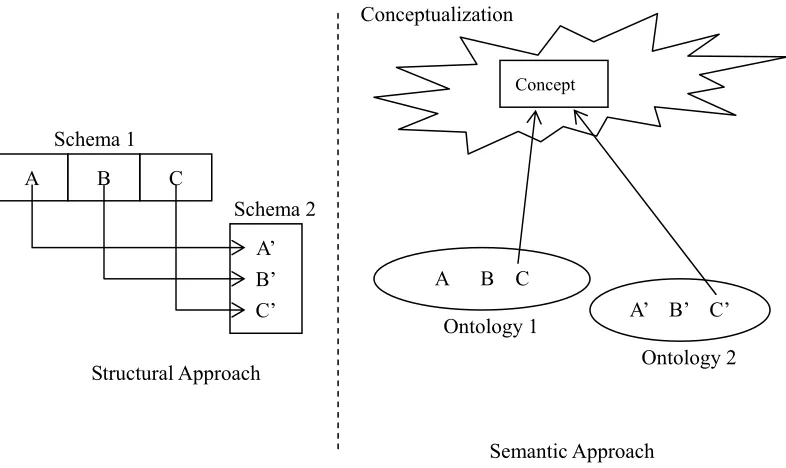
Figure 2-4. Difference of two types of approaches in terms of semantics. ... 23
Figure 2-5. Conceptualization, ontology, model and representation of ontology, semantics, and semantic integration based on Ontology. ... 29
Figure 2-6. Different architectures of employing ontologies [Wache, et al., 2001]. ... 33
Figure 2-7. Merging of ontologies. ... 39
Figure 2-8. Integration of ontologies. ... 40
Figure 2-9. A general framework for ontology alignment [Lambrix and Tan, 2006]. ... 47
Figure 3-1. From real world objects to representations. ... 65
Figure 3-2. From representation to real world objects. ... 66
Figure 3-3. A comprehensive fact. ... 68
Figure 3-4. A semantics interpretation chain. ... 71
Figure 3-5. A perspective on resolving heterogeneity to achieve interoperability [Hamill, et al., 1997]. ... 85
Figure 3-6. Structural mapping between XML document and relational table. ... 89
Figure 3-7. Pre-designed interface and information flow. ... 95
Figure 3-8. Interact with standard interfaces. ... 96
Figure 3-9. Establish interaction between anonymous components. ... 97
Figure 3-10. Infrastructure for semantic integration. ... 98
Figure 3-11. Difference between I and ℑ. ... 109
Figure 3-12. Difference between interpretation functions from I and ℑ. ... 111
Figure 3-13. Language, conceptualization, ontological commitment, and ontology [Guarino, 1998]. ... 115
Figure 3-14. Different ontological views with different languages which sets of intended models overlap. ... 117
Figure 3-15. An integration scenario. ... 118
Figure 3-16. Ontological equivalence mapping between different languages for the same conceptualization. ... 125
Figure 3-17. Semantic integration based on ontological views. ... 128
Figure 4-1. Architecture of the semantic integration enabled environment. ... 130
Figure 4-2. Architecture of semantic integration service. ... 131
Figure 4-3. An example of multiple concept trees for the same domain. ... 151
Figure 4-4. Deleting a node. ... 156
Figure 4-5. Inserting a node. ... 156
xi
Figure 4-7. An example of a moving operation. ... 157
Figure 5-1. Architecture of a collaborative promotion environment. ... 181
Figure 5-2. Screenshot of the management console. ... 182
Figure 5-3. A segment of an ontological view. ... 198
Figure 5-4. The frame-based representation of a concept. ... 202
Figure 5-5. Architecture of a collaborative intelligence system. ... 206
Chapter 1 Introduction
An information system is the entire combination of infrastructures, organizations,
personnel, and software components within a specific boundary for collecting,
processing, persisting, transferring, presenting, delivering, and exchanging information.
In the past several decades, a great number of information systems have been developed
and deployed. More systems are under design or development.
The information systems are usually deployed in an open environment. An open
environment is a computing environment where various platforms, technologies,
protocols, and standards coexist, and decentralized applications collaborate through
interoperability.
However, as many information systems are growing larger, more complex, and more
distributed, it becomes increasingly difficult for anyone to effectively organize and work
with the information and systems. As a case, semantics-based information integration in
various organizations has been hindered by differences in the software applications and
by the structural and semantic heterogeneity of the different information sources [De
Bruijn, et al., 2003]. In an open environment, the information systems, even within the
same domain, are often heterogeneous in terms of their (1) supporting infrastructures
(hardware platforms, operating systems, communication facilities, etc); (2) syntactic
representations of information; (3) schematic designs of information models, and (4)
semantics of information. This is a common problem in many areas such as enterprise
application integration where numerous ad-hoc programs have typically been created to
perform the integration process. These heterogeneities present major practical and
research challenges. This problem has made information retrieval and collaboration
among information systems extraordinarily difficult. For example, searching and finding
resources and information are becoming particularly challenging tasks. As such, there is
an emerging requirement to integrate these information sources and applications to
provide consistent services to global users.
There has already been a large body of solutions that address the first three challenges
[Sheth, 1998]. The fourth challenge, also known as the
semantic integration
problem
[Vetere and Lenzerini, 2005 and Noy, 2004], is an important topic of great interest to this
research and one that is increasingly attracting attention within research and industrial
communities.
from the Internet, using current search engines (with the search key word “
apple
”), you
may only be able to get a set of pages containing the word “
apple
” in their texts. You
must create a type list by yourself after reading the returned pages. Imagine that you get
millions of returned page links, and actually most of them have no relation to the fruit
“
apple
” but just contain that word. Whereas, the pages containing specific names of
apples like “
spitzenburg
” (it is also a kind of apple) will be omitted since there is no
semantic relationship between “
spitzenburg
” and “
apple
” specified in most of the web
pages. More seriously, pages written in another language like French and Chinese will be
ignored, which is not acceptable. However, things can become even worse. When we
conduct a real search case with Google
1, we cannot easily get those pages about fruit
“
apple
” — the most highly ranked pages (those we see in the first few screens) are about
the computer company “
Apple Inc.
”, not the fruit. As a matter of fact, the search engine
does not know what “
apple
” is. It just guesses that maybe the users are more interested in
these pages (about the company) based on the historical data it collected from previous
search cases.
Another example of the problem concerns the high number of online book-sellers today,
with each of them having their own database containing the information about the books
it sells. You can search through each seller’s website to find the information about the
books that you like. If you want to find the best price for one book from several sellers
you will need to search one by one and compare the results yourself. Currently, an
automatic cross-seller search is not feasible since each seller has a database that is
different from others in terms of both structure and content. For example, if the price in
seller
A
’s database is called “
Price
” but “
Cost
” in
B
’s database, a regular search engine
will never know that they are referring to the same thing without the support of a
semantic relationship between the two items. Therefore, the search engine can neither get
results correctly from various databases nor combine them into a unified result set
2.
The two scenarios reveal the importance of information semantics and semantic
integration, which are very crucial issues for large-scale information sharing, information
retrieval, and information integration in the Internet era. In recent years more and more
researchers are focusing on this field. However, there is still a long way to go.
As a category of solutions for the semantic integration problem, schema matching [Rahm
and Bernstein, 2001 and Wick, et al., 2008] aims at finding correspondences between
schema elements such as database tables and columns. Schema matching can be viewed
as the pairing of attributes (or groups of attributes) from the source schema and attributes
of the target schema such that the pairs are likely to be semantically related. Schema
matches can be discovered by analyzing the similarity of schema information,
preservation of constraints, domain knowledge, and instance data. The limitation of this
solution is in the lack of a concept model.
Ontology-driven semantic integration is another category of solutions for the semantic
integration problem [Hakimpour and Timpf, 2001]. Traditionally, it is based on available
ontologies. The
ontology integration
can be applied by discovering semantic
correspondences among a set of formal ontologies and (sometimes) creating a more
complete ontology [Wache, et al., 2001], given that multiple source ontologies are
available. However, in many scenarios, this is not the case. Instead, the “ontologies” are
implied in a different format, such as the underlying information representations.
The limitations of the two categories of solutions reveal a gap between the traditional
solutions and the actual open environments. New research is required to be conducted to
bridge such a gap.
This research is dedicated to understanding the nature of ontologies, semantics, and
semantic heterogeneities, to analyzing the research issues, and to building solid
theoretical foundations and engineering solutions to address the semantic integration
problem in open environments.
Chapter 2 Literature Review
2.1 Semantic Integration from A Cognitive Science
Perspective
2.1.1
Cognitive Science
As a kind of intelligent creature, humans are able to acquire knowledge, perceive and
memorize information, reason facts and rules based on obtained knowledge and
information, collaborate or compete with each other, analyze situations, make decisions
and create solutions for problems, and finally react to the world. Humans are said to be
behaving intelligently when they choose courses of action that are relevant to achieving
their goals, when they reply coherently and appropriately to questions that are put to
them, when they solve complex problems, or when they design or create something
useful and novel.
One of cognitive science’s focuses is how the intelligent behavior of a human being,
thinking, is conducted. In cognitive science, two approaches,
reasoning
and
searching
,
are most often considered as the pattern of thinking.
On the one hand there is an approach that starts with language and logic and that views
thinking as a process of inference or reasoning, usually using a language-like
representation. On the other hand, another approach views thinking (especially problem
solving and concept attainment) as a process of a heuristic search for problem solutions,
generally using representations of the world model [Posner, 1989]. The research on
semantics and logic, language acquisition, parsing, reading, and discourse mainly use the
language-and-reasoning approach, whereas the research on categories, induction and
problem solving largely employ the heuristic-search approach.
2.1.2
Architecture of Cognition
In cognitive science the notion of
architecture
is derived from computer science, where
the term stands for the hardware structure that produces a system that can be
programmed. The concept of architecture for cognitive science is the appropriate
generalization and abstraction of the concept of computer architecture applied to human
cognition: the fixed system of mechanisms that underlies and produces cognitive
behaviour.
The classical view about cognition assumes that both computers and human minds have
at least the following three distinct levels of organization [Posner, 1989]:
meaningful or rational ways.
(2)
The symbol level
. The semantic content of knowledge and goals is assumed to be
encoded by symbolic expressions. Such structured expressions have parts, each
of which also encodes some semantic content. The codes and their structures, as
well as the regularities by which they are manipulated, are another level of
organization of the system.
(3)
The physical (or biological) level
. For the entire system to run, it has to be
realized in some physical form. The structure and the principles by which the
physical object functions correspond to the physical or the biological level.
The three-level organization defines the classical computational or cognitive architecture.
Act* [Anderson, 1983] is the first theory of cognitive architecture with sufficient detail
and completeness. The following Figure 2-1 gives the basic architecture of Act*.
Declarative Memory
Production Memory
Working Memory Storage
Retrieval
Match
Execution Application
Encoding Performances
In this architecture there is a long-term declarative memory in the form of a semantic net
and a long-term procedural memory in the form of productions. Each production has a set
of conditions that test elements of a working memory and a set of actions that create new
structures in the working memory. The working memory is activation-based; it contains
the activated portion of the declarative memory plus declarative structures generated by
production firings and perception. Activation spreads automatically through working
memory and from there to other connected nodes in the declarative memory. New
productions are created by compiling the effects of a sequence of production firings and
retrievals from declarative memory.
2.1.3
From Cognitive Science to Semantic Integration
Generally, semantic integration is intended to discover semantic relationships, such as
equivalent to
,
is-a
, or
part-of
, between some subjects (mainly
concepts
) based on
obtained knowledge about the world. A semantic integration system must understand
integration requirements and be able to analyze the requirements, develop solutions, and
provide reasonable results to the requestor. This is a process very similar to human
thinking, which is a significant intelligent behaviour. The cognitive science perspective
provides some foundations and inspiration for analyzing, designing, and building a
semantic integration system.
According to the classical view of computing and cognition, certain kinds of systems,
including both minds and computers, operate on
representations
that take the form of
symbolic codes [Posner, 1989].
z
Ontology level
. For a domain of discourse, an ontology should be committed to by
all information systems to provide a conceptually consistent understanding for any
subject in the domain. It is conceptualization-dependent (i.e., different ontologies
for different domains’ conceptualizations) but technology-independent (not directly
manipulated by specific technical method).
z
Meta-data level
. Meta-data is an explicit specification for information in a specific
information system, following definitions about concepts and relationships
contained in an ontology to which the system is committed. The semantic
integration can be done at this level. That means that the duty of semantic
integration is to find semantic relationships between meta-data elements from
various information sources. This level is technology-dependent, i.e., specific
methods are required to handle different formalisms used to build the meta-data,
such as a database, data warehouse, structured documents, or arbitrary files.
z
Instance-data level
. In some cases specific instance data is required to be
compared and analyzed to discover semantic relationships. This level is
technology-dependent. For example, the instance data can be represented in a
literal, graphical, or analogical format. The semantic integration service must be
sensitive to any kind of these representations.
2.1.4
Process Model of Semantic Integration
common agreement on the intended meaning of the content exchanged in the
conversation.
The conversation must rely on some specific formalisms, such as speeches, written
documents, or graphs, which are in fact various representations of (the same)
conceptualizations and act as the medium of the conversation. On the other hand, during
a conversation, the same representation may be exchanged but the intelligent entities
need to identify that they are homonyms and are referring to different concepts.
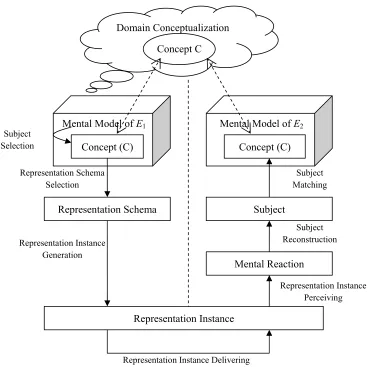
An elaborated analysis on the process of semantic integration between two intelligent
entities
E
1and
E
2is as follows:
(1)
Subject selection
:
E
1determines the subject to express, for example, a concept
C
in the conceptualization as a part of
E
1’s mental model).
(2)
Representation schema selection
:
E
1determines the schema of the representation
it prefers to use in this conversation, such as verbal speech.
(3)
Representation instance generation
:
E
1generates a representation instance for the
subject that is being exchanged following the construction rules of the chosen
representation schema, such as a specific word to say.
(4)
Representation instance delivering
:
E
1delivers the representation instance to
E
2,
e.g., by speaking that word.
(5)
Representation instance perceiving
:
E
2perceives the representation instance
delivered by
E
1, e.g., by hearing a voice or reading a document, to create some
kind of mental reaction in its memory.
(6)
Subject reconstruction
:
E
2converts the perceived representation instance into a
subject in its mental model. This is an initial understanding of the representation.
For example, if
E
2sees “Car” (which is actually some line shapes) on a piece of
paper, first it needs to convert this vision into the word “Car” which then can be
identified to be denoting a concept.
(7)
Subject matching
:
E
2tries to match its initial understanding to some existing
(8)
Match verifying
(optional): the process from (1) to (7) is repeated (this time
E
2is
the initiator) to verify that
E
2’s subject is equivalent to the one that
E
1wants to
deliver.
This process can be illustrated by the following Figure 2-2:
In this process, there is an important premise that the two intelligent entities share a
common concept in a specific domain that makes it possible for them to achieve a
successful semantic integration. Without the common concept, there is no possibility of
understanding each other unless they have another capability of learning (which will not
be touched on in this research), to create new concepts in their mental model.
Mental Model of E2
Domain Conceptualization
Concept C
Mental Model of E1 Subject
Selection Concept (C)
Representation Schema Selection
Representation Schema
Representation Instance Generation
Representation Instance
Representation Instance Delivering
Representation Instance Perceiving
Mental Reaction
Subject Reconstruction
Subject
Subject Matching
Concept (C)
In step (7), the mechanism that a semantic integration system adopts must combine two
ways in which human thinking is executed: searching and then inferring. As an example,
when a human perceives some representation, such as a picture, he may search in his
mental model to find something that can be exactly mapped to the content of the picture
(or highly similar to it). If the searching fails to find any candidate, he will start inferring
based on his knowledge. Say, since the content of the picture shows a mechanical object
with four wheels, it might be an automobile. The inference is guided by a series of IF …
THEN … rules that can lead to possible answers (usually reliable and reasonable,
depending on the richness of his knowledge). Neither searching nor inferring can do the
integration just by itself.
In step (8), if two sides of the conversation own similar knowledge backgrounds, the
semantic integration can be achieved very easily. If their backgrounds are not very
similar, or the representation generation and perceiving are not well done, e.g., not clearly
hearing the other one’s talk, then usually a process similar to the
Three-Way Handshake
in TCP/IP protocol needs to be applied. For example, after one person finishes talking
(the first way), another one needs to make sure his understanding is correct by asking “do
you mean
A
?” (the second way), and finally the first one answers “Yes, I do mean
A
” to
confirm that they have a common understanding (the third way), given that both of them
correctly delivered and perceived the representation
A
in the three rounds. If this is not
the case, the first one may have to answer that “No, actually I mean
B
” and restart the
process of verification.
primitives that is used to describe the requests and organize responses is also necessary to
support establishing a consistent understanding of each other.
In the above process, if
E
2cannot successfully finish the subject matching, e.g.,
E
2encounters a word that it never knows,
E
2can interrupt the process. For example,
E
2can
answer that “I don’t know what you are talking about”. Another alternative is a passive
learning process: if
E
2does not understand the previous representation (
r
1), it can ask
E
1to provide another representation,
r
2, and repeat the process. Assuming that
E
2can
understand
r
2, it can create a semantic relationship in its mental model, e.g., “
r
1equals to
r
2” or “
r
1is highly similar to
r
2”. The third alternative is positive learning:
E
2tries to find
a conceptualization that it guesses can match
r
1, and starts from (8) to verify its
correctness, e.g., by asking
E
1“do you mean
r
2?” where
r
2is the representation of the
matching subject.
2.2 A General Architecture for Semantic Integration
There are two basic approaches, one is the schema-based structural approach or mediated
schema approach, and the other one is the semantic approach or ontology-driven
approach. We will discuss them in the following two sections.
2.3 Schema-based Structural Approaches
In structural approaches, the integration is done by providing or generating a globally
unified schema that characterizes the underlying information sources. The global schema
can be a physically independent one, or a logically produced one (by establishing
matching correspondence among source schemas).
Wrapper
Mediator
Information Source1
Wrapper
Information Source2
Wrapper
Information Sourcen
…
Query Result
2.3.1
Schema Integration Fundamentals
Schema integration is one effective way to achieve data integration. Its target is to
develop a unified representation of information structured and stored differently in
separate databases. It mainly addresses the problem of syntactic and schematic
inconsistencies, e.g., differing structures.
As pointed out in [Mendling, et al., 2005], basically three approaches can be
distinguished in this context:
manual
,
semi-automatic
, and
automatic schema integration
.
A survey reported in [Batini, et al., 1986] uses the four steps of pre-integration,
comparison, conformation, and merging and restructuring to compare different
integration methodologies. Manual integration leverages the knowledge of a domain
expert.
Semi-automatic schema integration
relies on assertions to state semantic
relationships between the concepts of different schemas. These assertions represent
integration rules that are used by a so-called integrator to generate the global schema
[Spaccapietra, et al., 1992]. Although this approach is less time-consuming, it also
depends on a domain expert to state the assertions.
2.3.2
Schema Matching Fundamentals
Schema matching is a basic problem in traditional database-based application domains
such as data integration, E-business, data warehousing, and semantic query processing
[Rahm and Bernstein, 2001].
Match
is a fundamental operation in the manipulation of
data schemas, which takes two schemas
S
1and
S
2as input and produces a mapping
between elements of the two schemas that correspond semantically to each other [Li and
Clifton, 1994; Doan, et al., 2000; Mitra, et al., 1999].
[Rahm and Bernstein, 2001] proposes a comprehensive analysis on schema matching. In
its analysis, a
schema
is defined as
a set of elements
connected by some
structure
.
Representations are required for the schemas. Available and widely accepted
representations include the entity-relationship (ER) model, object-oriented (OO) model,
XML, or directed graphs. A
mapping
contains a set of
mapping elements
, each of which
indicates that certain elements of schema
S
1are mapped to certain elements in
S
2.
Furthermore, each mapping element can have a
mapping expression
which specifies how
the
S
1and
S
2elements are related. The mapping expression may be directional; for
example, a certain function from the
S
1elements is referenced by the mapping element to
the
S
2elements referenced by the mapping element, or it may be non-directional, that is, a
relation between a combination of elements of
S
1and
S
2. It may use simple relations over
scalars (e.g., =, <), functions (e.g., addition or concatenation), ER-style relationships
(e.g., is-a, part-of), set-oriented relationships (e.g., overlaps, contains), or any other terms
that are defined in the expression language being used. The
match
operation is defined to
be a function that takes two schemas
S
1and
S
2as input and returns a mapping between
those two schemas as output, called
match result
. Each mapping element of the match
result specifies that certain elements of schema
S
1logically correspond to certain
elements of
S
2, where the semantics of the correspondence is expressed by the mapping
2.3.3
Automatic Schema Matching
Schema matching can be performed manually. However, manually specifying schema
matches is tedious, time-consuming, error-prone, and therefore an expensive process
[Rahm and Bernstein, 2001], especially when the number of information sources is
growing rapidly and the systems are becoming larger and more complex. Therefore,
automated support for schema matching is required to provide faster and less
labor-intensive integration approaches.
There have been implementations of multiple match algorithms or
matchers
based on
different methods. The matchers may consider only schema information, instance data
(i.e., data contents), or use hybrid methods.
A. Schema-level approaches
Schema-level matchers only consider schema information, not instance data. The
available information includes the usual properties of schema elements [Giunchiglia and
Yatskvich, 2004], such as name, description, data type, relationship types (part-of, is-a,
etc), constraints, and schema structure (e.g., [Doan, et al., 2001 and Mitra, et al., 1999]).
A general implementation compares each
S
1element with each
S
2element and
determines a similarity metric in the range (0, 1) for each pair. Only the combinations
with a similarity value above a certain threshold are considered as match candidates. The
similarity metrics can be used to identify the best match candidates [Castano, et al., 2001
and Doan, et al., 2000]. On the other hand, structural-level matching can discover
matching combinations of elements that appear together in a structure.
Bernstein, 2001]. Name matching takes schema elements with equal or similar names
into consideration. The similarity of names can be defined and measured in various ways,
including:
•
Equality of names (the exact same names). An important sub-case is the
equality of names from the same XML namespace which ensures that the same
names indeed bear the same semantics.
•
Equality of canonical name representations after stemming and other
preprocessing. This is useful to deal with special prefix/suffix symbols (e.g.,
CName
Æ
customer name and EmpNO
Æ
employee number).
•
Equality of synonyms. For example,
car
can be matched to
automobile
. General
natural language dictionaries and domain-specific dictionaries are useful to deal
with synonyms.
•
Equality of hypernyms (name of a class’s super-class). E.g.,
book
is-a
publication
and
article
is-a
publication
imply that
book
can be matched to
article
.
•
Similarity of names based on common substrings; edit distance, pronunciation,
soundex (an encoding of names based on how they sound rather than how they
are spelled), etc. [Bell and Sethi, 2001]. For example,
representedBy
can be
matched to
representative
,
ShipTo
can be matched to
Ship2
, and
Business-to-Business
can be matched to
B2B
.
•
User provided name matches, such as
reportsTo
=
manager
and
issue
=
but
.
course. By providing context information such as the domain of discourse, the ambiguity
can be distinguished or reduced.
Description matching uses comments and description (usually written in natural language
to express the intended semantics of schema structures and elements) provided along with
the schemas that can also be evaluated linguistically to determine the similarity between
the schema elements. Simple approaches, such as extracting key words from the
description and sophisticated technologies, such as natural language understanding, can
be applied to look for semantically equivalent elements. For example, the iMAP system
pays attention to the description of elements, in addition to other schema information
[Dhamankar, et al., 2004].
Another category of the schema matching method adopts constraint information
contained in schemas to determine the similarity of schema elements [Larson, et al.,
1989]. The constraints include data types, value ranges, uniqueness, optionality,
relationship types, cardinalities, repeatability, reference, etc. For example, similarity can
be based on the equivalence of data types and domains, of key characteristics (e.g.,
unique, primary, foreign), or of relationship cardinality (e.g., 1:1 relationships), or of
is-a
relationships.
Rule-based matching techniques constitute another collection of schema matching
solutions [Madhavan, et al., 2001 and Melni, et al., 2002]. Rule-based techniques
discover similar schema elements by exploiting schema-level information using
hand-crafted rules. For example, two elements match if they have the same name and the
same number of sub-elements. The rules can exploit all possible information, including
element name, data types, structures, number of sub-elements, and integrity constraints.
Instance-level data can give important insight into the contents and meaning of schema
elements [Rahm and Bernstein, 2001]. When the useful schema information is limited or
the schemas are ambiguous, as is often the case for many structured or semi-structured
information sources, the analysis on data instances will become very helpful. Even when
substantial schema information is available, the use of instance-level matching can also
be valuable to uncover incorrect interpretations of schema information. For example, it
can help disambiguate between equally plausible schema-level matches by choosing to
match the elements whose instances are more similar.
Many approaches in schema-level matching can be applied to instance-level matching.
For text elements a
linguistic characterization
, based on information retrieval techniques,
is the preferred approach. This approach evaluates the similarity of two schema elements
by comparing the relative frequencies of words and combination of words in their data
instances. For numerical data type,
statistical characterization
, such as numerical value
ranges, averages, or value patterns, can provide insight into the similarity of the
corresponding schema elements.
Various approaches have been proposed to perform instance-level matching, such as
rules, neural networks, and machine learning techniques [Berlin and Motro, 2001; Doan,
et al., 2000; Li and Clifton, 1994; Li, et al., 2000]. Learning-based approaches can exploit
data instance-level information. For example, Doan et al. proposed the LSD system,
which employs the Naive Bayes learning method over data instances [Doan, et al., 2001].
The Naive Bayes method can easily construct some probabilistic rules based on the
analysis of data instances that find similarity between schema elements which names do
not reveal enough similarity clues. Note that the learning-based approaches are classified
as instance-level approaches, but in fact they can also utilize schema-level information.
Since each matching approach has a specific applicability for a given match task, a
matcher that uses just one single approach is unlikely to achieve as many good match
candidates as one that combines several approaches [Rahm and Bernstein, 2001].
Therefore, some hybrid approaches are proposed, including two folders: a
hybrid matcher
that integrates multiple matching approaches based on multiple criteria or information
sources (e.g., by using name matching with namespaces and thesauri combined with data
type compatibility), and
composite matchers
that combine the results of independently
executed matchers, including hybrid matchers.
One important issue of note is to the impossibility of determining, fully automatically, all
matches between two schemas, primarily because most schemas have some semantics
that affect the matching criteria but that are not formally expressed or often even not
documented [Rahm and Bernstein, 2001]. Therefore, the result of the match operation is
only a set of
match candidates
, which can be accepted, rejected, or modified by the user.
Furthermore, the user should be able to specify matches for elements which are
meaningful that the system fails to discover.
2.4 Ontology-driven Semantic Approaches
Since it is difficult to integrate the structural aspects of information sources from the
semantic perspective due to inherent embedded semantics within local schemas and
implicit assumptions, recently ontologies have been introduced to the area of semantic
integration as a possible solution to obtain semantic interoperability [Wache, et al., 2001].
In ontology-driven (or ontology-based) approaches, integration is obtained by sharing a
common ontology among various information sources, or generating a global ontology
that covers the underlying local ontologies of each source. Applying the general
integration architecture in this context, the mediator’s job is to integrate ontologies; the
wrappers’ job is to translate from the global ontology to local ontologies (if applicable)
and then from local ontology to local schema in terms of its conceptual model before the
data sources can deal with queries.
A B C
A’ B’ C’ Schema 1
Schema 2
Structural Approach
Ontology 1
Ontology 2 Conceptualization
Semantic Approach A B C
A’ B’ C’
Concept
2.4.1
Concept of Ontology: An Informal View
Ontologies have been recognized as a fundamental infrastructure for advanced
approaches to knowledge management [Arroyo, 2007]. Ontologies are useful for many
different applications that can be classified into several areas [Jasper and Ushold, 1999].
The common idea for all of these applications is to use ontologies in order to reach a
common understanding of a particular domain [Stuckenschmidt and van Harmelen,
2005], which may be reused and shared across applications and groups [Chandrasekaran,
et al., 1999]. The use of ontologies also helps to reach a common understanding of the
meaning of terms. In contrast to syntactic standards, the understanding is not restricted to
a common representation or a common structure. Therefore, ontologies are a promising
candidate that can support semantic interoperability and information retrieval, especially
in the Semantic Web [Berners-Lee, et al., 2001].
Many definitions about “ontology” have been proposed. A basic definition about
ontology is “the specification of conceptualizations, used to help programs and humans
share knowledge” [Gruber, 1993]. An ontology can also be understood as a model that
defines the concepts, properties, and relations of a domain of discourse [Crubzy, et al.,
2003].
Ontologies facilitate interoperability between heterogeneous systems involved in a
domain of common interest. It is known that any information system uses its own
ontology, either implicitly or explicitly [Li, et al., 2005]. As described in [Tan, et al.,
2006], ontologies are used for communication between people and organizations by
providing a common terminology over a domain. They provide the basis for
interoperability between systems. They can be used for making the content in information
sources explicit and serve as an index to a repository of information.
Tom Gruber, an AI specialist at Stanford University, proposes a richer definition: “An
ontology is a formal, explicit specification of a shared conceptualization” [Gruber, 1995].
Here,
z
“explicit” means that “the type of concepts used and the constraints on their use
are explicitly defined”;
z
“formal” refers to the fact that “it should be machine readable”;
z
“shared” refers to the fact that “the knowledge represented in an ontology is
agreed upon and accepted by a group”;
z
“conceptualization” refers to an abstract model that consists of the relevant
concepts and relationships that exist in a certain situation. In another sense, a
conceptualization is an abstract, simplified view of the world that we wish to
model for some purpose.
The basis of ontology is
Conceptualization
.
Conceptualization
consists of:
z
the identified concepts (objects, events, beliefs, etc). e.g. concepts
Professor
and
Course
in education domain;
relationship “
Professor
teach
Course
”.
In the information management and knowledge sharing areas, ontology can be defined as
follows [Fisseha, 2003]:
(i) An ontology is a vocabulary of concepts and relations rich enough to enable us to
express knowledge and intention without semantic ambiguity.
(ii) An ontology describes domain knowledge and provides an agreed-upon
understanding of a domain.
(iii) Ontologies are collections of statements written in a language such as RDF
3that
define the relations between concepts and specify logical rules for reasoning about them.
An ontology can contain not only concepts and relations, but also logical elements that
can support reasoning and inferring. A
formal ontology
consists of logical axioms that
convey the meaning of terms for a particular community [Bishr, et al., 1999]. A set of
logical axioms defining one term is called
intensional definition
and there is only one
intensional definition per term for each community [Hakimpour and Geppert, 2002].
Intensional definitions are estimating
intensional relation
(defined in [Guarino, 1998]).
For instance, “
Faculty
” is an intensional relation and its estimation by an intensional
definition is:
ι
[Faculty(x)] = Employee(x)
∧
(
∃
y: Course(y)
∧
teaches(x, y)).
Formal ontologies are considered more than schema definitions in databases. Schemas
are mainly concerned with organizing data in databases, but formal ontologies are
concerned with the understanding of the members of a community and help to reduce
ambiguity in communications.
The reason that ontologies are becoming so important is that currently we lack standards
(shared knowledge) which are rich in semantics and represented in a machine
understandable form. Ontologies have been proposed to solve the problems that arise
from using different terminology to refer to the same concept or using the same term to
refer to different concepts. With the aid of ontologies, semantic queries can exploit
conceptual knowledge that is independent of local schemas. By contrast, non-semantic
approaches result in queries defined in terms of local structural organization of data, e.g.
XQuery
4and SQL
5. In this case, the heterogeneity of information sources means that
different queries must be written to match multiple schemas.
The ability to exchange information at run time, also known as interoperability, is an
important topic. Ontologies are often used as interlinguas for providing interoperability
[Uschold and Gruninger, 1996]: they serve as a common format for data interchange.
Each system that wants to interoperate with other systems has to transfer its information
into this common framework.
Ontologies are expressed in languages that are machine process-able and can be used for
reasoning [Noy, 2003]. The expressed artifact is also called an “ontology model”, given
that the ontology itself is abstract. In ontology-based approaches, the description of
information semantics (local ontologies or conceptual models of information sources)
may be represented in ER
6, UML
7, RDF, or other logic models. Many ontology
languages have been proposed. Some are based on description logics (DL) [Badder and
Sattler, 2001], such as OWL and LOOM [Arens, et al., 1996], and some are frame-based
[Brachman and Levesque, 1984], such as F-logic [Kifer, et al., 1995].
4 http://www.w3.org/TR/xquery/ 5 http://en.wikipedia.org/wiki/SQL
In the definitions presented above the term “semantics” is frequently involved. Basically
semantics refers to the intended meaning of something, usually a symbol. In an ontology
related community, the term “semantics” has another explanation but is still similar to
“intended meaning”: semantics refers to the relationship between words (data) and the
world – the things the words (data) describe [Partridge, 2002]. [Partridge, 2002] defines
that ontology is about the existence of a set of objects; it also differentiates the fact that
an
ontology model
is a model that directly reflects the ontology.
Jeep isa Auto Van isa Auto
When we see this image, we consider it is a “car” because we have a conceptualization of “car” in our mind. Note that it is not really a car—it is just an image. But let’s assume that it is the real “car”. The actual intended meaning of a concept is domain-dependent. For example, sometimes we mention “car” as a specific individual car, and in other cases we may mention it as a category of individual cars. Here, let us assume that it refers to a category of individual cars. As far as the exceptional cases such as someone considering it as a “plane”, they exceed the scope of our discussion and will not be touched.
Conceptualization in one person’s mind. Conceptualization is abstract (abstraction of external world in individual mind). We can only understand it but we cannot “see” it. Here, let’s assume this graph and this word represent a conceptualization of “car”.
Car
1:1
1:1 One real-world object
corresponds to one unique conceptualization (in specific domain).
One conceptualization is specified by one unique ontology.
The domain from which the conceptualization derives. That means, the same real world object will lead to different conceptualizations in different domains. Generally speaking, when we are talking about conceptualization, we imply that we are in a specific domain, or a context of the problem we are interested in.
Ontology
To communicate with other people, we need something to specify that common “conceptualization”. It is “ontology”. An ontology is a specification of a conceptualization. It is an abstraction among a group of minds.
Automobile
Car Truck
A representation is required to represent the specification explicitly. It is an ontology model. An ontology model is defined by a kind of formal language to explicitly describe an ontology. Note that when we are talking about “ontology” in practice, it usually refers to an ontology model developed by applying that language.
An object in an ontology denotes something really existing in the world. It may be a physical object or an abstract idea.
The semantics relates an object in the conceptualization (represented as an element in an ontology model) to a unique object in the real world. The cardinality of the relationship between the real world object and ontology object is 1:1.
1:M
If we have another ontology model (in another form of representation), the semantic integration is to discover that the object “Jeep” is also related to the same real world object, thus it is the same as “Car” in the other ontology model. One ontology can be
represented by multiple ontology models.
1:1
1:1
2.4.2
Ontology-driven Semantic Integration
Regular information retrieval techniques have several shortcomings. First, they rely
on the input vocabulary of the user, which might not be completely consistent with
the vocabulary used in the information systems. Second, a specific encoding may
significantly reduce the recall of a query since related information with a different
encoding is not matched. Finally, full-text analysis may reduce precision because the
meanings of the words in the texts might be ambiguous.
Traditional integration solutions may result in some significant drawbacks [Hu, et al.,
2007]: (1) it is challenging to check the consistency and discover conflicts among
domain terminologies; (2) using some traditional ways such as schema matching, the
equivalence mappings can be realized but the inheritance mechanism of concepts
cannot be implemented; (3) implicit knowledge cannot be discovered without
reasoning. Therefore, ontology is often viewed as a key component to realize
semantic integration.
The use of ontologies as semantic translators is a viable approach to overcome the
problem of semantic heterogeneity [Hakimpour and Timpf, 2001]. Ontologies provide
machine-readable semantics of information sources that can be communicated
between applications and humans. Using an ontology to explicate the vocabulary can
help overcome some of these problems. When used for the description of available
information as well as for query formulation, an ontology serves as a common basis
for matching queries against potential results on the semantic level. The use of
informal ontologies like WordNet [Fellbaum, 1998] increases the recall of a query by
including synonyms in the search process. The use of more formal representations
like conceptual graphs [Sowa, 1999] further enhances the retrieval process, because a
formal representation can be used to increase recall by reasoning about inheritance
Guarino [Guarino, et al., 1999], ontologies help to decouple the description and query
vocabularies and increase precision as well as recall.
In ontology-driven approaches, integration is obtained by sharing common ontologies
among the information sources. Mappings are created between the ontologies and
local information models. According to the mapping direction, approaches are
classified into two categories [Levy, 1999; Levy, 2000; Li and Chang, 2000]:
global-as-view [Chawathe, et al., 1994] and local-as-view [Genesereth, et al., 1997].
In global-as-view approaches, each item in a global ontology is defined as a view
(query) over source schemas/ontologies. It is adopted in most data integration
systems. In local-as-view approaches, each item in each source schema/ontology is
defined as a view (query) over the global ontology. Many recent research works on
data integration follow this approach. The major challenge of this approach is that in
order to answer a query expressed over the global schema, one must be able to
reformulate the query in terms of queries to the sources. While in the global-as-view
approach such a reformulation is guided by the definitions in the mapping; here the
problem requires a reasoning step in order to infer how to use the sources for
answering the query.
The local-as-view approach better supports a dynamic environment where
information sources can be added to the integration system without the need of
restructuring the global ontology (given that the new systems are still committed to
the global ontology). Hence, the major work on information integration is to develop
algorithms for answering queries using these views.
While many systems and approaches use ontologies as an explicit description of the
information semantics (i.e., to describe the meaning of information), the role and use
of ontologies differs between the approaches. According to the role and use of
ontologies, three different categories of approaches can be identified: single-ontology
Stuckenschmidt and van Harmelen, 2005; Wache, et al., 2001]. With respect to the
role and use of ontology, more than 20 approaches have been developed to support
intelligent information integration based on information semantics, including SIMS
[Arens, et al., 1993], TSIMMIS [Garcia-Molina, et al., 1995], OBSERVER [Mena, et
al., 2000], CARNOT [Collet, et al., 1991], Infosleuth [Nodine, et al., 1999], KRAFT
[Preece, et al., 1999], PICSEL [Levy, et al., 1996], DWQ [Calvanese, et al., 1998(2)],
Ontobroker [Fensel, et al., 1998], SHOE [Heflin, et al., 1999], MECOTA [Wache, et
al., 1999], BUSTER [Visser, 2004], COIN [Goh, 1997]. Some approaches provide a
general framework where all three categories can be implemented [Calvanese, et al.,
1998(2)].
A. Single-ontology (Global Ontology) Approaches
Single-ontology approaches use one global ontology that provides a shared
vocabulary for the specification of the semantics. All information resources are
related to the one global ontology. An independent model of each information source
must be described for this system by relating the objects of each source to the global
Information Source Information Source Information Source Global Ontology
(a) Global ontology
Information Source Information Source Information Source Local Ontology
(b) Local ontologies Local Ontology Local Ontology Information Source Information Source Information Source Local Ontology
(c) Hybrid approach Local Ontology
Local Ontology Shared Vocabulary
![Figure 2-1. Architecture of Act* [Anderson, 1983].](https://thumb-us.123doks.com/thumbv2/123dok_us/7762648.1274940/21.612.136.496.414.667/figure-architecture-of-act-anderson.webp)

![Figure 2-6. Different architectures of employing ontologies [Wache, et al., 2001].](https://thumb-us.123doks.com/thumbv2/123dok_us/7762648.1274940/46.612.169.469.67.547/figure-different-architectures-employing-ontologies-wache-et-al.webp)
![Figure 2-9. A general framework for ontology alignment [Lambrix and Tan, 2006].](https://thumb-us.123doks.com/thumbv2/123dok_us/7762648.1274940/60.612.177.484.229.478/figure-general-framework-ontology-alignment-lambrix-tan.webp)