446 | P a g e
AN INTELLIGENT CONTROLLER DESIGNING FOR
pH NEUTRALIZATION PROCESS
Chandra Shekhar
1,
*Mr.S.K.Sharma
21,2
Chemical Engineering Department, DCRUST, Murthal, (India)
ABSTRACT
The control of pH is very important in the chemical industry, poses a more difficult problem because of inherent nonlinearities and frequently changing process dynamics. pH maintain in the effluent water is important factor for discharging effluent water in environment. In this paper SISO stable system with dead time is considered for pH neutralization. Continuous stirred mixing tank system used to neutralize pH of effluent water. Steady of the process consider in two cases as Regulatory and Servo problem. An intelligent controller which is fuzzy controller design for PI/PID by two different interface mechanism, Conventional P/PI/PID controllers are also designed using different tuning methods in both consider cases. The performance analysis (Time domain specification, Time integral performance) of both fuzzy and conventional controllers is done in both cases. Comparison of these controllers on the basis of analysis and controller performance gives best controller for process.
Keywords:
FPI, FPID, P controller, pH, PI controller, PID controller, Tuning.
I. INTRODUCTION
The most important characteristics of waste water is the pH value, proper control of pH value is necessary for
discharging waste water in environment. This waste water has to be neutralized before discharge or reuse
.
Itprovides the optimum condition of environment for microorganism activity between pH 6.5 and 7.5 and the
right water discharge to the public sewage as mandated by the Department of Environment of between pH 5 and
9 (Environmental Quality Act, 1974). Wastewater of pH below 4.5 and above 9 may greatly reduce the activity
of the microorganisms which treat the water and may not support their life at all.
In this paper Hydrogen chloric Acid (HCL = 3.01) used in wastewater treatment facilities to control alkalinity.
Sodium Hydro Oxide (NaOH = 10.98) base used to maintain pH of system in base region. A proper and simple
mathematical modeling for pH neutralization in Continuous Stirred Tank Reactors was done by McAvoy in
1972 in developing a pH neutralization process. In pH neutralization process two cases are considered Servo and
Regulatory problems. There after a tidy mathematical modeling of pH neutralization tank system [1] [8]. We
find a first order stable system transfer function. The transfer function model of the system obtained from the
open-loop response.
Here, Fuzzy controller and conventional controller both are designed. Comparison of both controllers
performance by different tuning methods, Mamdani [14] [15], Takagi-Sugano [14] [15] in Fuzzy controller and
Ziegler-Nicolson [5], Cohen-Coan [4], and Marlin [6] [9], Smith et al. [6] [9], Branica et al. [6] [9] on the basis
447 | P a g e
MATLAB 7.8 (2009). For finding the best controller which gives better robustness and higher stability for the
process system.
II.
CONVENTIONAL CONTROLLERS
[7]
P controller is designated by,
P
G(s)=K
PI controller is designated by,
P I
1
G(s)=K (1+ )
τ s
PID controller is designated by,
P D
I
1
G(s)=K (1+ +τ s)
τ s
Where, K =Proportional Gain, P τ =Integral Time Constant, I τ =Derivative Time Constant D
For the best performance of the system, there is need of adjusting these three parameters called controller
tuning.
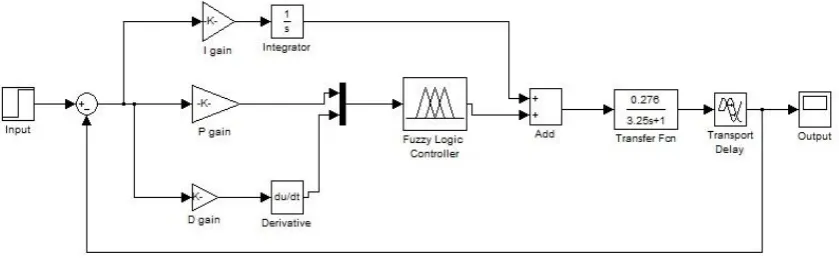
Fig.1 Fuzzy PID Diagram
III. SIMULATIONS
All simulations in this paper were performed using MATLAB 7.8 (control system design and simulation
software). There example consider for pH neutralization system for studying the different controllers
performance in both considered cases. Step input of 7 for regulatory response and step input of 5 for servo
response are given for process.
Example,
The Following process considered (S.S.Ram-B.Meenakhshipriya, 2016) [6] [9],
-0.5005s
0.276e G(s)=
3.2s+1 (Simulation run time t = 0-100 sec given for the process)
On comparing with standard FOPDT system get,
P
K
=
0.276,τ
=
3.2,
θ
=
0.5005Table given below show the Controllers parameters value of different controllers calculated by different
448 | P a g e
Conventional Controllers,
For P controller,
S.No. Method K C
1. Ziegler – Nicolson 20.5
2. Cohen-Coan 24.37
Table 1 (P Controller Parameter)
For PI controller,
S.No. Method K C τ I
1. Ziegler – Nicolson 18.636 1.667
2. Cohen-Coan 21.15 1.2574
Table 2 (PI Controller Parameters)
For PID controller,
S.No. Method K C τ I τ D
1. Ziegler – Nicolson 24.1176 1 0.25
2. Cohen-Coan 34.1018 1.1567 0.17697
3. Marlin 2.355 1.38 1.1786
4. Smith et al. 2.316 1.3831 1.707
5. Branica et al. 2.66 1.8621 2.912
Table 3 (PID Controller Parameters)
Fuzzy Controllers,
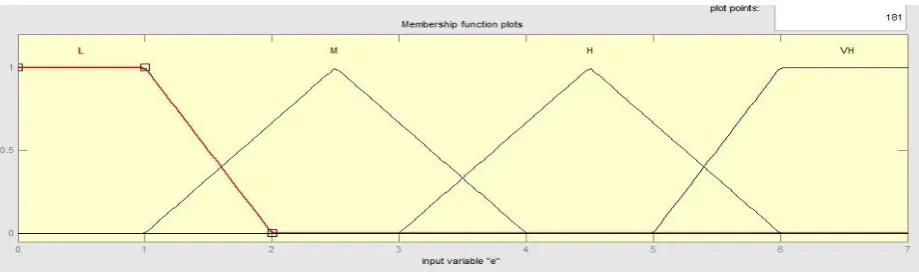
Fuzzy input and output membership function for both PI and PID controllers,
Fig. 2 I/P and O/P membership Function
For Fuzzy PI Controller,
For designing FPI controller value of proportional gain and integral gain are calculated for all methods by
iterative Analysis. we can make 6*6 rules but here only 30 rules are used given above in table 4 and Min AND.
449 | P a g e
CK = 21.15
τ
I=0.4Fuzzy Rules,
error VL L PM M H VH
Ou
tp
u
t
L VL VL VL VL VL
PM PM L L L L
M M M PM PM PM
H H H H M M
VH VH H VH VH H
Table 4 (FPI Controller Rules)
In membership function two trapezoidal and four triangle membership relations are used. Here VL – Very Low,
L –Low, PM – Positive Medium, M – Medium, H – High, VH – Very High code used on scale range.
For Fuzzy PID Controller,
For designing FPI controller value of proportional gain and integral gain are calculated for all methods by
iterative Analysis. We make 4*4 rules are used for process given below in table 5 and Prod AND, Probor OR
operation are used with Wtaver Defuzzification rule.
C
K = 5.5
τ
I= 0.4τ
D= 10Fuzzy Rules,
e\de L M H VH
L L L M H
M L M H H
H L H H VH
VH L H VH VH
Table 5 (FPID Controller Rules)
In membership function two trapezoidal and two triangle membership relations are used. Here, L – Low, M –
Medium, H – High, VH – Very High code used on scale range.
IV. ANALYSES
Conventional Controllers,
For P Controller,
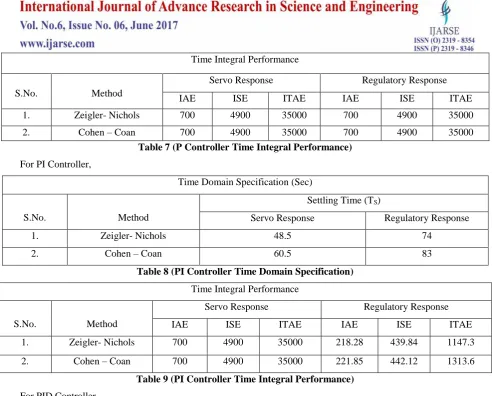
Time Domain Specification (Sec)
S.No. Method
Settling Time (TS)
Servo Response Regulatory Response
1. Zeigler – Nichols 6.4 10
2. Cohen – Coan 7.2 15.2
450 | P a g e
Time Integral Performance
S.No. Method
Servo Response Regulatory Response
IAE ISE ITAE IAE ISE ITAE
1. Zeigler- Nichols 700 4900 35000 700 4900 35000
2. Cohen – Coan 700 4900 35000 700 4900 35000
Table 7 (P Controller Time Integral Performance)
For PI Controller,
Time Domain Specification (Sec)
S.No. Method
Settling Time (TS)
Servo Response Regulatory Response
1. Zeigler- Nichols 48.5 74
2. Cohen – Coan 60.5 83
Table 8 (PI Controller Time Domain Specification)
Time Integral Performance
S.No. Method
Servo Response Regulatory Response
IAE ISE ITAE IAE ISE ITAE
1. Zeigler- Nichols 700 4900 35000 218.28 439.84 1147.3
2. Cohen – Coan 700 4900 35000 221.85 442.12 1313.6
Table 9 (PI Controller Time Integral Performance)
For PID Controller,
Time Domain Specification (Sec)
S.No. Method Settling Time (TS)
Servo Response Regulatory Response
1. Zeigler- Nichols 35 84.75
2. Cohen – Coan 39 83.75
3. Marlin et al. 37 77.74
4. Smith et al. 41 68.25
5. Branica et al. 32 64.25
Table 10 (PID Controller Time Domain Specification)
Time Integral Performance
S.No. Method Servo Response Regulatory Response
IAE ISE ITAE IAE ISE ITAE
1. Zeigler- Nichols 700 4900 35000 127.41 501.4 1539.1
2. Cohen – Coan 700 4900 35000 135.79 483.36 1574.6
3. Marlin et al. 700 4900 35000 127.18 407.5 1117.7
4. Smith et al. 700 4900 35000 126.8 410.2 1106.8
5. Branica et al. 700 4900 35000 126.16 345.24 1090.57
451 | P a g e
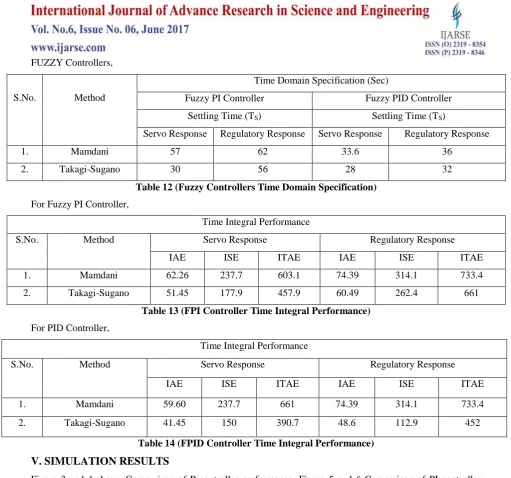
FUZZY Controllers,
S.No. Method
Time Domain Specification (Sec)
Fuzzy PI Controller Fuzzy PID Controller
Settling Time (TS) Settling Time (TS)
Servo Response Regulatory Response Servo Response Regulatory Response
1. Mamdani 57 62 33.6 36
2. Takagi-Sugano 30 56 28 32
Table 12 (Fuzzy Controllers Time Domain Specification)
For Fuzzy PI Controller,
Time Integral Performance
S.No. Method Servo Response Regulatory Response
IAE ISE ITAE IAE ISE ITAE
1. Mamdani 62.26 237.7 603.1 74.39 314.1 733.4
2. Takagi-Sugano 51.45 177.9 457.9 60.49 262.4 661
Table 13 (FPI Controller Time Integral Performance)
For PID Controller,
Time Integral Performance
S.No. Method Servo Response Regulatory Response
IAE ISE ITAE IAE ISE ITAE
1. Mamdani 59.60 237.7 661 74.39 314.1 733.4
2. Takagi-Sugano 41.45 150 390.7 48.6 112.9 452
Table 14 (FPID Controller Time Integral Performance)
V. SIMULATION RESULTS
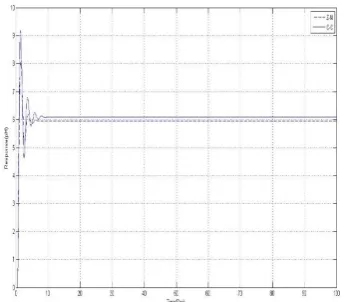
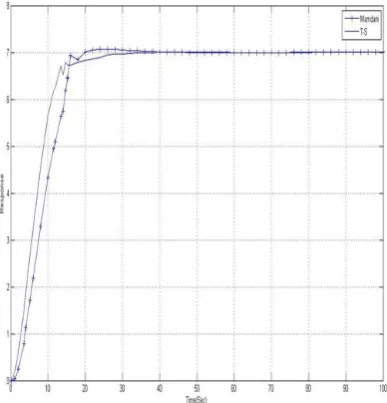
Figure 3 and 4 shows Comparison of P controller performance, Figure 5 and 6 Comparison of PI controller
performance, Figure 7 and 8 shows Comparison of PID controller performance, Figure 9 and 10 shows
Comparison of FPI controller performance, Figure 11 and 12 shows Comparison of FPID controller
performance in Regulatory and Servo response respectively by each considered method for pH neutralization
452 | P a g e
For P Controller,
Fig. 3 (Regulatory Response of P Controller) Fig. 4 (Servo Response of P Controller)
For PI Controller,
Fig. 5 (Regulatory Response of PI Controller) Fig. 6 (Servo Response of PI Controller)
For PID Controller,
453 | P a g e
For Fuzzy PI Controller,
Fig. 9 (Regulatory Response of FPI Controller) Fig. 10 (Servo Response of FPI Controller)
For FPID Controller,
Fig. 11 (Regulatory Response of FPID Controller) Fig. 12 (Servo Response of FPID Controller)
VI. RESULTS AND DISCUSSION
For controller designing, parameters are calculated by different controller designing methods in both
conventional and fuzzy controller, if any one parameters is changed controller response is also changed. Time
domain specification and time integral performance gives the result for best controller of the process. Controller
with minimum settling time are shows good response and time integral performance shows better stability for
454 | P a g e
VII. CONCLUSION
Here different controller are designed for same process and its performance and different analysis shows which
controller is best for this process. Two different controller, Conventional and Fuzzy both are designed in two
different cases Regulatory and Servo; controller in both case generally used for controlling the process. By
seeing the results of both controller above, it’s easy to decided suitable controller for process. Conventional
Controllers gives desired response but take too much time for stability of the process, in conventional controller
only two out of three controller which are Proportional-Integral and Proportional-Integral-Derivative controller
gives desired response with more oscillation. In Fuzzy controller two out of two controller which are Fuzzy
Proportional-Integral, Fuzzy Proportional-Integral-Derivative controller gives desired response without taking
more time and oscillation.
By the comparison of these controller we find that Fuzzy controller gives better response as compared to other
controller specially Fuzzy PID controller gives spontaneous response without oscillation in the controller
response. So Fuzzy PID controller is very suitable for this process.
REFERENCES
[1.] McAvoy TJ, Hsu E, Lowenthals S. Dynamics of pH in controlled stirred tank reactor. Industrial
Engineering Chemistry Process Design and Development. 1972; 11(1):68–70.
[2.] Shahian, B., & Hassul, M., Control system design using MATLAB. Englewood Cli!s, 1993, NJ: Prentice
Hall.
[3.] Tyreus, B. D.; Luyben, W. L. Tuning PI controllers for integrator/dead time processes. Ind. Eng. Chem.
Res. 1992, 2625−2628
[4.] Seborg, Edgar, Mellichap, Doyle, Process Dynamics and control; 2011; Edition 3rd page no. 223-225.
[5.] Donald R. Coughanour, Process System Analysis and Control; 1991; Edition 2nd page no. 54.
[6.] S.Sakthiya Ram, D. Dinesh Kumar and B.Meenakshipriya, Designing of PID controllers for pH
Neutralization process, Indian Journal of Science and Technology, 2016;vol. 9(12).
[7.] O’Dwyer A. Handbook of PI and PID Controller Tuning Rules. 2006; 2nd edition, World Scientific
Singapore.
[8.] Ibrehem AS. Mathematical model for neutralization system in Stirred tank Reactor. Bulletin of Chemical
Reaction Engineering Catalysis. 2011:6(11):47–52.
[9.] Sakthiya Ram S, Dinesh Kumar D, Meenakshipriya B. Designing of Controllers for pH Neutralization
Process. International Journal for Research in Applied Science and Engineering Technology. 2015;
3(12):164–9.
[10.]Thomas E. Marlin, Designing Processes and Control System for Dynamic Performance; 2015; Edition 2nd,
McGraw-Hill Inc.
[11.]Garcia C, De Godoy RJC., Modelling and simulation of pH neutralization plant including the process
instrumentation, Applications of MATLAB in Science and Engineering, 2011.485–10.
[12.]Kabila V, Glan Devadhas G., Comparative analysis of PID and fuzzy PID controller performance for
455 | P a g e
[13.]Jose T, Antony R, Isaac S., pH Neutralization in CSTR using model reference neural network and fuzzy
logic adaptive controlling schemes, International Journal of Advancements in Research and Technology,
2013, 2(1), 1–6.
[14.]D.Drinkov, M.Rainfronk, An introduction to Fuzzy Control, 1996, 2nd Edition, Springer.
[15.]Wojciceh Z. chmielowski, Fuzzy control in environmental engineering, 2016, 1st Edition, Springer.
[16.]W.W. Tan, F. Lu, A.P. Loh and K.C. Tan, Modeling and control of a pilot pH plant using genetic
algorithm, Engineering Applications of Artificial Intelligence, 2005, Vol.18, 485-494.
[17.]Ahmet Arslan Mehmet Kaya, Determination of fuzzy logic membership functions using genetic
algorithms, Fuzzy Sets and Systems, 2001, No.118, 297-306.
[18.]Alex D. Kalafatis, Liuping Wang and William R. Cluett, Identification of time-varying pH processes using
sinusoidal signals, Elsevier, Automatica, 2005, Vol.41, 685-691.
[19.]Braae, M., and Rutherfoed, D. A., Selection of Parameters for a Fuzzy Logic Controller, Fuzzy Sets and
Systems, 1979, 185-199.
[20.]Chan, H. C. and Yu, C. C., Auto tuning of gain-scheduled pH control: An experimental study, Ind. Eng.
Chem. Res., 1995, 34.
[21.]B.Jayadeva, Y.S.N.M. Rao, M.Chidambram, K.P. Madhavan, Nonlinear controller for a pH process”
Computers Chem. Engg. 1990, Vol. 14, 917-920,
[22.]S. Skogestad, A Procedure for SISO controllability analysis—with application to design of pH