Large electron screening effect in different
environments
Aleksandra Cvetinovi´c, Matej Lipoglavsek, Sabina Markelj and Jelena Vesi´c
Joˇzef Stefan Institute, Jamova cesta 39, Ljubljana, Slovenia
Abstract
Electron screening effect was studied on different hydrogen contain-ing targets with the7Li,11B and 19F ion beams. Results show large electron screening potentials strongly dependent on the proton number Z of the projectile. The largest ever measured screening potential with the value about a factor of 50 above the calculations from the model in adiabatic limit was observed in the graphite target containing hydrogen as an impurity.
1
Introduction
The tunneling probability at low energies can be approximated with the Gamow factorG=e−2πη [3] which describes the s-wave penetration through the Coulomb barrier of point like charges. Since G strongly depends on the projectile energy, in order to separate the strong energy dependence from effects of pure nuclear interaction, the cross section σ(E) is usually presented by introducing the astrophysical S-factor, which in the case of non-resonant reactions varies smoothly with energy [3],i.e.:
σ(E) = S(E) E e
−2πη. (1)
Here η = Z1Z2e2/4πε0¯h2E/μ represents the Sommerfeld parameter (Z1 and Z2 are the charge numbers of the interacting nuclei; E is the center of mass energy and μ is the reduced mass). When the reaction rate is very low, it is sensitive to electronic properties of the target material and the electrons surrounding the reacting nuclei can increase the tunneling probability through the Coulomb barrier, enhancing the cross sections compared to the cross section in the case of the bare nuclei. In order to take into account this effect, an enhancement factor defined as the ratio of screened and bare cross sections [4] is introduced:
f(E) = σ(E+Ue)
σ(E) , (2)
where Ue represents the electron screening potential. There are many ex-perimental results published by different groups [5-13] that are inconsistent with the theoretical models (i.e. model in adiabatic limit [4]). Also linear dependence of Ue on target Z number was suggested in ref. [10], while findings of our group show a dependence of Ue on target preparation [12, 13].
2
Experiment
amount of hydrogen was implanted using our Tectra IonEtch ion gun. The titanium hydride target was pressed from TiH2 powder into a 1 mm deep hole in a Cu backing which helped to cool the target after heating with the ion beam. The palladium target was first loaded and unloaded with hydrogen more than 10 times. The cycling was done by leaving the Pd foil in hydrogen gas at 1 bar for 24 hours and then heating in vacuum to 300◦ C. After that, the foil was radiation damaged with 45.3·1015 19F ions per cm2 at 7.8 MeV in order to create lattice defects to which hydrogen could be trapped [14] and then again left in hydrogen gas at 1 bar for another 2 hours. The tungsten target was treated in a similar way. The foil was produced by Plansee and it was mechanically polished and outgassed at 1200 K for stress relief. Electron microscopy showed large grains (5-20μm) [15]. The foil prepared in this way was pre-damaged with 20 MeV 186W ions up to radiation damage of 0.45 displacements per atom. Additionally, the foil was implanted with 5 keV protons from the ion gun with a beam intensity of 400 μA/cm2 for four hours in steps of half an hour. After each step we performed a reference measurement in order to check for hydrogen concentration. The maximum hydrogen concentration was achieved already after the first half hour. All targets were checked for hydrogen loss by repeatedly measuring yields at the same beam energy before and after each measurement at a given energy. It was found that only the graphite and Kapton targets lost some hydrogen during all measurements, while the W target lost some hydrogen only in the experiment with 19F ion beam. In order to correct for the hydrogen loss, the detected yields for a given beam energy were normalized to the average of the two control measurements. The α-particle yield from the 1H(7Li,α)4He reaction, according to the definition of the cross section σ(E) in the case of a thick target, was calculated as [16]:
Nα = 2NLinρNA
M
0
E0
εω σ(E)
dELi/dxdELi.
(3)
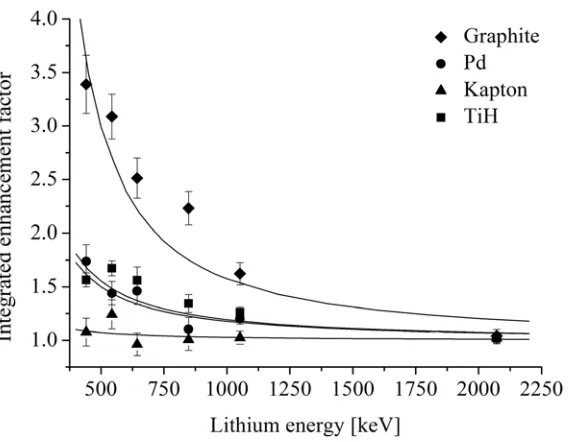
Figure 1: Integrated enhancement factors as a function of lithium beam energy for the1H(7Li,α)4He reaction in Kapton, Pd, graphite and TiH targets. The solid lines represent least-squares fits using eq. 3.
calculated from the approximation in adiabatic limit Uad are summarized in table 1. Fig. 1 shows obtained enhancement factors as a function of Li beam energy in Kapton, Pd, graphite and TiH targets.
The 1H(11B,αα)4He and 1H(19F,αγ)16O reactions were studied by mea-suring the narrow resonances at proton energies of 163 keV [19] and 340.46 keV [20], respectively. Since the beams lose all kinetic energy inside of the target region implanted with hydrogen, we observed step-like shaped resonances which are described by the infinitely thick target yield [3]:
YΔE→∞(E) = λ
2
2π ωγ εef fr
arctan
E−Er Γ/2
+π 2
. (4)
Here εef fr is the effective stopping power at the resonance energy Er, calculated by the SRIM [18] code. Measured α-particle and γ-ray yields we fitted to eq. 4, with Er, ωγ and Γ as free parameters. Since σ(E) is proportional toωγ,i.e.:
σ(E) =λ2 π
ωγ
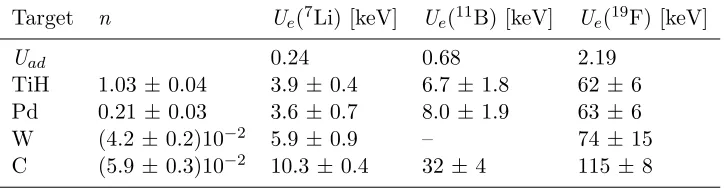
Table 1: The obtained electron screening potentials in reactions with lithium, boron and fluorine ion beam incident on implanted hydrogen in different targets together with bulk target hydrogen concentrations. The calculated values of the electron screening potentials in the adiabatic limitUad[2] are also given.
Target n Ue(7Li) [keV] Ue(11B) [keV] Ue(19F) [keV]
Uad 0.24 0.68 2.19
TiH 1.03±0.04 3.9± 0.4 6.7±1.8 62±6
Pd 0.21±0.03 3.6± 0.7 8.0±1.9 63 ±6
W (4.2± 0.2)10−2 5.9± 0.9 – 74± 15
C (5.9± 0.3)10−2 10.3 ±0.4 32 ±4 115±8
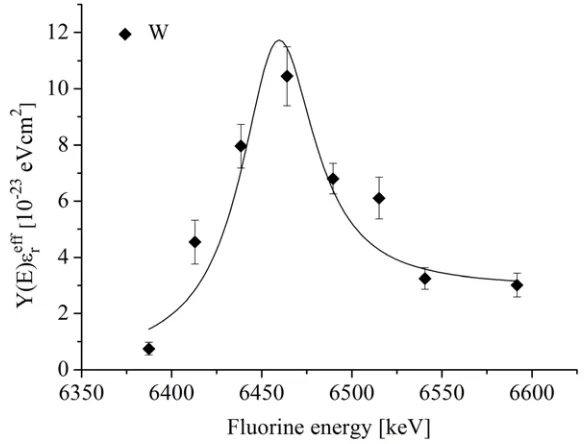
and assuming UeKapton = 0, the screening potential was calculated ac-cording to eq. 2 from the ratio (ωγ)metal/(ωγ)Kapton. The hydrogen concentrations we took from the experiment with the 7Li beam since the same targets were used with all three ion beams and since the experiments were performed immediately after each other. For the W target we observed a surface hydrogen peak in experiments with 19F (see fig. 2). Since this peak did not result from surface contamination, but from a larger number of hydrogen trapping sites at the surface [21], the W target was treated as a sum of a thin and a thick target. We assumed that the screening potential on the surface equals the one in the bulk and we found that the surface contains about 4 times higher hydrogen concentration than the bulk. The calculated values of the electron screening potential for the 1H(11B,αα)4He and 1H(19F,αγ)16O reactions are given in table 1.
Figure 2: The resonance observed from the1H(19F,αγ)16O reaction for W target fitted to a sum of a thin and an infinitely thick target yields. The γ-ray yield multiplied by the effective stopping power is shown as a function of beam energy.
we calculated that the dependence of the electron screening potential on the proton numberZ of the projectile seems to be higher thanZ2.
3
Summary
The electron screening effect on thick hydrogen containing graphite, titanium hydride, Pd, and W targets was investigated by studying the 1H(7Li,α)4He, 1H(11B,αα)4He and 1H(19F,αγ)16O reactions in inverse kinematics. Our measurements are the first ones that studied reactions with different charge numbers using physically the same targets. Contrary to expectations, large electron screening potentials were found in the graphite target: with7Li beam we observedUe(Li)= 10.3(4) keV, with11B beam Ue(B) = 32(4) keV and Ue(F) = 115(8) keV was deduced from the experiment with the19F beam. Large electron screening ofUe(Li)= 3.9(4) keV, Ue(B) = 6.7(18) keV and Ue(F) = 62(6) keV was found in titanium hydride. Similarly, high values of Ue were found also in the tungsten target,
i.e. Ue(Li)= 5.9(9) keV andUe(F)= 74(15) keV and in palladium: Ue(Li)
= 3.6(7) keV,Ue(B) = 8.0(19) keV and Ue(F) = 63(6) keV.
Also, these results clearly show that the dependence of the electron screening potential on the proton number Z of the projectile is not linear as it was previously supposed, but higher than Z2.
References
[1] D. Bemmerer et al., Eur. Phys. J. A 24, 313 (2005).
[2] D. Leitner et al., Proc. 2011 Particle Accelerator Conf., New York, USA, 2552 (2011).
[3] C. Iliadis, Nuclear Physics of Stars, Wiley-VCH, Weinheim (2007). [4] H. J. Assenbaum et al., Z. Phys. A 327, 461 (1987).
[5] L. Lamia et al., Astron. Astrophys. A188, 541 (2012). [6] A. Huke et al., Phys.Rev. C 78, 015803 (2008). [7] K. Czerski et al., J. Phys. G 35, 014012 (2008). [8] F. Raiola et al., Eur.Phys.J. A 19, 283 (2004).
[9] J. Kasagi, Prog. Theor. Phys. Suppl. 154, 365 (2004). [10] J. Cruz et al., J. Phys. G 35, 014004 (2008).
[11] F. Raiola et al., J. Phys. G 31, 1141 (2005).
[13] J. Vesic et al., Eur. Phys. J. A 50, 153 (2014).
[14] Y. Fukai, The Metal Hydrogen System, Springer, Berlin, Germany, (2005) Chapter 5.
[15] O. Ogorodnikova et al., J. Nucl. Mat. 451, 379 (2014).
[16] C. Rolfs and R. W. Kavanagh, Nucl. Phys. A 455, 179 (1986). [17] S. Engstler et al., Z. Phys. A 342, 471 (1992).
[18] J. F. Ziegler et al., The Stopping and Range of Ions in Matter, Lulu Press Co., Morrisville, NC, (2008), www.srim.org.
[19] Y.S. Chen et al., Nucl. Phys. A 106, 1 (1967). [20] K. Spyrou et al., Z. Phys. A 357, 283 (1997). [21] S. Markelj et al., Appl. Surf. Sci. 282, 478 (2013).