Available Online atwww.ijcsmc.com
International Journal of Computer Science and Mobile Computing
A Monthly Journal of Computer Science and Information Technology
ISSN 2320–088X
IMPACT FACTOR: 6.199
IJCSMC, Vol. 8, Issue. 5, May 2019, pg.259 – 267
ESP32 Based Data Logger
Ibrahim Al Abbas
Mechatronics Engineering Department, Faculty of Engineering Technology, Al Balqa Applied University, Jordan Email: [email protected]
Abstract— Data logger is an important realization of any measurement and instrumentation system. The developed data logger can be used in several measurement chains such as smart home applications and IIOT (Industrial Internet Of Things). The development of such data logger can be achieved by measuring several physical quantises such as temperature, humidity and position. The sensors readings are monitored by client software running in widely used Internet browsers. The main advantage of the design is the creation of a useful and important wireless based measurement system for any type of physical parameters monitoring. The ESP32 microcontroller system is used to record data from several sensors and the measurements are transmitted via Wi-Fi to client server.
Keywords— data logger, ESP32, sensory system, HTTP response
I. INTRODUCTION
The main purpose of single-chip microcontrollers is the implementation of digital control algorithms. The functioning of the microcontroller in the control system lies in the fact that it, receiving information from the control object about its condition, processes it in accordance with the algorithm stored in the program memory and issues control actions to the actuators. The interaction of the microcontroller with sensors and actuators is determined by the corresponding exchange protocols, considering the features of the functioning of the system and the requirements of software and hardware and circuit compatibility with other devices and systems.
The use of MC in equipment allows to increase productivity, quality, helps to solve complex problems of program regulation, significantly improves the technical and economic characteristics of automated equipment, increases its "intelligence".
In the framework of this work, a data logger system is developed. This development aims at introducing the principles of data logging using ESP32.
In recent years, when developing measurement systems of various types and levels of complexity, more and more attention has been paid to microcontroller technology. This is due to its rapid development and a wide range of products offered. Using microcontrollers allows you to design devices with qualities such as small dimensions, relative low cost, simplicity and reliability, compatibility with a personal computer through standard interfaces.
When developing a device, it becomes necessary to choose a microcontroller that meets the requirements for performance, reliability, application conditions, etc.
The choice of a microcontroller is one of the most important decisions on which the success or failure of an entire project depends. When choosing a microcontroller, there are numerous criteria.
The main goal of this work is to choose a microcontroller with a minimum price (to reduce the total cost of the system), but at the same time satisfying the system specification, i.e. performance requirements, reliability, application conditions, etc. The total cost of the system includes everything: engineering research and development, production (components and labor), warranty repair, updating, maintenance, compatibility, ease of use, etc.
The second step is to find microcontrollers that satisfy all system requirements. It usually includes a selection of literature, technical descriptions, and technical business journals, as well as demonstration consultations.
The last stage of the selection consists of several stages, the purpose of which is to narrow the list of acceptable microcontrollers to one. These steps include analysis of price, availability, development tools, manufacturer support, stability and availability of other manufacturers.
This project aims to develop a microcontroller data logger system. When performing the development of the MC, it is first necessary to develop a structural diagram of the data logger, determining the necessary structural modules and the relationships between them. Next, a choice of a specific element base is made, and on the basis of the structural diagram, a circuit diagram of the MPS is developed.
After the development of the circuit diagram, the check of the coordination of the elements by electrical parameters is performed.
II. LITERATURE REVIEW
In work [1], the author presents a log of temperature reading from the DS18B20 sensor every 10 minutes. The ESP32 will be in deep sleep mode between each reading, and it will request the date and time using Network Time Protocol (NTP). The circuit consists of LM35 temperature sensor, ESP32, SD card reader and alarm system. In work [2], the author presents a log of very simple motion detection alarm using a PIR sensor and a Keypad to active the alarm. When active, if movement is detected, an email is sent. The circuit consists of PIR sensor, ESP32 and Keypad.
In work [3], the author presents a logger in which a temperature sensor (DS18B20) is connected to Esp32 and an E-paper screen is used to display the readings. The sensor will measure the temperature every 5 seconds and save it in the data logger then display it on the screen. The circuit consists of DS18B20 Sensor, E-Paper display, ESP32, Keypad.
In work [4], the authors present a data logger system in which the readings of several sensors are sent to be published with Google Sheets using ESP32 board.
In work [5], the author presents a data logger based on ESP32. A memory is used to store the reading of a simple AVO meter circuit.
determine device specific events like operating duration; total power consumption etc., Combing this with the device temperature can be useful in understanding operating health of the machine. We have attached Hornbill Industrial Data Logger to a bench top drill machine, you may add it any machine where power and temperature measurements can result in useful insights. The circuit consists of MAX6675 Sensor, ESP32, Amplifier.
III.BACKGROUND
A Data logger is a set of hardware that performs sampling, conversion, storage and initial processing of various input analog signals. The system is the main element of multichannel measuring instruments that determines its technical characteristics.
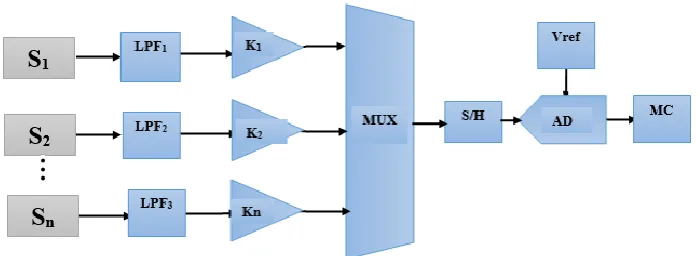
The Data loggers may include low-pass filters (LPFs), normalizing amplifiers (NU), an analog multiplexer (MUX), a sampling and storage device, an analog-to-digital converter (ADC), and a microcontroller (MC). Some types of Data loggers contain a programmable amplifier after the multiplexer, which allows you to rebuild the measurement range [7].
Main structure of data logger
The most common Data loggers’ structure is shown in Figure 1
Figure. 1: Data logger bloc diagram with one ADC
Fig3. 2. Structures of the Data loggers with Multi-ADC
Currently, there are two main approaches to the design of modern datalogger systems: building dataloggers using discrete components and building dataloggers using technology systems on a chip [8].
The first approach is the most difficult way to develop dataloggers. It requires a reasonable choice of the element base, circuitry and design of the printed circuit board. This approach involves the creation of a prototype and testing, which increases the time and cost of development. For all of the above, a highly qualified developer is required, as well as sufficiently large time and economic costs. Nevertheless, the construction of datalogger on discrete components is necessary for solving highly specialized problems. This is advisable in cases where for solving the problem there are no specialized systems on a chip or ready-made integrated dataloggers.
Maxim manufactures a significant number of highly integrated components with unique characteristics for building modern data loggers. The range of its products includes components for the implementation of any data logger unit, such as physical quantity sensors, integrated filters, operational and instrumental amplifiers, digital and analog multiplexers, sampling and storage devices, voltage reference sources, programmable amplifiers, analog-to-digital converters, microcontrollers etc.[9].
The components of data logger
1. Filter Integrated Circuits
The construction of active filters requires the use of low-noise operational amplifiers and a large number of passive components. At the same time, low-noise op-amps, as a rule, have a high level of energy consumption and high cost. In addition, the construction of filters leads to an increase in overall dimensions and complicate the tracing of the printed circuit board. Using off-the-shelf integrated allows you to realize low-pass filters up to the 8th order on a single chip. The filter circuit consists of elliptical filters, Butterworth and Bessel filters up to 8th order. Consumption of integrated filters in active mode does not exceed 1.2 mA.
2. Signal amplification and normalization
The signal amplification and normalization scheme are designed to match the voltage level of the sensor output analog signal to the full range of the ADC, which reduces the error of the ADC conversion. Choosing operational amplifiers for operation as part of a particular data loggers, in addition to metrological characteristics, such as voltage, bias, temperature and time drift of bias voltage, gain in open feedback, it is necessary to carefully analyze the noise characteristics of the op-amp.
3. Analog multiplexers
The main purpose of analog multiplexers is to transfer data from several signal sources to one receiver. Using an analog multiplexer helps to increase the number of channels when using one ADC. The main requirements for analog multiplexers are the minimum channel resistance in the open state, the maximum resistance in the closed state, speed, temperature drift of characteristics, power consumption, the values of switching voltages and currents, as well as the presence of built-in additional functions.
4. sample / hold Device
multichannel data acquisition systems, where they provide storage of the sample for conversion on one channel, while the multiplexer switches to another channel. The use of the I / O makes it possible to minimize the aperture error. The main criteria for sampling / storage devices are sampling speed, signal retention period, power consumption and overall dimensions [10].
5. A to D Converters
An analog-to-digital converter is the most important component of the data loggers, which determines the metrological characteristics, as well as the speed of the entire system. Modern ADC is a complex device, the production technology of which is far from every manufacturer of electronic components. The main parameters of the ADC are metrological characteristics, speed, functional completeness, cost, type of external interface, power consumption, type of housing.
6. Microcontroller
In this work ESP32 was selected as microcontroller system. This Node allows you to quickly program the module thanks to the built-in USB-TTL adapter. There are also programming and reset buttons on it, as well as a voltage regulator for powering the ESP32 microcontroller with a voltage of 3.3 V. Also, the board provides convenient access to the module pins, the step between which is quite narrow so that you can work with them without problems. The step between the outputs of the board is 2.54 mm, which is the standard for DIP-cases, which are convenient to work with a conventional radio amateur without special tools.
IV.SENSORY SYSTEM DESIGN
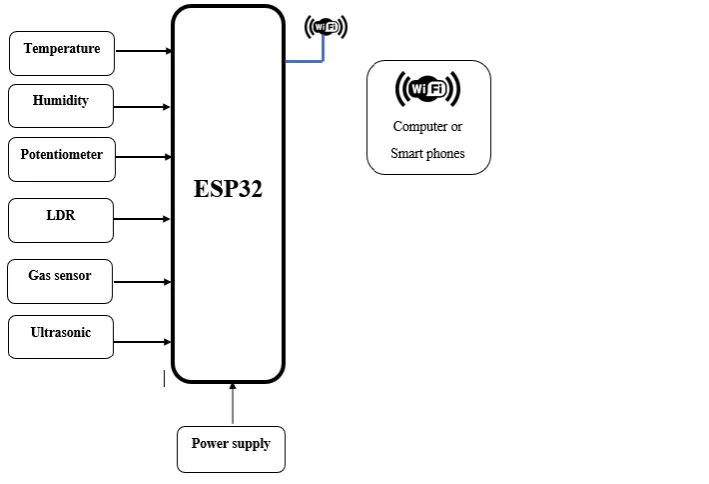
In the process of monitoring analog data, such as temperature, humidity, illumination, voltage, etc., in some cases it is necessary to use microcontroller system. Conventional measuring instruments do not allow the operation of the results of these measurements for further processing and analysis. To solve this problem, a data recording system can be used that allows the collection and accumulation of analog data in a storage device. Taking into account the high cost of data logger design and the lack of flexibility in configuring and operating circuit solutions from the Internet, it was decided to develop a multifunctional analog data logger with the ability to change over a wide range of measurement interval of analog signals. Figure shows the block diagram of data logger [11].
Figure 3. The block diagram of the data logger based on ESP32
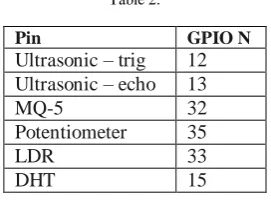
Table 2.
Pin GPIO N
Ultrasonic – trig 12
Ultrasonic – echo 13
MQ-5 32
Potentiometer 35
LDR 33
DHT 15
V. SOFTWARE DEVELOPMENT
To display the results on any internet browser, several codes are developed under programming languages which can be run under a web browser. These languages are HTML, CSS, java script, JQuery and Arduino. The table below shows the function of each language [12].
Table1: Functions of languages Languages Function
HTML Design the web page
CSS Format the web page and items
Jscript Define the functionality of the elements
JQuery Library for java script
Arduino Programming the esp32 chip and the sensors
An example of coding for reading an processing temperature senor is shown below
void handleDHTtemperature() { // Http response for Temperature
String b=""; // Define variable b as string to store the value as text
float t = dht.readTemperature(); //Define variable t as integer to read the temperature
// data from DHT11 sensor
Serial.print("temp="); //Print at serial monitor the text "temp=" and the value of t
Serial.println(t);
delay(2000);// Delay for 2 seconds.
b+=t; //Store the value of t in variable b as text
server.send (200,"text/plain",b); //Http response for the variable b.
}
VI.SYSTEM DESCRIPTION
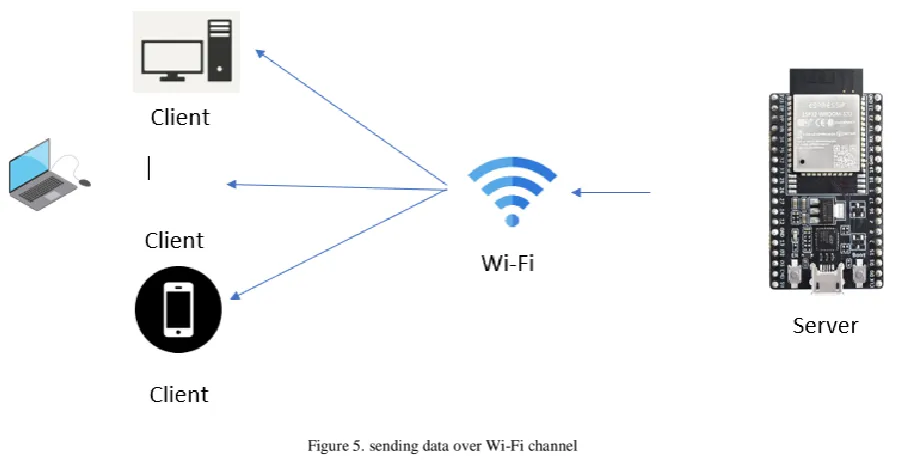
The system consists of the ESP32 microcontroller which plays a webserver that sends data via WIFI channel. Figure 5. Shows how the data are communicated with webserver and other clients.
Figure 5. sending data over Wi-Fi channel
Figure 6. Http request and Http response
VII. IMPLEMENTATION
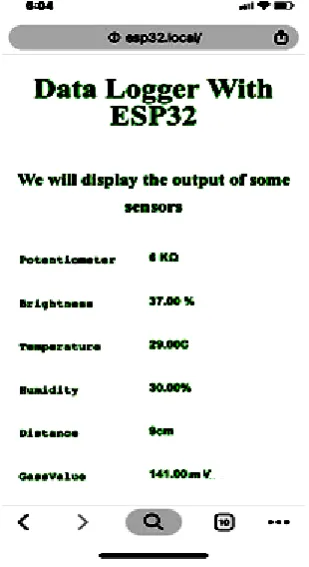
The developed system is utilized to read data from several sensors. The data are processed and sent into the web server. Then, the readings of the sensors are presented in web browser as shown in figure 7.
VIII. CONCLUSION
A data logger based on ESP32 is developed. It was shown that the ESP32 provides a good solution for data logger development and it is capable to be communicated with several clients. The sensors readings are presented in a web browser of a smart phone or a PC without any requirements of additional setting.
R
EFERENCES
[1] Lobaccaro, G.; Carlucci, S.; Löfström, E. A review of systems and technologies for smart homes and smart grids. Energies 2016, 9.
[2] ] Mohammad A. K. Alia, Tariq M. Younes, Mohammad Abu Zalata, Development of Equivalent Virtual Instruments to PLC Functions and Networks, Journal of Software Engineering and Applications, 2011, 4, 172-180, doi:10.4236/jsea.2011.43019 Published Online March 2011.
[3] Monzer M. Krishan, Tariq M. Younes and Farouq M. Al-Taweel,New Design of Socket Modules for Smart Home Applications,International Journal of Engineering Research and Technology. ISSN 0974-3154, Volume 12, Number 2 (2019), pp. 151-156.
[4] Jiang Feng, Dai Jian, Wu Fei, Zou Yan, Design of Socket Based on Intelligent Control and Energy Management, (IJACSA) International Journal of Advanced Computer Science and Applications, Vol. 6, No. 10, 2015.
[5] Shebel Alsabbah ; Tariq Mughrabi ,Neural network-based waveguide acoustic gas detector, 2008 5th International Symposium on Mechatronics and Its Applications,IEEE Xplore: 14 October 2008,DOI: 10.1109/ISMA.2008.4648867.
[6] Atsushi Mitani and TamonHosoya, Mechatronics Education in School of Design – Development of Educational Tool to Study Design Expression Using Mechatronics, JRM Vol.23 No.5 pp. 629-637, doi: 10.20965/jrm.2011.p0629.
[7] KazuhitoHyodo, HirokazuNoborisaka, and Takashi Yada, Development of Mechatronics Teaching Materials for Embedded System Engineer Education, JRM Vol.23 No.5 pp. 611-617, doi: 10.20965/jrm.2011.p0611(2011).
[8] Tariq M. Younes, Computer-Based Acoustic Detector for Determining the Type and Concentration of a Solution, Journal of Applied Research and Technology, pp 859-866, Vol. 10, December 2012.
[9] RubaAlawneh, Aism El Sheikh, Raid Kanaan, Development of Embedded Personal Health CareRecord System, IBusiness, volume 3, issue 6.
[10] https://dl.espressif.com/doc/esp-idf/latest/get -started/index.html
[11] Tariq M. Younes, Development of LVDT Signal Conditioner Using Waveguide Acoustic Resonance Tube, Sensors & Transducers, Vol. 206, Issue 11, November 2016, pp. 88-94.