Hybrid Binary-Ternary Joint Sparse Form and
its Application in Elliptic Curve Cryptography
Jithra Adikari,
Student Member, IEEE,
Vassil Dimitrov, and Laurent Imbert
Abstract
Multi-exponentiation is a common and time consuming operation in public-key cryptography. Its elliptic curve
counterpart, called multi-scalar multiplication is extensively used for digital signature verification. Several algorithms
have been proposed to speed-up those critical computations. They are based on simultaneously recoding a set of
integers in order to minimize the number of general multiplications or point additions. When signed-digit recoding
techniques can be used, as in the world of elliptic curves, Joint Sparse Form (JSF) and interleavingw-NAF are the
most efficient algorithms. In this paper, a novel recoding algorithm for a pair of integers is proposed, based on a
decomposition that mixes powers of 2 and powers of 3. The so-called Hybrid Binary-Ternary Joint Sparse Form
require fewer digits and is sparser than the JSF and the interleavingw-NAF. Its advantages are illustrated for elliptic
curve double-scalar multiplication; the operation counts show a gain of up to 18%.
Index Terms
Multi-exponentiation, Multi-scalar multiplication, Joint sparse form, Binary-ternary number system, Elliptic curves.
I. INTRODUCTION
Multi-exponentiation is a common operation in public-key cryptography. Most digital signatures are verified by
evaluating an expression of the form gahb, where g, hare elements of a multiplicative group; typically the group
F∗q of non-zero elements of the finite field Fq. To speed-up this operation, one generally uses the well known Shamir’s trick (see [1] and [2]), which is based on the simple fact it is unnecessary to compute the two expressions
separately since only the product is needed. Shamir first suggested to apply the square-and-multiply algorithm to
the binary expansions of bothaandbat the same time, and further noticed that some extra savings can be obtained
by precomputing the productgh. Iftdenote the bit-length of the largest exponent, this method requirestsquarings
and3t/4 multiplications on average.
This work was supported by the Natural Sciences & Engineering Research Council of Canada.
J. Adikari and V. Dimitrov are with the Advanced Technology Information Processing System Labs. (ATIPS), Department of Electrical and
Computer Engineering at the University of Calgary, 2500 University Dr. NW, Calgary, AB T2N 1N4, Canada (e-mail: [email protected];
L. Imbert is with the CNRS “PIMS-Europe” (UMI 3069), Centre for Information Security and Cryptography (CISaC), Department of
In the world of elliptic curves, the same critical operation rewrites [k]P+ [l]Q, wherek andl are two positive
integers, andP, Qare two elements of the group of points of an elliptic curve; a nice group, denoted additively, where
elements can be easily inverted (the cost of computing−P fromP is negligible). The square-and-multiply algorithm immediately translates into a double-and-add-subtract algorithm. Naturally, joint signed binary expansions [3], with
digits in{−1,0,1} have been considered. The scalarsk, l are represented as a2×t matrix
k= (kt−1 . . . k1 k0)
l= (lt−1 . . . l1 l0),
withki, li ∈ {−1,0,1} for all i. The number of additions required by Shamir’s simultaneous method is equal to the so-called joint Hamming weight; i.e., the number of non-zero columns. For example, ifkandl are both written
in the Non-Adjacent Form [4], [5], the computation of [k]P + [l]Q costs t+ 1 doublings and 5t/9 additions on
average.
Example 1: The 2×9matrix given by the NAFs ofk= 145andl= 207
145 = (0 1 0 0 1 0 0 0 1)
207 = (1 0 ¯1 0 1 0 0 0 ¯1)
has joint Hamming weight 5.
In [6], Solinas introduced the Joint Sparse Form (JSF) to further reduce the average number of non-zero columns.
The main idea behind Solinas’ algorithm is to make sure that out of three consecutive columns, at least one is a
zero-column. Solinas’ algorithm is given in terms of arithmetic operations but it basically reduces to computations
modulo8 (bit operations). By carefully choosing the positive/negative values of the remainders (mod 8), Solinas
proves the uniqueness and optimality (in the context of joint signed binary expansions) of the JSF, showing that
the computation of[k]P+ [l]Qrequirest doublings andt/2additions on average.
Example 2: Using the same values as above (k= 145,l= 207), the JSF
145 = (1 0 0 1 0 0 0 1)
207 = (1 1 0 1 0 0 0 ¯1)
has Hamming weight 4.
The simultaneous methods described above require precomputations of points involving both P and Q. For
example, the JSF algorithm needs the pointsP+QandP−Qto be precomputed. On the other hand, interleaving methods use precomputed values that only involve a single point, which allows the use of different methods for
each scalar (such as different width-wNAFs); the doubling steps being done jointly. When the same width-wNAF
is used for bothkandl, the overall cost of interleaving methods istdoublings and2t/(w+ 1)additions on average
(see [2, pp 111–113] for more details). We give an example of interleavingw-NAF in Section III.
In this paper, we describe a novel joint recoding scheme which uses both bases 2 and 3 in order to reduce the
average number of non-zero columns. In Section II, we present the basics of the so-called hybrid binary-ternary
number systems. In Section III, we extend the concept to represent pairs of integers and we introduce a new joint
II. HYBRIDBINARY-TERNARYNUMBERSYSTEM
The Hybrid Binary-Ternary Number System (HBTNS) was introduced by Dimitrov and Cooklev in [7] for
speeding-up modular exponentiation. In this system, an integer is written as a sum of powers of 2 and powers of 3;
i.e., it mixes bits and trits (radix-3 digits) except that the digit2never occurs. The use of base 3 naturally reduces
the number of digits1 required to represent a t-bit integer. In fact, it can be shown that the average base β = 210/1333/13≈2.19617and that the digit length is almost12%smaller than the binary length (log
β(2)≈0.88106) digits (see [7] for more details). More importantly, this number system is also very sparse; the average number of
non-zero digits in HBTNS is 5/13, leading to≈t/3 for at-bit number. Algorithm 1 computes the HBTNS of a positive integer.
Algorithm 1 HBTNS representation Input : An integern >0
Output : Arraysdigits[], base[]
1: i= 0
2: while n >0do
3: if n≡0 (mod 3)then
4: base[i]= 3; digits[i]= 0; n=n/3;
5: else ifn≡0 (mod 2)then
6: base[i]= 2; digits[i]= 0; n=n/2;
7: else
8: base[i]= 2; digits[i]= 1; n=n/2;
9: end if
10: i=i+ 1
11: end while
12: return digits[], base[]
Example 3: The hybrid binary-ternary representation ofn= 703 = (1010111111)2
digits[]= [1,0,0,0,1,0,0,1]
base[]= [2,3,3,3,2,3,2,2].
has only 8 digits among which 3 only are non-zero. Note that the binary representation requires 10 bits, out of
which 8 are different from zero. Observe that the least significant digit is the left-most value indigits[], such
that 703 = 1 + 2133+ 2334.
The idea of mixing bases 2 and 3 for elliptic curve scalar multiplication has been proposed by Ciet et al. in [8]
using the same decomposition as in Algorithm 1. Dimitrov, Imbert and Mishra generalized this concept in [9] by
20 21 22 23
30
31
32
33
34 1
1 1
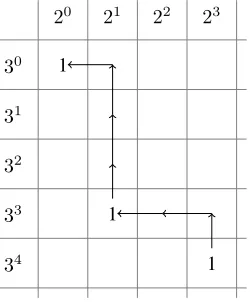
Fig. 1. An example of staircase walk for a double-base chain representing703
using a greedy approach to compute special signed double-base expansions; i.e., expressions of the form
X
i
±2ai3bi, witha
i, bi≥0,
where the exponents form two simultaneously decreasing sequences. These expansions, called double-base chains
(see Def. 1 below), allows for fast scalar multiplication. See [10] for more details about this number system.
Definition 1 (Double-base chain): Givenk > 0, a sequence (Kn)n>0, of positive integers satisfying:K1 = 1,
Kn+1 = 2u3vKn +s, with s ∈ {−1,1} for some u, v ≥0, and such that Km = k for some m > 0, is called a double-base chain for k. The length, m, of a double-base chain is equal to the number of terms (often called
{2,3}-integers), used to representk.
Any elliptic curve scalar multiplication algorithm based on mixing powers of 2 and powers of 3 requires point
doublings and additions, as well as, possibly fast, point triplings. In [9], Dimitrov et al. also proposed an efficient
tripling formula in Jacobian coordinates for ordinary elliptic curves over large prime fields (see [11] for improved
formulas). In [12], Doche and Imbert further extended the concept of double-base chains by allowing digits from
larger sets as in thew-NAF algorithm.
An easy way to visualize expansions using two bases (say e.g.2 and3), is to use a two-dimensional array (the
columns represent the powers of2and the rows represent the powers of3) into which each non-zero cell contains
the sign of the corresponding term. (by convention, the upper-left corner corresponds to2030= 1.) A double-base
chain can thus be represented by a staircase walk from the bottom-right corner to the upper-left corner, with
non-zero digits distributed along this path. An example of such a double-base chain is shown in Fig. 1; it was obtained
using Algorithm 1. (Since a given set of non-zero cells can lead to many different staircase walks, we adopt the
convention to walk North as much as we can before going East.)
In the next section, we consider an hybrid binary-ternary joint sparse form for a pair of integers. We propose an
algorithm which computes two double-base chains that share the same staircase walk; only the distribution of the
III. HYBRIDBINARYTERNARYJOINTSPARSEFORM
In Algorithm 2, the hybrid binary-ternary joint sparse form of a pair of integers is calculated by first checking
whether bothk1andk2are divisible by 3. If this is the case, both digits are set to0and the base set to3, otherwise
we check whether they are both divisible by 2 and proceed accordingly. Finally, if the pair is not divisible by 3 or
2, we make both numbers divisible by 6 by subtractingki mods 6∈ {−2,−1,0,1,2,3} fromki, and then divide the results by 2. Therefore, in the next step, both numbers are divisible by 3 and we generate a zero column.
Algorithm 2 Hybrid binary-ternary joint sparse form (HBTJSF) Input : Two positive integersk1, k2
Output : Arrayshbt1[], hbt2[], base[]
1: i= 0
2: while k1>0 ork2>0 do
3: if k1≡0 (mod 3)andk2≡0 (mod 3)then 4: base[i]= 3;
5: hbt1[i]= hbt2[i]= 0;
6: k1=k1/3; k2=k2/3;
7: else ifk1≡0 (mod 2)andk2≡0 (mod 2)then 8: base[i]= 2;
9: hbt1[i]= hbt2[i]= 0;
10: k1=k1/2; k2=k2/2;
11: else
12: base[i]= 2;
13: hbt1[i]= k1 mods6; hbt2[i]= k2 mods 6;
14: k1= (k1−hbt1[i])/2; k2= (k2−hbt2[i])/2; 15: end if
16: i=i+ 1
17: end while
18: return hbt1[], hbt2[], base[]
Example 4: The following example illustrates the advantage of the HBTJSF. For k1= 1225 andk2= 723 the
Joint Sparse Form
1225 = (1 0 1 0 ¯1 0 0 1 0 0 1)
723 = (1 0 ¯1 0 0 ¯1 0 ¯1 ¯1 0 ¯1)
has joint Hamming weight 7. The interleavingw-NAF (withw= 5for 1225 and w= 4for 723)
20 21 22 23 24
30
31
32
33
1
¯1 3
1225
20 21 22 23 24
30
31
32
33
3
¯2 2
723
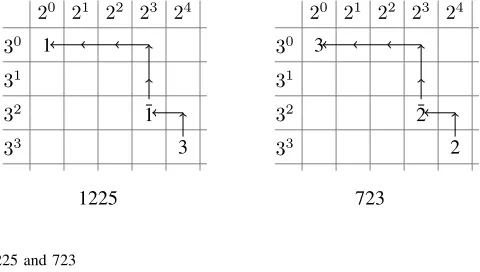
Fig. 2. Double-base chains for 1225 and 723
TABLE I
THE14POINTS THAT HAVE TO BE PRECOMPUTED FORHBTJSFSCALAR MULTIPLICATION
P -
-Q P±Q 2P±Q 3P±Q
- P±2Q - 3P±2Q
- P±3Q 2P±3Q
-has 6 non-zero elements2 (using w = 4 for 1225 and w= 5 for 723 also leads to 6 non-zero elements). Using Algorithm 2, the hybrid binary-ternary joint sparse form
1225 = (3 0 ¯1 0 0 0 0 1)
723 = (2 0 ¯2 0 0 0 0 3)
base[]= (2 3 2 2 2 3 3 2)
only requires 8 digits and has joint Hamming weight3. We show the corresponding double-base chains in Fig. 2.
Note the digits are distributed along the same staircase walk.
Since the HBTJSF uses the digit set{−2,−1,0,1,2,3}, a total of14points have to be precomputed (see Table I). Note that the points2P,2Q,3P,3Qare not needed as they correspond to pairs of integers that are simultaneously
divisible by 2 or 3. Also, since the negation of a point is negligible, only one set of point difference need to be
calculated; for example,2Q−P is easily deduced from P−2Q. IV. THEORETICALANALYSIS
Let us analyse the behaviour of Algorithm 2. We consider integers of the form6k+j withj∈ {−2, . . . ,3}. We want to know how often our algorithm performs a division by 3 and how often it performs a division by 2. More
importantly, we want to know how many non-zero columns we can expect on average.
We consider all pairs of numbers of the form (6i+j,6i0+j0) with j, j0 ∈ {0,1,2,3,4,5}. (Note that this is equivalent to j, j0 ∈ {−2,−1,0,1,2,3}.) Clearly, we have 36 such states, that we denoteSi,j. We can therefore
define the 36 ×36 transition matrix M, where M[6i+j,6i0 +j0] is equal to the probability P(Si0,j0|Si,j)
to go from state Si,j to state Si0,j0. For example, the state S0,0 corresponds to the case where both numbers
are divisible by 6. The divisions by 3 performed in step 6 of Algorithm 2 therefore lead to any of the states
S0,0, S0,2, S0,4, S2,0, S2,2, S2,4, S4,0, S4,2, S4,4, which correspond to a pair of even numbers, with probability 1/9.
Similarly, if both numbers are even, the divisions by 2 in step 10 lead to four different states with probability
1/4. For example, we go from S0,2 to any ofS0,1, S0,4, S3,1, S3,4 with probability1/4. In the last case; i.e., when
numbers are neither simultaneously divisible by 3 or 2, we make them divisible by 6 and perform a division by
2. Hence, we reach one of the four states S0,0, S0,3, S3,0, S3,3 that correspond to pairs of multiples of 3, with
probability1/4. The complete transition matrix is given in Appendix.
The stationary distributionπ∞is obtained aslimn→∞π0Mn, withπ0= (1/36, . . . ,1/36)our initial probabilities
(although they do not play any role). We have
π∞[i] = 27
236 ifi∈ {0,3,18,21},
π∞[i] = 1
59 otherwise.
This allows us to compute the following average probabilities:
p3=
5 X
i=0 5 X
j=0
π∞[6i+j] ifi, j≡0 (mod 3), pz=
5 X
i=0 5 X
j=0
π∞[6i+j] ifi, j≡0 (mod 3)or i, j≡0 (mod 2),
wherep3denotes the probability to perform a division by3andpzdenote the probability to generate a zero column.
Clearly, the probability to perform a division by2isp2= 1−p3and the probability to generate a non-zero column ispnz= 1−pz. We have
p2=32
59, p3= 27
59, pz= 35
59, pnz= 24
59. (1)
Now, usingp2 andp3, we can evaluate the average base
β= 59
√
232327= 59√
32751691810479015985152≈2.407765
For a pair oft-bit integers, the average number of columns of the HBTJSF array is thus approximately
(logβ2)×t≈0.7888×t. (2)
Finally, from (1) and (2), we derive that the expected number of elliptic curve additions per bit is approximately
24
59×0.7888≈0.3209.
We summarized our theoretical results in Table II, with real values rounded to the nearest hundredth. (For simplicity,
TABLE II
THEORETICAL COMPARISON OFHBTJSF, JSFAND INTERLEAVINGw-NAFFOR At-BIT PAIR OF INTEGERS
Parameters HBTJSF JSF Interleavingw-NAF
Average base 2.41 2 2
Avg # col. 0.79t t+ 1 t+ 1
Avg # base2col. 0.43t t+ 1 t+ 1
Avg # base3col. 0.36t 0 0
Avg # non-zero col. 0.32t 0.5t 2t/(w+ 1)
Precomp. 14 2 2w−1−2
TABLE III
COSTS OF SOME CURVE OPERATIONS FOR ORDINARY ELLIPTIC CURVES OVER PRIME FIELDS INJACOBIAN COORDINATES(a=−3)AND
TRIPLING-ORIENTEDDIKCURVES
Weierstrass / Jacobian (a=−3)
Cost S =0.8M
Doubling 3M + 5S 7M
Tripling 7M + 7S 12.6M
Addition (mixed) 7M + 4S 10.2M
Tripling-oriented DIK
Cost S =0.8M
Doubling 2M + 7S 7.6 M
Tripling 6M + 6S 10.8 M
Addition (mixed) 7M + 4S 10.2 M
V. COMPARISONS
Based on the above analysis, we compare our algorithm with the JSF and the w-NAF interleaving method
(assuming windows of size w = 4 for both scalars). We consider two kinds of curves for which we know that
triplings are useful [13]:
• Ordinary elliptic curves over large prime fields with Jacobian coordinates (witha=−3), • tripling-oriented Doche-Icart-Kohel curves [14].
The costs of the necessary curve operations are given in Table III; the last column give equivalent
multiplica-tion counts assuming S = 0.8M. These costs are reported in the comprehensive and accurate explicit-formulas
database [11]. Our results are summarized in Table IV for256-bit pairs of integers (similar values can be observed
for other sizes).
Remark 1: Note that the cost of precomputations is not included in our operation counts. In the case of JSF, only
P+QandP−Qhave to be computed, which is (almost, but not exactly) equivalent to two additions. In the case of interleavingw-NAF, we have to precompute3P,3Q,5P,5Q,. . . ,(2w−1−1)P,(2w−1−1)Q; that is, a total of
TABLE IV
COMPARISONS BETWEENHBTJSF, JSFAND INTERLEAVINGw-NAFFOR256-BIT INTEGERS
Weierstrass / Jacobian (a=−3)
HBTJSF JSF Inter.4-NAF Inter5-NAF
Mult. counts for dbl. 770 1792 1792 1792
Mult. counts for tpl. 1159 0 0 0
Mult. counts for add 836 1306 1044 870
Total mult. counts 2765 3098 2836 2662
Precomp. 14 2 6 14
Overhead 12.04% 2.57% -3.73%(a)
Tripling-oriented DIK
HBTJSF JSF Inter.4-NAF Inter.5-NAF
Mult. counts for dbl. 836 1946 1946 1946
Mult. counts for tpl. 994 0 0 0
Mult. counts for add 836 1306 1044 870
Total mult. counts 2666 3252 2990 2816
Precomp. 14 2 6 14
Overhead 21.98% 12.15% 5.63%
(a)Interleaving5-NAF seems slightly better than HBTJSF for ordinary curves
overFp, but this is without considering precomputation costs (see Rem. 1).
of HBTJSF, 14 points are needed as shown in Table I. The exact number of field operations is less than the field
cost of2doublings plus16additions, since common subexpressions eliminations techniques can be considered. We
believe that the more compact (the largest multiples are triples) set of points used in HBTJSF should give more
opportunities for savings than for Interleavingw-NAF.
VI. CONCLUSIONS
A new recoding algorithm for a pair of integers has been proposed. It is based on a decomposition of two
integers using mixed powers of 2 and 3. Our analysis shows that it requires almost 20% fewer digits than the
binary representation and that the average number of non-zero columns per bit is less than1/3. We have illustrated
the advantages of the so-called HBTJSF for elliptic curve double-scalar multiplication. Compared to the commonly
used JSF and interleaving w-NAF methods, the savings obtained with HBTJSF are significant (up to 18%) for
curves for which triplings are useful, such as e.g. ordinary curves over large prime fields or tripling-oriented DIK
curves.
ACKNOWLEDGMENTS
REFERENCES
[1] T. ElGamal, “A public key cryptosystem and a signature scheme based on discrete logarithms,”IEEE Transactions on Information Theory,
vol. 31, no. 4, pp. 469–472, July 1985.
[2] D. Hankerson, A. Menezes, and S. Vanstone,Guide to Elliptic Curve Cryptography. Springer, 2004.
[3] A. D. Booth, “A signed binary multiplication technique,”Quarterly Journal of Mechanics and Applied Mathematics, vol. 4, no. 2, pp.
236–240, 1951, reprinted in E. E. Swartzlander,Computer Arithmetic, Vol. 1, IEEE Computer Society Press Tutorial, Los Alamitos, CA,
1990.
[4] G. W. Reitwiesner, “Binary arithmetic,”Advances in Computers, vol. 1, pp. 231–308, 1960.
[5] M. Joye and S.-M. Yen, “Optimal left-to-right binary signed-digit exponent recoding,”IEEE Transactions on Computers, vol. 49, no. 7,
pp. 740–748, 2000.
[6] J. A. Solinas, “Low-weight binary representations for pairs of integers,” Center for Applied Cryptographic Research, University of Waterloo,
Waterloo, ON, Canada, Research report CORR 2001-41, 2001.
[7] V. Dimitrov and T. V. Cooklev, “Two algorithms for modular exponentiation based on nonstandard arithmetics,”IEICE Transactions
on Fundamentals of Electronics, Communications and Computer Science, vol. E78-A, no. 1, pp. 82–87, Jan. 1995, special issue on
cryptography and information security.
[8] M. Ciet, M. Joye, K. Lauter, and P. L. Montgomery, “Trading inversions for multiplications in elliptic curve cryptography,”Designs, Codes
and Cryptography, vol. 39, no. 2, pp. 189–206, May 2006.
[9] V. Dimitrov, L. Imbert, and P. K. Mishra, “Efficient and secure elliptic curve point multiplication using double-base chains,” inAdvances
in Cryptology, ASIACRYPT’05, ser. Lecture Notes in Computer Science, vol. 3788. Springer, 2005, pp. 59–78.
[10] ——, “The double-base number system and its application to elliptic curve cryptography,”Mathematics of Computation, vol. 77, no. 262,
pp. 1075–1104, 2008.
[11] D. J. Bernstein and T. Lange, “Explicit-formulas database,” URL: http://www.hyperelliptic.org/EFD/, joint work by Daniel J. Bernstein
and Tanja Lange, building on work by many authors.
[12] C. Doche and L. Imbert, “Extended double-base number system with applications to elliptic curve cryptography,” inProgress in Cryptology,
INDOCRYPT’06, ser. Lecture Notes in Computer Science, vol. 4329. Springer, 2006, pp. 335–348.
[13] D. J. Bernstein, P. Birkner, T. Lange, and C. Peters, “Optimizing double-base elliptic-curve single-scalar multiplication,” inProgress in
Cryptology – INDOCRYPT2007, ser. Lecture Notes in Computer Science, vol. 4859. Springer, 2007, pp. 167–182.
[14] C. Doche, T. Icart, and D. R. Kohel, “Efficient scalar multiplication by isogeny decompositions,” inPublic Key Cryptography, PKC’06,
APPENDIX
36×36TRANSITION MATRIX
M = 0 B B B B B B B B B B B B B B B B B B B B B B B B B B B B B B B B B B B B B B B B B B B B B B B B B B B B B B B B B B B B B B B B B B B B B B B B B B B B B B B B B B B B B B B B B B B B B B @ 1 9 0 1 9 0 1
9 0 0 0 0 0 0 0 1 9 0
1 9 0
1
9 0 0 0 0 0 0 0 1 9 0
1 9 0
1
9 0 0 0 0 0 0 0 1
4 0 0 1
4 0 0 0 0 0 0 0 0 0 0 0 0 0 0 1 4 0 0
1
4 0 0 0 0 0 0 0 0 0 0 0 0 0 0
0 1 4 0 0
1
4 0 0 0 0 0 0 0 0 0 0 0 0 0 0 1 4 0 0
1
4 0 0 0 0 0 0 0 0 0 0 0 0 0
0 19 0 19 0 19 0 0 0 0 0 0 0 19 0 91 0 19 0 0 0 0 0 0 0 19 0 19 0 19 0 0 0 0 0 0
0 0 1 4 0 0
1
4 0 0 0 0 0 0 0 0 0 0 0 0 0 0 1 4 0 0
1
4 0 0 0 0 0 0 0 0 0 0 0 0 1
4 0 0 1
4 0 0 0 0 0 0 0 0 0 0 0 0 0 0 1 4 0 0
1
4 0 0 0 0 0 0 0 0 0 0 0 0 0 0 1
4 0 0 1
4 0 0 0 0 0 0 0 0 0 0 0 0 0 0 1 4 0 0
1
4 0 0 0 0 0 0 0 0 0 0 0 0 0 0 1
4 0 0 1
4 0 0 0 0 0 0 0 0 0 0 0 0 0 0 1 4 0 0
1
4 0 0 0 0 0 0 0 0 0 0 0 0 0 0 1
4 0 0 1
4 0 0 0 0 0 0 0 0 0 0 0 0 0 0 1 4 0 0
1
4 0 0 0 0 0 0 0 0 0 0 0 0 0 0 1
4 0 0 1
4 0 0 0 0 0 0 0 0 0 0 0 0 0 0 1 4 0 0
1
4 0 0 0 0 0 0 0 0 0 0 0 0 0 0 1
4 0 0 1
4 0 0 0 0 0 0 0 0 0 0 0 0 0 0 1 4 0 0
1
4 0 0 0 0 0 0 0 0 0 0 0 0 0 0 1
4 0 0 1
4 0 0 0 0 0 0 0 0 0 0 0 0 0 0 1 4 0 0
1
4 0 0 0 0 0 0 0 0 0 0 0 0 0 0
0 0 0 0 0 0 1 4 0 0
1
4 0 0 0 0 0 0 0 0 0 0 0 0 0 0 1 4 0 0
1
4 0 0 0 0 0 0 0 0 1
4 0 0 1
4 0 0 0 0 0 0 0 0 0 0 0 0 0 0 1 4 0 0
1
4 0 0 0 0 0 0 0 0 0 0 0 0 0 0
0 0 0 0 0 0 0 1 4 0 0
1
4 0 0 0 0 0 0 0 0 0 0 0 0 0 0 1 4 0 0
1
4 0 0 0 0 0 0 0 1
4 0 0 1
4 0 0 0 0 0 0 0 0 0 0 0 0 0 0 1 4 0 0
1
4 0 0 0 0 0 0 0 0 0 0 0 0 0 0
0 0 0 0 0 0 0 0 1 4 0 0
1
4 0 0 0 0 0 0 0 0 0 0 0 0 0 0 1 4 0 0
1
4 0 0 0 0 0 0 1
4 0 0 1
4 0 0 0 0 0 0 0 0 0 0 0 0 0 0 1 4 0 0
1
4 0 0 0 0 0 0 0 0 0 0 0 0 0 0
0 0 0 0 0 0 19 0 19 0 19 0 0 0 0 0 0 0 19 0 91 0 19 0 0 0 0 0 0 0 19 0 19 0 19 0
1 4 0 0
1
4 0 0 0 0 0 0 0 0 0 0 0 0 0 0 1 4 0 0
1
4 0 0 0 0 0 0 0 0 0 0 0 0 0 0 1
4 0 0 1
4 0 0 0 0 0 0 0 0 0 0 0 0 0 0 1 4 0 0
1
4 0 0 0 0 0 0 0 0 0 0 0 0 0 0
0 0 0 0 0 0 0 1 9 0
1 9 0
1
9 0 0 0 0 0 0 0 1 9 0
1 9 0
1
9 0 0 0 0 0 0 0 1 9 0 1 9 0 1 9 1
4 0 0 1
4 0 0 0 0 0 0 0 0 0 0 0 0 0 0 1 4 0 0
1
4 0 0 0 0 0 0 0 0 0 0 0 0 0 0 1
4 0 0 1
4 0 0 0 0 0 0 0 0 0 0 0 0 0 0 1 4 0 0
1
4 0 0 0 0 0 0 0 0 0 0 0 0 0 0
0 0 0 0 0 0 0 0 0 0 0 0 1 4 0 0
1
4 0 0 0 0 0 0 0 0 0 0 0 0 0 0 1 4 0 0
1 4 0 0 1
4 0 0 1
4 0 0 0 0 0 0 0 0 0 0 0 0 0 0 1 4 0 0
1
4 0 0 0 0 0 0 0 0 0 0 0 0 0 0
0 0 0 0 0 0 0 0 0 0 0 0 0 1 4 0 0
1
4 0 0 0 0 0 0 0 0 0 0 0 0 0 0 1 4 0 0
1 4 0 1
4 0 0 1
4 0 0 0 0 0 0 0 0 0 0 0 0 0 0 1 4 0 0
1
4 0 0 0 0 0 0 0 0 0 0 0 0 0 0
0 0 0 0 0 0 0 0 0 0 0 0 0 0 1 4 0 0
1
4 0 0 0 0 0 0 0 0 0 0 0 0 0 0 1 4 0 0
1 4 1
4 0 0 1
4 0 0 0 0 0 0 0 0 0 0 0 0 0 0 1 4 0 0
1
4 0 0 0 0 0 0 0 0 0 0 0 0 0 0 1
4 0 0 1
4 0 0 0 0 0 0 0 0 0 0 0 0 0 0 1 4 0 0
1
4 0 0 0 0 0 0 0 0 0 0 0 0 0 0 1
4 0 0 1
4 0 0 0 0 0 0 0 0 0 0 0 0 0 0 1 4 0 0
1
4 0 0 0 0 0 0 0 0 0 0 0 0 0 0 1
4 0 0 1
4 0 0 0 0 0 0 0 0 0 0 0 0 0 0 1 4 0 0
1
4 0 0 0 0 0 0 0 0 0 0 0 0 0 0 1
4 0 0 1
4 0 0 0 0 0 0 0 0 0 0 0 0 0 0 1 4 0 0
1
4 0 0 0 0 0 0 0 0 0 0 0 0 0 0 1
4 0 0 1
4 0 0 0 0 0 0 0 0 0 0 0 0 0 0 1 4 0 0
1
4 0 0 0 0 0 0 0 0 0 0 0 0 0 0 1
4 0 0 1
4 0 0 0 0 0 0 0 0 0 0 0 0 0 0 1 4 0 0
1
4 0 0 0 0 0 0 0 0 0 0 0 0 0 0