A. D. MYASNIKOV AND A. USHAKOV
Abstract. In this paper we cryptanalyze two protocols: Grigoriev-Shpilrain authentication protocol and Wang et al. public key encryption protocols that use computational hardness of some variations of the conjugacy search problem in noncommutative monoids. We devise a practical heuristic algorithm solving those problems. As a conclusion we claim that these protocols are insecure for the proposed parameter values.
Keywords and phrases: Group-based cryptography, conjugacy search problem, matrix monoids, truncated polynomials.
AMS Classification: 94A60, 68W30.
1. Introduction
The conjugacy search problem plays a special role in group-based cryp-tography ([11, 12]). Most of the cryptosystems based on groups use one or another variation of that problem. For instance:
• [9] employs conjugacy search problem in braid groups;
• [1, 21] employ simultaneous conjugacy search problem in braid groups; • [19] employs twisted conjugacy problem;
• [20, 16, 17] employ decomposition problem in different (semi-)groups; • [15] employs conjugation and exponentiation in matrix groups. Yet, another protocol based on the conjugacy search problem was recently proposed in [5] by Grigoriev and Shpilrain, who introduced two authen-tication protocols: one is called the beta protocol and the other is called the full protocol. The security of both protocols relies on the hardness of the conjugacy search problem in a semigroup of of matrices over truncated polynomials. In this paper we test the following claim ([5, page 199]):
Our platform semigroup might be the first serious candidate for having generically hard conjugacy search problem.
Informally, generic case complexity is the complexity on “almost all” of the inputs, see [7, 8]. We prove that the claim is not true and, in fact, the conjugacy search problem is trivial in most of the cases (see Theorem 3). Trying to find difficult instances of the problem we modify the method of key generation. Our modification allows to generate nontrivial instances of the conjugacy search problem, but even that does not make the protocol
Date: December 10, 2012.
secure, we show that it can be attacked by a certain heuristic algorithm (see Section 4).
We also discuss a related work by L. Wang et al. (see [22]) which pro-poses a non-commutative version of Diffie-Hellman type encryption protocol which uses conjugation in noncommutative monoids and demonstrate their inadequacy.
1.1. The Grigoriev-Shpilrain authentication scheme. Here we intro-duce basic notions and formulate the conjugacy search problem together with the main security assumptions used in [5]. FixN, m, n, k∈N. Grigoriev-Shpilrain authentication protocol uses a semigroup of n×n matrices over N-truncated polynomials with coefficients in Zm. An N-truncated polyno-mial over a ring Zm is an element of the factor algebra
R=Zm[x1, . . . , xk]/hxi1· · ·xis |s=Ni.
LetGbe the ring of alln×nmatrices over truncatedk-variable polynomials over Zm. We say that X ∈ G is invertible if there exists Y ∈ G satisfying XY =Y X=I, whereI is the identity matrix.
Conjugacy search problem (CSP) in a semigroup G: Given elements A, C ∈ G find an invertible element X satisfying C = X−1AX, provided that such an element exists.
Public/private keys in Grigoriev-Shpilrain protocol: • Theprivate key is an invertible elementX∈G. • Thepublic key is a pair (A, X−1AX), where A∈G.
The key generation procedure is discussed in detail in Section 2. To check Alice’s identity, Bob runs the following protocol exactly once (cf. Feige-Fiat-Shamir type protocols, [3]).
Algorithm 1. The Grigoriev-Shpilrain authentication protocol (beta ver-sion).
1: Bob sends a random B∈Gto Alice.
2: Alice responds withX−1BX.
3: Bob chooses a random positive wordw(x, y) and checks the equality: trace(w(A, B)) = trace(w(X−1AX, X−1BX)).
4: Authentication is successful if the equality holds.
It is stated in [5, page 199] that forgery seems infeasible without finding the provers private key. This is not completely correct because to break this protocol it is sufficient to find any conjugator for the pair (A, X−1AX), i.e., to solve the conjugacy search problem for G. The security of the full version of the Grigoriev-Shpilrain protocol relies on the difficulty of the same conjugacy problem, as it has exactly the same public key pair (A, X−1AX). We omit the description of the full protocol here.
Another claim made in [5, page 199] is:
Our platform semigroup might be the first serious candidate for having generically hard conjugacy search problem.
This claim is the primary target of this paper. We investigate computational hardness of the conjugacy search problem forGand prove that it is easy on most of the inputs under the proposed key distribution.
1.2. Wang-Wang-Cao-Okamoto-Shao cryptosystem. Wang et al. in [22] propose several public key encryption schemes based on the CSP over a noncommutative monoid G. The most basic of the protocols works as follows. Fix A, X ∈ G, with X being invertible, and a number K ∈ N. Public/private keys in Wang et al. protocol are:
• Alice’sprivate keyis a number s∈N. • Alice’spublic key is an elementX−sAXs. • Bob’sprivate keyis a number t∈N. • Bob’spublic key is an elementX−tAXt.
After exchanging public information Alice and Bob can immediately com-pute theshared keyX−s−tAXs+t. Based on this simple protocol Wang et al. develop two ElGamal-type public key encryption protocols. Security of this scheme is based on the difficulty of the following computational problem: CSP-based computational Diffie-Hellman problem in G: Given el-ements A, X, X−sAXs, X−tAXt in G, for some random 1 ≤ s, t ≤ K, computeX−s−tAXs+t.
The value K is the main security parameter here and, hence, should be sufficiently large to provide a necessary level of security. That implies that the order of the cyclic subgroup generated by X must be at least K. Similarly we define the associated decision problem:
CSP-based decision Diffie-Hellman problem in G: Given elementsA, X, X−sAXs, X−tAXt in G, for some 1 ≤ s, t ≤ K, distinguish elements X−s−tAXs+t and X−lAXl for some random l ∈ [1, K] with probability cryptographically-significantly better than 1/2.
We discuss Wang’s et al. protocol in Section 3.
consistent with the notation above, we have n= 3, N = 1000, k= 10 and m= 11 orm= 12. Precisely, [22, page 11] states:
According to [15], we can choose the parameters as follows: µ= 3, λ= 1000and k= 10, while the ringR is instantiated withZ12.
The citation “[15]” references the Grigoriev-Shpilrain protocol [5] discussed above. The choice of Z11 or Z12 gives different algebraic structures with,
perhaps, very different algorithmic properties. To have a more complete picture, we analyze the protocol from [22] for both cases: Z11 and Z12 in
Section 3.
1.4. Our contribution. The main contribution of this paper is a heuristic algorithm for solving the conjugacy search problem in matrices over a semi-group of N-truncated polynomials. The heuristics used in the algorithm allow us to solve the conjugacy search problem on a majority of inputs generated using the parameters proposed in [5, 22] which invalidates the security claims. We also argue that the proposed sampling procedure with high probability generates trivial instances of the conjugacy problem.
In the following sections we argue the validity of the assumptions above with the main focus on solving the conjugacy search problem in G. In section 2 we discuss in more detail the sampling procedures proposed in [5] and emphasize the flaws in the construction of the problem instances. In Section 3 we show that the protocol of Wang et al. is neither secure nor feasible for the proposed parameter values. In Section 4 we describe our heuristic algorithm for the conjugacy search problem in the semigroup of matrices over truncated polynomials and provide experimental results.
2. Key generation
In this section we discuss the key generation procedures for protocols mentioned in the introduction. Both use two matrices A and X, where X is invertible.
The matrix A is somewhat similar to the base element in the Diffie-Hellman protocol and, in particular, the simpler A the faster the compu-tations. To make computations more efficient it is suggested in [5] to use sparse polynomials, i.e., polynomials with 5 monomials. A random 5-sparse polynomial is generated by selecting 5 random monomials of degree at mostN −1.
The matrix X is generated as a product of matrices: X=Ei1j1(m1)Ei2j2(m2)· · ·Eiljl(ml),
whereEij(m) is ann×n matrix that differs from the identity matrix I by one nontrivial off-diagonal polynomial m ∈ R in the position (i, j) (with i6=j). We can assume thatmi’s used in the generation ofX are monomials because for any 1≤i6=j≤3 and polynomials m1, m2 ∈R we have:
The monomialsml and indicesil, jl are chosen randomly. It is easy to check that the matricesEij(m) are invertible and:
Eij(m)−1=Eij(−m). Therefore,
X−1 =Eiljl(−ml)· · ·Ei2j2(−m2)Ei1j1(−m1).
In the next subsection we discuss some crucial observations and flaws of the proposed generation procedure with respect to the assumptions above.
2.1. Sparse truncated polynomials chosen uniformly randomly make CSP trivial. The original paper [5] does not state explicitly how to gener-ate random monomials used in the generation of entries forA and Ei,j(m). On the other hand mentioning the generic case hardness in one of the claims implies that they are generated uniformly. Hence, each m is a sum of 5 monomials axi1. . . xis where:
• ais a uniformly chosen fromZ11\ {0};
• xi1. . . xis is uniformly chosen from the (finite) set of power product
over{x1, . . . , x10} of power up toN = 1000.
Proposition 1. The following hold:
(a) The probability that a uniformly randomly chosen power product has degree smaller than500 is0.00102107974.
(b) The probability that a uniformly randomly chosen 5-sparse polyno-mial involves a monopolyno-mial of degree less than 500 is approximately 0.0051.
(c) The probability that a uniformly randomly chosen matrixA involves a monomial of degree less than500is approximately 0.0450.
Proof. The number of power products of degree at mostd ink variables is d+k
d
. Therefore, the number of power products of degree less than N is N+k−1
N−1
and of degree less then N/2 is N/N/2+2−1k−1 and
Pr(deg(m)< N/2) =
N/2+k−1
N/2−1
N+k−1
N−1
=
509 499
1009 999
= 0.00102107974.
A randomly generated polynomial p involves 5 uniformly randomly chosen monomials and hence:
Pr(all monomials in pare of degree≥500) = (1−0.00102107974)5≈0.9949. Similarly, a randomly generated matrix A involves 45 uniformly randomly chosen monomials and hence:
Next observe how conjugation by an elementary matrix E12(m)
trans-formsA:
E12−1(m)·A·E12(m) =
1 −m 0
0 1 0
0 0 1
a11 a12 a13
a21 a22 a23
a31 a32 a33
1 m 0
0 1 0
0 0 1
=
a11−ma21 a12+m(a11−a22)−m2a21 a13−ma23
a21 a22+ma21 a23
a31 a32+ma31 a33
.
(1)
Conjugation by other elementary matrices give similar formulae (see Appen-dix A). These formulae imply the following.
Lemma 2. If the degree of the smallest monomial involved in A is at least 500and deg(m)≥500, then E12−1(m)·A·E12(m) =A.
Theorem 3. The probability thatX−1AX=Afor randomly chosen matri-ces A and X is not smaller than 0.90750.
Proof. The matrix A is randomly chosen and involves 45 monomials; then it is conjugated by 50 random elementary matrices. The probability that at all steps no monomial of degree less that 500 will appears is:
(1−0.00102107974)95≈0.90750.
By Lemma 2 in this event we have X−1AX = A. Since we considered only a subset of all events that result in equality X−1AX = A the actual probability of obtaining a trivial conjugacy equation is even higher.
Therefore, for the suggested generation method the conjugacy search problem is trivial on most of the inputs. That does not mean that there are no difficult instances of CSP, but the key generation procedure is bad. Trying to find hard instances we modified the procedure for generating ran-dom monomials. Instead of choosing the monomials uniformly, it ranran-domly uniformly chooses the degree of the monomial and then the required num-bers of the involved variables are chosen. As above, N −1 is the maximal degree of a monomial and k is the number of variables. The procedure is the following:
Algorithm 2. Monomial generation.
1: Choose the degreesfrom {1, . . . , N−1}uniformly randomly.
2: Choose numbers i1, . . . , is from{1, . . . , k} uniformly randomly.
3. Analysis of Wang et al. primitive
In this section we discuss properties of Wang et al. protocols. The first observation is that the CSP-based Diffie-Hellman problem inGand the CSP inGare not much related. Indeed, the CSP-based Diffie-Hellman problem in Gis very restrictive because the conjugators come from the cyclic subgroup generated by X. The problem is only to recognize the power of X used in conjugation. The DH problem can be reduced to the conjugacy search problem relative to a subgroup generated by X (cf. [18]), but we do not see how it can be reduced to the general CSP in G (a general solution will not work – the centralizer will spoil the answer). Similarly, there is no way to reduce the general CSP to CSP-based DH problem. Therefore, computational hardness of any of these problems does not imply hardness of the other.
The main problem however is with the CSP-based Diffie-Hellman assump-tion in the semigroupG.
Recall that the orderord(X) of a group elementXis the smallest positive integermsuch thatXm =I. All Wang et al. protocols require computation of powersXifor large values ofiso thaticannot be recovered from the triple (A, X, X−iAXi) by simple enumeration. The requirement above implies that the order of the conjugating element X must be large. Indeed, let ord(X) =m andi > m. We can write i=m·k+r wherer < m. Then
Xi =Xm·k+r = (Xm)k·Xr=Xr.
Therefore, recovering a power Xi by brute-force enumeration is as hard as computing the power Xm, wherem=ord(X).
Next we present empirical evidence thatord(X) is small most of the time. First of all if we use the uniform random approach of Grigoriev-Shpilrain, then using the argument similar to Theorem 3 one can show that most of the instances ofX have small (in fact trivial) orders.
More surprisingly similar behaviour is observed whenXis generated using Algorithm 2. We performed a series of experiments and were able to compute the order of every instance of the matrixX. Moreover, in the case when the polynomial coefficients were taken fromZ11, all instances had orders 11, 121
or 1331 with 121 being the most frequent. Notice that these are all powers of 11 which is the order of the polynomial coefficients. In the case ofZ12the
orders were more diverse with 31104, 62208 and 124416 being the greatest but each occurring only once. Orders 72 and 144 were the most frequent and all values were multiples of 12. One explanation for the relatively small orders of X is that the terms of the polynomials are eliminated due to the small finite order of the coefficients.
work with finite, though huge semigroup). So the scheme is neither secure nor practical regardless of the generation procedure.
One can try to increase the order by introducing different sampling strate-gies. We performed experiments where monomials fromRwere chosen ran-domly with the degree N/5 = 200 at most. The idea is that introducing smaller degree polynomials will make truncation less common. Indeed, the size of power matrices became times larger then in the previous experiments. However, the orders of such matrices were again some small powers of 11.
4. Algorithm for solving the conjugacy problem
In this section we present a heuristic procedure for solving the conjugacy search problem in G. Recall that our goal is: given two matrices A and C = X−1AX in G compute a conjugator X. Essentially, our heuristic is a variation of a length-based attack that has been successfully used several times in group-based cryptography ([6, 4, 14, 10, 13]).
4.1. General idea of the attack. Since X is generated as a product of elementary matricesE1E2· · ·En, the matrixC can be viewed as a result of
a sequence of conjugations by the matrices Ei:
(2)
C0 = A
↓
C1 = E1−1 A E1
↓ C2 = E2−1E
−1
1 A E1E2
↓ .. . C =Cn= E−1n . . . E2−1E
−1
1 A E1E2. . . En
The goal is to reverse the sequence (2) and recover each single elementary matrix Ei one by one. Each Ei is a solution to the CSP for the pair of matrices (Ci−1, Ci), withCi−1 unknown. So, we need to solve the following
problem several times:
Recovering Ei: Given a matrix of the form Ei−1Ci−1Ei, findEi.
Clearly, the problem above is not very well defined because any elementary matrix E could have been used to obtain Ci from the unknown Ci−1. We
find the matrixE which fits the best for the role of the conjugator. This is done using the concept of a size function.
4.2. Size function attack. The following function will guide our process of recovery of elementary conjugators.
number of monomials in all entries ofM: size(M) = X
1≤i,j≤n
size(Mij).
For polynomialsp, q∈Rdefine a numberσp(q) to be the number of power products in p that are not present in q. Similarly, for matrices A, B ∈ G define a number:
σA(B) =
X
i,j
σaij(bij).
Intuitively, this function indicates how much one matrix is contained in the other. If two matrices are the same, thenσA(B) =σB(A) = 0. The opposite direction is not necessarily true because we disregard the coefficients of the polynomials.
Proposition 5. Let A ∈ G and B = Eij(m)−1AEij(m), where m is a monomial. Then
P r(σA(B) = 0)≥1−
7 size(A)2 10|BZ10(1000)|
,
where BZ10(1000) is the ball of radius 1000 in the Cayley graph of the free
abelian group Z10.
Proof. Without loss of generality we may assume thati= 1 and j= 2. By formula (1) on page 6, the matrixB gets new monomials from the products ma21,m(a11−a22)−m2a21, etc. Since, obviously,
size(aij)≤size(A),
each of those products involves not more than 3 size(A) monomials. The number σA(B) is positive only if a new monomial cancels out some old monomial. Therefore, the number of choices formthat induce cancelation of some old monomial can be bounded above by 7 size(A)2. Since the monomial mis chosen as a product of a random nonzero coefficient and a random power product and the total number of random power products is |BZ10(1000)|, it
is easy to get the claimed bound onP r(σA(B) = 0). In fact, in Proposition 5 we proved a stronger result. We proved that with high probability every new monomial in a conjugate matrix was not involved in the original matrix. Next, a trivial estimate:
|BZ10(1000)|=
1000 11
≥2·1025,
implies the following result.
Corollary 6. Let A ∈ G and B = Eij(m)−1AEij(m). If size(A) ≤ 105,
thenP r(σA(B) = 0)≥1−10−15.
Corollary 7. LetA∈GandB=Eij(m)−1AEij(m). Suppose thatsize(A)≤ 105. Then
Proof. Excluding all events when all the new monomials have power greater than 999 and, hence, being truncated (the trivial case for conjugacy) we
obtain the same estimate as in Corollary 6.
We consider size 105 because we think that bigger matrices are not prac-tical. By Corollary 7 the main assumption of the length based attacks:
size(Eij(m)−1AEij(m))>size(A)
holds for the majority of elements A, Eij(m) ∈ G. Hence, given a matrix Ck we find a conjugator as the matrix Eij(m) which gives the least value size(Eij(m)CkEij(m)−1).
Here we encounter another challenge. The number of the elementary matrices Eij(m) can be bounded below as 6·10· |BZ10(1000)| ≥ 1027; we
cannot simply enumerate them and test which ones reduce the size of the current matrixCi. In the next subsection we discuss a method reducing the number of the elementary matrices that need to be tested.
4.3. Reducing the number of the elementary matrices for tests. In this section we show how given a matrix of the form:
Ci =Eij(m)−1Ci−1Eij(m)
to find a small number of candidates for (i, j, m). We perform our procedure for all different values ofi, j separately, so, here we only consider the values i= 1, j= 2. Other cases are similar.
For a polynomial f ∈ R by Mon(f) denote the set of all monomials involved in f and for a pair of polynomials f, g ∈R define Frac(f, g) to be the set of monomials:
{xs1−t1 1 . . . x
s10−t10
10 |x
s1 1 . . . x
s10
10 ∈Mon(f), x
t1 1 . . . x
t10
10 ∈Mon(g), si ≥ti}. Let min(f) denote the minimal short-lex degree monomial in f ∈ R. The next theorem immediately follows from the discussion in Section 4.2. Proposition 8. IfCi=E12(m)−1Ci−1E12(m),Ci−1 6=Ci andsize(Ci−1)≤
105, then with probability at least 1−10−15 the monomialm belongs to the
following union:
M12(Ci) = Frac(−c11,min(c21))∪Frac(c12,min(c11))∪
Frac(−c12,min(c22))∪Frac(−c13,min(c23))∪
Frac(c22,min(c21))∪Frac(c32,min(c31)),
where cst is an element of Ci.
The size of the setM12(Ci) can be bounded above by
size(c11) + 2 size(c12) + size(c13) + size(c22) + size(c32)
and, therefore, is just linear in terms of size(Ci).
Using the setMst(Ci) we can define the corresponding set of elementary matrices
Est(Ci) ={Est(u)|u∈ Mst(Ci)}.
Using Proposition 8 it is easy to see that with probability at least 1−10−15 the true conjugatorEst(m) is in the setMst(Ci).
Some of the matrices in the setEst(Ci) may be eliminated even further if we impose the condition of Proposition 5
Est0 (Ci) =E ∈ Est(Ci)|σE−1C
iE(Ci) = 0 .
Finally we combine the sets corresponding to all possible locations of the monomial in an elementary matrix:
E(Ci) =∪s,tEst0 (Ci).
E(Ci) is the reduced set of candidate elementary matrices to be considered in the tests.
4.4. The results. Algorithms 3 and 4 are the two components describing the heuristic procedure for solving conjugacy search problem in G. This procedure is similar to the best descent variation of the length-based attack proposed in [14].
Algorithm 3. Reduction Input: A matrix B.
Output: MatrixY with minimal size(Y−1BY).
1: LetY =I.
2: loop
3: ComputeE(B);
4: if E(B) =∅then returnY.
5: Find ˆE ∈ E(B) minimizing size( ˆE−1BEˆ).
6: if size(B)−size( ˆE−1BEˆ)≤0then returnY.
7: SetY =Y ·Eˆ;
8: SetB = ˆE−1BEˆ;
9: end loop
Algorithm 4. Conjugacy search.
Input: A pair of matrices A andB =X−1AX for someX. Output: A matrix Y such thatY−1BY =Aor FAIL.
1: SetYA=Reduce(A);
2: SetYB=Reduce(B);
3: if YB−1BYB=YA−1AYAthen
4: return Y =YB·YA−1;
5: else
6: return FAIL.
7: end if
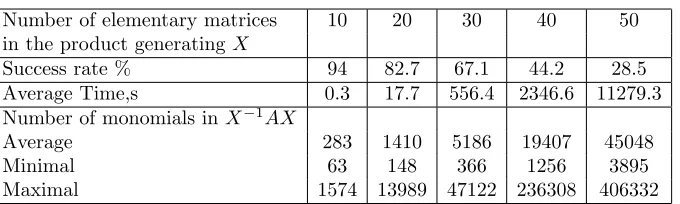
Algorithm 4 receives a pair A, B =X−1AX as the input. If it success-fully finds a conjugator Y (not necessarily equal to X) then it outputs Y, otherwise a failure is reported. We tested the effectiveness of the proce-dure described above by executing Algorithm 4 on sets of instances of the conjugacy search problem generated using Algorithm 2.
Algorithms were implemented in C++ using CRyptography And Groups (CRAG) [2] library. Since the size of input significantly depends on the number of elementary matrices used to generate the conjugator, experiments were performed for different lengths of the product. There were 100 instances generated using each value. Experiments were performed on a desktop PC with eight core 2.67GHz Intel i7 processor and 6 gigabytes memory.
The results of our experiments are shown in Table 1. From the table we can see that the attack can successfully break a significant portion of instances. Almost 30% of instances generated using products of 50 elemen-tary matrices were broken. This is the most hard case because of the size of the matrices in the conjugacy search problem. We want to point out that though we have considered matrices with 105 monomials in our proofs above, matrices of size 104 are already not very practical. It takes about 103 bits to store a single 1000-truncated monomial in 10 variables. Hence, public keys obtained using products of 50 elementary matrices will require several megabits of storage on average.
References
[1] I. Anshel, M. Anshel, D. Goldfeld, and S. Lemieux. Key agreement, the algebraic eraserT M, and lightweight cryptography. InAlgebraic Methods in Cryptography, vol-ume 418 ofContemporary Mathematics, pages 1–34. American Mathematical Society, 2006.
[2] CRyptography And Groups (CRAG) C++ Library. available at http://www.acc. stevens.edu/downloads.php.
Number of elementary matrices 10 20 30 40 50 in the product generatingX
Success rate % 94 82.7 67.1 44.2 28.5
Average Time,s 0.3 17.7 556.4 2346.6 11279.3 Number of monomials inX−1AX
Average 283 1410 5186 19407 45048
Minimal 63 148 366 1256 3895
Maximal 1574 13989 47122 236308 406332
Table 1. The success rate of solving the conjugacy search
problem using Algorithm 4.
[4] D. Garber, S. Kaplan, M. Teicher, B. Tsaban, and U. Vishne. Length-based conjugacy search in the braid group. In Algebraic Methods in Cryptography, volume 418 of
Contemp. Math., pages 75–88. Amer. Math. Soc., 2006.
[5] D. Grigoriev and V. Shpilrain. Authentication from matrix conjugation.Groups Com-plex. Cryptol., 1:199–206, 2009.
[6] J. Hughes and A. Tannenbaum. Length-based attacks for certain group based en-cryption rewriting systems. preprint. Available athttp://front.math.ucdavis.edu/ 0306.6032.
[7] I. Kapovich, A. G. Miasnikov, P. Schupp, and V. Shpilrain. Generic-case complexity, decision problems in group theory and random walks.J. Algebra, 264:665–694, 2003. [8] I. Kapovich, A. Myasnikov, P. Schupp, and V. Shpilrain. Average-case complexity
and decision problems in group theory.Adv. Math., 190:343–359, 2005.
[9] K. H. Ko, S. J. Lee, J. H. Cheon, J. W. Han, J. Kang, and C. Park. New public-key cryptosystem using braid groups. InAdvances in Cryptology – CRYPTO 2000, volume 1880 ofLecture Notes Comp. Sc., pages 166–183, Berlin, 2000. Springer. [10] J. Longrigg and A. Ushakov. Cryptanalysis of the shifted conjugacy authentication
protocol.J. Math. Crypt., 2:107–114, 2008.
[11] A. G. Miasnikov, V. Shpilrain, and A. Ushakov.Group-based Cryptography. Advanced Courses in Mathematics - CRM Barcelona. Birkh¨auser Basel, 2008.
[12] A. G. Miasnikov, V. Shpilrain, and A. Ushakov.Non-Commutative Cryptography and Complexity of Group-Theoretic Problems. Mathematical Surveys and Monographs. AMS, 2011.
[13] A. G. Miasnikov and A. Ushakov. Random subgroups and analysis of the length-based and quotient attacks.J. Math. Crypt., 2:29–61, 2008.
[14] A. D. Myasnikov and A. Ushakov. Length based attack and braid groups: Cryptanal-ysis of Anshel-Anshel-Goldfeld key exchange protocol. In Advances in Cryptology – PKC 2007, volume 4450 ofLecture Notes Comp. Sc., pages 76–88. Springer, 2007. [15] L. Sakalauskas, P. Tvarijonas, and A. Raulynaitis. Key agreement protocol (kap)
using conjugacy and discrete logarithm problems in group representation level. In-formatica, 18:115–124, 2007.
[16] V. Shpilrain and A. Ushakov. Thompson’s group and public key cryptography. In
Applied Cryptography and Network Security – ACNS 2005, volume 3531 of Lecture Notes Comp. Sc., pages 151–164. Springer, 2005.
[17] V. Shpilrain and A. Ushakov. A new key exchange protocol based on the decompo-sition problem. InAlgebraic Methods in Cryptography, volume 418 ofContemporary Mathematics, pages 161–167. American Mathematical Society, 2006.
[19] V. Shpilrain and A. Ushakov. An authentication scheme based on the twisted con-jugacy problem. In ACNS 2008, volume 5037 of Lecture Notes Comp. Sc., pages 366–372. Springer, 2008.
[20] V. M. Sidelnikov, M. A. Cherepnev, and V. Y. Yaschenko. Systems of open distri-bution of keys on the basis of noncommutative semigroups.Russian Acad. Sci. Dokl. Math., 48:384–386, 1994.
[21] A. Ushakov. Authenticated commutator key-agreement protocol. submitted. [22] L. Wang, L. Wang, Z. Cao, E. Okamoto, and J. Shao. New constructions of
Appendix A. Elementary conjugation formulas
E12−1(m)·A·E12(m) =
1 −m 0
0 1 0
0 0 1
a11 a12 a13
a21 a22 a23
a31 a32 a33
1 m 0
0 1 0
0 0 1
=
a11−ma21 a12+m(a11−a22)−m2a21 a13−ma23
a21 a22+ma21 a23
a31 a32+ma31 a33
E13−1(m)·A·E13(m) =
1 0 −m
0 1 0
0 0 1
a11 a12 a13
a21 a22 a23
a31 a32 a33
1 0 m
0 1 0 0 0 1
=
a11−ma31 a12−ma32 a13+m(a11−a33)−m2a31
a21 a22 a23+ma21
a31 a32 a33+ma31
E31−1(m)·A·E31(m) =
1 0 0
0 1 0
−m 0 1
a11 a12 a13
a21 a22 a23
a31 a32 a33
1 0 0
0 1 0
m 0 1
=
a11+ma13 a12 a13
a21+ma23 a22 a23
a31+m(a33−a11)−m2a13 a32−ma12 a33−ma13
E23−1(m)·A·E23(m) =
1 0 0
0 1 −m
0 0 1
a11 a12 a13
a21 a22 a23
a31 a32 a33
1 0 0
0 1 m
0 0 1
=
a11 a12 a13+ma12
a21−ma31 a22−ma32 a23+m(a22−m33)−m2a32
a31 a32 a33+ma32
E21−1(m)·A·E21(m) =
1 0 0
−m 1 0
0 0 1
a11 a12 a13
a21 a22 a23
a31 a32 a33
1 0 0
m 1 0
0 0 1
=
a11+ma12 a12 a13
a21+m(a22−a11)−m2a12 a22−ma12 a23−ma13
a31+ma32 a32 a33
E32−1(m)·A·E32(m) =
1 0 0
0 1 0
0 −m 1
a11 a12 a13
a21 a22 a23
a31 a32 a33
1 0 0
0 1 0
0 m 1
=
a11 a12+ma13 a13
a21 a22+ma23 a23
a31−ma21 a32+m(a33−a22)−m2a23 a33−ma23
Appendix B. Reduced sets of monomial candidates.
M12(Ci) = Frac(−c11,min(c21))∪Frac(c12,min(c11))∪Frac(−c12,min(c22))∪
Frac(−c13,min(c23))∪Frac(c22,min(c21))∪Frac(c32,min(c31)).
M13(Ci) = Frac(−c11,min(c31))∪Frac(−c12,min(c32))∪Frac(c13,min(c11))∪
Frac(−c13,min(c33))∪Frac(c23,min(c21))∪Frac(c33,min(c31)).
M31(Ci) = Frac(c11,min(c13))∪Frac(c21,min(c23))∪Frac(c31,min(c33))∪
Frac(−c31,min(c11))∪Frac(−c32,min(c12))∪Frac(−c33,min(c13)).
M23(Ci) = Frac(−c21,min(c31))∪Frac(−c22,min(c32))∪Frac(c13,min(c12))∪
Frac(c23,min(c22))∪Frac(−c23,min(c33))∪Frac(c33,min(c32)).
M21(Ci) = Frac(c11,min(c12))∪Frac(c21,min(c22))∪Frac(−c21,min(c11))∪
Frac(c31,min(c32))∪Frac(−c22,min(c12))∪Frac(−c23,min(c13)).
M32(Ci) = Frac(−c31,min(c21))∪Frac(c12,min(c13))∪Frac(c22,min(c23))∪
Frac(c32,min(c33))∪Frac(−c32,min(c22))∪Frac(−c33,min(c23)).
Department of Mathematics, Stevens Institute of Technology, Hoboken, NJ, USA