Birthday Forgery Attack on 128-EIA3
(V ersion1.5)Raja Zeshan Haider
National University of Science and Technology, Pakistan
Abstract. 128-EIA3 is an integrity algorithm considered for adoption as a third integrity algorithm by European Telecommunication Standard Institute (ETSI) for 4th generation of GSM networks.128-EIA3 is vul-nerable to birthday forgery attack. Birthday forgery attack requires min-imum 216 known message-MAC pairs for finding collision in 128-EIA3. 128-EIA3 is susceptible to internal collision of its universal hash function and external collision of its Xoring transformation. Birthday forgery at-tack on 128-EIA3 allows message forgery with success probability greater than 1/232.
Keywords: Collision, Message Authentication Code (MAC), Message Forgery
1
Introduction
The evolution of third generation UMTS (Universal Mobile Telecommunication System) comprising of new radio access system named LTE (Long Term Evolu-tion) and a new core network named SAE (System Architecture EvoluEvolu-tion) in-troduced two standardized algorithms, namely 128-EEA3,Encryption algorithm and 128-EIA3,Integrity algorithm. This resulting algorithm set is based on a core stream cipher algorithm named ZUC, after Zu Chongzhi, the famous Chinese sci-entist. The algorithms were designed at the Data Assurance and Communication Security Research Center (DACAS) of the Chinese Academy of Sciences. Prelim-inary drafts of their specifications [1, 2] are currently open for public evaluation, after their preliminary evaluation by ETSI (European Telecommunication Stan-dard Institute) task force and two funded teams of academic experts mandated by ETSI. After its adoption by 3GPP (3rd Generation Partnership Project), 128-EIA3 will represent the third LTE integrity algorithm.
In this paper we show that 128-EIA3 is vulnerable to birthday forgery attack. The attack is based on the well known problem of birthday paradox and it requires minimum 216 known message-MAC pairs for finding collision in
EIA3.Birthday forgery attack aims to find internal and external collision in 128-EIA3 for distinct messages of same length.
Outline of paper. In Section 2 short description of 128-EIA3 Integrity algo-rithm is provided.In section 3 birthday forgery attack on 128-EIA3 is described alongwith results and findings.In section 4 a variant of 128-EIA3 is suggested to thwart the birthday forgery attack.
2
Description of 128-EIA3 Algorithm
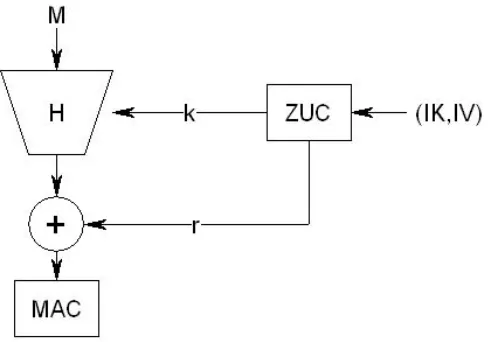
128-EIA3 is a universal a hash function which makes black box use of ZUC. 128-EIA3 takes input 128-bit key named integrity key IK and 128-bit initial-ization vector IV. IV is calculated from a set of parameters i.e.32-bit counter, 5-bit bearer identity, 1-bit direction which determines the direction of trans-mission; 0 for uplink and 1 for downlink.Counter variable of IV is incremented for each invocation of 128-EIA3 MAC generation oracle.IK and IV are input to the ZUC for generating key stream of length 64-bit more than the length of the message.128-EIA3 processes messages of length between 1 and 20000 bits and produces a 32-bit MAC value. Message is padded with a bit 1 before MAC calculation.Structure of 128-EIA3 is mentioned in following figure.
Fig. 1.Structure of 128-EIA3
makes use of the following universal hash function H:K×{0,1}∗→ {0,1}32 as
the message authentication code function.
H(k, x) =
k1 k2 · · · km+1
k2 k3 · · · km+2
..
. ... . .. ...
k32k33 · · ·km+32
x1 x2 .. . xm 1
The universal hash function above for 128-EIA3 is similar to the one based on Toeplitz matrix, with the exception that this universal hash function can handle variable-input-length messages.The output of universal hash function H is Xored with masking value derived from the ZUC generated keystream.Procedure for MAC calculation in 128-EIA3 algorithm is as follows.
Algorithm of 128-EIA3
Input: IK ∈ {0,1}128, IV ∈ {0,1}128 Where IV=IV(Count,Bearer,Direction)
Input:M= (m0, . . ., ml−1)∈ {0,1}l
keystream:(ks0, . . .,ksl+63)←ZUC(IK,IV)
T = 0
fori=0 tol-1 do Wi←(ksi, . . .,ksi+31)
if mi= 1 then
T←T⊕Wi
end if end for
Wl ←(ksl, . . .,ksl+31)
T ←T⊕Wl
Wmask ←(ksl+32, . . .,ksl+63)
MAC=T⊕Wmask
Output:MAC
3
Birthday Forgery Attack on 128-EIA3 Algorithm
Considering 128-EIA3 it can be divided into two components ,one is universal hash function H whose universality is based on the length of the message and hamming weight of the message and other is Xoring of the hash result with the masking value.Consider the message pair (x, x´)wherex,x´ are distinct messages of same length, with h(x) = g(Ht) and h(x´) = g(H
0
t) ,where h(x) relates to
128-EIA3 integrity algorithm,Htis the hash result of universal hash function H
and g is the output transformation that is the Xoring of the hash result with the masking value. Collisionh(x) =h(x´) can be of two reasons ,ifHt=H
0
t it is
said to be internal collision ,ifHt6=H
0
t butg(Ht) =g(H
0
t) it is said to be
exter-nal collision.128-EIA3 is prone to both interexter-nal and exterexter-nal collision.Interexter-nal collision in context of 128-EIA3 refers as the collision found in universal hash function H whereas external collision refers as collision due to Xoring transfor-mation of masking value with the hash result of the universal hash function H.
3.1 Internal Collision on 128-EIA3
128-EIA3 is susceptible to internal collision of its universal hash function H for distinct messages of same length under the same IK and IV.Internal collision of universal hash function H leads to external collision of 128-EIA3 under the same IK and IV.Internal collision on 128-EIA3 requires minimum 216known
message-MAC pairs and one chosen message to launch a verifiable message forgery under the same IK and IV with success probability of 1.
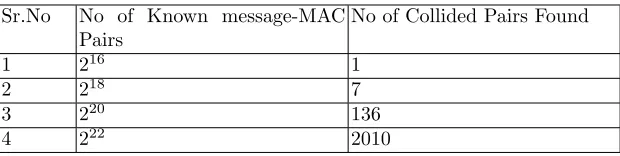
As in case of internal collision of message pair (x, x´),128-EIA3 will generate the same MAC for h(xky)= h(x´||y) for any single block y under the same IK and IV.The probability for finding internal collision in 128-EIA3 increases by increasing queries to MAC generation oracle.Although internal collision on 128-EIA3 under the same IK and IV is a trivial case but it exibits implications of reusage or repetition of IV under the same key.Occurrence of collided pairs in 128-EIA3 due to internal collision of universal hash function H under the same IK and IV for different known message-MAC pairs are as follows.
Sr.No No of Known message-MAC Pairs
No of Collided Pairs Found
1 216 1
2 218 7
3 220 136
4 222 2010
Table 1: Internal Collision Statistics.
3.2 External Collision on 128-EIA3
– IK is fixed and COUNTER variable of IV is incremented for each invocation of 128-EIA3 MAC generation oracle.
– IK is randomly generated and COUNTER variable of IV is incremented for each invocation of 128-EIA3 MAC generation oracle.
Above mentioned cases require minimum 216 known message-MAC pairs for
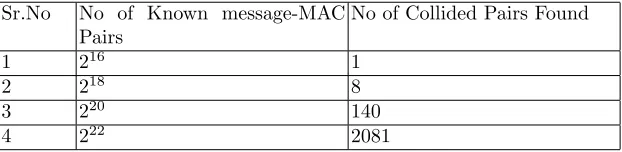
finding external collision in 128-EIA3. Probability for finding external collision in 128-EIA3 increases by increasing queries to 128-EIA3 MAC generation ora-cle.Occurrence of collided pairs in 128-EIA3 due to external collision of Xoring tranformation under different IK and IV for different known message-MAC pairs are as follows.
Sr.No No of Known message-MAC Pairs
No of Collided Pairs Found
1 216 1
2 218 8
3 220 140
4 222 2081
Table 2: External Collision Statistics.
The success probability of an opponent who wants to obtain a correct MAC value is equal to max(2−ik,2−m), whereik is the key length of IK in bits and
m is the length of the MAC result in bits.In case of 128-EIA3 success proba-bility of an opponent to obtain a correct MAC is greater than 2−32 as collision
is inevitable in 128-EIA3.A malicious attacker while observing communication in a GSM network and having access to MAC verification oracle can easily forge a message with success probability greater than 1/232.This situation can
be catastrophic when a centralized GSM authentication centre is autheticating subscribers and other elements of GSM network.The Design and Evaluation Re-port [5] erroneously invokes the security proofs of 128-EIA3 that no forgery of a new message can succeed with probability greater than 1/232.
4
Variant of 128-EIA3
Variant Algorithm of 128-EIA3
Input: IK ∈ {0,1}128, IV ∈ {0,1}128 Where IV=IV(Count,Bearer,Direction)
Input:M= (m0, . . ., ml−1)∈ {0,1}l
keystream:(ks0, . . .,ksl+63)←ZUC(IK,IV)
T = 0
Seq−N o= 1 fori=0 tol-1 do Wi←(ksi, . . .,ksi+31)
if mi= 1 then
T←T⊕Wi
end if end for
Wl ←(ksl, . . .,ksl+31)
T ←T⊕Wl
Wmask ←(ksl+32, . . .,ksl+63)
MAC=T⊕Wmask
MAC=MACkEN C ZU C(Seq−N o)
Output:M AC
Variant of 128-EIA3 is capable to thwart the birthday forgery attack but it requires in-depth analysis not only in terms of its cryptographic strength but also in context of its implementation perspective in GSM network,in realm of Long Term Evolution (LTE) security.
5
Conclusion and Direction for Future Work
128-EIA3 is not a-Almost Xor Universal hash function as it is susceptible to birthday forgery attack.Both internal collisions and external collisions are found in 128-EIA3.128-EIA3 if implemented in existing structure will have devastat-ing effect on the integrity mechanisms of GSM as it has to be implemented in Subscriber Identity Module (SIM) cards and in GSM network authentication centres.Applicability of key/keystream recovery attacks based on collision should be considered for 128-EIA3.
References
[2] ETSI/SAGE. Specification of the 3GPP Confidentiality and Integrity Algorithms 128-EEA3 128-EIA3. Document 2: ZUC Specification. Version 1.5, 4th January 2011. http://www.gsmworld.com/documents/EEA33ZUC1 5.pdf.
[3] J.L. Carter, M.N. Wegman, Universal classes of hash functions, Journal of Com-puter and System Sciences, Vol. 18, 1979, pp. 143154.
[4] B. Preneel, P.C. van Oorschot, ”MDx-MAC and building fast MACs from hash functions,” , Proc. Crypto’95, LNCS 963,Springer-Verlag, 1995, pp. 1-14.