© 2016, IJCSMC All Rights Reserved
143
Available Online atwww.ijcsmc.com
International Journal of Computer Science and Mobile Computing
A Monthly Journal of Computer Science and Information Technology
ISSN 2320–088X
IMPACT FACTOR: 6.017IJCSMC, Vol. 5, Issue. 11, November 2016, pg.143 – 148
A Technique of Combine Feature Selection and
Instance Selection for Effective Bug Triage
Aparna S. Murtadak
1, Prof. S. R. Durugkar
21
Department of Computer Engg, S.N.D.C.O.E.R.C. Yeola, Dist-Nasik, Savitribai Phule Pune University, Maharashtra, India
2
Department of Computer Engg, S.N.D.C.O.E.R.C. Yeola, Dist-Nasik, Savitribai Phule Pune University, Maharashtra, India
1
[email protected], 2 [email protected]
Abstract — The procedure of fixing bug is called as bug triage that expects to appropriately assign a developer to a new bug. Programming system firms pay huge cost in dealing with these software bugs. To diminish the time cost and labor cost of bug triaging, here presents an automatic approach to predict developer with significant skill to determine the new coming bug report. In proposed approach for Data reduction two data preprocessing techniques are used. It reduces the dimensions of Bug data set still maintaining the integrity of original bug data set. Diminishing the dimensionality of the data has been a difficult task in data mining but it is very important for accurate bug triage. And for Bug triage Naive Bayes and KNN algorithms are used in proposed approach. The experimental results demonstrate that the intended theme will efficiently improve the detection performance compared with earlier methods.
Keywords — Bug, Bug data reduction, Bug triage, Feature selection, Instance selection, Prediction for reduction order
I. INTRODUCTION
The procedure of extricating valuable data through data analysis is called data mining. Helpful information is obtained as a result of data mining which can be utilized to cut the expenses and time. In current programming development, software repositories are large-scale databases for storing the output of programming improvement. First stride in bug repository is to manage programming bugs but Bug fixing is an imperative and tedious procedure in programming support. Open source development projects normally consolidate an open bug repository to which both programming developers and clients can report bugs. The benefit of an open bug repository is that it might permit more bugs to be recognized and solved, enhancing the quality of the product item.
© 2016, IJCSMC All Rights Reserved
144
Because of the tremendously large number of bugs being accounted in Bug Repository, their classification during triaging is a boring and tedious procedure. Analysts have been for quite a while struggling to automate the bug triaging job. Decent success has also been accomplished.
Jeong et al. discover that more than 37 percent of bugs have been reassigned in manual bug triage and propose a graph based model Markov chains, which catches bug tossing history. This model has a few satisfying qualities. To begin with, it shows developer networks which can be utilized to discover group structures and to discover reasonable specialists for new task. Second, it assists to allocate master developers to bug reports [7]. To enhance the quality of bug reports, Breu et al. have manually examines 600 bug reports in open source developments to look for disregarded data in bug information [11].
Matter et al. propose an expertise model in view of source code contributions and apply in it a recommendation framework that allocates developers to bug reports. They compare vocabulary found in the developers contributions with the vocabulary found in the explanation of a bug report. And after that suggest developers whose contribution vocabulary is lexically like the vocabulary of the bug report [14]. Expansive open source developments are troubled by the rate at which new bug reports show up in the bug repository. In this paper authors present a semi-automated approach is used to the task a bug reports to a developer. This methodology applies a machine learning algorithm to the open bug archive to take in the sorts of reports every developer resolves. At the point when new bug report arrives, the classifier delivered by the machine learning procedure suggests a little number of developers appropriate to solve the bug report [2].
Park et al. change over bug triage into an improvement issue and propose a collaborative filtering approach to deal with manage diminishing the bug fixing time, which improves the recommendation quality [16]. From the above literature survey, it is concluded that early recognition and classification of bugs is important for maintaining the quality of software.
III. PROPOSED SYSTEM
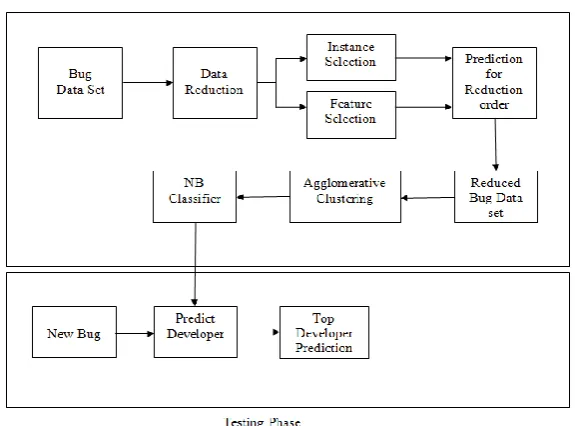
The procedure of fixing bug is a bug triage that expects to appropriately assign a developer to a new bug. But manual bug triage procedure is exceptionally tedious and excessive. So to escape time cost automatic bug triage in which text classification methods are used. The issue which is addressed for this is the huge bug dataset. Also, the huge bug dataset affects the quality of the bug datasets. So to lessen the bug dataset we used Feature selection and Instance selection procedures as shown in architecture. This procedures decreases the bug data in both word and bug dimensions. The proposed system gives the high quality of data and reduces the scale of data.
© 2016, IJCSMC All Rights Reserved
145
Fig 1: System Architecture
A. Pre-processing
The most vital stride of Data mining is data pre-processing. Raw data is acquired from bug repositories which can't be straightforwardly utilized for the further algorithms. Hence the information should be pre-processed to make it functional. Data pre-preparing is a monotonous stride of Data mining and most vital also. Therefore Data pre-processing is very important step in Implementation.
B. Instance Selection (IS):
Instance Selection is for acquiring a subset of relevant instances (i.e. important bug reports in bug data set). In Proposed system the purpose of Instance Selection algorithm is to reduce the size of a bug dataset by removing duplicate bug reports and keeping the originality of the bug dataset.
C. Feature Selection (FS):
This aims to acquire a subset of relevant features (i.e. important words in bug data set). In Proposed system the purpose of feature selection algorithm is to eliminate the irrelevant and redundant words from the selected bug data set, thus optimizing the efficiency of the classification and clustering algorithms.
IV. IMPLEMENTATION DETAILS
A. Dataset
To perform the experiments, we should set up the dataset for bug data reduction. In this paper bug data set of two large open source projects eclipse and Mozilla are used for experiment. Eclipse is a multi-language software development environment, including an Integrated Development Environment (IDE). And Mozilla is an open source web browser.
B. Algorithms
Following algorithms are used for data reduction in bug fixing. Instance Selection Algorithm:
Input: Bug Data set
© 2016, IJCSMC All Rights Reserved
146
{
for(j=i+1 to fdn)
{
Calculate distance using Pearson correlation score calculation
}
Step 5.1: Apply KNN to find top similar document to current document as set (ks)
Step 5.2: Remove all ks set from corpus
}
Step 6: Repeat step 5 for all Bug reports.
Feature Selection Algorithm:
Input: Bug Data set
Output: The set of selected words
Processing steps:
Step 1: Read all bug reports from input bug data set.
Step 2: Calculate unique words array U.
Step 3: Calculate term frequency of each unique word for every bug report.
Step 4: Re-rank all words in U.
Step 5: Calculate zero count for each word in all reports.
Step 6: Remove all words having information gain less than T.
Where T is user define threshold value.
Step 7: Calculate performance of Feature selection algorithm
Step 8: Display updated new bug data.
V. RESULT ANALYSIS
© 2016, IJCSMC All Rights Reserved
147
Fig 2: Result on Eclipse data set
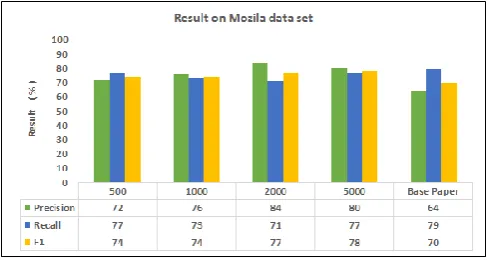
Below figure 3 shows result of Bug Triage accuracy with Instance selection and Feature selection on Mozilla in term of Precision, recall and F1 in comparison with Base paper result.
Fig 3: Result on Mozilla data set
VI. CONCLUSION
In this paper i have focused on data reduction for effective Bug triage. Bug triage is a costly stride of programming upkeep in both work cost and time cost. In this paper the proposed system focused on lessening bug information set with a specific goal to have less size of data and quality data, for that two data reduction techniques are used that is Instance Selection and Feature Selection. The Proposed system can be used any large open source development for large scale bug data. This reduces the large scale of bug data and provides high quality data. This data reduction is necessary for effective bug triage. And for bug triage KNN and Naive Bayes algorithms are used in this paper. In future we can use this system for any large project for data reduction and effective bug triage.
ACKNOWLEDGEMENT
I am very much thankful to all authors those are mentioned in the references. I would like to thanks my guide for their constant support and motivation. Also I would like to thanks PG coordinator and HOD of computer department who helped me in presenting this paper.
R
EFERENCES[1] Jifeng Xuan, He Jiang, Yan Hu, Zhilei Ren, Weiqin Zou, Zhongxuan Luo, and Xindong Wu,” Towards Effective Bug Triage with Software Data Reduction Techniques” IEEE transactions on knowledge and data engineering, vol. 27, no. 1, january 2015.
[2] J. Anvik, L. Hiew, and G. C. Murphy, “Who should fix this bug?” in Proc. 28th Int. Conf. Softw. Eng., May 2006, pp. 361–370.
© 2016, IJCSMC All Rights Reserved
148
[9] J. Anvik and G. C. Murphy, “Reducing the effort of bug report triage: Recommenders for development-oriented decisions,” ACM Trans. Soft. Eng. Methodol., vol. 20, no. 3, article 10, Aug. 2011.
[10] R. J. Sandusky, L. Gasser, and G. Ripoche, “Bug report networks: Varieties, strategies, and impacts in an F/OSS development community,” in Proc. 1st Intl. Workshop Mining Softw. Repositories, May 2004, pp. 80–84.
[11] S. Breu, R. Premraj, J. Sillito, and T. Zimmermann, “Information needs in bug reports: Improving cooperation between developers and users,” in Proc. ACM Conf. Comput. Supported Cooperative Work, Feb. 2010, pp. 301–310.
[12] S. Kim, K. Pan, E. J. Whitehead, Jr., “Memories of bug fixes,” in Proc. ACM SIGSOFT Int. Symp. Found. Softw. Eng., 2006, pp. 35–45.
[13] T. Zimmermann, R. Premraj, N. Bettenburg, S. Just, A. Schroter, and C. Weiss, “What makes a good bug report?” IEEE Trans. Softw. Eng., vol. 36, no. 5, pp. 618–643, Oct. 2010.
[14] D. Matter, A. Kuhn, and O. Nierstrasz, “Assigning bug reports using a vocabulary-based expertise model of developers,” in Proc. 6th Int. Working Conf. Mining Softw. Repositories, May 2009, pp. 131–140.
[15] S. Just, R. Premraj, and T. Zimmermann, “Towards the next generation of bug tracking systems,” in VL/HCC, pages 82– 85, 2008.