i
KNOWLEDGE MANAGEMENT AND PEFORMANCE OF KPMG IN NAIROBI CITY COUNTY, KENYA
Knowledge management and performance of kpmg…
FIDEL OKILLAH OSOME D53/OL/CTY/26746/14
A RESEARCH PROJECT SUBMITTED TO THE SCHOOL OF BUSINESS IN PARTIAL FULFILMENT OF THE REQUIREMENT FOR THE AWARD OF DEGREE IN MASTER OF BUSINESS ADMINISTRATION OF KENYATTA
ii
NOVEMBER, 2018 DECLARATION
I declare that, this project is my own original work and has not been presented for the award of any degree in any University.
Signed: ___________________________ Date ____________________
FIDEL OKILLAH OSOME D53/OL/CTY/26746/14
This research project has been submitted for the course examination with my approval as the University supervisor.
Signed: __________________________ Date_________________
Mr. Shadrack Bett
Department of Business Administration
iii
DEDICATION
iv
ACKNOWLEDGEMENT
v
TABLE OF CONTENTS
DEDICATION... iii
ACKNOWLEDGEMENT ... iv
TABLE OF CONTENTS ... v
LIST OF TABLES ... viii
LIST OF FIGURE ... ix
ABBREVIATIONS AND ACRONYMS ... x
OPERATIONAL DEFINITION TERMS ... xi
ABSTRACT ... xii
CHAPTER ONE: INTRODUCTION ... 1
1.1 Background of the Study ... 1
1.1.1 Organizational Performance ... 4
1.1.2 Knowledge Managmeent ... 6
1.1.3 KPMG ... 7
1.2 Statement of the Problem ... 9
1.3 Objectives of the Study-... 11
1.3.1 General Objective ... 11
1.3.2 Specific Objectives ... 11
1.4 Research Questions ... 11
1.5 Significance of the Study ... 12
1.6 Scope of the Study ... 12
1.7 Limitation of the Study ... 12
1.8 Organization of the Study ... 13
CHAPTER TWO : LITERATURE REVIEW ... 14
2.1 Introduction ... 14
2.2 Theoretical Literature Review ... 14
2.2.1 Resource Based View theory ... 14
2.2.2 Knowledge based view of the firm ... 15
2.2.3 Learning Organization Theory ... 16
2.3 Empirical Literature Review ... 17
vi
2.3.2 Knowledge Sharing and Firm Performance ... 20
2.3.3 Knowledge Storage and Firm Performance ... 23
2.4 Research Gaps ... 27
2.5 Conceptual Framework ... 28
CHAPTER THREE : RESEARCH METHODOLOGY ... 30
3.1 Introduction ... 30
3.2 Research Design ... 30
3.3 Target Population ... 30
3.4 Sampling Procedure ... 31
3.5 Data Collection Instrument ... 31
3.6 Validity and Reliability of the study ... 32
3.6.1 Validity ... 32
3.6.2 Reliability ... 32
3.7 Data Collection Procedure ... 33
3.8 Data Analysis and Presentation ... 34
3.9 Ethical Considerations ... 35
CHAPTER FOUR: RESEARCH FINDINGS AND DISCUSSIONS ... 36
4.1 Introduction ... 36
4.1.1 Response Rate ... 36
4.2 Demographic Information ... 37
4.2.1 Distribution of Respondents by Age ... 37
4.2.2 Distribution of Respondents by Gender ... 37
4.2.3 Respondents‟ Length of Service at KPMG ... 38
4.2.4 Level of Management ... 38
4.2.5 Knowledge Management ... 39
4.3 Descriptive Statistics ... 39
4.3.1 Knowledge Creation and Performance of KPMG ... 39
4.3.2 Knowledge Sharing and Performance of KPMG ... 41
4.3.3 Knowledge Storage and KPMG Performance ... 42
4.3.4 Knowledge Dissemination And Firm Performance ... 43
vii
4.4 Regression Analysis ... 45
4.4.1 Model Summary ... 46
4.4.2 ANOVA ... 46
4.4.3 Regression Coefficients ... 47
4.5 Key Findings and Discussions ... 48
CHAPTER FIVE: SUMMARY, CONCLUSION AND RECOMMENDATIONS ... 50
5.1 Introduction ... 50
5.2 Summary of the Findings ... 50
5.3 Conclusion ... 52
5.4 Recommendations for Policy and Practice ... 53
5.5 Suggestions for Further Studies ... 54
REFERENCES ... 55
APPENDICES ... 59
APPENDIX I: Introduction Letter ... 59
viii
LIST OF TABLES
Table 2.1 Research Gaps... 27
Table 3.1 Target Population ... 31
Table 3.2 Sample Size... 31
Table 4.1: Age ... 37
Table 4.2: Gender... 37
Table 4.3: Length of Service ... 38
Table 4.4: Level of Management ... 38
Table 4.5: Knowledge Management ... 39
Table 4.6: Knowledge Creation and Performance of KPMG ... 40
Table 4.7: Knowledge Sharing and Performance of KPMG ... 41
Table 4.8: Knowledge storage and KPMG Performance ... 42
Table 4. 9: Knowledge Dissemination And Firm Performance ... 43
ix
LIST OF FIGURE
x
ABBREVIATIONS AND ACRONYMS ICPAK Institute of Certified Public Accounts of Kenya
KM Knowledge management
KPMG Klynveld Peat Marwick Goerdeler
KS Knowledge sharing
KV Knowledge View of a Firm
NSE Nairobi Securities Exchange
OL Organizational Learning
PWC Price Water Coopers
RBV Resource Based View of a firm SPSS Statistical Package For Social Science
xi
OPERATIONAL DEFINITION TERMS
Knowlede dissemination the process of retrieving information, skills, processes that were stored to enable spur new skills and counter competitition. It invoves converting knowledge stored into use Knowledge creation process involved in generating know-how, skills and
experience and processes in an organization and integrating it in the employees and firm systems to improve performance Knowledge management the process of sourcing, creating, sharing, storing and
disseminating ideas, skills and experience in an organization Knowledge sharing the process of transferring knowledge, skills and competencies
to new staff, existing and growing human resource to foster performance
Knowledge storage the preservation and maintance of knowledge, processes, methods and skills developed by a firm to use later and improve performance and remain competitive
xii ABSTRACT
1
CHAPTER ONE INTRODUCTION
1.1Background of the Study
Company performance informs the reason as to why it was initiated and exists. Investors and shareholders always anticipate high returns on their investment and equity. However this has not always been realized especially in the current regime of high competition given the high number of entrants and free market economy (Ongeti, 2014). Audit firms have been faced with stiff competition due to poor strategic management and implementation. One of these key strategy is knowledge management.
Knowledge management is deemed as a benefit to marketing-oriented companies considering its diversification across other disciplines: Tan, (2011) states that knowledge should be accentuated. According to a study by Rajender and Kumar, (2012) in the United Kingdom, information and knowledge being re-used minimizes clarity of past projects and prevents cost wastage in rectifying challenges. Eminence of solutions during the construction phase of a construction project is hence improved.
2
encouraged (Senge, 1990). KS leads to organizational learning (OL) by making employees better problem solvers, more creative and innovative thinkers, more confident and proficient workers through provision of skills, insights and competences to perform work well (Kumaraswamy & Chitale, 2012). A firm‟s ability to gather, analyze and use knowledge is a requirement for business success (Senge, 1990).
By the resource profile of a company, enactment is driven whereas RBV states that superior performance source according to Wernerfelt, (1984) is embedded in the possession and deployment of distinctive resources that are difficult to imitate. In accordance with knowledge-based theory of the firm, knowledge is an important resource for the organization. Because of their KMS, the KBV illustrates that firms can differentiate themselves whereas according to Janz and Prasarnphanich, (2003), for an organization to remain competitive in the turbulent environment, there is need for them to align their action and gaols as stated in the theory of organization learning.
3
companies. New strategic imperative of organizations is progressively being acknowledged as Knowledge. Changing of operating environment according to Aosa (2002), is leading to the renovation of the business landscape. For adaptation of the changing business environment, strategy was therefore vital. The study hence tries to establish the influence of knowledge management on performance of selected audit firms in Kenya.
The new era of technological application is KM; incorporated in decision-making, critical planning etc. Knowledge according to Sher and Lee, (2004) is hence slowly next to labor, land and capital becoming the most important factor of production. The essence of competitive advantage according to Liu and Wei, (2009) is providing various abilities, which promote uniqueness to various companies such as Knowledge-based assets or resources. Dalkir (2005), states that a strategic approach is needed to ensure that they utilise the company‟s knowledge base, and also some of their individual skills, competences, thoughts, and ideas to establish a more effective company is represented by knowledge management.
4
KM processes as used by David and Yusoff (2010) included acquiring of knowledge and applying this knowledge, to increase social capital and having the company‟s performance improved. Knowledge is the most strategically significant resource of the firm as considered by the KBV theory. This opinion is made up of knowledge-holding employees considers a firm to be a distributed knowledge system. Moreover it maintains a firm's role to be coordination of the employees‟ work so that the knowledge and value for the firm is created (David &Yusoff, 2010; Spender, 1996).
According to Takeuchi and Nonaka, (2004), for the organisation to acquire, store and utilise knowledge for problem solving, dynamic learning etc., there has to be the aid of knowledge management practices. Moreover according to Lang, (2004), KM is able to curb decay and loss from intellectual assets. So as to sustain competitive advantage, knowledge assets should be maintained and managed. Knowledge management hence poses a strategic issue for companies (Curado, 2008; Stam, 2007; Warner &Witzed, 2004).
1.1.1 Organizational Performance
5
competencies and involving employee‟s enthusiasm. The organizational performance has been conceptualized from two perspectives; financial perspective and the non-financial perspectives. The traditional means of measuring the organizational performance was through the financial measurements only (Gitau, 2014).
The organization performance approach examines indicators the firm financial indicators only. New performance measurement frameworks that accommodate both the financial and non-financial measurements have been introduced. This includes the balanced score card, integrated performance measurement, shareholder model and the performance management framework. Some scholars have advocated for a mixture of the financial and non-financial performance measures. This mixture recommended organizational performance as stated by Mwandebe, (2009) in his study used profitability as the only financial measure of performance. Firm market share, productivity, leadership, corporate social responsibility, staff development and one financial and seven nonfinancial metrics namely Profitability, Market share, Productivity, Product leadership, Public responsibility, Personnel development, Employee attitudes and Balance between short range and long-range objectives.
6
commonly used include the productivity of the organization, organizational effectiveness and industry rating. He has provided the case of General Electric to illustrate these measures, which uses profitability, market position, productivity, product leadership, personnel development, employees‟ attitude and social responsibility as measures of performance.
Gittell (2005) on his part has explained key success factors in organizational performance, which include leadership, culture strategy and coordination. Another tool of measuring performance is the balanced scorecard. It also entails rules that give top administrators an understandable assessment of business. Business rules that explain results of actions already taken are considered. These financial measures have operational measures that deal with customer satisfaction, internal processes and the organization‟s innovation and improvement activities. For managers to be able to view performance in several areas simultaneously one has to consider the complexity of managing an organization. According to Kaplan and Norton, (2012) it entails looking at business from the following dimensions: internal processes; Innovation and learning and financial perspective.
1.1.2 Knowledge Managmeent
7
Jashapara, (2004) are those that adopt knowledge management in a strategic manner. The exploitation and development of knowledge assets in order to fulfill an organization‟s objectives is linked to knowledge management.
According to Zack, McKeen& Singh, (2009), observable organizational activities related to knowledge management are knowledge management activities. Various knowledge management have led to the implementation of formal approaches to knowledge management hence influencing the application of organizational knowledge. From KM, stand point KM practices and organizational performance are related as put up by previous studies. A study conducted by Suzana and Kasim (2010) on the role played by knowledge management in enhancing firm performance. The study found that levels of knowledge management were essential in identifying and improving organizational performance.
Knowledge management take different forms therefore, it is necessary to take a flexible approach in describing and classifying them. Six categories as conducted by Earl (2001) entail leadership, knowledge capture and acquisition, training and mentoring, policies and strategies, communication and incentives. Coombs and Hull (1998) describes approach which are both formal and informal practices; written and unwritten; fully knowledge-centered or only partially knowledge-knowledge-centered and so on. These routines are involved directly in knowledge application resulting to an organization‟s being able to transform its operations and explore new opportunities.
1.1.3 KPMG
8
East Africa has considerable experience in audit, tax and advisory services. The Nairobi office serves as the regional co-ordinating office providing the required networking to facilitate delivery of services on a timely basis to meet and exceed our clients‟ expectations. The firm is located at the ABC Towers 8th Floor, Westlands, Nairobi.
KPMG is among the 4 audit firms which include Ernst & Young, PricewaterhouseCoopers, and Deloitte & Touché , which are both local and international, oriented. These firms are registered as local partnerships and operate under the mandate of Institute of Certified Public Accountants of Kenya. They are subject to international quality performance reviews from the global network to ensure optimum performance and manage reputational risk. Four international accounting firms dominate the accounting profession in Kenya, which includes about 50 publicly traded companies listed on NSE.
9
Four (4) auditing firms are in control of Kenya‟s auditing industry with KPMG coming 3rd
after PWC and Delloite. These firms in addition have global roots. The difference in their strategies development and implementation is that the Big 4 has global standards. Local audit firms on the other hand, independently develop and implement their own strategies.
1.2 Statement of the Problem
Performance of firms globally and locally has been on the decline due to high competition, unfavourable government fiscal and monetary policies, poor management coordination and stakeholder involvement and above all poor knowledge management. Audit industry involves firms that check on the integrity and accountability nature of the accounting and finance structures among organizations.
10
Audit firms respond to competition in different ways. KBV has identified that what audit firms need to improve the industry is advanced knowledge as stated by Malik and Malik, (2008). Despite knowledge being recognized as an important asset many audit firms are not doing enough to effectively manage this important asset for competitive advantage (Gan, Ryan &Gururajan, 2006). Furthermore, effective knowledge management can help audit firms to improve internal processes, customer services and products (Rono, 2011). Audit firms can effectively use knowledge management to enhance their competitiveness. Newman (2009) views KM as a discipline sought to enhance how individuals and companies by maintaining the present and future value of knowledge assets.
11
that knowledge management affects employee performance in the bank and improve banks competitiveness.
1.3 Objectives of the Study- 1.3.1 General Objective
The general objective of the study was to determine the influence of knowledge management on performance of KPMG Kenya.
1.3.2 Specific Objectives
The study was guided by the following specific objectives:
i. To find out the influence of knowledge creation on the performance of KPMG Kenya ii. To establish the effect of knowledge sharing on the performance of KPMG Kenya iii. To assess the influence of knowledge storage on the performance of KPMG Kenya iv. To assess the influence of knowledge dissemination on the performance of KPMG
Kenya
1.4 Research Questions
The study sought to answer the following research questions;
i. What is the influence of knowledge creation on the performance of KPMG Kenya? ii. How does knowledge sharing influence the performance of KPMG Kenya?
iii. Does knowledge storage affect the performance of KPMG Kenya?
12 1.5 Significance of the Study
The study would be vital for policy invention in Kenyan Auditing Sector. This study ultimately facilitated utilization of knowledge resources effectively in Kenyan auditing firms resulting to enhanced performance. It would also be beneficial to other policy makers. Knowledge is vital in building and sustaining competitive advantage in the auditing sector and would be enhanced by the results of this study. If well implemented, this knowledge would improve Kenyan auditing firms by far.
The findings of the study would also be beneficial to scholars if it was added to the knowledge in the field of competitive strategy. The results of the study would highlight the how implementing knowledge resources affects organization‟s performance. In addition, the study would act as future reference in KM and how organizations operate.
1.6 Scope of the Study
The study sought to establish the effect of knowledge management on the performance of KPMG. The aspects of knowledge management considered were knowledge creation, knowledge sharing, knowledge dissemination and knowledge storage. This study was done at KPMG Kenya head offices in Nairobi City County. The population consisted of management staff at the firm head offices in Nairobi. The study sought to determine the role of knowledge creation, sharing, storage and dissemination on the performance of KPMG Kenya. The unit of observation was KPMG, the unit of analysis was the top management and middle management from KPMG.
1.7 Limitation of the Study
13
their firm. Some mayeven turn down the request to fill questionnaires. The study had an introduction letter from the University and assured them that the information they gave was treated confidentially and it was used purely for academic purposes.
The researcher may also encounter problems in eliciting information from the respondents as the information required was subject to areas of feelings, emotions, attitudes and perceptions, which can not be accurately quantified and/or verified objectively.The researcher encouraged the respondents to participate without holding back the information they may be having since the research instruments does not bear their names.
1.8 Organization of the Study
This research project comprises of three chapters. Chapter one involved background of the study, statement of the problem, purpose of the study, objectives of the study, research questions, and significance of the study, limitation of the study, assumptions of the study and organization of the study.Chapter two reviews literature which include theoretical review, empirical review, research gaps and the conceptual framework.
14
CHAPTER TWO LITERATURE REVIEW
2.1 Introduction
This chapter presented the literature review on knowledge management employed by various organizations and how they have contributed to organizational performance. It summarizes the information from other scholars who have carried out their research in the same field of study. The chapter presents the theoretical review, empirical review,summary,the research gaps and the conceptual framework.
2.2 Theoretical Literature Review
This study was guided by three theories which include RBV of the firm, KBV of the firm and organization learning theory
2.2.1 Resource Based View theory
15
This theory emerged in 1980s and 1990s, and it aided to achieving competitive advantage. Wenerfelt‟s book (1984) suggests that the firm‟s resource profile determines performance while having resources difficult to imitate influences the source of superior performance. According to Barney, (1991) Possession of certain key resources and effectiveness in deploying these resources in chosen markets can aid firms in achieving sustained competition as proposed by RBV. It is further stipulated that attributes of a firm‟s assets and their rare, valuable capabilities influence the company‟s competitive advantage and performance.
According to Baker and Sinkula, (2005) the RBV of the firm proposes that firm specific resources and capabilities affects firm performance. Key RBV determinants as stated by Grant (1991) are levels of resilience, replicability, limpidity and transferability, Amit, and Schoemaker (1993) argue that complementarity, shortage, non-tradability, exclusivity, limited substitutability, appropriability, resilience and similarity in planned industry factors constitute key firm resources. According to Day (1994), intangible assets for example market orientation, managing of knowledge and learning of an organization gives firms a chance to initiate abilities that improve competitive advantage causing improved market performance. This theory was used to establish how utilising knowledge management resources improved audit firms in Kenya especially KPMG.
2.2.2 Knowledge based view of the firm
16
entrenched and inbuilt in many entities like organizational culture and identity, policies, routines, documents, systems, and employees. This perception originally promoted by Penrose (1959) lays its foundation from the resourcebased view of the firm and encompasses from there. It originates from the strategic management literature, and was later expounded by others.
In spite of RBV of the firm recognizing what knowledge does in companies would help enhance competitive advantage, advocates of KBV claim that the resource-based perspective is not that much far-fetched from RBV. Specifically, knowledge is accorded a broad resource rather than one that has special characteristics by RBV. Thus, it does not make a distinction of the various types of knowledge-based capabilities. Information technologies as stated by Alavi and Leidner (2001) can be vital in the Knowledge Based View of the firm because information systems can be used to synthesize, enhance, and expedite large-scale intra- and inter-firm knowledge management. On context to their knowledge management strategies KBV shows that companies can distinguish themselves.
2.2.3 Learning Organization Theory
17
Learning organization as stated by Janz and Prasarnphanich, (2003) states that, organizations should reconsider their goals and actions so as to become competitive in a changing environment hence achieve their set goals. In spite of this a company has to make a sound decision for learning to occur by changing actions in accordance to the changing situation. Hence one has to link the action to the result and remember the result. It is similar to psychology and cognitive research to a very great extent because learning begins at a discrete level. But once information is shared, stored in a way that is transmittable and accessible and used as a goal by the organization as stated by Cha, Pingry and Thatcher, (2008), then does it become learning organization and once the information is shared then does it become organizational learning.
2.3 Empirical Literature Review
This section analyses the studies done by other authors/researchers in the area of knowledge management and organizational performance. The relationship between knowledge creation, sharing, storage and dissemination and organizational performance are the areas of focus.
2.3.1 Knowledge Creation and Firm Performance
18
Weill et al. (2002), we suggest that knowledge creation processes similarly supply a solid basis for firms to detectenvironmental changes and launch rapid responses. Knowledge creation processes increase organizational agility becausethey enhance the organization‟s knowledge reach and richness. The level of knowledge reach and richness significantlydetermines an organization‟s agility, as current and substantive knowledge stock allows firms to make quick decisions with ahigh degree of certainty, notwithstanding change and uncertainty in the environment (Sambamurthy et al. 2003). People andinformation are key differentiators in the presence of agile competition (Goldman Nagel and Preiss 1995), and knowledgecreation processes allow firms to maximally mobilize these intellectual resources.
New knowledge generated as a result of knowledge creation processes contributes to the firm‟s digital knowledge capital,“the IT-enabled repository of knowledge and the systems of interactions among organizational members to generateknowledge sharing of expertise and perspectives” (Sambamurthy et al., 2003). Knowledge codified through theexternalization process, for example, can be digitally transmitted to a broader set of functional units and organizationalmembers across geographical boundaries, reaching a more diverse audience that can benefit from such knowledge.
19
of knowledge creation processes for ensuring the quality ofknowledge products and justifying design decisions (Donnelan et al. 2005; Nonaka et al. 1995).
Greater knowledge reach and richness fostered by knowledge creation processes enable stronger organizational agility(Sambamurthy et al. 2003). Externally, enriched knowledge allows the organization to more accurate detect a relevant changein the environment (e.g., market opportunities, or evolving customer needs), and to more quickly comprehend the meaning ofsuch events. This enhanced speed in perception and comprehension is a key element in organizational agility. Internally,greater knowledge reach and richness promote tighter integration and coordination across functional units. This higher levelof rapid coordination allows the organization to respond quickly as soon as it senses significant changes or critical events inthe environment (Andrade and Fladeiro 2002; Sambamurthy et al. 2003). Moreover, a constant supply of new knowledgefrom well-established knowledge creation processes helps the firm build a solid knowledge base for continuously creatingsmall and short-term advantages. The know-how advantages from having a strong knowledge base enable firms to quicklyoutmaneuver competitors and to gain timing advantages (D'Aveni 1994).
20
proper solutions accurately gives the organization higher degree of certainty in adopting andimplementing innovative ideas. In other words, the agile organization is more capable of dealing with the risks associatedwith innovation not because they have strong tolerance for risks, but because their solid operating capabilities enable them tocommit the right resources and to act with maximal speed and confidence (Overby et al. 2005; Sambamurthy et al. 2003).
The impact of knowledge creation on firm performance, therefore, could be mediated by organizational agility. Specifically,two forms of organizational agility are critical to this mediation process - customer agility and operational agility. Customeragility is “the co-opting of customers in the exploration and exploitation of opportunities for innovation and competitiveaction moves” (Sambamurthyet al., 2003). More concretely, customer agility allows the firm to quickly implementdemand-side initiatives such as a manufacturer‟s new system to monitor retail sales and inventory level (Weill et al. 2002). When knowledge creation processes are in place, firms are able to absorb customers‟ ideas rapidly as sources of innovation.
2.3.2 Knowledge Sharing and Firm Performance
21
Dumoulin (2003) define knowledge sharing as a process where individuals exchange knowledge (tacit or explicit) and together create a new knowledge. Yang (2004) asserts knowledge sharing as a dissemination of information and knowledge to the entire organization or department.
Knowledge sharing between employees and within and across teams allows organizations to exploit and capitalize on knowledge-based resources (Cabrera & Cabrera, 2005; Damodaran&Olphert, 2000; Davenport &Prusak, 1998). Research has shown that knowledge sharing and combination is positively related to reductions in production costs, faster completion of new product development projects, team performance, firm innovation capabilities, and firm performance including sales growth and revenue from new products and services Lin, 2007d; Mesmer-Magnus &DeChurch, 2009).
Because of the potential benefits that can be realized from knowledge sharing, many organizations have invested considerable time and money into knowledge management (KM) initiatives including the development of knowledge management systems (KMS) which use state-of-the-art technology to facilitate the collection, storage, and distribution of knowledge. However, despite these investments it has been estimated that at least $31.5 billion are lost per year by Fortune 500 companies as a result of failing to share knowledge (Babcock, 2004).
Knowledge is a combination of data, information, facts, description and skills learnt through
experience and practice (Keskin, 2005). Knowledge in this study encompasses tacit and explicit
knowledge that employees learn by combining practical understanding of workplace routines,
experiences and insights that contribute to individual and collective action (Davenport and
22
sharing as the exchange of knowledge between and among individuals, teams, departments and
organizations.
Knowledge is created through interaction among individuals with different types and contents of
knowledge. Knowledge is created by tapping the tacit often subjective intuitions of individual
employees and making those insights available for testing and use by the company as a whole.
Nonaka (1991) holds that the key to knowledge creation is personal commitment and employees
sense of identity with the enterprise and its mission. After knowledge generation, knowledge
sharing creates the ability to exchange relevant ideas, knowledge, experiences and information.
Knowledge sharing is a learning activity which occurs through asking questions, sharing ideas,
suggesting potential solutions and adopting new behaviour patterns (Manaf, 2012). It is the
dynamic processes of interpersonal interaction (Nonaka and Takeuchi, 1995). Knowledge sharing
fuels growth in regional and national economies by fostering communities of innovators and
ensuring knowledge diffusion (Appleyard, 1996). According to Dunford (2000), knowledge
sharing is so important since much of the key knowledge is held by individuals unless there is
some structure to retain it within the organizational memory. Impliedly, knowledge sharing can
be used to capture, organize, reuse and transfer experience-based knowledge; contributing to
knowledge staying in the organization long after the employee leaves it.
Knowledge sharing helps the organization to use available resources in the most efficient way by
transferring the best practices from one department to another, from one project or client to
another. Knowledge sharing not only reduces the cost of production or service but also
contributes to the success of the organization since it helps in avoiding mistakes and develops the
ability to innovate (Keskin, 2005). When knowledge is shared, it becomes cumulative and
embedded within organizational processes, products and services. According to Ramirez, Garcia
23
however, how this relationship is influenced by firm-level institutions and organizational learning
is scantly known.
2.3.3 Knowledge Storage and Firm Performance
Knowledge storage involves both the soft or hard style recording and retention of both individual and organizational knowledge in a way so as to be easily retrieved. Knowledge storage utilizes technical systems such as modern informational hardware and software and human processes to identify the knowledge in an organization, then to code and index the knowledge for later retrieval (Karadsheh, 2009). In the other words, organizing and retrieving organizational knowledge means knowledge storage by providing the ability to retrieve and use the information by the individuals. It is vital that people know where to 19 find the information they require. Early KM practitioners focussed on using technology such as intranets, document repositories and collaborative software, but many of these systems failed as they overlooked people and process issues (Davenport &Prusak, 2000). The storage and retrieval stage bridges upstream repository creation and downstream knowledge distribution (Zack, 1999).
24
instilling knowledge to people. Knowledge as stated by Chooet. al., (2002) is needed by companies to develop high quality products; knowledge on customers and competitors is also needed to establish good market location and effective service.
Improved yield from the company, improved effectiveness from the company and devising a way to capture best practices, enhancing how you make decision, improving the company‟s innovation and a source of competitiveness and improving performance are some of goals and outcomes of a company with effective knowledge management.
The company being able to come up by either improved processes or improved products and services connects the effect of KMS on performance as stated by Soo et al. (2002). According to Kaseret. al., (2002), innovation is highly enhanced once the amount and quality of knowledge sharing among firms is considered. Exchange of party formed ideas brings about new knowledge, which pushes product and process innovation hence triggering new insights.
25
26
2.3.4 Knowledge Dissemination and Firm Performance
Knowledge is viewed in different ways by different scholars: a flowing mix offramed experiences (Remenyi, Money, Price, & Bannister, 2002), justified true belief (Mingers, 2008), organised information with a high proportion of human value added to include insight, interpretation, context, experience, wisdom (Davenport &Völpel 2001); the art of knowing (Minbaeva, 2007; Mitchell & Boyle, 2010) and a product of human reflection and experience (Roth 2003).
Similarly, researchers have used various terms to describe knowledge dissemination. These include knowledge transfer (Argotre, McEvily& Riis, 2003; Yang, 2007), knowledge flow (Gupta &Govindarajan, 1991), and knowledge sharing (Sparrow, 2006) among others. Essentially, knowledge dissemination relates to the distribution of embodied knowledge throughout an organisation or a value chain (Makore&Eresia-Eke, 2014). It is therefore the transfer of knowledge within and across settings, with the expectation that the knowledge would be used conceptually or instrumentally, in the form of modified or new practices. Nonaka and Takeuchi (1995) present a structured approach to knowledge dissemination in their knowledge creation spiral in which they identify four categories of knowledge dissemination namely socialisation, externalisation, combination and internalisation.
27
explicit knowledge to that which has already been created within the organisation. Internalisation entails converting new explicit knowledge into new tacit knowledge through repeated practice.
This means the application of knowledge and the use of the existing knowledge for decision-making, improving performance and achieving goals (Chong & Choi, 2005). Knowledge is transformed into action by embedding, using and exploiting it in the organisation‟s processes, procedures, products, services, problem solving, decision making and training (Zack, 1999). New knowledge is developed from the application of existing knowledge. Reviewing is crucial in ensuring that knowledge remains current and useful, and is updated (Debowski, 2006). Organizational knowledge should be implemented in the services, processes and products of the organization.
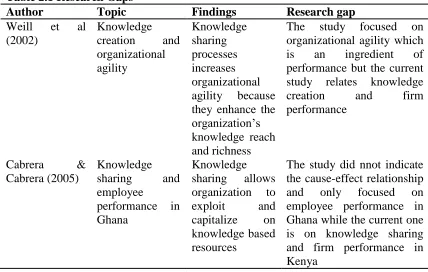
2.4 Research Gaps Table 2.1 Research Gaps
Author Topic Findings Research gap
Weill et al (2002)
Knowledge creation and organizational agility Knowledge sharing processes increases organizational agility because they enhance the organization‟s knowledge reach and richness
The study focused on organizational agility which is an ingredient of performance but the current study relates knowledge creation and firm performance
Cabrera & Cabrera (2005)
Knowledge sharing and employee
performance in Ghana
Knowledge sharing allows organization to exploit and capitalize on knowledge based resources
28 Danskin (2005) Knowledge
storage and firm performance in Madagascar
Knowledge is a resource whose storage and use is critical in firm performance
The study did not indicate how knowledge storage affects firm performance but its significance
Makere&Eresia-Eke (2014) Knowledge dissemination and organizational performance in Nigeria
Knowledge dissemination increases its
value and
improves firm performance and value chain
The study was done in Nigeria while the current is basedin Kenya
Source: Literature Reviewed
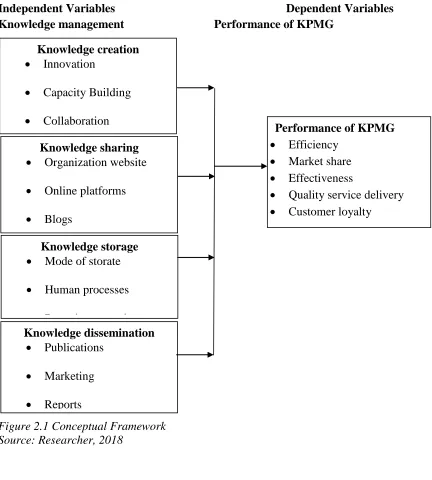
2.5 Conceptual Framework
29
Independent Variables Dependent Variables
Knowledge management Performance of KPMG
Figure 2.1 Conceptual Framework Source: Researcher, 2018
Knowledge sharing Organization website Online platforms Blogs
Knowledge storage Mode of storate Human processes Repository creation
Knowledge creation Innovation
Capacity Building Collaboration
Performance of KPMG Efficiency
Market share Effectiveness
Quality service delivery Customer loyalty
Knowledge dissemination Publications
30
CHAPTER THREE
RESEARCH METHODOLOGY
3.1 Introduction
This chapter presented the methodology that was used to carry out the study. It further describes the type and source of data, the target population and sampling methods and the techniques that was used to select the sample size. It also describes how data was collected, analyzed and presented.
3.2 Research Design
Research design was the basic plan that indicated an overview of the activities that were necessary to execute the research project. This research problem was studied through the use of a descriptive research design. According to Mugenda and Mugenda, (2008) the purpose of descriptive research is to determine and report the way things are and it helps in establishing the current status of the population under study. Borg and Gall, (2009) note that descriptive survey research was intended to produce statistical information about aspects of a study that interest policy makers. The research study focused on the role of knowledge management on the performance of KPMG. The underlining concept selected several targeted cases where an intensive analysis identifies the possible alternatives for solving the research questions on the basis of the existing solution applied in the selected case study.
3.3 Target Population
31
directorates which include audit, tax and advisory services who are 162 according to the KPMG Human Resources (2018). KPMG was selected among the audit firms in Kenya since its growth has been statistic for a while despite the engagement of knowledge management among other strategic management mesures. The target population for the study was therefore 162 respondents.
Table 3.1 Target Population
Directorate Population Percentage
Audit 31 19.14
Tax 49 30.24
Advisory Services 82 50.62
Total 162 100
Source: KPMG, 2018
3.4 Sampling Procedure
Sampling techniques provided a range of methods that facilitated in reducing the amount of data that needs to be collectded by considering only data from a sub-group rather than all possible cases or elements. According to Mugenda and Mugenda (2003), a sample of 25-30% is statistically significant to draw conclusions for a given study. The study therefore sampled 49 respondents from the population to inform the research findings which forms30% of the target population.
Table 3.2 Sample Size
Directorate Population Rate Sample Size
Audit 31 0.3 9
Tax 49 0.3 15
Advisory Services 82 0.3 25
Total 162 0.3 49
Source: Researcher, 2018
3.5 Data Collection Instrument
32
population.The questionnaire was carefully designed and tested with a few members of the population for further improvements. This was done in order to enhance its validity and accuracy of data to be collected for the study.
3.6 Validity and Reliability of the study
3.6.1 Validity
Validity is a measure of the degree to which data obtained from the instrument accurately and meaningfully represent the theoretical concept and in particular how the data represents the variables. Where validity has been established, any inferences made from such data was accurate and meaningful (Mugenda&Mugenda, 2003). The validity of a study increases by using various sources of evidence (Yin, 2003). The data was collected from the management employees at KPMG head offices. This issue confirmed the validity of the data and relevant results. The study conducted a pilot study at the PKF East Africa, one of the upcoming audit firms in Kenya with a regional presence. The study involved the 10 departmental heads of the audit firm in its head offices in Westlands. This enabled improvement of content validity of the research instruments.
3.6.2 Reliability
To establish the reliability and validity of the research instrument the study sought for opinions of experts in the field of study, especially the study‟s supervisor and lecturers in the school of business. This facilitated the necessary revision and modification of the research instrument thereby enhancing validity.
33
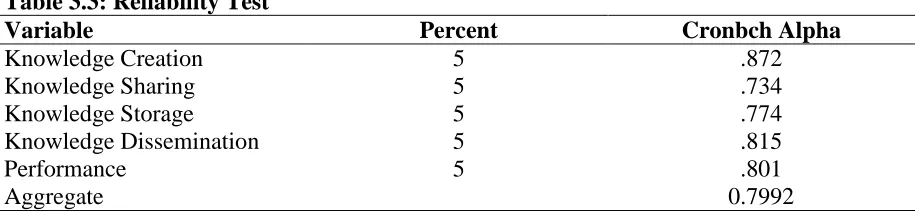
and the desirable situation was tested by Cronbach's alpha, which should be above the acceptable level of 0.70 (Hair et al., 1998). Alpha above the value of 0.7 is considered acceptable (George &Mallery, 2003).
The study carried out a reliability test to establish the reliability of the research instruments, a pilot test was carried out and a Cronbach alpha computed. The findings are as shown in Table 3.3.
Table 3.3: Reliability Test
Variable Percent Cronbch Alpha
Knowledge Creation 5 .872
Knowledge Sharing 5 .734
Knowledge Storage 5 .774
Knowledge Dissemination 5 .815
Performance 5 .801
Aggregate 0.7992
The study established that knowledge creation had a coefficient Cronbach alpha of 0.872, knowledge sharing had a Cronbach alpha coefficient of 0.734, knowledge storage had a Cronbach alpha coefficient of 0.774 and knowledge dissemination had a Cronbach alpha of 0.815. The study established that all the variables had a Cronbach alpha of 0.7992 which was above 0.7 an indication that the research instruments were sufficient to carry out the study. This is supported by George and Mallery (2003) who state that an Alpha coefficient value of above the value of 0.7 is considered acceptable.
3.7 Data Collection Procedure
34
and which was received. The questionnaire was administered using a drop and pick later method.
3.8 Data Analysis and Presentation
Before processing the responses, the completed questionnaires were edited for completeness and consistency. Quantitative data collected was analyzed by the use of descriptive statistics using SPSS (Version 22) and presented through percentages, means, standard deviations and frequencies. The information was displayed by use of bar charts, graphs and pie charts and in prose-form. This was done by tallying up responses, computing the percentages of variations in response as well as describing and interpreting the data in line with the study objectives and assumptions through use of SPSS (Version 22) to communicate research findings. Content analysis was used to test data that is qualitative in nature or aspect of the data collected from the open ended questions. In addition, the study conducted a multiple regression analysis.The multiple regression equation is;
Y = β0 + β1X1 + β2X2 + β3X3+ β4X4+ε
Where;
Y= Performance of KPMG B0 - intercept coefficient
εi – error term (extraneous variables)
X1 – Knowledge creation
X2– Knoweldge sharing
X3–Knowledge storage
35 β1,β2, andβ3 =regression coefficients
However, qualitative data was anlayzed using a likert scale of 1 to 5 based on weights for the degree of influence of independent variables on the dependent. 1 for Not at all, 2 for Low extent, 3 for moderate extent ,4 for greater extent and 5 very greater extent
3.9 Ethical Considerations
36
CHAPTER FOUR
RESEARCH FINDINGS AND DISCUSSIONS
4.1 Introduction
This chapter presents the findings of the analyzed data, presentation and interpretation. The general objective of the study was to determine the influence of knowledge management on performance of KPMG Kenya. The collected data was then coded into SPSS Version 23.0 for analysis and presentation. The findings are presented inform of figures and tables.
4.1.1 Response Rate
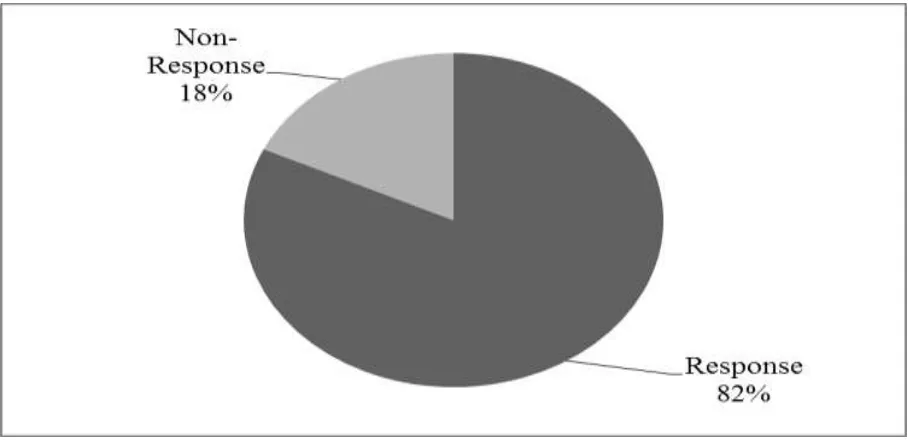
The researcher distributed 49 questionnaires to the management staff at the KPMG head offices in Nairobi, Kenya from the three main directorates which include audit, tax and advisory services.40 questionnaires were dully filled and returned ,this gave a response rate of 82%. This is supported by Mugenda and Mugenda (2013) who states that a response rate of 50% and above is deemed sufficient for the study. The findings are as shown in Figure 4.1.
37 4.2 Demographic Information
The researcher asked the respondents to indicate their demographic information to assess their relevance in the study. The findings of age, gender, number of years worked,level of management and knowledge management applicable are as shown in subsequent sections.
4.2.1 Distribution of Respondents by Age
The respondents were asked to indicate their age, the findings are as shown in Table 4.1. Table 4.1: Age
Age Frequency Percent
20 – 30 Years 5 12
30-40 Years 15 37
40 -50 Years 13 33
50 And Above Years 7 18
Total 40 100
Source: Field data, 2018
The findings show that 37 % of the respondents were aged between 30 - 40 years,33% were 40 - 50 years,18% were 50 years and above and 12% were 20 - 30 years. This shows that majority of the respondents were 30 years and above an indication that the respondents would give out informed views regarding the study.
4.2.2 Distribution of Respondents by Gender
The respondents were asked to indicate their gender, the findings are as shown in Table 4.2 Table 4.2: Gender
Frequency Percent
Male 24 59
Female 16 41
Total 40 100
38
The study established that majority of the respondents 59% were male followed by 41% who were female. The findings show that majority of the respondents were male an indication that KPMG had hired more males as to women.
4.2.3 Respondents’ Length of Service at KPMG
Respondents were asked to indicate how many years they had worked at the KPMG the findings are as shown in Table 4.3
Table 4.3: Length of Service
Period Worked at KPMG Frequency Percent
Less than 5 years 10 24
Between 5-10 years 17 43
Between 11-15 years 8 20
Over 15 years 5 12
Total 40 100
The study found out that 43% of the respondents‟ length of service was 5-10 years, followed by 24% whose length of service was less than 5 years,20% had severed between 11 -15 years and 12% having served for over 15 years . The findings in Table 4.4 show that majority of the respondents had worked for more than 5 yaers and indication that the respondents were skilled hence reliable data was sought.
4.2.4 Level of Management
Respondents were asked to indicate the level of management at the KPMG. The findings are as shown in Table 4.4
Table 4.4: Level of Management
Management Position Frequency Percent
Top Management 5 14
Middle Level 16 39
Lower Level 19 47
Total 40 100
39
The study found out that 47% of the respondents were lower level, 39% of the respondents were middle level and only 14% were in the top management. The findings show that the study was carried out in all of the departments an indication that reliable data was sought.
4.2.5 Knowledge Management
Respondents were asked to indicate how knowledge management was applicable to organization performance at the KPMG. The findings are shown in the Table 4.5
Table 4.5: Knowledge Management
knowledge management Frequency Percent
Knowledge creation 40 82
Knowledge storage 42 86
Knowledge sharing 37 76
Knowledge dissemination 39 80
Source: Field data, 2018
The study found that knowledge storage applicable was the highest with 86%,followed by knowledge creation with 82%,knowledge dissemination with 80% and knowledge sharing with 76%. The study show that majority of the respondents agreed that all of the knowledge management indicators were applied at KPMG.
4.3 Descriptive Statistics
The researcher carried out descriptive statistics to establish the level of agreement on each statement per study variables. The findings are as shown in subsequent sections.
4.3.1 Knowledge Creation and Performance of KPMG
40
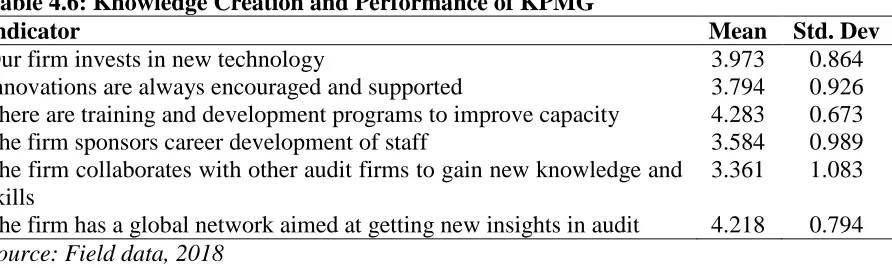
Table 4.6: Knowledge Creation and Performance of KPMG
Indicator Mean Std. Dev
Our firm invests in new technology 3.973 0.864
Innovations are always encouraged and supported 3.794 0.926 There are training and development programs to improve capacity 4.283 0.673
The firm sponsors career development of staff 3.584 0.989
The firm collaborates with other audit firms to gain new knowledge and skills
3.361 1.083 The firm has a global network aimed at getting new insights in audit 4.218 0.794 Source: Field data, 2018
The findings in the Table 4.6 shows that majority of the respondents agreed that KPMG invested in new technology as supported by a mean of 3.973 with standard deviation of 0.864.Majority of the respondents agreed that KPMG encouraged and supported innovation as supported by a mean of 3.794 with a stardard deviation of 0.926.Majority of respondent agreed that there was training and development programs to improve capacity as supported by a mean of 4.283 with a standard deviation of 0.673. This supported by supported by Donnelan et al .(2005)Nonaka et al. 1995 whose found that new product development, peer reviews are an important part of knowledge creation processes for ensuring the quality ofknowledge products and justifying design decisions
41
4.3.2 Knowledge Sharing and Performance of KPMG
The respondents were asked to indicate the extent to which they agreed with the statements regarding the role of knowledge sharing on performance of KMPG on a likert scale of 1-5 where; Strongly agree=5, Agree=4, Neutral=3, Disagree=2 and Strongly Disagree=1. The findings are as shown in Table 4.7.
Table 4.7: Knowledge Sharing and Performance of KPMG
Indicator Mean Std. Dev
The firm invests in knowledge sharing 3.974 0.927
The firm has a reliable internet coverage 4.317 0.692
The firm has an interactive website with all services and products 4.105 0.963 KPMG has online interactions with clients and partners over the social
media platform
3.441 1.086 The firm operates a blog to share ideas and interact with clients 3.463 0.987 Source: Field data, 2018
The study showed that the majority of respondents agreed that KPMG invested in knowledge sharing as supported by a mean of 3.974 and a standard deviation of 0.927. This is supported by (Disterer, 2001). Jackson, Chuang, Harden, Jiang, & Joseph, 2006).which state that knowledge sharing is also known as knowledge transfer which means sharing knowledge between individuals and groups in an enterprise Majority of respondents agreed that KPMG had a reliable internet coverage as supported by a mean of 4.317 and standard deviation of 0.692. Majority of respondents agreed that KPMG had an interactive website with all services and products as supported by a mean of 4.105 with a standard deviation of 0.963.
Majority of respondents moderately agreed that KPMG had online interactions with clients and partners over the social media platform as supported by a mean of 3.441 with standard deviation of 1.086.This is supported by (Keskin, 2005) which state that Knowledge is a combination of data, information, facts, description and skills learnt through experience and
42
interact with clients as supported by a mean of 3.463 and a standard deviation of 0.987.This is supported by (Davenport and Prusak, 1998). which adopted the definition by (Manaf, 2012) who defines knowledge sharing as the exchange of knowledge between and among individuals,
teams, departments and organizations.
4.3.3 Knowledge Storage and KPMG Performance
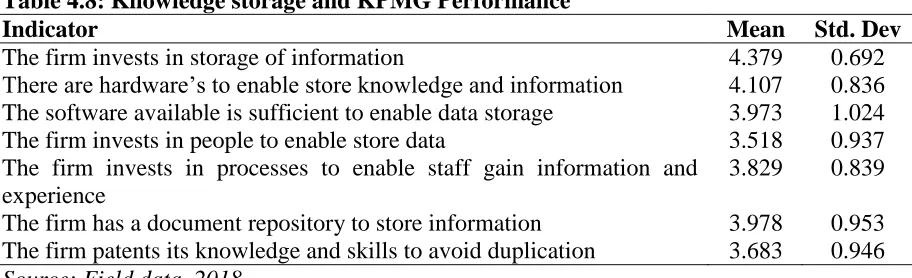
The respondents were asked to indicate the extent to which they agreed with the statements regarding the role of knowledge storage on performance of KMPG on a likert scale of 1-5 where; Strongly agree=5, Agree=4, Neutral=3, Disagree=2 and Strongly Disagree=1. The findings are as shown in Table 4.8.
Table 4.8: Knowledge storage and KPMG Performance
Indicator Mean Std. Dev
The firm invests in storage of information 4.379 0.692
There are hardware‟s to enable store knowledge and information 4.107 0.836 The software available is sufficient to enable data storage 3.973 1.024 The firm invests in people to enable store data 3.518 0.937 The firm invests in processes to enable staff gain information and
experience
3.829 0.839 The firm has a document repository to store information 3.978 0.953 The firm patents its knowledge and skills to avoid duplication 3.683 0.946 Source: Field data, 2018
43
Majority of respondents agreed that KPMG invested in people to enable store data as supported by a mean of 3.518 with standard deviation of 0.937. Majority of respondents agreed that KPMG invested in processes to enable staff gain information and experience as supported by a mean of 3.829 and a standard deviation of 0.839. Majorityof respondents agreed that KPMG had a document repository to store information as supported by a mean of 3.978 and standard deviation of 0.953. Majority of respondents agreed that KPMG patents its knowledge and skills to avoid duplication as supported by a mean of 3.683 and a standard deviation of 0.946. This is supported by Larsen (2001) who found that knowledge not only resides in the minds of individual employees, but is also constructed in the social interactions between members of teams.
4.3.4 Knowledge Dissemination And Firm Performance
The respondents were asked to indicate the extent to which they agreed with the statements regarding the role of knowledge dissemination on performance of KMPG on a likert scale of 1-5 where; Strongly agree=5, Agree=4, Neutral=3, Disagree=2 and Strongly Disagree=1. The findings are as shown in Table 4.9.
Table 4.1: Knowledge Dissemination And Firm Performance
Indicator Mean Std. Dev
The firm has a policy on dissemination of knowledge to other entities 4.373 0.697 The firm has annual publications to give information to the public and
other concerned entities
4.271 0.824 KPGM releases reports regularly on its operations to the users and
stakeholders
4.385 0.619 The firm conducts meetings, workshops and seminars to sensitize the
public and share information
3.482 0.965 The firm through marketing, disseminates information about its
products and services to the public
44
The study showed that the majority of respondents agreed that KPMG had a policy on dissemination of knowledge to other entities as supported by a mean of 4.373 and a standard deviation of 0.697. Majority of respondents agreed that at KPMG had annual publications to give information to the public and other concerned entities as supported by a mean of 4.271 and standard deviation of 0.824. Majority of respondents agreed that KPGM released reports regularly on its operations to the users and stakeholders as supported by a mean of 4.385 with a standard deviation of 0.619. This is supported by Chooet. al., (2002) who stated that knowledge is needed by companies to develop high quality products; knowledge on customers and competitors is also needed to establish good market location and effective service.
Majority of respondents moderately agreed that KPMG conducted meetings, workshops and seminars to sensitize the public and share information as supported by a mean of 3.482 with standard deviation of 0.965. Majority of respondents agreed that KPMG through marketing, disseminated information about its products and services to the public as supported by a mean of 3.854 and a standard deviation of 0.946. Majorityof respondents moderately agreed that KPMG used mainstream media to give information to the public as supported by a mean of 3.442 and standard deviation of 0.936.
4.3.5 Firm Performance
45 Table 4.10: Firm Performance
Indicator Mean Std. Dev
Firm profitability has improved with knowledge management 3.939 0.796
Employee productivity has been enhanced 3.831 0.816
The market share of the firm has gone up 3.963 0.792
Firm efficiency has improved 3.879 0.941
Customer service has improved with knowledge management 4.285 0.682
The firm competitiveness has improved 3.928 0.839
Source: Field data, 2018
The study showed that the majority of respondents agreed that KPMG profitability had improved with knowledge management as supported by a mean of 3.939 and a standard deviation of 0.796. Majority of respondents agreed that KPMG employee productivity had been enhanced as supported by a mean of 3.831 and standard deviation of 0.816. Majority of respondents agreed that the market share of the KPMG had gone up as supported by a mean of 3.963 with a standard deviation of 0.792.
Majority of respondents agreed that KPMG efficiency had improved as supported by a mean of 3.879 with standard deviation of 0.941. Majority of respondents agreed that KPMG Customer service had improved with knowledge management as supported by a mean of 4.285 and a standard deviation of 0.682. majority of respondents agreed that KPMG competitiveness had improved as supported by a mean of 3.928 and a standard deviation of 0.839.Majority of respondents agreed that the market share of the KPMG had gone up.
4.4 Regression Analysis
46 4.4.1 Model Summary
The findings of coefficient of correlation and coefficient of adjusted determination are as indicate in Table 4.11.
Table 4.2: Model Summary
Model R R Square Adjusted R Square Std. Error of the Estimate
1 .859a .738 .731 1.16339
a. Predictors: (Constant), Knowledge Creation, Knowledge Sharing, Knowledge Storage, Knowledge Dissemination
According to Table 4.12, coefficient of correlation R was 0.859 an indication of strong positive correlation between variables. Adjusted coefficient of determination R2 was 0.731 which translates to 73.1%. This means that 73.1% variation in performance can be attributed by the following; Knowledge creation, Knowledge sharing, Knowledge storage and Knowledge dissemination. The residual of 26.9% can be attributed to other factors beyond the scope of the current study.
4.4.2 ANOVA
An ANOVA was carried out at 5% level of significance. A comparison between F Calculated
and F Critical was carried out. The findings are as indicated in Table 4.12.
Table 4.3: ANOVA
Model Sum of Squares df Mean Square F Sig.
Regression 541.805 4 135.451 25.371 .000b
Residual 192.195 36 5.339
Total 734.000 39
b. Dependent Variable: Performance
c. Predictors: (Constant), Knowledge Creation, Knowledge Sharing, Knowledge Storage, Knowledge Dissemination
From the findings, F Calculated was 25.371 and F Critical was 2.4936. Since F Calculated > F Critical,
47 4.4.3 Regression Coefficients
To determine the individual factor influencing performance KPMG in Nairobi County, the following coefficient were generated.
Table 4.4: Coefficients
Model
Unstandardized Coefficients
Standardized Coefficients
t Sig.
B Std. Error Beta
(Constant) 4.167 .865 4.818 .000
Knowledge creation .069 .031 .124 2.212 .029
Knowledge acquisition .130 .061 .149 2.139 .034
Knowledge sharing .230 .061 .149 2.131 .034
Knowledge dissemination .822 .080 .712 10.300 .000
a. Dependent Variable: Performance
The resultant equation becomes;
Y= 4.167 + 0.069X1+0.130X2+0.239X3+ 0.822X4 Where: Y = Performance of SMEs
X1 = Knowledge creation
X2 = Knowledge sharing
X3 = Knowledge storage
X4 = Knowledge dissemination
48
An increase in knowledge dissemination while holding all the variables constant would lead to decrease in performance by 0.822. The study further established the p value of knowledge creation, knowledge sharing, knowledge storage and knowledge dissemination were less than 0.05 and the t values were greater than 1.96 an indication that the variables significantly influenced performance of KPMG, Kenya.
4.5 Key Findings and Discussions
On knowledge creation,the study established that knowledge creation significantly influenced firm performance, training and development programs to improve capacity having global network aimed at getting new insights in audit. Investing in new technology encouraged and supported innovation . Sponsoring career development of staff . Collaboration with other audit firms to gain new knowledge and skills. This supported by supported by Donnelan et al .(2005)Nonaka et al. 1995 whose found that new product development, peer reviews are an important part of knowledge creation processes for ensuring the quality ofknowledge products and justifying design decisions.
49
On knowledge storage, the study established that knowledge storage significantly influenced firm performance, investing in storage of information.Owning hardware‟s to enable store knowledge and information ensuring software is available sufficient to enable data storage. This is supported by Davenport and Prusak (2000) who found that the storage and retrieval stage bridges upstream repository creation and downstream knowledge distribution.