Available online: https://edupediapublications.org/journals/index.php/IJR/ P a g e | 742
A study on the relationship between Information and Communication
Technology and Employees’ Performance
.
*Amalathas Sukirtharaj. [email protected]
** Amalathas Amalraj. [email protected]
Abstract
This study investigates the relationship between Information and Communication
Technology and Employees’ Performance of Divisional Secretariats in the Trincomalee
District. 100 employees in the Divisional Secretariats in the Trincomalee District were
taken for this study. It aims in measuring the level of Information and Communication
Technology, and Employees’ Performance in the Divisional Secretariats in the
Trincomalee District. The results revealed that the level of Information and
Communication Technology, and Employees’ Performance are at moderate level and
there was a positive moderate relationship between Information and Communication
Technology, and Employees’ Performance in the Divisional Secretariats in the
Trincomalee District.
Key words: Information and Communication Technology; Employees’ Performance;
Divisional Secretariats.
1. Background of Study
This research study empirically investigates the relationship between Information and
Communication Technology and Employees’ Performance in the Divisional Secretariats
Available online: https://edupediapublications.org/journals/index.php/IJR/ P a g e | 743 The organizations and its existence are vital for the existence of living being in the world
(Andrew, 2016). Every organization must continuously interact with other organizations
and individuals – the consumers, suppliers, regulatory bodies, government and many
more. Every organization in the environment has goals and objectives related to each
other. The present organization environment is dynamic and will continue to be dynamic
much more every day.
In addition, in today’s economy, it is very difficult to have effective and efficient
organization due to intense complexities in the changing environment. The concept of
globalization and economic instability has increased both the frequency and the
magnitude of organizational change worldwide.
One of the concepts most frequently researched, discussed and written about in recent
years has been change in organizations and ways of its management. It is no surprise,
because change is inevitable for organizations that wish to stay competitive and be
profitable.
Change is any planned or unplanned transition from one scenario to another. Strategic
change is long term in nature, effects the entire organization and aims at achieving
effectiveness. Operational change on the other hand is short term in nature, affects
sections of the organization and focus on efficiency.
In an ever-changing global economy, Johnson and Scholes (2003) notes that
organizations must find ways for operating by developing new competences as the old
advantage and competences gained is quickly eroded owing to environmental changes.
Most organizational managers today would agree that change has become a constant
phenomenon which must be attended to and managed properly if an organization is to
survive. Changes in technology, the marketplace, information systems, the global
economy, social values, workforce demographics, and the political environment all have
Available online: https://edupediapublications.org/journals/index.php/IJR/ P a g e | 744
2. Literature Review
2.1 Importance of Organizational Change
In order to improve the internal and external functionality, the organizations need
changes and it is the demand of time (Caetano, 1999). An organization that does not
adopt changes cannot survive long in market (Boston, 2000).Organizational changes
provide different significant benefits e.g. it improves competitiveness, improves financial
performance, enhances employees and customer satisfaction and most important is that it
leads organization towards continuous improvement and sustainability ( Andrew &
Mohankumar, 2016). These are organizational benefits and every individual working in
an organization, usually have common goals and objectives and these changes made the
organization as a whole stronger (Boston, 2000).
Robertson and Seneviratne (2005) further explained that changes in technology and
physical setting to the ways change can be accomplished, which they group with
organization arrangements and social factors into a category they label organizational
work setting. Their model of the organizational change process has three phases: (a)
planned interventions create changes in the organization work setting; (b) these changes
in the work setting lead individuals to change their behavior; (c) these individual
behavioral changes impact organizational performance and individual development, the
key organization outcomes. Others involved in this discussion would emphasize that the
intervention strategy needs to be driven by vision and strategy (Beckhard and Harris
2008), and that the arrows linking the components should be double-headed, reflecting
the interactive nature of the components in the change process.
Richard (2009) noted that organizational performance should be related to factors such as
profitability, improved service delivery, customer satisfaction, market share growth, and
improved productivity and sales. Organization performance is therefore affected by a
multiplicity of individuals, group, and task, technological, structural, managerial and
environmental factors. From above related factors, there are some related factors
Available online: https://edupediapublications.org/journals/index.php/IJR/ P a g e | 745 performance and change such as satisfaction, service delivery, technology, organizational
structure task, and culture.
2.2 Information and Communication Technology (ICT)
There is a mutually beneficial relationship between organizational change in firms and
ICT investments. Information and communication Technology is a key to facilitating new
organizational approaches, from lean production to teamwork to customer relations. On
the other hand, organizational change is usually needed to realize the full benefits of
information and communications technology. Complex technology requires flexible work
organization and, at the same time, it increases the capacity to adopt a flexible work
organization. In knowledge-based economies, managers need to understand both
technological and organizational issues for the implementation of new business
approaches (Antonelli and Marchionnatti, 1998).
Organizational approaches central to firm competitiveness are often enabled only by ICT
investments.ICT permits closer interaction among internal functions such as production,
marketing, finance and strategic decision making; higher levels of vertical integration and
product diversification; more decentralization and team-working; and closer interaction
with customers and providers of intermediate goods and services. In Italy, one case study
found that ICT permits economies of scale for batch production, enables internal
restructuring by department and plant, strengthens market relations through electronic
communication systems, and allows co-operative relationships and networking to be
implemented through online communications systems (Antonelli and Marchionnatti,
1998).
3. Problem Statement
In order to maintain the Employees’ excellent Performance and to be more competitive,
most organizations are looking to find ways to reduce cost, improve quality and increase
Available online: https://edupediapublications.org/journals/index.php/IJR/ P a g e | 746 point for all improvement efforts aiming to drive out waste from the transformation
process, and ultimately improve an organization’s bottom line by improving products and
services, and lowering cost.
Most research work in relation to change management has been done in developed or
western cultural work settings (Andrew, 2015). Very few research works has been found
so far in developing countries like Sri Lanka. This requires more attention by researchers
and practitioners to establish the Impact of Change Management on Employees’
Performance in different work settings environments and cultures.
Fatima (2002) advocated that, change methods adopted by western cultures could be used
as a body of knowledge in the domestic situation. Accordingly, the research findings, and
change methods adopted by western cultures could be used as a body of knowledge in the
domestic situation in Sri Lanka. In this study the variables have been chosen to justify the
study in an underprivileged and developing economy where organizations thriving to
improve and increase their performance.
3.1 Research Question
This study investigates the relationship between Information and Communication
Technology and Employees’ Performance in the Divisional Secretariats in the
Trincomalee District. Based on the research problem the following research questions are
developed;
1. What is the level of Information and Communication Technology in the Divisional
Secretariats in Trincomalee District?
2. What is the level of Employees’ Performance in the Divisional Secretariats in
Trincomalee District?
Available online: https://edupediapublications.org/journals/index.php/IJR/ P a g e | 747
4. Objectives
Based on the review of literature and the conceptual framework, the following objectives
were developed to study the relationship between Information and Communication
Technology and Employees’ Performance in the Divisional Secretariats in the
Trincomalee District.
1. To identify the level of Information and Communication Technology in the
Divisional Secretariats in the Trincomalee District.
2. To identify the level of the Employees’ Performance in the Divisional Secretariats
in the Trincomalee District.
3. To assess the relationship Information and Communication Technology and Employees’ Performance in the Divisional Secretariats in the Trincomalee
District.
5. Conceptual Framework
Figure:1 Conceptual Framework
6. Method of Collection
A questionnaire consists of a set of questions presents to a respondent for their answers.
Under this study questions were issued to employees in a random basis. The respondents
were told the real purpose of study prior to issuing the questionnaire and their
information was collected from their own words.
6.1 Types of Data
a) Primary Data
Information Communication Technology
Available online: https://edupediapublications.org/journals/index.php/IJR/ P a g e | 748 Primary Data is referred as fresh data. Primary data is collected by / on behalf of the
person who are going to make use of data directly. There are many ways to derive
primary data. Primary data are collected especially for the purpose of whatever survey is
being conducted. Raw data are primary data, which have not been processed at all. The
primary data is obtained from structured questionnaires completed by the employees who
are working in Divisional Secretariats in Trincomalee.
The Main Primary sources are,
1. Inquiries and Conversations with administrative officers on related institutions.
2. Issuing Questionnaires.
3. Interview with employees who are working there.
b) Secondary Data
It is the already used for other purpose by persons / other officers. The data consists of
the information that already exist somewhere have been collected for other purposes.
The Main Secondary source data are;
1. Magazines
2. Administrative Reports of Divisional Secretariats
3. Newspapers
4. Central Bank Reports etc
5. Resource profile of Divisional Secretariats
6. Through Web Site/ Internet
The primary data is obtained from structured questionnaires. The questionnaire consists
of set of questions presented to a respondent for their answers. Under this study
questionnaires were issued to Divisional secretariats’ employees in a random basis. The
data collected from the 100 respondents in the Divisional Secretaries in the Trincomalee
Available online: https://edupediapublications.org/journals/index.php/IJR/ P a g e | 749 The primary data is obtained from structured questionnaires. The questionnaire consists
of set of questions presented to a respondent for their answers. Under this study
questionnaires were issued to Divisional secretariats’ employees in a random basis. The
data collected from the 100 respondents in the Divisional Secretaries in the Trincomalee
District.
7. Data Presentation and analysis
7.1 Demographic Characteristics of Participants
Table 1: Demographic Characteristics of Participants
Demographic Category Frequencies
Gender Male 55
Female 45
Total 100
Age 25-35 20
36-50 49
51-55 31
Total 100
Designation Management Assistant 17
Grama Niladhari 21
Samurthi officer 20
DO & Other Staff Officer 42
Total 100
Educational Level O/L 14
A/L 25
Diploma 26
Available online: https://edupediapublications.org/journals/index.php/IJR/ P a g e | 750 Post graduate/Master 07
Total 100
Experience in the Field Less than5 years 39
5-10 years 40
More than 10 years 21
Total 100
7.1.1 Gender
Among the sample, 55% of respondents were Male and 45% of respondents were
Female.
7.1.2 Age distribution of the respondents
The age distribution pattern of Divisional Secretariats’ employees in the Trincomalee
district is presented by the sample of 100. Among the sample 20% of the Divisional
Secretariats’ employees were found to be laid under the age distribution between 36-50
years, 49% were found under the distribution between 25-35 years, 31% were found
under the distribution above 50 years.
7.1.3 Designation of the respondents
Among the sample, 17% of the respondents were Management Assistants, 21% of the
respondents were Grama Niladharies, 20% of the respondents were Samurthi Officers
and 42% of the respondents were Development Officers and other Staff Officers.
7.1.4 Working Experience of the respondents
Working experience was categorized into 3 groups.39% of the respondents fell under
Available online: https://edupediapublications.org/journals/index.php/IJR/ P a g e | 751
7.1.5 Educational Qualification
Among the sample, 14% of the sample represents the people who have studied up to
G.C.E. O/L, 25% of the sample represents the people who have studied up to G.C.E. A/L,
26% of sample has completed the Diploma, 28% of sample has completed the
Undergraduate studies, and 7% of sample was Post graduate/Masters qualified graduates.
7.2 Research Information
The Mean value and Standard Deviation of the samples of the respondents for variables
of the sample taken to decide the extent to which Information Communication
Technology, contributing to Employees’ Performance.
Table 2: Mean value and Standard Deviation of the variables.
Variables Mean SD
Information Communication Technology 3.02 0.63
Employees’ Performance 3.32 0.52
(Source: Survey Data)
7.2.1 Information Communication Technology
Among the sample of the respondents analyzed, 23% of the respondents were in favour
of higher level of Information Communication Technology (ICT), and 51% were in
favour of moderate level of ICT, while 26% of the respondents indicated lower level of
ICT. The Average Mean value and Standard Deviation (SD) for ICT were 3.02 and 0.63
respectively (Table 2). The Mean value falls within the range of moderate scale of 2.5
<Xi< 3.5. Thereby, Information Communication Technology of the employees is at
moderate level.
7.2.2 Employees’ Performance
Among the sample of the respondents analyzed, 29% of the respondents were in favour
Available online: https://edupediapublications.org/journals/index.php/IJR/ P a g e | 752 Employees’ Performance and 4% were in favour of low level of Employees’
Performance. The Average Mean value and Standard Deviation (SD) for Employees’
Performance were 3.32 and 0.52 respectively (Table 2). The Mean value falls within the
range of moderate scale of 2.5 <Xi< 3.5. Thereby, the Performance of the employee is at
moderate level.
7.2.3 Relationship between Information and Communication Technology (ICT)
and Employees’ Performance.
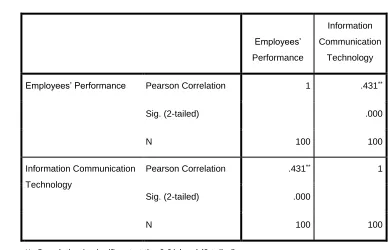
By observing the data a significant positive relationship exists between Information and
Communication Technology and Employees’ Performance. The table 5.10 shows a
correlation matrix, which describes such relationship between the variables.
Table 3: Correlation Analysis- ICT and Organizational performance
Employees’
Performance
Information Communication
Technology
Employees’ Performance Pearson Correlation 1 .431**
Sig. (2-tailed) .000
N 100 100
Information Communication Technology
Pearson Correlation .431** 1
Sig. (2-tailed) .000
N 100 100
**. Correlation is significant at the 0.01 level (2-tailed).
Available online: https://edupediapublications.org/journals/index.php/IJR/ P a g e | 753 The table 3 shows that Employees’ Performance (EP) have a positive significant
relationship with ICT (r = 0.431, p<0.000). In addition, it is revealed that the strength of
the relationship between these two variables is at moderate level as r is between 0.3 and
0.5.
By considering the correlation analysis and its values, as the p-value is less than 0.05, we
reject null hypothesis. Therefore, it can be concluded that Information Communication
Technology has significant positive correlation with Employees’ Performance in the
Divisional Secretariats in the Trincomalee District.
7.3 Information and Communication Technology
The results of this study revealed that, Information and Communication Technology of
the respondents obtained a Mean value of 3.02 and a Standard Deviation of 0.63 (Table
5.7). Among the sample 23% (Figure 5.9) of the respondents have shown high level
concern on this aspect by extending higher level of Information and Communication
Technology towards Performance of Employees, while 51% (Figure 5.9) of the
respondents have shown moderate level interest on this aspect. By observing the data for
the Correlation Analysis it revealed that a significant positive relationship exists between
Information and Communication Technology and Performance of Employees. It
explained that more than 74% of the respondents represented for moderate level and
above of Information and Communication Technology towards Performance of
Employees.
The Coefficient value of the Correlation Analysis (0.431) reveals that a moderate positive
relationship exists between Information and Communication Technology and
Performance of Employees.
Available online: https://edupediapublications.org/journals/index.php/IJR/ P a g e | 754
8.1 Introduction
Divisional Secretariats are the important public service centre. Divisional Secretariats in
general are considered as the engine of a Countries public service activities.
8.2 Conclusion
The study was set around to examine the influence of Information and Communication
Technology and Performance of Employees.
This empirical study was intended to identify the level of the independent variables and
to investigate the relationship between independent variables with the dependent variable.
The descriptive statistics shows that the mean values obtained for Information and
Communication Technology, and Employees’ Performance were at moderate level.
The objective to assess the relationship between the independent variables and the
dependent variable was based on the conceptual framework the relationship between the
Information and Communication Technology and Employees’ Performance.
The Correlation Analysis also shows that the relationship between Information and
Communication Technology and Employees’ Performance were significant.
Moderate Correlation was found between Information and Communication Technology
and Employees’ Performance.
8.3 Recommendations
The following recommendations are made to increase the Divisional Secretariat’s
Employees’ Performance through Change Management.
Performance standards should be established and communicated to the top –
bottom employees. This will help employees to achieve the standard and take
Available online: https://edupediapublications.org/journals/index.php/IJR/ P a g e | 755
Motivating the employees to help to achieve the high level of firm’s Employees’
Performance.
The study also recommends that investment be made in ICT due to its impact on
organization’s performance. However staff should be properly trained in new and
existing technologies in order for better performance to be achieved.
9. References
1. Andrew, A. (2016), The influence of organization Structure for change on
Employee Performance, Journal for Studies in Management and Planning e-ISSN:
2395-0463 Volume 02 Issue 5 May 2016.
2. Andrew, A. & Mohan Kumar, S. (2016), Relationship between Job Satisfaction
and Employee Readiness for Organizational Change, Journal for Studies in
Management and Planning e-ISSN: 2395-0463 Volume 02 Issue 2 February 2016.
3. Andrew, A. & Mohan Kumar, S. (2015), The Influence of Organization Culture
on Employee Readiness for Organizational Change, International Journal of
Research (IJR) e-ISSN: 2348-6848, p- ISSN: 2348-795X Volume 2, Issue 3,
March 2015.
4. Andrew, A. (2017), Relationship between Employee Readiness for
Organizational Change and Employee Performance, Journal for Studies in
Management and Planning, ISSN: 2395-0463 Volume 03 Issue 01 January 2017.
5. Andrew, A. & Mohan Kumar, S. (2017), Relationship between Self-Efficacy and
Employee Readiness for Organizational Change. International Journal of
Engineering Research and General Science Volume 5, Issue 1, January-February,
2017- ISSN 2091-2730.
6. Andrew, A. & Mohan Kumar, S. (2017), The Study on the Relationship between
Available online: https://edupediapublications.org/journals/index.php/IJR/ P a g e | 756 International Journal of Research p-ISSN: 2348-6848 e-ISSN: 2348-795X
Volume 04 Issue 07 June 2017.
7. Andrew, A. (2017), Influence of Employee Attitude on Employee Readiness for
Organizational Change, Asian Journal of Economics, Business and Accounting.
5(1): 1-11, 2017; Article no.AJEBA.37126 ISSN: 2456-639X . 2017.
8. Andrew, A. (2017), Employees’ Commitment and Its Impact on Organizational
Performance. Asian Journal of Economics, Business and Accounting. 5(2): 1-13,
2017; Article no.AJEBA.38396 ISSN: 2456-639X ,2017.
9. Andrew, A. (2018), Factors Influencing Undergraduate Students’ Academic
Performance in Examination, International Journal of Research. e-ISSN:
2348-6848 p-ISSN: 2348-795X Volume 05 Issue-01 January 2018.
10. Azharudeen, N.T. & Andrew, A. (2018), Emotional Exhaustion and Employee
Turnover Intention, International Journal of Research. e-ISSN: 2348-6848
p-ISSN: 2348-795X Volume 05 Issue-01 January 2018.
11. Melani, A. & Andrew, A. (2017), Social Media and Academic Performance of
Undergraduate Students, International Journal of Research .e-ISSN: 2348-6848
p-ISSN: 2348-795X Volume 04 Issue 14, 2017.
12. Nakuleskumar, P. & Andrew, A. (2018), A Study on the Relationship between
Job Satisfaction and Work Performance. International Journal of Research.
e-ISSN: 2348-6848 p-e-ISSN: 2348-795X Volume 05 Issue-01 January 2018.
13. Rishanth, N. & Andrew, A. (2018), The Influence of Information Technology on Students’ Academic Performances. International Journal of Research. e-ISSN:
2348-6848 p-ISSN: 2348-795X Volume 05 Issue-01 January 2018.
14. Robertson P. and Seneviratne S. (1995), outcomes of planned organizational
change in the public sector, Public Administration Review.
15. Sanjeeha, K. & Andrew, A. (2017), The Impact Of E-Learning On Academic
Performance -Special Reference to Third Year Management Students, of the
Available online: https://edupediapublications.org/journals/index.php/IJR/ P a g e | 757 International Journal of Research .e-ISSN: 2348-6848 p-ISSN: 2348-795X
Volume 04 Issue 14, 2017.
16. Seller, T. & Andrew, A. (2017), The Impact of Quality of Work Life on Job
Involvement of Auto Mechanic Employees, International Journal of Research,
p-ISSN: 2348-6848 e-p-ISSN: 2348-795X Volume 04 Issue 08 July 2017.
17. Sivarasa, T. & Andrew, A. (2015), Relationship between Employee Commitment
and Employee Readiness for Organizational Change (Special reference to the
Government schools in Batticaloa District), International Journal of Exclusive
Management Research (IJEMR)– - Online - ISSN 2249–2585 Print - ISSN