Security Notions and Generic Constructions for Client Puzzles
L. Chen1, P. Morrissey2, N.P. Smart2and B. Warinschi2 1
Hewlett-Packard Laboratories, Filton Road,
Stoke Gifford, Bristol, BS34 8QZ,
United Kingdom. [email protected] 2
Computer Science Department, Woodland Road, University of Bristol,
Bristol, BS8 1UB, United Kingdom.
{paulm, nigel, bogdan}@cs.bris.ac.uk
Abstract. Computational puzzles are mildly difficult computational problems that require resources (processor cycles, memory, or both) to solve. Puzzles have found a variety of uses in security. In this paper we are concerned withclient puzzles: a type of puzzle used as a defense against Denial of Service (DoS) attacks. Before engaging in a resource consuming protocol with a client, a server demands that the client solves a freshly generated client puzzle. Despite their widespread use, the lack of formal models for security of client puzzles prevents a full analysis of proposed puzzles and, more importantly, prevents rigorous proofs for the effectiveness of puzzles as a DoS defense. The main contribution of this paper is a formal model for the security of client puzzles as a stepping stone towards solving the above problems. We clarify the interface that client puzzles should offer and give two security notions for puzzles. Both functionality and security are inspired by, and tailored to, the use of puzzles as a defense against DoS attacks. The first notion – puzzle unforgeability – requires that an adversary is unable to produce valid looking puzzles on its own. The second notion – puzzle-difficulty – requires that an adversary spends at least an appropriate amount of resources solving puzzles. Our definitions fill an important gap: breaking either of the two properties immediately leads to successful DoS attacks. We illustrate this point with an attack against a previously proposed puzzle construction. We show that a subtle flaw renders the construction forgeable and we explain how to exploit this flaw to mount a DoS attack on certain protocols that use this puzzle.
We also provide a generic construction of a client puzzle. Our construction uses a pseudorandom function family to provide unforgeability and a one way function for the difficulty. We prove our generic construction meets our definitions of unforgeability and difficulty for client puzzles. Finally, we discuss and analyze (in the random oracle model) a practical instantiation of our construction based on hash functions.
1
Introduction
A Denial of Service (DoS) attack on a server aims to render it unable to provide some service by depleting its internal resources. For example, the famous TCP-SYN flooding attack [9] prevents further connections to a server by starting a large number of TCP sessions which are then left uncompleted. The effort of the attacker is rather small, whereas the server quickly runs out of resources (which are allocated to the unfinished sessions).
One countermeasure against connection depletion DoS attacks uses client puzzles [14]. When contacted by some unauthenticated, potentially malicious client to execute some protocol and before allocating any resources for the execution, the server issues a client puzzle – a moderately hard computational problem. The server only engages in the execution of the protocol (and thus allocates resources) when the client returns a valid solution to the puzzle. The idea is that the server spends its resources only after the client has spent a significant amount of resources itself. To avoid the burden of running the above mechanism when no attackers are present, the defense only kicks in whenever the server resources drop below a certain threshold.
Although sometimes technical, such security arguments are with respect to intuitive security notions for puzzles since rigorous formal models for the security of such puzzles are missing. The absence of such models has (at least) two undesirable consequences. On the one hand the investigation of puzzle constructions usually concentrates on some security aspects and omits others which are of equal importance when puzzles are used as part of other protocols. More importantly, the absence of formal models prevents a rigorous, reduction-based analysis of the effectiveness of puzzles against DoS in the style of modern cryptography (where the existence of a successful DoS attacker implies the existence of an attacker against client puzzles).
In this paper we aim to solve the first problem outlined above as a first key step towards solving the second one. The main contribution of this paper is a formal framework for the design and analysis of client puzzles. In addition to fixing their formal syntax, we design security notions inspired by, and therefore tailored for, the use of client puzzles as a defense against DoS attacks. Specifically, we require that an adversary cannot produce valid puzzles on his own (puzzle-unforgeability) and that puzzles are non-trivial – the client needs indeed to spend at least a specified amount of resources to solve them – (puzzle difficulty). The use of client puzzles that do not fulfill at least one of our notions immediately leads to a successful DoS attack. Our definitions use well-established intuition and techniques for defining one-wayness and authentication properties. Apart from some design decisions regarding the measure for resources and the precise oracles an adversary should have access to, there are no deep surprises here. However, we highlight that the lack of rigorous definitions such as those we put forward in this paper is dangerous. Constructions that are secure at an intuitive level, may be in fact insecure when used. Indeed, we explicitly demonstrate that a popular construction, that does not meet our notion of unforgeability, does not protect and in fact facilitates DOS attacks in systems that use it.
Furthermore, we give a generic construction of a client puzzle that is secure in the sense we define. Many ex-isting client puzzle constructions can be obtained as an instantiation of our generic construction, with only minor modifications if any. Our construction uses a pseudorandom function family to provide puzzle-unforgeability and puzzle-difficulty is obtained from a one-way function given a large part of the preimage. Difficulty here does not mean hardness of computation, but rather non-triviality. We prove our construction secure via an asymptotic reduction for unforgeability and a concrete reduction for difficulty. Next, we discuss our results in more details.
Our Contribution
FORMAL SYNTAX OF A CLIENT PUZZLE. Our first contribution is a formal syntax for client puzzles. We define a client puzzle as a tuple of algorithms for system setup, puzzle generation, solution finding, puzzle authenticity checking, and solution checking. The definition is designed to capture the main functionality required from client puzzles from the perspective of their use against DoS attacks.
SECURITYNOTIONS FORCLIENTPUZZLES. The use of puzzles against DoS attacks also inspired the two (orthogo-nal) security notions for client puzzles that we design.
To avoid storing puzzles handed out to clients (a resource consuming task), the server gives puzzles away and expects the client to hand back both the puzzle and its solution. Obviously, the server needs to be sure the client cannot produce puzzles on its own, as this would lead to trivial attacks. We remark that this aspect is often overlooked in existing constructions since it is only apparent when puzzles are considered in the precise context for which they are intended. We capture this requirement via the notion of puzzle-unforgeability. Formally, we define a security game where the adversary is given certain querying capabilities (he can for example request to see puzzles and their solutions, can verify the authenticity of puzzles, etc) and aims to output a new puzzle which the server deems as valid. The second notion, puzzle-difficulty, reflects the idea that the client needs to spend a certain amount of resources to solve a puzzle. In our definition we took adversary resources to mean “clock cycles”, as this design decision allows us to abstract away undesirable details like the distributed nature of many DoS adversaries. We define a security game where the adversary is given various querying capabilities sufficient for mimicking a DoS attack-like environment: he can see puzzles and their solutions, obtain solutions for puzzles he chooses, etc. The challenge for the adversary is to solve a given challenge puzzle spending less than a certain number of clock cycles, with probability better than a certain threshold.
is the puzzle construction proposed by Juels and Brainard [14]. We demonstrate the usefulness of our definitions by showing the Juels and Brainard construction is forgeable. We then explain how a system using this kind of puzzle can be attacked by exploiting the weakness we have identified.
GENERICCONSTRUCTIONS. We provide a generic construction of a client puzzle inspired by the Juels and Brainard sub-puzzle construction [14]. First, we evaluate a pseudorandom function (PRF), keyed by some secret value, on inputs including a random nonce, hardness parameter and a system specific string. This stage ensures uniqueness of the puzzle and the desired unforgeability; only the server that possesses the hidden key is able to perform this operation and hence generate valid puzzles. The remaining information to complete the puzzle is then computed by evaluating a one way function (OWF), for which finding preimages has a given difficulty, on the output of thePRF; the goal in solving the puzzle is to find such a preimage given the inputs to thePRFand the target. The idea is that the client would need to do an exhaustive search on the possible preimage space to find such a preimage. We certify the intuition by rigorous proofs that the generic construction meets the security definitions that we put forth, for appropriately chosen parameters. Importantly, manysecure variantsof previously proposed constructions can be obtained as instances of our generic construction. For example, the puzzle constructions proposed by Juels and Brainard [14] puzzle and the two-party variant of the Waters et al. puzzles [27] can be seen as variants of our generic construction. Finally, we provide concrete security bounds for the first of these puzzles. We do so in the random oracle model which we use to obtain secure and efficient instantiations of the two primitives used by our generic construction.
Related Work
MERKLEPUZZLES. The use of puzzles in cryptography was pioneered by Merkle [18] who used puzzles to establish a secret key between parties over an insecure channel. Since then the optimality of Merkle puzzles has been analyzed by Impagliazzo and Rudich [12] and Barak and Mahmoody–Ghidary [3]. The possibility of basing weak public key cryptography on one-way functions, or some variant of them was recently explored by Biham, Goren and Ishai [4]. Specifically, a variant of Merkle’s protocol is suggested whose security is based on the one-wayness of the underlying primitive.
CLIENT PUZZLES. Client puzzles were first introduced as a defense mechanism against DoS attacks by Juels and Brainard [14]. The construction they proposed uses hash function inversion as the source of puzzle-difficulty. They also attempt to obtain puzzle-unforgeability but partially fail in two respects. By neglecting the details of how puzzles are to be used against a DoS attack, the construction suffers from a flaw (which we explain how to exploit later in this paper) that can be used to mount a DoS attack. Secondly, despite intuitive claims that security is based on the wayness of the hash function used in the construction, security requires much stronger assumptions, namely one-wayness with partial information about the preimage. The authors also present a method to combine a key agreement or authentication protocol with a client puzzle, and present a set of informal desirable properties of puzzles. Building on this work, Aura et al. [2] use the same client puzzle protocol construction but present a new client puzzle mechanism, also based on hash function inversion, and extend the set of desirable properties.
An alternative method for constructing client puzzles and client puzzle protocols was proposed by Waters et al. [27]. This technique assumes the client puzzle protocol is a three party protocol and constructs a client puzzle based on the discrete logarithm problem for which authenticity and correctness can be verified using a Diffie–Hellman based technique. One of the main advantages of this approach is that puzzle generation can be outsourced from the server to another external bastion, yet verification of solutions can be performed by the server itself.
More recently Tritilanunt et al.[26] proposed a client puzzle based on the subset sum problem. Schaller et al. [23] have also used what they refer to as cryptographic puzzles for broadcast authentication in networks.
DOS ATTACKS. A classification of remote DoS attacks, countermeasures and a brief consideration of Distributed Denial of Service (DDoS) attacks were given by Karig and Lee [15]. Following this Specht and Lee [25] give a classification of DDoS attacks, tools and countermeasures. In [25] the adversarial model of [15] is extended to include Internet Relay Chat (IRC) based models. The authors of [25] also classify the types of software used for such attacks and the most common known countermeasures. Other classifications of DDoS attacks and countermeasures were later given by [7, 19].
A number of protocols have been designed to resist DDoS attacks. The most important examples are the JFK protocol [1] and the HIP protocol [20]. The JFK protocol of Aiello et al. [1] trades the forward secrecy property, known as adaptive forward secrecy, for denial of service resistance. The original protocol does not use client puzzles. In [24] the cost based technique of Meadows [16, 17] is used to analyze the JFK protocol. Two denial of service attacks are found and both can be prevented by introducing a client puzzle into the JFK protocol.
SPAM ANDTIME-LOCKCRYPTO. Other proposals for the use of puzzles include the work of Dwork and Naor who propose to use pricing function (a particular type of puzzles) to combat junk email [8]. The basic principle is the pricing function costs a given amount of computation to compute and this computation can be verified cheaply without any additional information. A service provider could then issue a “stamp duty” on bulk mailings. Finally, Rivest et al. introduced the notion of timed-release crypto in [21] and instantiate this notion with a time-lock puzzle. The overall goal of timed-release crypto is to encrypt a message such that nobody, even the sender, can decrypt it before a given length of time has passed.
Paper Overview We start with a sample client puzzle from Section 2. Our formal definition of a client puzzle and a client puzzle protocol is in Section 3. In Section 4 we give security notions for client puzzles in terms of unforgeability and difficulty. We demonstrate that the Juels and Brainard client puzzles is insecure in Section 5. Finally, our generic construction of a client puzzle is given in Section 6. We also include a sample instantiation based on hash functions which we analyze in the random oracle model. The Appendix contains additional notation and deferred proofs.
2
An Example Client Puzzle
As an example of a client puzzle we give a brief description of the puzzle generation process for the Juels and Brainard construction [14]. In our description we refer to the (authorized) puzzle generation entity (or user) as thegenerator and the (authorized) puzzle solving entity (or user) as thesolver. We use the term “puzzle” from here onwards for individual puzzle instances. We write{0,1}tfor the set of binary strings of lengthtand{0,1}∗for the set of binary
strings of arbitrary finite length. Ifx=x0, x1, . . . , xi, . . . , xj, . . . , xnis a bit string then we letxhi, jidenote the sub stringxi, . . . , xj.
For this construction the generator (generally some server) holds a long term secret valueschosen uniformly from a space large enough to prevent exhaustive key search attacks. The server also chooses a hardness parameter: a pair
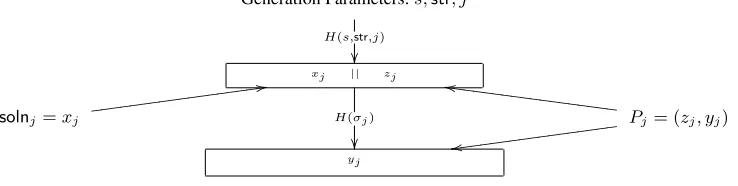
Q= (α, β)∈N2which ensure puzzles have a certain amount of difficulty to solve. We letH :{0,1}∗ 7→ {0,1}m be some hash function. To generate a new puzzle the generator performs the following steps to compute the required sub-puzzle instancesPjforj∈ {1,2, . . . , β}:
• A bit stringσjis computed asσj =H(s,str, j). The valuestrhas the structurestr=tkM fortsome server time
value1andM some unique value2. We denotexj=σjh1, αiandzj =σjhα+ 1, mi.
• A valueyjis computed asyj=H(σj)and the sub-puzzle instance isPj= (zj, yj).
The full puzzle instance is then the required parameters plus the tuple of sub-puzzle instancespuz = (Q,str, P = (P1, P2, . . . , Pβ)). The sub-puzzle instance generation process is summarized in Figure 1.
A solution to a given sub-puzzlePj is any stringx0jsuch thatH(x0j || zj) = yj. The solution to the full puzzle instance is a tuple of solutions to the sub-puzzles. To verify a potential solutionsoln = (Q,str,soln1,· · · ,solnβ)the generator verifies eachPj andsolnj by checking thatH(solnj || zj) = yj for eachj. The authenticity of a given puzzle is checked by regenerating eachPjusingsand comparing this to the puzzle submitted.
1
The details of the type of value this is are not described in [14] but here we will assume this is as a bit string.
2
Generation Parameters:s,str, j
H(s,str,j)
xj || zj
H(σj)
solnj=xj
1
1
c c c c c c c c c c c c c c c c c c
Pj= (zj, yj)
m
m
[[[[[[[[[[[[[[[[[[
q
q
ccccccccccccccccc
yj
Fig. 1.The Juels and Brainard Sub-Puzzle Instance Generation.
To incorporate this client puzzle into a client puzzle protocol the server allocates buffer slots, by using a hash table on the values ofM, for each puzzle and correct solution submitted. This ensures that only one puzzle instance and solution are accepted for a given value ofM.
3
Client Puzzles
The role of a client puzzle in a protocol is to give one party some assurance that the other party has spent at least a given amount of effort computing a solution to a given puzzle instance. In this section we give a formal definition of a client puzzle in the most general sense.
FORMALSYNTAX OFA CLIENTPUZZLE. A client puzzle is a tuple of algorithms: a setup algorithm for generating long term public and private parameters, an algorithm for generating puzzle instances of a given difficulty, a solu-tion finding algorithm, an algorithm for verifying authenticity of a puzzle instance and an algorithm for verifying correctness of puzzle and solution pairs. We formally define a client puzzle as follows.
Definition 1 (Client Puzzle).Aclient puzzleCPuz= (Setup,GenPuz,FindSoln,VerAuth,VerSoln)is given by the following algorithms:
• Setupis ap.p.t.setup algorithm. On input1k, for security parameterk, it performs the following operations:
• Selects the long term secret key spacesSpace, hardness spaceQSpace, string spacestrSpace, puzzle instance spacepuzSpaceand solution spacesolnSpace.
• Selects the long term puzzle generation keys←$ sSpace.
• Assignsparams←(sSpace,puzSpace,solnSpace,QSpace,Π)and outputs(params, s).
The tupleparamsis the public system parameters and as such is not explicitly given as an input to other algorithms. The valuesis kept private by the puzzle generator andΠ∈paramsis any additional public information, such as descriptions of algorithms, required for the client puzzle.
• GenPuzis ap.p.t.puzzle generation algorithm. On inputs∈sSpace,Q∈QSpaceandstr∈strSpaceit outputs a puzzle instancepuz∈puzSpace.
• FindSolnis a probabilistic solution finding algorithm. On inputspuz∈puzSpaceand a run timeτ ∈Nit outputs apotential solutionsoln∈solnSpaceafter at mostτclock cycles of execution.
• VerAuthis ad.p.t.puzzle authenticity verification algorithm. On inputss ∈ sSpaceand puz ∈ puzSpacethis outputstrueorfalse.
• VerSoln is a deterministic solution verification algorithm. On inputs puz ∈ puzSpace and a potential solution
soln∈solnSpacethis outputstrueorfalse.
For correctness we require that if(params, s)←Setup(1k)andpuz←GenPuz(s, Q,str), forQ∈ QSpaceandstr ∈ strSpace, then
• VerAuth(s,puz) =trueand
Remark 1.Typically client puzzles use a set of system parameters, most notably system time, as input to the puzzle generation algorithm. This is so the server has a mechanism for expiring puzzles handed out to clients. In our model we usestrto capture this input and do not enforce any particular structure on it.
Remark 2.To prevent DoS attacks that exhaust the server memory it is desirable that the server stores as little state as possible for uncompleted protocol runs (i.e. before a puzzle has been solved). We refer to this concern of client puzzles as “state storage costs” [2]. We build this into our definition of a client puzzle by insisting thatonlya single value ofs
is stored by a server; all the data necessary to solve a given puzzle and to re-generate, and hence verify authenticity of a puzzle and solution pair, is included in the puzzle descriptionpuz.
Remark 3.Generally, for a puzzle to be “secure” when used within a client puzzle protocol, we want puzzles generated to be unique and for puzzle and solution pairs to only be validly used once by a client. In actual usage, a server can filter out resubmitted correctly solved puzzle and solution pairs by, for example, using a hash table mechanism. Uniqueness of puzzles can be ensured by havingGenPuzselect a random noncenSand use this in the puzzle generation.
Remark 4.Our definition assumes private verifiability forVerAuth. Generally the only party concerned with checking who generated a given puzzle is the puzzle generator (client puzzles are usedbeforeany other transactions take place and to protect the generator and no other party). Although in some cases it may be useful to have publicly verifiable puzzles it would complicate the definition and we choose to keep our definition practical yet as simple as possible.
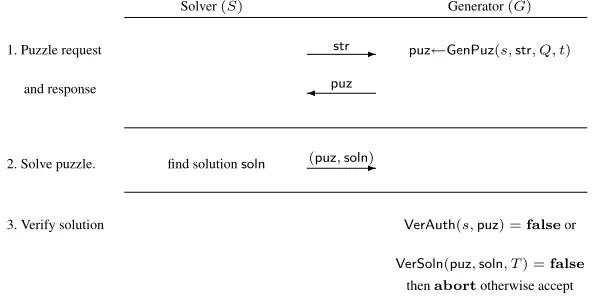
CLIENT PUZZLE PROTOCOLS. Intuitively, a client puzzle protocol is a protocol which uses a client puzzle in its message flows to provide DoS resistance. We first allow a one time setup during which the generatorGrunsSetup(1k) for security parameterkto obtainparamsands. We then defineΠ(CPuz), the client protocol between a solverSand
G, to be the message flows of Figure 2.
Solver(S) Generator(G)
1. Puzzle request str- puz←GenPuz(s,str, Q, t)
and response puz
2. Solve puzzle. find solutionsoln (puz,soln)
-3. Verify solution VerAuth(s,puz) =falseor
VerSoln(puz,soln, T) =false
thenabortotherwise accept
Fig. 2.The Client Puzzle ProtocolΠ(CPuz)constructed fromCPuz
One way to use a client puzzle protocols as a counter measure against connection depletion DoS attacks is to stack
4
Security Notions for Client Puzzles
We define two notions for client puzzles. The first measures the ability of an adversary to produce a correctly authen-ticating puzzle with an unknown private key. We refer to this as the ability of an adversary to forge a client puzzle. The second notion gives a measure of the likelihood of an adversary finding a solution to a given puzzle within a given number of clock cycles of execution. We refer to this as the difficulty of a client puzzle. Intuitively, these are both what one would expect to require from a client puzzle given its role in defenses against DoS attacks; being able to either forge puzzles or solve them faster than expected allows an adversary to mount a DoS attack.
We first review the definition of a function family since we will use function families to express security of a given client puzzle in terms of difficulty. Afunction familyis a mapF : I×D 7→ R. The setI is the set of all possible indices,Dthe domain andRthe range. Unless otherwise specified we assumeI=N. The setRis finite and all sets are nonempty. We writeFi:D7→RforFi(d) =F(i, d)wherei∈Iand refer toFias an instance ofF.
UNFORGEABILITY OFPUZZLES. We first define our notion of unforgeability of client puzzles. Intuitively, we require an adversary that sees puzzles generated by the server (possibly together with their associated solutions), and that can verify the authenticity of any puzzle it chooses, cannot produce a valid looking puzzle on his own.
To formalize unforgeability of a client puzzle we use the following gameExecUFA,CPuz(k)between a challengerC
and an adversaryA.
(1) The challengerCfirst runsSetupon input1kto obtain(params, s). The tupleparamsis given toAandsis kept secret byC.
(2) The adversaryAgets to make as manyCreatePuz(Q,str)andCheckPuz(puz)queries as it likes whichCanswers as follows.
• CreatePuz(Q,str)queries. A new puzzle is generatedpuz←GenPuz(s, Q,str)and output toA.
• CheckPuz(puz)queries. IfVerAuth(s,puz) =trueandpuzwas not output byCin response to aCreatePuz query thenCterminates the game setting the output to1. Otherwisefalseis returned toA.
(3) IfCdoes not terminate the game in response to aCheckquery then eventuallyAterminates and the output of the game is set to0.
We say the adversaryAwins ifExecUFA,CPuz(k) = 1and loses otherwise. We define the advantage of such an adversary as
AdvUFA,CPuz(k) = PrhExecUFA,CPuz(k) = 1i.
Puzzle-unforgeability then means that no efficient adversary can win the above game with non-negligible probability.
Definition 2 (Puzzle-unforgeability).A client puzzleCPuzisUFsecure if for anyp.p.t.adversaryAits advantage
AdvUFA,CPuz(k)is a negligible function ofk.
Remark 1.In the gameExecUFA,CPuz(k)we allowAaccess to all algorithms defined inCPuz. In particular, we allow unlimited access to theGenPuzalgorithm for any given chosen inputs. This allowsAto generate as many puzzles as it wishes (sinceAis p.p.t. it will anyway generate at most polynomially many) with any given chosen key and difficulty values. Notice that the adversary can find solutions to any puzzle by running theFindSolnalgorithm which is public. These abilities are sufficient to mimic the environment in which a DoS attacker would sit.
DIFFICULTY OFSOLVINGPUZZLES. We formalize the idea that a puzzleCPuzcannot be solved trivially via the game ExecQ,DIFFA,CPuz(k)between a challengerCand an adversaryA. The game is defined for each hardness parameterQ∈N
as follows:
(1) The challengerCrunsSetupon input1k to obtain(params, s)and passesparamstoA.
(3) At any point during the executionAis allowed to make a singleTest(str†)query. In response, the challenger generates a challenge puzzle aspuz†←GenPuz(s, Q,str†)which it returns toA.
AdversaryAterminates its execution by outputting a potential solutionsoln†. We define the running timeτofAas being the running time of all of the experimentExecQ,DIFFA,CPuz(k).
We say the adversary wins ExecQ,DIFFA,CPuz(k) if VerSoln(puz†,soln†) = true. In this case we set the output of ExecQ,DIFFA,CPuz(k)to be1and otherwise to0. We then define the success of an adversaryAagainstCPuzas
SuccQ,DIFFA,CPuz(k) = PrhExecQ,DIFFA,CPuz(k) = 1i.
We define the difficulty of puzzle solving by requiring that for any puzzle hardness the success of any adversary that runs in a bounded number of steps falls bellow a certain threshold (that is related to the hardness of the puzzle).
Definition 3 (Puzzle-difficulty). Let ε:N2 7→
N 7→ [0,1] be a family of monotonically increasing functions. We use the notationεk,Q(·)for the function within this family corresponding to security parameterkand hardness
parameterQ. We say a client puzzleCPuzisε(·)–DIFFif for allτ ∈N, for all adversariesAinExecDIFF,QA,CPuz(k), for
all security parametersk∈N, and for allQ∈Nit holds that
SuccQ,DIFFA
τ,CPuz(k)≤εk,Q(τ) whereAτ is the adversaryArestricted to at mostτclock cycles of execution.
Remark 1.The security game above allowsAto obtain many puzzle and solution pairs by making queries to model actual usage in DoS settings; when a client puzzle is used as part of a client puzzle protocol an adversary may see many such puzzles and solutions exchanged between a given generator and solver on a network. The adversary could then learn something from these.
Remark 2. In the definition of the Test query, we do allow the string str† to be one previously submitted as a CreatePuzSoln query and allow CreatePuzSoln queries on any string includingstr† after theTest query. It then immediately follows that a difficult puzzle needs to be such that each puzzle generated is unique. Otherwise, a previ-ously obtained solution through theCreatePuzSolnquery may serve as a solution to the challenge query. Furthermore, it also follows that solutions to some puzzles should not be related to the solutions of other puzzles, as otherwise a generalization of the above attack would work.
Remark 3.The queriesCreatePuz(used in the game for puzzle-unforgeability) andCreatePuzSolnused in the above game are related, but different. The queryCreatePuzSolnoutputs a puzzle together with its solution. The second is more subtle: in aCreatePuzquery we allowAto specify the value ofQused but inCreatePuzSolnwe do not (the value ofQis fixed throughout the difficulty game).
Remark 4.Clearly any puzzle that isε(·)–DIFFis also(ε(·) +µ)-DIFFwhereµ ∈ R>0is such thatε(τ) +µ≤ 1 (sinceSuccQ,DIFFA
τ,CPuz(k)≤εk,Q(τ)≤εk,Q(τ) +µ). The most accurate measure of difficulty for a given puzzleCPuz is then the functionε(τ) = infAτSucc
Q,DIFF
Aτ,CPuz(k).
Remark 5.Since we measure the running time of the adversary in clock cycles, the model abstracts away the possibility that the adversary may be distributed and thus facilitates further analysis (for example of the effectiveness of client puzzle defense against DoS attacks).
5
An Attack on the Juels and Brainard Puzzles
PROVING FORGEABILITY. The reason the construction is forgeable is the authentication is not unique to a given instance but covers a number of instances of varying difficulty. This occurs because the puzzle instance difficulty is not included in the first preimage of the sub-puzzle construction. We exploit this weakness and construct an adversary
AwithAdvUFA,CPuz(k) = 1.
We have the following lemma regarding the forgeability of the Juels and Brainard construction.
Lemma 1. The client puzzle construction of Juels and Brainard [14] isnotUFsecure.
Proof. To prove this we construct an adversaryAagainst theUFsecurity of the construction that can win the security gameExecUFA,CPuz(k)with probability 1. We now describe the details ofA.
At the start of the security game A is given a set of public parameters. The adversary then makes a query CreatePuz(Q,str)for some random choices ofQandstrwhereQ= (α, β)and receives a puzzle instancepuz = (Q,str, P = (P1, P2, . . . , Pβ))in response. NextA removes the first bit of eachPi to obtainPi† and constructs
Q†= (α+ 1, β)andpuz†= (Q†,str, P† = (P1†, P2†, . . . , Pβ†)). The adversary then makes a queryCheckPuz(puz†). ClearlyAwins with probability 1 sincepuzandpuz†are both generated from the samesandstrhencepuz†will
correctly verify yet was not output from aCreatePuzquery. 2
Remark 1.One could also prove Lemma 1 by having the adversary construct the forgery asQ† = (α, β−1)and then puz† = (Q†,str,(P†
1, . . . , P
†
β−1)). One could also vary the number of bits moved betweenαand eachPior change the number of sub-puzzles deleted. The reason we choose to give the proof in the manner given is because this specific method allows for the construction of a DDoS attack with the given assumptions we make about the protocol using this particular client puzzle. We describe this attack next.
CONSTRUCTING ADDOS ATTACK. We now use the forgeability of the construction to mount a DDoS attack on client puzzle protocols based on this client puzzles. The attack works when the difficulty parameter is increased in a certain way and when the hash table, mentioned in [14] and used to prevent multiple puzzle instance and solution submissions, is based on some unique data for each instance that is not in the preimage of any sub-puzzle. A hash table mechanism that depends on some unique data contained in each sub-puzzle preimage, as is mentioned in [14], would thwart the following DDoS attack on client puzzle protocols based on this client puzzle.
We first assume the client puzzle is used in the client puzzle protocol of [14] and the generator increasesQby increasingαmany times for each increase inβ. We also assume any hash tables used are computed using either the puzzle instance alone or the correct solutions alone.
To mount the DDoS attack the adversary commands each of its zombies (platforms the adversary controls) to start a run of the protocol with the server under attack. The server will begin to issue puzzle instances and then, when enough requests are received, will increaseQby incrementingα. Each zombie computes a solution to the first puzzle it receives and to submits this to the server. Then, while this puzzle has not expired, each timeαis incremented, a new puzzle and solution pair is trivially computed by removing the first bit from eachxiand concatenating this to the end of eachsolni previously computed. The new puzzle and solution pair are submitted to the server and will correctly verify and will then be allocated buffer space (due to our assumptions on the hash table mechanism). When a zombies’ puzzle expires it obtains a new one. As the valueQis increased then so will the puzzle expiry period and hence more forged puzzles can be used per valid puzzle obtained eventually exhausting the memory resources of the server.
Also, even if we assume that the buffer allocation based on the hash table mechanism is as in [14] the attack will still consume a huge amount of server computational resources. This is because the adversary can trivially spoof new puzzle instances and solutions from previous ones. These will not be allocated buffer space due to the hash table mechanism, but will consume computation via server verification computations. In the next section we give a an example instantiation of a generic construction that is a repaired version of the sub-puzzle mechanism; an unforgeable version of the sub-puzzle construction.
6
A Generic Client Puzzle Construction
and a one way function (OWF). We prove our generic construction is secure according to the definitions we put forth in this paper, and show one possible instantiation. Intuitively, the unforgeability of puzzles is ensured by the use of thePRFand the difficulty of solving puzzles is ensured by the hardness of inverting the one-way function. We first review some notational conventions and definitions regarding function families, pseudorandom functions, and concrete notions for pseudorandom function families and one way function families.
IfF is a function family then we use the notationf ←$ F fori ←$ I; f←Fi. We denote the set of all possible functions mapping elements ofD toRbyFunc(D, R). Arandom functionfromD toRis then a function selected uniformly at random fromFunc(D, R).
PSEUDORANDOMNESS. We define thePRF(pseudorandom function) gameExecPRF,bB,F (k)for an adversaryBagainst the function familyF :K ×D7→R, where|K|= 2k, as follows.
(1) Forb = 1the adversaryBhas black box access to a truly random functionRfrom the setFunc(D, R)and for
b= 0the adversaryBhas black box access to a functionFschosen at random fromF.
(2) The adversaryBis allowed to ask as many queries as it wants to whichever function it has black box access to. EventuallyBterminates outputting a bitb∗.
We set the output ofExecPRF,bB,F (k)to1ifb∗=band set the output to0otherwise. We then define the advantage of an adversary againstFin terms ofPRFas
AdvPRFB,F(k) =
Pr
ExecPRF,0B,F (k) = 1
−Pr
ExecPRF,1B,F (k) = 1
.
CONCRETEPSEUDORANDOM ANDONE WAY FUNCTION FAMILIES. Here we briefly review concrete notions of security for pseudorandom function and one way function families. We depart from the typical “(ε, t)- hardness” style of definitions, as they are not sufficient for our purposes. Instead we viewε, the probability of a break, as a function of the running timeτof the adversary. So, a primitive isε(·)- secure if for all adversaries running in timeτthe probability of breaking the primitive is at mostε(τ).
Definition 4 (νk(·)–PRFF).LetF :K ×D 7→ R be a function family andν :N 7→ N 7→ [0,1]be a family of monotonically increasing functions. We sayFis aνk(·)–PRFFif for allk∈ Kand for all adversariesAit holds that
AdvPRFAτ,F(k)≤νk(τ).
Note that, in the definition of an νk(·)–PRFF, the security parameter k specifies the size of the keyspace for the gameExecPRF,bA
τ,F(k)and the actual key, and hence function from the family used, is chosen at random from this keyspace.
Definition 5 (εi(·)–OWF).For an adversaryAwe define its advantage against a functionψ:X 7→ Y, whereX is
fixed and finite, in terms ofOWFas
AdvOWFA,ψ = Pr[x← X$ ; y←ψ(x); (˜x←A(y)∧ψ(˜x) =y)].
Letεi:N7→[0,1]be a monotonically increasing function. Then, the functionψis anεi(·)–OWFif for all adversaries
Ait holds thatAdvOWFAτ,ψ ≤εi(τ).
We then extend this definition to a family of functions as follows:
Definition 6 (ε(·)–OWFF).Letϕ:N7→ X 7→ Yandε:N7→ N7→[0,1]be function families. We sayϕis an
ε(·)–OWFFif for alli∈Nthe functionϕi:X 7→ Yis anεi(·)–OWF.
THEGENERICCONSTRUCTION. Our generic construction is based on the method of Juels and Brainard [14]. Most client puzzle constructions based on one way functions, such as the discrete log based scheme of [27], and the RSA based scheme of [10], can be described in this manner with some minor modifications. So, our generic construction pins down sufficient assumptions on the building blocks that imply security of the resulting puzzle. We letk∈Nthen letF :K ×D 7→ X where|X | ≥ |K|= 2k be a function family indexed by elements ofK. The domainDofF
of an element ofDexplicitly as an input toFs. We further letϕ:N7→ X 7→ Ybe a family of functions indexed byQ. We assume there is a polynomial time algorithm to computeϕQ for each value ofQand input. The various algorithms in the scheme are then as follows:
Setup(1k).The various spaces are chosen;sSpace←K,QSpace←
N,strSpace←{0,1}∗,solnSpace←XandpuzSpace←QSpace× strSpace× {0,1}k× Y. The parameterΠis assigned to be the polynomial time algorithm to computeϕ
Qfor all
Q ∈ QSpaceandx ∈ X. Finally, the valuesis chosen ass ←$ sSpaceand the tupleparams constructed then output.
GenPuz(s, Q,str).A nonce is selectednS $
← {0,1}k. Nextxis computed asx←F
s(Q,str, nS). The valuey∈ Yis computed asy←ϕQ(x)and the puzzle assigned to bepuz= (Q,str, nS, y)and output.
FindSoln(puz, τ).While this algorithm is within the allowed number of clock cycles of execution it randomly samples elements from the set of possible solutions without replacement and for each potential preimagex0∈ X computes
y0←ϕ
Q(x0). Ify0 =ythis outputsx0 then halts and otherwise continues with random sampling. If this algorithm reaches the last clock cycle of execution then it outputs a random element of the remaining unsampled preimage space. The set of possible solutions is generally a subset ofXthat is defined by the valueyof size dependent upon
Qin some manner; the details of how the size varies depends upon the function familyϕ.
VerAuth(s,puz0).For a puzzlepuz0 = (Q0,str0, n0S, y0)this computesx0asx0←Fs(Q0,str0, n0S)theny←ϕQ(x0). If
y0 =ythis outputstrueand otherwise outputsfalse.
VerSoln(puz0,soln0).Given a potential solutionsoln0 = x0 this checks if ϕQ(x0) = yand if so outputstrueand otherwise outputsfalse.
We use the notation CPuz = PROWF(F;ϕ) for the generic construction in this manner. The construction is summarized in Figure 3.
Q,str, nS soln puz
GenPuz,VerAuth
GenPuz,VerSoln,VerAuth
FindSoln
x=Fs(Q,str,nS) //
y=ϕQ(x)
,
,
x0=ϕ−Q1(y)
e d d c b a
l
l
] \ [ [ Z
Fig. 3.Solid arrows are actions performed by a generator and dashed ones by a solver. The lists of algorithms above/below arrows imply the actions are performed as part of these algorithms. The details of how each action is used in the given algorithm are given in the full description.
Remark 1.In the definition of anε(·)–OWFwe specify the domainX is fixed and finite but do not specify the exact size or shape of this; in our generic construction this is set to be the output space of somePRF.
Remark 2.The exact specification of theFindSolnalgorithm is not important for our theorems and proofs nor is it unique. Indeed, other techniques such as exhaustive search may even be faster than the algorithm given. The important point is such an algorithm exists and can be described.
Remark 3.The domainDofF is given as 3 tuples of the formN× {0,1}∗× {0,1}k which is the same as{0,1}∗.
However, we will always construct elements ofDfrom a given tuple rather than taking a bit string and encoding it as an element ofD. Hence we do not refer to this as a uniquely recoverable encoding onD.
Remark 5.Our generic construction is similar to the Juels and Brainard scheme [14] but avoids the forgeability prob-lems by including the hardness parameterQin the input toF.
Remark 6. Finally, we remark that the generic construction where the PRF function is replaced by a MAC is not necessarily secure. Indeed, one-wayness of the generic construction is guaranteed as long as the one-way function is applied to randomly chosen bit-string. While this property is ensured through the use of a pseudo-random function, it is does not always hold for a MAC. For example, using an artificial MAC in which most (say the first 3/4) of the output bits are constant, and a one-way function which discards only and precisely those bits, leads to an yield an insecure construction.
The following theorems capture the security of this generic construction. Their proofs can be found in Appendix B.1 and Appendix B.2 respectively.
Theorem 1. Let F be a PRFfamily and ϕ a family of functions as described above such that for each value of Q and for all y ∈ Y we have|ϕ−1
Q (y)|/|X | ≤ 1/2
k, wherek is the security parameter. Then the client puzzle
CPuz=PROWF(F;ϕ)isUFsecure.
The condition that|ϕ−Q1(y)|/|X | ≤1/2kfor all values ofQand for ally∈ Yin Theorem 1 prevents the following attack. An adversary may try to forge a puzzle instance by choosing a value forythen selecting a triple(Q,str, nS). If the valueyhas a large number of preimages then the adversary may win without attacking the pseudorandomness ofF at all.
Theorem 2. LetF be aν(·)–PRFFfamily for the function familyν(·),ϕanε(·)–OWFFfor the function familyε(·) andCPuz=PROWF(F;ϕ). ThenPROWF(F;ϕ)isγ(·)–DIFFwhereγk,Q(τ) = 2·νk(τ+τ0) + 1 +τ /(2k−τ)
· εQ(τ+τ1)andτo, τ1∈Nare some constants.
An adversary may try to solve puzzles by either computing the value Fs(Q,str, nS)for an unknown value ofs or by computing a preimage ofϕQ for the valuey provided. The functionνk in Theorem 2 captures that computing
Fsfor an unknown value ofsshould not be easy; the functionF needs to be a goodPRF. Intuitively,kshould be chosen to be large enough that it is easier to compute a preimage ofyunderϕQ than computing the corresponding valueFs(Q,str, nS).
Impact on Practical Implementations of Puzzles
The use of cryptographic puzzle schemes where puzzle creation is expensive, immediately leads to DoS attacks. From this perspective the use of a provably securePRFwould most likely be avoided by practical implementations. We now present an efficient implementation of our generic construction based on cryptographic hash functions. The scheme follows by instantiating the two components of our generic construction. We obtain essentially a modified Juels and Brainard scheme that incorporates the defence against the attack that we present in Section 5.
Given a hash functionH : {0,1}∗ 7→ {0,1}m a standard construction for aPRFfamilyF is as follows. Key generation selects a random strings ← {0,$ 1}k wherekis the security parameter. Function application is defined byFs(x) = H(s||x)for anyx ∈ {0,1}∗ Furthermore, given a hash function G : {0,1}∗ → {0,1}n we define the function family ϕof functionsϕQ : {0,1}m → {0,1}m−Q × {0,1}n by ϕQ(x) = (xhQ+ 1, mi, G(x)). In Appendix C we prove that in the random oracle model,Fis aνk(·)–PRFFfunction, for some some function family
ν withνk(τ)≤ 2mk and thatϕisε(·)–OWFFfor some function familyεwithε(τ)≤τ /2
m+τ /(2m−Q). Concrete bounds for the security of our construction follow by instantiating the bounds in Theorems 1 and 2.
References
1. W. Aiello, S. M. Bellovin, M. Blaze, R. Canetti, J. Ioannidis, A. D. Kermoytis and O. Reingold. Just Fast Keying: Key Agreement In A Hostile Internet. InACM Transactions on Information and System SecurityVol 4, No. 2, 1–30, 2004. 2. T. Aura, P. Nikander and J. Leiwo. DoS-Resistant Authentication with Client Puzzles. InSecurity Protocols Workshop.
Springer-Verlag LNCS 2133, 170–181, 2001.
4. E. Biham, Y. J. Goren and Y. Ishai. Basing Weak Public-Key Cryptoraphy on Strong One-Way Functions InTheory of Cryptography Conference. Springer-Verlag LNCS 4948, 55–72, 2008.
5. R. Canetti, S. Halevi and M. Steiner. Hardness Amplification of Weakly Verifiable Puzzles. InProceedings of Theory of Cryptography Conference – TCC 2005. Springer-Verlag LNCS 3378, 17–33, 2005.
6. L. Chen and W. Mao. An Auditable Metering Scheme for Web Advertisement Applications. InProceedings of the 4th International Conference on Information Security, Springer-Verlag LNCS 2200, 475–485, 2001.
7. C. Douligeris and A. Mitrokotsa. DDoS Attacks and Defence mechanisms: Classification and State–of–the–Art. InComputer NetworksVol 44, Issue 5, 643–666, 2004.
8. C. Dwork and M. Naor. Pricing via Processing or Combatting Junk Email. InAdvances in Cryptology – CRYPTO 1992
Springer-Verlag LNCS Vol. 740, 139–147, 1992.
9. W. Eddy.TCP SYN Flooding Attacks and Common Mitigations.RFC 4987, August 2007.
10. Y. Gao. Efficient Trapdoor-Based Client Puzzle System Against DoS Attacks. MSc Thesis, University of Wollongong, Com-puter Science Department. 2005.
11. B. Groza and Dorina Petrica. On Chained Cryptographic Puzzles. In3rd Romanian-Hungarian Joint Symposium on Applied Computational Intelligence (SACI). 25–26, 2006.
12. R. Impagliazzo and S. Rudich. Limits on the Provable Consequences of One–Way Permutations. InProceedings of the 21st Annual ACM Symposium on the Theory of Computing – STOC 1989.ACM, pages 44–61, 1989.
13. M. Jakobsson and A. Juels. Proofs of Work and Bread Pudding Protocols. InProceedings of the IFIP TC6/TC11 Joint Working Conference on Secure Information Networks: Communications and Multimedia Security. IFIP Conference Proceedings Vol. 152, 258–272, 1999.
14. A. Juels and J. Brainard. Client Puzzles: A Cryptographic Countermeasure Against Connection Depletion Attacks In Proceed-ings of the 1999 ISOC Network and Distributed System Security Symposium. 151–165, 1999.
15. D. Karig and R. Lee. Remote Denial of Service Attacks and Countermeasures Princeton University Department of Electrical Engineering Technical Report CE–L2001–002. 2001.
16. C. Meadows. A Formal Framework and Evaluation Method for Network Denial of Service. InProceedings of the 12th Computer Security Foundations WorkshopIEEE Computer Society Press, 4–13, 1999.
17. C. Meadows A Cost–Based Framework for Analysis of Denial of Service in Networks. InJournal of Computer Security Vol 9, Issues 1–2, 143–164, 2001.
18. R. Merkle. Secure Communications Over Insecure Channels. InCommunications of the ACM. Vol. 21, Issue 4, 294–299, 1978.
19. J. Mirkovic, J. Martin and P. Reiher. A Taxonomy of DDoS Attack and DDoS Defense Mechanisms. InACM SIGCOMM Computer Communication ReviewVol 34, Issue 2, 39–53, 2004.
20. R. Moskowitz, P. Nikander, P. Jokela and T. Henderson.Host Identity Protocol. Internet Draft, October 2007.
21. R. L. Rivest, A. Shamir and D. Wagner. Time-lock Puzzles and Timed-release Crypto. Massachusetts Institute of Technology Technical Report TR-684. 1996.
22. P. Rogaway. Formalizing Human Ignorance. InProgress in Cryptology – VIETCRYPT 2006. Springer-Verlag LNCS Vol. 4341, 211–228, 2006.
23. P. Schaller, S. Capkun and D. Basin. BAP: Broadcast Authentication Using Cryptographic Puzzles. InApplied Cryptography and Network Security.Springer-Verlag LNCS Vol. 4521, 401–419, 2007.
24. J. Smith, J. M. Gonz´alez–Nieto and C. Boyd Modelling Denial of Service Attacks on JFK with Meadows’s Cost–Based Framework. InProceedings of the 2006 Australasian workshop on Grid computing and e–researchVol 54, 125–134, 2006. 25. S. Specht and R. Lee. Distributed Denial of Service: Taxonomies of Attacks, Tools, and Countermeasures. InProceedings of
the 17th International Conference on Parallel and Distributed Computing Systems, 2004 International Workshop Security in Parallel and Distributed Systems543–550, 2004.
26. S. Tritilanunt, C. Boyd, E. Foo and J. M. Gonz´alez–Nieto. Toward Non-Parallelizable Client Puzzles. InCryptology and Network Security – CANS 2007. LNCS Vol. 4896, 247–264, 2007.
27. B. Waters, A. Juels, J. A. Halderman and E. W. Felten. New Client Puzzle Outsourcing Techniques for DoS Resistance. In
Proceedings of the 11th ACM Conference on Computer and Communication Security – CCSACM Press, 246–256, 2004.
A
Notation
We letd.p.t.denote deterministic polynomial time andp.p.t.probabilistic polynomial time. IfFis some function we use the notationx← F(y1, . . . , yn)for the process of obtainingxby runningF on inputsy1, y2, . . . , yn. IfA is some algorithm we use the notationx←AO1(·),O2(·)(y
1, . . . , yn)for the process of obtainingxby runningAon inputsy1, y2, . . . , ynwith access to oraclesO1(·)andO2(·). Ifxis some variable then we also use this for runningA orF with the given inputs and then assigning the output tox.
B
Proofs of Theorems
B.1 Proof of Theorem 1
Proof. Consider some adversaryAagainst theUFsecurity ofPROWF(F;ϕ). We define gamesG0andG1byG0= ExecUFA,CPuz(k)andG1=ExecUFA,CPuz0(k)where the schemes involved are defined byCPuz=PROWF(F;ϕ),CPuz0=
PROWF(R;ϕ)andRis some function selected at random from the set of functionsFunc(D,X). In other words, in gameG0the adversary tries to break our construction whereas in gameG1the adversary works against an idealized version of our construction, where the pseudorandom functionF had been replaced with a truly random function. We now argue that if the adversaryAsees a difference between the two games, then he breaks the security of the pseudorandom function. We do this by constructing an adversaryBsuch that:
Pr
AwinsG0−PrAwinsG1
= 2·Adv
PRF
B,F(k). SincePr
AwinsG0
=AdvUFA,CPuz(k), the theorem follows by boundingPr
AwinsG1
.
We now describe the details of the adversaryB. Forb = 0, at the start of the gameExecPRF,bB,F (k), the adversary
Bis given black box access to a functionFs† from the familyF with an unknown value of keys†. Forb = 1 the
adversaryBis given black box access to a functionRchosen randomly from the set of functionsFunc(D,X). The input strings toRwill have the same syntax as those to the members ofFs†. The adversaryBthen acts as a challenger
to the adversaryA. It does this as follows:
(1) The adversaryBfirst runs Setupon input1k to obtain a pair(params, s)and starts the adversaryAon input params. Throughout the simulationBdoes not use the value ofsbut instead answers queries made byAusing its black box access to eitherFs† orRdepending on the value ofb.
(2) The adversaryAwill then start to askCreatePuz(Q,str)andCheckPuz(puz)queries whichBanswers as follows:
• CreatePuz(Q,str)queries. For this the adversaryBselects a random noncenS $
← {0,1}k then computesxby querying whichever function it has black box access to on input(Q,str, nS). NextBcomputesy as the output ofϕQ(x)and replies toAwith the puzzlepuz= (Q,str, nS, y). The adversaryBalso keeps a list of all puzzles output toA.
• CheckPuz(puz)queries. For a givenpuz= (Q,str, nS, y)ifpuzwas output byBin response to aCreatePuz query then B outputs true. Otherwise B queries whichever function it has black box access to on inputs
(Q,str, nS)and receives a responsex. NextB computesy as the output ofϕQ(x). Ify = y thenBoutputs
1in its game againstCand terminates and otherwise responds withfalse.
(3) IfBhas not terminated in response to aCheckPuzquery then eventuallyAwill terminate. The adversaryBthen selects a bit at random, outputs this in its game againstCand terminates.
Ifb= 0then the above game betweenBandAwill be exactly the gameG0and ifb = 1we get the gameG1. Hence we have
PrhExecPRF,bB,F (k) = 1i= Pr
AwinsGb+
1 2
1−Pr
AwinsGb
.
As a result we get
2·AdvPRFB,F(k) =
Pr
AwinsG0−PrAwinsG1
We now boundPr[AwinsG1]. IfAwinsG1 we letpuz† = (Q†,str†, n†S, y†)be the puzzle on whichAwins the game, letx† =R(Q†,str†, n†
S)and letview(A)be the transcript ofA; everything that adversaryAsees during the game. SinceAwins it must be the case thatpuz† was not output in response to a CreatePuzquery. SinceϕQ†
is deterministic(Q†,str†, n†S)cannot have been output byRduring aCreatePuzquery; otherwisepuz† would have been output in response to this query. Furthermore, sinceRis a random function, y† must have been chosen byA
independently ofx†givenview(A). Sincex†is independent fromview(A), the probability that the adversary wins in the game is:
PrAwinsG1
= PrhϕQ†(x†) =y† i
where the second probability is over the choice ofx†inX. In other words, we have that:
PrAwinsG1
= ϕ −1 Q†(y†)
|X |
We therefore have:
AdvUFA,CPuz(k) = Pr
AwinsG0
= Pr
AwinsG0+ PrAwinsG1−PrAwinsG1
≤
Pr
AwinsG0
−PrAwinsG1
+ Pr
AwinsG1
= 2·AdvPRFB,F(k) +
|ϕ−Q1†(y
†)|
|X |
≤2·AdvPRFB,F(k) + 1 2k.
2
B.2 Proof of Theorem 2
Proof. We prove this theorem using a technique similar to the proof of Theorem 1. Again we define two gamesG0 andG1but this time haveG0=ExecDIFFA,CPuz(k)andG1=ExecDIFFA,CPuz0(k)whereCPuz=PROWF(F;ϕ),CPuz0=
PROWF(R;ϕ)andRis some random function selected from the set of functionsFunc(D,X). We again argue that if an adversaryAτ sees a difference between the two games then he breaks the concrete security of the pseudorandom function family. We do this by constructing an adversaryBsuch that
Pr
Aτ winsG0−PrAτwinsG1
= 2·Adv
PRF
Bτ+τ0,F(k).
The main difference with this proof and that of Theorem 1 is for the gameG1 we construct an adversaryCagainst
ϕQsuch thatAdvCτ+τ1,ϕQ = (1 +q/(2
k−q))·Pr
AτwinsG1
whereqis the number ofCreatePuzSolnqueries
made byAon a certain string. Then, sincePr
AτwinsG0
=SuccQ,DIFFA
τ,CPuz(k),Adv PRF
Bτ+τ0,F(k)≤νk(τ+τ 0)and
AdvCτ+τ1,ϕQ ≤εQ(τ+τ
1)the theorem follows.
We now describe the details of the adversaryB. Forb = 0, at the start of the gameExecPRF,bB,F (k), the adversary
Bis given black box access to a functionFs† from the familyF with an unknown value of keys†. Forb = 1 the
adversaryBis given black box access to a functionRchosen randomly from the set of functionsFunc(D,X). The input strings toRwill have the same syntax as those to the members ofFs†. The adversaryBthen acts as a challenger
to the adversaryA. It does this as follows:
(2) The adversaryAwill then start to askCreatePuzSoln(str)queries. To answer eachB selects a random nonce
nS $
← {0,1}kthen computesxby querying whichever function it has black box access to on input(Q,str, n S). NextBcomputesy←ϕQ(x)then assignspuz←(Q,str, nS, y)andsoln←xand passes(puz,soln)toA.
(3) EventuallyAwill make a singleTest(str∗)query. The adversaryBthen generates a challenge puzzle in the same manner as when answeringCreatePuzSolnqueries. We denote the challenge puzzle aspuz∗= (Q,str∗, n∗S, y∗). (4) The adversaryAwill then continue to askCreatePuzSoln(str)queries whichBanswers as before.
(5) Afterτclock cyclesAterminates outputting a potential solutionsoln∗=x∗. IfAwins, i.e. ifVerSoln(puz∗,soln∗) = true, thenBoutputs 1 and terminates and otherwise outputs a random bit and terminates.
By the way we constructB, ifb= 0then the above game between thatBsimulates forAwill be exactly the game
G0and ifb= 1the gameBsimulates forAwill be exactly the gameG1. Hence we have
Pr
ExecPRF,bB,F (k) = 1
= Pr
AwinsGb
+1 2
1−Pr
AwinsGb
.
As a result we get
2·AdvPRFB,F(k) =
Pr
AwinsG0−PrAwinsG1
.
The constantτ0is the timeBtakes on top of the time for the game; the simulation will take some additional clock cycles sinceBneeds to make its own queries in addition to the time taken byAfor the game. We refer to this as the “overhead” time. Since we define the running time ofAto be the running time of all the experimentExecQ,DIFFA,CPuz(k)
we have that the running time ofBwill beτ+τo.
We now construct the adversaryCagainstϕQ. At the start of its gameCis given an elementy† ∈ Y. Throughout the gameCwill simulate a random functionRfromFunc(D,X)by selecting a random element fromXfor each new value ofDqueried and maintaining a list of queries to answer consistently for previously queried values ofD. The adversaryCthen acts as a challenger toAin a gameG1as follows:
(1) The adversaryC first runs Setupon input1k to obtain a pair(params, s)and starts the adversary Aon input params.
(2) The adversaryAwill then start to ask CreatePuzSoln(str)queries. To answer eachC selects a random nonce
nS $
← {0,1}k then computesx←R(Q,str, n
S). NextC computesy←ϕQ(x)then assignspuz←(Q,str, nS, y) andsoln←xand passes(puz,soln)toA. We assume the adversaryCkeeps a recordQof all such queries made by
A.
(3) EventuallyAwill make a singleTest(str†)query. The adversaryCthen generates a challenge puzzle by selecting a random noncen†S ← {0,$ 1}k then assigns the challenge puzzle to bepuz† = (Q,str†, n†
S, y†). If there exists a query on the listQso that the puzzle output ispuz0 = (Q,str†, n†S,∗)thenC terminates and otherwise outputs puz†toA.
(4) The adversary A will then continue to ask CreatePuzSoln(str) queries. Algorithm C computes a puzzle and solution pair(puz,soln)as before. In the case wherestr =str† then if there is an entry onQso that the puzzle output ispuz0 = (Q,str†, n†S,∗)thenCaborts and otherwise outputs(puz,soln)toA.
(5) Afterτclock cyclesAterminates outputting a potential solutionsoln† =x†. The adversaryCthen outputsx†in its game againstϕQand terminates.
In the above simulation provided byC, the functionRthatCsimulates is a random one. As a result the only way
Acould find a correct solution withoutCaborting, i.e. withoutCcomputingR(Q,str†, n†S)at some point, would be forAto invert the functionϕQ.
To construct the advantage statements for this game we letEdenote the event thatCaborts. Since the choice of each noncenSis random and independent of the behavior ofAthe event thatAwinsG1is independent of whetherC aborts or not. As a result we have
AdvOWFC
τ+τ1,ϕQ= Pr
The adversaryC will abort only if a queryCreatePuzSoln(str†)is answered usingn†S at some point during the game. This will occur with probabilityq/2kwhereqis the number ofCreatePuzSoln(str†)queries made byAhence
Pr
¬E
= 1−q/2kand we can write
PrAτ winsG1
=
1 + q
2k−q
·AdvOWFC
τ+τ1,ϕQ(k).
The constantτ1captures the difference, in clock cycles of execution, between an actualG1game and the simula-tionCprovides in the same way asτ0is used.
As a result we get
SuccQ,DIFFA
τ,CPuz(k) = Pr
AτwinsG0
= PrAτwinsG0
+ PrAτwinsG1
−PrAτwinsG1
≤
Pr
AτwinsG0−PrAτwinsG1+ Pr
AτwinsG1
= 2·AdvPRFB
τ+τ0,F(k) + Pr
AτwinsG1
= 2·AdvPRFB
τ+τ0,F(k) +
1 + q
2k−q
·AdvOWFC
τ+τ1,ϕQ
≤2·νk(τ+τ0) +
1 + q
2k−q
·εQ(τ+τ1).
Finally, since the running time ofAis always at mostτwe can bound the number of queriesqbyτgiving the desired
result. 2
C
A More Detailed Analysis of our Random Oracle Based Instantiation
In this section we derive the concrete security bounds for thePRFfamily and the one-way function family imple-mented with random oracles.
Consider the gameExecPRF,0A,F whereH is used to instantiateF. In this case the adversary will be able to queryF
in a black box way, meaning it can make a query on someδand receiveH(s∗ ||δ)for some unknown values∗. The adversary will also have access to the random oracleHwhich it can query on any input it likes. We define the eventE
to be the event that the adversary makes a query toH(without using black box access toFs∗) of the formH(s∗||δ).
If eventEoccurs thenAcould make a query onδusing its black box access toFand would get the same value back as for the eventE. We then have
PrhExecPRF,0A
τ,F(k) = 1
i
= PrhExecPRF,0A,F (k) = 1|Ei·Pr[E] + PrhExecPRF,0A,F (k) = 1| ¬Ei·Pr[¬E].
If the event E does not occur then the simulation provided toAis exactly the same asExecPRF,1A,F (k)since the random functionRand the black box queries toFs∗ are answered in exactly the same way (sinceH is a random
oracle). HencePrExecPRF,0A,F (k) = 1 | ¬E
= PrExecPRF,1A,F (k) = 1. We then bound the termsPr[¬E] ≤1and
Pr
ExecPRF,0A,F (k) = 1|E
≤1. FinallyPr[E] =qH/2k whereqHis the number of random oracle queries made by
AandqH≤τgives
PrhExecPRF,0A
τ,F(k) = 1
i
≤PrhExecPRF,1A
τ,F(k) = 1
i
+ τ 2k giving the desired result that
νk(τ)≤
To showεQ(τ) =τ /2m+τ /(2m−Q)we consider an adversary who is given some valueyandQbits of a preimage
x. The adversary has access to the random oracleGused to instantiateϕQ. There are two ways such an adversary can compute a valuex˜such thatG(˜x) = y; he could queryGonxor he could queryGon some other valuex0 that is
also a preimage ofy. QueryingGonxhappens with probability at mostτ /2m−Q, whereτis the maximum number that can be made toG, since the adversary would have to find the remaining value of the preimage from a space of size2m−Q. QueryingGon some other preimagex0happens with probability at mostτ /2m. Combining these gives the desired result that
εQ(τ)≤
τ 2m+