36
Project Management Practices and Implementation of
Information Technology Projects among Selected
Commercial Banks in Kenya
1
MONGARE, Camanda Felix & 2Dr. Rosemary JAMES
1
MBA Scholar, School of Business, Kenyatta University
2
Lecturer, Management Science Department, School of Business Kenyatta University
ABSTRACT
The main objective of projects in commercial banks is efficient and effective service to customers and reduction of expenses in the banking institution. The main aim of the study was to establish the effects of project management practices on implementation of information technology projects among commercial banks in Kenya. The study used a descriptive survey method. All primary and secondary data were collected. Project Manager as well as the project team picked from the human resource, information technology, customer care, finance and credit departments were the respondents of the questionnaire in each bank. Descriptive as well as inferential statistics were used in analyzing the data. In analyzing the extent of the relationship between the variables in the project, the correlation was used. Regression was also used in obtaining an equation describing the dependent variable about the independent variable using the regression model. As per the analysis of the findings, the respondents stated that they often prepare cash flow statements. The findings showed that the respondents were in agreement that they set up credit guidelines for customers very often. Regarding monitoring and evaluation, the respondents it enhances the quality of project management. According to the findings, the risk is considered key factors for a performance management and that the banks have implemented risk management systems. The research made the conclusion that well-organized monitoring system provides a good base for the proper design of final assessment. The results indicated that project monitoring and evaluation has the strongest positive influence on the implementation of IT projects. In addition, fund management practices, stakeholder management, and project risk management are positively correlated to the implementation of IT projects. The correlation matrix states that the independent variables have a positive effect on the implementation of IT projects. This shows that these variables are very crucial and as such ought to be considered in any efforts to boost IT project implementation in commercial banks in Kenya. The study proposes that the management should involve stakeholders, fund managers, project monitoring and evaluation and project risk managers in project life cycle. The managers ought to have the will and ability to listen, truly seek and value different voices, make a special attempt to hear and comprehend. The banks ought to adopt the most upgraded ICT banking systems and open source software for non-critical internal procedures to enhance efficiency in the implementation of IT projects.
Keywords: ICT banking systems, project risk management, IT project implementation
INTRODUCTION
Project Management Institute (2004) characterizes project as impermanent effort to make an interesting item or service and in this way require successful management of assets. Projects are typically made up of groups of individuals who working together to attain a common objective, which is to meet the set standards in an auspicious, cost-effective way and to the concurred quality. Exercises performed by these individuals are regularly interrelated. Information Technology Services Project Management Group
37
(2012) characterizes a project as a group of related work exercises planned under the guidance of a project manager which, when done, will accomplish certain goals in a particular time frame.
According to Amade, Ogbonna and Kaduru (2010) commitment of contracting firms, project staff‟s skills, collective responsibility among project stakeholders, project management tools and methods, accuracy of project cost estimates, supplier attention to the specifications of the project, project financing, environmental factors, accuracy of designs, and accuracy of project schedules contributes to 55.2% of successful project implementation. Meroka (2011), reasons that financial viability, administration, market evaluation, and the nature of project are the basic achievement components of modern and business projects in Kenya.
Information and communications technologies (ICTs) have improved how business transactions are conducted thus taking care of the developing demands of clients for many companies (Brown and Molla, 2015). Among the noteworthy forces and dynamic improvements that are taking place in the all-inclusive business environment now is innovation through technology. This comes along with new products, service market openings and growing more data framework that is business arranged and bolsters management procedures, for example, fund management, controlling and coordinating (Ezehoha, 2015). The guarantee of ICTs in the banking sector has been recognized as far as its capability to: promote client base, diminish exchange costs, enhance the quality and opportuneness of reaction, upgrading opportunities for publication and marking, promote self-service and service customization, and promote customer communication and client relationship (Garau, 2014).
Project implementation
The methodologies of project implementation may differ from one organization to another and at times from one project to the other within the same institution. It is clearly stated in the literature that there has been a rapid growth in the last twenty years in recognizing the need and implementation of projects and business practices (Cooke-Davies & Arzymanow, 2014; Ibbs & Reginato, 2012; Mahaney & Greer, 2014). Despite the fact that the type of a project and its coverage may be a significant indicator of the methodologies that will be best suited for a specific project, choosing the methodology to use may be a tedious task for the group (Andersen, 2015). Sometimes, even after a lot of diligence has been used in identifying the management alternatives available for a particular venture, a perfect alternative may not be available. In those times when a formal methodology has not been identified, the ideal project may be to use a collective of “best practices,” in place of a concrete methodology (Caruso, 2014).
Research has revealed that devoid of standardized procedures and processes, the chances of doing a timely project, achieving the set goals, and cost-effective are far below the possibility of one of these variables shortcoming, or the venture been abandoned altogether (Cooke-Davies & Arzymanow, 2014). A number of ICT best practices which have been “harvested” from a look at the successful applications are proposed by Clockwork. Because of their simplicity, third world countries can effectively and speedily use such best practices for their objectives. This can be looked at from an angle of „technology leapfrog‟ that is achievable through ideal technology transfer (Caruso, 2014).
Cooke-Davies and Arzymanow (2014) and Mahaney & Greer (2014) stated that the most ideal ideal implementation practices are: failure to underestimate the complicated environment in which project evolve; being certain in selecting a project which can portray the greatest benefit for the targeted group; finding the right implementation practices; deciding on how an organizational procedure suits your project; and that a strong program and project management is important in developing and implementing successful projects. It is also good to value the Total Cost of Ownership (TCO) of a project. According to Alu (2013), the main function of project implementation mainly on information technology in the banking industry has led greatly to the expansion and development of banking sector.
Project Management Practices
As project management continued to evolve, practices became crucial. Both success and failure formed the basis for learning best practices. For instance, some best practices realized from the government were the use of life cycle stages, using templates like work breakdown system and risk management, and using earned value measurement (Kerzner, 2010). No specific best practice is best for each organization, and condition changes as individuals and organizations find better ways of reaching the final results. For
Ok
38
others, the best practice is just making sure that every person in the project management function makes use of similar project templates and software. Many companies have set their ideal practice already; they have no idea about it as it was not designed by a person in the management of the company and expanded to the organization. Nevertheless, most project managers do things in their own ways, in spite of the fact that the ways may not be formal with the organization. This method of doing things can be viewed as a best practice (Abudi, 2009).
Kotter and Best (2006) note that real challenge in project fund management practices resting with turning a plan into action for the company and carrying out this needs effective implementation. Implementation is made up of exercises that effectively organize the work. Project plan implementation will be a success when congruence is gained through. This may be divided into two categories which are; structure and process elements. The structure defines the design of a firm and shows the relationships that are existing between the different parts of the firm. The processing element includes; leadership, culture, resources as well as other management procedures. The company‟s structure must be compatible with the selected project plan. If there is incongruence, it will be good to make adjustments for the structure or for the project plan itself.
Chandler (2002) states that despite the fact that structure follows project plans, there is also proof that structure affects project plans in some situations. Osoro (2013) reviews the issue of successful project implementation by bringing about the idea of “soft” and “hard” aspects of implementation. His argument is that there are soft and hard components that need to fit together if the project plan is to be carried out. The soft elements entail the behavioral measures while the hard elements are made up of the analytical measures to the procedures used to make the following implementation of a project. He argues that this becomes one of building a central fit amongst the soft and hard components and organizational variables. In order to achieve success, the project must be supported by all members of an organization. That is the reason why the management ought to be involved from the start. The leader or manager of a company is very important for successful implementation of a project; there is a requirement for good management in the firm which ensures that all the company's effort is led towards the achievement of the organization's goals (Pearce and Robinson, 2007).
One of the most vital developments of an organization in the past years has been the noteworthy expansion in project work in varied departments and companies (Maylor et al. 2006). Academic study in the UK and other places ascertains this trend that has the possibility of continuing with the increased developments and projects that are being carried out through ventures and programmes (Midler, 1995). Project management experts like the IT Cortex and American Management Association have noted the same issues in project management such as unavailability of proper project management skills, scope creep, lack of setting clear objectives, high staff turnover, lack of enough resources, lack of organization, poor follow up, inadequate power allocated to the project leaders and lack of similar project management methodologies adopted by the group doing the project.
Information Technology Projects in Commercial Banks in Kenya
Commercial Banks and Mortgage Finance Institutions in Kenya all work with licenses and are regulated under the regulations of the Banking Act and the Regulations and Prudential Guidelines. More specifically, The Companies Act, the Central Bank of Kenya (CBK) Act, and the Banking Act regulate and govern the banking sector in Kenya. The Central Bank of Kenya (CBK) does not just play the role of formulation and implementation of monetary and fiscal policies in the country, but it is also charged with the responsibility of ensuring compliance of all banking industry players to the set statutory policies and standards.
Due to the increased demand for fast, effective and reliable services, industry players are in the process of employing technology as a method of satisfying the customers‟ needs and preferences (Mahaney & Greer, 2014). Well-designed outsourcing support functions (technology and operations) are utilized to offer services and in the management of costs (e.g., Automated Teller Machine networks, Cards processing, Bill presentment and Payments, Software Development, Call center operations and Network management) (Kishore et al., 2011).
Ok
39
IT and e-banking are currently the main elements that bolster the competitiveness of the countrywide economy and enhance the productivity and effectiveness of private and government banks. Many banks in the country are eager to find the opportunities that come with the growing economy. They wish to gain benefits from the more pervasive and enduring effects of e-banking upon their business organizations. They have adopted the Internet-based technologies to craft lean production frameworks and enhance their distribution efficiency. As such, the competitive nature of banks can be largely promoted (Mahaney & Greer, 2014). Additionally, banks need to offer excellent services to customers who know their rights and won‟t accept shoddy services. Thus, customer care is very important in banking. The issue of service marketing and banking services is becoming among the most critical and modern directions that have experienced substantial growth in the recent years in almost all institutions. This is because of the very imperative functions which banking industry has with the expansion and varieties that these services are desccribed with. As such, banking services have been influential in many aspects of contemporary society‟s life and activities (Osoro, 2013).
The World Bank's private arm, the International Finance Corporation found out that only half of its projects in Africa succeed (Chauvet et al., 2010). Most of the World Bank projects fail to meet their goals because of several problems that could be termed as “managerial” and “organizational” (Kwak, 2002): poor project design, lazy stakeholder management, delays between project identification and start-up, delayed project implementation, lack of been cost-effective, failure of coordination (Ahsan & Gunawan, 2010).
According to Alu (2013), the function of information technology in Nigerian banking industry cannot be overrated. Information technology has contributed greatly to the growth and development of Nigerian banking sector. In Ghana, Irechukwu (2015) reports that information technology has given opportunities for new markets, new products, new services and efficient delivery channels for the Ghanaian banking sector. Online electronic banking, mobile banking, and internet banking are some examples. Information technology has been critical in the Ugandan banking industry (Agboola, 2014) in that it has provided them with the methods of dealing with challenges posed by the current economy. Information technology is the foundation of current financial industry changes that strive to increase the pace and dependability of financial operations and of programs of strengthening the financial sector.
Statement of the Problem
The banking sector is at its best the most intensive information technology (IT) industry on which it relies for the development of relationships with its stakeholders. The banking industry is a highly competitive industry characterized by diversification of products and innovations. However, a number of projects in the Kenyan banking industry show that successful project implementation is a problem. According to Kenya Bankers Association (2014) banks did not meet the March 31st, 2014 deadline for the switch to chip-based ATM project and were facing major challenges in the implementation stage of the venture. A new bond trading framework carried out by the CBK in early 2012 minimized the activities in the bond market with trade going down by nearly half in one specific week just after the successful implementation project of the new system (CBK Publications, 2012).
Onsogo (2008) in an empirical study of information technology investment assessment of commercial banks in Kenya found that 56% of banks surveyed have had at least two (2) failed IT projects attributed to the failure to meet initially set out goals and project failure to be cost-effective and failure to be carried out within the specified timeframe. Onsogo (2008) established that the highest project failures occurred among small banks which accounted for 41% as compared to 25% among large banks. Information technology projects in commercial banks are aimed at serving customers in a more efficient and more effective manner and reducing costs for the banks. If the projects do not emerge successful, then it means that the customers will be disappointed as they will not be able to get the services they want from the banks thus resulting in failure, losses, and loss of trust by the customers on the financial institutions. Despite the fact that the prior research has categorically analyzed project implementation, factors in industries for instance manufacturing (Kuen, 2009; Muller & Turner, 2005); construction and (Skitmore & Wo Seng Lei, 2004), there is little proof of studies on the main implementation factors based on IT projects in the banking sector. Walubengo (2013) alludes to various causes of the project failures: corrupt
Ok
40
leadership, complicated procurement procedures, poor management of change management as a result of absence of top management support and institutionalization of projects under implementation. Nevertheless, these may be the same factors that affect information technology projects implemented by commercial banks and has use of methodologies brought about any change in projects results? This study established the effects of project management practices on the implementation of information technology projects among commercial banks in Kenya.
Research Objectives
The main objective of the research was to establish the effects of project management practices and implementation of information technology projects among selected commercial banks in Kenya
The particular objectives of the study included the following:
i) To assess effect of fund management on implementation of information technology projects among commercial banks in Kenya
ii) To find out the effects of stakeholder management on implementation of information technology projects among commercial banks in Kenya
iii) To identify the relationship between project monitoring and evaluation and implementation of information technology projects among commercial banks in Kenya
iv) To evaluate effects of project risk management on implementation of information technology projects among commercial banks in Kenya
Research Questions
The researcher was directed by the following research questions:
i) How does fund management affect implementation of information technology projects among commercial banks in Kenya?
ii) What is the effect of stakeholder management on implementation of information technology projects among commercial banks in Kenya?
iii) What is the connection between project monitoring and evaluation and implementation of information technology projects among commercial banks in Kenya?
iv) How does project risk management affect implementation of information technology projects among commercial banks in Kenya?
LITERATURE REVIEW Theoretical Review Systems Theory
This is a strategy for arranging and sorting out the cooperation between parts of a greater creature. It is in charge of arranging data rather than clarifying perceptions (Boulding, 2004). A framework is a composed structure that comprises of various segments which collaborate together in a way not quite the same as their cooperation with different substances and which last finished a particular period. As indicated by Brandell (2010), frameworks hypothesis influences us to understand the constituents and progression of customer frameworks with the point of deciphering the issues and building up an adjusted intercession systems so that the "decency to fit" between the general population and their condition is managed. As per Tao and Tan (2013), the lead of especially confused frameworks depends in transit in which the segments collaborate and their association with each other. This helps with grasping the fundamental structure of various frameworks applying the same basic issues. In ventures, the fundamental elements are the same for venture administrators, venture groups, financing offices, purchasers, time, spending plans and correspondence hone. The relating way of these variables is the thing that makes a venture one of a kind with its flow.
Haslett and Sankaran (2009) contended that the venture chiefs manage entangled frameworks and numerous partners, nonlinearities, different interdependencies and input frameworks. Run of the mill nonlinearities are frequently unforeseen modifications in the extent of the wander, expulsion of critical venture individuals or end of undertaking financing designs while interdependencies are the connections between venture group, partners, customers, temporary workers, and providers. The input structures are improve stages, advance updates and execution audits (Haslett and Sankaran, 2009). The frameworks
Ok
41
hypothesis will be useful in the exploration in the comprehension of the route in which distinctive venture administration rehearses identify with each other and the path in which those connections influence the usage of Information Technology related activities.
Theory of Constraints
This examination depended on the hypothesis of requirements. Hypothesis of Constraints (TOC) was at first introduced in 1984 by Eliyahu M. (Goldratt and Cox, 1984) through his progressive book, The Goal. It gives the approach to characterize what should be changed, what it will be changed to, and how to impact the change to keep enhancing the execution of a total framework.
TOC has been connected to creation finance administration rehearses, generation control, venture administration, execution estimation and in not revenue driven offices (Blackstone, 2010). This hypothesis helps with recognizing the most basic bottleneck in the procedures and frameworks, keeping in mind the end goal to enhance execution. Hypothesis of imperatives is established on the premise that, similar to a chain with its weakest connection, in an intricate framework anytime, there is generally only a solitary part of that framework which restrains its capacity to achieve a greater amount of its goals. For the framework to accomplish a decent change, the limitation should be found, and the whole framework must be keep running in view of it. This hypothesis depends on five stages which are; discover the framework requirements; settle on a choice in transit of misusing the framework limitations; subordinate every single other thing to the above choice; raise the framework imperatives; and if a requirement has been softened up the past advances, backpedal to the initial step, and don't enable inactivity to cause a framework's limitation (Rand, 2000).
Activities are going through focusing on conveying the undertakings that make up the venture, in the apparently levelheaded conviction that if these errands convenient, the task will be done on time too. In any case, all the time, venture administration turns into a disorganized exercise, that outcomes in an over the top strain to be up to errand due dates and regular re-finance administration practices of the undertaking. Clearly, in various cases, and for different reasons, the long set approach of been centered around assignment fruition does not function admirably. Thusly, ToC will give a premise in the present investigation for appreciating and will suggest what venture administration practices ought to be changed, what they ought to be changed to, and impact the change will keep on enhancing the execution of data innovation ventures.
Conceptual Framework
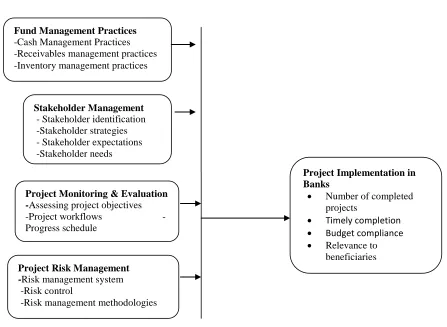
This is an instrument which researchers use to direct their inquiries. It is an arrangement of ideologies used to plan a research, a sort of a map (Kothari, 2004). It brings out the view of the researcher on the issue and gives guidance on the research. It can be an adapted from a model that has been used in another study, with changes to benefit the inquiry. Apart from directing the study, through the conceptual framework, the researcher will have the ability of portraying the relationships of the varied constructs that he wants to examine. The study was guided by the following conceptual framework:
Ok
42
Independent Variables Dependent variable
Figure 2.1: Conceptual framework
Source: Author, (2016)
RESEARCH METHODOLOGY Research Design
The study used a descriptive survey design. Surveys are more flexible in the sense that a wider range of information can be collected (Mugenda and Mugenda, 2003). They provide information that is useful for drawing comparisons and generalizations. Also, In-depth interviews were also used to gather data from the key informants who are authorities in the project management field. It was established that several other research papers of this nature had used similar research design.
Target Population
Burns and Grove (2003) cites that population is made up of all elements which meet certain criteria in the research. The study targeted 506 information technology projects undertaken by 13 commercial banks in Kenya out of a total of 43 commercial banks. These banks, therefore, represent 30% of the target population which is considered adequate for a descriptive survey as postulated by Mugenda and Mugenda (2003). The Nairobi region was chosen since it is the headquarters of all the banks. The study premises this because projects are rolled out from Nairobi and afterward spread to other nationwide branches. The study sought respondents from the project office in the banks‟ head office which comprises of a Project Manager and the project team drawn from the Human Resource, Information Technology, Customer Care, Finance, Credit Departments as well as selected staff. The following IT projects were considered:
Project Implementation in Banks
Number of completed
projects Timely completion
Budget compliance Relevance to
beneficiaries
Stakeholder Management
- Stakeholder identification -Stakeholder strategies - Stakeholder expectations -Stakeholder needs
Project Monitoring & Evaluation -Assessing project objectives Project workflows
-Progress schedule
Fund Management Practices -Cash Management Practices
-Receivables management practices -Inventory management practices
Project Risk Management -Risk management system -Risk control
-Risk management methodologies Ok
43
Automated Teller Machine networks, Software Development, Call center operations, Network management, Internet banking, Mobile Banking and Electronic fund transfer.
Sampling Design
According to Mugenda and Mugenda (2003), 10-30 % is a good proportion of the population which as well assists to reduce sampling errors. The respondents included the Project Managers, Human Resource, ICT, Customer Care and Finance / Credit. Stratified random sampling technique was used where the different departments form the strata. Therefore the sample of the study was 152 respondents which fulfill the minimum threshold of 30% as suggested by Mugenda and Mugenda (2003). It is also important to note that 30% of the target population was sampled in every state as shown in table 3.1. The study targeted the 152 respondents in 13 commercial banks in Kenya out of which 124 responded giving a reaction proportion of 81.58%.
Table 1. Sampling Frame
Department Population Percentage Sampled Sample Size
Research & Development
65 30 19
Human Resource 106 30 32
ICT 70 30 21
Customer Care 130 30 39
Finance / Credit 96 30 29
Marketing 39 30 12
Total 506 30 152
Data Collection
Both primary and secondary data was collected. Project Manager and the project team drawn from the human resource departement, information technology, customer care, finance and credit departments were the respondents of the questionnaire in each bank. The questionnaire was availed online and a link to be emailed to the respondents. Primary data was collected via questionnaires. The questionnaire was partitioned into six parts. Section 1 did a collection of the basic data regarding Banks, section 2 dealt with data on fund management practices, section 3 collected information on stakeholder involvement, section 4 collected information on project monitoring and evaluation, while section 5 collected information on project risk management while section 6 collected information on project implementation. The study also used qualitative questions drawn from the questionnaire for comparison and supplementary purposes.
Validity of Research Instruments
Validity demonstrates how much an instrument measures what it should gauge while the reliability of an instrument is the point at which it gives reliable outcomes (Kothari, 2004). Internal validity was accomplished by guaranteeing that survey item are responding to the research questions. The appropriate responses to a few inquiries were to confirm or clear up prior given answers. The inquiries were phrased legitimately and successively in basic dialect. Expert opinion was asked from the supervisor in order to guarantee legitimacy.
Reliability of Research Instruments
A pilot study was done to find out the reliability of the questionnaires. Reliability analysis was also carried out with the use of Cronbach‟s Alpha which gauges the internal consistency by identifying if certain item within a scale measures the same construct. Klien (1999) noted that the accepted alpha value is 0.7, thus forming the study‟s benchmark. Cronbach's α value for all factor classes were > .70, [Fund Management practices (.73), Stakeholder management (.82), Project Monitoring & Evaluation (.78), Project Risk management (.79) and Project implementation (.80)] which is viewed as sufficient confirmation of inside consistency. It ought to be noticed that Cronbach's α estimations of over 0.70 are adequate.
Ok
44
Data Analysis
After collecting the data, the filled-in and returned surveys were altered for culmination, coded and entries made into Statistical Package for Social Sciences (SPSS version 23). Coding is a specialized process where crude information is changed into effortlessly organized shape by the method of assigning symbols. This helps in consolidating the reactions into few categories for data analysis. The data-set was then passed through a verification procedure to check if the captured information connected with the information capture into SPSS.
The Karl Pearson's coefficient of connection was used in determining the bearing and quality of the connection between the factors. The Pearson's correlation coefficient, r, measures the quality of a direct regression between two variable (Gupta, 2004). The correlation coefficient, r, can go from +1 to - 1. An estimation of 0 demonstrates there is no relationship between the two factors. A positive relationship is spoken to by a value more noteworthy than 0. That is, as the estimation of one variable goes up, the value of the other likewise increases (Cooper and Schindler, 2001). Any value that is under 0 shows a relationship that is negative, that is, as the value of one variable goes up, the value of the other notes reduction (Cooper and Schindler, 2001). The correlation is noteworthy at the 0.05 level for 2-followed (Kothari, 2010).
Both distinct and inferential statistics were utilized to investigate the information. Descriptive analysis was carried out on primary data. Mean and standard deviations were utilized as measures of focal inclinations and dispersion separately. Further, regression was utilized to get an equation which depicts the reliant variable as far as the autonomous variable in light of the regression model. Information was exhibited in recurrence circulation tables, diagrams and pie charts that encouraged depiction and clarification of the research findings
The linear regression model was utilized to analyze the factual significance of the diverse independent variables on the reliant factors. As per IBM (2010), the suspicions of the linear regression should be met by the information broken down. The assumptions express that the coefficients should be direct, the reaction blunders ought to take after The Gaussian circulation, and the mistakes ought to have a comparable dissemination
Model 3.1 represents the relationship between project management practices and project implementation: Yi = β0 + β1X1 + β2X2 + β3X3 + β4X4 + έ ...3.1
Where; Y= Project implementation, X1= Fund Management practices,
X2= Stakeholder management,
X3= Project Monitoring and Evaluation,
X4= Project Risk management,
β0 = Constant,
β1=Regression coefficients,
The έ= Error term
RESEARCH FINDINGS AND DISCUSSION
Descriptive StatisticsFund Management Practices
Data was collected on three key areas of fund management practices; cash management, receivable management, and inventory management to establish the extent they influence implementation of projects in Kenya commercial banks based on certain statements on a scale of 1-5 where 1=never, 2=rarely, 3= sometimes, 4= often and 5= very often.
Cash Management Practices
The study determined the respondents‟ views in regards to cash management and the findings were as indicated in Table 2.
Ok
45
Table 2: Cash Management
Source: Survey Data, (2017)
After analyzing the findings, the respondents indicated that they prepare cash flow statements very often as indicated by a mean of 4.12 and a standard deviation of 1.003. The respondents also indicated that the often prepare budget (M=4.04, SD=0.849), the occurrence of cash deficit (M=3.91, SD=0.861) and determination of cash balance (M=3.90, SD=0.712). Table 2 shows the findings of the study. The findings concur with Atrill (2006) who offers that cash management is a managerial accounting strategy which focuses on maintenance of efficient levels of both elements of cash, current assets, and current liabilities, regarding each other. Fund management makes sure that a project has enough money to counter its short-term debts and operational costs.
Receivables Management Practices
The respondents were also requested to state the degree to which they agree with the following factors concerning the receivables management practices as shown in Table 3.
Table 3: Receivables Management Practices
Source: Survey Data, (2017)
The findings indicated that the respondents agreed that they set up credit guidelines for customers very often as shown by a mean of 4.56 and a standard deviation of 0.871. It was also established that the banks often review levels of bad debts (M=4.10, SD=0.761) and level of receivables (M=3.96, SD=0.968). It was further established that the banks provide for bad debts (M=3.05, SD=0.667) and sell product/service on credits (M=3.02, SD=0.793). The findings concur with Charvat (2013) who indicated that receivable management practices are key during project implementation to allow better management of the received materials.
Inventory Management practices
The respondents requested to reply to how often they perform the operations on inventory management practices as shown in Table 4.
Table 4: Inventory management practices
Source: Survey Data, (2017)
It was established that the banks prepare inventory budgets and review inventory levels very often as supported by a strong mean of 4.58 and 4.50 respectively. This is an indication that commercial banks consider inventory budget preparation and review of inventory levels very crucial in the implementation of projects. The findings are in line with Field and Keller (1997) who argued that best inventory management practices will result in success in project implementation with the notion that those firms that have adopted these practices outperform those that have not adopted regarding implementing their projects.
Fund Management Mean Std Dev
Preparation of budget 4.04 0.849
Determination of target cash balance. 3.90 0.712
Preparation of cash flow statements 4.12 1.003
Occurrence of cash deficit 3.91 0.861
Occurrence of cash surplus 3.79 0.990
Receivables management practices Mean Std Dev
Selling product/service on credits 3.02 0.793
Setting up of credit guidelines for customers 4.56 0.871
Review levels of receivables 3.96 0.968
Review levels of bad debts 4.10 0.761
Provision for bad debts 3.05 0.667
Inventory management practices Mean Std Dev
Preparation of inventory budgets 4.58 0.884
Review of inventory levels 4.50 0.741
Ok
46
Stakeholder Involvement
The study sought to find out the effect of shareholder management on implementation of information technology projects among commercial banks in Kenya. The respondents were therefore presented with statements to rate on a 5 point Likert scale. The results are presented in Table 4.5.
Table 5: Stakeholder Involvement
Statement Mean Std
Dev
Our organizational involves the stakeholders during the project cycle 4.01 1.054 Our bank undertakes early identification and management of stakeholders at the start of
a project
3.82 0.898
Stakeholder management involves managing stakeholder strategies 3.92 0.954
Stakeholders influence strategy 3.79 0.851
It is difficult to evaluate stakeholders needs and expectations about the objectives of the project
3.07 0.907
Stakeholders needs and expectations can influence project decisions 3.81 0.953
Source: Survey Data, (2017)
The findings shown in table 5 shows that the respondents agreed that organization involves the stakeholders during the project cycle (M=4.01, SD=1.054) and that stakeholder management involves managing stakeholder strategies (M=3.92, SD=0.954). The respondents also agreed that their banks undertake early identification and management of stakeholders when starting a project as supported by a mean of 3.82 and a standard deviation of 0.898. Further findings indicated that Stakeholders needs and expectations can influence project decisions (M=3.81, SD=0.953) and that stakeholders influence strategy (M=3.79, SD=0.851).
The findings of the study corroborates Mitchell, Agle and Wood (2011) who cite how stakeholder claims are given the priority and argues that a higher priority is given to a shareholder if he is trusted to have a legitimate claim to the claim which needs urgent action, and if the stakeholder can be influential by using power. According to Karlsen (2012), stakeholder management is made up of managing stakeholder strategies where management incorporates these conventional focus areas.
Project Monitoring and Evaluation
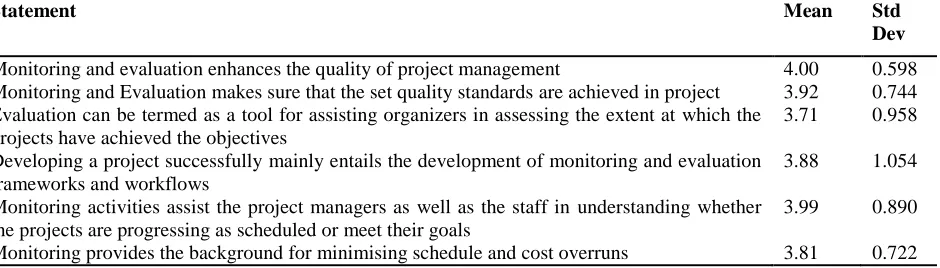
Concerning monitoring and evaluation, the respondents concurred that observing and assessment upgrade the nature of task administration as indicated by a solid mean of 4.00. The respondents additionally concurred that monitoring bolsters both venture administrators and staff in fathoming whether the undertakings are going ahead as planned or meet their goals (M=3.99, SD=0.890) and guarantees that required quality principles are accomplished in the task (M=3.92, SD=0.744). It was likewise settled that observing gives the foundation to diminishing timetable and cost invades (M=3.81, SD=0.722) and that assessment can be seen as an instrument for helping organizers to evaluate to what degree the tasks have accomplished the objectives (M=3.71, SD=0.958
Table 6: Project Monitoring and Evaluation
Statement Mean Std
Dev
Monitoring and evaluation enhances the quality of project management 4.00 0.598
Monitoring and Evaluation makes sure that the set quality standards are achieved in project 3.92 0.744 Evaluation can be termed as a tool for assisting organizers in assessing the extent at which the
projects have achieved the objectives
3.71 0.958
Developing a project successfully mainly entails the development of monitoring and evaluation frameworks and workflows
3.88 1.054
Monitoring activities assist the project managers as well as the staff in understanding whether the projects are progressing as scheduled or meet their goals
3.99 0.890
Monitoring provides the background for minimising schedule and cost overruns 3.81 0.722
Source: Survey Data, (2017)
Ok
47
The study findings depict therefore that monitoring and evaluation is an important aspect in project implementation since it gives the progress status which is used for the improvement of those phases that may limit the process of implementation. The findings, therefore, relates to the findings of Solomon and Young (2007) who concluded that monitoring and evaluation are are the main instruments for promoting the implementation of project management. Considering that in short and medium run managing complicated projects will incorporate corresponding methodologies from the financial viewpoint, which ought to regard the criterion of effectiveness, sustainability, and durability.
Risk Management
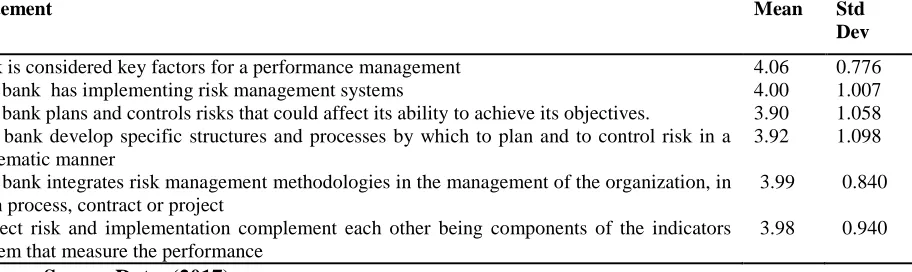
The study further sought to evaluate effects of project risk management on implementation of information technology projects among commercial banks in Kenya. The respondents were therefore provided with statements to rate on a 5 point Likert scale where 1-strongly disagree, 2- disagree, 3- neutral, 4-agree and 5- strongly agree. The findings are presented in Table 7.
Table 7: Risk Management
Statement Mean Std
Dev
Risk is considered key factors for a performance management 4.06 0.776
Our bank has implementing risk management systems 4.00 1.007
Our bank plans and controls risks that could affect its ability to achieve its objectives. 3.90 1.058 Our bank develop specific structures and processes by which to plan and to control risk in a
systematic manner
3.92 1.098
Our bank integrates risk management methodologies in the management of the organization, in each process, contract or project
3.99 0.840
Project risk and implementation complement each other being components of the indicators system that measure the performance
3.98 0.940
Source: Survey Data, (2017)
According to the findings shown in table 7, the risk is considered key factors for a performance management (M=4.06, SD=0.776) and that the banks have implemented risk management systems (M=4.00, SD=1.007). The study also found out that bank integrates risk management methodologies in the managing the firm, in every procedure, contract or project as indicated by a mean of 3.99 and a standard deviation of 0.840. The respondents also agreed that project risk and implementation complement each other being components of the indicators system that measure the performance (M=3.98, SD=0.940). It was further established that the respondents stated that the banks develop certain structures and processes of planning and controlling risk in a systematic manner (M=3.92, SD=1.098) and arrangements and controls risks which may have an impact on its ability to achieve its objective (M=3.90, SD=1.058). Risk management is therefore taken seriously in the implementation of banks projects in Kenya. The findings agree with Packendorff (2005) who maintains that implementing project risk management systems requires the organized the institution to come up with certain structures and processes of planning and controlling risk in an orderly manner and at all hierarchies of management. World practice has shown that the effectiveness of these actions relies upon the organization‟s ability to include risk management methodologies in the management of the organization, in every process, contract or project.
Project Implementation
On project implementation, the respondents were asked to state their level of agreement with the successful implementation of projects in their bank, using the scale: 1= strongly disagree; 2= disagree; 3= neutral; 4 = agree; 5= strongly agree. The results are presented in Table 8. Based on the findings displayed in Table 8, the respondents agreed that the implementations of the projects were successful with means ranging from 3.50 and 4.07. The respondents agreed that projects had met specific organizational objectives as shown by a mean of 4.07 and a standard deviation of 0.611. Studies have indicated that, if standardized procedures and processes are not put in place, the chances of a project been timely, meeting all the needed goals, and been cost efficient are far less than the possibility of one of these variables coming in short, or the project being abandoned altogether (Cooke-Davies & Arzymanow, 2014).
Ok
48 Table 8: Project Implementation
Statement Mean Std Dev
Project activities addressed objectives outlined 3.94 0.830
Projects have met specific organizational objectives 4.07 0.611
Projects have successfully addressed intended beneficiaries needs 3.89 0.858
Projects directly involved the beneficiaries 3.67 0.901
All stakeholders satisfactorily accepted project outcomes 3.56 0.942
There was timely completion of projects 3.85 0.961
The projects were budget compliant 3.69 0.820
Projects are sustainable in the long-term 3.50 0.932
Resource utilization was optimum 3.74 0.614
Project monitoring and evaluations was adequate and satisfactory 3.61 0.752
Source: Survey Data, (2017)
Inferential Statistics
This section brings about a discussion of the results of inferential statistics. Correlation analysis was used in measuring the strength of the connection between the independent variables, i.e., the relationship between project management practices and implementation of IT projects. Regression analysis discovered the relative criticality of each of the variables implementation of IT projects.
Correlation Analysis
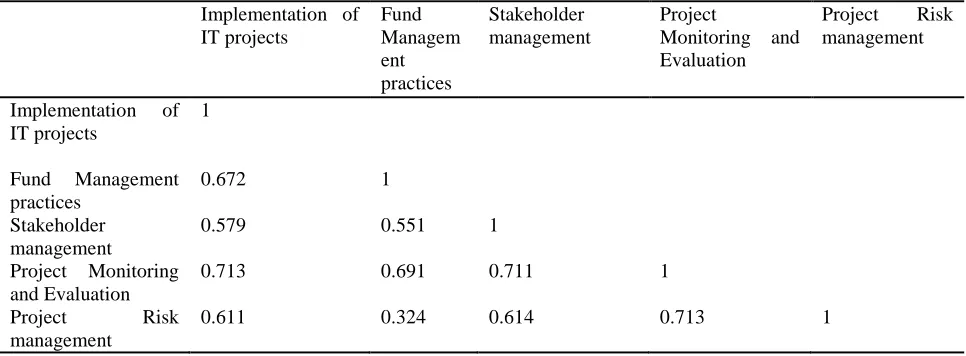
Pearson connection was utilized to quantify the level of relationship between factors under consideration, i.e., independent and the dependent variables. Pearson connection coefficients extend from - 1 to +1. Negative values show negative connection, and positive values demonstrate positive relationship where Pearson coefficient <0.3 demonstrates the frail connection, Pearson coefficient >0.3<0.5 shows direct relationship and Pearson coefficient>0.5 demonstrates solid connection (Kothari, 2004).
Table 9: Correlation Coefficients Source: Survey Data, (2017)
The analysis above shows that project monitoring and evaluation has the strongest positive (Pearson correlation coefficient =.713; P value 0.000) influence on the implementation of IT projects. Also, fund management practices, stakeholder management, and project risk management are positively correlated to the implementation of IT projects (Pearson correlation coefficient =.672, .579, and .611). The correlation matrix implies that the independent variables have a positive effect on the implementation of IT projects.
Regression Analysis
The regression model is used here in describing how the mean of the dependent variable makes changes depending on the changing conditions. Regression Analysis was carried out with fund management practices, stakeholder management, project monitoring and evaluation and project risk management as the
Implementation of IT projects
Fund Managem ent practices
Stakeholder management
Project
Monitoring and Evaluation
Project Risk management
Implementation of IT projects
1
Fund Management practices
0.672 1
Stakeholder management
0.579 0.551 1
Project Monitoring and Evaluation
0.713 0.691 0.711 1
Project Risk
management
0.611 0.324 0.614 0.713 1
Ok
49
independent variables and implementation of IT projects as the dependent variable.
Table 10: Model Summary
Model R R Square Adjusted R Square Std. Error of the
Estimate
1 0.937 0.878 0.789 0.5273
Source: Survey Data, (2017)
The findings in Table 10 show that correlations coefficient (R) is 0.937. This is strong and positive depicting a notable positive connection between the combined independent variables (fund management practices, stakeholder management, and project monitoring and evaluation and project risk management) and the dependent variable (implementation of IT projects). Further, the four independent variables that were studied explain 78.9% of the variations in the implementation of IT projects as represented by the adjusted R2. This therefore means that there are other factors not factored in this research which contribute 11.1% of the variations in the implementation of IT projects. This implies that these variables are very crucial therefore should be considered in any effort to boost IT project implementation in commercial banks in Kenya.
Table 11: ANOVA
Model Sum of Squares Df Mean Square F Sig.
1 Regression 2.534 2 1.267 9.475 .0179a
Residual 9.307 40 2.327
Total 3.465 42
a. Predictors: (Constant), fund management practices, stakeholder management, project monitoring and evaluation, project risk management
Source: Survey Data, (2017)
The P- value is 0.0179 which is less that 0.05 thus the overall model is statistical significance in predicting how fund management practices, stakeholder management, project monitoring and evaluation and project risk management influence project implementation of IT projects in commercial banks in Kenya. The F critical at 5% level of significance was 3.23. Since F calculated is greater than the F critical (value = 9.475), this shows that the overall model was significant.
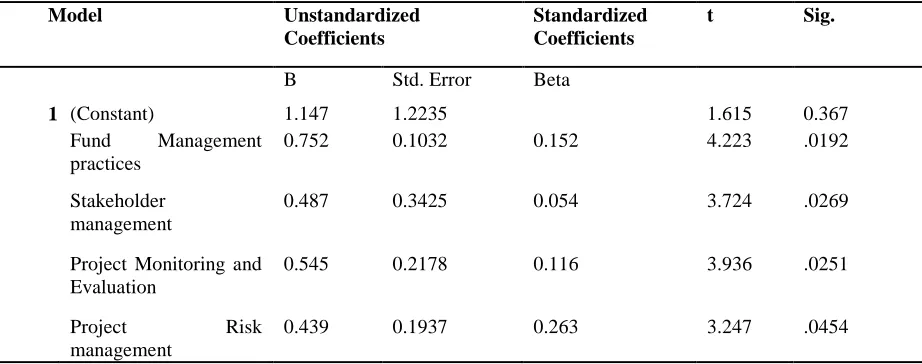
The research ran the procedure of getting the coefficients, and the results were indicated in the table below.
Table 12: Coefficient Results
Model Unstandardized
Coefficients
Standardized Coefficients
t Sig.
B Std. Error Beta
1 (Constant) 1.147 1.2235 1.615 0.367
Fund Management
practices
0.752 0.1032 0.152 4.223 .0192
Stakeholder management
0.487 0.3425 0.054 3.724 .0269
Project Monitoring and Evaluation
0.545 0.2178 0.116 3.936 .0251
Project Risk
management
0.439 0.1937 0.263 3.247 .0454
Source: Survey Data, (2017)
Multiple regression analysis was carried out to find the relationship between implementation of information technology projects and the four variables. Depending on the findings of the study, the multiple regression equations is;
Ok
50 Y=1.147 + 0.752 X1 +0.487 X2 + 0.545 X3 + 0.439X5
According to the regression equation established, taking all factors constant (fund management practices, stakeholder management, project monitoring and evaluation and project risk management), implementation of IT projects was 1.147.
The data findings analyzed also shows that fund management practice have a positive effect on the implementation of IT projects. Taking all other independent variables at zero, a unit increase in fund management practices will lead to a 0.752 increase in implementation of IT projects. Compared to the association between the other independent variables, that is stakeholder management, project monitoring and evaluation and project risk management and implementation of IT projects, findings presented in table 4.12, infer that fund management practices contribute most to the implementation of IT projects followed by project monitoring and evaluation. At 5% level of significance and 95% level of confidence, fund management practices had a 0.0192 level of significance.
This is in line with Jain (2012), who finds that fund management practices provide an opportunity to develop fund management practices tools for material-based, service-only, and service-plus-material ICT projects. Fund management plans and re-plans activities and tasks, synchronize dates and performs impact analysis and simulations to improve on-time completion of ICT projects. Herzner (2015) agrees that a successful ICT project cannot go on if there is no enough funding, and the cost of giving enough financing can be quite large. Because of these reasons, attention to project finance is acritical aspect of fund management among projects.
Garton and Erika (2015) also concur that the first step is to determine what competitive wages and benefits are in the project area. Necessary tools include wage and benefit surveys and governmental resources. Frimpong et al. (2013) however note that fund management practices as a key purpose of accomplishment for an ICT venture appears to be generally straight forward, however it is the readiest disappointment purpose of many undertakings as it demonstrates putting the opportune individuals in the ideal place at the perfect time with enough time to carry out the activity the correct way. Dvir et al. (2010) additionally contend that despite the fact that a not too bad level of store administration hones for a fruitful ICT venture is indispensable, there isn't a fundamental positive relationship between's reserve administration practices and achievement, if not negative all together.
Table 12 further additionally uncovers a constructive outcome partner administration on usage of IT anticipates. It was discovered that a unit increment in partner administration will prompt a 0.487 increment in usage of IT anticipates, partner administration demonstrated a 0.0269 level of importance. This is in concurrence with Vickland (2015) who watches that partner engagement is a fundamental thought in any ICT venture. Without connecting with partners, there can might be no coupling contract, possession or support for a particular undertaking. Slevin et al. (2014) likewise watch that the absence of investor association causes an extraordinary division among the expected recipients and the activities are seen as something constrained upon them by engineers who just needed to try out something.
Likewise, as per Khang and Moe (2011), numerous ICT projects, however not all, will need to deal with an extensive variety of shareholder groups, each with their worries, needs, irreconcilable circumstances and levels of impact. The finding is further in concurrence with Cooke-Davies and Arzymanow (2013), a project will probably succeed, particularly in the long haul, in the event that it contemplates its operational environment and attempts to address the issues of the partners influenced by it. Nothing finishes project quicker than giving groups something they didn't request and afterward imagining they did.
A positive relationship was additionally found between project monitoring and evaluation and usage of IT projects. Discoveries in the table demonstrate that a unit increment in project monitoring and evaluation will prompt to a 0.545 increment in the execution of IT projects, project monitoring and evaluation demonstrated a 0.0251 level of noteworthiness. This is bolstered by Sanginga (2013) who additionally discovered proof of a positive connection amongst monitoring and evaluation and ICT projects, however, scrutinized the nature of the M&E rehearses practices. The examination called attention to that M&E exercises were led as a major aspect of administrative necessity as opposed to being directed with an emphasis on enhancing the project delivery process. McCoy (2015) likewise concurs that monitoring and
Ok
51
assessment of ICT projects gives an appraisal of the viability of the ICT venture in accomplishing the objective and the significance and maintainability of the on-going task.
Observing and assessment analyze the effect of the ICT project as set to be accomplished by the project plan (Shapiro, 2004). It is an essential part of the management cycle incorporating into planning and designing of the ICT projects (Gyorkos, 2013). Project organizers ought to adjust observing and assessment exercises into the task design with such components included as people to do the assessments, recurrence, spending plan for the exercises and also particular on the best way to report the use of findings. The finding is likewise in concurrence with Jody and Ray (2014) who distinguished correlative roles of the two functions. Data from observing bolsters assessment to obtain a comprehension and get lessons in the center or towards the end of the ICT venture concerning what went appropriately to wrong for the learning reason. This could help in the overhauling of the venture.
Lastly, a positive affiliation was built up between project risk management and implementation of IT projects. Results in table 4.12, demonstrate that a unit increment in project risk management prompts 0.439 in the usage of IT projects. The measurement additionally demonstrated a 0.0454 level of noteworthiness. The finding is upheld by Abdul, Ayub, Nordiana Mohd and Ilias (2014) who offer that hazard strategy must be completed through the life cycle of the ICT project, from starting stage until the decommissioning of the projects. Inability to deal with the project risks through the life cycle of ICT projects will prompt poor project performance. The utilization of effective risk management strategies, for example, is expanding and has been the focal point of concentration as of late with a specific end goal to accomplish ICT project performance and furthermore emphasize on legally binding commitments (Chacko and Harris, 2006).
Kululanga and Kuotcha (2010) demonstrated that low execution of risk administration procedures is practically speaking causes the failure of the project, for example, meeting due dates, cost targets, and quality execution. Be that as it may, it is as yet uncertain concerning what degree does the hazard administration systems enhance execution of SMEs ICT extends in Kenya subsequently the need to decide the impacts of hazard administration methodologies on SMEs ICT project execution in Kenya. Speklé et al. (2015) additionally contend that accomplishing project performance shapes the premise to appropriation and usage of viable risk management methodologies. The ICT project risk management technique is implanted to authoritative internal control and review, a condition vital for compelling task chance administration measures in the ICT project.
CONCLUSIONS
The study concluded that well-planned monitoring system forms a solid base for the proper design of final evaluation. Monitoring and assessment enhance the quality of project management and ensures that required quality standards are achieved in the project. It was also established that assessment could be viewed as a tool for assisting planners to evaluate the scope in which the project has met its set goals. The importance of using a formal monitoring and evaluation flow is being enhanced by many international types of research, which showed that many of the projects go through serious issues before been completed and some of them are abandoned after huge investments. The investigation thus concluded that active monitoring and evaluation is a crucial determinant of implementation of its projects in commercial banks.
Commercial banks face different risks in the management of projects. Upon analyzing the findings, the respondents indicated that quality and uncertainty are essential elements used in performance management and a standard. Risk evaluation completely reveals the sensitivity of the project to its participants to make sure that all threats are fully understood. As such, targets and contingencies can be set at right levels, contracts can be negotiated with an actual comprehension of possible challenges, and risk control strategies can also be formed in advance.
RECOMMENDATIONS
The study recommends that the management should involve stakeholders in project life cycle. The stakeholders, on the other hand, ought to have the will and ability to listen, genuinely seeking and valuing
Ok
52
different voices, making some efforts to hear and understand. The procedure also requires that all those participating shows regard for one another and commit themselves to the process and be patient and disciplined enough to work as a team to achieve shared perspectives and typical outcomes. Effective participation will not be achievable by just adopting an efficient model from a different context. Public assistance ought to be designed and informed by critical principles and be sensitive to local ethical institutions and governance plans.
A well-ordered manual on outlining and overseeing assessment projects would be exceptionally expected to build the quality and responsibility of reports. To this end, other global associations' handbooks could be interpreted and adjusted to local conditions which can be utilized by commercial banks. It is additionally suggested that through extraordinary site visits, thorough specialized product audits and careful investigation of occasional reports the Project Team ought to build up its conclusion on the quality and opportuneness of services offered by commercial banks. These discoveries ought to likewise be confirmed in an accomplice exchange with contractual specialists and project beneficiaries.
Since the research affirms that every one of the banks under study intensely depends on ICT for their operations, it is prescribed that banks start ICT arrangements which government can actualize to enhance the ICT framework countrywide and as such improving internet connectivity and general ICT service delivery. They ought to embrace the most refreshed ICT banking strategies and open source programming for non-basic internal procedures to lessen the expense of software investment and along these lines increase upper hand in the market.
In addition, management of commercial banks in Kenya ought to guarantee that reception and implementation of sound risk management practices, that there is suitable hazard policy in place, that there is fitting risk-return tradeoff approach, that there exists favourable internal business condition and that proper credit risk limits are defined as the effect on the financial performance of the business banks.
REFERENCES
Abudi, G. (2009). Developing a Project Management Best Practice. Retrieved from, http://www.ginaabudi.com/articles/developing-a-project-management-best-practice
Achterkamp, M.C. and Vos, J.F.J. (2007). Investigating the use of the stakeholder notion in project management literature, a meta-analysis. International Journalof Project Management, 14, 240-248.
Agboola A.A (2014). Information Technology, Bank Automation, and Attitude of Workers in Ugandan Banks In Journal of Social Sciences, Kamia-Raj Enterprises, Gali
Alu, A.O (2013). Effects of Information Technology on Customer Services in the Banking Industry in Nigeria, M.B.A Thesis in Management and Accounting, Obafemi Awolowo University, Ile-Ife, Nigeria.
Andersen, E. S. (2015). Are we getting any better? Comparing project management in the years 2000 and 2014. Project Management Journal, 41 (4), 4-16.
Atrill, P. (2006).Financial management for decision makers 4th edition, Prentice Hall, London
Blackstone. (2010).Theory of Constraints. Retrieved from http://www.scholarpedia.org/article/Theory_of_Constraints. 2nd March, 2016.
Boulding, K. E. (2004). General systems theory: The skeleton of science. E: CO Special double 6(1), 127-139 Brandell, J. R. (2010) Theory &Practice in Clinical Social work. Thousand Oaks, CA: Sage.
Brown, I. & Molla, A. (2015). Determinants of Internet and cell phone banking adoption in SouthAfrica. Journal of Internet Banking and Commerce, 10 (1)
Burnes, B. (2004). Managing change – a strategic approach to organizational dynamics. (4th ed.). Cambridge: Prentice Hall. Caruso, J. B. (2014). Good enough! IT investment and business process performance in higher education. Edu cause Center for
Applied Research, (June), 1-14.
Charvat, J.J (2013). Project Management Methodologies: Selecting, Implementing, andSupporting Methodologies and Processes for Project, Hoboken, New Jersey: John Wiley & Sons, Inc.
Child, J. and McGrath, R. (2001). Organizations unfettered: organizational form in an information intensive economy. Academic Management [44(6): 1135–48].
Cleland, D.I. (2009), Project Management Strategic Design and Implementation. Singapore: McGraw-Hill.
Cooke-Davies, T.J. & Arzymanow, A. (2014). The maturity of project management in different industries: An investigation into variations between project management models. International Journal of Project Management, 2 (16), 471-478. Crawford, P. and Bryce, P. (2003). Project Monitoring and Evaluation: A Method for Enhancing the Efficiency and Effectiveness
of Aid Project Implementation, International Journal of Project Management, 21(5), 363-373.
Dobrea, R. C., Ciocoiu, N. and Tipa, S. (2010). Investments Characteristics in Infrastructure Industry, Economia. Seria Management journal, 13(1), 204-210.
Ok