NOVEL BINARY SEARCH ALGORITHM OF
BACKTRACKING FOR RFID TAG ANTI-COLLISION
X. L. Shi, F. Wei, Q. L. Huang, L. Wang, and X. W. Shi
National Key Laboratory of Antennas and Microwave Technology Xidian University
Xi’an 710071,P. R. China
Abstract—In RFID system,tag collision is a main problem for fast tag identification. On the base of binary search algorithm of backtracking,an enhanced binary anti-collision search algorithm for radio frequency identification (RFID) system is presented in this paper. By dynamically transferring the ID of the tag,the length of the data transferred can be decreased dramatically. Mathematical simulation result shows that compared with the binary search algorithm of backtracking,the proposed algorithm can save channel by more than 43.75% when handling multiple RFID tags simultaneously. Finally the proposed algorithm is successfully applied to a RFID device,which validates itself.
1. INTRODUCTION
Radio frequency identification (RFID) system has received more and more attention in many areas like manufacturing companies,material flow systems,etc. RFID technology is one of the branches of automatic identification technology. Compared with other automatic identification technology,RFID technology has lots of merits [1– 6]. Therefore,RFID techniques are used widely in many industries, manufacturing companies,material flow systems,etc.
anti-collision protocols,which reduce the collisions of received tag IDs are required.
Typically,there are two kinds of methods used to solve this problem. One is ALOHA-based algorithms and the other one is tree-based algorithms [1]. The ALOHA-based algorithms reduce the probability of tag collisions since tags are scheduled to transmit at distinct times. However,with the increase of the number of tags,the identification performance will be deteriorated sharply. The tree-based algorithms such as binary search algorithm [12] and dynamic binary search algorithm [13,14] are able to identify tags correctly according to locating the collision bit. Recently,the binary search algorithm of backtracking is proposed [12,15,16], which is an improvement on binary tree searching algorithm. When there is no collision,the reader can acquire next request signal from superior layer.
On the base of binary search algorithm of backtracking,a novel anti-collision algorithm is presented in this paper. By dynamically transferring the ID of the tag,the length of the data transferred can be decreased dramatically. Therefore,the new algorithm is able to suppress the occurrence of collisions and improve the identification efficiency significantly.
2. THE PROPOSED BINARY SEARCH ALGORITHM OF BACKTRACKING
2.1. Principle of the Novel Algorithm
Firstly,on the base of binary search algorithm of backtracking it is known that the ID of tag is transmitted integrally between the reader and the tag. However,the bits before x are already given and the bits after x are always 1 (x represents the highest bit of collision). Therefore,it is not necessary to transmit these two parts.
Secondly,in order to achieve the proposed algorithm,an additional request should be explained:
Request (IDm−x, x): When the reader sendsIDm−xwhich means the IDs from bit m tox,all the tags starting with these IDs response and transmit their IDs from bitx−1 to 0 (m represents the length of the encoding of the tag).
Finally,when collision occurs,the bit x which represents the highest bit of collision can be found according to the encoding of Manchester. Then,let bit x equal to 0 and keep the bits from m
2.2. Example
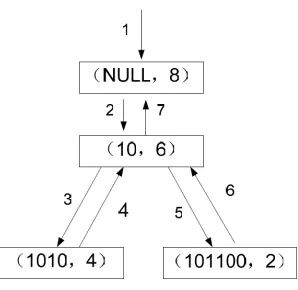
The detailed process can be demonstrated from the following example. In this example there are 4 tags in the interrogation zone of a reader. Their IDs are 10110011 (tag1),10100011 (tag2),10110111 (tag3), 11100011 (tag4),respectively.
First time: All tags respond after receiving the request (NULL, 8) sent by the reader. According to the encoding of Manchester,data (1?1?0?11) can be get,which means that the collision occurs in D6, D4,D2 and D6 is the highest bit of collision. Hence,two parameters of the next request is known.
Second time: Detecting the collision,the reader sends the request (10,6) to the tags and those tags whose ID starts with (10,6) respond. Hence,tag1,tag2 and tag3 respond and send data from D5 to D0 to the reader respectively.
Third time: Detecting the collision again,the reader sends the request (1010,4) and those tags whose ID starts with (1010,4) respond. Here,tag2 responds only and sends the data from D3 to D0 to the reader. As no collision occurs the reader reads the data from tag2 and sends the order of UNSELECT to let tag2 be inactive.
Fourth time: After identifying one tag successfully,the algorithm backtracks to the previous request. Now,the reader sends the request (10,6) again and tag1 and tag3 respond.
Fifth time: The reader sends the request (101100,2) after detecting the collision again and only tag1 responds. As no collision occurs,the reader reads the data from tag1. The reader sends the UNSELECT order to let tag1 be inactive.
Sixth time: The algorithm backtracks to the previous request at the node again. Now,the reader sends the request (10,6) again and only tag3 responds. Then,the reader reads the data from tag3 and let it be inactive.
Seventh time: The algorithm returns back to the previous request and the reader sends the request (NULL,8). Here,only tag4 responds and the reader reads the data from it. Until now,all the tags are successfully identified.
The working-flow of this identification can be seen in Figure 1. 2.3. Simulationand Comparisonof Two Algorithms
Figure 1. The process of identification by the proposed algorithm.
of the identification will take more time when more tags and longer UID are considered. N, n,m,M and S represent the total searching timesthe number of the tags in the interrogation area of a reader,the length of the encoding of the tags,the length of the encoding sent by the reader each time and the total length of the data transferred during the researching process respectively. Therefore,S is equal toN ×M.
In order to identify the four tags in the previous example using proposed algorithm,the total searching times N can be expressed as N(4) = (4− 1)×2 + 1 = 7. The formula of N = 2n −1 to calculate the total searching times can be obtained by mathematical induction [15,17,18]. The length of the encoding M is equal to m
and (m+ 1)/2 for binary search algorithm and the proposed algorithm respectively. Therefore,the total length of the data transferred during the researching processS is as follows:
Binary search algorithm of backtracking:
S1= (2n−1)×m (1)
Proposed algorithm in this paper:
S2 = (2n−1)×
(m+ 1)
2 (2)
With m = 8,the total length of the data transferred during the researching process of the two algorithms is shown in Table 1.
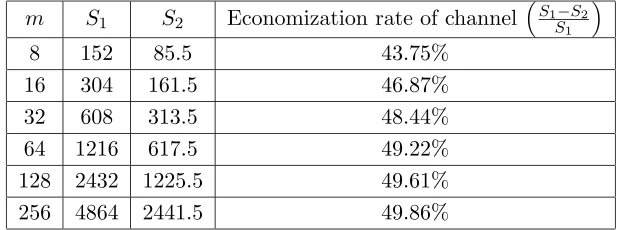
Withn = 10,the total length of the data transferred during the researching process of the two algorithms is shown in Table 2.
Table 1. Identification efficiency of the two algorithms (m= 8).
n S1 S2 Economization rate of channel
S1−S2
S1
10 152 85.5 43.75%
30 472 26505 43.75%
50 792 445.5 43.75%
70 1112 625.5 43.75% 90 1432 805.5 43.75% 110 1752 985.5 43.75%
Table 2. Identification efficiency of the two algorithms (n= 10).
m S1 S2 Economization rate of channel
S1−S2
S1
8 152 85.5 43.75%
16 304 161.5 46.87%
32 608 313.5 48.44%
64 1216 617.5 49.22% 128 2432 1225.5 49.61% 256 4864 2441.5 49.86%
remains stable,the new algorithm is able to save channel by 43.75%. Meanwhile,as shown in the second table,when the number of the tags remains unchanged,the new algorithm can save channel by more than 43.75% and the longer the bits of the encoding of tags in the interrogation area of a reader,the better the performance are. Hence, the performance of the proposed algorithm precedes the binary search algorithm considerably.
3. APPLICATION IN RFID SYSTEM
Figure 2. The photograph of the RFID device.
Figure 3. The photograph of an oscillograph monitoring the process of identification.
4. CONCLUSION
Collision caused by tags is a major factor in deferring tag identification of RFID systems. This paper proposed a novel binary anti-collision algorithm which can improve identification efficiency significantly. Dynamically transferring the ID has the potential to decrease the length of the binary encoding transferred. Therefore,the new algorithm is able to save channel by more than 43.75% when handling multiple RFID tags simultaneously. Moreover,the longer the bits of the encoding of tags,the better the performance are. Performance evaluation by simulation and the application in a RFID device show that the proposed algorithm has the superiority comparing to the binary search algorithm of backtracking.
ACKNOWLEDGMENT
The work is supported by the project of microwave RFID system and industrialization.
REFERENCES
1. Finkenzeller,K.,RFID Handbook: Radio-Frequncy Indetification Fundamentals and Applications in Contactless Smart Cards and Identification,2nd edition,John Wiley,New York,2003.
2. Fan,Z.,S. Qiao,H.-F. Jiang Tao,and L.-X. Ran,“Signal descriptions and formulations for long range UHF RFID readers,” Progress In Electromagnetics Research,PIER 71,109–127,2007. 3. Fan,Z.,S. Qiao,H.-F. Jiang Tao,and L.-X. Ran,“A miniaturized
printed dipole antenna with V-shaped ground for 2.45 GHz RFID readers,” Progress In Electromagnetics Research,PIER 71,149– 158,2007.
4. Xue,W. and X.-W. Sun,“Multiple targets detection method based on binary Hough transform and adaptive time-frequency filtering,” Progress In Electromagnetics Research,PIER 74,309– 317,2007.
5. Rostami,A. and A. Yazdanpanah-Goharriz,“A new method for classification and identification of complex fiber Bragg grating using the genetic algorithm,”Progress In Electromagnetics
Research,PIER 75,329–356,2007.
dynamics,”Progress In Electromagnetics Research,PIER 61,89– 110,2006.
7. Sarma,S.,D. Brock,and D. Engels,“Radio frequency identification and the electronic product code,” IEEE Micro., Vol. 21,No. 6,50–54,2001.
8. Meng,Z.,“Autonomous genetic algorithm for functional optimization,” Progress In Electromagnetics Research,PIER 72, 253–268,2007.
9. Tyzhnenko,A. G. and Y. V. Ryeznik,“Estimates of accuracy and efficiency of a MoM algorithm in for 2-D screens,” Progress In
Electromagnetics Research,PIER 71,295–316,2007.
10. Al Sharkawy,M. H.,V. Demir,and A. Z. Elsherbeni,“The iterative multi-region algorithm using a hybrid finite difference frequency domain and method of moment techniques,” Progress In Electromagnetics Research,PIER 57,19–32,2006.
11. Kim,D.-Y.,H.-G. Yoon,B.-J. Jang,and J.-G. Yook,“Interference analysis of UHF RFID systems,” Progress In Electromagnetics Research B,Vol. 4,115–126,2008.
12. Capetanakis,J. I.,“Tree algorithm for packet broadcast channels,” IEEE Trans. Inform Theory,Vol. 25,505–515,Sep. 1979.
13. Shih,D.,P.-L. Sun,D.-C. Yen,and S.-M. Huang,“Taxonomy and survey of RFID anti-collision protocols,” Computer and
Communications,Vol. 29,No. 11,2150–2166,2006.
14. Law,C.,K. Lee,and K. Y. Siu,“Efficient memory-less protocol for tag identification,”Proc. 4th International Workshop on DIALM, 75–84,Boston,Massachusetts,ISA,2000.
15. Du,H.-T.,K.-L. Xu,and W.-L. Wang,“An anticollision algorithm based on binary-tree searching of backtracting,” Journal of
Yunnan University,Vol. 28,133–136,2006.
16. Yu,S.,Y. Zhan,Z. Wang,and Z. Tang,“Anti-collision algorithm based on jumping and dynamic searching and its analysis,” Computer Engineering,Vol. 31,19–20,2005.
17. Ju,W.-C,and C.-F. Yu,“An anti-collision RFID algorithm based on the dynamic binary,” Journal of Fudan University,Vol. 44, No. 1,46–50,2005.