PROTOCOLS FOR RELIABLE AND SECURE
MESSAGE TRANSMISSION
A THESIS
submitted by
ASHISH CHOUDHURY
for the award of the degree
of
DOCTOR OF PHILOSOPHY
DEPARTMENT OF COMPUTER SCIENCE AND ENGINEERING
INDIAN INSTITUTE OF TECHNOLOGY, MADRAS
Thesis Certificate
This is to certify that the thesis entitled Protocols for Reliable and Secure Message Transmission submitted by Ashish Choudhury to the Indian Institute of Technology Madras, Chennai for the award of the Degree of Doctor of Philosophy is a record of bona-fide research work carried out by him under my supervision and guidance. The contents of this thesis have not been submitted to any other university or institute for the award of any degree or diploma.
Chennai 600036 Research Guide
Dedicated To
Acknowledgements
First of all, I would like to thank my advisor Prof. C.Pandu Rangan who has been having a tremendous influence on my professional development. He introduced me to the world of Algorithms, which motivated me to do research in Theoretical Computer Science, specially in the field of cryptography. I still remember the day when I went to him with a urge to join PhD under him and asked ”Sir, will you guide me if I join PhD under you?” and he replied ”you are most welcome”. That day really changed my career. I never thought that in him, I am going to get a great advisor, a great teacher, a great critic, a great friend and overall a great philosopher. For the past four years, we have developed a special bond, which is much much more than a student-advisor relationship. I have always considered him my father figure and truly speaking, he also never let me down and always treated me like his own pet child. He always provided me with the best facilities, whether it is a research environment (I can never forget the small, separate TCS Lab II, which he allocated to me for doing peaceful research) or whether it is financial help (I can never forget the personal money which he gave me as advance to visit U.S and Canada for attending CRYPTO 2009 and PODC 2009) or whether it is personal advise (he always gave me personal suggestions whenever I required it). I am always going to miss his after leaving IITM. Nevertheless, I will always be indebted to him for whatever he has done for me till now.
Beside my advisor, I also would like to acknowledge the members of my doctoral committee namely, Prof. P. Sreenivasa Kumar, Prof. S. V. Raghavan, Prof. Kamala Krithivasan, Prof. S. A. Choudam and Dr. A. Thangaraj for their encouragement and invaluable suggestions during my doctoral committee meetings. I would specially like to thank Prof. Kamala Krithivasan, who was my advisor during my M. S (by research) at IITM. She always took special interest in my progress and always motivated and encouraged me to do well. I would also like to thank the present and previous head of the department, Prof. C. Siva Ram Murthy and Prof. T. A. Golsalves, respectively for their kind help.
I would like to thank Dr. Tal Rabin, IBM research for her collaboration and lot of insightful remarks on some of our articles. Her critical remarks helped me a lot to improve my writing style and presentations. I can never forget the brain storming session and interaction that we used to have over Internet.
My special thanks to Dr. Kannan Srinathan of IIT Hyderabad, who was my senior at TCS lab. Truly speaking, he is the one who motivated me to do research in secure distributed computing. I have never seen a person like him. His simplicity and inno-cence is one thing, which I always tried to follow but without any success. For me, he is the best researcher that TCS lab has produced.
I would like to thank Prof. Bimal Roy and Prof. Palash Sarkar of ISI Kolkata for fruitful discussions (both technical as well as personal) that we had during every time we meet for various conferences. Specially I would like to thank Prof. Bimal Roy (Bimal da) who helped me significantly during by visit to Imphal for National level instructional workshop.
My sincere thanks to all of our department office staffs Radhai Madam, Saradha Madam, Balu Sir, Prema madam and Murali for helping me whenever I required. I would also like to thank Saraswati madam and Raghu sir of administrative block for processing my administrative papers quickly, whenever I required it.
Ash-win, Raghavendra, Naresh, Sharmila and Vivek deserve special acknowledgements. Specially, I would like to thank Ashwin (BV) for few of the collaborative work that we did together. Special mention goes to Billy, Thiru, Sai, Shinku, Nainesh and the pair (Vivek, Sharmi) for their nice company. Also, their cute son and future cryptographer of TCS lab, swithin deserves special acknowledgement.
The gang of close friends, Rima, Tanmoy, Prasun, Pawan, Hima, Tarun, Ashish, Hitesh, Kanchan, Kishore, Priya have stood by me though the ups and downs of my life. Specially, I would like to thank Kanchan, Priya and Bhanu didi, whom I always loved like my own sisters. They always prayed for me during my undergrad and their prayers helped me a lot to achieve what I am today. All my friends at GRKIST, specially Ashish, Shanil, Rochak, Purvik, Shataksh and many others deserve special acknowledgement. The time that I spent with them during my undergrad is simply unforgettable. My close friends Pawan and Prasun at IITM made my stay in IITM a pleasurable and memorable experience. I will never forget about those endless gossips, laughs that we had at our mess table. Cheers to you guys! Your friendship is truly beyond words of acknowledgement.
My sincere acknowledgements to Infosys Technology India for their Ph.D. fellowship and financial assistance during this work. I would also like to thank IARCS for the financial support provided to me during my visit to Japan for attending ICITS 2009.
Now I would like to thank few remarkable people who had, are having and will continue to have a tremendous influence on my life. My parents, Dr. Ajit Choudhury and Chanda Choudhury, for introducing me to the world and bestowing me with all the love of the world. Though my parents do not know too much about research, they somehow always supported me to do research. Salim uncle, who though being not my own uncle, has always loved me like his own son, deserved a very very special acknowledgement. My uncle, Ashit Choudhury from whom I got the first inspiration to do higher studies also holds a special place for me. My aunt Sikha and my cousin Anamika also deserves special acknowledgement. My dearest brother Avinash (Rahul) holds special place for me. Though we have several conflictions over various issues, he always respected me. He will always hold a special place in my life. I would always respect my maternal grand other and maternal grand father, who virtually gave me a new life. Otherwise, after getting the paralysis attack during my childhood, I would have simply lied down in the bed for the rest of my life. The fact that I am normal today is ONLY and ONLY due to their effort. My grandfather, grandmother, maternal uncle and aunt also deserves special acknowledgement for their blessings for me.
My father in law, mother in law and sister in law also deserves special acknowl-edgement. In them, I got another family. They always treated me like their own son and brother respectively. My father in law, Mr. Ahibhusan Patra deserves special acknowledgement. I have never seen a true karma yogi like him. He always inspired me to do my best.
Now I would like to say something about one of the most special person in my life. She is no other than my sweet wife Arpita Patra, who also happened to be my research colleague. In her, I have found a true friend, a true critic, a true pillar of support, a true philosopher, a true well wisher and above all, a true loving wife. My every moment of research and personal life has been a cherishing experience in her company. Though, we fight and argue a lot everyday over various personal and research relate issues, at the end of day, she is my loving wife. She is the best gift that IIT Madras has gifted to me.
Abstract
Consider the following problem: asenderS and areceiverRare part of an unreliable, connected, distributed network. The distrust in the network is modelled by an entity called adversary, who has unbounded computing power and who can corrupt some of the nodes of the network (excluding S and R) in a variety of ways. S wishes to send to Ra messagemS that consists ofℓelements, where ℓ≥1, selected uniformly from a
finite fieldF. The challenge is to design a protocol, such that after interacting withSas per the protocol,Rshould outputmSwithout any error (perfect reliability). Moreover,
this hold irrespective of the disruptive actions done by the adversary. This problem is called reliable message transmission or RMT in short. The problem of secure mes-sage transmissionor SMT in short requires an additional constraint that the adversary should not get any information about the message what so ever in information theoretic sense (perfect secrecy). Security against an adversary with infinite computing power is also known as non-cryptographic or information theoretic or Shannon security and this is the strongest notion of security. Notice that since the adversary has unbounded computing power, we cannot solve RMT and SMT problem by using classical crypto-graphic primitives such as public key cryptography, digital signatures, authentication schemes, etc as the security of all these primitives holds good only against an adversary having polynomially bounded computing power.
RMT and SMT problem can be studied in various network models and adversarial settings. We may use the following parameters to describe different settings/models for studying RMT/SMT:
1. Type of Underlying Network — Undirected Graph, Directed Graph, Hypergraph. 2. Type of Communication — Synchronous, Asynchronous.
3. Adversary capacity —Threshold Static, Threshold Mobile, Non-threshold Static, Non-threshold Mobile.
4. Type of Faults —Fail-stop, Passive, Byzantine, Mixed.
Irrespective of the settings in which RMT/SMT is studied, the following issues are common:
1. Possibility: What are the necessary and sufficient structural conditions to be satisfied by the underlying network for the existence of any RMT/SMT protocol, tolerating a given type of adversary?
2. Feasibility: Once the existence of a RMT/SMT protocol in a network is ascer-tained, the next natural question is, does there exist an efficient protocol on the given network?
3. Optimality: Given a message of specific length, what is the minimum communi-cation complexity (lower bound) needed by any RMT/SMT protocol to transmit the message and how to design a polynomial time RMT/SMT protocol whose total communication complexity matches the lower bound on the communication complexity (optimal protocol)?
Contents
1 Introduction 1
1.1 Overview of RMT and SMT . . . 2
1.2 Motivation for Studying RMT and SMT . . . 3
1.3 RMT, SMT and Its Variants . . . 3
1.4 Various Models for Studying RMT and SMT . . . 4
1.4.1 Underlying Network: Undirected, Directed and Hypergraph . . . 4
1.4.2 Type of Communication: Synchronous and Asynchronous . . . . 4
1.4.3 Adversary Capacity . . . 4
1.4.4 Type of Faults: Failstop, Passive, Byzantine and Mixed . . . 5
1.4.5 Type of Security: Perfect and Statistical . . . 5
1.5 Taxonomy of Settings for Studying RMT and SMT . . . 5
1.6 A Brief Overview of the Existing Results . . . 6
1.7 Motivation of Our Work . . . 6
1.8 Our Contribution and Models Discussed in this Thesis . . . 8
1.9 Organization of the Thesis and Brief Overview of Our Results . . . 8
2 Definition and Preliminaries 14 2.1 Definition of Various Type of Corruptions . . . 14
2.2 Definition of RMT, SMT and Its Variants . . . 14
2.3 Coding Theory Preliminaries . . . 16
2.3.1 RS Decoding Algorithm . . . 16
I Results for PRMT and SRMT in Synchronous Network 27 3 PRMT in Undirected Networks Tolerating Static Byzantine Adver-sary 28 3.1 Underlying Network Model and Adversary Settings . . . 28
3.2 Known Results . . . 29
3.2.1 Our Contribution . . . 30
3.3 Protocols . . . 30
3.3.1 Single Phase PRMT Tolerating Astatic tb . . . 30
3.3.2 Increasing the Throughput of Protocol 1-PRMT-Byzantine . . . . 31
3.3.3 Reliably Communicating a Set of Conflicts . . . 32
3.3.4 Protocol3-Optimal-PRMT-Static-Byzantine. . . 34
3.4 Concluding Remarks and Open Problems . . . 36
4.2 Existing Literature . . . 39
4.2.1 Our Contribution . . . 39
4.3 Limitations of Matching Technique . . . 40
4.4 Protocols . . . 40
4.4.1 Union Technique . . . 40
4.4.2 Protocol3-Optimal-PRMT-Mobile-Byzantine . . . 42
4.5 PRMT Tolerating Mobile Adversary (in Terms of Rounds) . . . 44
4.5.1 Round Based Network and Adversary Settings . . . 45
4.5.2 Transmission Graph . . . 46
4.5.3 Computing Minimum Number of Rounds for PRMT withρ= 1 . 48 4.5.4 Findingrmin in the Presence of More than 2tb+ 1 Paths forρ = 1 50 4.5.5 Computingrmin for Arbitrary Roaming Speed . . . 51
4.5.6 Computing Minimum Number of Rounds for Static Adversary . 54 4.5.7 Communication Optimal PRMT Protocol in Terms of Rounds . 55 4.6 Concluding Remarks and Open Problems . . . 57
5 On Tradeoff Among Network Connectivity, Phase Complexity and Communication Complexity of PRMT Tolerating Static Mixed Ad-versary 59 5.1 Underlying Network Model and Adversary Settings . . . 59
5.2 Existing Results for PRMT Tolerating Astatic(t b,tf) . . . 60
5.2.1 Justification to Study PRMT Tolerating Astatic (tb,tf) . . . 60
5.3 Holy Grail Problem of PRMT Tolerating Astatic (tb,tf) . . . 61
5.4 Our Solution to the Holy Grail Problem . . . 62
5.5 An Overview of Our Results in This Chapter . . . 62
5.6 Bounds for Single Phase PRMT Tolerating Astatic (tb,tf) . . . 63
5.6.1 Increasing the Throughput of Protocol 1-PRMT-Mixed . . . 65
5.6.2 PRMT Based on Both Error Correction and Detection Capability 65 5.7 Answer to the Holy Grail Problem of PRMT . . . 68
5.8 Upper Bound on Phase Complexity of PRMT Tolerating Astatic(t b,tf) . . . . 73
5.8.1 Protocol3-PRMT-Static-Mixed: A Three Phase PRMT Protocol 73 5.8.2 A Worst CaseO(D) Phase PRMT Protocol Tolerating Astatic (tb,tf) . 75 5.9 Concluding Remarks and Open Problems . . . 79
6 PRMT in Undirected Networks Tolerating Mobile Mixed Adversary 81 6.1 Network Model and Adversary Settings . . . 81
6.2 Characterization and Lower Bound on Communication Complexity . . . 82
6.2.1 PRMT AgainstAmobile (tb,tf)Requires More Communication Than PRMT AgainstAstatic (tb,tf) . . . 88
6.3 Communication Optimal PRMT Tolerating Amobile (tb,tf) . . . 88
6.4 Concluding Remarks and Open Problems . . . 91
7 PRMT in Directed Networks Tolerating Static Byzantine Adversary 92 7.1 Directed Network Model . . . 92
7.2 Characterization of Communication Optimal PRMT in Directed Network 93 7.2.1 Black Box Used in Our Protocol . . . 94
7.2.2 A Three Phase Communication Optimal PRMT Protocol . . . . 96
8 SRMT in Undirected Networks Tolerating Static Mixed Adversary 99
8.1 Network Model and Adversary Settings . . . 99
8.1.1 Tools Used in SRMT and SSMT Protocols . . . 99
8.2 Characterization of SRMT and Bounds on the Communication Com-plexity of SRMT . . . 100
8.2.1 Characterization of SRMT in Undirected Networks . . . 100
8.2.2 Lower Bound and Upper Bound for Single Phase SRMT . . . 101
8.2.3 Lower Bound and Upper Bound for Multi Phase SRMT . . . 105
8.3 Concluding Remarks and Open Problems . . . 105
II Results for PSMT and SSMT in Synchronous Network 107 9 PSMT in Undirected Networks Against Static Byzantine Adversary108 9.1 Existing Results for PSMT Tolerating Astatic tb . . . 108
9.1.1 Single Phase PSMT Tolerating Astatic tb . . . 108
9.1.2 Multi Phase PSMT Tolerating Astatic tb . . . 109
9.2 A Three Phase Polynomial Time PSMT Protocol . . . 111
9.2.1 Extracting Randomness . . . 112
9.2.2 Protocol3-Optimal-PSMT-Static-Byzantine. . . 112
9.3 Two Phase Communication Optimal PSMT Protocol . . . 114
9.4 Open Problem . . . 115
10 PSMT in Undirected Networks Against Mobile Byzantine Adversary116 10.1 Network Model and Adversary Settings . . . 116
10.2 Existing Results for PSMT Tolerating Amobile tb . . . 117
10.3 A Three Phase Communication Optimal PSMT ToleratingAmobile tb . . . 117
10.4 Concluding Remarks and Open Problems . . . 120
11 PSMT in Undirected Networks Tolerating Static Mixed Adversary 121 11.1 Network Model and Adversary Settings . . . 121
11.2 Existing Results for PSMT Tolerating Astatic (tb,tf,tp) . . . 122
11.2.1 Characterization and Lower Bound for Single Phase PSMT . . . 122
11.2.2 Characterization and Lower Bound for Multi Phase PSMT . . . 123
11.3 Limitations of Protocol3-Optimal-PSMT-Static-ByzantineAgainstAstatic (tb,tf,tp)124 11.4 A Four Phase Communication Optimal PSMT Tolerating Astatic (tb,tf,tp) . . . 125
11.4.1 A Conditional Single Phase Protocol to Establish a One Time Pad125 11.4.2 A Three Phase Protocol to Identify at least tb 2 Byzantine Cor-rupted Wires . . . 127
11.4.3 Protocol 4-Optimal-PSMT-Static-Mixed . . . 133
11.5 Concluding Remarks and Open Problems . . . 135
12 PSMT in Undirected Networks Tolerating Mobile Mixed Adversary 137 12.1 Network Model and Adversary Settings . . . 138
12.2 Characterization and Lower Bound on Communication Complexity for PSMT Tolerating Amobile (tb,tf,tp) . . . 138
12.3 Limitations of Protocol3-Optimal-PSMT-Mobile-Byzantineand 4-Optimal-PSMT-Static-MixedAgainst Amobile (tb,tf,tp) . . . 138
12.4 Nine Phase Communication Optimal PSMT . . . 139 12.5 Three Phase Communication Optimal PSMT Protocol ToleratingAmobile(t
12.5.1 Pseudo-Basis and Pseudo-Dimension . . . 145
12.5.2 How to Find Pseudo-Basis . . . 149
12.5.3 Protocol 3-Optimal-PSMT-Mobile-MixedTolerating Amobile (tb,tf,tp) . . . 151
12.6 Concluding Remarks and Open Problems . . . 152
13 PSMT in Directed Networks Tolerating Static Byzantine Adversary155 13.1 Network Model and Adversary Settings . . . 155
13.2 Existing Results for PSMT in Directed Network . . . 156
13.3 Overview of Our Results for PSMT in Directed Networks . . . 156
13.4 Tools Used in Our Protocols . . . 157
13.5 Two Phase PSMT in Directed Synchronous Network ToleratingAstatic tb . 158 13.5.1 Characterization of Two Phase PSMT in Directed Network . . . 158
13.5.2 Lower Bound on Communication Complexity of Two Phase PSMT162 13.6 Guessing Attack Against PSMT Protocol of [24, 62] in Directed Networks163 13.6.1 Security of Two Phase PSMT Protocol Against Guessing Attack 166 13.7 New Multi Phase PSMT Protocols Secure Against Guessing Attack . . . 166
13.7.1 Three Phase PSMT with 0< u≤ tb 2 and n= 3tb−2u+ 1 . . . . 166
13.7.2 Six Phase PSMT when tb 2 < u≤tb and n= 2tb+ 1 . . . 169
13.7.3 Six Phase PSMT Protocol whenu > tb and n= 2tb+ 1 . . . 170
13.8 Lower Bound on Communication Complexity of Multi Phase PSMT . . 170
13.9 Concluding Remarks and Open Problems . . . 174
14 SSMT in Undirected Networks Tolerating Static Mixed Adversary 178 14.1 Network Model and Adversary Settings . . . 178
14.2 Existing Results for SSMT Tolerating Astatic (tb,tf,tp) . . . 179
14.2.1 Existing Results for Single Phase SSMT . . . 179
14.2.2 Existing Results for Multi Phase SSMT . . . 183
14.3 A Four Phase Communication Optimal SSMT . . . 186
14.3.1 SSMT with Constant Factor Overhead Tolerating Astatic tb . . . 188
14.4 Concluding Remarks and Open Problems . . . 188
15 SRMT and SSMT in Directed Networks Tolerating Static Byzantine Adversary 191 15.1 Network Model and Adversary Settings . . . 191
15.1.1 Comparison of Our Model with the Model of [84, 72, 80] . . . 192
15.2 Existing Results for SRMT and SSMT in Directed Network . . . 192
15.3 Overview of Our Results for SRMT and SSMT in Directed Network . . 193
15.3.1 Overview of Our Protocols . . . 193
15.3.2 The Roadmap . . . 194
15.4 Tools Used in Our SRMT and SSMT Protocols . . . 194
15.5 A Three Phase SSMT Protocol in Directed Network ToleratingAstatic tb . 194 15.5.1 A Three Phase Exponential SSMT Protocol . . . 195
15.5.2 A Three Phase Efficient SSMT Protocol . . . 197
15.5.3 Inefficiency of the Three Phase SSMT Protocol of [24, 54, 87] . . 210
15.6 Six Phase Statistically Secure Pad Establishment Protocol . . . 214
15.6.1 Single Phase Conditional Pad Establishment Protocol . . . 215
15.6.2 A Six Phase Pad Establishment Protocol . . . 216
15.7 Communication Optimal SRMT Protocol in Directed Network . . . 222
15.7.1 Pre-Processing Step of the Protocol . . . 222
15.7.2 First Two Phases of the Protocol . . . 223
15.7.4 Remaining Phases of the Protocol . . . 230
15.7.5 Summary of the Steps of the Protocol . . . 232
15.8 Communication Optimal SSMT Protocol in Directed Network . . . 232
15.9 Lower Bound on Communication Complexity of SRMT and SSMT . . . 233
15.9.1 Lower Bound for SRMT Protocols . . . 233
15.9.2 Lower Bound for SSMT Protocols . . . 234
15.10Concluding Remarks and Open Problems . . . 237
III Results for PSMT and SSMT in Asynchronous Network 244 16 PSMT and SSMT in Asynchronous Network Tolerating Static Byzan-tine Adversary 245 16.1 Asynchronous Network Model . . . 246
16.2 Overview of Our Results for PSMT and SSMT in Asynchronous Network 247 16.3 APSMT When All Wires are Unidirectional from S to R . . . 248
16.3.1 Existing APSMT Protocol of [69] . . . 248
16.3.2 Characterization of APSMT in Presence of Unidirectional Wires 249 16.3.3 APSMT in Presence of n= 3tb+ 1 Unidirectional Wires . . . 249
16.4 APSMT When All Wires are Bidirectional BetweenS and R . . . 251
16.5 ASSMT When All Wires are Unidirectional from Sto R . . . 253
16.6 ASSMT When All Wires are Bidirectional BetweenS to R . . . 256
16.7 Concluding Remarks and Open Problems . . . 256
17 Conclusion and Directions for Further Research 258 17.1 Summary of Our Contributions . . . 258
17.2 Major Inferences Drawn From Our Results . . . 259
List of Figures
1.1 The taxonomy of settings in which RMT/SMT can be studied. . . 5
2.1 Protocol for RS Decoding . . . 25
3.1 Wire Abstraction of a Network. . . 29
3.2 Single Phase Reliable Message Transmission Tolerating Astatictb . . . 31
3.3 Reliably Sending a List of Confliction Tolerating Astatic tb . . . 33
3.4 Three Phase Communication Optimal PRMT Tolerating Astatic tb . . . 35
3.5 Summary of the Results for PRMT in Undirected Synchronous Network Tolerating Astatic tb . . . 37
4.1 Data Flow Over the n Wires During Phase I of Protocol 3-Optimal-PRMT-Mobile-Byzantine . . . 41
4.2 Three Phase Communication Optimal PRMT Tolerating Amobile tb . . . . 43
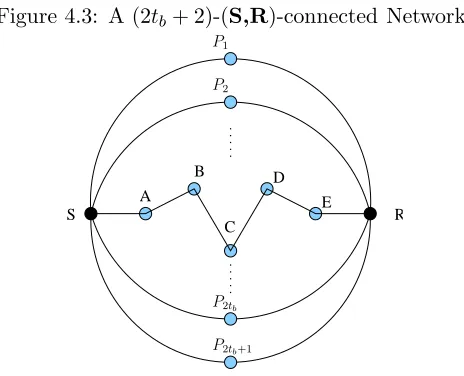
4.3 A (2tb+ 2)-(S,R)-connected Network. . . 45
4.4 A 3-(S,R)-connected Network G. . . 47
4.5 An rmin Round PRMT Protocol on Graph Grmin . . . 50
4.6 Algorithm for Finding rmin in the Presence of More than 2tb+ 1 Paths forρ= 1 . . . 50
4.7 Round-Optimal Reliable Message transmission of mS Tolerating a Mo-bile Adversary with Roaming Speed of ρ >1. . . 53
4.8 A 3rmin Round Communication Optimal PRMT Protocol in Terms of Rounds . . . 56
4.9 Summary of the Results for PRMT in Undirected Synchronous Network Tolerating Amobile tb . . . 57
5.1 Single Phase Reliable Message Transmission Tolerating Mixed Adversary 64 5.2 Protocol 2-SP-REL-Mixed . . . 66
5.3 A Three Phase PRMT Protocol Tolerating Mixed Adversary . . . 74
5.4 An O(D) Phase PRMT Protocol Tolerating Astatic(t b,tf) . . . 80
6.1 Single Phase PRMTED Protocol . . . 85
6.2 A Three Phase Communication Optimal PRMT Protocol Tolerating Amobile(t b,tf), n= 2tb+tf + 1,|m S|=nt b . . . 89
6.3 Summary of the Results for PRMT in Undirected Synchronous Network Tolerating Amobile (tb,tf) . . . 91
7.1 A Single Phase Protocol Based on Error Detection and Error Correction Capability of RS Codes . . . 95
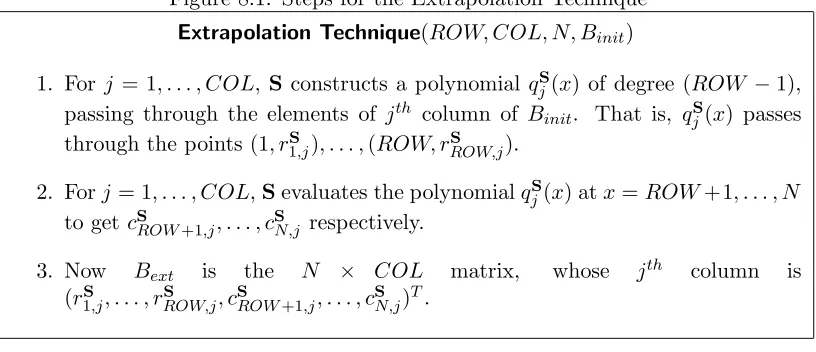
8.1 Steps for the Extrapolation Technique . . . 102 8.2 TheN×COLMatrixBextas Constructed from theROW×COLMatrix
Binit . . . 102
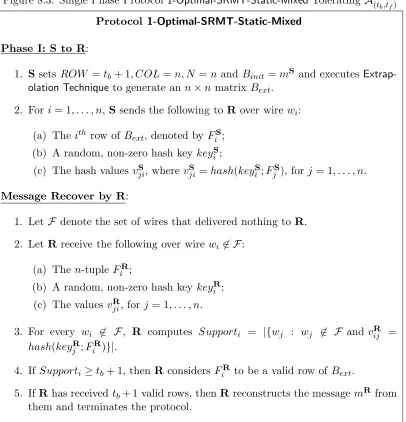
8.3 Single Phase Protocol 1-Optimal-SRMT-Static-MixedTolerating Astatic
(tb,tf) . 104
8.4 Summary of the Results for SRMT in Undirected Synchronous Network Tolerating Astatic
(tb,tf). . . 106
9.1 Existing PSMT Protocols in Undirected Synchronous Network withn= 2tb+ 1 Wires Tolerating Astatictb . . . 111
9.2 Algorithm for Extracting Randomness . . . 112 9.3 A Three Phase Communication Optimal PSMT Protocol ToleratingAstatic
tb 113
10.1 Three Phase Communication Optimal PSMT Tolerating Amobile
tb . . . . 119
11.1 Single Phase Protocol to Establish a One Time Pad of lengthn= 2tb+
tf +tp+ 1 . . . 126
11.2 A Three Phase Protocol to Identify More than tb
2 Byzantine Faults . . . 128
11.3 A Three Phase Protocol to Identify More than tb
2 Byzantine Faults with
a Communication Complexity of O(n2) . . . 132 11.4 A Four Phase Communication Optimal PSMT Protocol ToleratingAstatic
(tb,tf,tp),
n= 2tb+tf +tp+ 1, |mS|=n . . . 134
11.5 Summary of the Results for PSMT in Undirected Synchronous Network Tolerating Astatic(t
b,tf,tp) . . . 135
12.1 A Nine Phase Communication Optimal PSMT Protocol ToleratingAmobile (tb,tf,tp), n=
2tb+tf+tp+ 1 . . . 141
12.2 Remaining Execution of Protocol 9-Optimal-PSMT-Mobile-Mixed if R Executes Step 4 During Phase II. In this case, |mS|=n−1 . . . 142
12.3 Remaining Execution of Protocol 9-Optimal-PSMT-Mobile-Mixed if R Executes Step 5 During Phase II. In this Case, |mS|= n
2. . . 143
12.4 Algorithm to Check WhetherY Can be Linearly Pseudo-Expressed by B150 12.5 Algorithm to Find the Pseudo-Basis ofY . . . 150 12.6 A Three Phase Communication Optimal PSMT Protocol Tolerating
Amobile(t
b,tf,tp): n= 2tb+tf +tp+ 1,|m
S|=n2 . . . 153
12.7 Summary of the Results for PSMT in Undirected Synchronous Network Tolerating Amobile
(tb,tf,tp) . . . 154
13.1 A Two Phase Communication Optimal PSMT Protocol ToleratingAstatic tb 160
13.2 Guessing Attack onDW Protocol . . . 165 13.3 Three Phase PSMT Protocol: ℓ=n2u, n= 3t
b−2u+ 1,0< u≤ t2b;Cis
the set of all possible RS codewords of length nencoded by polynomials of degree tb . . . 176
13.4 Six Phase PSMT Protocol: n= 2tb+ 1,t2b < u≤tb, ℓ=n2u;Cdenotes the set of all possible
RS codewords of lengthN =n+u= 2tb+ 1 +uencoded using all possible polynomials of
degree 2u > tb . . . 177
14.1 Single Phase Communication Optimal SSMT Protocol ToleratingAstatic(t
b,tf,tp):
n= 2tb+tf +tp+ 1,|mS|= (tb+tf +tp) . . . 181
14.2 Three Phase SSMT Protocol ToleratingAstatic
(tb,tf,tp): n=tb+tf+max (tb, tp)+
14.3 Summary of the Results for SSMT in Undirected Synchronous Network Tolerating Astatic
(tb,tf,tp) . . . 188
14.4 Four Phase Communication Optimal SSMT Protocol ToleratingAstatic (tb,tf,tp):
n = tb +tf + max (tb, tp) + 1. If tb ≤ tp, then |mS| = n2, else |mS|=
(tb−tp)n2 . . . 190
15.1 Protocol 3-SSMT-Static-Byzantine-Directed-Exponential: A Three Phase Exponential SSMT Protocol, mS={mS
1, . . . , mSn
3},|m
S|= n
3 . . . 196
15.2 Phase I of Protocol3-SSMT-Static-Byzantine-Directed. . . 198 15.3 MatrixT as Computed bySDuringPhase Iof
3-SSMT-Static-Byzantine-Directed . . . 199 15.4 Phase II of Protocol 3-SSMT-Static-Byzantine-Directed . . . 202 15.5 Phase III of Protocol3-SSMT-Static-Byzantine-Directed. . . 209 15.6 Computation byS at the End of Phase II of Protocol ΠExistingmodif ied in [54] . 211 15.7 Single Phase Protocol1-Pad . . . 216 15.8 First Two Phases of Protocol6-Pad. . . 218 15.9 Remaining Phases of Protocol6-Pad . . . 220 15.10First Two Phases of Protocolu-Optimal-SRMT-Static-Byzantine-Directed:
|mS|= (t
b−u2 + 1)n2 . . . 224
15.11Execution of u-Optimal-SRMT-Static-Byzantine-Directed If S Does Not Receive u2 + 1 Identical Conflict Lists Through the Bottom Band . . . . 226 15.12Local Computation by S at the End of Phase II if S Receives u2 + 1
Identical Conflict Lists Through the Bottom Band . . . 227 15.13Execution of u-Optimal-SRMT-Static-Byzantine-Directed If S Receives
u
2 + 1 Identical Conflict Lists and|LSf ault| ≤(tb−u2) . . . 239
15.14Execution of u-Optimal-SRMT-Static-Byzantine-Directed If S Receives
u
2 + 1 Identical Conflict Lists and|L
S
f ault| ≥(tb−u2) + 1 . . . 240
15.15Execution of u-Optimal-SRMT-Static-Byzantine-Directed If S Receives ”continue” Signal Through the Majority Wires in the Bottom Band at the End of Phase IV . . . 241 15.16Summary of the Steps Executed in Protocol u
-Optimal-SRMT-Static-Byzantine-Directed . . . 242 15.17An O(u) Phase Communication Optimal SSMT Protocol u
-Optimal-SSMT-Static-Byzantine-Directed . . . 243 16.1 Protocol ΠU nidirectional
AP SM T withn= 3tb+ 1 unidirectional wires fromS to R.250
16.2 Protocol ΠU nidirectional
ASSM T withn= 2tb+ 1 unidirectional wires fromS to R.255
Chapter 1
Introduction
Achieving secure communication between two entities who are far away from each other is an age old problem. The notion of ”security” was first formalized by Shannon in his classical work [73]. In his work, Shannon assumed the following: there exists a sender S and a receiver R who are connected by an insecure channel. There exists a computationally unbounded adversary who can listen all the communication over the channel. Under these circumstances, Shannon showed that in order to securely send a message mS to Rof size ℓbits, the following should hold:
1. S and R should have acommon secret keyof size ℓbits beforehand;
2. The common secret key cannot be established between S and Rusing this com-mon channel;
3. Each time S wants to send a new message, S and R should use a new common key. That is, keys cannot be re-used.
The security achieved against the computationally unbounded adversary was termed ”perfect security” or ”perfect secrecy” or unconditional secrecy or information theoretic security. However, the above shortcomings made achieving perfect secrecy impractical. This motivated the research community to look for other alternatives. Two distinct approaches emerged in the literature as practical alternatives:
1. Polynomially Bounded Adversary: This approach was first introduced by Diffie and Hellman in their landmark paper [26]. In this approach, it is assumed that the computational power of the adversary ispolynomially bounded, but the adversary has full access to the cipher text. This models a ’passive’ eavesdrop-per of the channel betweenS and R. Under this assumption, Diffie and Hellman showed howS andRcan establish a common secret key using the insecure chan-nel connecting them. In their work, Diffie and Hellman also proposed a new paradigm, called public-key cryptography (PKC). In this paradigm, every party holds a public key and a private key, where the private key is kept secret and the public key is available to every one. IfSwants to send a message thenSencrypts the message using the public key of R and sends it to R. R then recovers the message by decrypting the encrypted message using his private key.
2. Bounded Bandwidth Adversary: This approach is based on the assumption that in reality, the information obtained by the adversary on the cipher text is partial. Unlike the traditional problem of secure communication, whereSand R are connected directly by a single insecure channel, in a real life scenario,S and Rmay be a part of a large, distributed network. Moreover, it may not be possible for the adversary to control the entire network. This is because the network may be very large and even if the attacker possess sufficient computational power, he would need to spend a considerable amount of time before he succeeds in getting hold of the network completely. And usually, a corrupt node/channel can be detected and corrected by the systems administrator in a relatively much lesser amount of time. Thus, the attacker can, at any given instant, control only a part of the network.
The assumption that the adversary has partial access to the network opens a new line of research, which can make achieving perfect security feasible, without restoring to any computational assumptions. Moreover, it also eliminates the un-realistic requirements, implied by Shannon’s theorem to achieve perfect security. This line of research lead to the problem ofreliable message transmission(RMT) and secure message transmission (SMT).
RMT and SMT were first introduced by Dolev, Dwork, Waarts and Yung [28]. In their model, S and R are connected by multiple, disjoint, communication channels, unlike classical model where only one communication channel is assumed. Moreover, it is assumed that a computationally unbounded adversary controls only a limited number of channels. Under this scenario, Dolev et al. showed how to achieve perfect security. The work of Dolev et al. has since set off an entire line of research.
This dissertation deals with RMT and SMT problem in several network model and adversary settings. This chapter is structured in the following manner: First, we recall the taxonomy or the framework for RMT and SMT problem. This taxonomy was first discussed in [75]. This provides a comprehensive framework to explore the depth and width of the problem in a unified way. We then briefly discuss about the existing literature of RMT and SMT and their limitations. We then emphasize on our contribution in this thesis and its impact on the literature. This will help to judge the stand that our results hold with respect to the past history and also to understand how our results have advanced the state-of-the-art research of this field. Lastly, we describe the chapter wise organization of this thesis.
1.1
Overview of RMT and SMT
In the problem of RMT, S and R are part of an unreliable, connected, distributed network. The distrust in the network is modelled by an entity called adversary, who hasunbounded computing powerand who can corrupt some of the nodes in the network (excluding S and R) in a variety of ways. S wishes to send to R a message mS that
consists of ℓ elements, where ℓ ≥ 1, selected uniformly and randomly from a finite field F. The challenge is to design a protocol, such that after interacting with S as per the protocol, Rshould outputmS without any error (perfect reliability), inspite of
the disruptive actions done by the adversary. The problem of SMT has an additional requirement that the adversary should not get any information about mS what so ever
1.2
Motivation for Studying RMT and SMT
RMT and SMT are fundamental problems in reliable and secure distributed computing. There are basically two motivations for studying RMT and SMT protocols:
1. Many fundamental fault tolerant distributed computing primitives, such as secure multiparty computation (MPC) [89, 37, 13, 17, 66, 8, 9, 11], Byzantine Agreement (BA) [63, 29, 27, 16, 44], Verifiable Secret Sharing (VSS) [18, 13, 66, 36], etc assume that there exists a direct and secure link between every two nodes in the network. This implies that the underlying network graph is a complete graph, which is an unrealistic assumption. In the networks, where S and R are not adjacent, RMT/SMT protocols help to simulate a virtual reliable/secure link between S and R. This way, we can simulate a virtual complete network, over which the above fault tolerant primitives can be executed.
2. The second motivation to study SMT is to achieve information theoretic secu-rity. The security of all existing public key cryptosystems, digital signatures are based on the unproven hardness assumptions of certain number theoretic prob-lems. However, the increase in computing speed and advent of new computing paradigms like Quantum computing [74] may render these assumptions very weak or useless in practice. But these factors have no effect on information theoretic security which is the strongest notion of security. Thus in a scenario, when ex-isting public key cryptosystems, digital signatures can not provide satisfactory security, SMT protocols may help to provide effective alternative.
1.3
RMT, SMT and Its Variants
We now give informal definition of different variants of RMT/SMT. A more formal and rigorous definition will appear in the next chapter.
1. An RMT protocol is called δ-reliable, for any δ = 2−Ω(κ), where κ is the error
parameter, if at the end of the protocol,Rcorrectly outputsS’s message, except with error probability δ. Moreover, this should hold, irrespective of the behavior of the adversary.
2. An SMT protocol is called ǫ-secure, for any ǫ = 2−Ω(κ), where κ is the error parameter, if at the end of the protocol, the adversary does not get any extra information about S’s message, except with probabilityǫ.
3. A message transmission protocol is called (ǫ, δ)-secure, if it is ǫ-secure and δ -reliable, for some ǫ, δ >0.
4. An RMT protocol is called perfectly reliable, also called as PRMT, if it is 0-reliable.
5. An RMT protocol is called statistically reliable, also called as SRMT, if it is
δ-reliable, for someδ >0.
6. A message transmission protocol is called perfectly secure, also called as PSMT, if it is (0,0)-secure.
1.4
Various Models for Studying RMT and SMT
There are various network settings and adversary model in which RMT and SMT problem can be studied and has been studied in the past. We may use the following parameters to describe different settings/models for studying RMT and SMT:
1. Underlying network; 2. Type of communication; 3. Adversary Capacity; 4. Type of faults; and 5. Type of security.
We now elaborate on each of the above attributes.
1.4.1 Underlying Network: Undirected, Directed and Hypergraph
The simplest of the network is undirected network model, where it is assumed that link between every two nodes is bidirectional and hence support both way communication. In directed network model, it is assumed that every communication link has a direction associated with it. Hypergraphs are the most general form of the network, where instead of edges, we have hyperedges. Each hyperedge will have a source node and a set of receiver(s). Any information sent by the source node will be received identically by all the receiver(s) of the hyperedge.
1.4.2 Type of Communication: Synchronous and Asynchronous
In a synchronous network, there exists a global clock in the system and so the trans-mission delay along every edge of the network is bounded. On the other hand, in an asynchronous network, there is no global clock in the system. Thus each link in the network has arbitrary (but finite) delay. The inherent difficulty in designing a protocol over asynchronous network comes from the fact that we cannot distinguish between a slow sender and a corrupted sender. Thus, if a receiver node is expecting some mes-sage from a sender node and if no mesmes-sage arrives then the receiver cannot distinguish whether the sender node is corrupted and did not sent the message at all or the message is just delayed in the network.
1.4.3 Adversary Capacity
The adversary capacity can be further categorized based on the following two proper-ties:
1.4.3.1 Corruption Capacity: Threshold and Non-Threshold
to see that a threshold adversary is a special type of non-threshold adversary, where the size of each set in the adversary structure is bounded by a threshold.
1.4.3.2 Adversary Behavior: Static and Mobile
If the adversary is static, then it controls the same set of nodes throughout the protocol execution. This is a valid assumption if the protocol is executed for a short period of time. On the other hand, if the adversary is mobile, then the adversary can corrupt different set of nodes during different instances of the protocol. This models a scenario when a protocol is executed for a long duration. Under this circumstances, the nodes which were corrupted in the earlier stage may be rectified, while in the mean time, the adversary may corrupt some other set of nodes. Such a scenario is best modelled by mobile adversary.
1.4.4 Type of Faults: Failstop, Passive, Byzantine and Mixed
The weakest type of corruption is the failstop corruption, where the adversary can simply stop the complete functioning of a node. This type of corruption is called failstop corruption and models the scenario when a node may get crashed due to system failure or natural calamity. Passive corruption means that the adversary has full access to the the computation and communication of the node. However, the adversary cannot make the node to deviate from the protocol. The most powerful type of corruption is Byzantine corruption, where a node is completely under the control of the adversary and may behave arbitrarily during the protocol execution. Lastly, the adversary may simultaneously control different set of nodes in passive, fail-stop and active fashion; such a generalized adversary is called mixed adversary.
1.4.5 Type of Security: Perfect and Statistical
Based on the security level achieved by a protocol, we may have perfect security or statistical security. See Section 1.3 for more details.
1.5
Taxonomy of Settings for Studying RMT and SMT
A taxonomy of settings in which RMT and SMT problem can be studied is presented in Fig. 1.1.
Figure 1.1: The taxonomy of settings in which RMT/SMT can be studied.
Underlying Network Type of Adversary Capacity Type of Type of
Communication Faults Security
Undirected Graph Directed Graph Undirected Hypergraph Directed Hypergraph
Synchronous Asynchronous
Threshold Static Threshold Mobile Non-Threshold Static Non-Threshold Mo-bile
Byzantine Fail-Stop Passive Mixed
Perfect Statistical
1. Connectivity of the underlying network;
2. Number of phases, denoted by r, taken by the protocol. Here a phase is a com-munication from S to Ror vice-versa,
3. Communication complexity denoted by b, which is the total number of field ele-ments communicated byS and R in the protocol and
4. Amount of computation done by S andR in the protocol.
Irrespective of the settings in which RMT/SMT is studied, the following issues are common:
1. Possibility: What are the necessary and sufficient structural conditions to be satisfied by the underlying network for the existence of any RMT/SMT protocol, tolerating a given type of adversary?
2. Feasibility: Once the existence of a RMT/SMT protocol in a network is ascer-tained, the next natural question is, does there exist an efficient protocol on the given network?
3. Optimality: Given a message of specific length, what is the minimum communi-cation complexity (lower bound) needed by any RMT/SMT protocol to transmit the message and how to design a polynomial time RMT/SMT protocol whose total communication complexity matches the lower bound on the communication complexity (optimal protocol)?
The above taxonomy and a unified framework for a number of research problems were first discussed in [75]. Different techniques are used to resolve the above issues in different settings. For example, the techniques used in designing optimal RMT/SMT protocols in undirected networks are completely different from the ones used in directed networks.
1.6
A Brief Overview of the Existing Results
The RMT and SMT problem were first proposed and solved by Dolev et al. [28]. Dolev et al. considered an undirected synchronous network and assumed that the adversary can corrupt at most tb nodes in the network in Byzantinefashion. The work of Dolev
et al. is followed by several other works, which considered RMT/SMT problem in several network settings and adversarial model. For example, [28, 70, 77, 4, 30, 42] studied PRMT and PSMT in undirected synchronous network, tolerating threshold static Byzantine adversary. In [24, 25, 87, 88], PSMT and SSMT in directed network is studied. In [35, 24] the authors have studied RMT and SMT in Hypergraphs. PSMT in asynchronous network is studied in [69, 76]. Threshold setting is discussed in [28, 42], while non-threshold setting is discussed in [41, 76, 25, 84]. In [82], PSMT in mobile setting is discussed. SSMT in studied in [33, 24, 86, 43, 5].
1.7
Motivation of Our Work
1. The issue of possibility, feasibilityand optimalityin the context of RMT and SMT in undirected networks has been completely resolved in [28, 70, 77, 4, 30, 81, 42]. However, all these works assume that the underlying network in synchronous and the adversary is a static adversary, who can corrupt the nodes only in Byzantine fashion. Not too much is known regarding the above issues in other network models and adversarial settings. For example, in a typical large network, certain nodes may be strongly protected and few others may be moder-ately/weakly protected. An adversary may only be able to fail-stop/eavesdrop a strongly protected node, while he may affect a weakly protected node in Byzan-tine fashion. Thus, we may capture the abilities of an adversary in a more realistic manner, using three parameterstb, tf, tp wheretb, tf, tp are the number of nodes,
which can be under the influence of the adversary in Byzantine, fail-stop and pas-sive fashion respectively. Also it is better to grade different kinds of disruption done by adversary and consider them separately rather than treating every kind of fault as Byzantine fault as this is an “overkill” and causes an over estimation of the resources required for RMT/SMT1. Thus it is justifiable to study RMT/SMT
in the context of mixed adversary. Unfortunately, not much is known prior to our work, regarding possibility, feasibility and optimality of RMT/SMT and its variants in the context of mixed adversary.
2. In undirected network model, it is assumed that the communication link between any two nodes in the network is bi-directional. However, in practice not every communication channel may admit bi-directional communication. For instance, a base-station may communicate to even a far-off hand-held device but the other way round communication may not be possible. In such a scenario, it is more appropriate to model the underlying network as a directed graph. Motivated by this, Desmedt et al. [24, 87] introduced the problem of RMT/SMT in directed network. However, they only resolved the issue of possibilityand feasibility and nothing is known regarding the issue of optimalityof RMT/SMT and its variants in directed network.
3. If a protocol is executed for a very short duration, then it is appropriate to model the adversary as static, who corrupts the same set of nodes throughout the protocol. However, in many practical scenarios, a protocol may be executed for a longer duration, where S andR may interact for a long time. In such scenarios, some of the faults which are done in the earlier stages, may be identified and fixed and in the mean time, a hacker may attack some other nodes. Evidently, in such cases the mobile adversary models the fault behavior more appropriately than static adversary. The issue of possibility and feasibilityof RMT/SMT tolerating mobile adversary has been resolved in [82]. Unfortunately, nothing is known regarding the issue ofoptimalityof RMT/SMT in the context of mobile adversary.
4. In a synchronous network, if S (R) sends some information along a path, then it is assumed thatR (S) will get the information (possibly corrupted) along the path after a fixed interval of time. However, this is a very strong assumption because the delay in the arrival of a single message will affect the overall security of the protocol. A typical large network like the Internet can be modelled more accurately by asynchronous networks than synchronous networks. The inherent difficulty in designing a protocol in asynchronous network comes from the fact
that we cannot distinguish between aslow senderand acorrupted sender. Due to this inherent difficulty, RMT/SMT protocols in asynchronous networks seem to very involved. In the literature, prior to our work, not too much is known regard-ing possibility, feasibility and optimality of RMT/SMT and its variants in asynchronous network.
1.8
Our Contribution and Models Discussed in this Thesis
In this thesis, we extend the state of the art discussed in the previous section by explor-ing RMT/SMT and its variants in various network models and adversarial settexplor-ings. In this thesis, we consider the following network model and adversary settings:
1. Underlying Graph: Undirected as well as directed.
2. Type of Communication: Synchronous as well as asynchronous. 3. Adversary Capacity: Threshold static as well as threshold mobile. 4. Type of Faults: Byzantine as well as mixed.
5. Type of security: perfect as well as statistical.
In the next section, we give the organization of the thesis and also informally summarize the results that will be presented in each chapter.
1.9
Organization of the Thesis and Brief Overview of Our
Results
In this thesis, we will be studying the RMT/SMT and its variants in different network models and adversarial settings. So instead of describing all network models and adver-sarial settings at the same place, we feel appropriate to discuss about various models in respective chapters. Accordingly, we also give the literature survey related to each model in the corresponding chapters. We believe that this will increase the readability of this thesis.
The thesis is divided into three parts. The first two parts deal with synchronous network, while the last part deals with asynchronous network. The results related to PRMT and SRMT in synchronous network are given in the first part, while the second part contains the results related to PSMT and SSMT in synchronous network. We now give a brief overview of the results that will be discussed in each chapter.
In the next chapter, we present the definitions used in this thesis. We also present the properties of Reed-Solomon (RS) codes, which will be used throughout this thesis. In Chapter 3, we study PRMT inundirected synchronous networktolerating thresh-old static Byzantine adversary, denoted by Astatic
tb . The adversaryA
static
tb controls the
same set oftb nodes throughout the protocol in Byzantine fashion. In [28], it is shown
that PRMT toleratingAstatictb is possible iff there existsn≥2tb+ 1 node disjoint paths,
also called aswiresbetweenSandR. Moreover, in [81], it is shown that any multiphase (more than two phase) PRMT protocol toleratingAstatic
tb must communicate Ω
nℓ n−tb
field elements to reliably send a message mS containing ℓfield elements. This implies
that ifn= 2tb+ 1, then any three or more phase PRMT must communicate Ω(ℓ) field elements because if n = 2tb + 1, then n = Θ(tb). In [49], the authors have shown
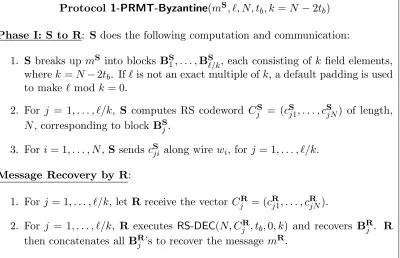
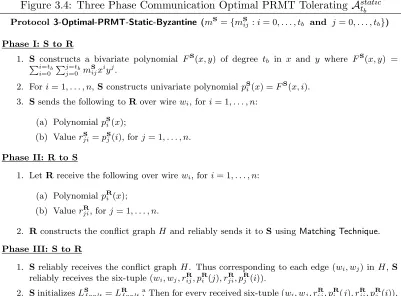
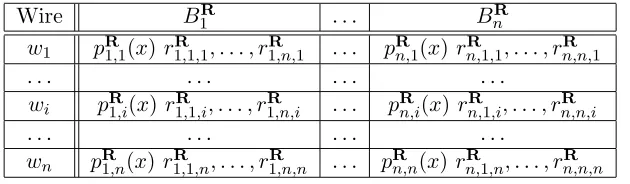
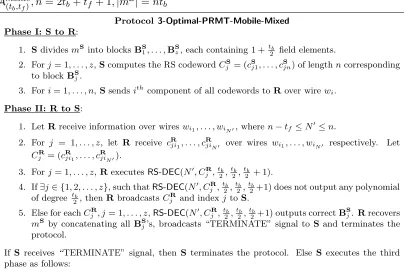
sends a sufficiently large message containing ℓ field elements by communicating O(ℓ) field elements. The core of Chapter 3 contains a discussion of an improved protocol, in which we significantly reduce the phase complexity of the PRMT protocol of [49]. Specifically, we design a three phase PRMT protocol which sends a sufficiently large message containing ℓfield elements by communicatingO(ℓ) field elements. This result is based on [58].
In Chapter 4, we study PRMT inundirected synchronous networktolerating thresh-old mobile Byzantine adversary, denoted by Amobile
tb . The adversary A
mobile
tb controls
different set of tb nodes in Byzantine fashion, during different phases of the protocol.
Intuitively, it seems that the connectivity requirement for PRMT tolerating Amobile tb
must be more in comparison to its static counter part Astatic
tb . However surprisingly, in
[82], the authors have shown that PRMT tolerating Amobile
tb is possible iff there exists
n ≥ 2tb+ 1 wires between S and R, which is same as the connectivity requirement
for any PRMT protocol toleratingAstatic
tb . SinceA
mobile
tb is more powerful thanA
static tb ,
the lower bound on the communication complexity of PRMT against Astatic
tb , as given
in [81], must hold against Amobile
tb . This implies that ifn= 2tb+ 1, then any three or
more phase PRMT must communicate Ω(ℓ) field elements to reliably send a message containingℓfield elements againstAmobile
tb . However, as far our knowledge is concerned,
there is no PRMT protocol tolerating Amobiletb , which satisfies this bound. So in
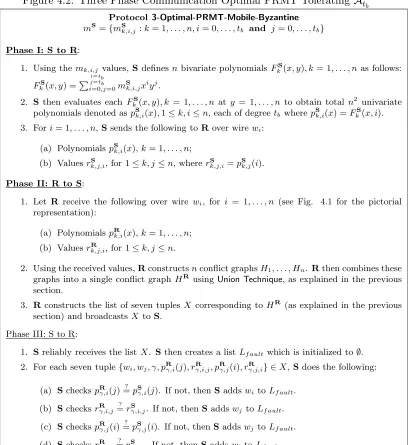
Chap-ter 4, we design athree phase PRMT protocol which sends a sufficiently large message containing ℓ field elements by communicating O(ℓ) field elements, tolerating Amobile
tb .
This protocol is different from the three phase PRMT protocol against Astatictb ,
hav-ing similar properties, which is presented in Chapter 3. Our communication optimal PRMT protocol against Amobile
tb gives the following conclusion: if the adversary does
only Byzantine corruption, then mobility of the adversary does not hinder to design a three phase PRMT with a communication complexity of O(ℓ). This result is based on [60].
All the existing PRMT protocols abstract the paths betweenSandRas wires, ne-glecting the intermediate nodes in the paths. However, in Chapter 4, we show that this causes significant over estimation of the communication complexity as well as the num-ber of communication rounds required by the protocol. So, we consider the underlying paths in its full form, instead of abstracting them as wires and derive a tight bound on the number of communication rounds required to achieve reliable communication from S to R tolerating a mobile adversary with arbitraryroaming speed. We show how our constant phase PRMT protocol against Amobile
tb can be easily adapted to design round
optimal and bit optimalPRMT protocol, provided the network is given as a collection of vertex disjoint paths.
Chapter 5 deals with PRMT inundirected synchronous network, tolerating threshold static mixed adversary, denoted byAstatic
(tb,tf). The adversaryA
static
(tb,tf) can control disjoint
set oftb andtf nodes in Byzantine and fail-stop fashion respectively. PRMT tolerating Astatic
(tb,tf) was first studied in [75], where the author has justified the study of PRMT
tolerating mixed adversary. The author has also given the necessary and sufficient condition for PRMT tolerating Astatic(t
b,tf). The characterization shows the existence of
more fault tolerance in a network, while the existing results offer no such insight. The main contribution of Chapter 5 is that we study the inherent tradeoff among the three important parameters of PRMT, namely the connectivity requirement n, phase complexity r and communication complexity b. Specifically, we give the answer to the following Holy Grail problem of PRMT:
of Astatic
(tb,tf) and a value b, what is the minimum number of phasesr needed
to reliably send a messagemS, where|mS|=ℓ, such that the total
commu-nication complexity of the protocol isO(b)?
We solve the above question by deriving a non-trivial lower bound onr. Moreover, we show that our lower bound is asymptotically tight. To the best of our knowledge, our lower bound is first of its kind and captures the inherent tradeoff amongn, b, ℓand
r simultaneously. This result is based on [6].
In Chapter 6, we focus on PRMT in undirected synchronous network, tolerating threshold mobile mixed adversary, denoted byAmobile
(tb,tf). The adversaryA
mobile
(tb,tf) can
con-trol different set of tb and tf nodes in Byzantine and fail-stop fashion respectively in
different phases of the protocol. We show that PRMT tolerating Amobile
(tb,tf) is possible
iff PRMT tolerating Astatic(t
b,tf) is possible. This shows that as far as possibilityis
con-cerned, mobility of the adversary does not add additional constraints. We then derive the lower bound on the communication complexity of any PRMT protocol tolerating
Amobile(t
b,tf) and show that the bound is asymptotically tight. Our lower bound reveals
the following important property: if the adversary is mixed, then any PRMT proto-col against mobile adversary requires more communication, as compared to its static counter part. Thus if the adversary can do mixed type of corruption, then mobility of the adversary affects optimalityof the protocols. This is quiet interesting because in Chapter 4 we show that mobility of the adversary has no effect onpossibility, as well as optimality, if the adversary does only Byzantinecorruption. This result is based on [19].
In Chapter 7, we study PRMT indirected synchronous network, tolerating threshold static Byzantine adversary, denoted by Astatic
tb . The condition for the possibility of
PRMT in undirected graph toleratingAstatic
tb , as given in [28], will also hold for directed
graphs. However, nothing is known regarding the optimality of PRMT in directed network. We make inroads toward this in Chapter 7. Specifically, the main contribution of Chapter 7 is that we resolve the following question:
what are the necessary and sufficient structural conditions that the underly-ing graph should satisfy for the possibility of communication optimal PRMT protocol, which sends a message of size ℓ field elements by communicating
O(ℓ) field elements over a directed network / digraph? The result of this chapter is based on [57].
In Chapter 8, we study SRMT inundirected synchronous network, tolerating thresh-old static Mixed adversary, denoted by Astatic(t
b,tf). The results stated in this chapter are
not contribution of this thesis. They are recalled from [75]. However, the main purpose of recalling these results here is to make the thesis self complete. This is because several of these results will be used in the subsequent chapters of the thesis.
Chapter 8 marks the end of first part of the thesis. In Chapter 9, we study PSMT in undirected synchronous network, tolerating Astatic
tb . From [28], any two or more phase
PSMT tolerating Astatic
tb is possible iff there exists n≥2tb+ 1 wires betweenS andR.
In [81], the authors have shown that any two or more phase PSMT tolerating Astatictb
must communicate Ωn−nℓ2t
b
field elements to securely send a messagemS containing
ℓ field elements. This implies that if n= 2tb+ 1, then any two or more phase PSMT
the two phase PSMT protocol of [77] does not provide perfect reliability. The authors in [4] also presented a two phase communication optimal PSMT protocol tolerating
Astatic
tb , which asymptotically satisfies the lower bound given in [77]. However, the
two phase PSMT protocol of [4] has the following two disadvantages: (a) Both S and R have to perform exponential amount of computation; (b) The protocol is optimal only if the message is exponentially large. The main contribution of Chapter 9 is a three phase polynomial time, communication optimal PSMT protocol toleratingAstatic
tb ,
which satisfies the lower bound given in [81]. Though our PSMT protocol requires one extra phase, it overcomes the shortcomings of the two phase PSMT protocol of [4]. The result of this chapter is based on [58].
In Chapter 10, we study PSMT inundirected synchronous networktolerating thresh-old mobile Byzantine adversary, denoted by Amobiletb . Intuitively, it seems that the
connectivity requirement for PSMT tolerating Amobiletb must be more than its static
counter part Astatic
tb . However surprisingly in [82], the authors have shown that PSMT
tolerating Amobile
tb is possible iff PSMT tolerating A
static
tb is possible. Since A
mobile tb
is more powerful than Astatic
tb , the lower bound on the communication complexity of
PSMT against Astatic
tb , as given in [81], must hold against A
mobile
tb . This implies that
if n= 2tb+ 1, then any two or more phase PSMT must communicate Ω(nℓ) field
ele-ments to securely send a message containing ℓfield elements againstAmobiletb . However,
to the best of our knowledge, the only known communication optimal PSMT protocol against Amobile
tb , achieving the above bound is due to [77], which takes O(tb) phases.
The major contribution of Chapter 10 is that we design a threephase communication optimal PSMT protocol which sends a sufficiently large message containing ℓ field el-ements by communicating O(nℓ) field elements, tolerating Amobile
tb . This protocol is
different from the three phase communication optimal PSMT protocol against Astatictb ,
having similar properties, which is presented in Chapter 9. Our communication optimal PSMT protocol against Amobile
tb gives the following conclusion: if the adversary does
only Byzantine corruption, then mobility of the adversary does not hinder to design a three phase PSMT with a communication complexity of O(nℓ). The result of this chapter is based on [60].
In Chapter 11, we study PSMT inundirected synchronous networktolerating thresh-old static mixed adversary. However, in addition to Byzantine and failstop corruption, we also consider passive corruption. Thus, the mixed adversary, denoted by Astatic
(tb,tf,tp)
corrupts a disjoint set of tb, tf and tp nodes in Byzantine, failstop and passive fashion
respectively throughout the protocol. In [75], the author has shown that any multi phase PSMT tolerating Astatic
(tb,tf,tp) is possible iff there exists n≥2tb+tf +tp+ 1 wires
between S and R. Moreover, any multi phase PSMT tolerating Astatic
(tb,tf,tp) must
com-municate Ωn−(2tnℓ
b+tf+tp)
field elements to securely send a message containingℓfield elements. However, no multi phase communication optimal PSMT protocol tolerat-ing Astatic(t
b,tf,tp) was presented in [75]. We completely resolve the issue of optimality
of multi phase PSMT tolerating Astatic
(tb,tf,tp) in Chapter 11. Specifically, we present a
four phase communication optimal PSMT protocol toleratingAstatic
(tb,tf,tp), which securely
sends a message containing ℓ field elements, by communicating O(nℓ) field elements over n= 2tb+tf+tp+ 1 wires. We also show that the techniques used to design
com-munication optimal PSMT protocol against Astatic
tb cannot be extended in a straight
forward manner to design communication optimal PSMT protocol against Astatic(t
b,tf,tp).
So to design our four phase PSMT protocol against Astatic
(tb,tf,tp), we use certain new
In Chapter 12, we study PSMT inundirected synchronous networktolerating thresh-old mobile mixed adversary, denoted by Amobile
(tb,tf,tp), who corrupts different set of tb, tf
and tp nodes in Byzantine, failstop and passive fashion respectively during different
phases of the protocol. To the best of our knowledge, nothing is known in the lit-erature regarding possibility and optimalityof PSMT in undirected synchronous network tolerating Amobile
(tb,tf,tp). In Chapter 12, we completely resolve these issues. The
result of this chapter is based on [19].
In Chapter 13, we study PSMT indirected synchronous networktoleratingthreshold static Byzantine adversary Astatic
tb . PSMT protocols in directed network tolerating
Astatic
tb are presented in [24, 62, 53]. However, recently in [88], the authors showed none
of these PSMT protocols tolerating Astatic
tb provide perfect secrecy. This brings forth
the question of designing PSMT protocols in directed networks tolerating Astatic tb . We
make inroads in this directions by providing communication optimal PSMT protocols in directed networks tolerating Astatic
tb . The result of this chapter is based on [57, 55].
In Chapter 14, we study SSMT inundirected synchronous networktolerating thresh-old static mixed adversary Astatic
(tb,tf,tp). The issue of possibility and optimality of
single phase SSMT toleratingAstatic
(tb,tf,tp) has been resolved in [75]. Moreover, the author
in [75] also resolved the issue ofpossibilityof multi phase SSMT toleratingAstatic(t
b,tf,tp).
Furthermore, Srinathan [75] also gave the lower bound on the communication complex-ity of multi phase SSMT tolerating Astatic
(tb,tf,tp). However, no multi phase communication
optimal SSMT protocol tolerating Astatic
(tb,tf,tp) was presented. We completely resolve the
issue of optimality of multi phase SSMT tolerating Astatic
(tb,tf,tp) in Chapter 14. The
contents of Chapter 14 is based on the results that appeared in [59].
In Chapter 15, we discuss about SRMT and SSMT indirected synchronous network tolerating threshold static Byzantine adversary, denoted byAstatic
tb . In [24], the authors
have given the necessary and sufficient condition for the existence of any SRMT and SSMT protocol tolerating Astatic
tb . However, to the best of our knowledge, nothing is
known in the literature regardingoptimalityof SRMT and SSMT in directed network tolerating Astatic
tb . The main contribution of Chapter 15 is that we present the lower
bound on the communication complexity of SRMT and SSMT in directed network tolerating Astatic
tb . Moreover, we show the tightness of the bound by designing
com-munication optimal SRMT and SSMT protocol in directed network tolerating Astatic tb .
The contents of this chapter is based on the results that appeared in [61]. The main reason for presenting the results for SRMT and SSMT together in the same chapter is that few of the results for SSMT will be used for SRMT. To make the chapter more readable and self contained, we present these results together in the same chapter.
Chapter 15 marks the end of second part of the thesis. In Chapter 16, we study PSMT and SSMT in asynchronous network tolerating Astatic
tb . Unlike synchronous
net-work, PSMT and SSMT has not been studied extensively in asynchronous network. To the best of our knowledge, the only known PSMT protocol in asynchronous network tolerating Astatic
tb is dues to [69]. However, in Chapter 16, we show that the PSMT
protocol of [69] does not provide perfect security. We then give the characterization for PSMT and SSMT in asynchronous network toleratingAstatictb , thus completely resolving
Chapter 2
Definition and Preliminaries
In this chapter, we give the definitions which are used throughout this thesis. We discuss about the properties of Reed-Solomon (RS) codes [45] which will be used extensively in our protocols.
2.1
Definition of Various Type of Corruptions
We now define the various type of corruptions that can be done by an adversary. Definition 2.1 (Fail-stop Corruption [31]) A node P is said to be fail-stop cor-rupted if the adversary can crash P at will at any time during the execution of the protocol. But as long as P is alive, P will honestly follow the protocol and the adver-sary will have no access to any internal state of P.
Definition 2.2 (Passive Corruption [31]) A node P is said to be passively cor-rupted if the adversary has full access to the information available/generated at P and all internal states of P. However, P will honestly follow the protocol execution.
Definition 2.3 (Byzantine Corruption [31]) A node P is said to be Byzantine cor-rupted if the adversary fully controls the actions of P. The adversary will have full access to the computation and communication of P and can force P to deviate from the protocol in any arbitrary manner.
2.2
Definition of RMT, SMT and Its Variants
Let the message to be transmitted be drawn uniformly and randomly from F. We define the view of a node Pj, at any point of the execution of a protocol Π to be
the information that Pj can get from its local input to the protocol (if any), all the
messages that Pj had earlier sent or received, the protocol code executed by Pj and
random coins ofPj. LetAbe acomputationally unbounded adversary, who can corrupt
some of the nodes in the network in a variety of ways1. The view of Aat any point of the execution of Π is defined as all the information that A can get from the views of all the nodes corrupted by A (i.e. all the information that these nodes can commonly compute from their views). For a message mS∈F, any adversaryAand any protocol
Π, let Γ(b A, mS,Π) denote the probability distribution on the view of the adversary A
at the end of the execution of Π. We now give the following definitions:
1Acan be static or mobile. Amay corrupt the nodes in Byzantine or fail-stop or passive or mixed