Available Online at www.ijcsmc.com
International Journal of Computer Science and Mobile Computing
A Monthly Journal of Computer Science and Information Technology
ISSN 2320–088X
IJCSMC, Vol. 4, Issue. 7, July 2015, pg.325 – 329
RESEARCH ARTICLE
EDGE DETECTION IN HSI USING NEW EDGE
DIRECTED INTERPOLATION (NEDI)
Alisha Chug Dr. Shashi Bhushan Mr. Karan Mahajan M.Tech Student Professor & Head of Department Assistant Professor Information Technology Information Technology Information Technology Chandigarh Engineering College Chandigarh Engineering College Chandigarh Engineering College
Landran, Mohali Landran, Mohali Landran, Mohali
ABSTRACT:- During HSI restoration process using LRMR algorithm some of pixels goes missing and usually at edges of images . Most of the shape information of an image is enclosed in edges. So first we detect these edges in an image and by using filters and then by enhancing those areas of image which contains edges, sharpness of the image will increase and image will become clearer. In this paper we proposed New Edge Directed Interpolation algorithm (NEDI) for edge detection.
KEYWORDS:- EDGE DETECTION, NEDI , LRMR
1. INTRODUCTION
Hyper spectral images are often degraded by, mixing various kinds of noises in the acquisition process, that include Gaussian noise, impulse noise, deadlines, stripes, etc . So during restoration process using Low Rank Matrix Recovery many pixels are missing at many places. So we need to recover pixels and especially at edges. Edges are significant local changes in the image and are important features for analyzing images. Boundary between two different regions in an image is called edge. Edge detection is frequently the first step in recovering information from images. Due to its importance, edge detection is an active research area. various edge detection algorithms are available.
1.1 EDGE DETECTION
therefore be substantially simplified. However, it is not always possible to obtain such ideal edges from real life images of moderate complexity.
1.2 NEW EDGE DIRECTED INTERPOLATION (NEDI )
Edges are visually attractive to the human perceptual system, many edge-directed interpolation methods have been developed for edge reconstructions [1-4]. The aim of edge directed methods is to preserve the edge sharpness during the up sampling process and is done by explicitly calculating the edge orientation and then interpolate along the edge orientation [1-4].Further quantize the edge orientations [2-4]. However, this interpolation way is constrained by the estimation accuracy of the edge orientation. Since, the edges of natural images are often blurred, blocky and noisy, the accuracy of edge orientations is usually unstable. The basic idea is to first estimate local covariance coefficients from a low-resolution image and then use these covariance estimates to adapt the interpolation at a higher resolution based on the geometric duality between the low-resolution covariance and the high-low-resolution covariance. The edge-directed property of covariance-based adaptation attributes to its capability of tuning the interpolation coefficients to match an arbitrarily oriented step edge. Two important applications of the new interpolation algorithm are studied: resolution enhancement of grayscale images and reconstruction of color images from CCD samples. Simulation results demonstrate that our new interpolation algorithm substantially improves the subjective quality of the interpolated images over conventional linear interpolation.
2. LITERTURE SURVEY
C.Naga Raju, “Morphological Edge Detection Algorithm Based on Multi-Structure Elements of Different
Directions”, 2011 proposed an edge detection algorithm based on multi- structure elements morphology. The proposed algorithm results are compared with differential edge detection operators such as Watershed method, Sobel operator and Canny operator and obtained the better edges over traditional methods. [5] Shihu Zhu,
“Edge Detection Based on Multi-structure Elements Morphology and Image Fusion”, 2011 proposed the new method of edge detection based on image fusion. Edges are detected using four different orientations SE (structure,element) where direction angles of all the structure elements are 0 and final edge result is got by image fusion using entropy, 135, 9045 weighted method. The proposed method show effective edges information [6] .Wenshuo Gao, “An Improved Sobel Edge Detection”, 2010 proposed a method which is
combination of Sobel edge detection operator and soft-threshold wavelet . This method used on images which include White Gaussian noises. The widely used operators such as Sobel, Prewitt, Roberts and Laplacain their anti-noise performances are poorso this paper proposes an edge detection method which combines soft-threshold wavelet denoising and Sobel Operator, its anti-noise performance is very strong. Firstly soft-threshold wavelet used to remove noise, then Sobel edge detection used for edge detection on the image. [7] Tapas Kumar, “A
Novel Method of Edge Detection using Cellular Automata”, 2010 proposed a new approach of edge detection based on cellular automata. The algorithm is basically designed for grayscale images. The algorithm works on the basis of bi-dimensional cellular automata. A result produced by Cellular Automata works satisfactorily for different gray level images and produce better edge detection effects as compared to Canny, Roberts, Prewitt and Sobel.[8]
.Jing Tian, “An Ant Colony Optimization Algorithm for Image Edge Detection”, 2008 proposed an Ant colony optimization based edge detection approach. Ant colony optimization (ACO) is an optimization algorithm based on real ants’ behavior and inspired by the natural behavior of ant species. In real life, ants leaves pheromone on the ground so that othrs ants can follow. The proposed algorithm establishes a pheromone matrix, which represents the edge information at each pixel position of the image. For this number of ants are dispatched to move on the image driven by the local variation of the image’s intensity values. [9] Madhu S. Nair, “HBT
3. PROPOSED METHODLOGY
Image acquisition is the first step of the proposed model; image will be loaded in to the working memory of the image restoration model. After acquiring the image, the next step will be to perform the low-rank matrix restoration (LRMR) to restore the image. The go decomposition or GoDec method will be used to create the cube of original image and its decomposed matrices. Afterwards, the image would undergo the pixel level restoration using the non-reference regularization algorithm . This method will recover the missing pixel regions. Then New Edge-Directed Interpolation (NEDI) filter will be used to recover the pixel expansion problem occurred due to the image de-noising and restoration processes. Then, various performance parameters would be obtained in the form of mean squared error (MSE), root mean squared error (RMSE), normalized absolute error (NAE), Structural similarity (SSIM) and peak signal to noise ratio (PSNR). The performance of the proposed model will be thoroughly studied in order to conclude the findings and the comparison of the proposed and existing models will be performed to evaluate the improvement in the performance of the proposed model.
The focus of four methods is the precise estimation of directions. NEDI is from covariance, ICBI is from the second order derivatives, EGII is from statistical analysis of two observation sets, and DCCI is from second order derivatives and parameter are determined by data training. How to utilize the information in LR images and infer the hidden pixel values is still a challenging topic for image interpolation is a severe ill-posed problem.
Algorithm 1: New edge directed image interpolation
1.
To perform our interpolation, we have to do so in two steps. a. First we compute for the 'b' pixels, and then for the 'a' pixels. b. The 'b' pixels have their 4 interpolation neighbours already known.c. The 'a' pixels will only have 4 neighbours after 'b' pixels have been determined.
d. This was not a concern with isotropic interpolation schemes like bilinear or bicubic because the location of a new pixel relative to the original pixmap (the fractional uv coordinates) were all that was needed to determine the appropriate weighting.
2.
The 'b' pixels correspond to those that are at Q(2x+1, 2y+1) for the super resolution image Q, where Q(2x, 2y) = P(x,y).a. By filling in the values for 'b' pixels, we end up completing the lattice for all Q(i,j), where (i+j) is even. This leaves only the 'a' pixels which are the set of all Q(i,j), where (i+j) is odd.
3.
To compute the ideal weights, we consider the following variables. a. M -- local window of pixels is of size MxMb. y -- A column vector of size M2 containing the pixels in the window. y(k) is kth pixel in the window.
c. C -- A matrix of size 4xM2 containing the interpolation neighbours of each pixel. The kth row vector contains the 4 interpolating neighbour pixels of y(k).
1 1
R = --- * CT · C r = --- * CT · y
M*M M*M
4.
R will end up being a 4x4 matrix, and r will be a column 4-vector. Wiener filtering tells us that optimal MMSE linear interpolation weights can be computed using the following.-1
· r = (CT · C)-1 * (CT · y)
instance, using images in colour space that separates luminance and chrominance (e.g., YIQ, YUV, YCbCr) means that we can limit EDI to only one channel. Namely, the luminance channel Y. The chrominance channels can be handled with reasonable quality by mere bilinear or bicubic interpolation (to be accurate, this holds true for natural images, but not quite true for overtly graphical or 'cartoony' images). RGB color would require the use of NEDI on all 3 channels because each channel controls both luminance AND chrominance simultaneously. Similarly, in HSL colorspace, we can afford bilinear or bicubic on the H channel, but NEDI is warranted on the S and L channels.
4. RESULTS AND DISCUSSIONS
In this section we will compare the results of the input image and after applying NEDI algorithm. The orignal image of the and the NEDI approaches are shown.
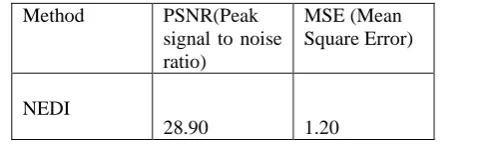
Fig: 4.1 a) original image b) Results of the NEDI Technique. The proposed algorithm is tested on the Hyper spectral Digital Imagery Collection Experiment (HYDICE) image of the Washington DC Mall is used in our simulated experiment.. The algorithm is applied using various performance indices , Peak signal to noise ratio (PSNR) and Root Mean Square Error (RMSE). In order to implement the proposed algorithm, design and implementation has been done in MATLAB using image processing toolbox.
Method PSNR(Peak signal to noise ratio)
MSE (Mean Square Error)
NEDI
28.90 1.20
Table 1: Interpolation evaluation of multiple method using the PSNR and MSE
The results have been obtained in the form of resulting images and the performance parameters. The image super resolution algorithm based on New edge directed interpolation and wavelet based image interpolation using Multilayer Perceptrons method have been evaluated under this performance evaluation survey. The results have shown that the NEDI (New edge directed interpolation) is the best method than the other candidates evaluated under this performance evaluation survey.
5. CONCLUSION AND FUTURE SCOPE
During HSI restoration process using LRMR algorithm, some of pixels were missing and especially at edges of images. Most of the shape information of an image is enclosed in edges. So first we detect these edges in an image and by using filters and then by enhancing those areas of image which contains edges, sharpness of the image will increase and image will become clearer. So we have used the NEDI algorithm for edge detection. It was found that it gave better results and edges were recovered effectively. But there is further scope for
METHODS PSNR MSE
improvement , as only work is done on edge detection further work can be on missing pixels in images using hybrid approach using LRMR and NRRA to get better values of PSNR and MSE .
REFERENCES
[1] Qing Wang and Ward, R.K., "A New Orientation-Adaptive Interpolation Method," IEEE Trans. on Image Processing, vol.16, no.4, pp.889-900, April 2007
[2] Siyoung Yang, Yongha Kim and Jechang Jeong, "Fine edge-preserving technique for display devices," IEEE Trans. on Consumer Electronics, vol.54, no.4, pp.1761-1769, November 2008
[3] Kwan Pyo Hong, Joon Ki Paik, Hyo Ju Kim and Chul Ho Lee, "An edge-preserving image interpolation system for a digital camcorder," IEEE Trans. on Consumer Electronics, vol.42, no.3, pp.279-284, Aug 1996
[4] M. J. Chena, C. H. Huang and W. L. Lee, “A fast edge-oriented algorithm for image interpolation,” Image and Vision Computing, Vol. 23, pp. 791-798, 2005.
[5] C.NagaRaju, S.NagaMani, G.rakesh Prasad, S.Sunitha, “Morphological Edge Detection Algorithm Based on Multi-Structure Elements of Different Directions”, International Journal of Information and Communication Technology Research Volume 1 No. 1, May 2011.
[6] Shihu Zhu, “Edge Detection Based on Multi-structure Elements Morphology and Image Fusion”, IEEE, 978-1-4244-9600-vol-6, 2011.
[7] Wenshuo Gao, Lei Yang, Xiaoguang Zhang, Huizhong Liu, “An Improved Sobel Edge Detection”, IEEE, 978-1-4244-5540-vol-9,2010.
[8] Tapas Kumar, G. Sahoo, “AA Novel Method of Edge Detection using Cellular Automata”, International Journal of Computer Applications (0975 – 8887) Volume 9– No.4, November 2010
[9] Jing Tian, Weiyu Yu, and Shengli Xie, “An Ant Colony Optimization Algorithm for Image Edge Detection”, IEEE, 978-1-4244-1823-vol-7, 2008.
[10] Madhu S. Nair, R. Vrinthavani, and M. Wilscy, “HBT Filter and Logarithmic Transform Based Edge Detection – A Modified Approach”, Engineering Letters, 17:3, EL_17_3_02, 1 August 2009.