Available Online atwww.ijcsmc.com
International Journal of Computer Science and Mobile Computing
A Monthly Journal of Computer Science and Information Technology
ISSN 2320–088X
IJCSMC, Vol. 4, Issue. 8, August 2015, pg.431 – 446
RESEARCH ARTICLE
FACIAL EXPRESSION RECOGNITION:
Machine Learning using C#
Author: Neda Firoz
([email protected])Advisor: Dr. Prashant Ankur Jain
([email protected])Abstract: Facial expression is an important channel for human interaction and can be applied in many real
applications. One precarious effort for facial expression recognition (FER) is to precisely extract emotional
features. While we know that the current approaches on FER in static images have not fully considered and
utilized the features of facial element and muscle actions, which represent geometric and appearance
physiognomies of facial expressions. So in this paper we propose a methodology to resolve this limitation using
prominent ‘salient’ distance features, and these are obtained by mining patch-based 3D Gabor features, selecting the ‘salient’ patches, and performing patch matching processes. The experimental results validate high correct
recognition rate (CRR), noteworthy performance improvements due to the consideration of facial element and
muscle movements, and quick processing time. The comparison with the state-of-the-art performance confirms
that the proposed approach achieves the highest CRR on the JAFFE database and is among the top performers
on the Cohn-Kanade (CK) database.
Keywords: Feature selection, Facial expression, Human communication, Pattern recognition
INTRODUCTION
Emotional information is very important way of information transmission in interpersonal
communication. It can convey a lot of information which words cannot convey. 54% of emotional
information is communicated through facial expressions. The Information contained in human face
accounts for a substantial proportion in image understanding. Facial expression recognition is the process
a person's mental state according to the facial expression. And it completes the interaction of intelligent
human-computer. Facial expression recognition system consists of four basic parts: expression image
acquisition, image preprocessing, face expression feature extraction and classification. So, in recent years,
the facial expression analysis has attracted attentions from many computer vision researchers. The facial
emotions recognition has been one of the dynamic research interests in the field of pattern recognition.
People extract the stretch eyebrows, frowned, giggle, half smile, frown, smiling and common human
facial expressions in much rich expression. People solve a series of problems of facial expression by
environmental interference. The passions will be reflected in facial expression. Expression solves many
practical problems especially in face expression.
In human-to-human conversation, the articulation and perception of facial expressions form a
communication channel in addition to voice which carries vital information about the mental, emotional,
and even physical state of the persons in conversation. A person's facial expressions in its simplest form is
a more subtle happy or angry thoughts, feelings or understanding of the speaker expected or unexpected
response from listeners, sympathy, or even what the speaker is saying no signal can provide to computing
background, brings our everyday human user to remain at the forefront in the fabric will move to absorb.
This set up a generally prediction, pervasive computing and ambient intelligence such as needed to
achieve the next generation of computing. It's easy to naturally occurring multimodal human-human
communication focused response to the user interface will need to be developed to identify such
interfaces and intentions and as expressed by feelings of social and emotional indicators will need to have
the ability. This vision of the future motivates the research for automated recognition of nonverbal actions
and expression.
My work presents an expression recognition method by manifesting the facial characteristics through
false geodesic distance and remodeling the facial expressions in the 3D space and verifies this method
being able to identify different expressions from static facial images in a more effective and remarkable
manner. The algorithms demonstrate that this method achieves better results of expression recognition
than traditional methods and shows stronger robustness to changes of illumination.
Facial Expression can deal with the studies related to psychology, driver state surveillance, patient
monitoring etc. In the developed countries the hospitals use the facial expression tool to study the
emotional states of patients who are deaf dumb or blind , or in many cases the patients who are not able to
explain their emotional state due to injury, disease etc. This can help the doctors to monitor them and
regulate the medications and proper care.
Thus the objectives of present work were to:
a) To be able to recognize the platform to develop a software tool such as php, java, dot net etc.
c) To locate the face from a static picture.
d) To generate the binary image and train the data sets from databases available online.
e) To detect human emotions.
f) To be able to improve the algorithms for further research.
Why use it?
The tool to recognize Facial Expression can be used to analyze the facial expressions of deaf and
blind people.
More than 10.000 manually annotated images used for training the software.
Objectivity in observations.
Accurate modeling of the face by describing various key points.
Who uses it?
The tool can be used worldwide at universities, research institutes, and companies in many markets, such
as consumer behavior research, usability studies, psychology, educational research, and market research.
Patient monitoring system
Market research: How do people respond to a commercial’s new design?
Driver surveillance system
And much more!
Facial expression is an important channel for human communication and can be applied in many real
applications. One critical step for facial expression recognition (FER) is to accurately extract emotional
features. Current approaches on FER in static images have not fully considered and utilized the features
of facial element and muscle movements, which represent static and dynamic, as well as geometric and
appearance characteristics of facial expressions. The approach is to solve this limitation using ‘salient’
distance features, which are obtained by extracting patch-based 3D Gabor features, selecting the ‘salient’
patches, and performing patch matching operations. The experimental results demonstrate high correct
recognition rate (CRR), significant performance improvements due to the consideration of facial element
and muscle movements, promising results under face registration errors, and fast processing time. The
comparison with the state-of-the-art performance confirms that the proposed approach achieves the
highest CRR on the JAFFE database and is among the top performers on the Cohn-Kanade (CK)
database. (Ligang Zhang, et al, 2011)
DATABASES:
Six basic expressions were based on descriptions of prototypic emotions. Image sequences from neutral to
values. In this proposed project, all the images of six basic expressions from the JAFFE database will be
used. For the CK database, 1,184 images that represent one of the six expressions are selected, four
images for each expression of 92 subjects. The images are chosen from the last image (peak) of each
sequence, then one every two images. The images of 10 subjects in the JAFFE database are classified into
10 sets, each of which includes images of one subject. Similarly, all images in the CK database are
classified into 10 similar sets and all images of one subject are included in the same set.
The Japanese female facial expression (JAFFE) database [35] contains 213 gray images of
seven facial expressions (six basic + neutral) posed by 10 Japanese females. Each image
has a resolution of 256*256 pixels. Each object has three or four frontal face images for
each expression and their faces are approximately located in the middle of the images. All
images have been rated on six emotion adjectives by 60 subjects.
The Cohn-Kanade AU coded facial expression (CK) database [36] is one of the most
comprehensive benchmarks for facial expression tests. The released portion of this database
includes 2105 digitized image sequences from 182 subjects ranged in age from 18 to 30 years.
65% are female; 15% are African-American and 3% Asian or Latino.
There is no instance in which 70% or more of the people in one cultural group judged a picture as
showing one of these emotions and a similar percentage of the people in another cultural group judged the
same expression as showing a different one of these emotions. (Brown, et al, 1991)
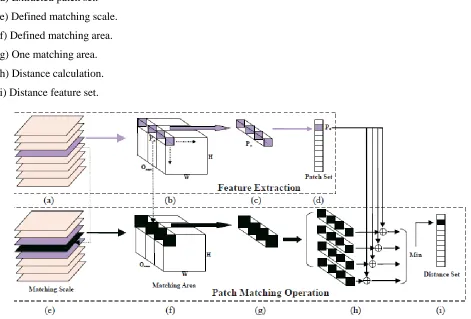
FLOWCHART OF THE METHOD
Fig 1
METHODOLOGY OVERVIEW
Building distance features.
(a) One scale is selected from eight-scale Gabor images.
(b) Patches are extracted across all rows and columns in the selected scale image.
Skin Color Segmentation
Face Detection
Eyes Detection
Lip Detection
Apply Bezier Curve on Lip
Apply Bezier Curve on Eye
Database and Training
(c) One extracted patch say Pa.
(d) Extracted patch set.
(e) Defined matching scale.
(f) Defined matching area.
(g) One matching area.
(h) Distance calculation.
(i) Distance feature set.
Fig 2 Pseudo code execution
ALGORITHM USED
Pseudo code of building distance features.
(1) Defining moving steps.
(2) Extracting Patches.
(3) Recording matching area.
(4) Recording matching scale.
Input: Image set Si (i=1,…,10); patch size Pj (j=1,…,4); emotion index Ek (k=1,…,6); scale SCm
(m=1,…,8); orientation On (n=1,…,4); orientation number Onum; image width W, height H (W=H=48).
Output: Extracted patches, matching area and matching scale.
For each emotion Ek , each scale SCm , each patch size Pj
Choose one set Si randomly from 10 sets;
Choose one image of emotion Ek randomly from Si;
For ih = 1 to (H-Pj+1) by Move_step
For iw = 1 to (W-Pj+ 1) by Move_step
Extract patches with sizes of Pj*Pj*Onum; (2)
Record the matching area (Lx,Ly,Rx,Ry): (3)
Lx = Max(ih-0.5*Pj,1); Rx = Min(ih+1.5*Pj,H);
Ly = Max(iw-0.5*Pj,1); Ry = Min(iw+1.5*Pj,W).
Record the matching scale SCm; (4)
End
End
End
Return patches, matching area and matching scale.
Discussion of the Facial expression application available on Google’s play store in mobile
applications:
There are few applications available on Play Store of Google to recognize the facial expressions. Example
of one such application is Face Recognition application which can start experimenting with face
recognition right away. It shows you how to perform face recognition with face recognizer in OpenCV
using Eigenfaces algorithms.
Another Example is Facial Expressions Training which improves lie detector abilities to help read the
faces of human being in the scientific field of psychology.
Thus we find the usefulness of the project undertaken to be able to recognize the facial expressions.
Notable software with face recognition ability includes:
digiKam (KDE)
iPhoto (Apple)
OpenCV (Open Source)[10]
Photoshop Elements (Adobe Systems)
Picasa (Google)
Picture Motion Browser (Sony)
Windows Live Photo Gallery (Microsoft)
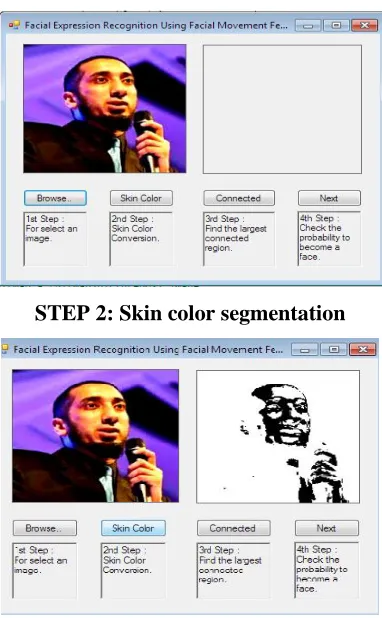
Fig 3 Skin color segmentation
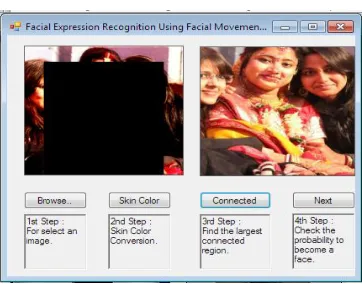
Fig4 finding connected region
Fig 6 Eye / lip detected
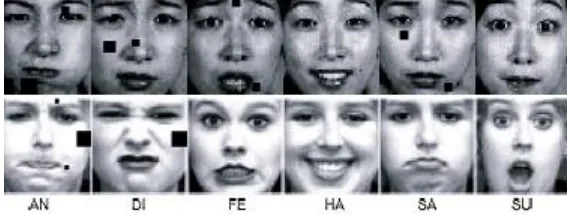
Fig 7 Emotional state of a human face
Results of the software tested
STEP 1: Browse the database
STEP 3: Finding Connected Region
STEP 4: Binary image conversion
STEP 5: Eye and Lip Detection
STEP 7: Emotion Displayed
SUMMARY
This work accomplishes the issue of facial expression recognition using facial movement features. The
effectiveness of the approach is testified by the recognition performance, computational time, and
comparison with the state-of-the-art performance. The experimental results also show significant
performance improvements due to the consideration of facial movement features, and promising
performance under face registration errors. The results tell us that patch-based Gabor features give a
better performance over point-based Gabor features in terms of obtaining regional features, keeping the
position information, achieving a better recognition performance, and requiring a less number. Different
emotions have different ‘salient’ areas; though, the majority of these areas are distributed around mouth and eyes. In supplement to, these ‘salient’ areas for each emotion seem to be not influenced by the choice
of using point-based or using patch-based features. These ‘salient’ patches are distributed across all scales
with an emphasis on the higher scales. Intended at both the JAFFE and CK databases, DL2 performs the
best among four distances. And as for emotion, anger underwrites most to the misrecognition. While the
JAFFE database requires larger sizes of patches than the CK database to keep useful information. The
proposed approach can be potentially applied into many applications, such as patient state detection,
driver fatigue monitoring, and intelligent tutoring system. In our future work, we can extend our approach
to a video based FER system by combining patch-based Gabor features with motion information in
multi-frames. Recent progress on action recognition [47] and face recognition [48] has laid a foundation for
using both appearance and motion features.
CONCLUSION
Thus, a real-time processing was resulted when our approach dealt with the development of the software
tool by time efficient language, C#. Among three stages, computing Gabor images takes the biggest
proportion of the overall time, while the classification requires the least amount of time.
The facial expressions are important determinants of human emotion detection. Thus we developed a tool
which is capable of determining the human emotion through facial expression. The tool works on dot net
platform and uses the supportive algorithm for deploying it on the machine utilizing various machine
learning adaptive methods. The thesis is basically focusing on static images which can be stored in the
database, and further analysis can be done via the tool. The further research can be done on video based
image extraction and the algorithms can be developed using the current algorithm as a source referred as
genetic algorithm.
REFERENCES
[1] Z. Zeng, M. Pantic,G. I. Roisman, and T. S. Huang, A Survey of Affect Recognition Methods:
Audio, Visual, and Spontaneous Expressions, Pattern Analysis and Machine Intelligence, IEEE
Transactions on, vol. 31, pp. 39 58, 2009.
[2] T. Yan, C. Jixu, and J. Qiang, A Unified Probabilistic Frame work for Spontaneous Facial
Action Modeling and Understanding, Pattern Analysis and Machine Intelligence, IEEE Transactions on,
vol. 32, pp. 258 273, 2010.
[3] P. S. Aleksic and A. K. Katsaggelos, Automatic facial expression recognition using facial
animation parameters and multi stream HMMs, Information Forensics and Security, IEEE Transactions
on, vol. 1, pp. 3 11, 2006.
[4] D. Hamdi, V. Roberto, S. Albert Ali, and G. Theo, Eyes do not lie: spontaneous versus posed smiles,
in Proceedings of the international conference on Multimedia Firenze, Italy: ACM, 2010, pp.703 706.
[5] T. H. Wang and J. J. James Lien, Facial expression recognition system based on rigid and non rigid
motion separation and 3D pose estimation, Pattern Recognition, vol. 42, pp. 962 977, 2009.
[6] M. Yeasin, B. Bullot, and R. Sharma, Recognition of facial expressions and measurement of
[7] Y. Cheon and D. Kim, Natural facial expression recognition using differential AAM and
manifold learning, Pattern Recognition, vol. 42, pp. 1340 1350, 2009.
[8] F. Tsalakanidou and S. Malassiotis, Real time 2D+3D facial action and expression recognition,
Pattern Recognition, vol. 43, pp. 1763 1775, 2010.
[9] I. Cohen, N. Sebe, A. Garg, L. S. Chen, and T. S. Huang, Facial expression recognition from video
sequences: temporal and static modeling, Computer Vision and Image Understanding, vol. 91, pp. 160
187, 2003.
[10] G. Zhao and M. Pietikainen, Boosted multi resolution spatio temporal descriptors for facial
expression recognition, Pattern Recognition Letters, vol. 30, pp. 1117 1127, 2009.
[11] F. Dornaika and F. Davoine, Simultaneous Facial Action Tracking and Expression Recognition
in the Presence of Head Motion, International Journal of Computer Vision, vol. 76, pp. 257 281,
2008.
[12] A. Kapoor, W. Burleson, and R. W. Picard, Automatic prediction of frustration, International
Journal of Human Computer Studies, vol. 65, pp. 724 736, 2007.
[13] L. Peng and S. J. D.Prince, Joint and implicit registration for face recognition, in Computer
Vision and Pattern Recognition, 2009. CVPR 2009. IEEE Conference on, 2009, pp. 1510 1517.
[14] T. Huang, A. Nijholt, M. Pantic, and A. Pentland, Human Computing and Machine
Understanding of Human Behavior: A Survey, in Artifical Intelligence for Human Computing. vol.
4451: Springer Berlin / Heidelberg, 2007, pp. 47 71.
[15] T. Serre, L. Wolf, S. Bileschi, M. Riesenhuber, and T. Poggio, Robust Object Recognition
with Cortex Like Mechanisms, Pattern Analysis and Machine Intelligence, IEEE Transactions on, vol.
29, pp. 411 426, 2007.
[16] J. Mutch and D. G. Lowe, Multiclass Object Recognition with Sparse, Localized Features, in
[17] H. Jhuang, T. Serre, L. Wolf, and T. Poggio, A Biologically Inspired System for Action
Recognition, in Computer Vision, 2007. ICCV 2007. IEEE 11th International Conference on, 2007, pp.
1 8.
[18] L. Zhen, L. Shengcai, H. Ran, M. Pietikainen, and S. Z. Li, Gabor volume based local binary
pattern for face representation and recognition, in Automatic Face & Gesture Recognition, 2008. FG
�08. 8th IEEE International Conference on, 2008, pp. 1 6.
[19] L. Wiskott, J. M. Fellous, N. Kuiger, and C. von der Malsburg, Face recognition by elastic bunch
graph matching, Pattern Analysis and Machine Intelligence, IEEE Transactions on, vol. 19, pp.
775 779, 1997.
[20] G. Littlewort, M. S. Bartlett, I. Fasel, J. Susskind, and J. Movellan, Dynamics of facial
expression extracted automatically from video, Image and Vision Computing, vol. 24, pp. 615
625, 2006.
[21] H. Y. Chen, C. L. Huang, and C. M. Fu, Hybrid boost learning for multi pose face detection and
facial expression recognition, Pattern Recognition, vol. 41, pp. 1173 1185, 2008.
[22] S. Hoch, F. Althoff, G. McGlaun, and G. Rigoll, Bimodal fusion of emotional data in an automotive
environment, in Acoustics ,Speech, and Signal Processing, 2005. Proceedings. (ICASSP 05). IEEE
International Conference on, 2005, pp. 1085 1088.
[23] G. Guo and C. R. Dyer, Learning from examples in the small sample case: face expression
recognition, IEEE Transactions on Systems, Man, and Cybernetics, Part B, vol. 35, pp. 477 488, 2005.
[24] S. Zafeiriou and I. Pitas, Discriminant Graph Structures for Facial Expression Recognition,
Multimedia, IEEE Transactions on, vol. 10, pp. 1528 1540, 2008.
[25] T. Xiang, M. K. H. Leung, and S. Y. Cho, Expression recognition using fuzzy spatio temporal
[26] C. Shan, S. Gong, and P. W. McOwan, Facial expression recognition based on Local Binary
Patterns: A comprehensive study, Image and Vision Computing, vol. 27, pp. 803 816, 2009.
[27] Z. Guoying and M. Pietikainen, Dynamic Texture Recognition Using Local Binary Patterns with
an Application to Facial Expressions, Pattern Analysis and Machine Intelligence, IEEE Transactions
on, vol. 29, pp. 915 928, 2007.
[28] P. Yang, Q. Liu, and D. N. Metaxas, Boosting encoded dynamic features for facial expression
recognition, Pattern Recognition Letters, vol. 30, pp. 132 139, 2009.
[29] C. Orrite, A. Gañán, and G. Rogez, HOG Based Decision Tree for Facial Expression
Classification, in Pattern Recognition and Image Analysis, 2009, pp. 176 183.
[30] S. Shiguang, G. Wen, C. Yizheng, C. Bo, and Y. Pang, Review the strength of Gabor features for
face recognition from the angle of its robustness to mis alignment, in Pattern Recognition, 2004.
ICPR 2004. Proceedings of the 17th International Conference on, 2004, pp. 338 341 Vol.1.
[31] D. Gabor, Theory of communication, Institution of Electrical Engineers Journal Radio and
Communication Engineering, vol. 93, pp. 429 457, 1946.
[32] C. Cortes and V. Vapnik, Support vector networks, Machine Learning, vol. 20, pp. 273 297,
1995.
[33] C. C. Chang and C. J. Lin, LIBSVM: a library for support vector machines, 2001, Software
available at http://www.csie.ntu.edu.tw/cjlin/libsvm, 2001.
[34] T. Serre, L. Wolf, and T. Poggio, Object recognition with features inspired by visual cortex,
in Computer Vision and Pattern Recognition, 2005. CVPR 2005. IEEE Computer Society Conference on,
2005, pp. 994 1000 vol. 2.
[35] M. Lyons, S. Akamatsu, M. Kamachi, and J. Gyoba, Coding facial expressions with Gabor
wavelets, in Automatic Face and Gesture Recognition, 1998. Proceedings. Third IEEE International
[36] T. Kanade, J. F. Cohn, and T. Yingli, Comprehensive database for facial expression analysis, in
Automatic Face and Gesture Recognition, 2000. Proceedings. Fourth IEEE International Conference
on, 2000, pp. 46 53.
[37] Y. Freund and R. E. Schapire, A decision theoretic generalization of on line learning and an
application to boosting, 1997, pp. 119 139.
[38] M. S. Bartlett, G. Littlewort, I. Fasel, and J. R. Movellan, Real Time Face Detection and Facial
Expression Recognition: Development and Applications to Human Computer Interaction, in Computer
Vision and Pattern Recognition Workshop, 2003. CVPRW 03. Conference on, 2003, pp. 53 53.
[39] P. Viola and M. J. Jones, Robust Real Time Face Detection, International Journal of
Computer Vision, vol. 57, pp. 137 154, 2004.
[40] M. Kyperountas, A. Tefas, and I. Pitas, Salient feature and reliable classifier selection for facial
expression classification, Pattern Recognition, vol. 43, pp. 972 986, 2010.
[41] C. Zhengdong, S. Bin, F. Xiang, and Z. Yu Jin, Automatic coefficient selection in Weighted
Maximum Margin Criterion, in Pattern Recognition, 2008. ICPR 2008. 19th International Conference
on, 2008, pp. 1 4.
[42] W. Yuwen, L. Hong, and Z. Hongbin, Modeling facial expression space for recognition, in
Intelligent Robots and Systems, 2005. (IROS 2005). 2005 IEEE/RSJ International Conference on,
2005, pp. 1968 1973.
[43] Z. Wenming, Z. Xiaoyan, Z. Cairong, and Z. Li, Facial expression recognition using kernel
canonical correlation analysis (KCCA), Neural Networks, IEEE Transactions on, vol. 17, pp. 233 238,
2006.
[44] Y. Horikawa, Facial Expression Recognition using KCCA with Combining Correlation Kernels
and Kansei Information, in Computational Science and its Applications, 2007. ICCSA 2007.
[45] J. Bin, Y. Guo Sheng, and Z. Huan Long, Comparative study of dimension reduction and
recognition algorithms of DCT and 2DPCA, in Machine Learning and Cybernetics, 2008
International Conference on, 2008, pp. 407 410.
[46] J. J. Wong and S. Y. Cho, A face emotion tree structure representation with probabilistic
recursive neural network modeling, Neural Computing & Applications, vol. 19, pp. 33 54, 2010.
[47] K. Schindler and L. van Gool, Action snippets: How many frames does human action
recognition require?, in Computer Vision and Pattern Recognition, 2008. CVPR 2008. IEEE
Conference on, 2008, pp. 1 8.
[48] A. Hadid and M. Pietikainen, Combining appearance and motion for face and gender