IRENE NYAMBURA WAITHAKA C50/CE/24715/2012
THESIS SUBMITTED TO THE SCHOOL OF SECURITY, DIPLOMACY AND PEACE STUDIES IN PARTIAL FULFILMENT OF THE
REQUIREMENTS FOR THE AWARD OF DEGREE OF MASTER OF ARTS (INTERNATIONAL RELATIONS AND DIPLOMACY) OF KENYATTA
UNIVERSITY
DEDICATION
ACKNOWLEDGEMENTS
First and foremost am grateful to the Almighty God the Father, Son and Holy Spirit for granting me the physical, emotional, spiritual and financial help in the course of writing this thesis.
This work would also not have been possible without the contributions of several people. I would like to sincerely thank you Dr. F. Kinyanjui for her enduring patience, guidance and overwhelming support through my scholarship journey. Dr. Wasonga for reading and providing his invaluable insight into my work, thank you. Special thanks to the members of staff, Department of History, Archaeology and Political Studies for their unwavering support and contributions. Special thanks to Dr. Susan Mwangi Owino for consistently asking for my work whenever we met on the corridors of the department.
I wish to also appreciate my postgraduate colleagues Florence, Naomi, Nyakundi, Marcellus, Tony, Nyarieko, Hillary, Albert and Loise who selflessly offered moral and intellectual support throughout the journey.
I would also like to acknowledge the former Permanent Secretary Ministry of Foreign Affairs and International Trade, Dr. Eng. Karanja Kibicho who responded to my plea on Twitter and subsequently assisted me in collecting data. Ms. Njambi Kinyugu who organized interviews prior to my visits in the Ministry, Asante Sana. Special recognition to all the Members of staff at the MFA&IT who willingly agreed to set time for interviews. Without their input and narratives this work would not have been duly completed.
TABLE OF CONTENTS
DECLARATION ... Error! Bookmark not defined.
DEDICATION ... ii
ACKNOWLEDGEMENTS ... iv
TABLE OF CONTENTS ... v
OPERATIONAL TERMS ... ix
ACRONYMS AND ABBREVIATIONS ... x
ABSTRACT ... xiii
CHAPTER ONE: INTRODUCTION ... 1
1.0 Introduction ... 1
1.1 Background of the Problem ... 1
1.2 Statement of the Problem ... 6
1.3 Research Questions ... 6
1.4 Research Objectives ... 7
1.5 Research Premises ... 7
1.6 Justification and Significance of the Study ... 7
1.6 Scope of the study ... 8
1.7 Limitations of the Study ... 8
1.8 Literature Review ... 9
1.8.1 Diplomacy as Communication ... 9
1.8.2 Evolution of Diplomatic Communication ... 12
1.8.3 Diplomatic Trends ... 14
1.8.4 The Concept of Digital Diplomacy ... 16
1.8.5 Diplomacy as a Foreign Policy Tool ... 18
1.8.6 Application of ICTs in the Foreign Policy Process ... 21
1.9 Theoretical perspectives on Digital Diplomacy ... 24
1.9.1 The Actor Network Theory (ANT) ... 24
1.9.2 Centre for Democracy and Technology the three Phases of e-Government .... 26
1.10 Methodology ... 27
1.10.1 Research Design ... 27
1.10.2 Population Sampling ... 28
1.10.2.1 Population ... 28
1.10.2.2 Sampling and Sampling Technique ... 28
1.10.3 Data Collection Methods ... 29
1.10.4 Data Analysis ... 32
1.10.5 Ethical Considerations ... 32
1.11 Summary and Conclusions ... 33
CHAPTER TWO: KENYA’S FOREIGN POLICY AND DIPLOMATIC TRENDS ... 34
2.0 Introduction ... 34
2.1 Understanding the Nature of Kenya’s Foreign Policy ... 34
2.2 Foreign Policy in Kenya during the Kenyatta Regime 1963-1978 ... 35
2.3 Foreign Policy under the Moi Regime 1978-2002 ... 40
2.4 Foreign Policy under the Kibaki Regime 2002-2012 ... 44
2.5 Foreign Policy under President Uhuru Kenyatta’s Regime 2013-2014 ... 47
2.6 Foreign Policy Aspects as Articulated in Kenya’s New Constitution ... 49
2.7 The Written Kenya Foreign Policy ... 52
2.8 Diplomatic Trends in Kenya ... 54
2.9 Summary and Conclusions ... 59
CHAPTER THREE: ICT INFRASTRUCTURE IN KENYA AND THE MINISTRY OF FOREIGN AFFAIRS AND INTERNATIONAL TRADE ... 62
3.1 Kenya’s ICT Environment 1963-2002 ... 62
3.2 Kenya’s ICT Environment 2002-2014 ... 65
3.3 Understanding e-Government in Kenya ... 71
3.4 The Architecture Ministry of Foreign Affairs and International Trade ... 75
3.5 Application of ICTs in Kenya’s Ministry of Foreign Affairs and International Trade ... 78
3.6 The Uses of ICTs in Kenya’s Ministry of Foreign Affairs and International Trade ... 82
3.6.1 Online dissemination of information ... 82
3.6.2 Online Sharing of Documents and Memos ... 84
3.6.3 Direct Communication ... 88
3.7 Training on ICT ... 90
3.8 Application: Levels of ICT Integration ... 93
3.8.1 Publishing ... 93
3.8.2 Interaction ... 94
3.8.3 Transaction ... 95
3.9 Summary and Conclusions ... 95
CHAPTER FOUR: APPLICATION OF ICTS IN KENYA’S FOREIGN POLICY AND DIPLOMATIC PROCESSES ... 97
4.0 Introduction ... 97
4.1 Application of ICTs in Kenya’s Foreign Policy Process ... 97
4.1.1 Information Gathering ... 98
4.1.2 Knowledge Management (aspects of km include creation, retention / sharing) ... 101
4.1.3 Policy Planning and Coordination ... 104
4.1.4 Implementation ... 108
4.3 Application and Impact of ICT in the Conduct of Diplomatic processes ... 114
4.3.1 Service to Citizens ... 118
4.3.2 Protection and promotion of national interests ... 121
4.3.3 Negotiation ... 124
4.4 Summary and Conclusions ... 129
CHAPTER FIVE: SUMMARY, CONCLUSIONS, AND RECOMMENDATIONS ... 132
5.0 Introduction ... 132
5.1 Summary and Conclusions ... 132
5.2 Recommendations ... 136
REFERENCES ... 139
APPENDICES ... 148
A1: Chapter Outlines ... 148
A2: Organizational structure of the ministry of foreign affairs and international trade ... 149
A3: Map showing thelocation of the minsitry of foreign affairs ... 150
A4: Research Instrument ... 151
A5: List of Key Informants ... 154
A6: Graduate School Research Approval ... 155
A7: Research Permit ... 156
OPERATIONAL TERMS
Diplomacy: refers to the art of conducting negotiations peacefully by employing the persuasion techniques.
Digital Diplomacy: the conduct of diplomatic activities through the use of information communication technologies thus achieving set diplomatic objectives in a new platform.
Digital divide: the disparities in access to ICTs between communities and countries. Foreign Policy: a document describing the intents and objectives of a state in reference to relating with other countries in the world.
ICTs: the umbrella term for technologies used in the sending and receiving of information in organizations and general working environments
Non- State Actors: They are bodies or organizations that are non-governmental in nature that influences the actions of a state in international relations.
Public diplomacy: the exchange between governments and the public through social media platforms, the internet, real time videoconferencing among other ICT tools
Publishing- the dissemination of institutional/organizational information to a wide scope of audience through platforms such as websites.
Interaction- two way communications between distinct parties
Transaction- the ability of citizens to access institutional/organizational services online
Bilateral relations: the productive relations between two sovereign states.
ACRONYMS AND ABBREVIATIONS AISI African Information Society Initiative
ANT Actor Network Theory
AU African Union
CCK Communications Commission of Kenya CDMA Code Division Multiple Access
CIA Central Intelligence Agency
COMESA Common Market for Eastern and Southern Africa CPA Comprehensive Peace Agreement
CS Cabinet Secretary
EAC East African Community EASBRIG East African Standby Brigade
EASSy Eastern Africa Submarine Cable System ERP Enterprise Resource Planning
EU European Union
FDI Foreign Direct Investment
FOCAC Forum on African –China Corporation FP Foreign Policy
FSI Foreign Service Institute GDP Gross Domestic Product
GITS Government Information Technology Service GSM Global System for Mobile Communication G2C Government to Citizen
G2G Government to Government
IGAD Inter-Governmental Authority on Development IMF International Monetary Fund
IOR-ARC Indian Ocean Rim-Association for Regional Cooperation ITU International Telecommunication Union
KANU Kenya African National Union KCA Kenya Communication Act. KICTAnet Kenya ICT Action Network KIF Kenya ICT Federation
KIRDI Kenya Industrial Research and Development Institute KM Knowledge Management
KP&TC Kenya Post and Telecommunications Corporation MC10 The 10th WTO Ministerial Conference
MDGs Medium Development Goals MFAs Ministries of Foreign Affairs
MFA&IT Ministry of Foreign Affairs and International Trade MTPs Medium Term Plans
NAASP New Asia-Africa Strategic Partnership
NACOSTI National Commission for Science, Technology and Innovation NARC National Rainbow Coalition
NEPAD New Partnership for Africa’s Development NOFBI National Optic Fibre Backbone Infrastructure NSAs Non-State Actors
PADIS Pan African Development System
QDDR Quadrennial Diplomacy and Development Review SAPs Structural Adjustment Programs
S.M.S Short Message Service
TEAMS The EAST African Marine System
TICAD Tokyo International Conference on Africa Development UAE United Arab Emirates
UK United Kingdom
UN United Nations
UNEP United Nations Environmental Program
UNIDO United Nations Industrial Development Organization UNON United Nation Office in Nairobi
UNSC United Nation Security Council
UNVDR United Nations Vienna Convention on Diplomatic Relations USA United States of America
ABSTRACT
CHAPTER ONE: INTRODUCTION 1.0 Introduction
The world is experiencing an ICT revolution that is progressively influencing all spheres of life including diplomacy and precisely so diplomatic communication. This chapter delves into the concept of digital diplomacy and its implementation in developing countries with a bias in Kenya. To this end, it is organized into the following subtopics: background of the problem, statement of the problem, research questions, research objectives, premises of the study, justification and significance of the study, scope of the study and limitations of the study. This is followed by a detailed literature review, methodology, summary and conclusions.
1.1 Background of the Problem
electronic display of information and data (OECD, 2002). Kimathi (2012) provides a simpler definition of ICT as the technologies utilized in the sending and receiving of information in industrial and working contexts.
According to Toffler (1980), the world has gone through three waves of revolutions that have resulted in significant changes in human civilization. The first wave, 1650-1750, was the agrarian revolution, which led to the transitioning of human lifestyles from nomadic to sedentary. The second wave occurred in the 18th century is referred to as the industrial revolution and was characterised by mass production of goods. The third and current wave is the information age that is embodied by the consumption of information and knowledge management. Toffler (1980) explained that the integration of new technologies in the third wave has resulted in dramatic changes in virtually all fields of study from physics, genetics to politics and even in everyday routine activities. Blumler and Kavanagh (1999) were of the view that the third wave is an on-going process that exemplifies media abundance and explosion of means of communication.
also been produced in other developed countries such as United Kingdom, Germany, Netherlands and, Canada (Maarek & Wolfsfeld, 2005).
The ubiquitous nature of ICT is also felt in the area of diplomacy. In view of this, it has led to the emergence of the concept of digital diplomacy. According to Grech (2006), the phrases digital diplomacy, virtual diplomacy, cyber diplomacy and e-diplomacy are used interchangeably by researchers and academicians. As it is the case in political communication, Abbasov (2007) noted that the question of digital diplomacy has only been powerfully built and researched on in developed countries such as the United States, United Kingdom and Canada. This creates a gap in literature on the status of digital diplomacy in developing countries such as Kenya. It is from this vein, that this study is deemed significant.
there are dissimilar impacts of ICT revolution on politics, international relations, economic social as well as security settings across the globe.
As a result, this study sought to explore the explicit relationship between ICTs and diplomacy. Nweke (2012) emphasized that digital diplomacy is only possible between states that have access to digital information as this enables them to participate in the delivery of diplomatic services electronically. Westcott (2008) argued that nations that assume that diplomacy will continue to be conducted in the traditional way in the contemporary society are likely to lose ground. This is because they will fail to understand the new dynamics that are necessary for putting in place policies that enable the integration of ICTs in the sphere of diplomacy. This notwithstanding, what are the prospects of digital diplomacy in the developing world especially in the context of a world characterised by a digital gap?
The above question is significant because African nations are characterised by lack of adequate ICT infrastructure as well as manufacturing industries for ICT products. Nweke (2010) stated that developing countries are not isolated from the impact of digital technology.
authoritarian regimes, economic development as well as cyber security. These studies, however, do not focus on digital diplomacy.
In reference to studies that have specifically focussed on diplomacy, most researchers have edged towards the aspect of public diplomacy which is the engagement of citizens in a nation’s foreign policy through ICT tools (Shehadey, 2013). Public diplomacy in this context, considers the transformation of the exchange between governments and the public through social media platforms, the internet, real time video-conferencing among other ICT tools (IPU, 2013). Nweke (2010) categorises this form of engagement as Government to Citizen (G2C). However, the questions that this study sought to answer is what is the status of ICT integration in Kenya’s Ministry of Foreign Affairs and International Trade and what implication does this have on the conception of digital diplomacy at the ministry.
the current situation in the ministry in reference to integration of ICT in the sphere of diplomacy.
1.2 Statement of the Problem
The implementation of ICT in the public sector accrues benefits to the governments as well as citizens. Digital diplomacy is one of the areas where ICTs is of great importance. Diplomacy involves communication between states. For developing countries, digital diplomacy has the potential of reducing the huge costs involved in setting up and running physical embassies. In addition, it reduces the aspects of time and space. However, the digital divide exists between the developed countries and the developing countries thus curtailing the rolling out of digital diplomacy in developing countries that have limited and outdated ICT infrastructure. Given that digital diplomacy requires good ICT infrastructure, this study explores the integration of ICTs in Kenya’s diplomatic operations amid the digital divide between the developed and developing countries.
1.3 Research Questions
This study was guided by the following research questions
1. What has been Kenya’s Foreign Policy and diplomatic trends since independence 1963-2014?
2. What is the state of ICT infrastructure in Kenya and the Ministry of Foreign Affairs and International Trade?
1.4 Research Objectives
The study was guided by the following main objective which was to investigate the scope to which Kenya has integrated ICT in the conduct of its diplomatic activities. Consequently, the particular objectives of the study were as follows
1. To survey Kenya’s Foreign Policy and diplomatic trends
2. To explore the ICT infrastructure in Kenya’s Ministry of Foreign Affairs and International Trade.
3. To examine the integration of ICT in Foreign Policy and diplomatic processes.
1.5 Research Premises
1. Regimes types have shaped Kenya’s foreign policy and diplomatic trends 2. Kenya has made efforts to develop ICT infrastructure in Kenya’s Ministry of
Foreign Affairs and International Trade.
3. ICT has been integrated in Kenya’s Foreign Policy and diplomatic processes
1.6 Justification and Significance of the Study
The study specifically focuses on the Ministry of Foreign Affairs because diplomacy as an institution in Kenya and in most countries in the world is conducted by the Ministry of Foreign Affairs. Last but not least, the period 1963 to 2014 was warranted because Kenya attained independence in 1963.
The study was also significant as it filled the gap in literature on the concept of digital diplomacy in the developing countries. The study findings inform diplomacy stakeholders and bureaucrats in Kenya about the potential of embedding technology in the conduct of diplomatic services. Further, the findings of the study illuminate on the changing nature of diplomacy in a world that is progressively becoming digital in its operation.
1.6 Scope of the study
The study sought to analyse how Kenya’s Ministry of Foreign Affairs has incorporated ICT in the conduct of diplomatic activities vis-à-vis digital diplomacy. This was justified given that digital diplomacy is a concept that is widely being researched in developed countries while its status in developing countries is under-researched. The process of ICT integration was examined from 1963 to 2014 particularly because 1963 is the year that Kenya got independence and 2014 in order to capture the trends, changes and the present status.
1.7 Limitations of the Study
because they were best suited to provide the necessary information needed to meet the study’s objectives. Given that it is difficult to get information from government departments, the researcher had to corroborate the information provided with available secondary sources. In addition, the researcher had to work with the appointments scheduled by the respondents. This slowed up the process of getting the data required to a great extent.
1.8 Literature Review
The literature review section focuses on several themes that are relevant to the present study in respect to the conception of digital diplomacy and its varied facets that are deemed ideal in its actualization. Further, the literature review is also consistent of the American Experience with a view to give a background on digital diplomacy in developed countries.
1.8.1 Diplomacy as Communication
Diplomatic Relations (UNVDR) 1961 communication as the lifeline of diplomacy is captured in several clauses for example Art 27.1 the host state is obligated to authorize and protect free communication on the States that have missions for all their official responsibilities. Copeland (2009) emphasized on the significance of communication in diplomacy by arguing that diplomacy as a tool of international relations provides states with alternatives in regards to non-violent conflict resolution methods such as cross-cultural communication, compromise and negotiation.
Johnson and Hall (2002) traced the word diplomacy to a Greek verb “diploun” which means “to double” and a Greek noun diploma which implies an official document written on double leaves and joined together. In view of this, diploma has a connotation of communication which in the context of international relations may have a secret message and an official paper that confers particular rights to the bearer (p.67).
meetings, a hand shake, level of representation as well as exchange of gifts among representatives of sovereign nations. Johsnson and Hall (2002) explained that a handshake is especially used to exemplify the quality of inter-state relations. Consequently, the venue of meeting and the kind of negotiating table signals aspects of power and prestige as so do the delegations sent as representatives of states (Chen, 1981).
Written communication is the other communication method in diplomacy and entails varied documents utilized in communication between states with specific formats on how they should be written (Nalwanga, 2011). These include protocols, memorandum of understanding, treaties, Aide memoires, press communiqué, joint communiqué as well as resolutions. Other forms of written diplomatic communication include briefs, reports, diplomatic notes, messages as well as speeches. Nick (2001) advises that written diplomatic communication should generally be grounded on the fundamental principles of international law as well as the principle of equality of states in the international system.
The above diplomatic communication methods serve as an ideal background in understanding how diplomatic communication has changed with the integration of information communication technologies. The next section will detail on the evolution of diplomatic communication in light of ICT integration.
1.8.2 Evolution of Diplomatic Communication
Having identified why communication and diplomacy are inseparable, it becomes important to identify how the communication revolution has impinged on diplomatic communication. According to Archetti (2010), diplomatic communication can be traced to the dawn of history by arguing that gathering, sharing and reporting of information have been the staple diet for diplomats since time immemorial. As early as the 14th century in Ancient Egypt there were the Amarna letters that were basically a collection of the cuneiform tablets that contained intelligence on how Egypt needed to maintain control of her empire in Asia (Jonsson and Hall, 2002). Consequently, the diplomacy in Byzantine Empire was grounded on information gathering and communication.
communication mechanisms and further enhanced the aspect of secrecy in diplomatic communication. Organized communication methods at the ministry level with time yielded to the need for states to train their diplomats on ciphering and deciphering of diplomatic information for purpose of restricting access to information.
Grech (2006) documents that wind powered sailing vessels formed the bulk of diplomatic communication a century and a half ago. This evolved as new avenues of communication such as steamships, telegraph, telephone and air mail were actualized. Nickles (2003) upon examining the impact of the telegraph on diplomatic communications indicated that it had accelerated international relations and overcame the challenge of distance thus opening up the possibility of messages travelling faster than people could by horses, ship or train.
1.8.3 Diplomatic Trends
Over the years, there have been several forms of diplomacy that have been utilized by states across the globe including track one diplomacy. According to the 1961 Vienna Convention on Diplomatic Relations, track one diplomacy is conducted by the official representatives of a government or state. Gichoya (2016) explained that track one diplomacy involves discussions spearheaded by officials from the ministry of foreign affairs, government heads or high level state representatives. The conduct of this form of diplomacy occurs at either the bilateral or multilateral levels. Track one diplomacy is ideal in issues touching on conflict resolution, border disputes as well as the equal distribution of resources and opportunities. Essentially, this type of diplomacy is limited to senior government officials and thus has high potential of escalating the conflict.
Gichoya (2016) provided shuttle diplomacy as the other form of diplomacy. Shuttle diplomacy is conducted by a senior mediator who travels back and forth to meet the parties involved in a negotiation process. Shuttle diplomacy is preferred as it does not require the use of the common tactics employed in public conversations. In addition, it is private and creates a substantial level of trust that would not be possible in other contexts. Shuttle Diplomacy is ideal for intense international issues. Gichoya (2016) further documented that shuttle diplomacy is enhanced by modern means of transportation especially in the aviation industry as well as information communication technologies.
Multilateral diplomacy is the next form of diplomacy. The 1961 Vienna Convention on Diplomatic Relations traces multilateral diplomacy back to the 20th Century and involves relations among three or more countries. Drawing from the UN Charter, multilateral diplomacy has over time augmented the instruments used to conflicts both peacefully and coercively. The States that break the rules or norms o the UN may be subjected to economic sanctions, negotiation, mediation, adjudication, diplomatic pressures, arbitration or military force when the other avenues have failed.
media and cultural exchanges as well as cultivating likability. Ishmael (2013) argued that public diplomacy seeks to promote, build and relay positive image of a country with the intent of influencing the opinion of international citizens abroad. In other words public diplomacy is a form of branding the image of a country with a view to appeal to the foreign citizens. Public diplomacy enhances relations between the state the foreign citizens, provides avenues of feedback on a state’s foreign policy and promotes cultural diversification. Last but not least is digital diplomacy that forms the bulk of this thesis and is discussed in the following section.
1.8.4 The Concept of Digital Diplomacy
According to Larson (2004) the wave of information revolution facilitated the growth of digital diplomacy otherwise referred to as E-diplomacy, Virtual diplomacy or Cyber diplomacy. Larson also suggested that based on the current technological and economic trends, the information revolution is bound to advance even further.
Grech (2006) cited Gordon Smith’s definition of virtual diplomacy that articulates it as “the conduct of what was regarded as classical diplomacy but that is now an activity being practised in a different way because of changes in technology and
because it is practised by a broader a range of people including those that are not
professional diplomats.” Digital diplomacy thus ceases to be a professional affair and draws from ideas from people of other professions with certain global interests and concerns. Nalwanga (2011) best explained this by arguing that the advances made in technology has made diplomacy to cease to be a reserve for a few as the Non State Actors (NSAs) now have an avenue to broaden the international development agenda and as such scaling down the hegemony of states in the field of diplomacy.
Nweke (2010) stipulated that the implementation of digital diplomacy is only possible in states that have the ability to send, receive and process digital information. According to Ipu (2013), the use of ICTs in diplomacy has transformed international communications among the foreign states as well as official diplomats abroad. Electronic communication can be traced to the invention of the World Wide Web in 1989. Other scholars have however traced digital diplomacy to inventions made during the industrial revolution as well as the communications revolution in the 1980s (Abbasov, 2007).
open ended short-messages-service (S.M.S), Facebook posts, You Tube, Google to mention but the few possibilities when it comes to exploring the online communication platforms. Digital diplomacy is likened to a new marriage between state departments in this context Ministry of Foreign Affairs and the Silicon Valley giants whose job is promoting tech evangelism in international trade and relations.
The concept of digital diplomacy has started gaining immense attention among the Western Scholars. However, there are only a few studies that have focussed on digital diplomacy in African countries. Considering that the concept is still at its infancy stage, there is need for African scholars to increasingly venture into it and hence be at the fore front in advising the African States on the possibilities of digital diplomacy in reference to their States’ interests.
1.8.5 Diplomacy as a Foreign Policy Tool
by private diplomacy. Secondly, foreign policy can be articulated as a range of issues and preoccupations of a Nation. In the case of European Countries these issues may include community budgets pertaining to the harmonisation of the African Union policies on development. The third segment involves the specific daily operational problems which make up the routine of the external such as visits, lobbying of a vote in the UN, instructions to a delegation, consular problems and so on. Moreover, it is important to note that the foreign policies of individual states do not remain static in light of changes in governments after the electioneering periods.
Hill (2003) stated that it is not the “foreign” that is eliminated when there are changes in governments but rather the policy is redesigned to align to the goals, objectives and the ideas of the new government. Changes in foreign policy as Keukeleire and Schunz (2008) indicated is also influenced by transformative social changes such as, technology, globalization and the embrace of global governance bodies. Holsti (1995) discerned that the essence of foreign policy to states governments is that it acts as a diplomatic note to other friendly and non-friendly states in the world. Foreign policy as a diplomatic note leads to actions between states such as making trade alliances, attending summit meetings and sharing of doctrines that influence the international economy.
others. Essentially, all states would wish to place the same priority on the stated goals however those who make the foreign policy are inclined to maximize on some of them at the cost of others in light of the real world issues. For example, there have been competing priorities of “guns versus butter” which implies that in order to pursue deterrence in armaments then states have to sacrifice this by imposing high tax on weapons and other arms (Dikici, 2013). In addition, States may also face competing interests in the formulation of the foreign policy such as realizing that the strategy of promoting economic growth through regional trade reduces their goal of political autonomy. To avert this, states may embrace IT development to influence their nation’s competitiveness in the globalized word (Moon-Gi, 2006).
Foreign policy is also significant in today’s globalized World because the contemporary world societies are more connected through networks of interdependency and transnational associations. In light of this, the document can be used by the governments to sustain relations with other states, to manipulate the actions of other states on certain issues or even to alter the conditions of other countries (Westcott, 2008). This is possible because countries that depend on other countries for their developmental projects in terms of loans and grants may be forced to align their foreign policy towards the issues advanced by donor countries. For example, some western nations are forcing African countries to adopt gay rights to continue receiving grants. To this end, foreign policy also acts as an instrument for diplomatic negotiation and recognition of states in the International forum.
exchanges between or among states. It can also be used to propel diplomatic recognition in world conferences and summits besides enhance participation in discussions leading to joining or withdrawing from international agreements or treaties. The foreign policy also informs on the processes joining alliances vis-à-vis membership in international as well as regional organizations.Ultimately, diplomacy serves as one of the tools in advancing the objectives and goals of a state’s foreign policy to other nations in the global arena. To this end, the embedding of ICTs in conduct of diplomacy implicitly extends to the foreign policy making process.
Scholars agree that diplomacy is indeed a significant tool in advancing a state’s foreign policy objectives and goals. European States, Australia, Canada and United States of America have linked the concept of digital diplomacy in propagation of their Foreign policy objectives and goals. Nweke (2010); Nalwanga (2012) provide insights on the context in African countries with a bias towards Nigeria and Uganda respectively.
1.8.6 Application of ICTs in the Foreign Policy Process
understanding the new technologies but further harnessing them in the quest to achieve policy objectives.
Several scholars have determined varied ways of assessing a foreign policy process. For instance, Aronson (1991) provided that there is a general cycle that informs the foreign policy process that includes 1) information gathering that is made efficient with access to ICTs. 2) Transmission of information gathered that is heightened by the World Wide Web. 3) Analysis, synthesis as well as presentation of information gathered by foreign policy specialists. 4) Governments ability to implement foreign policy decisions through winning support from target interest groups. Aronson emphasizes that the advances made in ICTs have been essential in efficiently managing the foreign policy cycle.
Hanson (2012) provides eight key elements of the foreign policy process that include knowledge management, public diplomacy, information management, consular communications, disaster response, internet freedom, external resources as well as policy planning.
There is scarcity of studies in Kenya that have focused on ICT integration in the foreign policy process. In an effort to fill this gap, this study will be guided by the foreign policy process of information gathering, knowledge management, policy planning and coordination as well as implementation.
individuals, organizations as well as states through the Ministries of Foreign Affairs (MFAs). The emergence of advanced ICTs has revolutionized the communication among MFAs as well as other stakeholders in international relations (Grant, 2005). Essentially, the application of ICTs in the MFAs has led to the emergence of several diplomatic buzz words such as public diplomacy and digital diplomacy.
Saddiki (2006) explains that the first generation of ICTs to be integrated in MFAs as forms of diplomatic communication included the telegraph, print press, telephones as well as radio. Subsequently, televisions, early generation computer, digital computers as well as satellite were integrated. Grech (2006) documents that in modern day, the digital computer and the World Wide Web has shaped diplomatic communication thus the utilization of social media, electronic mail among other internet substitutes available to modern diplomats.
implications for African Nations in light of integration of digital technology in international relations.
Nonetheless, the existent studies on digital diplomacy are based on the experience of developed western nations. Subsequently, these studies on digital diplomacy fail to focus on how ICTs are utilized in the MFAs in respect to diplomacy and instead assume that digital diplomacy is a representation of all online actions exhibited by MFAs.
1.9 Theoretical perspectives on Digital Diplomacy
According to Nweke (2010), there is no single theoretical underpinning that precisely explains how technology and international relations and diplomacy are related. Nweke (2010) further argues that the evolution of digital governance cannot be linked to any “grand theory” as the circumstances surrounding its embedding by individuals and organizations alike is stemmed from different and wide ranging perspectives.
1.9.1 The Actor Network Theory (ANT)
in the last few years gained immense influence in international relations as well as organizational and state studies.
Nweke (2012) argued that though proponents of ANT have mostly edged towards science and technological activities, it cannot be denied that science is not profoundly different from social activities. From this vein, ANT was fundamental to this study as it acknowledged both the human actors as well as non-human actors within an institution. The theory identifies two major players in a communication setting that is the actor and the actant. Drawing from the theory, the actor is linked to the non-human aspects hence machines, hybrids and texts among others. In addition, the actors can be defined as the “identities”, “things”, relations or networks that have the potential of layering within other assorted networks. Consequently, “actants” are the agents who can in this context be individuals or collective bodies that can form or discontinue relations with other agents. Essentially, actants are responsible for the aspect of forming associations.
In reference to the study’s interest digital diplomacy, the actors represented information communication technologies while the actants represented all the state agents attached to the political and diplomatic affairs directorate. Since ANT covers hardware and software components of ICT, the researcher was be able to comprehensively investigate how ICT is employed in the ministry of foreign affairs and international trade.
diplomacy. Within the constricted focus on diplomacy, the theory helped the researcher to interrogate how diplomats or rather the diplomatic fraternity applies ICTs in their quest for achieving their states interests in the international scene. It is important to note that states pursue their interests and identities through the foreign policy. In reference to this study, this helped the researcher in interrogating Kenya’s foreign policy in relation to the diplomatic trends. Moreover, it aided the researcher in exploring how the systematic vicious cycle of communication or interaction evidenced in the delivery of diplomatic services has changed in view of the digital age.
functions such as email contact for government officials as well as feedback forms that can allow users to submit policy proposals or even legislative comments. The final stage is on Transaction that is characterized by ability of citizens to access ministerial services or transact business with the foreign ministry online. In such a context a transaction website offers direct links to the ministerial services at any given time. This is deemed significant as it enhances public service delivery precisely because it ensures that those services offered by the ministry are made faster, simpler and cost effective for both the ministry and stakeholders.
Given that this study is qualitative in nature, the framework helped the researcher in deriving the relevant narratives from informants which in-turn aided in answering the research questions on digital diplomacy.
1.10 Methodology 1.10.1 Research Design
evolution of the institution of diplomacy in Kenya. This in turn helped the researcher in conducting an in depth evaluation on the state of digital diplomacy in Kenya.
1.10.2 Population Sampling 1.10.2.1 Population
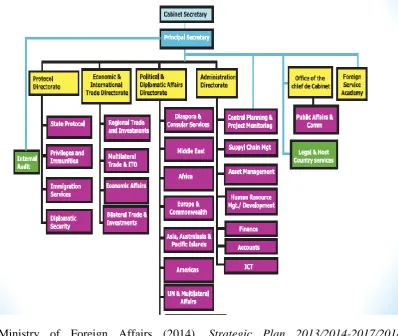
The target population of the study was the Ministry of Foreign Affairs and International Trade. The researcher began by visiting the information desk at the Ministry of Foreign Affairs and International Trade so as to obtain the relevant information about the structure of ministry. This aided the researcher in identification of the most ideal participants in the Ministry to inform on the study.
1.10.2.2 Sampling and Sampling Technique
Departments and offices selected included the Political and Diplomatic Directorate, Economic and International Trade Directorate, Protocol Directorate, Administration Directorate African Union and African Affairs office, Diaspora and Consular Services office, Communications Unit and Public Affairs and Communication Office. In addition, the researcher also used the technique in selecting individuals that informed on the set research questions. Purposive sampling was ideal for the study as it allowed the researcher to choose respondents basing on their line of work at the Ministry. This not only allowed for inclusion of key informants but also for varied categories that gave the researcher an opportunity to compare the informants’ views on the subject of the study. In addition, the technique allowed optimum efficiency within the projected constraints of finances, logistics and human resources. The researcher sought to capture the views of 5senior level officers, 7middle level officers as well as 3low level officers in the Ministry. To this end, the interviews conducted cut across Heads of departments, diplomats to desk officers. Nonetheless, majority of the interviewed respondents were senior and mid-level officers.
1.10.3 Data Collection Methods
large extent informal and as such the researcher was not necessitated to follow it to the letter. Instead the researcher treated the questions flexibly and used every opportunity available to gather as much information as possible from each of the respondents. This allowed the researcher to harness more information from the respondents depending on their mandate, knowledgeability as well as their patience in answering the research questions.
The discussions with the respondents were grounded on themes such as use of ICTs in the Ministry of Foreign Affairs and International Trade, Training of Staff on utilization of ICTs in conduct of diplomacy, ICT and Foreign Policy Transformation, the Perception of Digital Diplomacy among the Staff in the Ministry of Foreign Affairs as well as the level of ICT integration at the Ministry. This approach was highly beneficial to the researcher especially in aspects of seeking clarifications as well posing further questions as the discussion took course. The researcher was forced on several occasions to intervene especially when the respondents divulged out of scope or when the response given was an indication that the respondent had not understood the question.
researcher engaged Kenyan Diplomats who are active on Twitter and based in Kenyan Missions abroad.
Initially, the researcher was faced with the challenge of access to the desired information from the Ministry of Foreign Affairs and International Trade. This is despite the researcher presenting a copy of the Introduction Letter from the National Commission for Science Technology and Innovation (NACOSTI) approving the study. Upon pursuing why there was no official communication detailing why the Ministry officials could not allow the study to proceed, the researcher was sent from one office to the other. It was a case of the researcher camping in the MFA&IT offices to see officials only to be referred to another official. Essentially, it was a frustration technique that led to the researcher consulting widely with everyone who was willing to listen at the Ministry. When a breakthrough was not forthcoming, the researcher took to Twitter a social media platform to seek redress from the Permanent Secretary Ministry of Foreign Affairs and International Trade. The results were fulfilling as the Permanent Secretary acted swiftly and scheduled a meeting with researcher. The meeting led to the researcher being accorded with all the necessary help to collect the data. Indeed, the researcher was elated by the fact that the social media platforms had helped in breaking the Chains of Bureaucracy in the Ministry. More importantly the online breakthrough was related to the researcher’s study on Digital diplomacy.
statistical abstracts. The secondary data aided the researcher in corroborating the primary data’s validity and reliability. It is from this vein, that the researcher formed a basis of analysing as well as interpreting the state of digital diplomacy in Kenya.
1.10.4 Data Analysis
Information gathered from the in-depth interviews was related to the study’s premises. Interpretation of the gathered information was done in relation to the research topic, objectives of the study, nature and the methodology. Inductive analysis was employed to discover patterns, themes and categories of the data that was gathered. The researcher was also able to employ deductive analysis to analyze if the gathered data was in line with the study’s conceptual framework. The qualitative data gathered helped the researcher in revealing the state of digital diplomacy and its operation in Kenya. The collected data was described and illustrated using tables, graphs and pictures where necessary.
1.10.5 Ethical Considerations
confidentiality such that the information they provided would in no way be used to compromise their position.
1.11 Summary and Conclusions
This chapter has endeavoured to problematize the issue of digital diplomacy in developing countries with a constricted focus on Kenya. The researcher argues that digital diplomacy has gained ground in the developed countries thus creating a ripe ground for research on its status in the developing world.
CHAPTER TWO: KENYA’S FOREIGN POLICY AND DIPLOMATIC TRENDS
2.0 Introduction
This work falls within the framework of diplomatic communication and more precisely digital diplomacy. Diplomacy as an institution is mainly centred on foreign policy. As such, the researcher found it important to interrogate Kenya’s foreign policy as well as her diplomatic trends in the quest to find out how ICT has been integrated. The chapter is organized into the following subtopics diplomacy as a foreign policy tool, understanding the nature of Kenya’s foreign policy, foreign policy during the Kenyatta, Moi, Kibaki and Uhuru Kenyatta regimes, foreign policy aspects as articulated in Kenya’s new constitution and the written foreign policy. Last but not least is Kenya’s diplomatic trends.
2.1 Understanding the Nature of Kenya’s Foreign Policy
A different perspective is provided by Angawa (2010) who opined that Kenya’s foreign policy is best understood by articulating how the political system in the country works especially in matters of policy making. Angawa further states that though Kenya promulgated a new constitution in August 2010 the conduct of foreign policy has largely remained under the premise of the old constitution in which the President is the overall head of most government institutions. Ultimately, it then goes to say that the final decisions on the formulation, implementation and projection of Kenya’s foreign policy lies with the President. In view of this, Kenya’s foreign policy in light of the five decades of independence have been shaped by different Presidents that are Mzee Jomo Kenyatta 1963-1978, Daniel Arap Moi 1978- 2002, Mwai Kibaki 2002-2012 and currently, Uhuru Kenyatta. As such the following is an interrogation of Kenya’s Foreign Policy under the above stated ruling elites.
2.2 Foreign Policy in Kenya during the Kenyatta Regime 1963-1978
described President Kenyatta as a Pan-Africanist who essentially took a pragmatic approach when it came to the conduct of both domestic and international affairs.
Given that Kenya had no written foreign policy during this reign, the principles and objectives of Kenya’s FP during the Kenyatta regime are only traceable in the KANU manifesto which was the ruling party as well as the Sessional Paper no.10/1965 on African Socialism. In view of this, the KANU manifesto (1963) outlined that Independent Kenya would safeguard Kenya’s national integrity, preserve military forces with the capability to protect the Kenyan people as well as the state, promote East African Cooperation through developing foundations such as the East African Common market and the East African Common Services Organization. Further, Kenya would fully participate in international issues and be a non-aligned state when it came to global politics and internal economics.
Oyugi (1994) discussed that the foreign policy during the Kenyatta regime was rather unequivocal as it mostly edged towards the intensification of relations in two major regions in the world, Eastern Africa as well as Western Europe. As such, relations with the socialist bloc as well as the rest of Africa were on the peripheral. This was evidenced by the ample Kenyan ambassadors in Western Europe and Eastern Africa as opposed to the communist countries. The robust relations with the Western countries ensured that Kenya continued to be a recipient of aid. For example, in 1964 Kenya signed and agreement with Britain training Kenya’s security forces as well as supply of military equipment and arms. Further, the Royal Air Force in Britain was authorized to establish Kenya Air Force (Howell, 1968).
Nevertheless, Kenya sustained a relationship with both sides of the divide. Giteleson (1977) observed that Kenya also maintained cordial relations with communist countries such as China and Russia as they also provided aid as well as technical assistance. For example, in May 1964 President Kenyatta sent a delegation to the Soviet Union headed the then Vice-president Oginga Odinga, Joseph Murumbi and other close allies with the aim of pitching and securing investment to the country’s burgeoning economy.
international platform was further cemented when she was selected as the headquarters of the United Nations Environmental Program (UNEP). It is important to note that this was the first time a United Nations body was being located in Sub-Saharan Africa. These aspects made Kenya attain prestige in the international system besides boosted her economic empowerment.
The critics of Kenyatta however disagree that he exhibited the non-alignment principles as his government seemed to have strong anti-communist inclinations. Some instances in this regard are documented by Oyugi (1994) who notes that in 1966 Kenya broke diplomatic relations with China and subsequently in 1968 with Czechoslovakia citing interference with domestic issues. In the case of China, ideological differences were attributed to the tense diplomatic ties that saw the demotion of ambassadorial post to Kenya be lowered to a Charge d’affaires (Larkin, 1971). This worsened in 1967 when the then Charge d’affaires was declared as persona non grata. In the case of the Soviets, the main reason appeared to have been linked to a controversy surrounding the shutting down of the Lumumba Institute that had been funded by the Soviets. This was further compounded by the refusal of aid amounting to 16 million sterling pounds without any explanation. As such, it is argued that the Kenyatta regime considered that the best interests of Kenya economically, socially and politically lay in strengthening ties with North America as well as the Western European countries.
recognized that Kenya had to borrow money, technology as well as any economic assistance without any long-term commitment. In reference to technology, which is the foundation of this study, it is imperative to note as will be articulated in the following chapter that the Kenyatta regime was skeptical on its capabilities and thus the 1970s ban on importation of computers. The regime was especially attracted to economic engagements that had no strings attached politically. Orwa (1987) explained that the Kenyatta regime pursued an open policy due to the belief that this would diversify Kenya’s external trade by virtue of attracting all interested foreign investment partners and thus paving way for rapid economic development. These economic interests were also hinged on the realization that domestic saving as well as tax increases were not sufficient to spur economic growth hence the need to attract foreign private investment as well as borrowed money from international financial institutions. The economic interests pursued by Kenyatta’s regime in the foreign policy were given the same importance as internal security, territorial integrity, political independence and stability (Orwa, 1987).
was due to limited resources available to the ministry in the quest to push for national objectives in the international context. Incidentally, the state of affairs also provided the Kenyan elites with an opportunity to set for Kenya the international goals which also advanced their interests in the domestic frontier.
2.3 Foreign Policy under the Moi Regime 1978-2002
The foreign policy under president Moi who took over the presidency after the death of Mzee Jomo Kenyatta was not substantially different. This is because he sought to follow the footsteps of his predecessor hence the Nyayo slogan which is a Swahili word meaning footstep. The principle of non-alignment persisted in his relations with countries in the international system. In addition, the Moi regime strengthened relations with Western European Countries which was exhibited through presidential visits. Further, Kenya strengthened her support to African countries that were still under colonial rule which was exhibited through invitation of liberation leaders to military pass out parades as well as national day celebrations.
Additionally, in 1985 Moi sent a delegation led by KANU party chairman David Akiki Amayo to Soviet Communist party in Moscow. This was reciprocated when the Chinese party officials came to visit Kenya.
Oyugi (1994) informs that the renewed relations with the Soviets and China in the 1980s should be viewed against a background of understanding that Moi had first normalized relations with the United States of America and Western European countries and further announced closer economic relations with the two. Moreover, it should also be noted that unlike the 1970s and 1980s when China was viewed as a communist threat in the international system things had changed due to her cooperation with USA in both capital investment as well as arms transfer.
Odhiambo (1990) articulated that in reference to Kenya’s relations with Eastern Africa the objectives were relatively the same as during the Kenyatta era. This is because the 1980s were exhibited by concerted efforts by Kenya to increase trade within the region as well as countries in the northern corridor such as Rwanda, Sudan, Burundi and Zaire.
initiated its quest to expand its markets in the African continent as well as liberalise trade in the domestic frontier.
According to Mwagiru (2006) the pursuits of Kenya’s foreign policy in the 1980s were distinct as there were heightened efforts to change the course of events in Kenya’s near abroad. This was exhibited through presidential diplomacy in conflict management in war zones within the near African region. This was premised on the thought that Kenya’s interests in Central and East Africa would be compromised by a regional environment characterized by protracted conflicts. As such, Kenya initiated several measures that sought to manage conflicts in Somalia, Uganda and Sudan in order to secure an enabling environment for trade within the region. For example, in 1986 President Moi successfully mediated against a civil war in Uganda between forces of General Basillio Okello and those of Yoweri Museveni. In addition, Moi was at the centre stage in managing conflict between FRELIMO government and Renamo rebel group in 1989 in Mozambique.
Drawing from Keesing (1983) the Moi regime similar to the Kenyatta regime was categorical when it came to aspects of guarding national sovereignty, territorial integrity and national security. To this end, President Moi in 1983 was quoted saying that “our foreign policy continues to be guided by principles of non-alignment, good neighborliness and non-interference in internal affairs of other
President Moi signed a military agreement with the U.S.A. in 1980 that provided Kenya with access to facilities of the U.S. Rapid Deployment Force. This was deemed necessary due to the uncertainty of the long-term objectivities of Cuban and Soviet forces in Ethiopia.
Accordingly Gachie (2011), the 1980s as the diplomatic golden age that was characterized by several heads of States visiting the country including the British monarch, British Prime Minister as well as the Catholic Pope John Paul II. In the same light, President Moi made trips to countries such as France, United States of America, China, Britain and Germany. Further, Kenya hosted several important world events such as the World Conference on Women as well as the establishment of the Inter-Governmental Authority on Development (IGAD).
conflicts with former allies was when Kenya broke diplomatic ties with Norway due to alleged interference with Kenya’s domestic affairs.
Mwagiru (2006) notes that Kenya’s diplomacy of conflict management in the 1990s came to an end when the then Zaire was engaged in civil war between 1996 and 1997 despite Kenya’s mediation efforts. Kenya’s efforts were transcended by South Africa which attained independence in 1994. Nonetheless, Mwagiru argues that the diplomatic efforts exhibited in the 1990s were often ad hoc in nature hence did not assert Kenya’s foreign policy direction per se as it was dependent on the personalities appointed to spearhead the country’s diplomatic objectives at the regional level as well as at the international level.
2.4 Foreign Policy under the Kibaki Regime 2002-2012
development partners that were conspicuous during the Kibaki era were South Africa and Brazil.
The article by New Africa Magazine asserts that Kenya’s FP during the Kibaki reign can be underscored by three major paradigms. To begin with, the regime was keen on the East African Community (EAC) that now comprised of Kenya, Burundi, Uganda, Rwanda and Tanzania. Secondly, the regime was keen on pursuit of a larger Horn of Africa through IGAD hence encompassing Somalia, Djibouti and Ethiopia. This was further evidenced by the redrawing of Kenya’s diplomatic roster such that Kenyan diplomats within the EAC, IGAD and AU were ranked higher than those in EU capitals. Thirdly, is Kibaki’s radical push for the so called East Policy where the presidency actively involved with countries such as China, Japan and South Korea. As would be expected, in light of this East Policy his regime’s relations with the traditional allies such as the European Union (EU) countries were lukewarm to say the least.
Corporation (FOCAC), New Asia-Africa Strategic Partnership (NAASP) as well as Tokyo International Conference on Africa Development (TICAD) based in Japan (Munene, 2013).
Chege (2012) noted that as soon as Kibaki was accorded power in 2003 the government developed an economic reform program whose aim was to oversee the economic recovery of the country within a span of three years. Indeed, the quest was successful as the GDP growth between 2003 and 2007 rose from 2.9% to 7.1% (Chege, 2012). Subsequently, the economic growth was also diversified in that several other sectors such as tourism, transport, construction, agriculture, manufacturing, telecommunications as well as the financial sector contributed to the rise of GDP. It was against these economic objectives that Kenya’s foreign policy was anchored. The most significant aspect of this growth is that it was mostly spurred at the domestic level as opposed to foreign direct investment. Chege (2012) cites that as opposed to the case in most African States Kenya recorded external aid at between 5 to 10 percent during the first term of President Kibaki. Foreign Direct Investment (FDI) during this period was still largely linked to Western European countries especially Britain.
power plant in Naivasha which was spearheaded by Japanese firm Toyota Tsusho, Hyundai from Korea as well as Indian Contractor KEC International Limited (New African Magazine, 2012). The budding relations were further strengthened by President’s Kibaki visits to Tokyo, Beijing, New Delhi and Tripoli.
In reference to conflict management, the Kibaki administration inherited the Sudanese peace process which in 2005 gained a milestone through the signing of the Comprehensive Peace Agreement (CPA) (Presidential Press Service, 2010). The Kibaki administration through regional organizations such as IGAD, COMESA and the UN supported the implementation of the CPA besides seeking commitment of President Omar Bashir and First President Salva Kiir. Kenya has continued to be a persistent peace guarantor on the region which was significant in January 2011 when a referendum passed with a 98.83 percent for South Sudan to be an Independent Country. Davis (2011) argued that Kenya through the Kibaki administration had a challenge of striking a diplomatic balance whilst pursuing its national interests in South Sudan. Nevertheless, Kenya was able to maintain a neutral posture besides act as an impartial player by managing its Pro-South interests without being anti-North. As such, Kenya’s inclinations in Khartoum were not perturbed by her pursuit of CPA instead the influence was significant in ensuring a peaceful referendum process.
2.5 Foreign Policy under President Uhuru Kenyatta’s Regime 2013-2014
shedding the light towards his influence in the pursuit of Kenyan interests abroad. According to Obala (2013) during Kenyatta’s inauguration on 9th April 2013, the President’s elect speech gave a foreign policy basis on aspects such as free movement of goods and people, regional security, strengthening of regional bodies as well as respect to the equality of nations in the international system. The President elect was emphatic on the significance and the need to enhance relations with regional bodies such as IGAD and East African Community. IGAD was cited as essential in the fight against terrorism and piracy in Somalia while the EAC was noted to be key in the advancement of regional cooperation and trade. The president elect indicated that his administration would push for the abolishment non-tariff barriers to trade within the East African Nations. Further, Uhuru Kenyatta pledged continued partnership with the African Union and argued that African Nations could work together in the innovations of solutions to African problems. To the rest of the world, the president promised that Kenya would continue to invest in deepening relations with other nations across the globe besides engage and endorse international instruments and treaties.
According to Kagwanja (2013) in an article titled Inside Kenyatta’s Emerging, Assertive Policy in East Africa he argued that Kenyatta’s government was edging towards an African-centred approach in its foreign policy objectives. The conclusion drawn from the article was that the regime is moving away from the traditional “look west policy” as well as the newly described “look east policy” and is instead focusing on a “look inwards policy” in light of the International Criminal Court cases. Nevertheless, this line of thought can be challenged given that Kenya has solidified its relations with the western allies. This is evidenced by the President’s visit to the UK as well as the visit of United States President Barack Obama to Kenya. Essentially, the contradictions exhibited within the foreign policy agendas of Uhuru Kenyatta’s regime are proof that it’s too early in the term to draw conclusions on its foreign policy strategy.
The Kenyatta regime has associated itself with the paradigm of being digital to date. In fact, during the 2013 general election the Jubilee coalition used the digital narrative as a campaign tool. The coalition identified itself “digital” team as opposed to “analogue” which referred to the Raila Odinga lead team (Mutiga, n.d.). This resonated well with Kenyans and indeed Africans given that the continent was transitioning from conventional extraterrestrial television to digital television.
2.6 Foreign Policy Aspects as Articulated in Kenya’s New Constitution
ratifications of international instruments such they are recognized under the Kenyan law. The old constitution necessitated international treaties to be domesticated for them to be applied as municipal laws. However, the Constitution of Kenya (2010) in article 2 (6) states that ‘Any treaty or convention ratified by Kenya shall form part of the law of Kenya under the constitution’.
The new constitution is also hailed for its attempt to shift the aspect of managing Kenya’s foreign policy from the presidency alone to include other stakeholders such as Parliament. For example article 152 (2) concisely state the presidential appointment of all cabinet secretaries must be approved by the Parliament. As such, the top foreign affairs officer who is the Cabinet secretary to the Ministry of Foreign Affairs and International Trade must be evaluated and approved by parliament. Subsequently, Parliament is given power by article 152 (6) to dismiss the cabinet secretary due to reasons such as gross violation of the law as articulated by the constitution, commission of crime in contravention of both national and international law as well as gross misconduct.