E
ffi
cient and Provably Secure Certificateless
Signcryption from Bilinear Maps
∗Wenjian Xie
†Zhang Zhang
College of Mathematics and Computer Science Guangxi University for Nationalities, Nanning 530006, China
Abstract. Signcryption is a cryptographic primitive that fulfills both the functions of digital signature and public key encryption simultaneously, at a cost significantly lower than that required by the traditional signature-then-encryption approach. In 2008, Barbosa and Farshim introduced the notion of certificateless signcryption (CLSC) and proposed the first CLSC scheme [2], but which requires six pairing operations in the signcrypt and unsigncrypt phases. In this paper, aimed at designing an efficient CLSC scheme, we pro-pose a new efficient CLSC scheme from bilinear maps, which requires only two pairing operations in the signcrypt and unsigncrypt phases and is more efficient than all the schemes available.
Keywords:Certificateless; Signcryption scheme; Bilinear pairing
1
Introduction
In a traditional public key cryptography (PKC), any user of the system who wants to communicate with others must obtain their authorized public key, that means any public key should be associated with the owner by a certificate, which is a signature issued by the trusted Certificate Authority (CA). However this brings a large amount of computation, communication cost and certificate management problems. In order to solve those prob-lems, Shamir [21] firstly introduced the concept of identity based cryptography (ID-PKC) in 1984. A user can use an email address, an IP address or any other information related his
∗Recently Sharmila Deva Selviet al.pointed out that our scheme are not secure against Type I adversary
[20]. We have to re-formalize a new security model which is a little weaker than the original one. In this model, we assume that the ciphertext from the signcryption oracle is valid under the original public key of the sender.
identity, that is publicly know and unique in the whole system, as his public key. The ad-vantage of an identity based cryptography is that anyone can simply use the user’s identity to communicate with each other. This can be done even before the user gets its private key from the Key Generation Center (KGC). However, the user must completely trust KGC, which can impersonate any user to sign or decrypt of any message. This issue is generally referred to as key escrow problem in identity based cryptography.
In 2003, Al-Riyami and Paterson [1] introduced the concept of certificateless public key cryptography (CL-PKC), which eliminate the use of certificates as in the traditional PKC and solve the key escrow problem that is inherent in identity based cryptography. In a certificateless cryptosystem, the KGC is involved to issue a partial private keydID for a user with identity ID. Then the user independently generates his public/private key pair (pkID, skID) usedIDand a secret valuexIDchosen by himself, and publishespkID.
In 2008, Barbosa and Farshim introduced the notion of certificateless signcryption (CLSC) and proposed the first CLSC scheme [2], which requires six pairing operations in the signcrypt and unsigncrypt phases. And aimed at designing an efficient CLSC scheme, Wu and Chen proposed a new CLSC scheme [23], which requires four pairing operations in the signcrypt and unsigncrypt phases, but unfortunately it was found insecure by Sharmila
et al. [19]. We note that in pairing based cryptosystems, although numerous papers discuss
the complexity of pairings and how to speed up the pairing computation [5, 8, 14, 15], the computation of the pairing still remains time-consuming.
Our Contribution. It is fair to say that devising an efficient certificateless signcryption still remains an important problem. In this paper, motivated by identity-based signcryption scheme proposed in [4] and certificateless public key encryption scheme [13], we present a new efficient certificateless pairing-based signcryption scheme, which requires only two pairing operations in the signcrypt and unsigncrypt phases. Observations [22] pinpointed problems arising when many provably secure pairing based protocols are implemented using asymmetric pairings and ordinary curves. Our proposal avoids those problems thanks to the fact that it does not require to hash onto an elliptic curve cyclic subgroup.
Organization. The rest of this paper is organized as follows: In next Section, we describe some preliminaries, including bilinear map groups, our complexity assumptions and the notion of certificateless signcryption scheme. We describe its security models in Section 3 and propose our certificateless signcryption scheme in Section 4. In Section 5, we present its security and efficiency analysis. Finally, we conclude this paper in Section 6.
2
Preliminaries
2.1
Bilinear Map Groups
Letkbe a security parameter and pbe ak-bit prime number. Let us consider groupsG1,
G2andGT of the same prime orderpandP,Qbe generators of respectivelyG1andG2. We
GT satisfying the following properties:
− Bilinearity: ∀(S,T)∈G1×G2,∀a,b∈Z∗p,e(aS,bT)=e(S,T)ab. − Non-degeneracy:∀S ∈G1,e(S,T)= 1 for allT ∈G2iffS =O.
− Computability: ∀(S,T)∈G1×G2,e(S,T) is efficiently computable.
− There exists an efficient, publicly computable (but not necessarily invertible) isomor-phismψ: G2→ G1such thatψ(Q)= P.
Such bilinear map (called bilinear pairing) groups are known to be instantiable with ordi-nary elliptic curves such as those suggested in [17] or [6]. In this case, the trace map can be used as an efficient isomorphismψ as long asG2 is properly chosen [22]. With
super-singular curves, symmetric pairings (i.e. G1= G2) can be obtained andψis the identity.
2.2
Related Complexity Assumptions
Definition 1. The Discrete Logarithm Problem(DLP) in G2 is, given (Q, αQ)∈ G22 for
unknownα∈Z∗p, to computeα.
The advantage of any probabilistic polynomial time algorithmAin solving theDLPin
G2is defined as
AdvDLPA = Pr[A(Q, αQ)= α|α∈Z∗p].
TheDLassumption is that, for any probabilistic polynomial time algorithmA, the advan-tageAdvDLP
A is negligible.
Definition 2. TheComputational Diffie-Hellman Problem(CDHP) inG2is, given (Q, αQ,
βQ)∈G3
2for unknownα, β ∈Z∗p, to computeαβQ.
The advantage of any probabilistic polynomial time algorithmAin solving theCDHP
inG2 is defined as
AdvCDHPA =Pr[A(Q, αQ, βQ)= αβQ|α, β ∈Z∗p].
The CDHassumption is that, for any probabilistic polynomial time algorithm A, the ad-vantageAdvCDHPA is negligible.
Definition 3. Theq-Strong Diffie-Hellman Problem(q-SDHP) [10] in the groups (G1,G2)
consists of, given a (q+2)-tuple (P,Q, αQ, α2Q, . . . , αqQ)∈G1×Gq2+1for unknownα∈Z∗p, finding a pair (c,α1+cP) withc∈Z∗p.
The advantage of any probabilistic polynomial time algorithmAin solving theq-SDHP
in (G1,G2) is defined as
AdvqA-S DHP = Pr[A(P,Q, αQ, α2Q, . . . , αqQ)=(c, 1
α+cP)|α,c∈Z
∗
p].
The q-SDH assumption is that, for any probabilistic polynomial time algorithm A, the advantageAdvqA-S DHPis negligible.
Definition 4. The q-Bilinear Diffie-Hellman Inversion Problem(q-BDHIP) [9] in the groups (G1,G2,GT) consists of, given a (q+2)-tuple (P,Q, αQ, α2Q, . . . , αqQ)∈G1×G
q+1 2
The advantage of any probabilistic polynomial time algorithm A in solving the
q-BDHIPin (G1,G2,GT) is defined as
AdvqA-BDHIP= Pr[A(P,Q, αQ, α2Q, . . . , αqQ)= e(P,Q)1/α|α∈Z∗p].
The q-BDHI assumption is that, for any probabilistic polynomial time algorithm A, the advantageAdvqA-BDHIPis negligible.
2.3
Certificateless Signcryption Scheme
A certificateless signcryption scheme is defined by the following seven algorithms:
Setup: This algorithm takes a security parameter k as input and returns the system parametersparamsand a secret master keymaster-key.
Partial-Private-Key-Extract: This algorithm takes params, master-key and a user’s identityIDas input. It returns a partial private keydIDcorresponding to the user.
Set-Secret-Value: Taking params and a user’s identity ID as input, this algorithm generates a secret value xID.
Set-Public-Key: Taking paramsand a user’s identity ID and his secret value xID as input, this algorithm generates pkIDfor the user with identityID.
Set-Private-Key: It takesparams, a user’s partial private key dID and his secret value
xIDas input, and returns the user’s full private keyskID.
Signcrypt: This algorithm takes as input the sender’s private key skIDS, the receiver’s identityIDRand public key pkIDR, and a messagemand returns a ciphertext σ. We write
σ= Signcrypt(skIDS, IDR,pkIDR, m).
Unsigncrypt: It takes the sender’s identity IDS and public key pkIDS, the receiver’s
privateskIDR and the corresponding ciphertextσas input, and outputs the messagemif the ciphertext σ is valid, or the symbol ⊥ otherwise. We writeδ = Unsigncrypt(IDS, pkIDS,
skIDR, σ), whereδis the messagemor the symbol⊥.
params, as an implied inputs to Signcrypt and Unsigncrypt algorithms, is omitted. The Setup and Partial-Private-Key-Extract algorithms are performed by KGC. Once a partial private keydIDis given to a user via secure channel, the user runsSet-Secret-Value algorithm and generates his own public/private key pair.
3
Security Model for Signcryption
adaptive chosen ciphertext attacks and the existential unforgeability against adaptive cho-sen message attacks. The adversaryAIrepresents a normal third party attacker against the CLSC scheme. That is,AIis not allowed to access to themaster-keybutAI may requests public key and replaces public keys with values of its choice. The adversaryAIIrepresents a malicious KGC who generates partial private key of users. The adversaryAII is allowed to have access to themaster-keybut not replace a public key. Note that, as in [2, 11, 12], we do not consider attacks targeting ciphertext where the sender and receiver identities are the same. In particular we disallow such queries to relevant oracles and do not accept this type of ciphertext as a valid forgery.
3.1
Confidentiality Model for Certificateless Signcryption
The confidentiality property (indistinguishability of encryptions under adaptively cho-sen ciphertext attacks (IND-CCA2)) required for certificateless signcryption is captured by the following two games againstAI andAII.
Game IND-CCA2-I. Now we illustrate the first game performed between a challenger Cand a Type I adversaryAI for a certificateless signcryption scheme.
Initialization:Cruns the algorithmSetupon input a security parameterk, and obtains
master-keyandparams, and sendsparamstoAI.
Find stage: The adversaryAI performs a polynomially bounded number of queries. These queries may be made adaptively, i.e. each query may depend on the answers to the previous queries.
− Hash Queries: AI can request the hash values of any input.
− Partial Private Key Extraction: AI is able to ask for the partial private key dID for anyID. Ccomputes the partial private keydIDcorresponding to the identityIDand returnsdIDtoAI.
− Public Key Extraction: On receiving a public key extraction for any identity ID, C computes the corresponding public key pkIDand sends it toAI.
− Private Key Extraction: For anyID,Ccomputes the private keyskIDcorresponding to the identityIDand sends skIDtoAI. Here,AI is not allowed to query this oracle on any identity for which the corresponding public key has been replaced. This re-striction is imposed due to the fact that it is unreasonable to expect that the challenger is able to provide a full private key for a user for which it does not know the secret value.
− Public Key Replacement: For any identity ID, AI can pick a new secret value x′ID and compute the new public pk′IDcorresponding to the new secret valuex′ID, and then replacepkIDwith pk′ID.
receivers, but those ciphertext are generated by IDS using his own secret value and partial private key.
− Unsigncrypt Queries:AI produces a sender’s identityIDS, a receiver’s identityIDR and a ciphertext σ. Csends the result of Unsigncrypt(IDS, pkIDS, skIDR, σ) toAI. Note that, it is possible that the public key pkIDR has been replaced earlier byAI. In this case, to correctness of the unsigncryption oracle’s answer, we assume that AI additionally submits the corresponding secret value toC. Again, we disallow queries whereIDS= IDR.
Challenge: At the end of Find stage, AI returns two distinct messages m0 and m1
(assumed of equal length), a sender identity ID∗S and a receiver identity ID∗R, on which it wishes to be challenged. The adversary must have made no partial private key ex-traction and private key exex-traction on ID∗R. C picks randomly a bit β ∈ {0,1}, computes
σ∗=Signcrypt(sk
ID∗S, ID∗R, pkID∗R, mβ) and returns it toAI.
Guess stage: AI asks a polynomial number of queries adaptively again as in theFind
stage. It is not allowed to extract the partial private key and private key corresponding to
ID∗Rand it is not allowed to make an unsigncrypt query onσ∗with senderID∗Sand receiver
ID∗Runless the public keypkID∗Sof the sender or that of the receiver pkID∗R has been replaced after the challenge was issued.
Eventually,AI outputs a bitβ′and wins the game ifβ=β′. AI’s advantage is defined asAdvAINDI −CCA2−I = 2Pr[β=β′]−1.
Game IND-CCA2-II. This is the second game where Cinteracts with adversary AII as follows:
Initialization: Cruns the algorithmSetupon input a security parameterkto generate
master-keyandparams, and sendsmaster-keyandparamstoAII.
Find stage: In this stage, AII may adaptively make a polynomially bounded number of queries as inGame IND-CCA2-I. The only constraint is that AII can not replace any public keys. Obviously,AII can compute the partial private keys of any identities by itself with themaster-key.
Challenge: At the end of Find stage, AII returns two distinct messages m0 and m1
(assumed of equal length), a sender identity ID∗S and a receiver identity ID∗R, on which it wishes to be challenged. The adversary must have made no private key extraction on
ID∗R. C picks randomly a bit β ∈ {0,1}, computes σ∗=Signcrypt(skID∗S, ID∗R, pkID∗R, mβ)
and returns it toAII.
Guess stage: AII asks a polynomial number of queries adaptively again as in the Find stage. It is not allowed to extract the private key corresponding toID∗Rand it is not allowed to make an unsigncrypt query onσ∗with senderID∗Sand receiver ID∗R.
Eventually,AII outputs a bitβ′ and wins the game ifβ=β′. AII’s advantage is defined asAdvAINDII−CCA2−II = 2Pr[β= β′]−1.
means that the confidentiality is preserved even if a sender’s private key is compromised.
Definition 5(IND-CCA2). An CLSC scheme is said to be IND-CCA2 secure if no poly-nomially bounded adversaryA ∈ {AI,AII}has a non-negligible advantage wins the games described above(Game IND-CCA2-I,Game IND-CCA-II).
3.2
Unforgeability Model for Certificateless Signcryption
The authenticity property (existential unforgeability against chosen message attacks (EUF-CMA)) for certificateless signcryption schemes is captured by the following two games againstAI andAII, respectively.
Game EUF-CMA-I. This is the game where AI interacts with its Challenger C as follows:
Initialization: Cruns the algorithmSetupon input a security parameterkto generate
master-keyandparams, and sendsparamstoAI.
Queries: The adversaryAIperforms a polynomially bounded number of queries adap-tively as inGame IND-CCA2-Igame.
Output: Finally, AI produces a new triple (ID∗S,ID∗R, σ∗) (i.e. a triple that was not produced by the signcryption oracle) where the partial private key and the private key of
ID∗Swas not extract and wins the game if the result ofUnsigncrypt(ID∗S, pkID∗S, skID∗R, σ∗)
is not the⊥symbol.
The adversaryAI’s advantage is its probability of victory.
Game EUF-CMA-II. This is the game whereAII interacts with its Challenger C as follow:
Initialization: Cruns the algorithmSetupon input a security parameterkto generate
master-keyandparams, and sendsparamsandmaster-keytoAI.
Queries: The adversaryAIIperforms a polynomially bounded number of queries adap-tively as inGame IND-CCA2-IIgame.
Output: Finally, AI produces a new triple (ID∗S,ID∗R, σ∗) (i.e. a triple that was not produced by the signcryption oracle) where the private key ofID∗Swas not extract and wins the game if the result ofUnsigncrypt(ID∗S, pkIDS∗, skID∗R, σ∗) is not the⊥symbol.
The adversaryAII’s advantage is its probability of victory.
Note that this definition allows the adversary have access to the secret key of the receiver of the forgery, which guarantees the insider security.
4
New e
ffi
cient CLSC scheme
In this section, we propose a new efficient CLSC scheme which consists of the follow-ing seven algorithms.
Setup: Given a security parameterk, the algorithm works as follows:
− Outputs descriptions of bilinear map groups (G1,G2,GT) of same prime orderp>2k. − Chooses an arbitrary generatorQ ofG2 and setsP = ψ(Q) ∈ G1 andg = e(P,Q) ∈
GT.
− Randomly picks s ∈Z∗pand setsPpub = sQas, respectively,master-keyand system public key.
− Selects three distinct cryptographic hash functionsH1 : {0,1}∗ → Z∗p, H2 : {0,1}n ×
G2×GT ×G32 →Z∗pandH3:GT ×G2 → {0,1}n wherenis the length of message to
be signcrypted.
− The system parameters areparams=<G1,G2,GT,e,p,P,Q,g,Ppub, ψ,H1,H2,H3 >
and publishesparams.
Partial-Private-Key-Extract: Givenparams, master-keyand an identity ID ∈ {0,1}∗, this algorithm works as follows: ComputeQID= H1(ID)∈Z∗p anddID = s+1Q
IDPand sendsdID to the user with identity ID as his partial private key via a secure channel. The user can check its correctness by checking whether e(dID,Ppub+QIDQ) = g. For convenience, we defineTID =Ppub+H1(ID)Q.
Set-Secret-Value: This algorithm takes as inputparamsand a user’s identity ID. It picks a random valuexID∈R Z∗p and outputsxIDas the user’s secret value.
Set-Public-Key: Givenparams, a user’s identityIDand the secret valuexID, this algorithm computes his public key pkID = xID(Ppub+H1(ID)Q).
Set-Private-Key: Given params, the user’s partial private key dID and his secret value
xID∈Z∗p, and output a pair (dID,xID) as the user’s private key skID.
Signcrypt: To send a messagem∈ {0,1}nto Bob with identityBand public key pk
B, Alice with private key skAworks as follow:
− Randomly picks r1 ∈R Z∗p and computes u = r1(Ppub + H1(B)Q) and c = m ⊕
H3(gr1,r1pkB).
− Computesh2 = H2(m,u,gr1,r1pkB,pkA,pkB),v= r1r+h2
1 dAandw= xAh2+r1.
− Sets ciphertextσ= (c,u,v,w).
Unsigncrypt: To unsigncrypt a ciphertext σ = (c,u,v,w) from Alice with identity Aand public key pkA, Bob with private keyskB acts as follows:
− Computesgr′1 =e(d
B,u) andm=c⊕H3(gr
′
1,xBu).
− Setsh2 = H2(m,u,gr
′
1,xBu,pkA,pkB) andr′
1TA = wTA−h2pkA.
− Acceptmif and only ife(v,r′1TA)= gr
′
1gh2 hold, return⊥otherwise.
Consistency: The correctness of the proposed scheme can be easily verified with follow-ing:
gr1′ = e(d
B,u)= e( 1
s+QB
xBu= xBr1(sQ+QBQ)= r1xB(sQ+QBQ)= r1pkB
and
e(v,wTA−h2pkA)=e(v,r1TA)= e(
r1+h2
r1
1
s+QA
P,r1(sQ+QAQ))=gr1gh2.
5
Analysis of the Proposed Scheme
5.1
Proof of security
In this section, we will provide two formal proofs that our scheme is IND-CCA2 secure under theq-BDHIassumption andCDHassumption and UF-CMA secure under theq-SDH
assumption and DL assumption. We now present the security analysis of our proposed scheme in the random oracle model [7].
Theorem 1. Under the q-BDHI assumption and CDH assumption, the proposed CLSC scheme is IND-CCA2 secure in the random oracle model.
This theorem follows from Lemmas 1 and 2.
Lemma 1. Assume that an IND-CCA2-I adversary AI has non-negligible advantage ϵ against our scheme when running in timeT, askingqi queries to random oraclesHi (i = 1,2,3),qppkpartial private key queries,qskprivate key queries,qpkpublic key requests,qpkr public key replacement queries, qs signcryption queries and qun unsigncryption queries. Then there is an algorithmCto solve theq-BDHIPforq=q1+1 with probability
ϵ′ ≥ ϵ
q1(q2+q3+qs)
(1−qs
2q2+q3+2qs 2k )(1−
qun 2k )
within a timeT′ <T +[3q1+qpk+4qs+3qu(q2+qs)]Tmult +qu(q2+qs)Texp+[2q2qs+ 2q3qs+qs+3qu(q2+qs)]TpwhereTmult denotes the time for computing multiplication in
G1orG2,Texpdenotes the time for computing exponentiation inGT andTp is the time for pairing computation.
Proof. Suppose that there exists an adversary AI can attack our scheme. We want to build an algorithmCthat runsAI as a subroutine to solveq-BDHIP. Assume thatCgets a random instance ofq-BDHIPin as follows: Given (P,Q, αQ, α2Q, . . . , αqQ)∈G1×G
q+1 2 for
unknownα∈Z∗p. And its goal is to computee(P,Q)1/α ∈G
T by interacting with adversary AI. In the preparation phase,Crandomly picksω0, ω1,· · · , ωq−1 ∈R Z∗p. As in the technique of [4], it builds a generator G ∈ G1 such that it knows q− 1 pairs (ωi + ω0,α+1ωiG) for
i∈ {1,2,· · · ,q−1}. To do so,
− It expands f(z)=∏qi=−11(z+ωi) to obtainc0,c1,· · · ,cq−1 ∈Z∗pso that f(z)=
∑q−1
i=0 ciz
i.
− It sets generator H = ∑qi=−01ci(αiQ) = f(α)Q ∈ G2 and G = ψ(H) = f(α)P ∈ G1.
The system public key is fixed to Ppub =
∑q
i=1ci−1(α
iQ)− ω
0( ∑q−1
i=0 ci(α
iQ)) so that
− For 1≤i≤ q−1,Cexpands fi(z)= f(z)/(z+ωi)=∑qj=−20djzjand
q−2 ∑
j=0
djψ(αjQ)= fi(α)P=
f(α)
α+ωi
P= 1
α+ωi
G. (1)
The pairs (ωi+ω0,α+1ωiG) are computed using the left member of (1).
Throughout the game, we assume that H1 Queriesare distinct, that the target identity
ID∗Ris submitted toH1 Queriesat some point and that any query involving an identityID
comes after aH1 QueriesonID. To maintain consistency between queries made byAI,C keeps the following lists:Lifori= 1,2,3 of data for query/response pairs to random oracle
Hi;Lpkof data for query/response pairs toPublic Key Extractionoracle. Then,Crandomly picksµ∈R {1,2,· · · ,q1}and runsAIon input of<G1,G2,GT,e,p,G,H,g,Ppub, ψ >where
g=e(G,H), and answers various oracle queries as follows:
H1Queries: On the j-th non-repeat query IDj(from this point on we denote the j-th non-repeat identity query to this oracle with IDj), if j , µ, C sets QIDj = ωj +ω0. It then adds < IDj,QIDj,
1
α+ωjG > to the list L1 which is initially empty and returns QIDj. Otherwise, it returnsQIDµ =ω0and adds<IDµ,QIDµ,⊥>toL1.
H2Queries: For each query (m,S1,S2,S3,pkIDS,pkIDR),Cproceeds as follows:
− If< m,S1,S2,S3,pkIDS,pkIDR,S4,h2,c>∈L2for some (S4,h2,c), returnsh2.
− Cgoes through the listL2 with entries< m,S1,S2,⊥,pkIDS,pkIDR,S4,h2,c >(those
entries are added in answer AI’s signcrypt query), for some (S4,h2,c), such that
e(ψ(S1),pkIDR) = e(ψ(S4),S3). If such a tuple exists, it returns h2 and replaces the
symbol⊥withS3.
− IfCreaches this point of execution, it returns a random h2 ∈R Z∗p. Then, sets h3 =
H3(S2,S3)∈ {0,1}nand updatesL2with input<m,S1,S2,S3,pkIDS,pkIDR,⊥,h2,c=
m⊕h3 >.
H3Queries: For each query (S2,S3),Cproceeds as follows:
− If< S2,S3,h3,S1,S4,S5 >∈L3for some (h3,S1,S4,S5), returnsh3.
− C goes through the list L3 with entries < S2,⊥,h3,S1,S4,S5 >(those entries
are added in answer AI’s signcrypt query), for some (h3,S1,S4,S5), such that
e(ψ(S1),S5) = e(ψ(S4),S3). If such a tuple exists, it returns h3 and replaces the
symbol⊥withS3.
− IfCreaches this point of execution, it returns a randomh3∈R {0,1}nand updates the listL3with input<S2,S3,h3,⊥,⊥,⊥>.
Partial Private Key Extraction: For each new query IDj, if j = µ, then Cfails. Other-wise, finds< IDj,QIDj,
1
α+ωjG >inL1 and returnsdIDj =
1
α+ωjG.
Public Key Extraction: For each query IDj, C checks in list Lpk, which is initially empty, if < IDj,xIDj,pkIDj >∈ Lpk for some pkIDj. If so, returns pkIDj. Otherwise, C picks xIDj ∈R Z∗p at random, sets pkIDj = xIDj(Ppub+ H1(IDj)H), then returns pkIDj and adds< IDj,xIDj,pkIDj >inLpk.
Otherwise finds< IDj,QIDj,
1
α+ωjG >and< IDj,xIDj,pkIDj > inL1 andLpk, respectively, and returns skIDj =(
1
α+ωjG,xIDj).
Public Key Replacement: For each query< IDj,pk′IDj >,Cfinds< IDj,xIDj,pkIDj > in Lpk and sets pkIDj = pk′IDj. If Lpk does not contain < IDj,xIDj,pkIDj >, C queries
Public Key Extractionoracle with IDjfirst.
Signcrypt Queries: For each query (IDa,IDb,m), wherea,b ∈ {1,2,· · · ,q1}. We
ob-serve that, ifa,µ,Cknows the sender’s private key skIDa =(
1
α+ωaG,xIDa) and can answer the query according to the specification of Signcryptalgorithm. We thus assume a = µ
and hence b , µ by the irreflexivity assumption. Observe that C knows the receiver’s partial private keydIDb =
1
α+ωbGby construction. The difficulty is to find a random triple (c,u,v,w,h2)∈ {0,1}n×G2×G1×Z∗p×Z∗pfor which
e(v,wTIDa −h2pkIDa)=e(dIDb,u)g h2
where TIDa = Ppub + H1(IDa)H. To do so, C randomly secrets r1,r2,r3 ∈R Z∗p and
h3 ∈R {0,1}n and sets v = r1dIDb, w = r2, h2 = r3, u = r1r2TIDa − r1r3pkIDa − r3TIDb and c = m ⊕ h3, where pkIDa = xIDa(Ppub + H1(IDa)H) is the original public key of IDa generated by Public Key Extraction oracle. Then, C sets S2 = e(dIDb,u), adds
<S2,⊥,h3,u,TIDb,pkIDb >and<m,u,S2,⊥,pkIDa,pkIDb,TIDb,h2,c>toL3andL2 respec-tively (Cfails ifH2orH3is already defined in the corresponding value but this only happens
with probability small than (2q2+q3+2qs)/p) , and returns ciphertextσ =(c,u,v,w).
Unsigncrypt Queries: For each query (IDa,IDb, σ = (c,u,v,w)), where a,b ∈ {1, 2,· · · ,q1}. we assume that b = µ (and hence a , µ by the irreflexivity assumption),
because otherwise C knows the receiver’s private key skIDb = (
1
α+ωbG,xIDb) and can answer the query according to the specification of Unsigncrypt algorithm. Note that, for all valid ciphertexts σ = (c,u,v,w), logT
IDbu = logTIDa(wTIDa − h2pkIDa), where
h2 = H2(m,u,gr1,xIDbu,pkIDa,pkIDb) is the hash value obtained in theSigncryptalgorithm. Hence, we have the relation
e(ψ(TIDa),u)=e(ψ(TIDb),wTIDa−h2pkIDa).
Cfinds < IDa,xIDa,pkIDa > and< IDb,xIDb,pkIDb > in Lpk, and searches through list L2 for entries of the form < mk,u,S2,k,xIDbu,pkIDa,pkIDb,S4,k,h2,k,c > (Here, we needn’t to consider the entries inL2withS3 =⊥, because ofa, µ) indexed byk∈ {1,2,· · · ,q2+qs}, where xIDb is the secret value of the IDb (if pkIDb has been replaced byAI, Cgets it from AI). If none is found, σ is invalid, returns ⊥. Otherwise, each one of them is further examined: for the corresponding indexes,Cchicks if
e(ψ(TIDa),u)= e(ψ(TIDb),wTIDa −h2,kpkIDa). (2)
Note that, if (2) is satisfied, means that h2,k is the correct hash value obtained in the
Signcryptalgorithm. And after gets the correct hash valueh2,k,Ctests if
e(v,wTIDa −h2,kpkIDa)=S2,kg
h2,k, (3)
is returned. Overall, an inappropriate rejection occurs with probability smaller thanqun/p across the whole game.
At the end of Find stage, AI outputs two distinct messages m0 and m1 (assumed of
equal length), a sender identity ID∗S and a receiver identityID∗R, on which it wishes to be challenged. IfID∗R , IDµ,Caborts. Otherwise, it randomly picksc ∈R {0,1}n,r1,w∈R Z∗p and v ∈R G∗1, sets u = r1H and σ∗ = (c,u,v,w), and sends σ∗ to AI as the challenge ciphertext.
At the end of Guess stage, AI outputs its guess. Note that,AI cannot recognize that is not a proper ciphertext unless it queries H3on (e(dIDµ,u),xIDµu). Along the guess stage,
AI’s view is simulated as before and its eventual output is ignored. Standard arguments can show that a successfulAI is very likely to query H3on (e(dIDµ,u),xIDµu) if the simulation is indistinguishable from a real attack environment.
To produce a result Cfetches a random entry< S2,S3,h3,S1,S4,S5 > fromL3. With
probability 1/(q2 + q3 + qs) (as L3 contains no more than q2 + q3 + qs records by con-struction), the chosen entry will contain the right elementS2 = e(dIDµ,u) = e(α1G,r1H) =
e(G,H)r1/α = e(f(α)P, f(α)Q)r1/α, where f(z) = ∑q−1 i=0 ciz
i is the polynomial for which
H = f(α)Q. Then, q-BDHIPsolution can be extracted by noting that, ifγ∗ = e(P,Q)1/α,
then
e(G,H)1/α = γ∗(c20)e(c
0P,
q−2 ∑
i=0
ci+1(αiQ))e(
q−2 ∑
i=0
ci+1ψ(αiQ),H).
In an analysis of C’s advantage, we note that it only fails in providing a consistent simulation because one of the following independent events:
E1 : AI does not choose to be challenged onIDµ.
E2 : APartial Private Key ExtractionorPrivate Key Extractionquery is made onIDµ.
E3 : Caborts in answerAI’s signcrypt query because of collision onH2orH3.
E4 : Crejects a valid ciphertext at some point of the game.
We clearly have Pr[¬E1] = 1/q1 and we know that ¬E1 implies ¬E2. We also already
observed thatPr[E3]≤qs(2q2+q3+2qs)/2k andPr[E4]≤ qun/2k. We thus find that
Pr[¬E1∧ ¬E2∧ ¬E3∧ ¬E4]≥
1
q1
(1−qs
2q2+q3+2qs 2k )(1−
qun 2k ).
We obtain the announced bound by noting thatCselects the correct element fromL3with
probability 1/(q2+q3+qs). The running time of theq-BDHIattackerCis bound byT′ < T+[3q1+qpk+4qs+3qu(q2+qs)]Tmult+qu(q2+qs)Texp+[2q2qs+2q3qs+qs+3qu(q2+qs)]Tp.
Lemma 2. Assume that an IND-CCA2-II adversary AII has non-negligible advantage
ϵ against our scheme when running in time T, asking qi queries to random oracles Hi (i = 1,2,3), qsk private key queries,qpk public key requests, qssigncrypt queries and qun unsigncrypt queries. Then there is an algorithmCto solve theCDHPwith probability
ϵ′ ≥ ϵ
q1(q2+q3+qs)
(1−qs
2q2+q3+2qs 2k )(1−
within a timeT′ <T +[1+qpk +qsk+5qs+2qu(q2+qs)]Tmult+qu(q2+qs)Texp+[qs+ 7qu(q2+qs)]TpwhereTmult,TexpandTp denote the same quantities as inLemma 1.
Proof. Suppose that there exists an adversaryAII can attack our scheme. We want to build an algorithmCthat runsAIIas a subroutine to solveCDHP. Assume thatCgets a random instance of CDHP as follows: Given (Q, αQ, βQ) ∈ G32 for unknownα, β ∈ Z∗p. And its goal is to computeαβQby interacting with adversaryAII.
Throughout the game, we assume that H1 Queriesare distinct, that the target identity
ID∗Ris submitted toH1 Queriesat some point and that any query involving an identityID
comes after aH1 QueriesonID. To maintain consistency between queries made byAII,C keeps the lists: Lifori=1,2,3 andLpkas in the proof ofLemma 1. Crandomly pickss∈R
Z∗
pas themaster-key, computesPpub = sQ, and sends< G1,G2,GT,e,p,P,Q,g,Ppub, ψ > and the master-key s to AII. Then, C randomly picks µ ∈R {1,2,· · · ,q1} and answers
various oracle queries as follows:
H1Queries: On the j-th non-repeat query IDj (from this point on we denote the j-th non-repeat identity query to this oracle withIDj),Crandomly picksQIDj ∈R Z∗p and adds
< IDj,QIDj >toL1, which is initially empty, then returnsQIDj.
H2Queries: For each query (m,S1,S2,S3,pkIDS,pkIDR),Cproceeds as follows: − If< m,S1,S2,S3,pkIDS,pkIDR,h2,c>∈L2 for some (h2,c), returnsh2.
− Otherwise, Creturns a randomh2 ∈R Z∗p. Then, setsh3 = H3(S2,S3) ∈ {0,1}n and
updatesL2with input<m,S1,S2,S3,pkIDS,pkIDR,h2,c=m⊕h3>.
H3Queries: For each query (S2,S3),Creturns the previously assigned value if it exists
and a randomh3 ∈R {0,1}notherwise. In the latter case,Cadds<S2,S3,h3 >toL3, which
is which is initially empty.
Public Key Extraction: For each queryIDj,Cproceeds as follows: − If< IDj,xIDj,pkIDj >∈Lpk for some pkIDj, returnspkIDj.
− Else, if j=µ,Creturns pkIDj =(s+H1(IDj))αQand adds< IDj,⊥,pkIDj >inLpk. − ElseCpicksxIDj ∈R Z∗pat random, sets pkIDj = xIDj(Ppub+H1(IDj)Q), then returns
pkIDj and adds<IDj,xIDj,pkIDj >inLpk.
Private Key Extraction: For each new queryIDj, if j=µ, thenCaborts the simulation. Otherwise finds<IDj,xIDj,pkIDj >inLpk, and returnsskIDj = (
1
s+H1(IDj)P,xIDj).
Signcrypt Queries: For each query (IDa,IDb,m), wherea,b ∈ {1,2,· · · ,q1}. We
ob-serve that, ifa, µ,Cknows the sender’s private keyskIDa =(
1
s+QIDaP,xIDa) and can answer the query according to the specification ofSigncryptalgorithm, we thus assumea= µ. Ob-serve thatCknows the receiver’s private key skIDb = (
1
s+QIDbP,xIDb) by construction. The difficulty is to find a random triple (c,u,v,w,h2)∈ {0,1}n×G2×G1×Z∗p×Z∗pfor which
e(v,wTIDa −h2pkIDa)=e(u,dIDb)g h2
whereTIDa = Ppub+ H1(IDa)Q. To do so, Crandomly secrets r1,r2,r3 ∈R Z∗p and h3 ∈R {0,1}n and sets v = r
1dIDb, w = r2, h2 = r3, u = r1r2TIDa −r1r3pkIDa −r3TIDb and c =
m ⊕ h3. Then, C computes S2 = e(dIDb,u) and S3 = xIDbu, adds < S2,S3,h3 > and
defined in the corresponding value but this only happens with probability small than (2q2+
q3+2qs)/p), and returns ciphertextσ=(c,u,v,w).
Unsigncrypt Queries: For each query (IDa,IDb, σ = (c,u,v,w)), where a,b ∈ {1,2,· · · ,q1}. we assume that b = µ, because otherwise C knows the receiver’s
pri-vate key skIDb = (
1
s+QIDbP,xIDb) and can answer the query according to the specifica-tion of Unsigncrypt algorithm. Note that, for all valid ciphertexts σ = (c,u,v,w), logT
IDbu = logTIDa(wTIDa − h2pkIDa), where h2 = H2(m,u,g r1,x
IDbu,pkIDa,pkIDb) is the hash value obtained in theSigncryptalgorithm. Hence, we have the relation
e(ψ(TIDa),u)=e(ψ(TIDb),wTIDa−h2pkIDa).
Csearches through listL2 for entries of the form< mk,u,e(s+H11(IDb)P,u),S3,k,pkIDa,pkIDb,
h2,k,c > such that e(ψ(u),pkIDb) = e(ψ(TIDb),S3,k), indexed byk ∈ {1,2,· · · ,q2+ qs}, If none is found, σ is invalid, returns ⊥. Otherwise, each one of them is further examined: for the corresponding indexes,Cchicks if
e(ψ(TIDa),u)= e(ψ(TIDb),wTIDa −h2,kpkIDa). (4)
Note that, if (4) is satisfied, means that h2,k is the correct hash value obtained in the
Signcryptalgorithm. And after gets the correct hash valueh2,k,Ctests if
e(v,wTIDa−h2,kpkIDa)=e( 1
s+H1(IDb)
P,u)gh2,k, (5)
meaning that σ = (c,u,v,w) is a valid ciphertext from IDa to IDb. If the unique k ∈ {1,2,· · · ,q2+qs}satisfying (4) and (5) is detected, the matchingmk is returned. Overall, an inappropriate rejection occurs with probability smaller thanqun/pacross the whole game.
At the end of Find stage, AII outputs two distinct messages m0 and m1 (assumed of
equal length), a sender identity ID∗S and a receiver identityID∗R, on which it wishes to be challenged. If ID∗R , IDµ, Caborts. Otherwise, it randomly picksc ∈R {0,1}n, w ∈R Z∗p andv ∈R G∗1, setsu = (s+ H1(IDµ))βQ andσ∗ = (c,u,v,w), and sendsσ∗ to AII as the challenge ciphertext.
At the end of Guess stage, AII outputs its guess. Note that,AII cannot recognize that is not a proper ciphertext unless it queries H3on (e(dIDµ,u),xIDµu). Along the guess stage,
AII’s view is simulated as before and its eventual output is ignored. Standard arguments can show that a successfulAII is very likely to queryH3 on (e(dIDµ,u),xIDµu) if the simulation is indistinguishable from a real attack environment.
To produce a result Cfetches a random entry<S2,S3,h3 > fromL3. With probability
1/(q2 +q3 +qs) (as L3 contains no more than q2 +q3 +qs records by construction), the chosen entry will contain the right element S3 = xIDµu = (s + H1(IDµ))αβQ. Then, C
returnsαβQ= (s+H1(IDµ))−1S3as the solution ofCDHP.
In an analysis of C’s advantage, we note that it only fails in providing a consistent simulation because one of the following independent events:
E2 : APrivate Key Extractionquery is made onIDµ.
E3 : Caborts in answerAII’s signcrypt query because of collision onH2orH3.
E4 : Crejects a valid ciphertext at some point of the game.
We clearly have Pr[¬E1] = 1/q1 and we know that ¬E1 implies ¬E2. We also already
observed thatPr[E3]≤qs(2q2+q3+2qs)/2k andPr[E4]≤ qun/2k. We thus find that
Pr[¬E1∧ ¬E2∧ ¬E3∧ ¬E4]≥
1
q1
(1−qs
2q2+q3+2qs 2k )(1−
qun 2k ).
We obtain the announced bound by noting thatCselects the correct element fromL3with
probability 1/(q2 +q3 +qs). The running time of theCDHattacker Cis bound by T′ < T +[1+qpk +qsk+5qs+2qu(q2+qs)]Tmult+qu(q2+qs)Texp+[qs+7qu(q2+qs)]Tp.
Theorem 2. Under theq-SDHassumption andDLassumption, the proposed CLSC scheme is EUF-CMA secure in the random oracle model.
This theorem follows from Lemmas 3 and 4.
Lemma 3. Assume that there exists an EUF-CMA-I adversaryAI that makesqi queries to random oracles Hi (i = 1,2,3),qppk partial key queries,qsk private key queries,qpk public key requests,qpkr public key replacement queries,qssigncrypt queries andqununsigncrypt queries. Assume also that, within a time T, AI produces a forgery with probabilityϵ ≥ 10(qs+1)(qs+q2)/2k. Then, there is an algorithmCto solve theq-SDHPforq = q1+1
with probability
ϵ′ ≥ 1
9q1
(1− q−1 2k )
in expected timeT′ ≤23q2[T +(qpk+4qs+3qu(q2+qs))Tmult+qu(q2+qs)Texp+(2q2qs+ 2q3qs+qs+3qu(q2+qs))Tp][ϵ(1−qu/2k)(1−qs(q2+q3+qs)/2k)]−1+3q1TmultwhereTmult, Texp andTpdenote the same quantities as inLemma 1.
Proof. Suppose that there exists an adversaryAI can attack our scheme. We want to build an algorithmCthat runsAIas a subroutine to solveq-SDHP. Assume thatCgets a random instance ofq-SDHPas follows: Given (P,Q, αQ, α2Q, . . . , αqQ)∈G1×G
q+1
2 for unknown
α ∈ Z∗
p. And its goal is to find a pair (c,c+1αP) by interacting with adversary AI. In the preparation phase, as in the technique of [4],Cbuilds a generatorG∈G1such that it knows
q−1 pairs (ωi,α+1ωiG) fori∈ {1,2,· · · ,q−1}. To do so,
− It randomly picksω1, ω2,· · · , ωq−1 ∈R Z∗pand expands f(z)=
∏q−1
i=1(z+ωi) to obtain
c0,c1,· · · ,cq−1∈Z∗pso that f(z)=
∑q−1
i=0 ciz
i.
− It sets generators H = ∑qi=−01ci(αiQ) = f(α)Q ∈ G2 andG = ψ(H) = f(α)P ∈ G1.
The system public key is fixed to Ppub =
∑q
i=1ci−1(α
iQ) so that P
pub = αH although Cdoes not knowα.
− For 1≤i≤ q−1,Cexpands fi(z)= f(z)/(z+ωi)=
∑q−2
j=0djz
jand
q−2 ∑
j=0
djψ(αjQ)= fi(α)P=
f(α)
α+ωi
P= 1
α+ωi
G. (6)
Throughout the game, we assume that H1 Queriesare distinct, that the target identity
ID∗Sis submitted toH1 Queriesat some point and that any query involving an identityID
comes after aH1Querieson ID. To maintain consistency between queries made byAII, Ckeeps the lists: Lifori= 1,2,3 andLpk as in the proof ofLemma 1. Then,Crandomly picksµ∈R {1,2,· · · ,q1}and runsAIon input of<G1,G2,GT,e,p,G,H,g,Ppub, ψ >where
g=e(G,H), and answers various oracle queries as follows:
H1Queries: On the j-th non-repeat query IDj (from this point on we denote the j-th non-repeat identity query to this oracle with IDj), if j , µ, CsetsQIDj = ωj. It then adds
< IDj,QIDj,
1
ωj+αG >to the listL1 which is initially empty and returnsQIDj. Otherwise, it returns a randomω∗ ∈R Z∗pand adds< IDµ,QIDµ = ω∗,⊥>toL1.
AI’s queries to other oracle (exceptH1 Queriesoracle) are answered as in the proof of
Lemma 1.
Eventually, AI outputs a valid ciphertext σ = (c,u,v,w) from ID∗S to ID∗R. If
ID∗S , IDµ, C aborts. Otherwise, having the knowledge of skID∗R, C computes h2 =
H2(m∗,u,e(dIDR∗,u),xID∗Ru,pkIDS∗,pkID∗R), where m∗ = Unsigncrypt(ID∗S, pkID∗S, skID∗R, σ)
(For simplicity, we denote σ = (c,u,v,w,h2) as AI’s outputs). Then, using the oracle replay technique [18],Cgenerates one more valid ciphertext fromσ= (c,u,v,w,h2) which
is named as σ′ = (c,u,v′,w′,h′2). This is achieved by running the turing machine again with the same random tape but with the different hash value.
Sinceσ=(c,u,v,w,h2) andσ′ =(c,u,v′,w′,h′2) are both valid ciphertext for the same
messagem∗and randomnessr1, we obtain the relations
w′TID∗S −h′2pkID∗S = r1TID∗S =wTID∗S −h2pkID∗S.
Then,we have
(w′−w)TID∗S =(h′2−h2)pkID∗S.
Hence, Ccan compute xID∗S = (w′−w)/(h′2− h2). From the specification of Unsigncrypt
algorithm, we know that
e(v,wTID∗S−h2pkID∗S)=gr1gh2 =e((r1+h2)G,H)
and
e(v′,w′TID∗S −h′2pkID∗S)= gr1gh
′
2 = e((r
1+h′2)G,H).
Hence, we have
e(v,wTID∗S)e(v,−h2pkID∗S)e(−h2G,H) = e(v′,w′TID∗S)e(v′,−h2′pkID∗S)e(−h′2G,H),
e(wv,TID∗S)e(−h2v,pkID∗S)e(−h2G,H) = e(w′v′,TID∗S)e(−h′2v′,pkID∗S)e(−h′2G,H),
e(wv−w′v′,TID∗S)e(h′2v′−h2v,pkID∗S) = e((h2−h′2)G,H),
e(wv−w′v′,TID∗S)e(xID∗S(h′2v′−h2v),TID∗S) = e((h2−h′2)G,H),
and
e((h2−h′2)− 1
Hence, Ccan compute α+1ω∗G = (h2−h′2)−1[wv−w′v′ +(w′ −w)(h′2v′− h2v)/(h′2 −h2)].
From α+1ω∗G,Ccan proceed as in [4] to extract α+1ω∗P: it first obtainsγ−1, γ0,· · · , γq−2 ∈Z∗p for which f(z)/(z+ω∗)=γ−1/(z+ω∗)+
∑q−2
i=0 γiz
i and eventually computes
1
α+ω∗P=
1
γ−1
α+1ω∗G−
q−2 ∑
i=0
γiψ(αiQ)
before returning the pair (ω∗,α+1ω∗P) as the solution ofq-SDHP.
In an analysis ofC’s advantage, we note that it only fails because one of the following independent events:
E1 : AI does not choose to be challenged onIDµ.
E2 : APartial Private Key ExtractionorPrivate Key Extractionquery is made onIDµ.
E3 : Cfails in using the oracle replay technique [18] to generate one more valid ciphertext.
E4 : ω∗ =ωi fori∈ {1,2,· · · ,q−1}.
We clearly havePr[¬E1] = 1/q1 and Pr[E4] ≤ (q−1)/2k and we know that¬E1 implies
¬E2. From Lemma 12in [18], we know that Pr[¬E3] ≥ 1/9. We obtain the announced
bound by noting that
Pr[¬E1∧ ¬E2∧ ¬E3∧ ¬E4]≥
1 9q1
(1− q−1 2k ).
From the proof ofLemma 12in [18], we know that the total running timeT′of solving theq-SDHPwith probabilityϵ′ ≥ 91q
1(1− q−1
2k ) is bound by 23q2[T +(qpk+4qs+3qu(q2+
qs))Tmult+qu(q2+qs)Texp+(2q2qs+2q3qs+qs+3qu(q2+qs))Tp][ϵ(1−qu/2k)(1−qs(q2+
q3+qs)/2k)]−1+3q1Tmult where the last term accounts for the cost of the preparation phase. Thus, this completes the proof.
Lemma 4. Assume that there exists an EUF-CMA-II adversaryAIIthat makesqiqueries to random oraclesHi(i=1,2,3),qskprivate key queries,qpkpublic key requests,qssigncrypt queries and qun unsigncrypt queries. Assume also that, within a time T, AII produces a forgery with probabilityϵ ≥ 10(qs+1)(qs+q2)/2k. Then, there is an algorithmCto solve
theDLPwith probability
ϵ′ ≥ 1
9q1
in expected timeT′ ≤ 23q2[T +(qpk+qsk+5qs+2qu(q2 +qs))Tmult +qu(q2+qs)Texp + (qs+7qu(q2+qs))Tp][ϵ(1−qu/2k)(1−qs(q2+q3+qs)/2k)]−1+TmultwhereTmult,Texpand Tpdenote the same quantities as inLemma 1
Proof. Suppose that there exists an adversaryAII can attack our scheme. We want to build an algorithmCthat runsAII as a subroutine to solveDLP. Assume thatCgets a random instance ofDLP as follows: Given (Q, αQ) ∈ G22 for unknownα ∈ Z∗p. And its goal is to computeαby interacting with adversaryAII.
Throughout the game, we assume that H1 Queriesare distinct, that the target identity
ID∗Sis submitted toH1 Queriesat some point and that any query involving an identityID
keeps the lists: Lifori=1,2,3 andLpkas in the proof ofLemma 1. Crandomly pickss∈R
Z∗
pas themaster-key, computesPpub= sQ. and sends< G1,G2,GT,e,p,P,Q,g,Ppub, ψ > and the master-key s to AII. Then, C randomly picks µ ∈R {1,2,· · · ,q1} and answers
various oracle queries as in the proof ofLemma 2.
Eventually, AI outputs a valid ciphertext σ = (c,u,v,w) from ID∗S to ID∗R. If
ID∗S , IDµ, C aborts. Otherwise, having the knowledge of skID∗R, C computes h2 =
H2(m∗,u,e(dIDR∗,u),xID∗Ru,pkIDS∗,pkID∗R), where m∗ = Unsigncrypt(ID∗S, pkID∗S, skID∗R, σ)
(For simplicity, we denote σ = (c,u,v,w,h2) as AII’s outputs). Then, using the oracle replay technique [18],Cgenerates one more valid ciphertext fromσ= (c,u,v,w,h2) which
is named as σ′ = (c,u,v′,w′,h′2). This is achieved by running the turing machine again with the same random tape but with the different hash value.
Sinceσ=(c,u,v,w,h2) andσ′ =(c,u,v′,w′,h′2) are both valid ciphertext for the same
messagem∗and randomnessr1, we obtain the relations
w′TID∗S −h′2pkID∗S = r1TID∗S =wTID∗S −h2pkID∗S.
Then, we have
(w′−w)TID∗S = (h′2−h2)pkID∗S, (h′2−h2)−1(w′−w)TID∗S = αTID∗S.
Hence,Ccan computeα=(h′2−h2)−1(w′−w) as the solution ofDLP.
In an analysis ofC’s advantage, we note that it only fails because one of the following independent events:
E1 : AI does not choose to be challenged onIDµ.
E2 : APrivate Key Extractionquery is made onIDµ.
E3 : Cfails in using the oracle replay technique [18] to generate one more valid ciphertext.
We clearly havePr[¬E1] =1/q1 and we know that¬E1implies¬E2. FromLemma 12in
[18], we know thatPr[¬E3]≥ 1/9. We obtain the announced bound by noting that
Pr[¬E1∧ ¬E2∧ ¬E3]≥
1 9q1
.
From the proof ofLemma 12in [18], we know that the total running timeT′of solving theDLPwith probabilityϵ′ ≥ 91q
1 is bound by 23q2[T+(qpk+qsk+5qs+2qu(q2+qs))Tmult+
qu(q2+qs)Texp+(qs+7qu(q2+qs))Tp][ϵ(1−qu/2k)(1−qs(q2+q3+qs)/2k)]−1+Tmultwhere the last term accounts for the cost of compute the system public key in the preparation phase. Thus, this completes the proof.
5.2
E
ffi
ciency
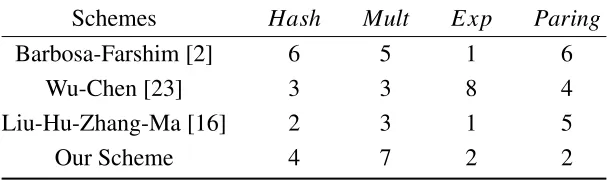
of computational cost in Table 1. In Table 1 we use Hash, Mult, E xp, and Paring as abbreviations for hash operations, point multiplications inG1orG2, exponentiations inGT and pairing computations respectively.
Table 1: Comparison of the CLSC Schemes
Schemes Hash Mult E xp Paring
Barbosa-Farshim [2] 6 5 1 6
Wu-Chen [23] 3 3 8 4
Liu-Hu-Zhang-Ma [16] 2 3 1 5
Our Scheme 4 7 2 2
According to the result in [3, 5], the pairing operation is several times more expensive than the multiplication inG1andG2and exponentiation inGT. Hence reducing the number of pairing operations is critical. As shown in Table 1, our CLSC scheme only requires two pairing operations in signcrypt and unsigncrypt phases. Above all, our scheme is more efficient than all the schemes available.
6
Conclusion
Certificateless public key cryptography is receiving significant attention because it is a new paradigm that simplifies the traditional PKC and solves the inherent key escrow prob-lem suffered by ID-PKC. Certificateless signcryption is one of the most important security primitives in CL-PKC. In this paper, we proposed a new efficient certificateless signcryp-tion scheme based on bilinear pairing, which requires only two pairing operasigncryp-tions in the signcrypt and unsigncrypt phases. The security of our scheme is based on the hardness assumptions ofDLP,CDHP,q-SDHPandq-BDHIP.
References
[1] S. S. Al-Riyami and K. G. Paterson. Certificateless public key cryptography. In
Advances in Cryptology-ASIACRYPT 2003, volume 2894 of LNCS, pages 452–473.
Springer-Verlag, 2003.
[2] M. Barbosa and P. Farshim. Certificateless signcryption. Cryptology ePrint Archive: Report 2008/143, Available from:http://eprint.iacr.org/2008/143.
[4] P. S. L. M. Barreto, B. Libert, N. McCullagh, and J. Quisquater. Efficient and provably-secure identity-based signatures and signcryption from bilinear maps. In
Advances in Cryptology-ASIACRYPT 2005, volume 3788 of LNCS, pages 515–532.
Springer-Verlag, 2005.
[5] P. S. L. M. Barreto, B. Lynn, and M. Scott. Efficient implementation of pairing-based cryptosystems. Journal of Cryptology, 17(4):321–334, 2004.
[6] P. S. L. M. Barreto and M. Naehrig. Pairing-friendly elliptic curves of prime order. Cryptology ePrint Archive: Report 2005/133, Available from: http://eprint.iacr. org/2005/133.
[7] M. Bellare and P. Rogaway. Random oracles are practical: a paradigm for design-ing efficient protocols. In First ACM Conference on Computer and Communications
Security, pages 62–73. ACM, 1993.
[8] I. F. Blake, V. Kumar Murty, and G. Xu. Refinements of miller’s algorithm for com-puting the weil/tate pairing. Journal of Algorithms, 58(2):134–149, 2006.
[9] D. Boneh and X. Boyen. Efficient selective-id secure identity-based encryption with-out random oracles. InAdvances in Cryptology-EUROCRYPT 2004, volume 3027 of
LNCS, pages 223–238. Springer-Verlag, 2004.
[10] D. Boneh and X. Boyen. Short signatures without random oracles. In Advances
in Cryptology-EUROCRYPT 2004, volume 3027 of LNCS, pages 56–73.
Springer-Verlag, 2004.
[11] X. Boyen. Multipurpose based signcryption: A swiss army knife for identity-based cryptography. In Advances in Cryptology-CRYPTO 2003, volume 2729 of
LNCS, pages 383–399. Springer-Verlag, 2003.
[12] L. Chen and J. Malone-Lee. Improved identity-based signcryption. In Public Key
Cryptography-PKC 2005, volume 3386 of LNCS, pages 362–379. Springer-Verlag,
2005.
[13] Y. Chen and F. Zhang. A new certificateless public key encryption scheme. Wuhan
University Journal of Natural Sciences, 13(6):721–726, 2008.
[14] I. Duursma and H. Lee. Tate pairing implementation for hyperelliptic curves y2 =
xp − x+ d. In Advances in Cryptology-ASIACRYPT 2003, volume 2894 of LNCS,
pages 111–123. Springer-Verlag, 2003.
[15] S. D. Galbraith, K. Harrison, and D. Soldera. Implementing the tate pairing. In
Algorithmic Number Theory, volume 2369 ofLNCS, pages 69–86. Springer-Verlag,
2002.
[17] A. Miyaji, M. Nakabayashi, and S. Takano. New explicit conditions of elliptic curve traces for FR-reduction. IEICE Transactions on Fundamentals, E84-A(5):1234– 1243, 2001.
[18] D. Pointcheval and J. Stern. Security arguments for digital signatures and blind sig-natures. Journal of Cryptology, 13(3):361–396, 2000.
[19] S. S. D. Selvi, S. S. Vivek, and C. P. Ragan. On the security of certificateless sign-cryption schemes. Cryptology ePrint Archive: Report 2009/298, Available from:
http://eprint.iacr.org/2009/298.
[20] S. S. D. Selvi, S. S. Vivek, and C. P. Ragan. Security weaknesses in two certificateless signcryption schemes. Cryptology ePrint Archive: Report 2010/092, Available from:
http://eprint.iacr.org/2010/092.
[21] A. Shamir. Identity-based cryptosystems and signature schemes. In Advances in
Cryptology, volume 196 ofLNCS, pages 47–53. Springer-Verlag, 1985.
[22] N. P. Smart and F. Vercauteren. On computable isomorphisms in efficient asymmetric pairing based systems. Cryptology ePrint Archive: Report 2005/116, Available from:
http://eprint.iacr.org/2005/116.
[23] C. Wu and Z. Chen. A new efficient certificateless signcryption scheme. In
Interna-tional Symposium on Information Science and Engieering, 2008. ISISE’08., volume 1,