Fair Computation with Rational Players
∗Amos Beimel† Adam Groce‡ Jonathan Katz§ Ilan Orlov†
Abstract
We consider the problem offair multiparty computation, where fairness means (informally) that all parties should learn the correct output. A seminal result of Cleve (STOC 1986) shows that fairness is, in general, impossible to achieve if a majority of the parties ismalicious. Here, we treat all parties asrational and seek to understand what can be done.
Asharov et al. (Eurocrypt 2011) showed impossibility of rational fair computation in the two-party setting, for a particular function and a particular choice of utilities. We observe, however, that in their setting the parties have no strict incentive to compute the functioneven in an ideal world where fairness is guaranteed. Revisiting the problem, we show that rational fair computationispossible, for arbitrary functions, as long as the parties have a strict incentive to compute the function in an ideal world where fairness is guaranteed. Our results extend to more general utility functions that do not directly correspond to fairness, as well as to the multi-party setting. Our work thus shows a new setting in which game-theoretic considerations can be used to circumvent a cryptographic impossibility result.
1
Introduction
Cryptography and game theory are both concerned with understanding interactions between mu-tually distrusting parties with potentially conflicting interests. Cryptography typically adopts a “worst case” viewpoint; that is, cryptographic protocols are designed to protect the interests of each party againstarbitrary(i.e., malicious) behavior of the other parties. The game-theoretic per-spective, however, views parties as being rational; game-theoretic protocols, therefore, only need to protect against rational deviations by other parties.
Significant effort has recently been devoted to bridging cryptography and game theory; see [12, 28] for surveys. This work has tended to focus on two general sets of questions:
Using cryptographic protocols to implement games (e.g., [10, 13, 6, 11, 32, 1, 25, 24]). Given a game played by parties relying on an external trusted entity (a mediator), when can the mediator be replaced by a cryptographic protocol executed by the parties themselves?
Applying game theory to cryptographic protocols (e.g., [23, 28, 19, 33, 1, 20, 21]). What game-theoretic definitions are appropriate for computationally bounded, rational parties executing
∗This is the full version of [22].
†Department of Computer Science, Ben Gurion University. Research supported by ISF grant #938/09. Email:
{amos.beimel,ilanorlov}@gmail.com.
‡Department of Mathematics, Reed College. Portions of this work were done while at the University of Maryland.
Email: [email protected].
§Department of Computer Science, University of Maryland. Research supported by NSF awards
a protocol? Can impossibility results in the cryptographic setting be circumvented if we are willing to take a game-theoretic approach?
Here, we turn our attention to the question of fair computation in a rational setting, where fairness means that all parties should learn the value of some functionf evaluated on the parties’ inputs. Following the work of Asharov et al. [4] (see further below), our goal is to understand when fairness is achievable by rational parties running some cryptographic protocol, without the aid of any external trusted entity. Our work touches on both the settings outlined above. Our motivation was to circumvent the strong impossibility result of Cleve [9] for fair computation without an honest majority by investigating a relaxed model where parties are rational but not malicious. In this sense, our work can be viewed as a generalization of the line of work on rational
secret sharing [23, 19, 33, 1, 29, 30, 37, 35, 5, 14], which can be viewed as a special case of fair computation for a specific function with parties’ inputs provided by a trusted dealer. It is also possible to view rational fair computation from a different perspective. Specifically, consider a natural “fairness game” involving a trusted mediator who computes a functionf on behalf of some parties (and gives all parties the result), and where parties can choose whether or not to participate and, if so, what input to send to the mediator. One can then ask whether there exists a real-world protocol (replacing the mediator) that preserves equilibria of the original mediated game. Our work demonstrates a close connection between these complementary viewpoints.
In addition to the above, we also consider more general utilities that do not directly correspond to fairness. Here, too, our goal is to understand when there exists a protocol such that running the protocol is a game-theoretic equilibrium with respect to the given utility function(s).
1.1 Our Results
We begin by discussing the two-party case where utilities correspond naturally to the problem of fairness. We then describe our more general results that include this setting as a special case.
Fairness in the two-party setting. Consider first the setting studied by Asharov et al. [4]. Here, there are two partiesP1 and P2 who wish to compute a functionf of their inputsx1 andx2,
where the joint distribution ofx1 andx2 is common knowledge. (Asharov et al. assume that x1, x2
are uniform and independent but we allow for arbitrary distributions.) Furthermore, as in work on rational secret sharing, assume parties’ utilities are such that each party prefers to learn the correct answer f(x1, x2) and otherwise prefers that the other party outputs an incorrect answer.
Informally, a cryptographic protocol computing f is rationally fair if having both parties run the protocol is a (computational, Bayesian) Nash equilibrium with respect to fail-stop deviations.1
Asharov et al. show a negative result in this context: they give a function f, a distribution on the inputs, and a specific set of utilities for which there is no fair protocol computing f with correctness better than 1/2. They also show that correctness 1/2 can be achieved (for that func-tion, distribufunc-tion, and utilities), but their work seemed to suggest that the power of rational fair computation is relatively limited.
Looking closely at their impossibility result, we observe that for their specific choices of f, the input distribution, and the utilities, the parties have no strict incentive to run any protocol at all. Namely, the utility each party obtains by running any protocol that correctly (and fairly) computes f is equal to the expected utility that each party obtains if it simply guesses the input
1
of the other party and computes the function on its own (without any interaction).2 In other words, even in an ideal world with a trusted mediator computing f with complete fairness, the parties would be indifferent between using the trusted mediator or not. In game-theoretic terms, computing f (even in an ideal world) is not a strict Nash equilibrium. If running a (real-world) protocol incurs any cost at all, there is thus little hope that the parties will prefer to run any
protocol for computingf.
Asharov et al. rule out rational fair computation for a specific function, a specific input distri-bution, and aspecific set of utilities. Are there any settings where rational fair computation (with complete correctness)is possible? Assuming the existence of secure oblivious transfer, we show:
Theorem(Informal) Fix f, a distribution on inputs, and utility functions such that computing f in the ideal world (with complete fairness) is a strict Nash equilibrium for both parties. Then, for the same input distribution and utility functions, there is a protocol Π for computing f (where correctness holds with all but negligible probability) such that following Π is a computational Nash equilibrium. This holds in both the fail-stop and Byzantine settings.
In addition to the fact that we show a positive result, our work goes beyond the setting consid-ered in [4] in several respects: we handle arbitrary (deterministic) functions where parties receive possibly different outputs, and treat arbitrary distributions over the parties’ inputs. (In [4], only single-output functions and independent, uniform input distributions were considered.) Moreover, we also treat the Byzantine setting where, in particular, parties have the option of changing their inputs; Asharov et al. [4] only treat the fail-stop case.
The multiparty setting, and general utilities. The preliminary version of our paper [22] only considered the two-party setting. Here, we also generalize the above to the multi-party setting, where there are k parties and up to t of them may be colluding. We first observe that rational fairness3 is easy to achieve if completely fair computation for t malicious parties is possible, i.e.,
when t < k/2 if a broadcast channel is available, and when t < k/3 otherwise. This is because no matter what the t parties in the coalition do they will be unable to prevent the rest of the parties—assuming they follow the protocol—from learning the correct output. Thus, the problem is only interesting when t, kare such that completely fair computation is not possible.
A next question is: what set of utilities best models fairness in the multi-party setting? Should the utility of a party in a coalition depend only on whether that party learns the correct answer, or also on whether every member of the coalition learns the correct answer? Similarly, does it matter whether no party outside the coalition learns the correct answer, or whether even one party outside the coalition fails to do so? Rather than choose arbitrarily among these options, we make
no assumptions on the utility functions of the parties. Each party can have a different utility function, and in fact these utilities need not correspond to a notion of fairness at all. We show:
Theorem(Informal) Fix f, a distribution on inputs, and utility functions such that computing f in the ideal world is astrictNash equilibrium for all coalitions of size at mostt. Then, for the same input distribution and utility functions, there is a protocol Π for computing f (where correctness
2Specifically, using the input distributions and utility functions from [4], a party’s utility if both parties (run some
protocol and) output the correct answer is 0, whereas if both parties guess then each party is (independently) correct with probability 1/2 and so the expected utility of each party is 1
4·1 + 1
4·(−1) + 1 2·0 = 0. 3
holds with all but negligible probability) such that following Π is a computational Nash equilibrium for coalitions of size at most t. This holds in both the fail-stop and Byzantine settings.
Note that this subsumes the result in the two-party case described earlier.
1.2 Other Related Work
The most relevant prior work is that of Asharov et al. [4], already discussed above. Here we merely add that their main motivation was to develop formal definitions of various cryptographic goals in a game-theoretic context, with fairness being only one example. Their paper takes an important step toward that goal.
As observed earlier, work on rational secret sharing [23, 19, 33, 1, 29, 30, 37, 35, 5, 14] can be viewed as a special case of fair secure computation, where the function being computed is the reconstruction function of the secret-sharing scheme being used, the parties’ inputs are generated (and authenticated) by a dealer, and a specific class of utilities is assumed. Thus, in certain settings, our results give rational secret-sharing protocols where following the protocol is a (computational) Nash equilibrium. Most of the work on rational secret sharing, however, has focused on achieving
stronger equilibrium notions, something we leave for future work.
An analogue of our results is given by Izmalkov et al. [31, 32, 27, 26] who, essentially, also show protocols for rational fair computation of a function whenever parties would prefer to compute that function in the ideal world. The main difference is that we assume standard communication channels, whereas the protocols of Izmalkov et al. require strong physical assumptions such as secure envelopes and ballot boxes.
There has recently been a significant amount of work on fairness in the cryptographic setting, showing functions that can be computed with complete fairness [16, 17, 2, 34, 3] and exploring various notions of partial fairness (see [18, 7] and references therein). The class of functions that are known to be computable with complete fairness is fairly limited; partial fairness and rational fairness are incomparable notions.
2
Model and Definitions
Given a deterministic functionf :X1× · · · ×Xk →Y1× · · · ×Yk, we letfi denote the restriction of
f to itsith output. We consider two settings in which kparties P1, . . . , Pk wish to computef on
their respective inputs x1, . . . , xk, withPi receiving fi(x1, . . . , xk): an ideal-world computation of
f using a trusted party, and areal-world computation off using some protocol Π. In each setting, the inputs x1, . . . , xk are chosen according to some joint probability distribution D known to all
parties, and in each setting we consider both fail-stop and Byzantine strategies.
We consider general utility functions defined over the (true) inputs4and (actual) outputs5of the parties. (This encompasses the case considered in [4, 22], where utilities are specifically assumed to model fairness.) We assume without loss of generality that utilities are nonnegative.
We consider potential deviations by coalitions of parties, with single-player deviations as a special case. IfC ⊂ {1, . . . , k}is a coalition, thenCdef= {1, . . . , k}\C. We letxC(resp.,yC) represent
4Parties may send any value to the trusted party (resp., use any value when running Π), but their true inputs are
those given to them at the outset of the game.
5Parties may choose their actual output arbitrarily, and need not output the value given to them by the trusted
the inputs (resp., outputs) of the members of C and, for i ∈ C, let xC[i] (resp., yC[i]) denote the input (resp., output) ofPi. The utility of a coalition of parties is simply the sum of the utilities of
its members. Following the cryptographic convention, we view a coalition of parties as being under the control of some central entity who coordinates the actions of the members of the coalition. We assume that the members of the coalition are able to freely communicate out-of-band, and so in particular they can share their inputs at the outset of the game.
2.1 Execution in the Ideal World
Our ideal world includes a trusted party who computes f with complete fairness. This defines a natural game that proceeds as follows:
1. Inputsx1, . . . , xk are sampled according to a joint probability distribution D, and xi is then
given to Pi.
2. Each party sends a value to the trusted party. We also allow parties to send a special value⊥ denoting an abort. Let x′i denote the value sent byPi.
3. If any x′i =⊥, the trusted party sends ⊥ to all parties. Otherwise, the trusted party sends
fi(x′1, . . . , x′k) to each party Pi.
4. Each party Pi outputs some value yi which need not be equal to the value it received from
the trusted party.
In thefail-stopsetting, we restrictx′i ∈ {xi,⊥}. In theByzantinesetting we allowx′ito be arbitrary.
The “desired” play in this game is for each party to send its input to the trusted party, and then output the value returned by the trusted party. To fully define an honest strategy, however, we must specify what each party does for every possible value (including ⊥) it receives from the trusted party. Let Wi denote a function from inputs to a distribution on outputs. We formally
define strategy (cooperate, Wi) for Pi as follows:
Pi sends its input xi to the trusted party. If the trusted party returns anything other
than⊥, thenPi outputs that value. If instead⊥is returned, then Pi generates output
according to the distributionWi(xi).
As long as all parties follow honest strategies, the distributions Wi are irrelevant (as they are
never used). They are important, however, insofar as they serve as threats in case of an abort by other parties: namely,P1 (for example) knows that if he aborts then every other Pi will determine
its own output according toWi(xi), and soP1 must take this into account when deciding whether
to abort. The situation in which each partyPiplays (cooperate, Wi) is at-resilient, Bayesian, strict
Nash equilibrium if the following two conditions hold:
1. For every coalitionC of size at mostt, every (allowed6) deviation by the members ofC does not increase the expected utility ofC.
2. Moreover, for every coalition C of size at most t, every (allowed) deviation by the members ofCthat hasx′C ̸=xC with nonzero probability results instrictly lower expected utility forC.
6I.e., in the fail-stop case the only allowed deviation is aborting, whereas in the Byzantine case parties are allowed
The second condition means that the members of any coalition have a strict incentive to send their true inputs to the trusted party. The first condition implies that, having done so, these parties have no incentive to output anything other than what they received from the trusted party.
Definition 1. Fix f, a distributionD, and utility functions {Ui}ki=1. We say these are t-incentive
compatible in the fail-stop (resp., Byzantine) setting if there exist {Wi}ki=1 such that the strategy profile
(
(cooperate, W1), . . . ,(cooperate, Wk) )
is a t-resilient, Bayesian, strict Nash equilibrium in the ideal-world game defined above.
The setting of Asharov et al. [4]. For completeness, we show that the (two-party) setting con-sidered by Asharov et al. isnot incentive compatible, even in the fail-stop setting. In [4] the utilities are such that (1) getting the correct answer while the other party outputs an incorrect answer gives utility 1; (2) getting an incorrect answer while the other party outputs the correct answer gives utility−1; and (3) any other outcome gives utility 0. Furthermore (cf. [4, Definition 4.6]), f corre-sponds to boolean XOR, and the inputs for each party are chosen uniformly and independently. We claim that there is no choice ofW1, W2 for which
(
(cooperate, W1),(cooperate, W2)
)
is a 1-resilient, Bayesian, strict Nash equilibrium. To see this, fixW1, W2 and note that playing
(
(cooperate, W1),
(cooperate, W2)
)
gives utility 0 to both parties. On the other hand, if P1 aborts and outputs a
random bit, then regardless of the guessing strategyW2 employed byP2, the partiesP1 and P2 are
each correct with independent probability 1/2 and so the expected utility of P1 remains 0. This
shows an allowed deviation byP1 that does not result in lower expected utility forP1.
In contrast, if the utilities are modified so that when both parties get the correct answer they each obtain utility 1/2 (and everything else is unchanged), then the settingis incentive compatible in the fail-stop setting. To see this, letW1, W2be the uniform distribution (regardless of the input).
Playing ((cooperate, W1),(cooperate, W2)
)
gives utility 1/2 to both parties. If, on the other hand,
P1 ever aborts on some input then—no matter howP1 determines its output—P1 and P2 are each
correct with independent probability 1/2. The expected utility of deviating is 1/8, which is strictly smaller than 1/2; thus, we have a Bayesian strict Nash equilibrium. Our results imply that a rational (fair) protocolcan be constructed for this setting.
2.2 Execution in the Real World
In the real world there is no trusted party, and the players instead must communication in order to compute f. We thus have a real-world game in which inputs x1, . . . , xk are jointly sampled
according to D, input xi is given to Pi, and the parties execute some strategy (i.e., run some
protocol) and then decide on their respective outputs.
The goal is to construct a protocol Π such that running the protocol is a (computational) Nash equilibrium. In designing the protocol, we assume the existence of a secure communication channel between each pair of parties, as well as a broadcast channel. (These could both be realized using standard cryptographic techniques.) We assume that communication occurs in synchronous rounds, but allow rushing so that in any given round a deviating coalition obtains the messages sent to it by other parties before sending its own messages for that round.
As in the ideal world, we again consider two types of deviations. In the fail-stop setting, each party follows the protocol as directed except that it may choose to abort the protocol at any point. Upon aborting, a party may output whatever value it likes (and not necessarily the value prescribed by the protocol). Parties who follow the protocol decide on their output as prescribed by the protocol. We stress that in the fail-stop setting a party is assumed not to change its input when running the protocol. In contrast, in the Byzantine setting parties may behave arbitrarily (and, in particular, may run the protocol using a different input).
We now define what it means for Π to induce a game-theoretic equilibrium. Our equilibrium notion of interest is (Bayesian) computational Nash equilibrium (see [28]). We say a protocol induces at-resilient computational Nash equilibrium if any (allowed) deviation by a coalition C of at mosttprobabilistic polynomial-time parties yields expected payoff at most negligibly more than what C can obtain by running the protocol honestly (and then outputting the value prescribed by the protocol); in other words, deviating from the protocol cannot increase the expected utility ofC more than a negligible amount. (By Bayesian we simply mean that we take the expectation also over the possible inputs of the parties outside the coalition C.) In our setting, then, we have the following definition of what it means for Π to be a rational protocol (the definition is equivalent to a generalized version of the definition used by Asharov et al. [4, Definition 4.6]):
Definition 2. Fix f, a distribution D, utilities for the parties, and a protocol Π computingf. We say Π is a t-rational protocol (with respect to these parameters) in the fail-stop (resp., Byzantine) setting if running Π is a t-resilient, Bayesian, computational Nash equilibrium in the real-world game defined above.
We consider computational Nash equilibria, rather than computational strict Nash equilibria, since the latter are notoriously difficult to define [14]; also, the goal of our work is only to construct real-world protocols that induce a Nash equilibrium. (We define strict Nash equilibria in the ideal world only because we use it for our results.) We stress that it only makes sense to speak of Π being a rational protocol with regard to some specific input distribution and utilities; it is possible, e.g., for Π to be rational for one set of utilities but not another.
3
Positive Results for Rational Computation
We show broad positive results for rational computation in both the fail-stop and Byzantine settings. Namely, we show that whenever computing the function honestly is a t-resilient, Bayesian, strict Nash equilibrium in the ideal world, then there exists a protocol Π computingf such that running Π is a Bayesian computational Nash equilibrium in the real world.
Our protocols all share a common structure. As in prior work on fairness [16, 36, 18], our protocols have two stages. The first stage is a “pre-processing” step that relies on any protocol for (unfair) secure multi-party computation, and the second stage takes place in a sequence of n
iterations, where nis the security parameter. In our work, the stages take the following form:
First stage:
1. A value r∗ ∈ {1, . . .} is chosen according to a geometric distribution. This represents the iteration (unknown to the parties) in which all parties will learn the correct output.
2. Values {(tr1, . . . , trk)}rn=1 are chosen, with tri the value that Pi should learn in iterationr. For
r ≥r∗ we havetr
i =fi(x1, . . . , xk), while forr < r∗ the value tri depends on Pi’s input only
3. Each trI value is shared in a k-out-of-kmanner among all parties.
Second stage: In each iteration r ∈ {1, . . . , n}, for every i ∈ {1, . . . , k} each party other than
Pi broadcasts its share of tri, thus allowing (only) Pi to reconstruct tri. When the protocol ends
(either through successful termination or an abort by the other party) each party Pi outputs the
most-recently-learned value tri.
The key difference with respect to prior work is how we set the distribution of the {tri} for
r < r∗. Here we use the assumption thatf, D, and the utilities are incentive compatible, and thus there are “guessing strategies”Wi(xi) for the parties—in case the protocol is aborted—that are in
equilibrium (see Section 2.1). We use exactly these distributions in our protocol.
3.1 The Fail-Stop Setting
We first present an analysis of the fail-stop setting, which already demonstrates the main issues. We sayWi hasfull support if for everyxi the distributionWi(xi) puts nonzero probability on every
element in the range of fi. We begin by proving a technical lemma.
Lemma 3. Fix a function f, a distribution D, and utilities for the parties that are t-incentive compatible in the fail-stop (resp., Byzantine) setting. Then there exist {Wi} with full support
such that
(
(cooperate, W1), . . . , (cooperate, Wk) )
is at-resilient, Bayesian, strict Nash equilibrium in the fail-stop (resp., Byzantine) setting.
Proof We focus on the fail-stop setting; the proof for the Byzantine setting is analogous. In-centive compatibility means that there exist distributions {Wi′} such that the strategy vector (
(cooperate, W1′), . . . , (cooperate, Wk′) )
is a t-resilient, Bayesian, strict Nash equilibrium. The
{Wi′} may not have full support, but we show that they can be modified so that they do.
Let umax denote the highest possible utility a coalition of size at mostt can obtain. For some
coalitionCand inputsxCfor the members of this coalition, letu⊥(xC) denote the maximum expected utility this coalition can obtain if it aborts; this expectation is taken over the distributionD from which inputs are chosen, as well as the randomized strategies—determined by{Wi′}—that are used by the players outside ofC. Letu(xC) be the expected utility the coalition obtains if each member of the coalition sends its input to the trusted party and then outputs the value received from the trusted party. Letu∗ be the minimum value ofu(xC)−u⊥(xC), where this minimum is taken over all coalitionsC of size at mosttand over all inputsxC. By definition of incentive compatibility, we must haveu∗>0.
Set ϵ = 2k·uu∗
max > 0, and define Wi(xi) as follows: with probability (1−ϵ) choose output
according toWi′(xi), and with probability ϵoutput a uniform element from the range of fi. Note
thatWi has full support. We claim that the strategy vector (
(cooperate, W1), . . . ,(cooperate, Wk) )
is a t-resilient, Bayesian, strict Nash equilibrium. To see this, consider any coalition C of size at most t, and some set of inputs xC for the members of this coalition. In case of an abort by any member ofC, note that the parties outsideC all follow the original strategies{Wi′}with probability at least 1−ϵk. Therefore, the maximum expected utility of C following an abort (assuming the players outside ofC determine their outputs using the modified strategies {Wi}) is at most
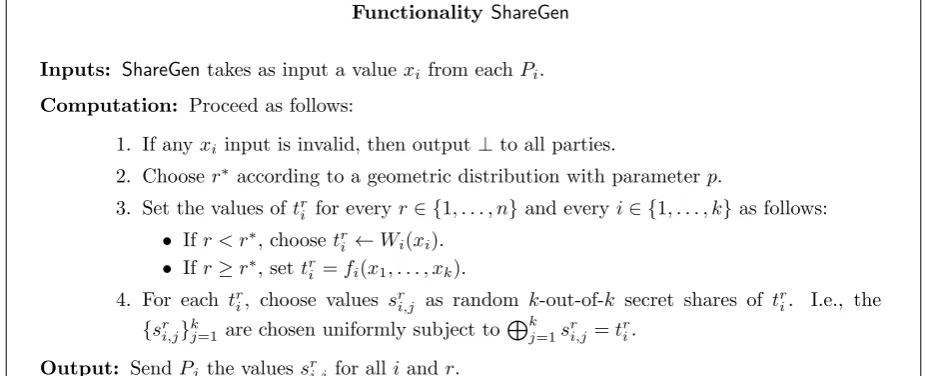
Functionality ShareGen
Inputs: ShareGentakes as input a valuexi from eachPi.
Computation: Proceed as follows:
1. If anyxi input is invalid, then output ⊥to all parties.
2. Chooser∗ according to a geometric distribution with parameterp.
3. Set the values oftr
i for everyr∈ {1, . . . , n}and everyi∈ {1, . . . , k} as follows:
• Ifr < r∗, choosetri ←Wi(xi).
• Ifr≥r∗, set tir=fi(x1, . . . , xk).
4. For each tri, choose values sri,j as random k-out-of-k secret shares of tri. I.e., the
{sri,j}kj=1 are chosen uniformly subject to⊕kj=1sri,j=tri.
Output: SendPj the valuessri,j for alliandr.
Figure 1: FunctionalityShareGen. The security parameter isn. This functionality is parameterized by a real number p >0 to be determined later.
That is, aborting results in strictly lower utility than behaving honestly.
We now formally state and prove our main theorem.
Theorem 1. Fix a functionf, a distributionD, and utilities for the parties. If these aret-incentive compatible in the fail-stop setting, then (assuming the existence of general secure multiparty compu-tation for tfail-stop adversaries) there exists a protocol Π computing f such that Π is at-rational protocol (with respect to the same distribution and utilities) in the fail-stop setting.
Proof By definition of t-incentive compatibility, and using Lemma 3, there exist {Wi} with
full support for which the strategy profile (
(cooperate, W1), . . . ,(cooperate, Wk) )
is a t-resilient, Bayesian, strict Nash equilibrium. We define a functionality ShareGen (cf. Figure 1) based on these {Wi}; this functionality is also parameterized by a constantp >0 that we will set later. We
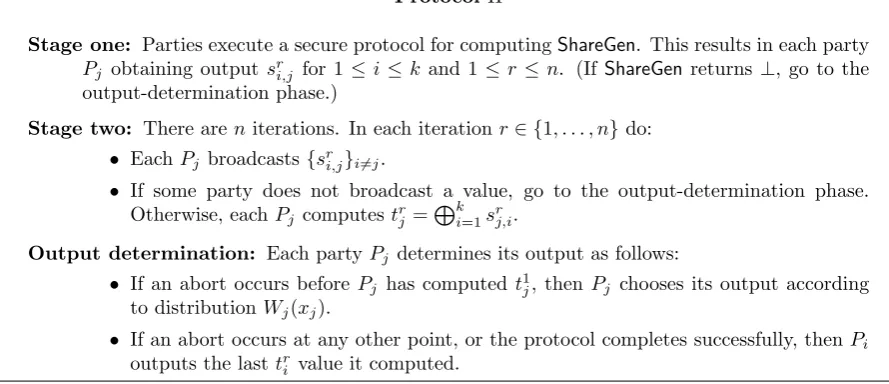
define our protocol Π, that uses ShareGen as a building block, in Figure 2.
ShareGen starts by choosing a special iteration r∗ according to a geometric distribution with a parameter p to be defined later. It then creates outputs for each party in each iteration. In iterations beforer∗, the outputs are chosen independently using the distributions{Wi(xi)}. From
iteration r∗ on, the outputs are the actual value of the function. These output values are then shared in ak-out-of-kmanner, with shares sent to each player, to prevent the output values from being learned prematurely. Since p is a constant, we have r∗ ≤n with overwhelming probability, and hence when Π is run honestly all parties obtain the correct answer with all but negligible probability. (Alternately, one could modifyShareGen to enforce that r∗ ≤n always.)
Protocol Π can use any multiparty computation protocolπfor computingShareGenthat is secure with unanimous abort [15] against t fail-stop adversaries. Since we assume a fail-stop adversarial model, this means we can analyze Π in a hybrid world where there is a trusted entity computing
Protocol Π
Stage one: Parties execute a secure protocol for computingShareGen. This results in each party
Pj obtaining output sri,j for 1≤i ≤k and 1≤r ≤n. (If ShareGenreturns ⊥, go to the
output-determination phase.)
Stage two: There areniterations. In each iteration r∈ {1, . . . , n} do:
• EachPj broadcasts{sri,j}i̸=j.
• If some party does not broadcast a value, go to the output-determination phase. Otherwise, eachPj computestrj =
⊕k i=1s
r j,i.
Output determination: Each partyPj determines its output as follows:
• If an abort occurs beforePj has computed t1j, then Pj chooses its output according
to distributionWj(xj).
• If an abort occurs at any other point, or the protocol completes successfully, thenPi
outputs the lasttr
i value it computed.
Figure 2: Formal definition of our protocol.
Our goal is to show that there exists ap >0 for which Π (in the hybrid world discussed above) is a t-rational protocol with respect to the given function f, distribution D, and parties’ utilities. Fix an arbitrary coalition C of size at most t, and an arbitrary inputxC for the parties in C. We show that no fail-stop deviation by C can increase the expected utility of the coalition. (Because we are now in a hybrid world with access to an ideal functionality computing ShareGen, we no longer need to restrict attention to polynomial-time behavior, or consider negligible changes to the expected utility.)
Before continuing the analysis, we introduce two conceptual changes to the protocol that can only increase the expected utility of C. First, at the outset of each iteration r we first inform C whether r > r∗ or not. Second, if any party in C ever aborts in some iteration r withr ≤r∗, then we inform the parties inCwhetherr =r∗ before those parties generate their output. (The decision to abort, however, cannot be changed.)
Note that once r > r∗, the coalition C cannot increase its expected utility by deviating from the protocol: although the parties inChave learned the correct outputs of the function, the parties outside C have also obtained their respective correct outputs in iteration r∗ ,and will only ever output those values from then on. Thus, this situation is analogous to the situation in the ideal world once all parties have been given their outputs by the trusted party. Since, by assumption, the parties in C have no incentive to deviate—namely, to output values other than the ones given to them by the trusted party—in the latter case, they have no incentive to deviate in the former case, either.
Let umax denote the highest possible utility a coalition of size t can obtain. Let u(xC) be the
expected utility of the parties inC if they follow the protocol honestly when given inputsxC, and letu⊥(xC) be the maximum expected utility the coalition can obtain (in the ideal world) if it aborts when given those inputs. Let u∗ be the minimum value of u(xC)−u⊥(xC), where this minimum is taken over all coalitionsCof size at mosttand all inputsxC; since we have a strict Nash equilibrium in the ideal world,u∗ >0.
do not abort, and execute the protocol until the end, they receive expected utility u(xC). On the other hand, if they abort then with some probabilityα(which may depend on bothxC andtr
C) they
are told thatr =r∗, in which case they can potentially obtain utilityumax; with probability 1−α,
however, they are told that r > r∗ in which case they receive expected utility at mostu⊥(xC) (as
C has no information beyond what it could compute from its own inputs). That is, the expected utility of aborting is at most
α·umax+ (1−α)·u⊥(xC).
Thus, as long as α ≤u∗/umax, the expected utility of aborting is at most the expected utility of
following the protocol. We now show that the parameterp >0 can be set so that the stated bound on α holds (for all xC andtrC).
Let q= minxC,tC{Pr[∀Pi ∈ C:Wi(xi) =ti]}. Since the {Wi} have full support, q >0. Now, for
any coalitionC given inputs xC and observing outputstC in some iterationr ≤r∗, we have
α def= Pr[r∗ =r|trC =tC∧r∗ ≥r]
= Pr[r
∗ =r∧tr
C=tC|r∗ ≥r]
Pr[tr
C =tC |r∗≥r]
= Pr[r
∗ =r|r∗ ≥r]·Pr[tr
C =tC |r∗=r]
Pr[r∗ =r|r∗ ≥r]·Pr[tr
C =tC |r∗=r] + Pr[r∗ > r|r∗ ≥r]·Pr[trC =tC |r∗> r]
= p·Pr[t
r
C =tC|r∗ =r] p·Pr[tr
C =tC |r∗ =r] + (1−p)·Pr[trC=tC|r∗ > r]
≤ p
p+ (1−p)·q
= p
p·(1−q) +q ≤ p q.
We thus see that by settingpto a sufficiently small (positive) constant, we can ensureα≤u∗/umax
as required above.
Assuming p is set as just described, the above shows that in any iterationr < n, the coalition
C has no incentive to abort. The only remaining case to analyze is when r = n. In this case it would indeed be advantageous forCto abort whenr∗≥n; however, this occurs with only negligible probability and so does not impact the expected utility ofC by more than a negligible amount.
Although security notions beyond game-theoretic equilibria are not the focus of our work, we note that the protocol presented in the proof of the previous theorem is private in addition to being rational. That is, the parties learn the function output only, but nothing else regarding other parties’ inputs.
3.2 The Byzantine Setting
parties. Moreover, all parties should now verify the signatures on all broadcast shares, and treat an invalid or missing signature as an abort. We omit the details, which are straightforward.
A proof of the following is completely analogous to the proof in the previous section:
Theorem 2. If a functionf, a distributionD, and utilities for the parties aret-incentive compatible in the Byzantine setting, then (assuming the existence of digital signatures and general secure multiparty computation fortmalicious adversaries) there exists a protocol Π computingf that is a t-rational protocol (with respect to the same distribution and utilities) in the Byzantine setting.
4
Conclusions and Future Work
Given the stark impossibility results for fairness in a purely malicious context [9], it is natural to try to understand whether, or to what extent, fairness is achievable in arational setting. Asharov et al. [4] gave a somewhat pessimistic answer to this question, as they show a specific case where rational fairness cannot be achieved (if correctness better than 1/2 is desired). Our work, in contrast, shows broad feasibility results for rational fairness: roughly, we show that whenever computing the function is a strict Nash equilibrium in the ideal world, then it is possible to construct a rational fair protocol computing the function in the real world.
Within the broader context of research at the intersection of game theory and cryptography, our result can be interpreted in two ways:
• Given a “fairness game” defined in an ideal world where there is a trusted entity (i.e., a “mediator”) computing some function on behalf of the parties, a natural question to ask is when a game-theoretic equilibrium in the ideal world can be implemented via a real-world protocol. We do not provide a complete answer to this question, but we do show a partial characterization: roughly, whenever there is a strict Nash equilibrium in the ideal world, there is a protocol that induces a computational Nash equilibrium in the real world.
• We show a new setting in which cryptographic impossibility results can be circumvented by assuming rational behavior. Viewed in this light, our results can be seen as a generalization of work on rational secret sharing.
Our work suggests several interesting directions for future research. First, can positive results be shown even when our definition of a strict Nash equilibrium is relaxed? Or can a converse of our result be shown, at least under certain conditions? It will also be interesting to explore stronger game-theoretic solution concepts in the real world. We construct real-world protocols that induce a computational Nash equilibrium, but one could also aim to construct protocols satisfying some of the stronger equilibrium notions proposed, e.g., in [23, 29, 30, 14].
References
[1] I. Abraham, D. Dolev, R. Gonen, and J. Halpern. Distributed computing meets game theory: Robust mechanisms for rational secret sharing and multiparty computation. In 25th Annual
ACM Symp. on Principles of Distributed Computing (PODC), pages 53–62. ACM Press, 2006.
[2] G. Asharov. Towards characterizing complete fairness in secure two-party computation. In
9th Theory of Cryptography Conference—TCC 2014, volume 8349 of LNCS, pages 291–316.
[3] G. Asharov, A. Beimel, N. Makriyannis, and E. Omri. Complete characterization of fair-ness in secure two-party computation of Boolean functions. In 9th Theory of Cryptography
Conference—TCC 2015, volume 9014 ofLNCS. Springer, 2015.
[4] G. Asharov, R. Canetti, and C. Hazay. Towards a game theoretic view of secure computation. InAdvances in Cryptology—Eurocrypt 2011, volume 6632 of LNCS, pages 426–445. Springer, 2011. Full version available athttp://eprint.iacr.org/2011/137.
[5] G. Asharov and Y. Lindell. Utility dependence in correct and fair rational secret sharing.
Journal of Cryptology, 24(1):157–202, 2011.
[6] I. Barany. Fair distribution protocols, or how the players replace fortune. Mathematics of Operations Research, 17:327–340, 1992.
[7] A. Beimel, Y. Lindell, E. Omri, and I. Orlov. 1/p-Secure multiparty computation without honest majority and the best of both worlds. InAdvances in Cryptology—Crypto 2011, volume 6841 ofLNCS, pages 277–296. Springer, 2011.
[8] R. Canetti. Security and composition of multiparty cryptographic protocols. Journal of Cryp-tology, 13(1):143–202, 2000.
[9] R. Cleve. Limits on the security of coin flips when half the processors are faulty. In 18th
Annual ACM Symp. on Theory of Computing (STOC), pages 364–369. ACM Press, 1986.
[10] V.P. Crawford and J. Sobel. Strategic information transmission. Econometrica, 50:1431–1451, 1982.
[11] Y. Dodis, S. Halevi, and T. Rabin. A cryptographic solution to a game theoretic problem. In
Advances in Cryptology—Crypto 2000, volume 1880 ofLNCS, pages 112–130. Springer, 2000.
[12] Y. Dodis and T. Rabin. Cryptography and game theory. In N. Nisan, T. Roughgarden, ´E. Tardos, and V.V. Vazirani, editors, Algorithmic Game Theory, pages 181–207. Cambridge University Press, 2007.
[13] F. Forges. Universal mechanisms. Econometrica, 58:1342–1364, 1990.
[14] G. Fuchsbauer, J. Katz, and D. Naccache. Efficient rational secret sharing in standard com-munication networks. In7th Theory of Cryptography Conference—TCC 2010, volume 5978 of
LNCS, pages 419–436. Springer, 2010.
[15] S. Goldwasser and Y. Lindell. Secure multi-party computation without agreement. Journal of Cryptology, 18(3):247–287, 2005.
[16] S. D. Gordon, C. Hazay, J. Katz, and Y. Lindell. Complete fairness in secure two-party computation. J. ACM, 58(6), 2011.
[18] S. D. Gordon and J. Katz. Partial fairness in secure two-party computation. Journal of Cryptology, 25(1):14–40, 2012.
[19] S. D. Gordon and Jonathan Katz. Rational secret sharing, revisited. In 5th Intl. Conf. on Security and Cryptography for Networks, volume 4116 ofLNCS, pages 229–241. Springer, 2006.
[20] R. Gradwohl. Rationality in the full-information model. In 7th Theory of Cryptography
Conference—TCC 2010, volume 5978 ofLNCS, pages 401–418. Springer, 2010.
[21] R. Gradwohl, N. Livne, and A. Rosen. Sequential rationality in cryptographic protocols. In
51st Annual Symposium on Foundations of Computer Science (FOCS), pages 623–632. IEEE,
2010.
[22] A. Groce and J. Katz. Fair computation with rational players. In Advances in Cryptology— Eurocrypt 2012, volume 7237 ofLNCS, pages 81–98. Springer, 2012.
[23] Joseph Halpern and Vanessa Teague. Rational secret sharing and multiparty computation. In
36th Annual ACM Symp. on Theory of Computing (STOC), pages 623–632. ACM Press, 2004.
[24] P. Hub´aˇcek, J. Buus Nielsen, and A. Rosen. Limits on the power of cryptographic cheap talk. InAdvances in Cryptology—Crypto 2013, Part I, volume 8042, pages 277–297. Springer, 2013.
[25] S. Izmalkov, M. Lepinski, and S. Micali. Perfect implementation. Games and Economic
Behavior, 71(1):121–140, 2011. Available at http://hdl.handle.net/1721.1/50634.
[26] Sergei Izmalkov, Matt Lepinski, and Silvio Micali. Verifiably secure devices. In5th Theory of
Cryptography Conference—TCC 2008, volume 4948 ofLNCS, pages 273–301. Springer, 2008.
[27] Sergei Izmalkov, Silvio Micali, and Matt Lepinski. Rational secure computa-tion and ideal mechanism design. In 46th Annual Symposium on Foundations of
Computer Science (FOCS), pages 585–595. IEEE, 2005. Full version available at
http://dspace.mit.edu/handle/1721.1/38208.
[28] Jonathan Katz. Bridging game theory and cryptography: Recent results and future directions. In5th Theory of Cryptography Conference—TCC 2008, volume 4948 ofLNCS, pages 251–272. Springer, 2008.
[29] Gillat Kol and Moni Naor. Cryptography and game theory: Designing protocols for exchanging information. In 5th Theory of Cryptography Conference—TCC 2008, volume 4948 of LNCS, pages 320–339. Springer, 2008.
[30] Gillat Kol and Moni Naor. Games for exchanging information. In 40th Annual ACM Symp.
on Theory of Computing (STOC), pages 423–432. ACM Press, 2008.
[31] Matt Lepinski, Silvio Micali, Chris Peikert, and Abhi Shelat. Completely fair SFE and coalition-safe cheap talk. In23rd Annual ACM Symp. on Principles of Distributed Computing
(PODC), pages 1–10. ACM Press, 2004.
[32] Matt Lepinski, Silvio Micali, and Abhi Shelat. Collusion-free protocols. In 37th Annual ACM
[33] Anna Lysyanskaya and Nikos Triandopoulos. Rationality and adversarial behavior in multi-party computation. In Advances in Cryptology—Crypto 2006, volume 4117 of LNCS, pages 180–197. Springer, 2006.
[34] N. Makriyannis. On the classification of finite Boolean functions up to fairness. In9th Interna-tional Conference on Security and Cryptography for Networks (SCN), volume 8642 of Lecture Notes in Computer Science, pages 135–154. Springer, 2014.
[35] S. Micali and A. Shelat. Truly rational secret sharing. In 6th Theory of Cryptography
Conference—TCC 2009, volume 5444 ofLNCS, pages 54–71. Springer, 2009.
[36] T. Moran, M. Naor, and G. Segev. An optimally fair coin toss. In6th Theory of Cryptography Conference—TCC 2009, volume 5444 ofLNCS, pages 1–18. Springer, 2009.