2892
Emotion Representation Mapping for Automatic Lexicon Construction
(Mostly) Performs on Human Level
Sven Buechel & Udo Hahn
{sven.buechel|udo.hahn}@uni-jena.de
Jena University Language & Information Engineering (JULIE) Lab Friedrich-Schiller-Universit¨at Jena, Jena, Germany
http://www.julielab.de
Abstract
Emotion Representation Mapping (ERM) has the goal to convert existing emotion ratings from one representation format into another one, e.g., mapping Valence-Arousal-Dominance annota-tions for words or sentences into Ekman’s Basic Emoannota-tions and vice versa. ERM can thus not only be considered as an alternative to Word Emotion Induction (WEI) techniques for automatic emo-tion lexicon construcemo-tion but may also help mitigate problems that come from the proliferaemo-tion of emotion representation formats in recent years. We propose a new neural network approach to ERM that not only outperforms the previous state-of-the-art. Equally important, we present a refined evaluation methodology and gather strong evidence that our model yields results which are (almost) as reliable as human annotations, even in cross-lingual settings. Based on these re-sults we generate new emotion ratings for 13 typologically diverse languages and claim that they have near-gold quality, at least.
1 Introduction
From its inception, researchers in the field of sentiment analysis aimed at predicting the affective state that is typically associated with a given word based on a list of linguistic features, a problem referred to asword emotion induction(WEI) (Hatzivassiloglou and McKeown, 1997; Turney and Littman, 2003). Early research activities have focused onsemantic polarity(the positiveness or negativeness of a feeling) for quite a long time. But more recently this focus on binary representations has been replaced by more expressiveemotion representation formatssuch as Basic Emotions or Valence-Arousal-Dominance. In the meantime, WEI has become an active area of research, regularly featured in shared tasks (Rosenthal et al., 2015; Yu et al., 2016b). Based on these achievements, WEI techniques have become a natural methodological choice for the automatic construction of emotion lexicons (K¨oper and Schulte im Walde, 2016; Shaikh et al., 2016).
Yet, only very recently, a radically different approach to automatic emotion lexicon construction has been proposed. Instead of relying on linguistic features (such as similarity with seed words or word em-beddings), the goal ofemotion representation mapping(ERM) is to derive new emotional word ratings in one formatbased on known ratings of the same wordsin another format(Buechel and Hahn, 2017a). For example, ERM could use empirically gathered ratings for Basic Emotions and convert them into a Valence-Arousal-Dominance representation scheme, with greater precision than currently achievable by WEI algorithms. As a much appreciated side effect, one of the promises of ERM is to make otherwise incompatible resources (lexicons or annotated corpora, as well as tools) compatible, and incomparable systems comparable. Thus, this approach has the potential to mitigate some of the negative effects that arise from not having a community-wide standard for emotion annotation and representation (Calvo and Mac Kim, 2013; Buechel and Hahn, 2018a).
We here want to contribute to this endeavor by providing a large-scale evaluation of previously pro-posed ERM approaches for four typologically diverse languages and report evidence that ERM clearly
outperforms current state-of-the-art WEI algorithms. Furthermore, we present our own deep learning model which performs even better against all competitors. Most importantly, however, we propose a new methodology for comparing the reliability of ERM against human annotation reliability, a major shortcoming of previous work. As a result, we find that our proposed model performs competitive to a reasonably large group of human raters, even in cross-lingual settings. Based on this evidence, we automatically construct emotion lexicons for 13 languages and claim that they have (near) gold quality. These lexicons as well as our experimental code base and results are publically available.1
2 Related Work
Figure 1: Affective space spanned by the Valence-Arousal-Dominance (VAD) model, together with the position of six Basic Emotions. Adapted from Buechel and Hahn (2016).
Psychological Models of Emotion. Models
of emotion typically fall into two main groups, namely discrete (or categorical) and dimen-sional ones (Stevenson et al., 2007; Calvo and Mac Kim, 2013). Discrete models are built around particular sets of emotional categories deemed fundamental and universal. Ekman (1992), for instance, identifies six Basic Emo-tions (Joy, Anger, Sadness, Fear, Disgust and Surprise). In contrast, dimensional models con-sider emotions to be composed out of several in-fluencing factors (mainly two or three). These are often referred to asValence (corresponding to the concept of polarity), Arousal (a calm– excited scale), and Dominance (perceived de-gree of control over a (social) situation)—the VAD model. The last dimension, Dominance, is quite often omitted, thus constituting the VA model. For convenience, both will be jointly re-ferred to as VA(D). An illustration of VAD and its relationship to Basic Emotions is given in Figure 1.
Lexical Data Sets. In contradistinction to NLP where many different representation formats for
emo-tions are being used, lexical resources originating from psychology labs almost exclusively subscribe either to VA(D) or Basic Emotions models (typically omitting Surprise; the BE5 format). Over the years, a considerable number of resources built on these premises have emerged from psychological research for various languages.2 In more detail, these lexical ratings have been gathered via questionnaire studies by collecting individual ratings from a large number of subjects for each lexical item under consideration (typically between 20 to 30 individual ratings per item). These individual assessments are then averaged to yield aggregated scores on which we base our experiments. The emotion values we deal with must thus be understood as an average emotional reaction when presenting a lexical stimulus to a group of human judges.
In this paper, we restrict ourselves to the VA(D) and BE5 format. Following the conventions of the emotion lexicons used in our experiments (Table 1), each VA(D) dimension receives a value from the interval [1,9] where ‘1’ means “most negative/calm/submissive”, ‘9’ means “most posi-tive/excited/dominant” and ‘5’ means “neutral”. Conversely, values for BE5 categories range in the interval[1,5] where ‘1’ means “absence” and ‘5’ means “most extreme” expression of the respective emotion.3 Consequently, the VA(D) and BE5 formats are conceptually different from one another inso-far as VA(D) dimensions are bi-polar, whereas BE5 categories are uni-polar.
1https://github.com/JULIELab/EmoMap 2
See, e.g., Tables 1 and 6. An enhanced list of these and similar data sets is provided in Buechel and Hahn (2018a).
3Although these intervals are fairly well established conventions, in some data sets different rating scales were used,
Abbrev. VA(D) BE5 Dom? Overlap en 1 Bradley and Lang (1999) Stevenson et al. (2007) 3 1,028 en 2 Warriner et al. (2013) Stevenson et al. (2007) 3 1,027 es 1 Redondo et al. (2007) Ferr´e et al. (2017) 3 1,012 es 2 Hinojosa et al. (2016b) Hinojosa et al. (2016a) 3 875 es 3 Stadthagen-Gonzalez et al. (2017b) Stadthagen-Gonz´alez et al. (2017a) 7 10,491 de 1 V˜o et al. (2009) Briesemeister et al. (2011) 7 1,958 pl 1 Riegel et al. (2015) Wierzba et al. (2015) 7 2,902 pl 2 Imbir (2016) Wierzba et al. (2015) 3 1,272
Table 1: Data sets used in our experiments; with abbreviation (including language code according to ISO 639-1), the bibliographic sources of the VA(D) and BE5 ratings, information on whether Dominance is included and the number of overlapping entries.
Word Emotion Induction. Automatically constructing such word-level emotion data sets has been a
focus of NLP-based sentiment analysis studies from the beginning. In fact, the problem to automatically predict polarity or emotion scores for a given word based on some linguistic features—often referred to as Word Emotion Induction (WEI)—is already dealt with in the seminal work of Hatzivassiloglou and McKeown (1997). At first, the features taken into account were typically derived from co-occurrence or terminology-based similarity with a small set ofseed word with known emotional scores (Turney and Littman, 2003; Esuli and Sebastiani, 2005). Nowadays, these features are almost completely replaced by word embeddings, i.e., dense, low-dimensional vector representations of words that are trained on large volumes of raw text in an unsupervised manner. WORD2VEC(Mikolov et al., 2013), GLOVE (Pennington et al., 2014) and FASTTEXT (Bojanowski et al., 2017) are among today’s most popular algorithms for generating embeddings.
WEI algorithms constitute a natural baseline for ERM because, first, they produce the same out-put (emotion ratings for words according to some emotion representation format), yet their predictions are based on expressively weaker features (word embeddings instead of emotion ratings for the same word but in another format), thus constituting a harder task. Second, they form the currently prevailing paradigm for the automatic construction of emotion lexicons (K¨oper and Schulte im Walde, 2016; Shaikh et al., 2016), a problem for which ERM offers a promising alternative.
Word V A D J A S F D
sunshine 8.1 5.3 5.4 4.3 1.2 1.3 1.3 1.2 terrorism 1.6 7.4 2.7 1.1 3.0 3.4 4.1 2.5 orgasm 8.0 7.2 5.8 4.3 1.3 1.3 1.4 1.2
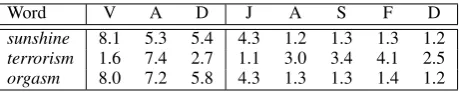
Table 2: Three lexical items and their emotion val-ues in VAD (second column group) and BE5 (third column group) format. VAD scores are taken from Warriner et al. (2013), BE5 scores were automatically derived (see Section 4.4).
Emotion Representation Mapping. In
con-trast to WEI, ERM is based on the condition that the pairs of data sets in Table 1 are com-plementary in the sense that, when combining these lexicons, a subset of their entries are then encoded inboth emotion formats, i.e., VA(D) andBE5. This condition is illustrated for three lexical items in Table 2.
Although such complementary data sets have been available for quite some time, ERM has only recently been introduced to NLP by
Buechel and Hahn (2016) in order to compare a newly proposed VAD-based prediction system against previously established results on Basic Emotion gold standards. In a follow-up study, Buechel and Hahn (2017b) devised EMOBANK, a VAD-annotated corpus which, in part, also bears BE5 ratings on the sentencelevel. They found that both kinds of annotation were highly predictive for each other using a k-Nearest-Neighbor approach. In later studies, they examined the potential of ERM as a substitute for manual annotation oflexical items, also in cross-lingual settings (Buechel and Hahn, 2017a; Buechel and Hahn, 2018a). Although their evaluation was limited in expressiveness, they already found evidence that ERM may be comparable to human performance in terms of the quality of the resulting ratings.
di-mensions given BE5 categories and vice versa. Yet, this was mainly done to inspect the respective slope-coefficients as an indicator of the relationship of dimensions and categories. Thus, the overall goodness of the fit wasnotin the center of interest and was not even reported by Stevenson et al. (2007).
3 Methods
LetL:={w1, w2, ..., wn}be a set of words. Lets,tdenote two distinctemotion representation formats
such that both emos(wi) ∈ R|s| and emot(wi) ∈ R|t| describe the emotion vector associated with
wi relative to s andt, respectively, where |s|, |t|denote the number of variables which each format
employs (e.g., 3 for VAD and 5 for BE5). The task we address in this paper is to predict the target emotion ratings T := {emot(wi)| wi ∈ L} given the set L and the corresponding source emotion
ratingsS := {emos(w
i)| wi ∈ L}. Performance will be measured as Pearson correlationr between
the predicted values and human gold ratings (oner-value per element of the target representation). In general, the Pearson correlation between two data seriesX :=x1, x2, ..., xnandY :=y1, y2, ..., yntakes
values between+1(perfect positive correlation) and−1(perfect negative correlation) and is computed as
rxy :=
Pn
i=1(xi−x¯)(yi−y¯)
pPn
i=1(xi−x¯)2
pPn
i=1(yi−y¯)2
(1)
wherex¯andy¯denote the mean values forXandY, respectively.
3.1 Reference Methods
The first method against which we will compare our proposed model is linear regression (LR) as used by Stevenson et al. (2007) in their early study. LR predicts an emotion value in the target representation tas the affine transformation
emotLR(wi) :=W emos(wi) +b (2)
whereW is a|t| × |s|matrix andbis a|t| ×1vector. The model parameters are fitted using ordinary least squares. In contrast, Buechel and Hahn (2017b) proposed the use ofk-Nearest-Neighbor Regression (KNN) for ERM. This simple supervised approach predicts the target value as
emotKNN(wi) :=
1
k
X
wi0∈NEAREST(wi,k,S)
emot(wi0) (3)
where NEAREST yields theknearest neighbors ofwi in the training set (determined by the Euclidean
distance between the source representations of two words). Thekparameter was fixed to20based on a pilot study.4We used thescikit-learn.orgimplementation for both LR and KNN.
3.2 Proposed Model: A Multi-Task Feed-Forward Neural Network for ERM
Despite the fact that the above set-ups already perform quite well for ERM (see Section 4), both LR and KNN are rather basic types of models lacking deeper sophistication. As a consequence, we here propose the use of Feed-Forward Neural Networks5(FFNNs) for ERM which have been shown to be capable of approximating arbitrary functions, in theory at least (Hornik, 1991). In general, an FFNN consists of an input layerwith activationa(0) := emos(wi) ∈R|s|followed by multiple hidden layers with activation
a(l+1):=σ(W(l+1)a(l)+b(l+1))whereW(l+1)andb(l+1)are the weights and biases for layerl+ 1and σis a nonlinear activation function. Since the emotion formats under scrutiny capture affective states as real-valued vectors, the activation on the output layeraout(whereoutis the number of non-input layers in the network) is computed as the affine transformation
emotFFNN(wi) :=a(out):=W(out)a(out−1)+b(out) (4)
4In contrast, Buechel and Hahn (2017a) determinedkfor each lexiconindividuallybased on a dev set. Now, we deviate
from this approach since it is inapplicable for the cross-lingual lexicon construction presented in Section 4.4.
5Note that applying neural architectures currently popular for other NLP tasks is not advisable because of the simplicity of
Consequently, our model differs from the other approaches presented in this section bysharingmodel parameters (weights and biases of the hidden layers) across the different dimensions/categories of the target format with only the last layer having parameters which are uniquely associated to one of the outputs (see Equation 4). This can be considered as a mild form of multi-task learning (Caruana, 1997), a machine learning technique which has been shown to strongly decrease the risk of overfitting (Baxter, 1997) and also speeds up computation by greatly decreasing the number of tunable parameters compared to training individual layers for each affective dimension/category.
The remaining specifications of our model are as follows. We train two-hidden layer FFNNs (both with 128 units), ReLU activation,.2dropout on the hidden layers (none on the input layer)6 and Mean-Squared-Error loss. Each model was trained for10,000iterations (well beyond convergence, indepen-dently of the size of the training set) using the ADAMoptimizer (Kingma and Ba, 2015). Keras.io was used for implementation.
3.3 Baseline: Word Emotion Induction
As a natural baseline for ERM, we will use a recent state-of-the-art method for word emotion induc-tion (WEI) by Du and Zhang (2016).7 They propose Feed-Forward Neural Networks (similar to our proposed model for ERM) in combination with a boosting algorithm. The authors used FFNNs with a single hidden layer of100units and ReLU activation. The boosting algorithm ADABOOST.R2 (Drucker, 1997) was used to train the ensemble (one per target variable). We implemented this approach with scikit-learnusing exactly the same settings as in the original publication.8 As for the word em-beddings this method needs as input, we used the pre-trained FASTTEXT embeddings that Facebook Research makes available for a wide range of languages trained on the respective Wikipedias.9This way, we hope to achieve a particularly high level of comparability across languages because, for each of them, embeddings are trained on data from the same domain and of a similar order of magnitude.10
3.4 Comparison to Human Reliability
Since common metrics for Inter-Annotator Agreement (IAA), such as Cohen’s Kappa, are not applicable for real-valued emotion scores (Carletta, 1996), we will now discuss how to compare our own results against human assessments in order to put their reliability on a safe ground.
One possible point of comparison that has been used in previous work (Buechel and Hahn, 2017a; Buechel and Hahn, 2018a) is inter-study reliability (ISR), i.e., the correlation between the ratings of common words in different data sets. However, this procedure comes with a number of downsides. First, the number of pairs of data sets with substantially overlapping entries is rather small since researchers focus mainly on acquiring ratings fornovelwords instead of gathering annotations anew for ones already covered. Thus, employing ISR comparison with human performance is only possible on few data sets. In particular, we are not aware of any pair of data sets with significantly overlapping BE5 ratings. Second, ISR is sensitive to differences in acquisition methodologies (e.g., alternative sets of instructions or rating scales) and may thus vary substantially between different pairs of data sets.
As an alternative, these shortcomings lead us to propose split-half reliability(SHR) as a new basis for our comparison. SHR is computed by splitting all individual ratings for each of the items into two groups. These individual ratings are then averaged for both groups and the Pearson correlation between the group averages is computed. The whole processes is repeated (typically 100 times) with random splits before averaging the results from each iteration (Mohammad and Bravo-Marquez, 2017). Thus, an
6
We found the usual recommendation of.2on input and.5on hidden layers (Srivastava et al., 2014) too high given the small number of features in our task (2 to 5).
7
In our most recent contribution featuring a large-scale evaluation of many current WEI approaches on numerous data sets, we found that among the existing ones the model proposed by Du and Zhang (2016) performs best, only beaten by our own, newly proposed model (Buechel and Hahn, 2018b). Note that even compared to this more advanced approach to WEI, the performance figures we report here for ERM still remain much higher (see Section 4). Hence, the claim of this paper that ERM is superior to WEI, remains valid even despite most recent achievements for the latter task.
8
Publicly available at:https://github.com/StevenLOL/ialp2016_Shared_Task
9
https://github.com/facebookresearch/fastText/blob/master/pretrained-vectors.md
10For English, much larger embedding models are publicly available, yet not for the other languages under consideration; cf.
important difference between SHR and ISR is that the former is computed on asingledata set whereas the latter requires twodifferentdata sets with overlapping items. On the other hand, ISR can be computed on the final ratings alone, whereas SHR requires knowledge of the judgments of the individual raters. Most often, these individual ratings are not distributed. Yet, luckily, SHR values are commonly reported when publishing emotion lexicons (see below).
Still, both SHR and ISR—as well as other popular approaches to reliability estimation for numerical emotion scores, e.g., the leave-one-out approach presented by Strapparava and Mihalcea (2007)—are heavily influenced by the number of participants of a study. For SHR, this is intuitively clear because with enough subjects, both groups should yield reliable estimates of the true population mean ratings, leading to very high correlation values between the groups. As a result, by splitting the number of raters into two groups for the SHR estimate, this technique will on average produce lower correlation values than if the study was repeated with the full number of participants and correlation between the first and second study had been computed (test-retest reliability). To counterbalance this effect, when reporting SHR values, authors often turn to Spearman-Brown adjustment (SBA; Vet et al. (2017)), a technique which estimates the reliabilityr∗of a study if the number of subjects was increased by the factork:
r∗:= k r
1 + (k−1)r (5)
werer is the empirically measured SHR and kis set to 2 for the use case discussed above (virtually doubling the number participants).
Since some authors of the data sets in Table 1 apply SBA while others do not, the reported SHR values must be normalized to guarantee a consistent evaluation. Going one step further, we can even apply SBA to normalize the reported values with respect to the number of participants in a given study, thus establishing an even more consistent ground for evaluation.
Val Aro Dom Joy Ang Sad Fea Dsg
en 1 — — — — — — — —
en 2 .914 .689 .770 — — — — — es 1 — — — .915 .889 .915 .889 .864 es 2 .839 .730 .730 .915 .915 .915 .889 .889 es 3 .880 .750 — .754 .786 .818 .802 .739
de 1 — — — — — — — —
pl 1 .928 .630 — .884 .802 .821 .821 .802 pl 2 .935 .679 .725 .884 .802 .821 .821 .802
Table 3: Normalized split-half reliabilities for VAD and BE5 for the data sets used in our experiments. “—” indi-cates that reliability has not been reported.
We chose the normalized number of participants to be 20, i.e., the adjusted scores (reported in Table 3) estimate the empirical SHR values, if the given study was conducted with 20 participants (the average correlation between two ran-domly assigned groups of 10 raters). Nor-malization was conducted by applying Equation (5) to the reported values with k := N∗/N, if SBA was not already ap-plied, ork := N∗/(2×N), if SBA was already applied to the reported values;N being the actual number of participants
andN∗:= 20being the normalized number of participants.
It is important to note that the decision for N∗ = 20 is necessarily arbitrary, to some degree, with higher SHR estimates arising from higher values ofN∗. However, 20 raters are often used in psycho-logical studies (Warriner et al., 2013; Stadthagen-Gonzalez et al., 2017b), while being way higher than the number of raters typically used in NLP for emotion annotation, both for the word and sentence level (Yu et al., 2016a; Strapparava and Mihalcea, 2007). Thus, we argue that this choice constitutes a rather challenging line of comparison for our system.
4 Results
4.1 Ablation Experiments on Affective Dimensions and Categories
Valence Arousal Dominance
Joy
Anger Sadness Fear Disgust
0.00 0.02 0.04 0.06 0.08 0.10
0.12 VAD
BE5
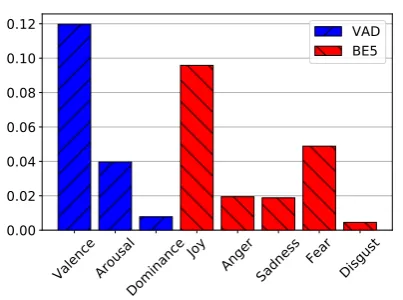
Figure 2: Relative importance of the affec-tive variables of VAD and BE5 for predicting the alternative format, respectively; measured in drop of Pearsonr when using all variables vs. omitting the one under scrutiny.
Previous work has limited itself to data sets compris-ing all three VAD dimensions with the implicit be-lief that Dominance provides valuable affective infor-mation which is important for ERM. However, since only about half of the data sets developed in psy-chology labs (and even less provided by NLP groups) actuallydocomprise Dominance, this decision mas-sively decreases the amount of data sets at hand. To resolve this dilemma, the following experiment aims at quantifying the relative importance of the different affective variables of the VAD and the BE5 format.
Our set-up works as follows: For each data set from Table 1 that includes the Dominance dimen-sion, we trained one LR model11(Section 3.1) to map VAD to BE5 and another one to map BE5 to VAD (‘dim2cat’ and ‘cat2dim’ for short) applying 10-fold cross-validation. The resulting performance measure-ments were averaged over all data sets.
We then repeated this procedure once for each VAD
dimension (when mapping dim2cat) and each BE5 category (when mapping cat2dim), omitting one of the dimensions/categories from the source representation in every iteration, thus constituting a kind of ablation experiment. Next, for each of the “incomplete” models, we computed the difference between its performance and the performance of the “complete” model (not lacking any of the variables). Now, we can use this loss of performance as an estimate of therelative importanceof the respective left-out dimension or category. The results of this experiment are depicted in Figure 2.
As can be seen, regarding VAD, Valence is by far the most important dimension with a performance drop of .12 when ablating it. In turn, Arousal, the second-best dimension only increases performance by .04, whereas Dominance contributes to less than .01 of the performance. Similarly, for Basic Emotions, Joy is the most important category, although BE5 seems to distribute the affective information more equally across its variables (with the exception of Disgust which contributes far less than .01 to the performance).
Since our data suggest that Dominance plays only a minor role within the VAD framework, we will notlimit our further experiments to data sets including this dimension—as it was done in previous work (Section 2)—but rather include the large variety of bi-representational data sets which leave it out (see Table 1).
4.2 Monolingual Representation Mapping
In this experiment, we compared the performance of the WEI baseline, the LR- and KNN-based reference methods for ERM and our newly proposed FFNN model. For each of these methods and data sets in Table 1, we trained one model to map cat2dim and another one to map dim2cat (for the ERM methods) or to predict VA(D) ratings and BE5 ratings based on word embeddings for the WEI baseline. The whole process was conducted using 10-fold cross-validation where we used identical train/test splits for all methods.12 The results of this experiment are displayed in Table 4a, only showing the average
values over VA(D) and BE5, respectively, but allowing for an easy comparison between the different approaches.
11
Linear regression was used because it does not comprise any hyperparameters that might heavily influence the outcome of this experiment (thus leading to greater generality of the results).
cat2dim dim2cat
WEI LR KNN FFNN WEI LR KNN FFNN en 1 .685 .841 .840 .853** .818 .844 .868 .877* Avg. .688 .828 .832 .844 .757 .806 .831 .839
(a) Results of the monolingual experiment for the WEI base-line, two reference methods (LR and KNN) as well as our FFNN model in Pearsonr. Best result per data set and emotion format in bold, second best result underlined; significant difference (paired two-tailed t-test) over the second best system marked with “*”, “**”, or “***” forp < .05,.01, or.001, respectively.
Val Aro Dom Joy Ang Sad Fea Dsg en 1 .969 .741 .848 .962 .876 .871 .873 .805 Avg. .956 .754 .810 .932 .855 .816 .838 .752
(b) Results of the monolingual experiment per affective dimen-sion in Pearson r. Color indicates outperforming human SHR ( blue ), being outperformed ( red ) or SHR not being reported (white; “—” meaning that the respective variable is not included).
Table 4: Results of the monolingual experiment. As can be seen, all of the ERM
approaches (LR, KNN, FFNN) per-form more than 10%-points bet-ter than the state of the art in word emotion induction (WEI) for VAD prediction and at least about 5%-points better for BE5 predic-tions (on average over all data sets and affective variables). This find-ing already strongly suggests that ERM is the superior approach for automatic lexicon creation, given that the required data are avail-able. This might be especially use-ful in situations where, say, large VAD but only small BE5 lexicons are available for a given language (see Section 4.4). Regarding the ordering of the ERM approaches, KNN outperforms LR in almost all cases. The advantage is more pronounced for mapping dim2cat (2.5%-points difference on aver-age) than cat2dim (.4%-points dif-ference). On top of that, our pro-posed FFNN model outperforms KNN by a 1.2%-point margin for cat2dim and a .8%-point margin for dim2cat (again as average over all data sets) performing best on each single data set. Regarding the 16
cases of Table 4a (8 data sets times two mapping directions), the performance gain of FFNN compared to the respective second best system is statistically significant13 in all but 2 cases. The differences be-tween the individual ERM approaches might appear quite small, yet become a lot more meaningful considering the proximity to human annotation capabilities as discussed in the following paragraphs.
Table 4b displays the performance figures of the FFNN model relative to each affective variable. As can be seen, among VAD, Valence is the easiest dimension to predict (r = .956on average over all data sets) whereas for Arousal the performance is worst . Similarly, for BE5, Joy obtains the best values (r =.932) and Disgust is the hardest to predict. Interestingly, the overall ordering of performance within the two formats is consistent with the ordering of human reliability (see Table 3).
Comparing our system performance against human SHR (based on 20 participants per study; see Section 3.4), again our approach seems to be highly reliable (color coding of Table 4b). In particular, ERM using the FFNN model outperforms SHR in over half of the applicable cases (25 of 38). For mapping cat2dim it surpasses human reliability in all but 2 cases whereas when mapping dim2cat the reported SHR is surpassed in over half of the cases (14 out of 25).
This result, astonishing as it might appear, is yet consistent with findings from previous work which, in turn, were based on ISR (not on SHR) data (Buechel and Hahn, 2017a; Buechel and Hahn, 2018a). We conclude that in the monolingual set-up, ERM using the FFNN model substantially outperforms current capacities in word emotion induction and is even more reliable than a medium sized human rating study. Thus these automatically produced ratings should be cautiously attributed gold standard quality.
4.3 Crosslingual Representation Mapping
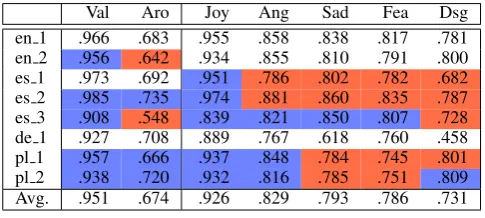
Val Aro Joy Ang Sad Fea Dsg en 1 .966 .683 .955 .858 .838 .817 .781 en 2 .956 .642 .934 .855 .810 .791 .800 es 1 .973 .692 .951 .786 .802 .782 .682 es 2 .985 .735 .974 .881 .860 .835 .787 es 3 .908 .548 .839 .821 .850 .807 .728 de 1 .927 .708 .889 .767 .618 .760 .458 pl 1 .957 .666 .937 .848 .784 .745 .801 pl 2 .938 .720 .932 .816 .785 .751 .809 Avg. .951 .674 .926 .829 .793 .786 .731
Table 5: Results of crosslingual experiment in Pearson r. Color indicates outperforming human SHR ( blue ), being outperformed ( red ) or SHR not being reported (white).
In the crosslingual set-up, we make use of the fact that our model does not rely on any language-specific information, since the cat-egories/dimensions describe supposedly uni-versal affective states rather than linguistic entities. Thus, models trained on one lan-guage could, in theory, be applied to another one without any need for adaptation. This ca-pability comes in handy when only data sets according tooneemotion format exist for a given language. In such cases we could still train our model on data available for other languages and use it to produce new ratings for the language in focus. This section aims at estimating the performance of lexicons de-rived in this manner.
For each of the data sets in Table 1, we trained FFNN models to map cat2dim and dim2cat, respec-tively. We trained on each gold lexicon that did not cover the language of the data set under scrutiny (e.g., for testing on en 1, the models were trained on all Spanish, Polish and German data sets, but not on en 2). Since this set-up leads to fixed train and test sets, we did not perform cross-validation. For comparability between data sets, the Dominance dimension was excluded for this experiment.
Overall, the results remained astonishingly stable compared to the monolingual set-up, with perfor-mance figures for Valence and Joy dropping by less than 1%-point on average over all data sets (see Table 5). Also, Anger, Sadness, Fear and Disgust only suffer a moderate decrease of about 5%-points at most—only the performance of Arousal decreased more than that.
A possible explanation for these strong results is the marked increase in the amount of training data that comes along with training on the majority of the available data (independent of language). This circumstance seems to counterbalance much of the negative effects that may arise in this crosslingual applications.
In comparison to SHR, the ERM approach still turns out to work quite well. Regarding VA, we outperform human reliability in 8 of 10 cases. Concerning BE5, SHR was beaten in about half of the cases (11 of 25). We conclude that, although the capability of our mapping approach suffers a bit in the crosslingual set-up, it still produces very accurate predictions and can thus be attestedneargold quality, at least.
4.4 Automatic Lexicon Construction for Diverse Languages
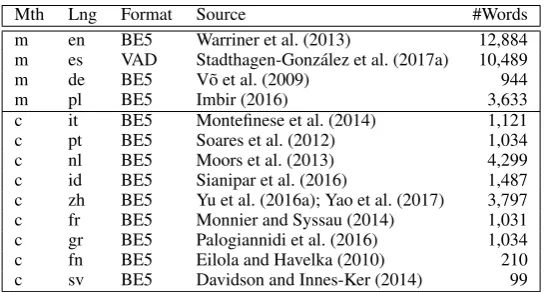
After the positive evaluation of the FFNN model for ERM, the last bit of our contributions is to apply the created models to a wide variety of data sets which so far bear emotion ratings foroneformat only (either VA(D) or BE5). Based on the experiments reported so far, we claim that these have gold quality (for the monolingual approach, Section 4.2) or near-gold quality (for the crosslingual approach, Section 4.3).
For the monolingual approach, we train our model on the data set on which we achieved the highest performance in Section 4.2 for the respective language (assuming this hints at particularly “clean” data). In contrast, in the crosslingual set-up, training data are acquired by concatenatingallthe available data sets from Table 1 (consequently ignoring Dominance for compatibility).
5 Conclusion
Mth Lng Format Source #Words
m en BE5 Warriner et al. (2013) 12,884 m es VAD Stadthagen-Gonz´alez et al. (2017a) 10,489 m de BE5 V˜o et al. (2009) 944
m pl BE5 Imbir (2016) 3,633
c it BE5 Montefinese et al. (2014) 1,121 c pt BE5 Soares et al. (2012) 1,034 c nl BE5 Moors et al. (2013) 4,299 c id BE5 Sianipar et al. (2016) 1,487 c zh BE5 Yu et al. (2016a); Yao et al. (2017) 3,797 c fr BE5 Monnier and Syssau (2014) 1,031 c gr BE5 Palogiannidi et al. (2016) 1,034 c fn BE5 Eilola and Havelka (2010) 210 c sv BE5 Davidson and Innes-Ker (2014) 99
Table 6: Overview of automatically constructed emotion lexi-cons; mapping methodology (monolingual or crosslingual), lan-guage (codes according to ISO 639-1), target emotion format, source lexicon of the mapping process and number of previously unknown ratings (excluding those present in other lexicons). In this paper, we addressed the
rel-atively new task ofemotion repre-sentation mapping. It aims at trans-forming emotion ratings for lexical units from one emotion representa-tion format into another one, e.g., mapping from Valence-Arousal-Dominance representations to Ba-sic Emotion ones. Based on a large-scale evaluation we gathered solid empirical evidence that the proposed neural network model consistently outperforms the pre-vious state-of-the-art performance figures in both word emotion in-duction and emotion representation mapping. Hence, the approach we propose currently constitutes the best-performing method for auto-matic emotion lexicon creation.
We also proposed a novel methodology for comparison against human rating capabilities based on normalized split-half reliability scores. For the first time, this allows for a large-scale evaluation against human performance. Our experimental data suggest that our models perform competitive relative to human assessments, even in cross-lingual applications, thus producing (near) gold quality data. We take this as a strong hint towards the reliability of the methods we propose.
Finally, we used these models to produce new emotion lexicons for 13 typologically diverse languages which are publicly available along with our code and experimental data (see Footnote 1).
Acknowledgements
We thank the anonymous reviewers for their thoughtful comments and suggestions.
References
Jonathan Baxter. 1997. A Bayesian/information theoretic model of learning to learn via multiple task sampling.
Machine Learning, 28(1):7–39.
Piotr Bojanowski, Edouard Grave, Armand Joulin, and Tomas Mikolov. 2017. Enriching word vectors with
subword information. Transactions of the Association for Computational Linguistics, 5:135–146.
Margaret M. Bradley and Peter J. Lang. 1999. Affective Norms for English Words (ANEW): Stimuli, instruction
manual and affective ratings. Technical Report C-1, The Center for Research in Psychophysiology, University of Florida, Gainesville, Florida, USA.
Benny B. Briesemeister, Lars Kuchinke, and Arthur M. Jacobs. 2011. Discrete Emotion Norms for Nouns: Berlin
Affective Word List (DENN–BAWL).Behavior Research Methods, 43(2):441.
Sven Buechel and Udo Hahn. 2016. Emotion analysis as a regression problem: Dimensional models and their
implications on emotion representation and metrical evaluation. In ECAI 2016 — Proceedings of the 22nd
European Conference on Artificial Intelligence. Including Prestigious Applications of Artificial Intelligence (PAIS 2016), volume 285 ofFrontiers in Artificial Intelligence and Applications, pages 1114–1122, The Hague, The Netherlands, August 29 – September 2, 2016.
Sven Buechel and Udo Hahn. 2017a. A flexible mapping scheme for discrete and dimensional emotion
repre-sentations: Evidence from textual stimuli. InCogSci 2017 — Proceedings of the 39th Annual Meeting of the
Sven Buechel and Udo Hahn. 2017b. EMOBANK: Studying the impact of annotation perspective and
represen-tation format on dimensional emotion analysis. InEACL 2017 — Proceedings of the 15th Conference of the
European Chapter of the Association for Computational Linguistics, volume 2, short papers, pages 578–585, Valencia, Spain, April 3–7, 2017.
Sven Buechel and Udo Hahn. 2018a. Representation mapping: A novel approach to generate high-quality
multi-lingual emotion lexicons. In LREC 2018 — Proceedings of the 11th International Conference on Language
Resources and Evaluation, pages 184–191, Miyazaki, Japan, May 7–12, 2018.
Sven Buechel and Udo Hahn. 2018b. Word emotion induction for multiple languages as a deep multi-task learning
problem. In NAACL-HLT 2018 — Proceedings of the 2018 Conference of the North American Chapter of
the Association for Computational Linguistics: Human Language Technologies, volume 1, long papers, pages 1907–1918, New Orleans, Louisiana, USA, June 1–6, 2018.
Rafael A. Calvo and Sunghwan Mac Kim. 2013. Emotions in text: Dimensional and categorical models.
Compu-tational Intelligence, 29(3):527–543.
Jean C. Carletta. 1996. Assessing agreement on classification tasks: The Kappa statistic.Computational
Linguis-tics, 22(2):249–254.
Rich Caruana. 1997. Multitask learning.Machine Learning, 28(1):41–75.
Per Davidson and ˚Ase Innes-Ker. 2014. Valence and arousal norms for Swedish affective words. Technical Report
Volume 14, No. 2, Lund University, Lund, Sweden.
Harris Drucker. 1997. Improving regressors using boosting techniques. InICML 1997 — Proceedings of the 14th
International Conference on Machine Learning, pages 107–115, Nashville, Tennessee, USA, July 8–12, 1997.
Steven Du and Xi Zhang. 2016. Aicyber’s system for IALP 2016 Shared Task: Character-enhanced word vectors
and boosted neural networks. In IALP 2016 — Proceedings of the 2016 International Conference on Asian
Language Processing, pages 161–163, Tainan, Taiwan, November 21–23, 2016.
Tiina M. Eilola and Jelena Havelka. 2010. Affective norms for 210 British English and Finnish nouns. Behavior
Research Methods, 42(1):134–140.
Paul Ekman. 1992. An argument for basic emotions.Cognition & Emotion, 6(3-4):169–200.
Andrea Esuli and Fabrizio Sebastiani. 2005. Determining the semantic orientation of terms through gloss
classifi-cation. InCIKM 2005 — Proceedings of the 14th ACM International Conference on Information and Knowledge
Management, pages 617–624, Bremen, Germany, October 31 – November 05, 2005.
Pilar Ferr´e, Marc Guasch, Natalia Mart´ınez-Garc´ıa, Isabel Fraga, and Jos´e Antonio Hinojosa. 2017. Moved by
words: Affective ratings for a set of 2,266 Spanish words in five discrete emotion categories. Behavior Research
Methods, 49(3):1082–1094.
Vasileios Hatzivassiloglou and Kathleen R. McKeown. 1997. Predicting the semantic orientation of adjectives. In
ACL-EACL 1997 — Proceedings of the 35th Annual Meeting of the Association for Computational Linguistics & 8th Conference of the European Chapter of the Association for Computational Linguistics, pages 174–181, Madrid, Spain, July 7–12, 1997.
Jos´e Antonio Hinojosa, Natalia Mart´ınez-Garc´ıa, Cristina Villalba-Garc´ıa, Uxia Fern´andez-Folgueiras, Alberto S´anchez-Carmona, Miguel Angel Pozo, and Pedro R. Montoro. 2016a. Affective norms of 875 Spanish words
for five discrete emotional categories and two emotional dimensions. Behavior Research Methods, 48(1):272–
284.
Jos´e Antonio Hinojosa, Irene Rinc´on-P´erez, M. Ver´onica Romero-Ferreiro, Natalia Mart´ınez-Garc´ıa, Cristina Villalba-Garc´ıa, Pedro R. Montoro, and Miguel Angel Pozo. 2016b. The Madrid Affective Database for
Span-ish (MADS): Ratings of dominance, familiarity, subjective age of acquisition and sensory experience. PLoS
One, 11(5):e0155866.
Kurt Hornik. 1991. Approximation capabilities of multilayer feedforward networks.Neural Networks, 4(2):251 –
257.
Kamil K. Imbir. 2016. Affective Norms for 4900 Polish Words Reload (ANPW R): Assessments for valence,
arousal, dominance, origin, significance, concreteness, imageability and, age of acquisition. Frontiers in
Diederik Kingma and Jimmy Ba. 2015. ADAM: A method for stochastic optimization. InICLR 2015 — Pro-ceedings of the 3rd International Conference on Learning Representations, pages 1–15, San Diego, California, USA, May 7–9, 2015.
Maximilian K¨oper and Sabine Schulte im Walde. 2016. Automatically generated affective norms of abstractness,
arousal, imageability and valence for 350,000 German lemmas. In LREC 2016 — Proceedings of the 10th
International Conference on Language Resources and Evaluation, pages 2595–2598, Portoroˇz, Slovenia, May 23–28, 2016.
Tomas Mikolov, Ilya Sutskever, Kai Chen, Gregory S. Corrado, and Jeffrey Dean. 2013. Distributed
represen-tations of words and phrases and their compositionality. In NIPS 2013 — Proceedings of the 27th Annual
Conference on Neural Information Processing Systems, pages 3111–3119, Lake Tahoe, Nevada, USA, Decem-ber 5–10, 2013.
Saif M. Mohammad and Felipe Bravo-Marquez. 2017. Emotion intensities in tweets. In*SEM 2017 —
Pro-ceedings of the 6th Joint Conference on Lexical and Computational Semantics, pages 65–77, Vancouver, British Columbia, Canada, August 3–4, 2017.
Catherine Monnier and Arielle Syssau. 2014. Affective norms for French words (FAN). Behavior Research
Methods, 46(4):1128–1137.
Maria Montefinese, Ettore Ambrosini, Beth Fairfield, and Nicola Mammarella. 2014. The adaptation of the
Affective Norms for English Words (ANEW) for Italian.Behavior Research Methods, 46(3):887–903.
Agnes Moors, Jan De Houwer, Dirk Hermans, Sabine Wanmaker, Kevin van Schie, Anne-Laura Van Harmelen, Maarten De Schryver, Jeffrey De Winne, and Marc Brysbært. 2013. Norms of valence, arousal, dominance,
and age of acquisition for 4,300 Dutch words. Behavior Research Methods, 45(1):169–177.
Elisavet Palogiannidi, Polychronis Koutsakis, Elias Iosif, and Alexandros Potamianos. 2016. Affective lexicon
creation for the Greek language. InLREC 2016 — Proceedings of the 10th International Conference on
Lan-guage Resources and Evaluation, pages 2867–2872, Portoroˇz, Slovenia, 23–28 May 2016.
Jeffrey Pennington, Richard Socher, and Christopher Manning. 2014. GloVe: Global vectors for word
represen-tation. InEMNLP 2014 — Proceedings of the 2014 Conference on Empirical Methods in Natural Language
Processing, pages 1532–1543, Doha, Qatar, October 25–29, 2014.
Ana P. Pinheiro, Marcelo Dias, Jo˜ao Pedrosa, and Ana P. Soares. 2017. Minho Affective Sentences (MAS):
Probing the roles of sex, mood, and empathy in affective ratings of verbal stimuli.Behavior Research Methods,
49(2):698–716.
Jaime Redondo, Isabel Fraga, Isabel Padr´on, and Montserrat Comesa˜na. 2007. The Spanish adaptation of ANEW
(Affective Norms for English Words).Behavior Research Methods, 39(3):600–605.
Monika Riegel, Małgorzata Wierzba, Marek Wypych, Łukasz ˙Zurawski, Katarzyna Jednor´og, Anna Grabowska,
and Artur Marchewka. 2015. Nencki Affective Word List (NAWL): The cultural adaptation of the Berlin
Affective Word List–Reloaded (BAWL–R) for Polish.Behavior Research Methods, 47(4):1222–1236.
Sara Rosenthal, Preslav I. Nakov, Svetlana Kiritchenko, Saif M. Mohammad, Alan Ritter, and Veselin Stoyanov.
2015. SemEval 2015 Task 10: Sentiment analysis in Twitter. In SemEval 2015 — Proceedings of the 9th
International Workshop on Semantic Evaluation @ NAACL-HLT 2015, pages 451–463, Denver, Colorado, USA, June 4–5, 2015.
Samira Shaikh, Kit Cho, Tomek Strzalkowski, Laurie Feldman, John Lien, Ting Liu, and George Aaron Broadwell. 2016. ANEW+: Automatic expansion and validation of affective norms of words lexicons in multiple languages. In LREC 2016 — Proceedings of the 10th International Conference on Language Resources and Evaluation, pages 1127–1132, Portoroˇz, Slovenia, 23–28 May 2016.
Agnes Sianipar, Pieter van Groenestijn, and Ton Dijkstra. 2016. Affective meaning, concreteness, and subjective
frequency norms for Indonesian words. Frontiers in Psychology, 7:#1907.
Ana Paula Soares, Montserrat Comesa˜na, Ana P. Pinheiro, Alberto Sim˜oes, and Carla Sofia Frade. 2012. The
adaptation of the Affective Norms for English Words (ANEW) for European Portuguese. Behavior Research
Methods, 44(1):256–269.
Nitish Srivastava, Geoffrey E. Hinton, Alex Krizhevsky, Ilya Sutskever, and Ruslan Salakhutdinov. 2014. Dropout:
A simple way to prevent neural networks from overfitting. Journal of Machine Learning Research, 15:1929–
Hans Stadthagen-Gonz´alez, Pilar Ferr´e, Miguel A. P´erez-S´anchez, Constance Imbault, and Jos´e Antonio Hinojosa. 2017a. Norms for 10,491 Spanish words for five discrete emotions: Happiness, disgust, anger, fear, and sadness.
Behavior Research Methods. Available:https://doi.org/10.3758/s13428-017-0962-y.
Hans Stadthagen-Gonzalez, Constance Imbault, Miguel A. P´erez-S´anchez, and Marc Brysbært. 2017b. Norms of
valence and arousal for 14,031 Spanish words. Behavior Research Methods, 49(1):111–123.
Ryan A. Stevenson, Joseph A. Mikels, and Thomas W. James. 2007. Characterization of the Affective Norms for
English Words by discrete emotional categories. Behavior Research Methods, 39(4):1020–1024.
Carlo Strapparava and Rada Mihalcea. 2007. SemEval 2007 Task 14: Affective text. In SemEval 2007 —
Proceedings of the 4th International Workshop on Semantic Evaluations @ ACL 2007, pages 70–74, Prague, Czech Republic, June 23–24, 2007.
Peter D. Turney and Michael L. Littman. 2003. Measuring praise and criticism: Inference of semantic orientation
from association. ACM Transactions on Information Systems, 21(4):315–346.
Melissa L. H. V˜o, Markus Conrad, Lars Kuchinke, Karolina Urton, Markus J. Hofmann, and Arthur M. Jacobs.
2009. The Berlin Affective Word List Reloaded (BAWL–R). Behavior Research Methods, 41(2):534–538.
Henrica C. W. de Vet, Lidwine B. Mokkink, David G. Mosmuller, and Caroline B. Terwee. 2017. Spearman-Brown prophecy formula and Cronbach’s alpha: Different faces of reliability and opportunities for new
appli-cations. Journal of Clinical Epidemiology, 85:45–49.
Amy Beth Warriner, Victor Kuperman, and Marc Brysbært. 2013. Norms of valence, arousal, and dominance for
13,915 English lemmas. Behavior Research Methods, 45(4):1191–1207.
Małgorzata Wierzba, Monika Riegel, Marek Wypych, Katarzyna Jednor´og, Paweł Turnau, Anna Grabowska, and
Artur Marchewka. 2015. Basic emotions in the Nencki Affective Word List (NAWL BE): New method of
classifying emotional stimuli. PLoS One, 10(7):e0132305.
Zhao Yao, Jia Wu, Yanyan Zhang, and Zhenhong Wang. 2017. Norms of valence, arousal, concreteness,
familiar-ity, imageabilfamiliar-ity, and context availability for 1,100 Chinese words. Behavior Research Methods, 49(4):1374–
1385.
Liang-Chih Yu, Lung-Hao Lee, Shuai Hao, Jin Wang, Yunchao He, Jun Hu, K. Robert Lai, and Xuejie Zhang.
2016a. Building Chinese affective resources in valence-arousal dimensions. InNAACL-HLT 2016 —
Proceed-ings of the 2016 Conference of the North American Chapter of the Association for Computational Linguistics: Human Language Technologies, pages 540–545, San Diego, California, USA, June 12–17, 2016.
Liang-Chih Yu, Lung-Hao Lee, and Kam-Fai Wong. 2016b. Overview of the IALP 2016 Shared Task on
dimen-sional sentiment analysis for Chinese words. InIALP 2016 — Proceedings of the 2016 International Conference