Automatic Estimation of Word Significance oriented for
Speech-based Information Retrieval
Takashi Shichiri Graduate School of Science and Tech.
Ryukoku University Seta, Otsu 520-2194, Japan
Hiroaki Nanjo Faculty of Science and Tech.
Ryukoku University Seta, Otsu 520-2194, Japan
Takehiko Yoshimi Faculty of Science and Tech.
Ryukoku University Seta, Otsu 520-2194, Japan
Abstract
Automatic estimation of word significance oriented for speech-based Information Re-trieval (IR) is addressed. Since the sig-nificance of words differs in IR, automatic speech recognition (ASR) performance has been evaluated based on weighted word er-ror rate (WWER), which gives a weight on errors from the viewpoint of IR, instead of word error rate (WER), which treats all words uniformly. A decoding strategy that minimizes WWER based on a Minimum Bayes-Risk framework has been shown, and the reduction of errors on both ASR and IR has been reported. In this paper, we propose an automatic estimation method for word significance (weights) based on its influence on IR. Specifically, weights are estimated so that evaluation measures of ASR and IR are equivalent. We apply the proposed method to a speech-based information retrieval sys-tem, which is a typical IR syssys-tem, and show that the method works well.
1 Introduction
Based on the progress of spoken language process-ing, the main target of speech processing has shifted from speech recognition to speech understanding. Since speech-based information retrieval (IR) must extract user intention from speech queries, it is thus a typical speech understanding task. IR typically searches for appropriate documents such as news-paper articles or Web pages using statistical
match-ing for a given query. To define the similarity be-tween a query and documents, the word vector space model or “bag-of-words” model is widely adopted, and such statistics as the TF-IDF measure are intro-duced to consider the significance of words in the matching. Therefore, when using automatic speech recognition (ASR) as a front-end of such IR systems, the significance of the words should be considered in ASR; words that greatly affect IR performance must be detected with higher priority.
Based on such a background, ASR evaluation should be done from the viewpoint of the quality of mis-recognized words instead of quantity. From this point of view, word error rate (WER), which is the most widely used evaluation measure of ASR accuracy, is not an appropriate evaluation measure when we want to use ASR systems for IR because all words are treated identically in WER. Instead of WER, weighted WER (WWER), which consid-ers the significance of words from a viewpoint of IR, has been proposed as an evaluation measure for ASR. Nanjo et.al showed that the ASR based on the Minimum Bayes-Risk framework could reduce WWER and the WWER reduction was effective for key-sentence indexing and IR (H.Nanjo et al., 2005).
For well-defined IRs such as relational database retrieval (E.Levin et al., 2000), significant words (=keywords) are obvious. On the contrary, de-termining significant words for more general IR task (T.Misu et al., 2004) (C.Hori et al., 2003) is not easy. Moreover, even if significant words are given, the weight of each word is not clear. To properly and easily integrate the ASR system into an IR sys-tem, the weights of words should be determined au-tomatically. Conventionally, they are determined by an experienced system designer. Actually, in con-ventional studies of minimum WWER decoding for key-sentence indexing (H.Nanjo and T.Kawahara, 2005) and IR (H.Nanjo et al., 2005), weights were defined based on TF-IDF values used in back-end indexing or IR systems. These values reflect word significance for IR, but are used without having been proven suitable for IR-oriented ASR. In this paper, we propose an automatic estimation method of word weights based on the influences on IR.
2 Evaluation Measure of ASR for IR
2.1 Weighted Word Error Rate (WWER)
The conventional ASR evaluation measure, namely, word error rate (WER), is defined as Equation (1).
WER= I +D+S
N (1)
Here, N is the number of words in the correct tran-script, I is the number of incorrectly inserted words,
D is the number of deletion errors, and S is the
num-ber of substitution errors. For each utterance, DP matching of the ASR result and the correct transcript is performed to identify the correct words and calcu-late WER.
Apparently in WER, all words are treated uni-formly or with the same weight. However, there must be a difference in the weight of errors, since several keywords have more impact on IR or the understanding of the speech than trivial functional words. Based on the background, WER is gener-alize and weighted WER (WWER), in which each word has a different weight that reflects its influence
ASR result : a b c d e f Correct transcript : a c d’ f g
DP result : C I C S C D
WWER= (VI+VD+VS)/VN
VN =va+vc+vd+vf+vg,VI=vb
VD =vg,VS = max(vd+ve, vd)
vi: weight of word i
Figure 1: Example of WWER calculation
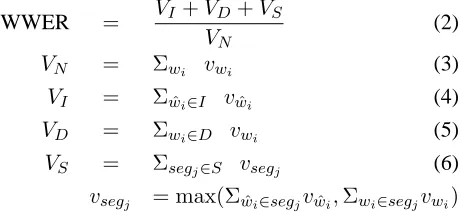
on IR, is introduced. WWER is defined as follows.
WWER = VI+VD+VS
VN
(2)
VN = Σwi vwi (3)
VI = Σwˆi∈I vwˆi (4)
VD = Σwi∈D vwi (5)
VS = Σsegj∈S vsegj (6)
vsegj = max(Σwˆi∈segjvwˆi,Σwi∈segjvwi)
Here,vwiis the weight of wordwi, which is thei-th
word of the correct transcript, andvwˆi is the weight
of wordwˆi, which is thei-th word of the ASR
re-sult. segj represents the j-th substituted segment,
andvsegj is the weight of segmentsegj. For
seg-mentsegj, the total weight of the correct words and
the recognized words are calculated, and then the larger one is used as vsegj. In this work, we use
alignment for WER to identify the correct words and calculate WWER. Thus, WWER equals WER if all word weights are set to1. In Fig. 1, an example of a WWER calculation is shown.
WWER calculated based on ideal word weights represents IR performance degradation when the ASR result is used as a query for IR. Thus, we must perform ASR to minimize WWER for speech-based IR.
2.2 Minimum Bayes-Risk Decoding
Next, a decoding strategy to minimize WWER based on the Minimum Bayes-Risk framework (V.Goel et al., 1998) is described.
decision rule minimizing Bayes-risk is given as fol-lows. It is equivalent to the orthodox ASR (maxi-mum likelihood ASR) when a 0/1 loss function is used.
The minimization of WWER is realized us-ing WWER as a loss function (H.Nanjo and T.Kawahara, 2005) (H.Nanjo et al., 2005).
3 Estimation of Word Weights
A word weight should be defined based on its in-fluence on IR. Specifically, weights are estimated so that WWER will be equivalent to an IR perfor-mance degradation. For an evaluation measure of IR performance degradation, IR score degradation ratio (IRDR), which is described in detail in Section 4.2, is introduced in this work. The estimation of weights is performed as follows.
1. Query pairs of a spoken-query recognition re-sult and its correct transcript are set as training data. For each query pairm, do procedures 2 to 5.
2. Perform IR with a correct transcript and calcu-late IR scoreRm.
3. Perform IR with a spoken-query ASR result and calculate IR scoreHm.
4. Calculate IR score degradation ratio (IRDRm = 1−HRmm).
5. Calculate WWERm.
6. Estimate word weights so that WWERm and
IRDRmare equivalent for all queries.
Practically, procedure 6 is defined to minimize the mean square error between both evaluation mea-sures (WWER and IRDR) as follows.
F(x) =
Here, x is a vector that consists of the weights of words.Em(x)is a function that determines the sum
of the weights of mis-recognized words. Cm(x)is
a function that determines the sum of the weights of the correct transcript. Em(x) andCm(x)
corre-spond to the numerator and denominator of Equation (2), respectively.
In this work, we adopt the steepest decent method to determine the weights that give minimal F(x). Initially, all weights are set to 1, and then each word weight (xk) is iteratively updated based on Equation
(9) until the mean square error between WWER and IRDR is converged.
4 Weight Estimation on Orthodox IR
4.1 WEB Page Retrieval
In this paper, weight estimation is evaluated with an orthodox IR system that searches for appropri-ate documents using statistical matching for a given query. The similarity between a query and docu-ments is defined by the inner product of the feature vectors of the query and the specific document. In this work, a feature vector that consists of TF-IDF values is used. The TF-IDF value is calculated for each wordtand document (query)ias follows.
TF-IDF(t, i) = tft,i
Here, term frequency tft,i represents the
of documents that contain wordt. A word that curs frequently in a specific document and rarely oc-curs in other documents has a large TF-IDF value. We normalize TF values using length of the docu-ment (DLi) and average document lengths over all
documents (avglen) because longer document have more words and TF values tend to be larger.
For evaluation data, web retrieval task “NTCIR-3 WEB task”, which is distributed by NTCIR (NTC, ), is used. The data include web pages to be searched, queries, and answer sets. For speech-based informa-tion retrieval, 470 query utterances by 10 speakers are also included.
4.2 Evaluation Measure of IR
For an evaluation measure of IR, discount cumula-tive gain (DCG) is used, and described below.
DCG(i) = ⎧ ⎨
⎩
g(1) ifi= 1
DCG(i−1) + g(i)
log(i) otherwise (11)
g(i) = ⎧ ⎪ ⎪ ⎪ ⎪ ⎨
⎪ ⎪ ⎪ ⎪ ⎩
h ifdi ∈H
a else ifdi∈A
b else ifdi∈B
c otherwise
Here, di represents i-th retrieval result
(docu-ment). H, A, and B represent a degree of relevance; H is labeled to documents that are highly relevant to the query. A and B are labeled to documents that are relevant and partially relevant to the query, respec-tively. “h”, “a”, “b”, and “c” are the gains, and in this work,(h, a, b, c) = (3,2,1,0)is adopted. When re-trieved documents include many relevant documents that are ranked higher, the DCG score increases.
In this work, word weights are estimated so that WWER and IR performance degradation will be equivalent. For an evaluation measure of IR perfor-mance degradation, we define IR score degradation ratio (IRDR) as below.
IRDR= 1−H
R (12)
Rrepresents a DCG score calculated with IR results by text query, andH represents a DCG score given by the ASR result of the spoken query. IRDR repre-sents the ratio of DCG score degradation affected by ASR errors.
4.3 Automatic speech recognition system
In this paper, ASR system is set up with follow-ing acoustic model, language model and a decoder Julius rev.3.4.2(A.Lee et al., 2001). As for acous-tic model, gender independent monophone model (129 states, 16 mixtures) trained with JNAS corpus are used. Speech analysis is performed every 10 msec. and a 25 dimensional parameter is computed (12 MFCC + 12ΔMFCC +ΔPower). For language model, a word trigram model with the vocabulary of 60K words trained with WEB text is used.
Generally, trigram model is used as acoustic model in order to improve the recognition accuracy. However, monophone model is used in this paper, since the proposed estimation method needs recog-nition error (and IRDR).
4.4 Results
4.4.1 Correlation between Conventional ASR
and IR Evaluation Measures
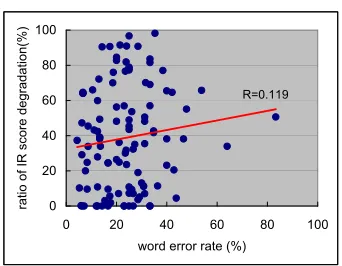
We analyzed the correlations of conventional ASR evaluation measures with IRDR by selecting appropriate test data as follows. First, ASR is per-formed for 470 spoken queries of an NTCIR-3 web task. Then, queries are eliminated whose ASR re-sults do not contain recognition errors and queries with which no IR results are retrieved. Finally, we selected 107 pairs of query transcripts and their ASR results as test data.
0 20 40 60 80 100
0 20 40 60 80 100 word error rate (%)
ratio of IR score degradation(%)
R=0.119
Figure 2: Correlation between ratio of IR score degradation and WER
0 20 40 60 80 100
0 20 40 60 80 100 keyword error rate (%)
ra
tio of IR
scor
e
degr
adati
on(
%)
R=0.224
Figure 3: Correlation between ratio of IR score degradation and KER
should be given a different weight based on its influ-ence on IR.
4.4.2 Correlation between WWER and IR
Evaluation Measure
In ASR for IR, since some words are significant, each word should have a different weight. Thus, we assume that each keyword has a positive weight, and non-keywords have zero weight. WWER calculated with these assumptions is then defined as weighted keyword error rate (WKER).
Using the same test data (107 queries), keyword weights were estimated with the proposed estima-tion method. The correlaestima-tion between IRDR and WKER calculated with the estimated word weights is shown in Figure 4. A high correlation between IRDR and WKER is confirmed (correlation coeffi-cient: 0.969). The result shows that the proposed method works well and proves that giving a differ-ent weight to each word is significant.
The proposed method enables us to extend
text-based IR systems to speech-text-based IR systems with typical text queries for the IR system, ASR results of the queries, and answer sets for each query. ASR results are not necessary since they can be substi-tuted with simulated texts that can be automatically generated by replacing some words with others. On the contrary, text queries and answer sets are indis-pensable and must be prepared. It costs too much to make answer sets manually since we should con-sider whether each answer is relevant to the query. For these reasons, it is difficult to apply the method to a large-scale speech-based IR system. An esti-mation method without hand-labeled answer sets is strongly required.
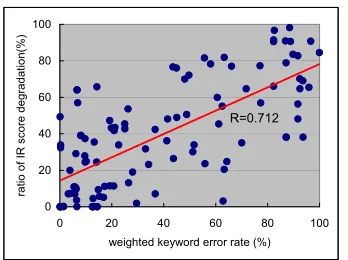
An estimation method without hand-labeled an-swer sets, namely, the unsupervised estimation of word weights, is also tested. Unsupervised estima-tion is performed as described in Secestima-tion 3. In un-supervised estimation, the IR result (document set) with a correct transcript is regarded as an answer set, namely, a presumed answer set, and it is used for IRDR calculation instead of a hand-labeled answer set.
The result (correlation between IRDR and WKER) is shown in Figure 5. Without hand-labeled answer sets, we obtained high correlation (0.712 of correlation coefficient) between IRDR and WKER. The result shows that the proposed estima-tion method is effective and widely applicable to IR systems since it requires only typical text queries for IR. With the WWER given by the estimated weights, IR performance degradation can be confidently pre-dicted. It is confirmed that the ASR approach to minimize such WWER, which is realized with de-coding based on a Minimum Bayes-Risk frame-work (H.Nanjo and T.Kawahara, 2005)(H.Nanjo et al., 2005), is effective for IR.
4.5 Discussion
0 20 40 60 80 100
0 20 40 60 80 100 weighted keyword error rate (%)
ra
tio of IR
scor
e
degr
adati
on(
%)
R=0.969
Figure 4: Correlation between ratio of IR score degradation and WKER (supervised estimation)
0 20 40 60 80 100
0 20 40 60 80 100 weighted keyword error rate (%)
ra
tio of IR
scor
e
degr
adati
o
n(
%)
R=0.712
Figure 5: Correlation between ratio of IR score degradation and WKER (unsupervised estimation)
avoided using a large amount of dummy data (pair of query and IRDR) with unsupervised estimation. In this work, although obtained correlation coefficient of 0.712 in unsupervised estimation, it is desirable to obtain much higher correlation. There are much room to improve unsupervised estimation method.
In addition, since typical queries for IR system will change according to the users, current topic, and so on, word weights should be updated accord-ingly. It is reasonable approach to update word weights with small training data which has been in-put to the system currently. For such update sys-tem, our estimation method, which may encounter the over-fitting problem to the small training data, may work as like as cache model (P.Clarkson and A.J.Robinson, 1997), which gives higher language model probability to currently observed words.
5 Conclusion
We described the automatic estimation of word sig-nificance for IR-oriented ASR. The proposed
esti-mation method only requires typical queries for the IR, and estimates weights of words so that WWER, which is an evaluation measure for ASR, will be equivalent to IRDR, which represents a degree of IR degradation when an ASR result is used as a query for IR. The proposed estimation method was evalu-ated on a web page retrieval task. WWER based on estimated weights is highly correlated with IRDR. It is confirmed that the proposed method is effective and we can predict IR performance confidently with such WWER, which shows the effectiveness of our proposed ASR approach minimizing such WWER for IR.
Acknowledgment: The work was partly supported
by KAKENHI WAKATE(B).
References
A.Lee, T.Kawahara, and K.Shikano. 2001. Julius – an open source real-time large vocabulary recognition en-gine. In Proc. EUROSPEECH, pages 1691–1694.
C.Hori, T.Hori, H.Isozaki, E.Maeda, S.Katagiri, and S.Furui. 2003. Deriving disambiguous queries in a spoken interactive ODQA system. In Proc. IEEE-ICASSP, pages 624–627.
E.Levin, S.Narayanan, R.Pieraccini, K.Biatov, E.Bocchieri, G.D.Fabbrizio, W.Eckert, S.Lee, A.Pokrovsky, M.Rahim, P.Ruscitti, and M.Walker. 2000. The AT&T-DARPA communicator mixed-initiative spoken dialogue system. In Proc. ICSLP.
H.Nanjo and T.Kawahara. 2005. A new ASR evalua-tion measure and minimum Bayes-risk decoding for open-domain speech understanding. In Proc. IEEE-ICASSP, pages 1053–1056.
H.Nanjo, T.Misu, and T.Kawahara. 2005. Minimum Bayes-risk decoding considering word significance for information retrieval system. In Proc. INTER-SPEECH, pages 561–564.
NTCIR project web page. http://research.nii.
ac.jp/ntcir/.
P.Clarkson and A.J.Robinson. 1997. Language Model Adaptation using Mixtures and an Exponentially De-caying cache. In Proc. IEEE-ICASSP, volume 2, pages 799–802.
T.Misu, K.Komatani, and T.Kawahara. 2004. Confirma-tion strategy for document retrieval systems with spo-ken dialog interface. In Proc. ICSLP, pages 45–48.