Dynamic and Static Prototype Vectors for Semantic Composition
Siva Reddy University of York, UK [email protected]
Ioannis P. Klapaftis University of York, UK [email protected]
Diana McCarthy Lexical Computing Ltd, UK [email protected]
Suresh Manandhar University of York, UK [email protected]
Abstract
Compositional Distributional Semantic methods model the distributional behav-ior of a compound word by exploiting the distributional behavior of its constituent words. In this setting, a constituent word is typically represented by a feature vec-tor conflating all the senses of that word. However, not all the senses of a constituent word are relevant when composing the se-mantics of the compound. In this paper, we present two different methods for se-lecting the relevant senses of constituent words. The first one is based on Word Sense Induction and creates a static multi prototype vectors representing the senses of a constituent word. The second creates a single dynamic prototype vector for each constituent word based on the distribu-tional properties of the other constituents in the compound. We use these proto-type vectors for composing the seman-tics of noun-noun compounds and evalu-ate on a compositionality-based similar-ity task. Our results show that: (1) se-lecting relevant senses of the constituent words leads to a better semantic compo-sition of the compound, and (2) dynamic prototypes perform better than static pro-totypes.
1 Introduction
Vector Space Models of lexical semantics have become a standard framework for representing a word’s meaning. Typically these methods (Sch¨utze, 1998; Pado and Lapata, 2007; Erk and Pad´o, 2008) utilize a bag-of-words model or
syntactic dependencies such as subject/verb, ob-ject/verb relations, so as to extract the features which serve as the dimensions of the vector space. Each word is then represented as a vector of the extracted features, where the frequency of co-occurrence of the word with each feature is used to calculate the vector component asociated with that feature. Figure 1 provides an example of two nouns assuming a bag-of-words model.
vector dimensions
animal buy apartment price rent kill house h30 60 90 55 45 10i
[image:1.595.309.539.382.422.2]hunting h90 15 12 20 33 90i
Figure 1: A hypothetical vector space model.
Compositional Distributional Semantic meth-ods formalise the meaning of a phrase by ap-plying a vector composition function on the vectors associated with its constituent words (Mitchell and Lapata, 2008; Widdows, 2008). For example, the result of vector addition to compose the semantics of house hunting from the vectors house and hunting is the vector h120, 75, 102, 75, 78, 100i.
As can be observed the resulting vector does not reflect the correct meaning of the compound
house hunting due to the presence of irrelevant co-occurrences such as animalorkill. These co-occurrences are relevant to one sense ofhunting, i.e. (the activity of hunting animals), but not to the sense ofhuntingmeant inhouse hunting, i.e. the activity of looking thoroughly. Given thathunting
has been associated with a single prototype (vec-tor) by conflating all of its senses, the application of a composition function ⊕ is likely to include irrelevant co-occurrences inhouse⊕hunting.
A potential solution to this problem would in-volve the following steps:
1. build separate prototype vectors for each of the senses ofhouseandhunting
2. select the relevant prototype vectors ofhouse
and hunting and then perform the semantic composition.
In this paper we present two methods (section 3) for carrying out the above steps on noun-noun compounds. The first one (section 3.1) applies Word Sense Induction (WSI) to identity differ-ent senses (also called static multi prototypes) of the constituent words of a compound noun and then applies composition by choosing the relevant senses. The second method (section 3.2) does not identify a fixed set of senses. Instead, it represents each constituent by a prototype vector which is built dynamically (also called as a dynamic proto-type) by activating only those contexts considered to be relevant to the constituent in the presence of the other constituent, and then performs the com-position on the dynamic prototypes. For perform-ing composition, we use vector composition func-tions.
Our evaluation (section 5) on a task for rat-ing similarity between noun-noun compound pairs shows: (1) sense disambiguation of constituents improves semantic composition and (2) dynamic prototypes are better than static multi prototypes for semantic composition.
2 Related work
Any distributional model that aims to describe lan-guage adequately needs to address the issue of compositionality. Many distributional composi-tion funccomposi-tions have been proposed in order to es-timate the semantics of compound words from the semantics of the constituent words. Mitchell and Lapata (2008) discussed and evaluated vari-ous composition functions for phrases consisting of two words. Among these, the simple additive (ADD) and simple multiplicative (MULT) func-tions are easy to implement and competitive with respect to existing sophisticated methods (Wid-dows, 2008; Vecchi et al., 2011).
Let us assume a target compound noun N that
consists of two nounsnandn0. Bold letters
repre-sent their corresponding distributional vectors ob-tained from corpora. ⊕(N)denotes the vector of
N obtained by applying the composition function
⊕onnandn0. Real number vi denote theith
co-occurrence inv. The functions ADD and MULT
following Mitchell and Lapata (2008) are defined as follows:
ADD: ⊕(N)=αn+βn0 i.e.⊕(N)i=αni+βn0i
MULT: ⊕(N)=nn0 i.e.⊕(N)i= ni. n0i
(1)
whereαandβare real numbers.
Relevant to our work is the work of Erk and Pad´o (2008) who utilize a structured vector space model. The prototype vector of a constituent word is initially built, and later refined by removing ir-relevant co-occurrences with the help of the selec-tional preferences of other constituents. The re-fined vectors are then used for the semantic com-position of the compound noun. The results are encouraging showing that polysemy is a problem in vector space models. Our approach differs to theirs in the way we represent meaning - we ex-periment with static multi prototypes and dynamic prototypes. Our vector space model is based on simple bag-of-words which does not require se-lectional preferences for sense disambiguation and can be applied to resource-poor languages.
There are several other researchers who tried to address polysemy for improving the performance of different tasks but not particularly to the task of semantic composition. Some of them are Navigli and Crisafulli (2010) for web search results clus-tering, Klapaftis and Manandhar (2010b) for tax-onomy learning, Reisinger and Mooney (2010) for word similarity and Korkontzelos and Manandhar (2009) for compositionality detection. In all cases, the reported results demonstrate that handling pol-ysemy lead to improved performance of the cor-responding tasks. This motivates our research for handling polysemy for the task of semantic com-position using two different methods described in the next section.
3 Sense Prototype Vectors for Semantic Composition
with respect to the other constituent. An exemplar is defined as a corpus instance of a target word.
These sense specific prototype vectors are then used for semantic composition. LetNbe the
com-pound noun with constituentsnandn0. Our aim
is to select the relevant senses ofnandn0.
3.1 Static Multi Prototypes Based Sense Selection
In the first stage (section 3.1.1), a WSI method is applied to bothnandn0. The outcome of this stage
is a set of clusters (senses). Each of these clus-ters is associated with a prototype vector taking the centroid of the cluster. Following Reisinger and Mooney (2010) we use the terminologymulti prototype vectors in the meaning of sense clus-ters. Let S(n) (resp. S(n0)) be the set of pro-totypes of n, where eachsn
i ∈ S(n) denotes the
ithsense of the nounn. Since these prototypes of
constituents are static and do not change when the compound changes we refer to them asstatic multi prototypes.
In the next stage (section 3.1.2), we calculate all the pairwise similarities between the clusters ofn
andn0, so as to select a pair of clusters with the
highest similarity. The selected clusters are then combined using a composition function, to pro-duce a single vector representing the semantics of the target compound nounN.
3.1.1 Graph-based WSI
Word Sense Induction is the task of identifying the senses of a target word in a given text. We ap-ply a graph-based sense induction method, which creates a graph of target word instances and then clusters that graph to induce the senses. We fol-low the work of Klapaftis and Manandhar (2010a) for creating the graph and applyChinese Whispers
(CW) (Biemann, 2006), a linear graph clustering method that automatically identifies the number of clusters.
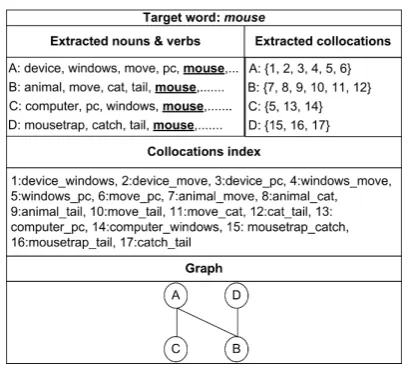
Figure 2 provides a running example of the dif-ferent stages of the WSI method. In the example, the target wordmouseappears with theelectronic devicesense in the contextsA,C, and with the an-imalsense in the contextsBandD.
Corpus preprocessing: Let bc denote the base
corpus consisting of the contexts containing the target wordtw. In our work, a context is defined
[image:3.595.314.518.59.244.2]by a set of words in a window of size 100 around the target.
Figure 2: Running example of WSI
The aim of this stage is to capture words con-textually related totw. In the first step, the target word is removed frombcand part-of-speech
tag-ging is applied to each context. Only nouns and verbs are kept and lemmatised. In the next step, the distribution of each word in the base corpus is compared to the distribution of the same noun in a reference corpus using the log-likelihood ra-tio (G2) (Dunning, 1993). Words that have aG2
below a pre-specified threshold (parameterp1) are
removed from each context of the base corpus. The result of this stage is shown in the upper left part of Figure 2.
Graph creation & clustering: Each contextci ∈
bcis represented as a vertex in a graphG. Edges
between the vertices of the graph are drawn based on their similarity, defined in Equation 2, where
smcl(ci, cj) is the collocational weight of
con-textsci,cj andsmwd(ci, cj)is their bag-of-words
weight. If the edge weight W(ci, cj) is above
a prespecified threshold (parameter p3), then an
edge is drawn between the corresponding vertices in the graph.
W(ci, cj) =
1
2(smcl(ci, cj) +smwd(ci, cj)) (2)
Collocational weight: The limited polysemy of
collocations is exploited to compute the similar-ity between contexts ci andcj. In this setting, a
collocation is a juxtaposition of two words within the same context. Given a context ci, a total of
N
2
is below a prespecified threshold (parameter p2).
At the end of this process, each contextcioftwis
associated with a set of collocations (gi) as shown
in the upper right part of Figure 2 . Given two con-textsci and cj, the Jaccard coefficient is used to
calculate the similarity between the collocational sets, i.e.smcl(ci, cj) = ||ggi∩i∪ggj|j|.
Bag-of-words weight: Estimating context
simi-larity using collocations may provide reliable es-timates regarding the existence of an edge in the graph, however, it also suffers from data sparsity. For this reason, a bag-of-words model is also em-ployed. Specifically, each contextci is associated
with a set of words (gi) selected in the corpus
preprocessing stage. The upper left part of Fig-ure 2 shows the words associated with each con-text of our example. Given two concon-texts ci and
cj, the bag-of-words weight is defined to be the
Jaccard coefficient of the corresponding word sets, i.e.smwd(ci, cj) = ||ggi∩i∪ggj|j|.
Finally, the collocational weight and bag-of-words weight are averaged to derive the edge weight between two contexts as defined in Equa-tion 2. The resulting graph of our running exam-ple is shown on the bottom of Figure 2. This graph is the input to CW clustering algorithm. Initially, CW assigns all vertices to different classes. Each vertexiis processed for anxnumber of iterations
and inherits the strongest class in its local neigh-borhoodLN in an update step. LN is defined as
the set of vertices which share a direct connection with vertexi. During the update step for a vertex i: each classCk receives a score equal to the sum
of the weights of edges(i, j), wherejhas been
as-signed classCk. The maximum score determines
the strongest class. In case of multiple strongest classes, one is chosen randomly. Classes are up-dated immediately, which means that a node can inherit classes from its LN that were introduced in the same iteration.
Experimental settingThe parameters of the WSI
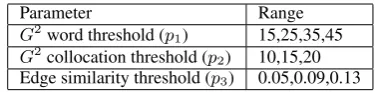
method were fine-tuned on the nouns of the SemEval-2007 word sense induction task (Agirre and Soroa, 2007) under the second evaluation set-ting of that task, i.e. supervised (WSD) evaluation. We tried various parameter combinations shown in Table 1. Specifically, we selected the parameter combination p1=15, p2=10, p3= 0.05 that
maxi-mized the performance in this evaluation. We use ukWaC (Ferraresi et al., 2008) corpus to retrieve all the instances of the target words.
Parameter Range
G2word threshold (p1) 15,25,35,45
G2collocation threshold (p
2) 10,15,20
[image:4.595.321.509.61.107.2]Edge similarity threshold (p3) 0.05,0.09,0.13
Table 1: WSI parameter values.
3.1.2 Cluster selection
The application of WSI on the nounsn ∈ N and n0 ∈ N results in two sets of clusters (senses) S(n)andS(n0). ClusterS(n)is a set of contexts of the word n. Each context is represented as
an exemplar e, a vector specific to the context. Only the 10000 most frequent words in the ukWaC (along with their part-of-speech category) are treated as the valid co-occurrences i.e. the dimensionality of the vector space is 10000. For example, the exemplar of hunting in the context
“the-x purpose-n of-i autumn-n hunting-n be-v in-i part-n to-x cull-v the-x number-n of-i young-j autumn-n fox-n” is h purpose-n:1, autumn-n:2,
part-n:1, cull-v, number-n:1, young-j:1, fox-n:1i
For every clustersn
i inS(n)we construct a
pro-totype vectorvsni by taking the centroid of all the
exemplars in the cluster. Following Mitchell and Lapata (2008), the context words in the prototype vector are set to the ratio of probability of the con-text word given the target word to the overall prob-ability of the context word1.
The next step is to choose the relevant sense of each constituent for a given compound. We as-sume that the meaning of a compound noun can be approximated by identifying the most similar senses of each of its constituent nouns. Accord-ingly all the pairwise similarities between thevsn i
andvsn0
i are calculated using cosine similarity and
the pair with maximum similarity is chosen for composition.
3.2 Dynamic Prototype Based Sense Selection
Kilgarriff (1997) argues that representing a word with a fixed set of senses is not a good way of mod-elling word senses. Instead word senses should be defined according to a given context. We propose a dynamic way of building word senses for the con-stituents of a given compound.
We use an exemplar-based approach to build the dynamic sense of a constituent with the help of other constituent. In exemplar-based modelling
1This is similar to pointwise mutual information without
followed by huge tarpon that like to use the light of your torch to help them hunt. At the the Christmas trade this year or the lights will be off, probably for ever. The Merrymen embrace better health - but doing so in the light of real and trusted information about the present your organisation in a professional light and in a way our all our clients value. continues to be significant, together with other light industries such as electrical engineering
and near-infrared light, along with red light emitted by hydrogen atoms and green light Figure 3: Six random sentences oflightfrom ukWaC
(Erk and Pad´o, 2010; Smith and Medin, 1981), each word is represented by all its exemplars with-out conflating them into a single vector. De-pending upon the purpose, only relevant exem-plars of the target word are activated. Exemplar-based models are more powerful than just proto-type based ones because they retain specific in-stance information. As described in the previous section, an exemplar is a vector that represents a single instance of a given word in the corpus.
Let Enbe the set of exemplars of the wordn.
Given a compoundN with constituentsnandn0,
we remove irrelevant exemplars inEn creating a
refined set En0
n ⊂ En with the help of the other
constituent wordn0. The prototype vectornn0 of
nis then built from the centroid of the refined
ex-emplar setEn0
n . The vectornn
0
represents the rel-evant prototype vector (sense) ofnin the presence
of the other constituent wordn0. Unlike the static
prototypes defined in the previous section, the pro-totype vectors ofn and n0 are built dynamically
based on the given compound. Therefore, we re-fer to them as dynamic prototype vectors.
3.2.1 Building Dynamic Prototypes
We demonstrate our method of building dynamic prototypes with an example. Let us take the compound traffic light. Let Traffic, Light and TrafficLight denote the prototype vectors of
traffic, light and traffic light respectively. Word
lightoccurs in many contexts such as quantum the-ory, optics, lamps and spiritual theory. In ukWaC,
light occurs with 316,126 exemplars. Figure 3
displays 6 random sentences oflightfrom ukWaC. None of these exemplars are related to the target compound traffic light. When a prototype vec-tor of light is built from all its exemplars, irrel-evant exemplars add noise increasing the seman-tic differences betweentraffic light andlight and thereby increasing the semantic differences be-tweenTrafficLightandTraffic⊕Light. This is not desirable. The cosine similarity sim(Light, TrafficLight) is found to be 0.27.
We aim to remove irrelevant exemplars oflight
with the help of the other constituent wordtraffic
and then build a prototype vector of light which is related to the compoundtraffic light. Our intu-ition and motivation for exemplar removal is that it is beneficiary to choose only the exemplars of
light which have context words related to traffic
since the exemplars oftraffic lightwill have con-text words related to bothtrafficandlight. For ex-ample car, road, transport will generally be found within the contexts of all the words traffic, light
andtraffic light.
We rank each exemplar oflightwith the help of collocations of traffic. Collocations of trafficare defined as the context words which frequently oc-cur withtraffic, e.g. car, road etc. The exemplar of
lightrepresenting the sentence “Cameras capture
carsrunning redlights. . .” will be ranked higher
than the one which does not have context words re-lated totraffic. We use Sketch Engine2(Kilgarriff
et al., 2004) to retrieve the collocations of traffic
from ukWaC. Sketch Engine computes the collo-cations using Dice metric (Dice, 1945). We build a collocation vectorTrafficcollocfrom the colloca-tions oftraffic.
We also rank each exemplar oflight using the distributionally similar words totraffici.e. words which are similar totraffice.g. transport, flow etc. These distributionally similar words helps to re-duce the impact of data sparseness and helps pri-oritize the contexts of light which are semanti-cally related totraffic. Sketch Engine is again used to retrieve distributionally similar words oftraffic
from ukWaC. Sketch Engine ranks similar words using the method of Rychl´y and Kilgarriff (2007). We build the vectorTrafficsimilarwhich consists of
the similar words oftraffic.
Every exemplarefrom the exemplar setElight3
is finally ranked by
sim(e,Trafficcolloc) +sim(e,Trafficsimilar)
2Sketch Enginehttp://www.sketchengine.co. uk
3InE
light, we do not include the sentences which have the
We choose the top n% of the ranked exemplars inElightto construct a refined exemplar setElighttraffic.
A prototype vector LightTraffic is then built by taking the centroid of Etrafficlight . LightTraffic
de-notes the sense of light in the presence of traf-fic. Since sense oflightis built dynamically based on the given compound (heretraffic light), we de-fineLightTrafficas the dynamic prototype vector. The similarity sim(LightTraffic, TrafficLight) is found to be 0.47 which is higher than the ini-tial similarity 0.27 of Light and TrafficLight. This shows that our new prototype vector oflight
is closer to the meaning oftraffic light.
Similarly we build the dynamic prototype vec-tor TrafficLight of traffic with the help of light. The dynamic prototypesTrafficLight and LightTrafficare used for semantic composition to constructTrafficLight⊕LightTraffic
4 Composition functions
Given a compound, we perform composition using the sense based prototypes selected in the above section. We use the composition functions ADD and MULT described in Equation 1.
For the function ADD, we use equal weights for both constituent words i.e. α = β = 1. For the function MULT there are no parameters.
5 Evaluation
Mitchell and Lapata (2010) introduced an evalua-tion scheme for semantic composievalua-tion models. We evaluate on their dataset, describe the evaluation scheme, and present the results of various models.
5.1 Dataset
Mitchell and Lapata (2010) prepared a dataset4
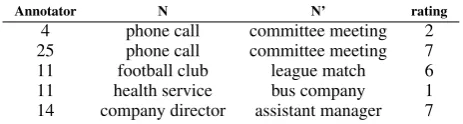
which contains pairs of compound nouns and their similarity judgments. The dataset consists of 108 compound noun pairs with each pair having 7 an-notations from different annotators who judge the pair for similarity. A sample of 5 compound pairs is displayed in Table 2.
5.2 Evaluation Scheme
For each pair of the compound nouns, the mean value of all its annotations is taken to be the final similarity judgment of the compound.
4We would like to thank Jeff Mitchell and Mirella Lapata
for sharing the dataset.
Annotator N N’ rating
[image:6.595.306.538.62.124.2]4 phone call committee meeting 2 25 phone call committee meeting 7 11 football club league match 6 11 health service bus company 1 14 company director assistant manager 7 Table 2: Evaluation dataset of Mitchell and Lapata (2010)
LetN andN0be a pair. To evaluate a model, we
calculate the cosine similarity between the com-posed vectors⊕(N)and⊕(N0)obtained from the composition on sense based prototypes generated by the model. These similarity scores are corre-lated with human mean scores to judge the perfor-mance of the model.
5.3 Models Evaluated
We evaluate all the models w.r.t. the composition functions ADD and MULT.
Static Single Prototypes: This model does not
perform any sense disambiguation and is similar to the method described in (Mitchell and Lapata, 2008). The prototype vector of each constituent formed by conflating all its instances is used to compose the vector of the compound.
Static Multi Prototypes:In the method described in section 3.1, word sense induction produces a large number of clusters i.e. static multi proto-types. We tried various parameters like choosing the target prototype of a constituent only from the top 5 or 10 large clusters.
Dynamic Prototypes: In the method described
in section 3.2, the dynamic prototype of a con-stituent is produced from the top n% exemplars of the ranked exemplar set of the constituent. We tried various percent activation (n%) values - 2%, 5%, 10%, 20%, 50%, 80%.
Compound Prototype: We directly use the
cor-pus instances of a compound to build the proto-type vector of the compound. This method does not involve any composition. Ideally, one expects this model to give the best performance.
Static Multi Prototypes with Guided Selection:
Parameter Description ADD MULT Static Single Prototypes
0.5173 0.6104
Static Multi Prototypes
Top 5 clusters 0.1171 0.4150 Top 10 clusters 0.0663 0.2655
Dynamic Prototypes
Top 2 % exemplars 0.6261 0.6552
Top 5 % exemplars 0.6326 0.6478 Top 10 % exemplars 0.6402 0.6515 Top 20 % exemplars 0.6273 0.6359 Top 50 % exemplars 0.5948 0.6340 Top 80 % exemplars 0.5612 0.6355
Static Multi Prototypes with Guided Selection
Top 5 clusters 0.2290 0.4187 Top 10 clusters 0.2710 0.4140
Compound Prototype
[image:7.595.178.420.61.240.2]0.4152
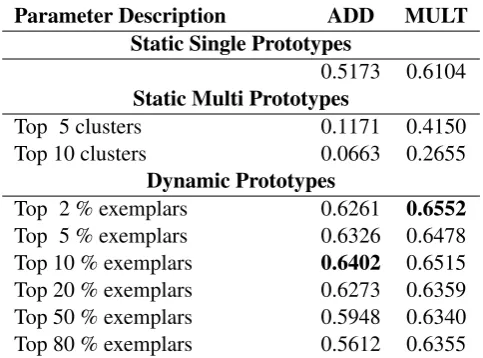
Table 3: Spearman Correlations of Model predictions with Human Predictions
compound. This is a guided way of sense selec-tion since we are using the compound prototype vector which is built from the compound’s corpus instances. The performance of this model gives us an idea of the upper boundary of multi prototype models for semantic composition.
5.4 Results and Discussion
All the above models are evaluated on the dataset described in section 5.1. Table 3 displays the Spearman correlations of all these models with the human annotations (mean values).
The results of Static Single Prototypes model are consistent with the previous findings of Mitchell and Lapata (2010), in which MULT per-formed better than ADD.
All the parameter settings of Dynamic Proto-types outperformed Static Single ProtoProto-types. This shows that selecting the relevant sense prototypes of the constituents improve semantic composition. We also observe that the highest correlation is achieved by including just the top 2% exemplars for each constituent. It seems that as the sample of exemplars increases, noise increases as well, and this results in a worse performance.
The comparison between Static Single Proto-types and Static Multi ProtoProto-types shows that the former performs significantly better than the lat-ter. This is not according to our expectation. The
possible reason for poor performance could be be-cause of the sense selection process (section 3.1.2) which might have failed to choose the relevant sense of each constituent word.
However, Static Multi Prototypes with Guided Sense Selection still fail to perform better than Static Single Prototypes. Therefore, we can con-clude that the lower performance of Static Multi Prototypes cannot be attributed to the sense selec-tion process only. Despite that, the applied graph clustering method results in the generation of a very large number of clusters, some of which re-fer to the same word usage with subtle difre-ferences. Hence, our future work focuses on a selection pro-cess that chooses multiple relevant clusters of a constituent word. Additionally, our ongoing work suggests that the use of verbs as features in the graph creation process (section 3.1.1) causes the inclusion of noisy edges and results in worse clus-tering.
se-lection process.
The performance of Compound Prototype is lower than the compositional models. The reason could be due to the data sparsity. Data sparsity is known to be a major problem for modelling the meaning of compounds. In a way, the results are encouraging for compositional models.
In all these models, the composition function MULT gave a better performance than ADD.
6 Conclusions
This paper presented two methods for dealing with polysemy when modeling the semantics of a noun-noun compound. The first one represents senses by creating static multi prototype vectors, while the second represents context-specific sense of a word by generating a dynamic prototype vector. Our experimental results show that: (1) sense dis-ambiguation improves semantic composition, and (2) dynamic prototypes are a better representation of senses than static multi prototypes for the task of semantic composition.
In future, we would like to explore other static multi prototype approaches of Reisinger and Mooney (2010) and Klapaftis and Manandhar (2010a) in comparison with dynamic prototypes. Dynamic prototypes are found to be particularly encouraging since they present a different mech-anism for sense representation unlike traditional methods.
Acknowledgements
The authors are grateful to Lexical Computing Ltd for providing a free installation of Sketch En-gine at University of York. The authors would like to thank anonymous reviewers for their ex-cellent feedback. This work is supported by the European Commission via the EU FP7 INDECT project, Grant No.218086, Research area: SEC-2007-1.2-01 Intelligent Urban Environment Ob-servation System.
References
Eneko Agirre and Aitor Soroa. 2007. Semeval-2007 task 02: Evaluating word sense induction and dis-crimination systems. InProceedings of the Fourth International Workshop on Semantic Evaluations (SemEval-2007), pages 7–12, Prague, Czech Repub-lic, June. Association for Computational Linguis-tics.
Chris Biemann. 2006. Chinese Whispers - An Ef-ficient Graph Clustering Algorithm and its Appli-cation to Natural Language Processing Problems. In Proceedings of TextGraphs, pages 73–80, New York, USA.
Lee R. Dice. 1945. Measures of the amount of ecologic association between species. Ecology, 26(3):pp. 297–302.
Ted Dunning. 1993. Accurate Methods for the Statis-tics of Surprise and Coincidence. Computational Linguistics, 19(1):61–74.
Katrin Erk and Sebastian Pad´o. 2008. A structured vector space model for word meaning in context. In
Proceedings of the Conference on Empirical Meth-ods in Natural Language Processing, EMNLP ’08, pages 897–906, Stroudsburg, PA, USA. Association for Computational Linguistics.
Katrin Erk and Sebastian Pad´o. 2010. Exemplar-based models for word meaning in context. In Pro-ceedings of the ACL 2010 Conference Short Papers, ACLShort ’10, pages 92–97, Stroudsburg, PA, USA. Association for Computational Linguistics.
Adriano Ferraresi, Eros Zanchetta, Marco Baroni, and Silvia Bernardini. 2008. Introducing and evalu-ating ukWaC, a very large web-derived corpus of english. InProceedings of the WAC4 Workshop at LREC 2008, Marrakesh, Morocco.
Adam Kilgarriff, Pavel Rychly, Pavel Smrz, and David Tugwell. 2004. The sketch engine. InProceedings of EURALEX 2004.
Adam Kilgarriff. 1997. I don’t believe in word senses. InComputers and the Humanities, 31(2):91-113.
Ioannis Klapaftis and Suresh Manandhar. 2010a. Word sense induction & disambiguation using hier-archical random graphs. InProceedings of the 2010 Conference on Empirical Methods in Natural Lan-guage Processing, pages 745–755, Cambridge, MA, October. Association for Computational Linguistics.
Ioannis P. Klapaftis and Suresh Manandhar. 2010b. Taxonomy Learning Using Word Sense Induction. InProceedings of NAACL-HLT-2010, pages 82–90, Los Angeles, California, June. ACL.
Ioannis Korkontzelos and Suresh Manandhar. 2009. Detecting compositionality in multi-word expres-sions. In Proceedings of the ACL-IJCNLP 2009 Conference Short Papers, ACLShort ’09, pages 65– 68, Stroudsburg, PA, USA. Association for Compu-tational Linguistics.
Jeff Mitchell and Mirella Lapata. 2008. Vector-based models of semantic composition. InProceedings of ACL-08: HLT, pages 236–244, Columbus, Ohio.
Roberto Navigli and Giuseppe Crisafulli. 2010. Induc-ing word senses to improve web search result clus-tering. InEMNLP, pages 116–126.
Sebastian Pado and Mirella Lapata. 2007. Dependency-based construction of semantic space models. Computational Linguistics, 33(2):161–199.
Joseph Reisinger and Raymond J. Mooney. 2010. Multi-prototype vector-space models of word mean-ing. InHLT-NAACL, pages 109–117.
Pavel Rychl´y and Adam Kilgarriff. 2007. An ef-ficient algorithm for building a distributional the-saurus (and other sketch engine developments). In
Proceedings of the 45th Annual Meeting of the ACL on Interactive Poster and Demonstration Sessions, ACL ’07, pages 41–44, Stroudsburg, PA, USA. As-sociation for Computational Linguistics.
Hinrich Sch¨utze. 1998. Automatic Word Sense Dis-crimination. Computational Linguistics, 24(1):97– 123.
Edward E. Smith and Douglas L. Medin. 1981. Cate-gories and concepts / Edward E. Smith and Douglas L. Medin. Harvard University Press, Cambridge, Mass. :.
Eva Maria Vecchi, Marco Baroni, and Roberto Zam-parelli. 2011. (linear) maps of the impossible: Cap-turing semantic anomalies in distributional space. In
Proceedings of the Workshop on Distributional Se-mantics and Compositionality, pages 1–9, Portland, Oregon, USA, June. Association for Computational Linguistics.