Benchmarking Noun Compound Interpretation
Su Nam Kim and Timothy Baldwin
Department of Computer Science and Software Engineering and
NICTA Victoria Lab
University of Melbourne, VIC 3010 Australia
{snkim,tim}@csse.unimelb.edu.au
Abstract
In this paper we provide benchmark results for two classes of methods used in inter-preting noun compounds (NCs): semantic similarity-based methods and their hybrids. We evaluate the methods using 7-way and binary class data from the nominal pair in-terpretation task of SEMEVAL-2007.1 We summarize and analyse our results, with the intention of providing a framework for benchmarking future research in this area.
1 Introduction
This paper reviews a range of simple and hybrid approaches to noun compound (NC) interpretation. The interpretation of NCs such ascomputer science
and paper submission involves predicting the se-mantic relation(SR) that underlies a given NC. For example,student priceconventionally expresses the meaning that astudent benefits from the price(SR = BENEFICIARY), whilestudent protest conven-tionally means astudent undertaking aprotest (SR = AGENT).2
NCs are formed from simplex nouns with high productivity. The huge number of possible NCs and potentially large number of SRs makes NC interpre-tation a very difficult problem. In the past, much NC interpretation work has been carried out which tar-gets particular NLP applications such as information extraction, question-answering and machine trans-lation. Unfortunately, much of it has not gained
1The 4th International Workshop on Semantic Evaluation 2SRs used in the examples are taken from Barker and
Sz-pakowicz (1998).
traction in real-world applications as the accuracy of the methods has not been sufficiently high over open-domain data. Most prior work has been car-ried out under specific assumptions and with one-off datasets, which makes it hard to analyze perfor-mance and to build hybrid methods. Additionally, disagreement in the inventory of SRs and a lack of resource sharing has hampered comparative evalua-tion of different methods.
The first step in NC interpretation is to define a set of SRs. Levi (1979), for example, proposed a system of 9 SRs, while others have proposed classifications with 20-30 SRs (Finin, 1980; Barker and Szpakow-icz, 1998; Moldovan et al., 2004). Smaller sets tend to have reduced coverage due to coarse granularity, whereas larger sets tend to be too fine grained and suffer from low inter-annotator agreement. Addi-tionally pragmatic/contextual differentiation leads to difficulties in defining and interpreting SRs (Down-ing, 1977; SparckJones, 1983).
training data sets and the effectiveness of the algo-rithms in different domains (coverage of SRs over the NCs is another issue).
Our aim in this paper is to compare and analyze existing NC interpretation methods over a common, publicly available dataset. While recent research has made significant progress, bringing us one step closer to practical applicability in NLP applications, no direct comparison or analysis of the approaches has been attempted to date. As a result, it is hard to determine which approach is appropriate in a given domain or build hybrid methods based on prior ap-proaches. We also investigate the impact on perfor-mance of relaxing assumptions made in the origi-nal research, to compare different approaches in an identical setting.
In the remainder of the paper, we review the re-search background and NC interpretation methods in Section 2, describe the methods and system archi-tectures in Section 3, detail the datasets used in our experiments in Section 4, carry out a system evalu-ation in Section 5 and Section 6, and finally present a discussion and conclusions in Section 7 and Sec-tion 8, respectively.
2 Background and Methods
2.1 Research Background
In this study, we selected three semantic similar-ity based models which had been found to perform strongly in previous research, and which were easy to re-implement: SENSE COLLOCATION(Moldovan et al., 2004), CONSTITUENT SIMILARITY (Kim and Baldwin, 2005) and CO-TRAINING, e.g. using SENSE COLLOCATIONorCONSTITUENT SIMILAR-ITY (Kim and Baldwin, 2007). These approaches were evaluated over a 7-way classification using open-domain data from the nominal pair interpre-tation task of SEMEVAL-2007 (Girju et al., 2007). We test their performance in both 7-way and binary-class binary-classification settings.
2.2 Sense Collocation Method
The SENSE COLLOCATION method of Moldovan et al. (2004) is based on the pair of word senses of NC constituents. The basic idea is that NCs which have the same or similar sense collocation tend to have the same SR. As an example,car factoryand
auto-mobile factoryshare the conventional interpretation of MAKE, which is predicted bycar and automo-bilehaving the same sense across the two NCs, and
factory being used with the same sense in each in-stance. This intuition is formulated in Equations 1 and 2 below.
The probability P(r|fifj) (simplified to
P(r|fij)) of a SR r for word senses fi and fj is calculated based on simple maximum likelihood estimation:
P(r|fij) = nn(r, f(f ij)
ij) (1)
The preferred SRr∗for the given sense combina-tion is that which maximises the probability:
r∗ = argmaxr∈RP(r|fij)
= argmaxr∈RP(fij|r)P(r) (2)
2.3 Constituent Similarity Method
The intuition behind the CONSTITUENT SIMILAR-ITY method is similar to theSENSE COLLOCATION method, in that NCs made up of similar words tend to share the same SR. The principal difference is that it doesn’t presuppose that we know the word sense of each constituent word (i.e. the similarity is cal-culated at the word rather than sense level). The method takes the form of a 1-nearest neighbour clas-sifier, with the best-matching training instance for each test instance predicting its SR. For example, we may find that test instancechocolate milkmost closely matchesapple juice and hence predict that the SR isMATERIAL.
This idea is formulated in Equation 3 below. For-mally,SAis the similarity between NCs(Ni,1, Ni,2)
and(Bj,1, Bj,2):
SA((Ni,1, Ni,2),(Bj,1, Bj,2)) = ((αS1 +S1)×((1−α)S2 +S2))
2 (3)
where S1 is the modifier similarity (i.e.
S(Ni,1, Bj1)) and S2 is the head noun similarity
them) using the method of Wu and Palmer (1994) as implemented in WordNet::Similarity (Pat-wardhan et al., 2003). This is done for each pairing of WordNet senses of the two words in question, and the overall lexical similarity is calculated as the average across the pairwise sense similarities.
2.4 Co-Training by Sense Collocation
Co-training by sense collocation (SCOLL CO-TRAINING) is based on the SENSE COLLOCATION method and lexical substitution (Kim and Baldwin, 2007). It expands the set of training NCs from a relatively small number of manually-tagged seed instances. That is, it makes use of extra train-ing instances fashioned through a bootstrap process. For example, assumingautomobile factorywith the SR MAKE were a seed instance, NCs generated from synonyms, hypernyms and sister words of its constituents would be added as extra training in-stances, with the same SR of MAKE. That is, we would add car factory (SYNONYM),vehicle
fac-tory (HYPERNYM) and truck factory (SISTER
WORD), for example. Note that the substitution takes place only for one constituent at a time to avoid extreme variation.
2.5 Co-training by Constituent Similarity
Co-training by Constituent Similarity (CS CO-TRAINING) is also a co-training method, but based on CONSTITUENT SIMILARITY rather than SENSE COLLOCATION. The basic idea is that when NCs are interpreted using the CONSTITUENT SIMILAR-ITY method, the predictions are more reliable when the lexical similarity is higher. Hence, we progres-sively reduce the similarity threshold, and incorpo-rate higher-similarity instances into our training data earlier in the bootstrap process. That is, we run theCONSTITUENT SIMILARITYmethod and acquire NCs with similarity equal to or greater than a fixed threshold. Then in the next iteration, we add the ac-quired NCs into the training dataset for use in clas-sifying more instances. As a result, in each step, the number of training instances increases monoton-ically. We “cascade” through a series of decreas-ing similarity thresholds until we reach a saturation point. As our threshold, we used a starting value of
0.90, which was decremented down to0.65in steps of0.05.
Method Description SCOLL sense collocation
SCOLLCT sense collocation + SCOLLco-training
CSIM constituent similarity
CSIM+SCOLLCT constituent similarity + SCOLLco-training
HYBRID SCOLL+ CSIM+ SCOLLCT
[image:3.612.314.561.72.143.2]CSIMCT constituent similarity + CSIMco-training
Table 1: Systems used in our experiments
TEST
untagged test data
untagged test data
untagged test data
untagged test data tagged data
tagged data
tagged data
tagged data
tagged data
TRAIN
Extension of Training data by similar words − Synonym − Hypernym − Sister word
Extended TRAIN Sense Collcation
Step 1
Similarity
Step 2
Step 3
Step 4
Similarity
Step 5
Sense Collcation
Similarity
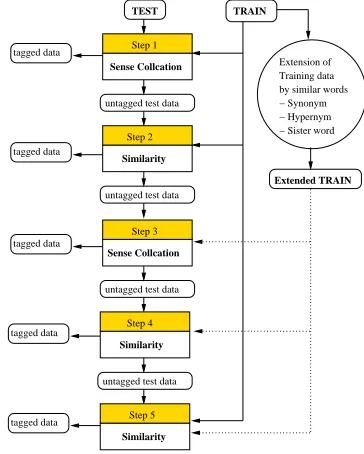
Figure 1: Architecture of theHYBRIDmethod
3 Systems and Architectures
We tested the original methods of Moldovan et al. (2004) and Kim and Baldwin (2005), and combined them with the co-training methods of Kim and Bald-win (2007) to come up with six different hybrid sys-tems for evaluation, as detailed in Table 1. To build the classifiers, we used the TIMBL5.0 memory-based learner (Daelemans et al., 2004).
[image:3.612.333.515.182.409.2]train-TRAIN
#of Tagged >= 10% of test Threshold
Tagged
finalize current tags and end reduce Threshold
TEST
get Similarity
Sim >= T
N Y
Y
N
if T == 0.6 & (#of Tagged < 10% of test) N
[image:4.612.115.256.66.280.2]Y
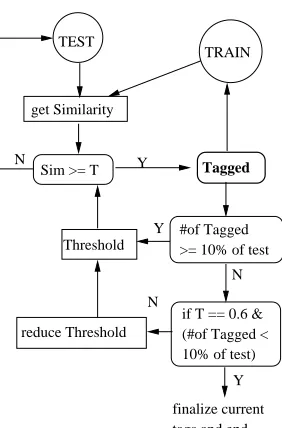
Figure 2: Architecture of the CSIMCT system
ing data through the advent of hypernyms and sis-ter words, using the SCOLL CO-TRAININGmethod. This step benefits from a larger amount of training data (17,613 vs. 937). The fourth step is to apply the CONSTITUENT SIMILARITY method (EXTCS) over the consolidated training data, with the thresh-old unchanged at0.8. The final step is to apply the CONSTITUENT SIMILARITY (CSTT) method over the combined training data without any restriction on the threshold (to guarantee a SR prediction for every test instance). We select SRs from the training instances whose similarity is higher than the origi-nal training data and expanded training data. How-ever, since the generated training instances are more likely to contain errors, we apply a linear weight of
0.8 to the similarity values for the expanded train-ing instances. This gives preferential treatment to predictions based on the original training instances. Note that this weight was based on analysis of the error rate in the expanded training instances. In pre-vious work (Kim and Baldwin, 2007), we found the overall classification accuracy rate after the first it-eration to be 70-80%. Hence, we settled on a weight of0.8.
The CSIMCT system is based solely on the
CON-STITUENT SIMILARITYmethod with cascading. We perform iterative CS co-training as described in Sec-tion 2.5, with the slight variaSec-tion that we hold off
Binary 7-way
[image:4.612.317.538.71.179.2]SR Test Train Train* Test Train Train* CE 80 136 2,588 36 71 1,854 IA 78 135 1,400 36 68 1,001 PP 93 126 2,591 55 78 2,089 OE 81 136 3,085 35 52 1,560 TT 71 129 2,994 27 50 1,718 PW 72 138 2,577 28 64 1,510 CC 74 137 2,378 37 63 1,934 Total 549 937 17,613 254 446 11,664
Table 3: Number of instances associated with each SR (Train* is the number of expanded train in-stances)
on reducing the threshold if less than 10% of the test instances are tagged on a given iteration, giving other test instances a chance to be tagged at a higher threshold level relative to newly generated training instances. The residue of test instances on comple-tion of the final iteracomple-tion (threshold =0.6) are tagged according to the best-matching training instance, ir-respective of the magnitude of the similarity.
4 Data
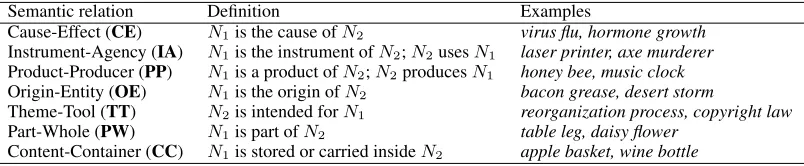
We used the dataset from the SEMEVAL-2007 nominal pair interpretation task, which is based on 7 SRs: CAUSE-EFFECT (CE), INSTRUMENT-AGENCY (IA), PRODUCT-PRODUCER (PP), ORIGIN-ENTITY (OE), THEME-TOOL (TT), PART-WHOLE (PW), CONTENT-CONTAINER (CC). The task in SEMEVAL-2007 was to identify the compatibility of a given SR for each test instances using word senses retrieved from WORD-NET 3.0 (Fellbaum, 1998) and queries. Table 2 shows the definition of the SRs.
In our research, we interpret the dataset in two ways: (1) as abinary classificationtask for each SR based on the original data; and (2) as a7-way clas-sificationtask, combining together all positive test and training instances for each of the 7 SR datasets into a single dataset. Hence, the size of the dataset for 7-way classification is much smaller than that of the original dataset. We also expand the training in-stances using SCOLL CO-TRAINING. Table 3 de-scribes the number of test and train instances for NC interpretation for the binary and 7-way classification tasks.
Semantic relation Definition Examples
Cause-Effect (CE) N1is the cause ofN2 virus flu, hormone growth
Instrument-Agency (IA) N1is the instrument ofN2;N2usesN1 laser printer, axe murderer
Product-Producer (PP) N1is a product ofN2;N2producesN1 honey bee, music clock
Origin-Entity (OE) N1is the origin ofN2 bacon grease, desert storm
Theme-Tool (TT) N2is intended forN1 reorganization process, copyright law
Part-Whole (PW) N1is part ofN2 table leg, daisy flower
Content-Container (CC) N1is stored or carried insideN2 apple basket, wine bottle
Table 2: The set of 7 semantic relations, whereN1 is the modifier andN2is the head noun
across multiple SR datasets (i.e. occur as an instance in more than one of the 7 datasets), none of which occur as positive instances for multiple SRs. As such, no NC instances in the 7-way classification task end up with a multiclass classification. Also note that some of NCs are contained within ternary or higher-order NCs: 40 test NCs and 81 training NCs for the binary classification task, and 24 test NCs and 42 training NCs for the 7-way classification task. For these NCs, we extracted a “base” binary NC based on the provided bracketing. The follow-ing are examples of extraction of binary NCs from ternary or higher-order NCs.
((billiard table) room)→table room (body (bath towel))→body towel
In order to extract a binary NC, we take the head noun of each embedded NC and combine this with the corresponding head noun or modifier. E.g.,table
is the head noun ofbilliard table, which combines with the head noun of the complex NCroomto form
table room.
5 Experiment 1: 7-way classification
Our first experiment was carried out over the 7-way classification task—i.e. all 7 SRs in a single classifi-cation task—using the 6 systems from Section 3. In our results in Table 4, we use the system categories from SEMEVAL-2007 ofA4andB4, where A4 sys-tems use none of the provided word senses, and B4 systems use the word senses.3 We categorized our systems into these two groups in order to evaluate them separately within the bounds of the original SEMEVAL-2007 task. In each case, the baseline is a majority class classifier.
3In the original SEMEVAL-2007 task, there were two
fur-ther categories, which incorporated the “query” with or without the sense information.
Class Method P R F1 A
– Majority .217
A4 CSIM .518 .522 .449 .528
CSIMCT .517 .511 .426 .522
B4 SCOLL .705 .444 .477 .496 SCOLLCT .646 .466 .498 .508
CSIM+SCOLLCT .523 .520 .454 .528
HYBRID .500 .505 .416 .516
Table 4: Experiment 1: Results (P=precision, R=recall,F1=F-score,A=accuracy)
Step Method Tagged Ai Untagged
1 SCOLL 12 1.000 242
2 CSIM 57 .719 185
3 extSCOLL 0 .000 185 4 extCSIM 78 .462 107 5 CSIMREST 107 .393 0
Table 5: Experiment 1: Classifications for each step of the HYBRID method (CSREST=the final
ap-plication of CS over the remaining test instances, Ai=accuracy for classifications made at stepi)
Tables 5 and 6 show the results at each step for theHYBRIDand CSIMCT methods, respectively. As
each method proceeds, the amount of tagged data in-creases but the classification accuracy of the system decreases, due to the inclusion of increasingly noisy training instances in the previous step. The perfor-mance of each individual relation is shown in Fig-ure 3, which largely mirrors the findings of the sys-tems in the original SEMEVAL-2007 task in terms of the relative difficulty to predict each of the 7 SRs.
6 Experiment 2: binary classification
[image:5.612.106.508.71.154.2]Iteration θ Tagged Ai Untagged
1 .90 29 .897 225
2 .85 12 .750 213
3 .80 31 .613 182
4 .75 43 .535 139
5 .70 63 .540 76
6 .65 26 .346 50
[image:6.612.91.280.70.152.2]7 <.65 49 .250 1
Table 6: Experiment 1: Classifications at each step of the CSIMCT method (θ=threshold,Ai=accuracy for classifications made at iterationi)
CE IA PP OE TT PW CC
Relations Accuracy(%)
KE w/ multiple classes
0 20 40 60 80 100
0 20 40 60 80 100
0 20 40 60 80 100
precision recall Fscore
Figure 3: Experiment 1: Performance over each SR (CSIM+SCOLLCT method)
6 systems. We also present the best-performing sys-tem within each group from the SEMEVAL-2007 task. The methods for computing the baselines are described in Girju et al. (2007).
As with the first experiment, we analyzed the number of tagged instances and accuracy for the HY-BRIDand CSIMCT methods, as shown in Tables 8
and 9, respectively. The overall results are similar to those for the 7-way classification task.
Figures 4 and 5 show the performance for posi-tive and negaposi-tive classifications for each individual SR. The performance when the classifier outputs are mapped onto the 7-way classification task are simi-lar to those in Figure 3.
7 Discussion and Conclusion
We compared the performance of the 6 systems in Tables 4 and 7 over the 7-way and binary clas-sification tasks, respectively. The performance of all methods exceeded the baseline. The CON-STITUENT SIMILARITY (CSIM) system performed the best in group A4 andCONSTITUENT
SIMILAR-Class Method P R F1 A
– All True .485 1.000 .648 .485 – Probability .485 .485 .485 .517 – Majority .813 .429 .308 .570 A4 Best .661 .667 .648 .660 CSIM .632 .628 .627 .650 CSIMCT .615 .557 .578 .627
B4 Best .797 .698 .724 .763 SCOLL .672 .584 .545 .634 SCOLLCT .602 .571 .554 .619
CSIM+SCOLLCT .660 .657 .654 .669
[image:6.612.314.541.71.202.2]HYBRID .617 .568 .587 .625
Table 7: Experiment 2: Binary classification results (P=precision,R=recall,F1=F-score,A=accuracy)
Step Method Tagged Ai Untagged
1 SCOLL 21 .810 526
2 CSIM 106 .689 420
3 extSCOLL 0 .000 420 4 extCSIM 61 .607 359 5 CSIMREST 359 .619 0
Table 8: Experiment 2: Classifications for each step of the HYBRID method (CSREST=the final ap-plication of CS over the remaining test instances, Ai=accuracy for classifications made at stepi)
ITY + SCOLLCT (CSIM+SCOLLCT ) system
per-formed the best in group B4 for both classification tasks. In general, the performance ofCONSTITUENT SIMILARITYis marginally better than that ofSENSE COLLOCATION. Also, the utility of co-training is confirmed by it outperforming bothCONSTITUENT SIMILARITYandSENSE COLLOCATION.
In order to compare the original methods with the hybrid methods, we observed that the original methods, SCOLLand K, and their co-training vari-ants performed consistently better than the hybrid methods,HYBRIDand CSIMCT. We found that the
combination of the methods lowers overall perfor-mance. We also found that the number of training instances contributes to improved performance, pre-dictably in the sense that the methods are supervised, but encouraging in the sense that the extra training data is generated automatically. As expected, the step-wise performance ofHYBRIDand CSIMCT
[image:6.612.92.279.220.351.2]Iteration θ Tagged Ai Untagged
1 .90 21 .810 526
2 .85 52 .726 474
3 .80 56 .714 418
4 .75 74 .595 344
5 .70 101 .722 243
6 .65 222 .572 21
[image:7.612.91.279.70.152.2]7 <.65 21 .996 0
Table 9: Experiment 2: Classifications at each step of the CSIMCT method (θ=threshold,Ai=accuracy for classifications made at iterationi)
CE IA PP OE TT PW CC
relations Accuracy(%)
KE w/ binary classes & tagged as "true"
Fscorerecall precision
0 20 40 60 80 100
0 20 40 60 80 100
[image:7.612.330.515.72.200.2]0 20 40 60 80 100
Figure 4: TPR for each SR for the binary task (pos-itive instances, CSIM+SCOLLCT method)
our expectation that: (a) the similarity threshold is strongly correlated with the quality of the resultant data; and (b) the method is susceptible to noisy train-ing data.
Our performance comparison over the binary classification task from the SEMEVAL-2007 task shows that our 6 systems performed below the best performing system in the competition, to varying de-grees. This is partly because the methods were origi-nally designed for multi-way (positive) classification and require adjustment for the binary task reformu-lation, although their performance is competitive.
Finally, comparing the SCOLL and CSIM meth-ods, we found that the methods interpret SRs with 100% accuracy when the sense collocations are found in both the test and training data. However, the CSIMmethod is more sensitive than the SCOLL method to variation in the sense collocations, which leads to better performance. Also, the CSIMmethod interprets NCs with high accuracy when the com-puted similarity is sufficiently high (e.g. with simi-larity≥0.9the accuracy is 89.7%). Another benefit
CE IA PP OE TT PW CC
Relations Accuracy(%)
KE w/ binary classes & tagged as "false"
0 20 40 60 80 100
0 20 40 60 80 100
0 20 40 60 80 100
precision recall Fscore
Figure 5: TNR for each SR for the binary task (neg-ative instances, CSIM+SCOLLCT method)
of this method is that it interprets NCs without word sense information. As a result, we conclude that the CSIMmethod is more flexible and robust. One pos-sible weakness of CSIM is its reliance on the simi-larity measure.
8 Conclusions and Future Work
In this paper, we have benchmarked and hybridised existing NC interpretation methods over data from the SEMEVAL-2007 nominal pair interpretation task. In this, we have established guidelines for the use of the different methods, and also for the rein-terpretation of the SEMEVAL-2007 data as a more conventional multi-way classification task. We con-firmed thatCONSTITUENT SIMILARITY is the best method due to its insensitivity to varied sense col-locations. We also confirmed that co-training im-proves the performance of the methods by expand-ing the number of trainexpand-ing instances.
Looking to the future, there is room for improve-ment for all the methods through such factors as threshold tweaking and expanding the training in-stances further.
References
Satanjeev Banerjee and Ted Pedersen. 2003. Extended gloss overlaps as a measure of semantic relatedness. In Proceedings of the Eighteenth International Joint Conference on Artificial Intelligence, pp. 805–810, Acapulco, Mexico.
[image:7.612.96.274.224.352.2]on Computational Linguistics, pp. 96–102, Montreal, Canada.
Walter Daelemans, Jakub Zavrel, Ko van der Sloot, and Antal van den Bosch. 2004. TiMBL: Tilburg Mem-ory Based Learner, version 5.1, Reference Guide. ILK Technical Report 04-02.
Pamela Downing. 1977. On the Creation and Use of En-glish Compound Nouns.Language, 53(4):810–842.
James Fan and Ken Barker and Bruce W. Porter. 2003. The knowledge required to interpret noun compounds. In In Proceedings of the 7th International Joint Con-ference on Artificial Intelligence, Acapulco, Mexico, 1483–1485.
Christiane Fellbaum, editor. 1998. WordNet: An Elec-tronic Lexical Database. MIT Press, Cambridge, USA.
Timothy W. Finin. 1980. The Semantic Interpretation of Compound Nominals. Ph.D. thesis, University of Illinois.
Roxana Girju. 2007. Improving the Interpretation of Noun Phrases with Cross-linguistic Information. In
Proceedings of the 45th Annual Meeting of the As-sociation of Computational Linguistics, pp. 568–575, Prague, Czech Republic.
Roxana Girju and Preslav Nakov and Vivi Nastase and Stan Szpakowicz and Peter Turney and Deniz Yuret. 2007. SemEval-2007 Task 04: Classification of Se-mantic Relations between Nominals. InProceedings of the 4th Semantic Evaluation Workshop (SemEval-2007), Prague, Czech Republic, pp.13–18.
Su Nam Kim and Timothy Baldwin. 2005. Auto-matic interpretation of Noun Compounds using Word-Net similarity. InProceedings of the 2nd International Joint Conference On Natural Language Processing, pp. 945–956, JeJu, Korea.
Su Nam Kim and Timothy Baldwin. 2006. Interpreting Semantic Relations in Noun Compounds via Verb Se-mantics. InProceedings of the 44th Annual Meeting of the Association for Computational Linguistics and 21st International Conference on Computational Lin-guistics (COLING/ACL-2006). pp. 491–498, Sydney, Australia.
Su Nam Kim and Timothy Baldwin. 2007. Interpreting Noun Compound Using Bootstrapping and Sense Col-location. InProceedings of the Pacific Association for Computational Linguistics (PACLING), pp. 129–136, Melbourne, Australia.
Maria Lapata. 2002. The disambiguation of nominaliza-tions. Computational Linguistics, 28(3):357–388.
Judith Levi. 1979. The syntax and semantics of complex nominals. InThe Syntax and Semantics of Complex Nominals. New York:Academic Press.
Dan Moldovan, Adriana Badulescu, Marta Tatu, Daniel Antohe, and Roxana Girju. 2004. Models for the se-mantic classification of noun phrases. InProceedings of the HLT-NAACL 2004 Workshop on Computational Lexical Semantics, pp. 60–67, Boston, USA.
Preslav Nakov and Marti Hearst. 2006. Using Verbs to Characterize Noun-Noun Relations. InProceedings of the 12th International Conference on Artificial Intelli-gence: Methodology, Systems, Applications (AIMSA), Bularia.
Diarmuid ´O S´eaghdha and Ann Copestake. 2007. Co-occurrence Contexts for Noun Compound Interpre-tation. In Proc. of the ACL-2007 Workshop on A Broader Perspective on Multiword Expressions, Prague, Czech Republic.
Siddharth Patwardhan, Satanjeev Banerjee, and Ted Ped-ersen. 2003. Using measures of semantic related-ness for word sense disambiguation. InProceedings of the Fourth International Conference on Intelligent Text Processing and Computational Linguistics.
Barbara Rosario and Hearst Marti. 2001. Classify-ing the Semantic Relations in Noun Compounds via a Domain-Specific Lexical Hierarchy. InIn Proceed-ings of the 6th Conference on Empirical Methods in Natural Language Processing (EMNLP-2001), 82–90.
Karen Sparck Jones. 1983. Compound noun interpre-tation problems. Computer Speech Processing, Frank Fallside and William A. Woods, Prentice-Hall, Engle-wood Cliffs, NJ.
Lucy Vanderwende. 1994. Algorithm for automatic interpretation of noun sequences. In Proceedings of the 15th Conference on Computational linguistics, pp. 782–788.