Treeblazing: Using External Treebanks to Filter Parse Forests
for Parse Selection and Treebanking
Andrew MacKinlay♦♥, Rebecca Dridan♦♥, Dan Flickinger♣, Stephan Oepen♠ and Timothy Baldwin♦♥
♦Dept of Computer Science and Software Engineering, University of Melbourne, Australia ♥NICTA Victoria Research Laboratories, University of Melbourne, Australia
♣Center for Study of Language and Information, Stanford University, USA ♠Department of Informatics, Universitetet i Oslo, Norway
[email protected],[email protected],
[email protected],[email protected],[email protected]
Abstract
We describe “treeblazing”, a method of us-ing annotations from the GENIA treebank to constrain a parse forest from an HPSG parser. Combining this with self-training, we show significant dependency score im-provements in a task of adaptation to the biomedical domain, reducing error rate by 9% compared to out-of-domain gold data and 6% compared to self-training. We also demonstrate improvements in treebanking efficiency, requiring 25% fewer decisions, and 17% less annotation time.
1 Introduction
Computational linguistic research is driven by the development of reference resources for specific tasks and languages. The advent of services such as Amazon’s Mechanical Turk has driven down the cost of annotation considerably, assuming a given task can be broken down into piecemeal units which are intuitive and manageable for non-experts. This is not an option, however, for fine-grained tasks which require an expert understand-ing of a theory or domain, such as syntactic tree-banking or discourse annotation.
Two main approaches have been adopted to ef-ficiently create new resources: (1) domain adap-tation, where a trained model from one domain is stochastically adapted to a new domain, us-ing unlabelled data from the new domain (Daum´e III and Marcu, 2006); and (2) annotation projec-tion, where the labels in a pre-existing resource are semi-automatically translated into an indepen-dent formalism, e.g. in translating the PTB into the CCG formalism (Hockenmaier and Steedman, 2002). This paper looks at both of these ap-proaches: domain adaptation from unannotated
data in the form of self-training combined with re-source translation over the GENIA treebank (Yuka et al., 2005), in the context of training an HPSG parse selection model for biomedical text, and us-ing the GENIA treebank annotations and retrained parse selection model to accelerate treebanking.
Our contributions are: (1) we propose a series of methods for transferring annotation from a tra-ditional phrase structure treebank to constrain the parse forest of a precision grammar; (2) we show that this constrained forest can be used to domain-adapt a parse selection model; (3) we demonstrate improvements in treebanking performance using the constrained forest; and (4) we develop a small-scale HPSG treebank for the biomedical domain.
2 Related Work
Domain adaptation is an active research area, trig-gered by the observation that parsers trained on one domain show decreased performance when used in other domains (Gildea, 2001). Much domain-adaptation work involves some small amount of in-domain data to tune a model, but Mc-Closky et al. (2006) showed “self-training” using unannotated in-domain data could achieve signifi-cant improvements in parser accuracy.
In parsing-related research that has used anno-tated data, but in an incompatible format, we see two main use cases. The first uses an existing tree-bank to create a treetree-bank for some completely dif-ferent linguistic framework, generally to induce a grammar in that framework. Xia (1999) presents work on transforming Penn Treebank (PTB) trees into Lexicalized Tree Adjoining Grammar (LTAG) structures. The work of Hockenmaier and Steed-man (2002) is roughly parallel, but targets Com-binatory Categorial Grammar (CCG). The tech-niques include binarisation, adding an extra level
of NP structure, and remapping node labels to CCG categories. An analog in the framework of Head-driven Phrase Structure Grammar (HPSG) is described by Miyao et al. (2004).
The second use case is to use the incompatible annotations to select the correct tree from the out-put of a compatible parser. Sometimes, a func-tion over the original annotafunc-tions produces a score of the new analysis candidates, and a single best analysis is selected (Wang et al., 1994; Niu et al., 2009). In other work, the original annotations do not uniquely disambiguate the parse forest, but the partial annotations can still be used. Riezler et al. (2002) used PTB annotations to partially dis-ambiguate a parse forest built using a grammar in the Lexical-Functional Grammar (LFG) frame-work (Butt et al., 2002), and then built a model using the partially-disambiguated forest. Another use of partially disambiguated forests is described by Tanaka et al. (2005), who manually created a Japanese treebank (Bond et al., 2004) by select-ing the best parses from the candidate parses of-fered as candidates from JaCy, an HPSG grammar of Japanese. The annotators reject or affirm dis-criminantsto select the best tree, as is described in more detail in§3.1. Their data was already human-annotated with POS tags, which they used to con-strain the parse forest, requiring on average 19.5% fewer decisions and 15% less time per tree.
Tanaka et al. (2005) used only POS tags. Our work can be viewed as a syntactic extension of this. We investigate strategies for adapting the English Resource Grammar (ERG: Flickinger (2000)) to the biomedical domain using informa-tion contained in the GENIA treebank (GTB), a corpus of 1,999 abstracts from PubMed in the do-main of human blood cells and transcription fac-tors, annotated according to a slightly simplified version of the PTB II annotation guidelines.
3 Setup
We explore two branches of experimentation us-ing a common core of tools, resources and meth-ods. This section describes the necessary details of our treebanking process, the test data we use, and some peculiarities of parsing biomedical data that affected our experiments.
3.1 Treebanking
All our experiments are based on the Redwoods treebanking methodology (Oepen et al., 2004),
where the treebank is constructed by selecting from a parse forest of candidate trees licensed by the grammar. All experiments reported in this pa-per make use of the ERG. We first parse an input, and then select the (up to) 500 top-ranked parse trees according to a parse selection model. This set of parse trees is then presented to the human tree-banker in the form ofdiscriminants(Carter, 1997; Oepen et al., 2004). The discriminants used here correspond to instantiations of the 200 lexical and syntactic rules of the ERG, as well as the lexical entries themselves, but only those that correspond to ambiguity in the parse forest and can thus dis-criminate between candidate parse trees.
During treebanking, the annotator confirms or rejects some subset of discriminants, and at each stage, the Redwoods machinery performs inference to automatically reject those discrimi-nants that are incompatible with the current set of manually-selected and inferred discriminants. This means that each manual decision can directly or indirectly rule out a large number of trees, and the number of decisions required is on average proportional to the logarithm of the number of parses (Tanaka et al., 2005).
Treebanking gives us a large number of re-jected trees, along with the single correct gold tree, which can be used to build a discriminative parse selection model, in our case using TADM (Mal-ouf, 2002). This is applied to parsing unseen data, and also for the next iteration of treebanking.
3.2 Data: a new biomedical HPSG treebank
In order to evaluate the impact of the proposed method on parser accuracy over biomedical text, we require a gold-standard treebank in the tar-get domain. We use a subset of the data used in the GTB, created by first removing those abstracts (approximately half) that overlap with the GENIA event corpus (GEC: Kim et al. (2008)), to hold out for future work. From this filtered set, our test cor-pus comes from the 993 sentences of the first 118 abstracts (PubMed IDs 1279685 to 2077396).
sentences of the corpus were double-annotated in each round of treebanking (agreement figures for unseen data are shown in§6.3)
The first round of annotation of a 500-sentence subset of the corpus served to determine a suit-able parser configuration and calibrate between annotators using the 200-sentence overlap. From this, we developed a set of annotation guidelines, which will be made available with the corpus. One key domain-specific guideline related to the treat-ment of noun compounds, which are never disam-biguated in the flat GTB structure. In the biomed-ical domain, noun compounds are generally left-bracketed – 83% of three-word compounds ac-cording to Nakov and Hearst (2005) – so we stipulated that noun compounds should be left-bracketed and adjectives attached high in cases of doubt, as a tie-breaking strategy.
We also used this first-iteration treebank to build a domain-tuned parse-selection model (duplicat-ing the data 10 times and combin(duplicat-ing it with a larger out-of-domain corpus, using the DUPLIC
method of MacKinlay et al. (2011) to provide im-provements for sparse in-domain data). The ex-ternal corpus was the WeScience corpus (Ytrestøl et al., 2009), a selection of Wikipedia articles on NLP. We improved the parser’s handling of named entities, as described in§3.3, and then reparsed the treebank with the new parsing configuration and parse selection model, giving 866 parseable sen-tences. After updating the treebank according to the new guidelines using this new parse forest, and checking inter-annotator agreement on the over-lap, we annotated the remaining sentences. All accuracy figures we report are over the data set of 669 trees complete at the time of experimentation.
3.3 Biomedical parsing setup
We parsed sentences using the ERG with the PET parser (Callmeier, 2000), which uses POS tags to constrain unknown words. Following Velldal et al. (2010), we primarily use the biomedically trained GENIA tagger (Tsuruoka et al., 2005), but defer to TnT (Brants, 2000) for tagging nominal ele-ments, because it makes a useful distinction be-tween common and proper nouns.
Biomedical text poses a unique set of chal-lenges, mostly relating to named entities, such as proteins, DNA and cell lines. To address this, we used the GENIA tagger as a named-entity (NE) recogniser, treating named entities as atomic
lex-ical items. However, the NE tagging is often overzealous and discards internal structure, mis-leading the parser. To overcome this, we supply multi-token NEs as both a single atomic NE token and the individual words, thus giving PET a lattice as input. The increased parse coverage and bet-ter parse quality made this a worthwhile strategy, with the downside of increased ambiguity, making parse selection more difficult.
4 Blazing
In §2, we reviewed work that uses linguistic information from superficially incompatible for-malisms for treebanking or parse selection. Our experiments here use syntactic information from the GTB to partially disambiguate the parse forest produced by the ERG. We do this by disallowing certain candidate ERG trees on the basis of GTB-derived information, and we follow Tanaka et al. (2005) in denoting this process “blazing”.1
As detailed below, we can use this partially disambiguated forest: (1) to train parse selection models; and (2) to reduce treebanking effort, ab-stractly similarly to Tanaka et al. (2005). The goal is not to apply all constraints from the GTB to the ERG parse trees; rather, we want to apply the mini-malamount of constraints possible, while still suf-ficiently restricting the parse forest for our target application. We call the set of trees remaining after blazingsilvertrees, to represent the fact that they are not gold standard, but are generally of better quality than the discarded analyses.
For an iteration of blazing, we parse each GTB sentence, obtaining the top-500 trees according to the parse selection model. Each discriminant (as discussed in §3.1) which corresponds to a meaningful difference between the candidate trees (derivations) is supplied to the blazing module.
A given discriminant can be ruled out, ignored or asserted to be true, but we never make use of the latter, since we can just rule out incompatible discriminants, which are easier to identify. This process happens with all discriminants for a sen-tence simultaneously, so it is possible to rule out all parse trees. This may indicate that none of the candidate parses are desirable, or that the imper-fect blazing process is not completely successful.
The blazing module is given the GTB XML source for the tree, and a set of discriminants, each of which includes the name of the rule or lexical
entry, as well as the corresponding character span in the source tree. It applies some pre-configured transformations to the GTB tree, and examines each discriminant for whether it should be ruled out, by comparing to the corresponding GTB con-stituents overlapping with the supplied charac-ter span. Primarily, these decisions depend on whether a discriminant is a crossing-bracket dis-criminant, i.e. corresponds to phrase structures in the ERG derivation trees which would have cross-ing brackets with any overlappcross-ing constituents (ig-noring punctuation). As discussed below, in some configurations we can also use the rule name or lexical type to rule out particular discriminants.
5 Parse Selection
Our first set of experiments was designed to eval-uate the impact of blazing on parse selection, specifically in a domain-adaptation scenario. As mentioned in§3.1, parse selection is the process of selecting the top n parses, using a discrimi-native statistical model trained using the correct and incorrect trees from the treebanking process. However, as discussed in§2, statistical models are
highly sensitive to differences in domain, and ide-ally, one would domain-tune off in-domain tree-bank data. Self-training (e.g. McClosky et al. (2006)) bypasses this need for in-domain anno-tations, by parsing the new domain with an out-of-domain model, treating the top-ranked parse as gold, and training a new model accordingly. In this work, we extend that idea by using blazing to transfer annotations from the GTB, hopefully fil-tering out incorrect trees in the process, and arrive at better-quality top-ranked parses.
5.1 Blazing configurations
Blazing depends on the fact that the ERG and the GTB both have a theoretical linguistic un-derpinning, and so we expect they would share many assumptions about phrase structure, partic-ularly for phenomena such as PP-attachment and co-ordination. However there are also dispari-ties, even between the unlabelled bracketing of the GTB and ERG trees.
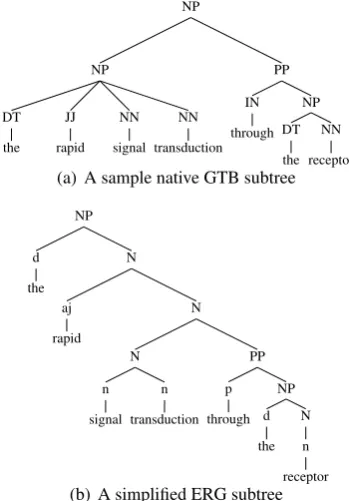
One pervasive difference is the attachment of specifiers and pre- and post-modifiers to NPs. The GTB attaches pre-modifiers and specifiers as low as possible, before attaching post-modifying PPs at a higher level, while the ERG makes the op-posite decision and disallows this order of
attach-NP
NP
DT
the JJ
rapid NN
signal NN
transduction PP
IN
through NP DT
the NN
receptor (a) A sample native GTB subtree
NP
d
the
N
aj
rapid
N
N
n
signal n
transduction PP
p
through NP d
the N
n
receptor (b) A simplified ERG subtree
Figure 1: Sample trees
ment. The other important difference is phrase branching – the GTB allows arbitrarily many chil-dren per node, while the ERG allows at most two. We show a sample NP exemplifying the differ-ences in Figure 1.
One strategy for handling this is to make as few assumptions as possible while avoiding spurious conflicts. Denoted IEP (ignore equal parent), it involves ignoring GTB nodes with the same label as the parent when looking for crossing-bracket constituents. From the GTB tree in Figure 1, the blazing module would ignore the boundaries of the second-level NP when looking for crossing-bracket discriminants. This ensures that we never rule out the corresponding good subtree shown in the figure in favour of some invalid bracketing from the ERG that by chance has no conflicts with the GTB tree; meanwhile the PP would still be considered. Note that for a flat NP with no post-modifiers, no changes are necessary as the exter-nal boundaries still correspond with the edges of the top-level NP in the ERG, and the extra internal boundaries in the ERG have no effect since they cannot cause any crossing brackets.
for crossing-bracket discriminants. Firstly, the phrases are binarised in a similar way to much pre-vious work (Miyao et al., 2004; Hockenmaier and Steedman, 2002). We heuristically determine the head of each phrase using a simple category match between the phrase category and the POS, then re-cursively split multiple-branched nodes. This bi-narisation applies to all phrasal categories, not just NPs. We then systematically alter the attachment positions of determiners and pre-nominal modi-fiers, forcing them to attach as high as possible, but preserving the binary branching. As a lightweight but imperfect attempt to avoid creating invalid structures for appositions and conjunctions, this NP rearrangement is abandoned if any tokens are parentheses, commas or conjunctions. The trans-formation is labelledRP(raise premods).
5.2 Experimental Configuration
We create a parse forest by parsing 10747 sen-tences from a GTB subset not overlapping with the test corpus, using the WeScience model to de-termine the top 500 parses. The best-performing method we found to create parse selection mod-els from this parse forest was to apply the blaz-ing configurations to determine the silver trees, and then select the top-ranked parse from that set, according to the WeScience model. We call this top parse our pseudo-gold analysis. Remaining silver trees are ignored, while incorrect trees are used as negative data as usual. To show how much effect blazing has, we also used two other methods to select the pseudo-gold parse: ran-dom selection from that same top 500, to give us a baseline, and ‘plain’ self-training using the top-ranked parse without the blazing-based filter-ing, in each case using other trees from the for-est as negative data. We then trained parse selec-tion models using the gold standard out-of-domain (WeScience) data plus the in-domain pseudo-gold analyses from each configuration, and evaluated by parsing our test corpus.
5.3 Evaluation
We use two different styles of evaluation metric. In keeping with previous work using the ERG, we report exact match figures, denoted AccN,
repre-senting the percentage of sentences for which the exact gold tree was in the topN parses. Here, as in Zhang et al. (2007), we use Acc1 and Acc10.
However, exact match can be very blunt for the fine-grained ERG analyses, giving no indication of
Config Gold Acc EDMNA
Added A1/ A10 P / R / F (WeSc only) WeSc 12.3 / 39.2 82.4 / 79.2 / 80.7 Random WeSc 6.1 / 20.0 70.7 / 70.2 / 70.5 Self-train WeSc 12.9 / 39.2 82.4 / 80.3 / 81.3*
IEP+ S-T WeSc 12.9 / 39.2 83.5 / 80.9 / 82.2***†† RP+ S-T WeSc 13.3 / 40.1 83.8 / 81.2 / 82.5***†††
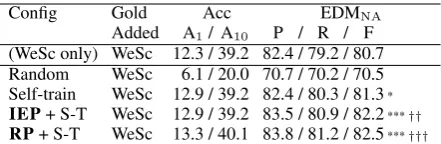
Table 1: Results over the test corpus. “WeSc only” shows parsing using a pure WeScience model. Other configurations used models trained from the same training sentence parse forest, set-ting a pseudo-gold tree either randomly, self-trained (best from a WeScience model), or blaz-ing (highest-ranked of the silver trees, other silver trees discarded). The gold WeScience data is also used for training. Significance figures are against “WeSc only”, (*: p < 0.05; ***:p < 0.001), and
“Self-train”, (††:p <0.01; †††:p <0.001)
how ‘right’ or ‘wrong’ the top analysis is. To sup-plement AccN, we use Elementary Dependency
Match (EDM: Dridan and Oepen (2011)). This is based on triples extracted from the semantic out-put of the parser, providing a more granular mea-sure of the quality of the analyses. We use the EDMN A configuration that is arguably the most
compatible with other dependency-based parser evaluation, although we make no claims of direct comparability.
5.4 Results
We present our results in Table 1, including the best-performing blazing configurations, the self-training results and the weak baseline trained on a random tree from the same GTB parse forest as used in blazing.
We also show the parsing accuracy results ob-tained using only out-of-domain data, designated “WeSc only”, as a strong baseline. We see some evidence that self-training can be a useful domain-adaptation strategy, giving a weakly significant F-score improvement over using WeScience only. This echoes previously mentioned work, although has not been evaluated for this parser or grammar before. More importantly, our blazing strategy yields strongly significant F-score improvements over both the strong baseline out-of-domain model and the standard self-training.
5.5 Discussion
IEP RP
Discrims/Sent 144.2 144.2
Rejected/Sent 40.8 42.8
Unblazed Sents 3.9% 3.4%
Overblazed Sents 14.2% 15.3% Usably Blazed Sents 81.9% 81.3% Trees/Sent (overall) 423.3 423.3 Silver Trees/Sent (blazed) 98.4 88.5 Silver Trees/Sent (usable) 120.1 108.8
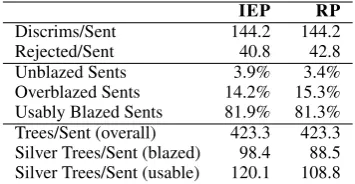
Table 2: Blazing Statistics, over all 10747 parseable training sentences. The first block shows discriminants available per sentence, and how many were rejected by the blazing (remov-ing≥ 1 tree). The second block shows
percent-age of unblazed sentences (no discriminants re-jected), overblazed sentences (all trees removed) and usably-blazed sentences (≥ 1 removed and
≥1silver tree remaining). The third block shows
how many parses were produced initially, the av-erage number of trees remaining over blazed sen-tences (inc. overblazed with 0 trees) and the aver-age number remaining over usably blazed.
a significant boost in dependency score without needing additional human annotation. The exact match results are inconclusive – the best improve-ment is not significant, although the granular EDM metric may provide a better reflection of perfor-mance for downstream applications in any case.
In our initial investigations, a range of config-urations failed to provide improvements over the baseline. If we don’t augment the training data with human-annotated WeScience data, the per-formance drops. Also, if we don’t use the self-training/blazing combination as described but in-stead treated all silver trees as pseudo-gold (i.e treat all remaining post-blazing parse trees as if they were manually marked as good), the model performs poorly. Table 2 provides some explana-tion for this. Over sentences which provide usable discriminative training data (at least one incorrect and one silver tree), on average more than 100 sil-ver trees remain, so it is failing to disambiguate sufficiently between the ERG analyses. This is probably due to an imperfect transfer process and shallower, less precise GTB analyses.
6 Reducing treebanking labour
Blazing is designed to reduce the size of the parse forest, so it seems natural to evaluate its impact on the treebanking process, and whether we can re-duce the amount of time and number of decisions
required to enable more efficient treebanking.
6.1 Mapping between treebanks
In addition to the transformation strategies men-tioned in §5.1, we used a number of additional
strategies (most of which we had already tried initially, for parse selection, but rejected). One rule concerns the internals of noun compounds, which are flat in the GTB; we may wish to add some structure to them. As discussed in §3.2,
biomedical noun compounds are predominantly left-bracketed, and left-bracketing was also our tie-breaking policy for annotating the test set. In theBNC strategy (bracket noun compounds), we added bracketing to noun compounds to have noun sequences maximally left bracketed, and adjec-tives attaching as high as possible. This makes as-sumptions which are not explicitly licensed by the data (and arguably overfits to our data set), so this transformation is only applied where no useful dis-tinctions are made by less restrictive approaches.
We also use a mapping strategy which does not make changes to the tree structure but which use the POS labels to rule out trees, denotedMP for
map POS. It uses the prefixes of the lexical types – e.g. a simple transitive verb would have the lex-ical type v np le, where the prefix ‘v’ indicates ‘verb’. We used a mapping constructed by manual inspection of a correspondence matrix between the POS tags produced by TnT (Brants, 2000) and the lexical type prefixes from the gold-standard ERG parse of the same sentences over a WeScience sub-set. This gave us the matching ERG type prefixes for 20 PTB/GTB POS tags, which are mostly what we would expect for the open classes – e.g.VB*
verb tags map to the ‘v’ prefix.
During mapping, given a pairing of a GENIA tree and a set of ERG discriminants, for each POS tag or inner node in the GENIA tree, we find all lexical discriminants with the same character span. If there are multiple discriminants with different matching labels, and there is at least one allowed and one disallowed by the mapping, then we reject all disallowed discriminants. This is less sophisti-cated than the mapping technique of Tanaka et al. (2005) for various reasons.
6.2 Selecting a blazing strategy
strat-Standard Blazed Ann 1 DecisionsTime (sec) 6.25150 1447 3.51113 1074 Ann 2 DecisionsTime (sec) 6.42105 1017 4.6896 804
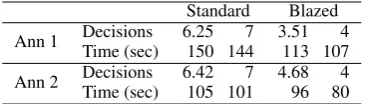
Table 3: Number of decisions and treebanking time (mean then median) using the fallback blaz-ing configuration (80 sentences for each column)
egy, and dynamically fall back to a less restrictive strategy, but this capability is not yet present in the Redwoods machinery. Our approach is based on the number of decisions being logarithmic in the number of trees. If we can get roughly 40 silver trees, the remaining treebanking is very tractable and fast, only requiring a few decisions chosen from a handful of remaining discriminants. How-ever further restriction below this saves relatively little time, and increases the chance of the blazing removing the correct tree, which we wish to avoid (the machinery does not allow the treebanker to ‘undo’ either manual or blazed decisions, except by clearing and restarting).
The parse forest for treebanking was created by having a list of candidate blazing strategies using various combinations of IEP (least restrictive),
RP, BNC and MP – with the combination RP
+BNC+MPas the most restrictive. For each sen-tence, we select the least restrictive strategy which still gives us fewer remaining trees than a thresh-old of 40. If no strategies do so, we use the strat-egy which gives us the fewest trees for the given sentence. Using another subset of the GENIA tree-bank containing 864 parseable sentences, 48% of sentences came below the threshold of 40, while 36% were above and 16% were not disambiguated at all. Most sentences (41%) used the least restric-tive configuration usingIEPalone.
6.3 Blazed Treebanking Results
For this strategy to be useful for treebanking, it should be both more efficient, in terms of fewer decisions and less annotation time, and valid, in terms of not introducing a bias when compared to conventional unblazed treebanking. To evalu-ate these questions, we selected 160 sentences at random from the previously described parse forest of 864 sentences. These sentences were divided randomly into four equal-sized groups: blazed for both annotators, standard for both annotators, and two groups blazed for one annotator only, so we
Ann. 1 Std Blz Agreed Sentences 42.5 45.0
Std
Ann. 2 Agreed, excl rej 32.4 33.3
Rejection F-score 80.0 82.4 Constituent F-score 88.7 87.6 Agreed Sentences 42.5 57.5
Blz Agreed, excl rej 39.5 45.2 Rejection F-score 44.4 78.3 Constituent F-score 86.2 84.8
Table 4: Agreement figures for different combi-nations of blazed and unblazed overlap between annotators 1 and 2, with 40 sentences per cell. ‘Agreed’ is the percentage of those with an identi-cal tree selected, or all trees rejected; ‘excl rej’ ig-nores sentences rejected by either annotator. ‘Con-stituent F-score’ (also excludes rejections) is the harmonic mean of the labelled per-constituent pre-cision. ‘Rejection F-score’ is the harmonic mean of the precision of rejection decisions.
could compare data about timing and decisions be-tween the standard and blazed sentences for each annotator, and inter-annotator agreement for each possible combination of blazed and standard tree-banking. The divisions took no account of whether we were able to usably blaze the sentences, re-flecting the real-world scenario, so some sentences in the blazed configuration had no restrictions ap-plied. The items were presented to the annotators so they could not tell whether the other annota-tor was treebanking in standard or blazed config-uration, to prevent subconscious biases affecting inter-annotator agreement. The experiments were conducted after both annotators had already famil-iarised themselves with the treebanking environ-ment as well as the characteristics of the domain and the annotation guidelines.
Annotators worked in a distraction-free envi-ronment so we could get accurate timing figures. The treebanking machinery records how many de-cisions were made as well as annotation time, both important factors in annotation efficiency. The re-sults for efficiency are shown in Table 3 where we see a 43% reduction in the mean decisions required for annotator 1, and 27% reduction for annotator 2. Annotator 1 also shows substantial 25% reduction in mean annotation time, but the time decrease for annotator 2 is only 8%. In 30% of successfully-blazed sentences, the annotators cleared all blazed decisions, suggesting it is some-times too zealous.
possible criterion of exact tree match. For a less blunt metric that still roughly reflects agreement, we also follow Tanaka et al. (2005) in reporting the (micro-averaged) harmonic mean of precision across labelled constituents indexed by character span, where constituents selected by both annota-tors are treated as gold (inaccurately denoted ‘F-score’ for brevity). Annotators should also agree on rejected trees, where no parses are valid. In Table 4, we show exact match agreement accuracy (identical trees and matching rejections both count as correct), as well as the same figure ignoring sen-tences rejected by either, and the harmonic mean of precision of both labelled constituents and tree rejections. The figures are similar between cells, with notable exceptions being higher exact match when both annotators had blazed forests, and a surprising dip in the rejection “F-score” in the bot-tom left cell. The latter is partially because the re-jection scores are based on small numbers of trees (5–10, the union of the sets of rejected trees), so are sensitive to small numbers of disagreements. In this particular case, of 7 trees rejected by either annotator, 2 were rejected by both.
6.4 Blazed Treebanking Discussion
The reductions in mean numbers of decisions strongly support the efficacy of this technique, al-though the discrepancies between the annotators suggest that the different treebanking techniques may be more or less amenable to speed-up using these tools. The timing figures are somewhat more equivocal, although still a substantial 25% for an-notator 1. This is partially to be expected, since some of the treebanking will be taken up with un-avoidable tasks such as evaluating whether the fi-nal tree is acceptable that blazing cannot avoid. However, the 8% reduction in mean annotation time for annotator 2 is still fairly modest. This could be affected by annotator 2’s more extensive treebanking experience leading to a lower baseline time, with less room for improvement, but as we still see a 21% reduction in median parsing time this could be due to a few outlier sentences inflat-ing the mean for the blazed configuration.
For agreement, we are primarily concerned here with whether blazing here introduces a bias that is distinguishable from what we see when an-notators are working under standard non-blazed conditions – which may be manifested in de-creased agreement between configurations where
only one annotator has blazed data, and when both have non-blazed data. Thus the fact that we see quite similar agreement figures between the half-blazed and standard configurations is very encour-aging (apart from the low F-score for rejections in one cell). This small amount of data sug-gests that any changes in the resultant trees in-troduced by blazing are hard to distinguish from the inevitable “background noise”. Given this, the fact that we see a noticeably higher exact match score when both annotators have blazed sentences suggests we may be justified in using blazing to improve inter-annotator agreement, although the lower constituent score may indicate we have in-sufficient data to reach that conclusion.
7 Conclusion and Future Work
We have presented a procedure for blazing – us-ing annotations from an external phrase structure treebank to constrain the parse forest produced by a precision HPSG grammar. Our work used the GENIA treebank and the ERG as the target gram-mar, although it would in principle be applica-ble to any similar phrase structure treebank and other grammars or even frameworks. The GENIA trees were mapped onto corresponding ERG parse forests and used to exclude incompatible trees. In conjunction with self-training, we used this to cre-ate a parse selection model for the ERG adapted to the biomedical domain. We also used it as a pre-filter to the treebanking process to improve tree-banking efficiency, and created an HPSG treebank of biomedical text.
For future work, we would investigate whether this training data can be useful to augment a small in-domain human-annotated treebank, and whether the methods do indeed generalise to other corpora and grammars.
Acknowledgements
References
Francis Bond, Sanae Fujita, Chikara Hashimoto, Kaname Kasahara, Shigeko Nariyama, Eric Nichols, Akira Ohtani, Takaaki Tanaka, and Shigeaki Amano. 2004. The Hinoki treebank: A treebank for text understanding. InIn Proc. of the First IJCNLP, Lecture Notes in Computer Science, pages 554–559. Springer Verlag.
Thorsten Brants. 2000. TnT – a statistical part-of-speech tagger. InProceedings of the Sixth Conference on Ap-plied Natural Language Processing, pages 224–231, Seat-tle, Washington, USA, April. Association for Computa-tional Linguistics.
Miriam Butt, Helge Dyvik, Tracy Holloway King, Hiroshi Masuichi, and Christian Rohrer. 2002. The parallel gram-mar project. InProceedings of COLING-2002 Workshop on Grammar Engineering and Evaluation, pages 1–7. Ulrich Callmeier. 2000. PET – a platform for
experimen-tation with efficient HPSG processing techniques. Nat. Lang. Eng., 6(1):99–107.
David Carter. 1997. The TreeBanker. A tool for super-vised training of parsed corpora. In Proceedings of the Workshop on Computational Environments for Grammar Development and Linguistic Engineering, pages 9–15, Madrid, Spain.
Hal Daum´e III and Daniel Marcu. 2006. Domain adaptation for statistical classifiers. Journal of Artificial Intelligence Research, 26(1):101–126.
Rebecca Dridan and Stephan Oepen. 2011. Parser evalua-tion using elementary dependency matching (to appear). In Proceedings of the 12th International Conference on Parsing Technologies.
Dan Flickinger. 2000. On building a more efficient gram-mar by exploiting types. Natural Language Engineering, 6 (1):15–28.
Daniel Gildea. 2001. Corpus variation and parser perfor-mance. InProceedings of EMNLP 2001, pages 167–202, Pittsburgh, USA.
Julia Hockenmaier and Mark Steedman. 2002. Acquiring compact lexicalized grammars from a cleaner treebank. InProceedings of Third International Conference on Lan-guage Resources and Evaluation, Las Palmas.
Jin-Dong Kim, Tomoko Ohta, and Jun’ichi Tsujii. 2008. Corpus annotation for mining biomedical events from lit-erature.BMC Bioinformatics, 9:10.
Andrew MacKinlay, Rebecca Dridan, Dan Flickinger, and Timothy Baldwin. 2011. Cross-domain effects on parse selection for precision grammars (to appear). Research on Language and Computation.
R. Malouf. 2002. A comparison of algorithms for maxi-mum entropy parameter estimation. InProceedings of the Sixth Conference on Natural Language Learning (CoNLL-2002), pages 49–55.
David McClosky, Eugene Charniak, and Mark Johnson. 2006. Reranking and self-training for parser adaptation. In Proceedings of the COLING/ACL 2006, pages 337– 344, Sydney, Australia.
Yusuke Miyao, Takashi Ninomiya, and Jun’ichi Tsujii. 2004. Corpus-oriented grammar development for acquiring a head-driven phrase structure grammar from the penn tree-bank. InProceedings of IJCNLP-04.
Preslav Nakov and Marti Hearst. 2005. Search engine statistics beyond the n-gram: application to noun com-pound bracketing. InProceedings of the Ninth Conference on Computational Natural Language Learning, CONLL ’05, pages 17–24, Stroudsburg, PA, USA. Association for Computational Linguistics.
Zheng-Yu Niu, Haifeng Wang, and Hua Wu. 2009. Ex-ploiting heterogeneous treebanks for parsing. In Proceed-ings of the Joint Conference of the 47th Annual Meeting of the ACL and the 4th International Joint Conference on Natural Language Processing of the AFNLP, pages 46– 54, Suntec, Singapore, August. Association for Computa-tional Linguistics.
S. Oepen, D. Flickinger, K. Toutanova, and C.D. Manning. 2004. LinGO Redwoods: A Rich and Dynamic Tree-bank for HPSG. Research on Language & Computation, 2(4):575–596.
Stefan Riezler, Tracy H. King, Ronald M. Kaplan, Richard Crouch, John T. Maxwell, III, and Mark Johnson. 2002. Parsing the wall street journal using a lexical-functional grammar and discriminative estimation techniques. In
Proceedings of the 40th Annual Meeting on Association for Computational Linguistics, ACL ’02, pages 271–278, Stroudsburg, PA, USA. Association for Computational Linguistics.
Takaaki Tanaka, Francis Bond, Stephan Oepen, and Sanae Fujita. 2005. High precision treebanking—blazing useful trees using POS information. InProceedings of the 43rd Annual Meeting of the Association for Computational Lin-guistics (ACL’05), pages 330–337, Ann Arbor, Michigan, June. Association for Computational Linguistics. Yoshimasa Tsuruoka, Yuka Tateishi, Jin-Dong Kim, Tomoko
Ohta, John McNaught, Sophia Ananiadou, and Jun’ichi Tsujii. 2005. Developing a robust part-of-speech tagger for biomedical text. Advances in Informatics, pages 382– 392.
Erik Velldal, Lilja Øvrelid, and Stephan Oepen. 2010. Resolving speculation: MaxEnt cue classification and dependency-based scope rules. In Proceedings of the Fourteenth Conference on Computational Natural Lan-guage Learning, pages 48–55, Uppsala, Sweden, July. As-sociation for Computational Linguistics.
Jong-Nae Wang, Jing-Shin Chang, and Keh-Yih Su. 1994. An automatic treebank conversion algorithm for corpus sharing. InProceedings of the 32nd Annual Meeting of the Association for Computational Linguistics, pages 248– 254, Las Cruces, New Mexico, USA, June. Association for Computational Linguistics.
F. Xia. 1999. Extracting tree adjoining grammars from bracketed corpora. InProceedings of the 5th Natural Lan-guage Processing Pacific Rim Symposium (NLPRS-99), pages 398–403.
Gisle Ytrestøl, Dan Flickinger, and Stephan Oepen. 2009. Extracting and annotating Wikipedia sub-domains – to-wards a new eScience community resource. In Proceed-ings of the Seventh International Workshop on Treebanks and Linguistic Theories, Groeningen, The Netherlands, January.
Tateisi Yuka, Akane Yakushiji, Tomoko Ohta, and Jun’ichi Tsujii. 2005. Syntax annotation for the GENIA corpus. InProceedings of the IJCNLP 2005, pages 222–227, Jeju Island, Korea.