Impact of Citing Papers for Summarisation of Clinical Documents
Diego Moll´a Christopher Jones Macquarie University
Sydney, Australia
Abeed Sarker Arizona State University
Tempe, AZ, USA [email protected]
Abstract
In this paper we show that information from citing papers can help perform ex-tractive summarisation of medical publica-tions, especially when the amount of text available for development is limited. We used the data of the TAC 2014 biomed-ical summarisation task. We report sev-eral methods to find the reference pa-per sentences that best match the citation text from the citing papers (“citances”). We observed that methods that incorporate lexical domain information from UMLS, and methods that use extended training data, perform best. We then used these ranked sentences to perform extractive summarisation and observed a dramatic improvement of ROUGE-L scores when compared with methods that do not use in-formation from citing papers.
1 Introduction
Text-based summarisation is a well-established area of research that aims to automatically pro-duce condensed text representations of the origi-nal text. Text-based summarisation is useful in an increasing number of application domains where people cannot afford to spend time to read all the relevant information. This is certainly the case in the medical domain, and several approaches for the automated summarisation of medical text have been proposed, e.g. as surveyed by Afantenos et al.(2005).
Information from citing texts has been used in decades-old studies (Garfield et al., 1964). More recently, Nakov et al. (2004) proposed the use of citations for the semantic interpretation of bio-science text. They used the text surrounding the citations, which they named “citances”, to sum-marise the original text. Further research focused
on the extraction of the citances and surrounding text (Qazvinian and Radev, 2010) and on the use of these citances to gather information about the original text, which could be used as a surrogate of, or in addition to, a summary of the text (Mo-hammad et al., 2009; Abu-Jbara and Radev, 2011). The Biomedical Summarization Track of the 2014 Text Analysis Conference (TAC 2014 BiomedSumm Track)1 was designed as a set of shared tasks that focus on the use of the ci-tances to build summaries of biomedical docu-ments. The track organisers provided a small data set of 20 biomedical documents for training and fine-tuning. Each paper of the data set (henceforth “reference paper”) has 10 citing papers, and the data are annotated with the citances found in the citing papers. For each citance, four annotators appointed by the National Institute of Standards and Technology (NIST) identified various pieces of information related to the track tasks. Three tasks were defined:
Task 1a Identify the text spans from the refer-ence paper that most accurately reflect the text from the citance.
Task 1b Classify what facet of the paper a text span belongs to. There are 6 fixed facets: hypothesis,method,results,implication, dis-cussion, anddata-set-used.
Task 2 Generate a structured summary of the ref-erence paper and all of the community dis-cussion of the paper represented in the ci-tances.
We have used the data from the TAC 2014 BiomedSumm Track to explore the hypothesis that using the information from citing papers can im-prove the results of an extractive summarisation
1http://www.nist.gov/tac/2014/
system. Whereas in prior work the information from the citing papers is presented as the sum-mary of the reference paper to form what has been called citation-based summarisation, in this paper we will use the information from the citing papers as a step to select the most important sentences from the reference paper. This way the resulting summaries are directly comparable with standard extractive summarisation methods, and they suf-fer less from problems of balance, coherence and readability that typically affect summarisation sys-tems based on multiple papers.
In this paper we present experiments with sev-eral settings to address task 1a of the TAC 2014 BiomedSumm track, and how these can help for task 2 and build extractive summaries. We have not explored yet how to incorporate the facet of the citances (task 1b) into task 2 and therefore we will not discuss task 1b in the remaining of this paper.
2 Finding the Best Fit to a Citance
Task 1a of the TAC 2014 BiomedSumm track as-sumes that the citances are known, and the goal is to identify the text spans from the reference paper that most accurately reflect the text from the ci-tance. Figure 1 shows an example of the data for one citance.
To identify the sentences in the reference paper that best fit a citance we have tried several meth-ods, all of which are based on computing the sim-ilarity between a sentence in the reference paper and the citance text. In all cases we have modelled each sentence as a vector, and used cosine similar-ity as the means to determine the closest match. Our methods vary on how the sentence vectors have been built, and how the similarity scores have been used to select the final sentences.
In our initial experiments we obtained best re-sults after lowercasing, but without removing stop words or stemming, so all experiments conducted in this paper preprocess the text in this manner.
2.1 Oracle
We tried an oracle approach in order to have an up-per bound. The oracle consists of the output given by one of the four annotators. The evaluation of the oracle was based on comparing each annota-tor against the other three annotaannota-tors. The eval-uation results are technically not an upper bound because the evaluation method is slightly
differ-ent for two reasons: first, the annotator that is be-ing used to select the target sentences is dropped from the gold data; and second, each original run is converted into multiple oracle runs, one per an-notator, and the final result is the average among these runs. But it gives an idea of how much room for improvement is left by the automatic methods.
2.2 tf.idf and SVD
A straightforward method to build the sentence vectors is to compute thetf.idf scores of the sen-tence words. For each reference paper we com-puted a separatetf.idf matrix where the rows are the set of all sentences in the reference paper plus all sentences that appear in the citance text.
We also applied a variant that performs Singular Value Decomposition (SVD) on thetf.idf matrix, with the aim to reduce the size of the matrix and hopefully detect possible latent word relations. We tried with 100, 500, and 1000 components. In this paper we show the results for 500 components since it obtained the best results in our preliminary experiments.
2.3 Additional Data
Traditional uses of tf.idf rely on relatively large corpora. Given the very small amount of text used to computetf.idf in our scenario (just the reference paper sentences and the set of citances for that ref-erence paper), we expanded the data as follows.
Topics. Given a reference paper, we used the pa-per sentences plus all sentences of all documents that cite the reference paper, not just the sentences in the citance text. In the TAC data set, each refer-ence paper had 10 citing papers.
Documents. In each reference paper we used all sentences of all documents of the TAC2014 set. This included the documents citing the reference paper, and all other documents.
Abstracts. We added the sentences of a sepa-rate collection of 2,657 abstracts extracted from PubMed and made available by Moll´a and Santiago-Mart´ınez (2011).2 There was no guar-antee that these abstracts were from any topic re-lated to the reference paper. The resulting dataset may therefore contain noise but the additional text may help determine the important words of a doc-ument.
2http://sourceforge.net/projects/
Reference article: Voorhoeve.txt
Citance text: In this context, while the development of TGCTs would be allowed by a partial functional inactivation of p53 (see [53], [54]), such mechanism would be insufficient to counteract the pro-apoptotic function of p53 induced by a persistent damage, causing a rapid cell death
Target reference text: These miRNAs neutralize p53-mediated CDK inhibition, possibly through di-rect inhibition of the expression of the tumor-suppressor LATS2. We provide evidence that these miRNAs are potential novel oncogenes participating in the development of human testicular germ cell tumors by numbing the p53 pathway, thus allowing tumorigenic growth in the presence of wild-type p53 ... Altogether, these results strongly suggest that the expression of miR-372/3 suppresses the p53 pathway to an extent sufficient to allow oncogenic mutations to accumulate in TGCTs ... However, whereas in the majority of the cases neoplastic transformation will require inactivation of p53 (for example by expression of HPV E6, HDM2, or mutant p53), miR372&3 uniquely allowed transformation to occur while p53 was active
Figure 1: Extract of the data for task 1a. The goal is to identify the target reference text, which is an extract of the reference article. In this example, three extracts are indicated in the target reference text, separated with “...”.
2.4 Additional Context
Conventional methods for the calculation oftf.idf assume that each document contains a reasonable amount of words. In our case we use sentences, not full documents, and therefore the information is much sparser. It is conceivable that better results may be achieved by expanding each sentence. In our experiments, we expanded each sentence by adding text from neighbouring sentences. A con-text window ofnsentences centred on the original sentence was used. We experimented with context windows of 5, 10, 20 and 50 sentences. In our preliminary experiments we observed best results for a context window of 50 sentences but it was marginally better than 20 sentences and at the ex-pense of computation time so in this paper we use a context window of 20.
2.5 Maximal Marginal Relevance
Maximal Marginal Relevance (Carbonell and Goldstein, 1998) uses a greedy algorithm to ap-proximate the selection of sentences that max-imises the similarity between the sentences and a query, while at the same time penalising similarity among the chosen sentences. The algorithm uses a parameterλthat adjusts the contribution of each of these two optimisation criteria, giving the defi-nition shown in Figure 2.
For the experiments reported here we use λ = 0.97 since it gave the best results in our prelimi-nary experiments.
2.6 UMLS and WordNet
As mentioned above, we used SVD as a means to detect latent word relations. In addition we used domain knowledge to detect explicit word relations. In particular, for every word we used all of its synsets as defined by WordNet (Fell-baum, 1998) to leverage synonymy information. We also used each word’s most salient Unified Medical Language System (UMLS) concept ID and corresponding semantic types by means of the MetaMap tool (Aronson, 2001), using MetaMap’s default word-sense disambiguation process. We tried several ways of using WordNet and UMLS, including the following:
1. Replace the word with the WordNet or UMLS IDs or semantic types, and applytf.idf as before.
2. Keep the word and add the WordNet or UMLS IDs or semantic types and applytf.idf as before. This way the data contain specific word information, plus information about word relations.
3. Apply thetf.idf similarity metrics separately for each information type and return a linear combination of all. We tried several combi-nations and settled with this one:
0.5×w+ 0.2×c+ 0.3×s
MMR= arg max Di∈R\S
λ(sim(Di, Q))−(1−λ) max Dj∈S
sim(Di, Dj)
Where:
• Qis the question sentence. In this paper, we used the citance text asQ. • Ris the set of sentences in the reference paper.
• S is the set of sentences that haven been chosen in the summary so far.
Figure 2: Maximal Marginal Relevance (MMR)
concepts, and s stands for the tf.idf of the UMLS semantic types. We did not observe any improvement of the results when incor-porating the WordNet synsets in our prelim-inary experiments and therefore we did not use them in the experiments reported in this paper.
2.7 Results
To evaluate the methods we have used the ROUGE-L F1 score. ROUGE (Lin, 2004) is a popular evaluation method for summarisation systems that compares the output of the system against a set of target summaries. For each ci-tance, we used the target reference text provided by the annotators, except for the Oracle setting, as described above, where the reference text of one annotator was compared against the reference text of the other three annotators.
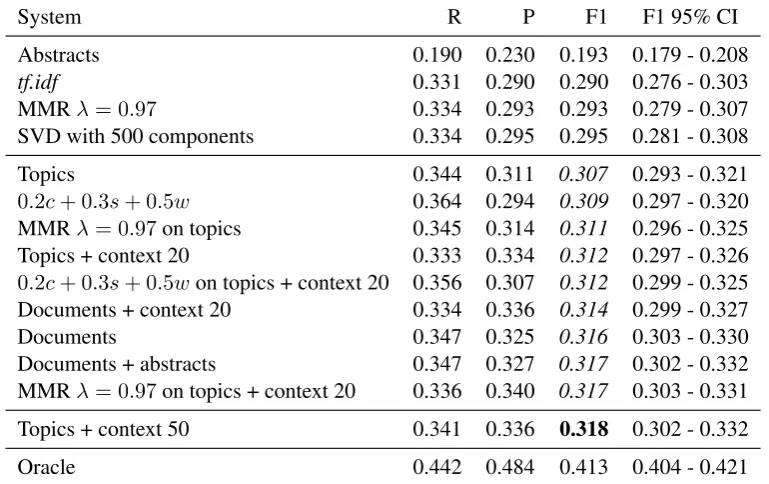
Table 1 summarises the results of our experi-ments. The results of the oracle approach are rel-atively poor. This indicates relrel-atively low agree-ment among the annotators.
We can observe an improvement of the results when using additional text to compute the tf.idf scores. When adding related documents (the 10 citing papers) the results clearly improved. When using a fairly large set of unrelated abstracts alone the results worsened dramatically, but when using the unrelated abstracts in addition to the related documents the results improved marginally wrt. using related documents. This seems to point that adding more data to form thetf.idf models helps up to a point. Ideally, we should add data that are on the topic of the reference paper.
There was also a small improvement of the re-sults when the original sentences were extended within a context window.
The approaches giving the best results have overlapping confidence intervals. This is not sur-prising, given that prior work has observed that
it is very difficult for two different extractive summarisation systems to produce ROUGE F1 scores with non-overlapping confidence intervals due to the long-tailed nature of the distribution of ROUGE F1 scores among different systems (Cey-lan et al., 2010). In our case, in addition, the amount of data is fairly small. Nevertheless, it ap-pears that using UMLS improves the results, and whereas MMR gives better results than UMLS, the difference is so small that it might not be worth in-corporating MMR. SVD appears to improve the results over plaintf.idf, but again the improvement is small and the computation time increased dra-matically. None of the methods approached the results of the oracle, so there is room for improve-ment. Still, as we will show below, these tech-niques are useful for extractive summarisation.
Note that the best result overall is plain tf.idf where the data have been expanded with the citing papers and the sentences have been expanded with a large context window (50, instead of 20). The computation time of this approach far exceeded that of the other approaches in the table, so there is still room for further exploring the use of UMLS, or smart forms to determine the related documents and extending the sentence context.
3 Building the Final Summary
Whereas the goal of task 1a of the TAC 2014 BiomedSumm track was to find the text from the reference paper that most accurately reflects the text from the citances, the goal of task 2 was to build a summary of the reference paper and all of the community discussion of the paper represented in the citances. This task was set as tentative by the organisers of the track. Figure 3 shows the target summary produced by one of the annotators.
System R P F1 F1 95% CI
Abstracts 0.190 0.230 0.193 0.179 - 0.208
tf.idf 0.331 0.290 0.290 0.276 - 0.303
MMRλ= 0.97 0.334 0.293 0.293 0.279 - 0.307
SVD with 500 components 0.334 0.295 0.295 0.281 - 0.308
Topics 0.344 0.311 0.307 0.293 - 0.321
0.2c+ 0.3s+ 0.5w 0.364 0.294 0.309 0.297 - 0.320 MMRλ= 0.97on topics 0.345 0.314 0.311 0.296 - 0.325 Topics + context 20 0.333 0.334 0.312 0.297 - 0.326
0.2c+ 0.3s+ 0.5won topics + context 20 0.356 0.307 0.312 0.299 - 0.325 Documents + context 20 0.334 0.336 0.314 0.299 - 0.327
Documents 0.347 0.325 0.316 0.303 - 0.330
Documents + abstracts 0.347 0.327 0.317 0.302 - 0.332 MMRλ= 0.97on topics + context 20 0.336 0.340 0.317 0.303 - 0.331
Topics + context 50 0.341 0.336 0.318 0.302 - 0.332
[image:5.595.107.492.78.320.2]Oracle 0.442 0.484 0.413 0.404 - 0.421
Table 1: ROUGE-L results of TAC task 1a, sorted by F1. The best result is inboldface, and all results within the 95% confidence interval range of the best result are initalics.
In the article A genetic screen implicates miRNA-372 and miRNA-373 as oncogenes in tes-ticular germ cell tumors, Voorhoeve et al., performed genetic screens of miRNA to investigate its novel functions; which has implicated two of them as oncogenes. They demonstrated that miRNA-372&3 participate in proliferation and tumorigenesis of primary human cells along with oncogenic RAS and active wild-type p53 by numbing the p53 pathway.
The authors created expression library by cloning most annotated human miRNAs into their vector and made a corresponding microarray for barcode detection. Guo et al, contradicted this by stating that bead-based platform is more flexible and cost-effective for detecting barcode changes.
Voorhoeve et al., observed that in response to mitogenic signals like RAS primary human cells undergo growth arrest; in contrast cells lacking p53 overcame this arrest. They demon-strated that expression of miRNA-372&3 enabled cells to continue proliferating thus causing a selective growth advantage.
Voorhoeve et al., established that miRNA 371-3 cluster suppresses an inhibitor of CDK activity which is essential for development of TGCTs. On further investigation they observed that 3UTR of LATS2 is indeed the direct target of miRNA-372&3.
This article has a huge impact on society as Voorhoeve et al., have indicated that deregulated expression of miRNA-372&3 predisposes cells to carcinogenic events and these miRNA ex-pressions must be carefully controlled during differentiation to prevent progression to cancer. Their expression library has helped in the functional annotation of miRNA encompassing other regulatory functions that result in DNA damage response, differentiation, sensitivity to growth factors, resistance to anti-cancer drugs etc. It remains to be seen how widespread oncogenic miRNAs are; nevertheless, their study has provided a system for uncovering the roles of other miRNAs in tumorigenesis.
so straightforward to accept that such information would help produce a summary that does not ex-plicitly incorporate the contribution from the cit-ing papers. To test whether information from citing papers is useful even for a standard, non-community-based summary, we altered the data from TAC as follows: We removed the abstract from the reference paper, and used the abstract from the reference paper as the target summary. In other words, we produced training and test data such as is often done in standard text summarisa-tion settings. Figure 4 shows the target summary for the reference paper in our example.
One of the 20 papers from the training set did not include an abstract and it was removed for the modified task.
Below we described our approaches to solve task 2 and its modified version.
3.1 Oracle
The oracle version compared the data of one an-notator against that of the other anan-notators. Again, by building this oracle we have an idea of the dif-ficulty of the task. The oracle was used for the unmodified task 2 but it was not possible for the modified task because only one target abstract was available for each reference paper.
3.2 Using Reference Text Alone
Our first set of experiments used the reference text alone. These methods basically used some of the most common single-document summarisation techniques. In particular we tried the following extractive summarisation techniques, which calcu-lated a score of sentence importance and selected the top sentences:
1. tf.idf, SVD: compute the sum of thetf.idf, or tf.idf+SVD values of the candidate sentence.
2. Additional data, additional context: extend the data or sentence context prior to the com-putation oftf.idf as described in Section 2.
3. UMLS, WordNet: incorporate UMLS and WordNet information as described in Sec-tion 2.
3.3 Using Citing Text
We incorporated the citing text in a very straight-forward way. For every citance, we used the meth-ods described in Section 2 to rank the sentences. We then scored each sentenceiby using rank(i,c),
which has values between 0 (first sentence) andn (last sentence) and represents the rank of sentence iin citancec:
score(i) = X c∈citances
1−rank(i, c) n
3.4 Results
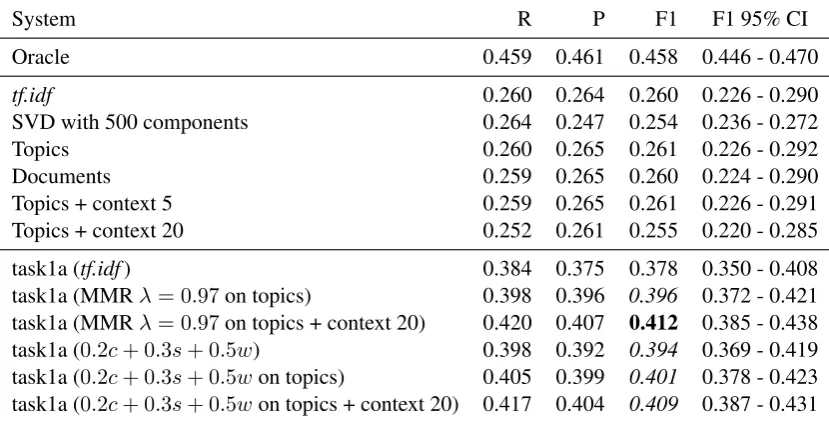
Table 2 shows the result of the unmodified task 2, and Table 3 shows the results of the modified ver-sion. For the unmodified version we set an up-per limit of 250 words up-per summary, as originally specified in the shared task. For the revised data set we kept the same upper limit of 250 words be-cause it appeared to give the best results.
We observe that the confidence intervals of the best results of the version that uses the TAC data approached the results of the oracle, which is very encouraging, especially given the relatively sim-ple approaches tried in this paper. Overall, we observed that using the scores of task 1a pro-duced much better results than using the infor-mation from the reference paper alone. The dif-ference was statistically significant, and given the above mentioned observation that it is generally difficult to obtain ROUGE F1 scores that have a difference that is statistically significant among different extractive summarisers (Ceylan et al., 2010), we have good evidence to the validity of approaches that leverage human knowledge of the paper through the exploitation of the citation links between papers.
Of the traditional methods, that is, the methods that did not incorporate the data of task1a, we ob-served no significant improvements over a simple tf.idf approach. Even adding additional context or documents did not help. This was the case both for the version that used the TAC data and the version that used the abstracts as the target summaries.
We can also observe that the ROUGE scores are higher for the original TAC task than for our modi-fied task. This is compatible with the original goal of the TAC shared task, since the annotators were instructed to build sample summaries that incorpo-rate the information from the citances. In contrast, the target summaries for our modified task were written before the citing papers.
Endogenous small RNAs (miRNAs) regulate gene expression by mechanisms conserved across metazoans. While the number of verified human miRNAs is still expanding, only few have been functionally annotated. To perform genetic screens for novel functions of miR-NAs, we developed a library of vectors expressing the majority of cloned human miRNAs and created corresponding DNA barcode arrays. In a screen for miRNAs that cooperate with onco-genes in cellular transformation, we identified miR-372 and miR-373, each permitting prolif-eration and tumorigenesis of primary human cells that harbor both oncogenic RAS and active wild-type p53. These miRNAs neutralize p53-mediated CDK inhibition, possibly through di-rect inhibition of the expression of the tumor-suppressor LATS2. We provide evidence that these miRNAs are potential novel oncogenes participating in the development of human tes-ticular germ cell tumors by numbing the p53 pathway, thus allowing tumorigenic growth in the presence of wild-type p53.
Figure 4: Original abstract as the new sample target summary
System R P F1 F1 95% CI
Oracle 0.459 0.461 0.458 0.446 - 0.470
tf.idf 0.260 0.264 0.260 0.226 - 0.290
SVD with 500 components 0.264 0.247 0.254 0.236 - 0.272
Topics 0.260 0.265 0.261 0.226 - 0.292
Documents 0.259 0.265 0.260 0.224 - 0.290
Topics + context 5 0.259 0.265 0.261 0.226 - 0.291
Topics + context 20 0.252 0.261 0.255 0.220 - 0.285
task1a (tf.idf) 0.384 0.375 0.378 0.350 - 0.408
task1a (MMRλ= 0.97on topics) 0.398 0.396 0.396 0.372 - 0.421 task1a (MMRλ= 0.97on topics + context 20) 0.420 0.407 0.412 0.385 - 0.438 task1a (0.2c+ 0.3s+ 0.5w) 0.398 0.392 0.394 0.369 - 0.419 task1a (0.2c+ 0.3s+ 0.5won topics) 0.405 0.399 0.401 0.378 - 0.423 task1a (0.2c+ 0.3s+ 0.5won topics + context 20) 0.417 0.404 0.409 0.387 - 0.431
Table 2: Rouge-L results of task 2 using the TAC 2014 data. The summary size was constrained to 250 words. Inboldfaceis the best result. Initalicsare the results within the 95% confidence intervals of the best result.
System R P F1 F1 95% CI
tfidf 0.293 0.192 0.227 0.190 - 0.261
SVD with 500 components 0.291 0.181 0.218 0.197 - 0.239
Documents 0.289 0.192 0.226 0.188 - 0.260
0.2c+ 0.3s+ 0.5w 0.314 0.210 0.247 0.207 - 0.284
task1a (tfidf) 0.425 0.264 0.320 0.293 - 0.353
task1a (MMRλ= 0.97) 0.418 0.275 0.324 0.299 - 0.351 task1a (MMRλ= 0.97on topics) 0.436 0.272 0.330 0.300 - 0.363 task1a (0.2c+ 0.3s+ 0.5w) 0.439 0.276 0.333 0.308 - 0.358 task1a (0.2c+ 0.3s+ 0.5won topics) 0.428 0.276 0.330 0.304 - 0.357 task1a (0.2c+ 0.3s+ 0.5won topics + context 20) 0.451 0.279 0.338 0.312 - 0.366
were within confidence intervals.
4 Summary and Conclusions
We have experimented with approaches to incor-porate information from the citing papers in an ex-tractive summarisation system. We observed that ranking the sentences of the reference paper by comparing them against the citances improved re-sults over methods that did not incorporate such information. In other words, the information intro-duced by the community of authors citing a paper is useful to produce an extractive summary of the reference paper. The improvement of results was considerable, and it suggests that a good strategy to build summaries is to focus on finding citing pa-pers and use that information in the summariser.
Given the small amount of data available we did not try supervised methods. It is conceivable that, if further data are available, better results might be achieved by applying classification-based ap-proaches. It would be interesting to test whether supervised methods that rely on larger volumes of annotated training data would also benefit from in-formation from the citing papers. Alternatively, the additional data could be used to produce an additional development set to fine-tune the param-eters in the approaches that we have explored in this paper.
Further research includes performing a new evaluation that uses as target summaries annota-tions from people who have not read the abstract, since it is conceivable that authors of citing papers used text from the abstract of the original paper, and that could explain our comparatively good re-sults.
We observed a general improvement of results when we included additional information at the stage when the underlying models fortf.idf were created. Both adding additional sentences, and ex-panding the existing sentences by adding a context window, helped produce better results. This sug-gests an additional strategy to improve the qual-ity of summarisation systems: find related docu-ments, and use their information to create better-informed language models of the reference paper. At the time of submission of this paper the re-sults of the TAC 2014 BiomedSumm track were not available. The organisers of TAC 2014 pro-posed a different approach to evaluate task 1a, based on a direct comparison of the string off-sets of the extracts from the reference papers. We
anticipate that such evaluation metrics is proba-bly too strict since it does not accommodate cases where the extract has similar information to the an-notated text span. It will be interesting to contrast the TAC evaluation results with our evaluation and observe whether the same conclusions still apply.
5 Acknowledgements
This research was possible thanks to a winter in-ternship by the second author funded by the De-partment of Computing at Macquarie University.
References
Amjad Abu-Jbara and Dragomir Radev. 2011. Coher-ent Citation-Based Summarization of SciCoher-entific Pa-pers. InProceedings of the 49th Annual Meeting of the Association for Computational Linguistics: Hu-man Language Technologies, pages 500–509.
Stergos Afantenos, Vangelis Karkaletsis, and Panagi-otis Stamatopoulos. 2005. Summarization from Medical Documents: a survey. Artificial Intelli-gence in Medicine, 33(2):157–177.
A R Aronson. 2001. Effective mapping of biomedical text to the UMLS Metathesaurus: the MetaMap pro-gram. Proceedings / AMIA ... Annual Symposium. AMIA Symposium, pages 17–21, January.
Jaime Carbonell and Jade Goldstein. 1998. The use of MMR, diversity-based reranking for reordering doc-uments and producing summaries. InProceedings of the 21st annual international ACM SIGIR confer-ence on Research and development in information retrieval - SIGIR ’98, pages 335–336, New York, New York, USA. ACM Press.
Hakan Ceylan, Rada Mihalcea, Umut ¨Ozertem, Elena Lloret, and Manuel Palomar. 2010. Quantifying the Limits and Success of Extractive Summariza-tion Systems Across Domains. In Human Lan-guage Technologies: The 2010 Annual Conference of the North American Chapter of the Association for Computational Linguistics, number June, pages 903–911. Association for Computational Linguis-tics.
Christiane Fellbaum, editor. 1998. WordNet: an elec-tronic lexical database. Language, Speech, and Communication. MIT Press, Cambrige, MA.
Eugene Garfield, Irving H Sher, and Richard J Torpie. 1964. The Use of Citation Data in Writing the His-tory of Science. Technical Report 64, Institute for Scientific Information, Philadelphia, PA, USA.
Saif Mohammad, Bonnie Dorr, and Melissa Egan. 2009. Using citations to generate surveys of sci-entific paradigms. Proceedings of Human Lan-guage Technologies: The 2009 Annual Conference of the North American Chapter of the Association for Computational Linguistics, (June):584–592.
Diego Moll´a and Maria Elena Santiago-Mart´ınez. 2011. Development of a Corpus for Evidence Based Medicine Summarisation. In Proceedings of the Australasian Language Technology Workshop.
Preslav I Nakov, Ariel S Schwartz, and Marti A Hearst. 2004. Citances : Citation Sentences for Semantic Analysis of Bioscience Text. InSIGIR 2004.