TAT: an author profiling tool with application to Arabic emails
Dominique Estival, Tanja Gaustad, Son Bao Pham, Will Radford
Appen Pty Ltd
Chatswood NSW 2067, Australia
{destival,tgaustad,sbpham,wradford}@appen.com.au
Ben Hutchinson∗ Google Sydney, Australia
Abstract
This paper reports on the application of the Text Attribution Tool (TAT) to profiling the authors of Arabic emails. The TAT sys-tem has been developed for the purpose of language-independent author profiling and has now been trained on two email corpora, English and Arabic. We describe the overall TAT system and the Machine Learning ex-periments resulting in classifiers for the dif-ferent author traits. Predictions for demo-graphic and psychometric author traits show improvements over the baseline for some of the author traits with both the English and the Arabic data. Arabic presents particular challenges for NLP and this paper describes more specifically the text processing compo-nents developed to handle Arabic emails.
1 Introduction
The goal of the TAT project is to develop a language-independent Text Attribution Tool (TAT) which can provide information on authors for a variety of docu-ment types and a range of languages. In the first im-plementation, the TAT has been developed for pro-filing the authors of email messages in English and Arabic, with other languages to be added in the fu-ture. (Estival et al., 2007) describes the Machine Learning experiments and the results obtained for the English email data. In this paper, we will focus on the results obtained for Arabic emails and will
∗
The work presented in this paper was carried out while this author was working at Appen Pty Ltd.
describe the aspects of the TAT which are particular to the processing of our Arabic email data.
We first introduce the two tasks of author attri-bution and author profiling in Section 2. In Sec-tion 3, we describe the data set on which our tool was trained and tested. Section 4 contains an overall description of the TAT system, followed by a more specific description of the processing steps required for Arabic emails in Section 5. After presenting the general experimental setup in Section 6, we re-port on the results achieved for several demographic and psychometric traits in Section 7 and propose our general conclusions in Section 8.
2 Author attribution and author profiling
The ability to recognise the identity or certain char-acteristics of authors automatically from texts has a number of potential applications. Author identifi-cation and author profiling can provide valuable in-formation for marketing intelligence (Glance et al., 2005), while the rapidly growing field of sentiment analysis and classification (Oberlander and Now-son, 2006) is another application where profiling can make a contribution. Also, author profiling forensics may be helpful in narrowing the choice of potential authors when identifying the source of a threat (Cor-ney et al., 2002; Argamon et al., 2005; Abbasi and Chen, 2005a).
Author attribution is the task of deciding for a given text which author, usually from a predefined set of authors, has written it. Historically, author identification has its roots in literature, with stud-ies of the Bible (Friedmann, 1997), Shakespeare (Ledger and Merriam, 1994) or the Federalist
pers (Mosteller and Wallace, 1964). Recently, au-thor identification has also been applied to more in-formal texts, such as emails (de Vel, 2000; de Vel et al., 2001; de Vel et al., 2002), newsgroup messages (Zheng et al., 2003; Zheng et al., 2006) or blog en-tries (Koppel et al., 2005; Oberlander and Nowson, 2006).
Author profiling is the task of predicting one or more traits for the author of a text and the author profile consists of the set of traits predicted for that author. A major difference between author profiling and author attribution is that it is possible to pre-dict author traits even when the training data does not contain any document by the actual author. An-other difference is that greater accuracy can be ex-pected for author profiling when the training data is made up of more authors, because the models for each trait are expected to be more robust. The accu-racy of author identification, on the other hand, can be expected to decrease if the number of potential authors is increased.
In (Estival et al., 2007), we presented our work on author profiling for English emails and discussed the literature on previous research in that area for En-glish texts. For Arabic texts, very few studies have been published in the area of author attribution; the only work we know of can be found in (Abbasi and Chen, 2005b) and (Abbasi and Chen, 2005a). We are not aware of any work on author profiling for Arabic.
For author attribution in Arabic, Abbasi and Chen (2005a) apply two different machine learners to a dataset of Arabic forum messages by 20 authors (with 20 messsages per author). The feature set comprises lexical, syntactic, structural and content-specific features, including a number of features specifically tailored to Arabic. These relate mostly to inflection (counting roots rather than inflected words), word length (adjusting the range for the Ara-bic word length distribution to reflect the fact that Arabic words tend to be shorter than English ones) and elongation dashes (excluding them from word length measurements, but tracking their usage). The main conclusion reached is that using an SVM clas-sifier with all the features achieves the best accuracy on their data set, but that the overall performance is lower than for English.
Abbasi and Chen (2005b) use the same approach,
and in addition include an in-depth comparison be-tween the feature sets and results for English and Arabic on forum messages.
3 Data
The data collected for this project and used for train-ing the TAT consists of two sets of emails from 1033 English speakers and from 1030 Arabic speak-ers. The English data set contains emails written by both native and non-native speakers of English: na-tive speakers of US English, nana-tive speakers of Aus-tralian/NZ English, native speakers of Spanish from the US and native speakers of Egyptian Arabic from Egypt. The Arabic data set contains emails written by native speakers of Egyptian Arabic, as described in more detail below. In the rest of this section, we focus on the data collection and validation processes for Arabic emails.
3.1 Data Collection
For the Arabic email data set, the collection was conducted in Egypt and all the writers were native speakers of Egyptian Arabic. Compared with the English email data set, a special feature is the encod-ing of the input for Arabic email. The widespread use of the Internet and even more of text messages via mobile phones without the possibility of Arabic script input has led to the use of the Latin alphabet and the development of some transliteration conven-tions in the Arabic speaking world. Even though Arabic keyboards are now more common, people still sometimes write email using a Latin keyboard. However, there are no strict rules for the conversion of Arabic script into Latin characters and the way of writing emails with a Latin keyboard varies greatly according to dialect or country, and even across in-dividuals.
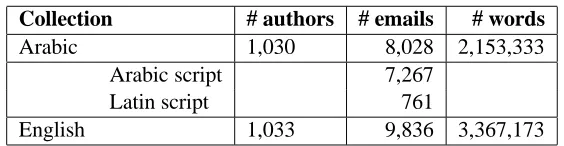
Table 1 gives an overview of the number of au-thors, number of emails and number of words for both the Arabic and English data set. We also in-clude the proportion of emails in Arabic script and in Latin script for the Arabic data.
pro-Collection # authors # emails # words
Arabic 1,030 8,028 2,153,333
Arabic script 7,267
Latin script 761
English 1,033 9,836 3,367,173
Table 1: Overview of the collected English and Arabic email data.
cess also included notification of privacy and the as-surance that their identity would be protected. The respondents agreed to fill out a web questionnaire to provide demographic and psychometric information about themselves and to donate at least ten email messages.
Demographic traits cover basic demographic in-formation about the author, namely age, gender, and level of education. The psychometric traits of the Arabic collection are based on a customized version of the short Eysenck Personality Questionnaire Re-vised (EPQR-S) (Francis et al., 2006), consisting of 51 questions. These questions aim to identify four psychometric traits: extraversion, lie (or social de-sirability), neuroticism (or emotionality), and psy-choticism (or toughmindedness).
After completing the questionnaire, the writers ei-ther composed new email messages which they then sent to their recipients and also forwarded to the data collection email address, or directly forwarded previously sent emails, e.g. from their email client “SentBox”.
We collected at least 10 emails from each author, for a total number of 2000 words per author in the Arabic data set. Research has shown that the more complex morphology of Arabic (combined with a rich vocabulary) leads to a higher degree of inher-ent sparseness in Arabic data compared to similar English data. This suggests that larger amounts of data are needed for statistical Natural Language Pro-cessing (NLP) applications in Arabic (Goweder and Roeck, 2001). Therefore, while the minimum was set at 1000 words per writer for the English data, it was 2000 words per writer for the Arabic data.
3.2 Data Validation
The email messages were checked manually to fil-ter out erroneous content such as foreign language emails or forwarded chain letters and to ensure
con-sistency and accuracy of the documents in the cor-pus. As with any data collection of email, plagia-rism and copying were issues that required careful checking of all the data received and we developed a plagiarism detecter to reject emails which had al-ready been submitted.
For both the English and the Arabic data collec-tions, a minimum number of 5 lines per email had been set. Because Arabic writers often do not use new lines or new paragraphs, this had to be mea-sured visually on the screen for the Arabic data.
In summary, the final Arabic data set contains a combined total of 8028 email messages, from 1030 writers who met the following criteria: 1) a valid questionnaire was received for each author; 2) there are at least 5 valid email messages for the author; and 3) the total word count for that author’s valid email messages is at least 2000 words.
4 System Description
Figure 1 gives a high-level overview of the TAT sys-tem. The system includes several data repositories and a number of components for deriving features and for building classifiers. While the current focus is on processing email input in English and in Ara-bic, the underlying processing architecture is lan-guage independent and will be extended to other types of documents and to other languages.
The modular processing architecture is organized around a chain of processing modules. This chain al-lows flexible experimentation with various process-ing modules. At the same time, it provides a ro-bust software framework that promotes reuse and supports flexible deployment options by connecting specific modules together for the task at hand.
anno-Figure 1: TAT System Diagram
tations and saved in a common structure called the Annotation Repository.
The process is data-driven in the sense that the output of each processing module depends on its in-put rather than on the way the module is combined with other modules in the chain. This enables pro-cessing modules to be reused in different propro-cessing chains and in different control environments as long as the input requirements are met.
5 Arabic Text processing
After the initial data collection and validation, sev-eral processing steps are needed, including character encoding normalisation, document structure pars-ing, text processing and linguistic analysis. The re-sults of this processing provides the input to the fea-ture extraction phase. A more extensive description of the processing steps for the English data can be found in (Estival et al., 2007).
Arabic emails present a number of challenges for NLP, including different ways of writing Ara-bic in Latin script (so-called “franco-araAra-bic”); typ-ical spelling variants in the Egyptian dialect of Ara-bic and possible spelling normalisation;
morphol-ogy; English loanwords, spelling errors, and typos. The Arabic processing modules perform the fol-lowing functions:
1. Language and character-set identification. The language is tagged as either English or Arabic and the script as either “roman” or “arabic”, us-ing character-based language models.
2. Document structure parsing. This stage distin-guishes the text of the email written by the au-thor from other types of elements (adverts, sig-natures, reply lines, or quoted text).
3. Tokenisation. The input text is split into para-graphs, sentences and words. Words are mainly strings of alphanumeric characters, with a few major exceptions for transliterated Arabic: some two character sequences, e.g. “ 3’ ”, can
indicate a single Arabic glyph, namely
¨
. 4. Character set normalisation. In order to achieveis very commonly used in NLP for Arabic be-cause it represents Arabic orthography strictly on a one-to-one basis (unlike common roman-ization schemes that add morphological infor-mation not actually expressed in the Arabic script).
5. Spelling normalisation. Informal written Arabic often contains non-standard spellings (Buckwalter, 2004; Goweder and Roeck, 2001). We have therefore normalised the spelling based on common spelling variations in Egyptian Arabic. Examples include word
fi-nal
ø
becomingø
or word finalp
becomingè
. Also, depending on the context,Z
can take different chairs or appear by itself on the line.We normalise the hamza chair to
@
.6. Morphological analysis. By comparing the normalised version of a given word with dictio-naries of prefixes, suffixes and clitics, linguistic features such as number and person are added, and the remainder of the word is tagged as a stem. The root letters of the stem are then pre-dicted using simple linguistic heuristics, e.g. long vowels are less likely to be root letters.
7. Lexicon taggers. The following word classes are currently tagged: conjunctions, preposi-tions, pronouns, discourse particles, interrog-ative pronouns, English loan words, colloquial Egyptian words, and frequent roots.
8. Named Entity Recognition. Named entities which are not language-dependent are tagged. These include numeric dates, numeric times, phone numbers, email addresses and URLs.
6 Experimental setup
Recent years have seen an exponential increase in the use of statistical language processing tech-niques for a wide range of tasks. In particular, text and document classification problems greatly bene-fit from statistical approaches. Author profiling can be viewed as a type of document classification task, where the classes correspond to traits of the authors. These traits are arranged along various dimensions and the different options for each dimension are mu-tually exclusive. For example “male” and “female”
are the possibilities for the gender dimension. For each dimension, the email and questionnaire data are used to construct classifiers, using a range of Ma-chine Learning (ML) techniques.
Each document constitutes a single data instance for the purposes of the experiments. For each ex-periment, ten-fold cross-validation was used, so the results reported in Section 7 are on the entire data set. Once the best combination of ML classifiers, pa-rameters and feature selection has been determined during development, that model is used to classify the test data to evaluate the performance for a given trait.
6.1 Traits and classes
We distinguish three different demographic and four psychometric traits in the experiments presented in this paper, namely age, gender, and level of educa-tion for the demographic traits, and extraversion, lie, neuroticism, and psychoticism for the psychometric traits (Eysenck and Eysenck, 1975). This informa-tion is extracted from the quesinforma-tionnaires.
For the traits taking numerical values, subjects were split into three classes based on the first and third quartiles. Table 2 summarizes the data distri-bution for each trait across these classes.
Demographics
Age: Gender: Level of education:
<25 (691) Male (728) No tertiary edu. (970) 25 to 35 (236) Female (302) Some tert. edu. (60)
>35 (103)
Psychometrics
Extraversion: Lie: Neuroticism: Psychoticism:
low low low low
medium medium medium medium
high high high high
Table 2: Traits and Classes, with frequencies in parentheses where applicable.
6.2 Features
For each document, a feature vector is calculated. A feature is typically a descriptive statistic calculated from both the raw text and the annotations. For ex-ample, a feature might express the relative frequency of two different annotation types (e.g. number of words/number of sentences), or the presence or ab-sence of an annotation type (e.g. Advert).
For the Arabic data, 518 features were calculated. These were divided into several subgroups shown in Table 3. The main purpose of the groupings was to make more informed choices during the feature selection stage and to facilitate experimentation with various combinations of feature groups.
Character-level features cover features such as the frequency of punctuation characters or word length. Arabic-specific character features include informa-tion on spelling normalisainforma-tion and Arabic special characters. Morphological features mainly encode information on number, person and gender markers, such as clitics or suffixes. Lexical features include certain POS tags (e.g. preposition) and whether a word is an English loanword or specific to the Egyp-tian dialect.
6.3 Classification algorithms and feature selection
Classifiers for predicting author traits from the linguistic features were trained using the WEKA toolkit (Witten and Frank, 2005). During training, classifiers are created by the selection of sets of features for each trait, and classifier parameters are tuned through cross-validation. To evaluate and test the classifiers, new documents are given as input
and existing classifiers are selected to predict author traits.
The machine learning algorithms tested include decision trees (J48 (Quinlan, 1993), RandomForest (Breiman, 2001)), lazy learners (IBk (Aha et al., 1991)), rule-based learners (JRip (Cohen, 1995)), Support Vector Machines (SMO (Keerthi et al., 2001)), as well as ensemble/meta-learners (Bag-ging (Breiman, 1996), AdaBoostM1 (Freund and Schapire, 1996)). These algorithms were used in combination with feature selection methods based on either a feature subset evaluator together with a search method (consistency subset evaluator with a best-first search) or a single attribute evaluator with various numbers of attributes selected (χ2, GainRa-tio, and InformationGain) (see chapter 10.8 in (Wit-ten and Frank, 2005) for details).
7 Results and discussion
The results shown here were computed on the Ara-bic email data set described in Section 3 using the different classifiers and general setup introduced in Section 6. Table 4 shows the results on all seven traits (demographic and psychometric), including the respective baseline associated with each separate classification task. We also state which settings (ML algorithm, feature set, and feature selection) were used to achieve the results reported. Education and gender are both binary classification tasks, whereas age uses three classes. All the psychometric traits are divided into three classes (see Section 6.1 and Table 2 for details on the exact split).
Feature group Description
all all features for Arabic
arabicNamedEntities language independent named entities, such as URLs arabicChar Arabic character features
arabicMorphological Arabic morphology features arabicLexical Arabic lexicon and word features
Table 3: Feature groups for Arabic.
Trait ML algorithm Features Feature Sel. Baseline Results
Age: Bagging all except arabicLexical InfoGain 70.09 72.10
Gender: SMO all None 72.16 81.15
Education: Bagging all InfoGain 93.62 93.66
Extraversion: SMO all except arabicMorphological None 48.27 54.35
Lie: Bagging all InfoGain 40.41 52.30
Neuroticism: Bagging all InfoGain 43.42 54.93
Psychoticism: Bagging all InfoGain 49.39 56.98
Table 4: Results for all demographic and psychometric traits on Arabic email data.
tested for, classification is significantly1 improved over the baseline. For education, virtually no im-provement can be seen which is due to the extremely skewed data (as indicated by the very high baseline of 93.62%). Even though the baselines for the other demographic traits are also quite high, our system still achieves a better classification accuracy for age and gender than the majority baseline.
The better result for gender can in part be ex-plained by the fact that gender is morphologically marked in Arabic. One of the relevant constructions with respect to identifying an author’s gender are predicative sentences with first person subjects. For example, in the Arabic equivalent of “I am happy”, happy is morphologically marked as either feminine or masculine. Since our features include morpholog-ical information, our classifier detects gender differ-ences very accurately. A more detailed analysis of the effects of each feature group on the prediction of gender (shown in Table 5) reveals that lexical fea-tures are also of great assistance.
Table 6 shows the results for English and Ara-bic demographic traits that are directly comparable. This seems to confirm previous results showing that predicting author traits for Arabic is likely to be
1Significance was tested using aχ2test with p=0.01.
more difficult than for English. One should not for-get, however, that the baselines for all Arabic demo-graphic traits are extremely high which means that little data is available for the minority classes.
For the psychometric traits, we achieve similar improvements over the baseline as for English. This is particularly encouraging, as most research on Ara-bic author attribution has shown results for AraAra-bic to be lower than for English. It seems that predicting a profile rather than an identity might be advantageous for Arabic, or at least a viable back-off option.
From our results, two ML algorithms emerge as best performing for all traits examined, namely SMO and Bagging. Bagging seems to profit from feature selection whereas the Support Vector Ma-chine based SMO algorithm does not show addi-tional improvements when combined with feature selection. This differs slightly from our results with the English data set, where no clear conclusion could be drawn with regard to the usefulness of feature se-lection for different algorithms.
Feature Group Best Accuracy Decrease in Accuracy
all 81.15 0.00
all except arabicNamedEntities 80.79 -0.36 all except arabicMorphological 80.19 -0.96
all except arabicChar 79.99 -1.16
all except arabicLexical 77.44 -3.71
Table 5: Contribution of feature groups to improvements in gender prediction.
Trait English email data Arabic email data
Accuracy Improvement over Baseline Accuracy Improvement over Baseline
Age 56.46 +17.03 72.10 +02.01
Gender 69.26 +14.78 81.15 +08.99
Education 79.92 +21.14 93.66 +00.04
Table 6: Comparison of results for demographic traits for English and Arabic.
8 Conclusion and future work
We have presented some results of experiments to automatically predict author traits from email mes-sages. This work is of interest for a number of po-tential applications, from marketing intelligence to sentiment analysis. The results presented in this pa-per were conducted on the Arabic subset of the email data we have collected (containing approximately 8028 emails).
The experiments reported here were aimed at dis-covering how well a range of ML algorithms per-form on our data set for three demographic and four psychometric author traits. Our results support the conclusions drawn in (Estival et al., 2007) that the chosen approach works well for author profiling and that using different classifiers in combination with a subset of available features can be beneficial for predicting single traits.
Future work will include the extension of the TAT to other document types and other languages. For Arabic text processing, it might be fruitful to investigate a more sophisticated analysis of words into roots (Darwish, 2002; de Roeck and Al-Fares, 2000).
Acknowledgements
This research was carried out within the framework of a BAA grant (IS-QD-2467). We would like to thank Judith Bishop for her important contribution
to the project in successfully managing the data col-lection.
References
Ahmed Abbasi and Hsinchun Chen. 2005a. Applying authorship analysis to Arabic web content. In Paul B. Kantor et al., editor, Intelligence and Security
In-formatics, Proceedings of the IEEE International Con-ference on Intelligence and Security Informatics (ISI 2005), pages 183–197. Springer.
Ahmed Abbasi and Hsinchun Chen. 2005b. Apply-ing authorship analysis to extremist-group web forum messages. IEEE Intelligent Systems, 20(5):67–75.
Ahmed Abdel-Khalek and Sybil Eysenenck. 1983. A cross-cultural study of personality: Egypt and Eng-land. Research in Behaviour and Personality, 3:215– 226.
David Aha, Dennis Kibler, and Mark Albert. 1991. Instance-based learning algorithms. Machine
Learn-ing, 6(1):37–66.
Shlomo Argamon, Sushant Dhawle, Mosche Koppel, and James W. Pennebaker. 2005. Lexical predictors of personality type. In Proceedings of the 2005 Joint
An-nual Meeting of the Interface and the Classification Society of North America, St. Louis.
Leo Breiman. 1996. Bagging predictors. Machine Learning, 24(2):123–140.
Leo Breiman. 2001. Random forests. Machine
Tom Buchanan, John A. Johnson, and Lewis R. Gold-berg. 2005. Implementing a Five-Factor personality inventory for use on the internet. European Journal of
Psychological Assessment, 21:115–127.
Tim Buckwalter. 2000. Arabic transliteration. http://www.qamus.org/transliteration.htm.
Tim Buckwalter. 2002. Arabic morphological analyzer. Linguistic Data Consortium (LDC2002L49).
Tim Buckwalter. 2004. Issues in Arabic orthography and morphology analysis. In Proceedings of the COLING
2004 Workshop on computational approaches to Ara-bic script-based languages, Geneva.
William Cohen. 1995. Fast effective rule induction. In
Twelfth International Conference on Machine Learn-ing, pages 115–123.
Malcolm Corney, Olivier de Vel, Alison Anderson, and George Mohay. 2002. Gender-preferential text min-ing of e-mail discourse. In Proceedmin-ings of the 18th
An-nual Computer Security Applications Conference (AC-SAC 2002), pages 282–292, Las Vegas.
Kareem Darwish. 2002. Building a shallow Arabic mor-phological analyzer in one day. In Proceedings of
ACL 2002 Workshop on computational approaches to Semitic languages, Philadelphia.
Anne de Roeck and Waleed Al-Fares. 2000. A morpho-logically sensitive clustering algorithm for identifying Arabic roots. In Proceedings of ACL 2000, Toulouse.
Olivier de Vel, Alison Anderson, Malcolm Corney, and George Mohay. 2001. Mining email content for author identification forensics. SIGMOD Record,
30(4):55–64.
Olivier de Vel, Alison Anderson, Malcolm Corney, and George Mohay. 2002. E-mail authorship attribution for computer forensics. In Daniel Barbara and Sushil Jajodia, editors, Data Mining for Security
Applica-tions. Kluwer Academic Publishers.
Olivier de Vel. 2000. Mining e-mail authorship. In
Pro-ceedings of the Workshop on Text Mining, ACM In-ternational Conference on Knowledge Discovery and Data Mining (KDD’2000), Boston.
Dominique Estival, Tanja Gaustad, Son Bao Pham, Will Radford, and Ben Hutchinson. 2007. Author profiling for English emails. In Proceedings of the 10th
Confer-ence of the Pacific Association for Computational Lin-guistics (PACLING 2007), pages ??–??, Melbourne.
Hans Eysenck and Sybil Eysenck. 1975. Manual of the Eysenck Personality Questionnaire. Hooder and
Stoughton Educational, London.
Leslie Francis, Christopher Lewis, and Hans-Georg Ziebertz. 2006. The short-form revised Eysenenck personality questionnaire (EPQR-S): A German edi-tion. Social Behaviour and Personality, 34(2):197– 204.
Yoav Freund and Robert Schapire. 1996. Experiments with a new boosting algorithm. In Thirteenth
Interna-tional Conference on Machine Learning, pages 148–
156, San Francisco.
Richard Friedmann. 1997. Who wrote the Bible?
Harper, San Francisco.
Natalie Glance, Matthew Hurst, Kamal Nigam, Mathew Siegler, Robert Stockton, and Takashi Tomokiyo. 2005. Deriving marketing intelligence from online discussion. In Proceedings of the eleventh ACM
SIGKDD international conference on Knowledge dis-covery in data mining, pages 419–428, Chicago.
Abduelbaset Goweder and Anne De Roeck. 2001. As-sessment of a significant Arabic corpus. In
Proceed-ings of the ACL/EACL Workshop on Arabic Language Processing: Status and Prospects, Toulouse.
Sathiya Keerthi, Shirish Shevade, C. Bhattacharyya, and K. Murthy. 2001. Improvements to Platt’s SMO algo-rithm for SVM classifier design. Neural Computation, 13(3):637–649.
Moshe Koppel, Jonathan Schler, and Kfir Zigdon. 2005. Automatically determining an anonymous author’s na-tive language. In Paul B. Kantor et al., editor,
In-telligence and Security Informatics, Proceedings of the IEEE International Conference on Intelligence and Security Informatics (ISI 2005), pages 209–217.
Springer.
Gerrard Ledger and Thomas Merriam. 1994. Shake-speare, Fletcher, and The Two Noble Kinsmen.
Lit-erary and Linguistic Computing, 9(3):235–248.
F. Mosteller and D.L. Wallace. 1964. Inference and
Dis-puted Authorship: The Federalist. Series in
behav-ioral science: Quantitative methods edition. Addison-Wesley.
Warren T. Norman. 1963. Toward an adequate taxonomy of personality attributes: replicated factor structure in peer nomination personality rating. Journal of
Abnor-mal and Social Psychology, 66:574–583.
Jon Oberlander and Scott Nowson. 2006. Whose thumb is it anyway? Classifying author personality from weblog text. In Proceedings of the COLING/ACL
2006 Main Conference Poster Sessions, pages 627–
634, Sydney.
Ian H. Witten and Eibe Frank. 2005. Data Mining:
Prac-tical machine learning tools and techniques. Morgan
Kaufmann, San Francisco, 2nd edition.
Rong Zheng, Yi Qin, Zan Huang, and Hsinchun Chen. 2003. Authorship analysis in cybercrime investiga-tion. In Hsinchun Chen et al., editor, Proceedings of
the first NSF/NIJ Intelligence and Security Informatics Symposium, pages 59–73. Springer.